

Tonality in Sales: What the Research Actually Says (and How to Train It)
You've got 93 seconds. That's the average duration of a live cold call - and most end before the prospect understands what you're selling. With a 16.6% connect rate and cold calling converting at roughly 9% compared to 25% for referrals, every second of live conversation is absurdly expensive. Your words matter, but tonality in sales - the way your voice shapes every word - is probably the highest-ROI skill you're not training.
The Stat Everyone Gets Wrong
You've seen it everywhere: "55% of communication is body language, 38% is tone, and only 7% is words." It shows up in sales blogs, tonality guides, Reddit threads, and LinkedIn carousels.
The problem: Albert Mehrabian's original experiments involved single words spoken to convey feelings about liking or disliking someone. Not sales calls. Not pitches. Not multi-sentence conversations about enterprise software. As Big Think explains, the 7-38-55 ratio was never meant to describe all communication - it was a narrow finding about emotional intent behind isolated words. The Mehrabian model has limited applicability to sales conversations where context, argument quality, and relationship dynamics all play significant roles.
So what does the research actually say?
A 2024 paper in Personality and Social Psychology Bulletin found that falling vocal intonation at sentence ends signals speaker confidence and, under moderate elaboration, increases message processing - making strong arguments land harder. And a Journal of Consumer Research study analyzing Kickstarter pitches found that vocal tones conveying focus, low stress, and stable emotions drove perceived competence and correlated with actual funding outcomes.
That's a very different picture than "38% tone." Tonality doesn't carry some magical percentage of meaning. It shapes how your listener processes what you say - whether they perceive you as competent, whether they engage with your argument, and whether they trust you enough to keep listening.
What Sales Tonality Actually Means
Tonality isn't just "sounding confident." It's a set of vocal mechanics you can isolate, measure, and train. A useful framework starts with PAVP, then adds dimensions that matter on real calls (especially in sales communication):
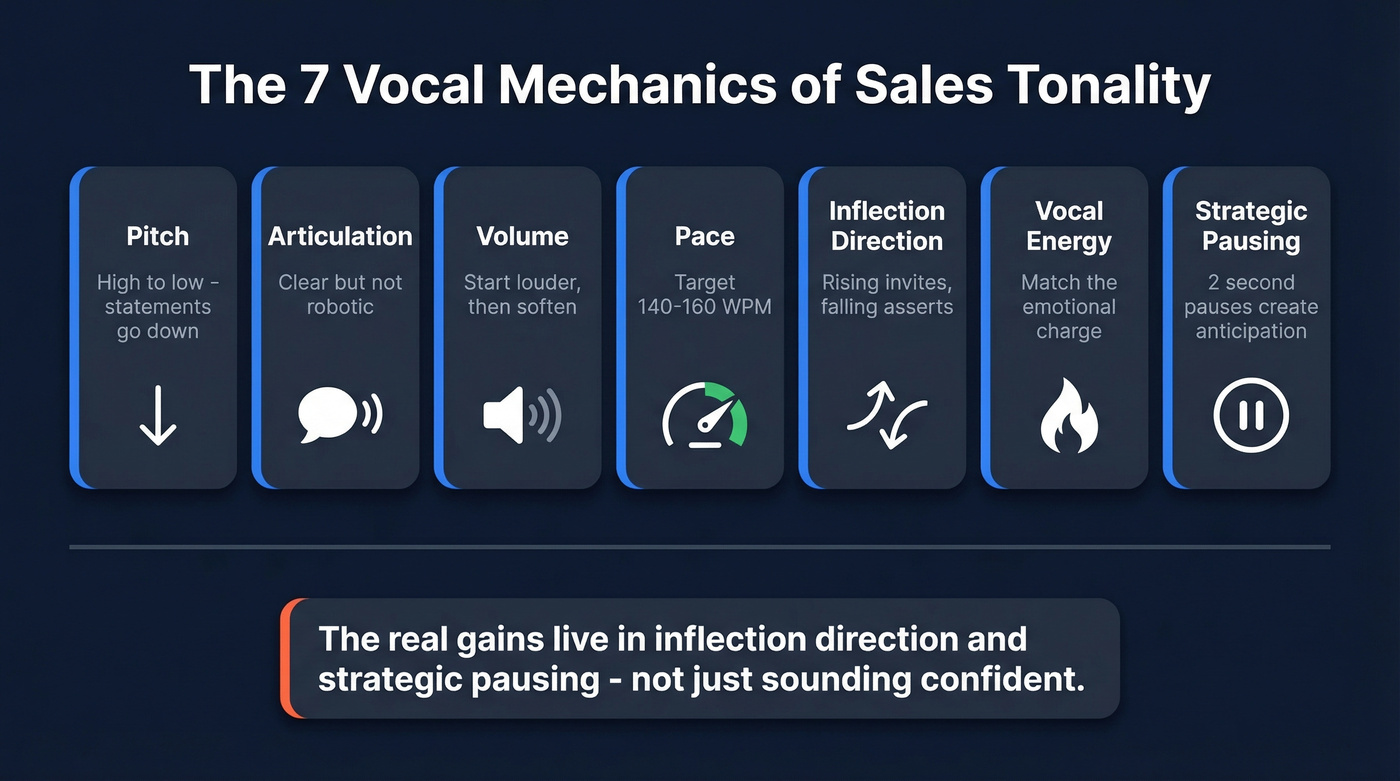
- Pitch - how high or low your voice sits. Statements should inflect downward. Uptalk (rising pitch on statements) makes you sound uncertain.
- Articulation - how clearly you pronounce words. Mumbling kills authority. Over-enunciating sounds robotic.
- Volume - how loud or soft you speak. Start slightly louder to command attention, then soften to build trust.
- Pace - how fast you talk. Target 140-160 WPM. Nervous reps speed up; confident reps slow down.
- Inflection direction - rising inflection invites; falling inflection asserts. This is one of the clearest vocal variables in persuasion research.
- Vocal energy - the emotional charge behind your words. Low energy reads as disinterest. Excessive energy reads as desperation.
- Strategic pausing - silence is a tool. A two-second pause before a key point creates anticipation. A pause after a question gives the prospect space to think.
The PAVP mnemonic is a decent starting point, but inflection direction and strategic pausing are where the real gains live.
Six Tonal Patterns That Close Deals
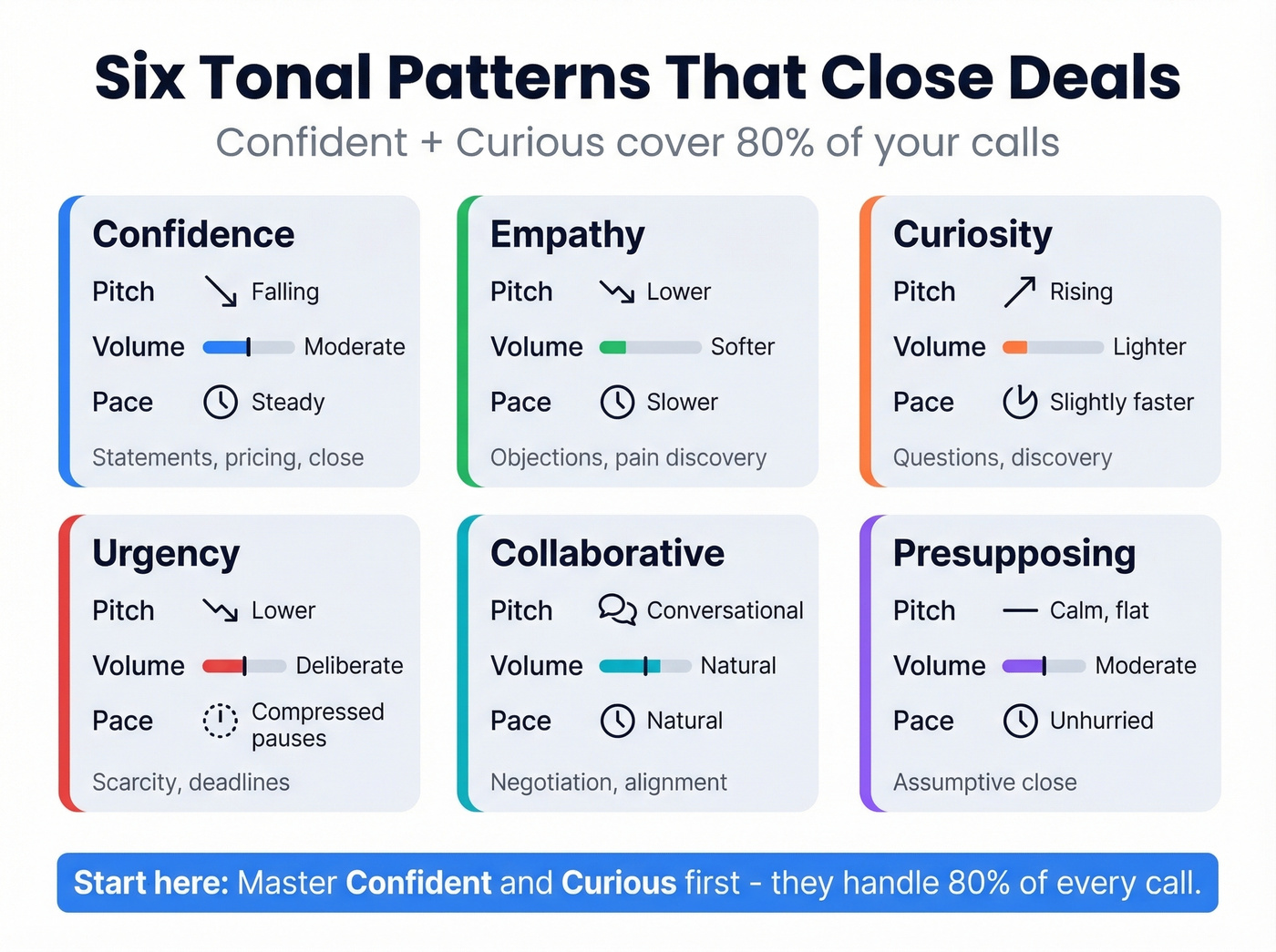
Jordan Belfort popularized the concept of tonal patterns, and Jeremy Miner's NEPQ method leans into curiosity-driven delivery. The six patterns below distill these frameworks into specific vocal mechanics anchored to persuasion research and practical call coaching.
| Pattern | Pitch | Volume | Pace | When to Use |
|---|---|---|---|---|
| Confidence | Falling ↓ | Moderate | Steady | Statements, pricing, close |
| Empathy | Lower | Softer | Slower | Objections, pain discovery |
| Curiosity | Rising ↑ | Lighter | Slightly faster | Questions, discovery |
| Urgency | Lower | Deliberate | Compressed pauses | Scarcity, deadlines |
| Collaborative | Conversational | Natural | Natural | Negotiation, alignment |
| Presupposing | Calm, flat | Moderate | Unhurried | Assumptive close |
Confidence / Certainty is your anchor pattern. The 2024 falling-intonation study supports this: ending declarative sentences with a downward pitch signals confidence and increases how deeply listeners process your argument. When you say "We've helped 200 companies solve this exact problem," that sentence needs to land with a period, not a question mark.
Empathy / Understanding is the pattern you shift into when a prospect pushes back. Drop your pitch, soften your volume, slow your pace. You're not agreeing with their objection - you're signaling that you heard it.
Curiosity is the discovery workhorse. Rising inflection on questions is natural and inviting. "What's driving the timeline on this?" should sound like you genuinely want to know (and pair well with strong discovery questions).
Urgency isn't about sounding panicked. Lower your voice, slow down deliberately, and compress your pauses. "The pilot pricing expires Friday" hits harder at a measured pace than rattled off quickly.
Collaborative is your negotiation mode - conversational volume, natural pace, the vocal equivalent of sitting on the same side of the table (useful when you’re thinking about an anchor in negotiation).
Presupposing is the assumptive close. Calm certainty, as-if framing, zero questioning inflection. "Let's get the contract over to your team this afternoon" - said as a statement, not a request.
Here's the thing: you don't need to master all six. Confident and Curious cover 80% of calls. Everything else is situational.

You only get 93 seconds on a cold call. Don't waste them on bad numbers. Prospeo gives you 125M+ verified mobile numbers with a 30% pickup rate - so your trained tonality actually reaches a live human.
Nail the tonality. We'll make sure someone's there to hear it.
Matching Tone to Each Sales Stage
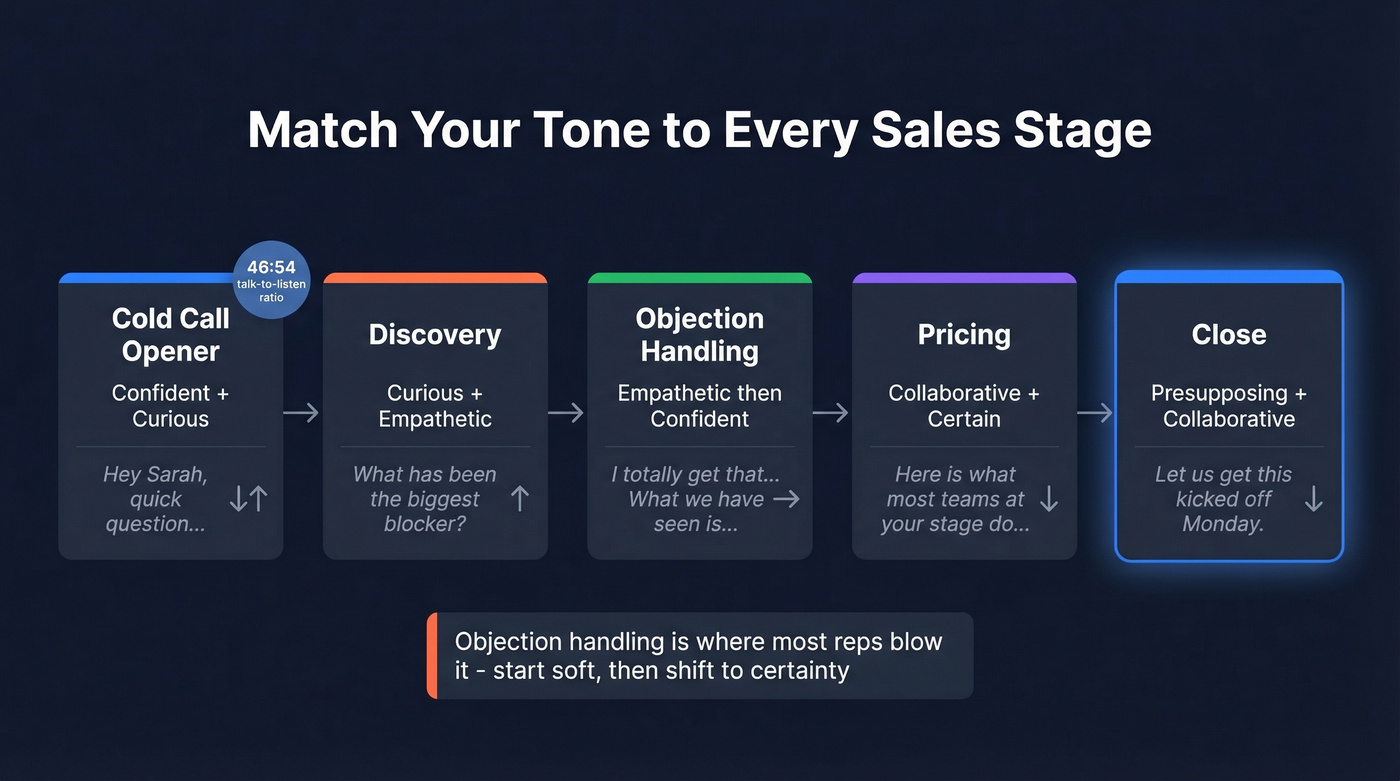
Different stages demand different tonal combinations:
| Stage | Pattern Combo | Example |
|---|---|---|
| Cold call opener | Confident + Curious | "Hey Sarah, quick question..." ↓ then ↑ |
| Discovery | Curious + Empathetic | "What's been the biggest blocker?" ↑ |
| Objection handling | Empathetic → Confident | Soften, then shift to certainty |
| Pricing / negotiation | Collaborative + Certain | "Here's what most teams at your stage do..." ↓ |
| Close | Presupposing + Collaborative | "Let's get this kicked off Monday." ↓ |
Objection handling deserves the most attention because it's where most reps blow their vocal delivery. Analysis of thousands of recorded sales conversations highlights a consistent pattern: top performers acknowledge without agreeing, empathize without apologizing, and ask questions before answering. The emotional drivers behind objections - status quo bias, loss aversion, fear of making the wrong decision - are rarely logical (and show up constantly in sales pipeline challenges).
Matching aggression or jumping to a rebuttal signals that you're not listening. Start in Empathy mode: softer, slower, lower pitch. "I totally get that - switching vendors is a real lift." Then transition to Confidence: steady pace, falling intonation, moderate volume. "What we've seen with teams in your situation is..." That shift from empathy to certainty mirrors the SPIN Selling progression from problem questions to implication questions. Tone matching is critical here - calibrate your vocal energy to meet the prospect where they are before guiding them toward a calmer, more productive conversation.
During discovery, your talk-to-listen ratio matters as much as your voice. The benchmark for successful cold calls is 46:54 - you talk 46% of the time, the prospect talks 54%. Curiosity tonality naturally supports this ratio because rising inflection and genuine questions invite longer prospect responses (a core part of modern sales prospecting techniques).
Annotated Script Examples
Two scenarios with explicit tonal markup showing exactly where to shift your voice.
Cold Call Opener - Before (flat/robotic):
"Hi this is Mike from Acme I'm calling because we help companies like yours with their sales process do you have a minute?"
After (confident + curious):
"Hey Sarah -
[pace: moderate, volume: slightly above conversational]quick question for you.[pause 1.5s][↓ pitch, pace: slow]I noticed your team just opened three new AE roles.[rising inflection]Are you building out outbound, or backfilling?[pause 2s - let her answer]"
The pause after "quick question for you" is doing heavy lifting. It signals confidence because you're not rushing to justify your call.
Objection - "We already have a vendor":
Before (defensive): "Oh, well, we're actually different because we offer..."
[pace: fast, pitch: rising - sounds like begging]
After (empathetic → confident):
[volume -20%, pace: slow]"Makes total sense - you should have a vendor for this.[pause 2s][↓ pitch, volume: normal]Most of the teams we work with had one too. The conversation usually starts when[pace: deliberate]they realize their current data is bouncing 15-20% of emails.[rising inflection]Is that something you've run into?"
Notice the uptalk warning in action: the "before" version ends statements with rising pitch, which sounds uncertain. The "after" version reserves rising inflection for the actual question.
Vocal Mistakes That Kill Deals
Five patterns we see on almost every call review:
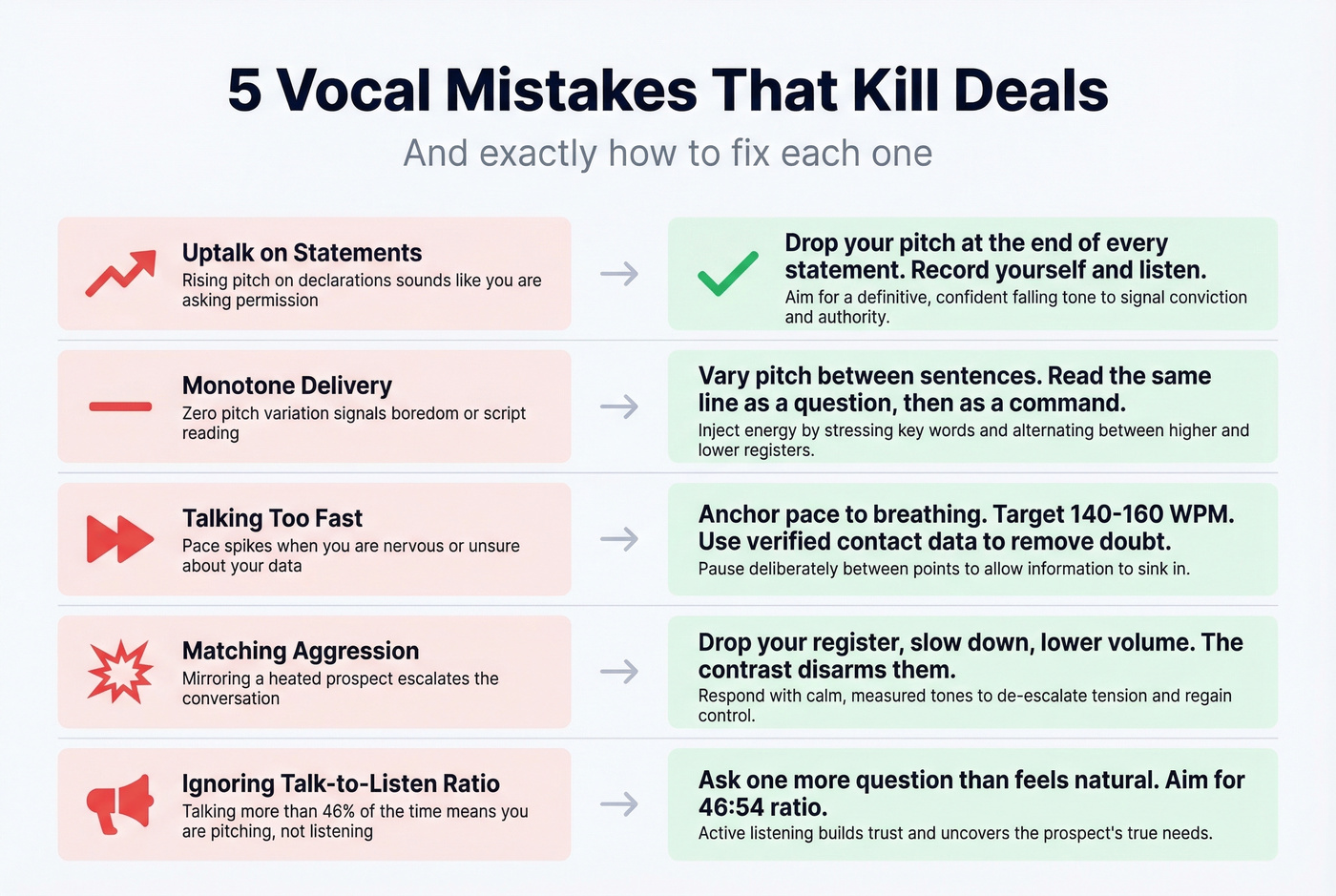
Uptalk on statements. Ending declarative sentences with rising pitch makes you sound like you're asking for approval. Fix: consciously drop your pitch at the end of every statement. Record yourself and listen for it. This is a common complaint in r/sales threads - reps know they sound uncertain but can't pinpoint why.
Monotone delivery. Zero pitch variation signals boredom or script-reading. Fix: vary your pitch noticeably between sentences. Read the same line as a question, then as a command - feel the difference.
Talking too fast when nervous. Pace spikes when you're uncertain about whether you've even reached the right person. Fix: anchor your pace to your breathing. Target 140-160 WPM. Part of the nervousness is data quality - if you're not sure the number is valid, your voice betrays that doubt before you say a word. Verified contact data removes that uncertainty before you ever dial.
Matching aggression during objections. When a prospect gets heated, mirroring their energy escalates the conversation. Fix: drop your register, slow down, and lower your volume. The contrast disarms them.
Ignoring talk-to-listen ratio. If you're talking more than 46% of the time on a cold call, you're pitching when you should be listening. Ask one more question than feels natural.
How to Actually Practice (Not Just "Sound Confident")
The #1 complaint on r/sales about tonality advice is that it's vague. "Sound confident" isn't a training plan. Here's one that is.
Daily warm-up (2 minutes): Hum for 30 seconds to warm your vocal cords. Do jaw releases. Slide your pitch from low to high and back. Then read a single headline in three tones: confident, empathetic, curious. This takes less time than making coffee. Stand up while you do it - your posture changes your diaphragm engagement and pitch range.
Weeks 1-2: Record every call. After each one, score yourself on the four PAVP dimensions, 1-5 scale each. Don't try to fix everything - just build awareness. Most reps are shocked at how different they sound versus how they think they sound.
Weeks 3-4: Focus on one tonal pattern per day. Monday is Confidence. Tuesday is Curiosity. The "news anchor" drill works well: read the same paragraph as confident, then empathetic, then curious, and feel how your pitch, pace, and volume shift. Try the mirror-matching exercise - listen to a recording of a top performer and mimic their cadence, then gradually blend in your natural voice. Record a 60-second pitch, play it back, critique yourself on each PAVP dimension, and re-record.
Ongoing: Review two calls per week. Track your PAVP scores over time. Watch for pattern drift - most reps default to monotone under pressure. Conversation intelligence tools like Gong or Chorus can automate some of this feedback, analyzing your tone, pace, and talk ratio across every call. When reviewing recordings, listen for three things the research links to perceived competence: vocal focus, low stress signals, and emotional stability.
We've seen reps transform their cold call performance in 2-3 weeks with this protocol. The key is consistency, not talent.
Let's be honest: most sales teams spend thousands on objection-handling scripts and zero dollars on vocal delivery training. That's backwards. A mediocre script delivered with confident, varied tonality will outperform a perfect script read in monotone every single time. If your team has budget for one training initiative this quarter, make it tonality (and treat it like a real sales activity, not a “nice-to-have”).
Confidence starts before the call. Vocal training gets you 80% there. The other 20% is preparation - knowing you've reached the right person at a valid number. Prospeo's Mobile Finder covers 125M+ verified numbers with a 30% pickup rate, and the free tier gives you 75 verified emails per month plus 100 Chrome extension credits - enough to test whether better data changes how you sound on the phone.
Mastering six tonal patterns means nothing if your list is full of bounced emails and dead numbers. Prospeo's 98% email accuracy and 7-day data refresh ensure every rep on your team reaches real decision-makers - starting at $0.01 per email.
Stop perfecting your pitch to voicemail. Start reaching real buyers.
FAQ
What is tonality in sales?
Tonality is the combination of pitch, pace, volume, articulation, and inflection that shapes how your words land with a prospect. Two reps can read the same script and get completely different results based on vocal delivery alone. Mastering it means controlling these mechanics deliberately rather than leaving them to habit.
Is the 55/38/7 rule valid for sales calls?
No. Mehrabian's original experiments tested single words conveying liking or disliking - not multi-sentence sales conversations. The real evidence for vocal persuasion comes from research on intonation patterns and competence cues, not an oversimplified ratio. Use it as a conversation starter, not a training foundation.
What's the best tone of voice for cold calling?
Confident plus curious. Use falling intonation on statements to signal certainty and rising inflection on questions to invite engagement. Keep pace at 140-160 WPM and volume conversational. Pair this with verified direct dials so you're not second-guessing whether you've even reached the right person.
How long does it take to improve vocal delivery?
With structured practice - daily two-minute warm-ups plus weekly call reviews - most reps notice measurable improvement within 2-3 weeks. The protocol matters more than natural talent. Recording yourself is non-negotiable; you can't fix what you can't hear.