

Top of Funnel Marketing: Benchmarks, Budgets, and the Playbook Nobody Gives You
Your VP of Sales just asked why pipeline is down 20%. Marketing points to MQLs. Sales points to lead quality. Finance points to the budget line item that says "brand awareness" and asks what it actually bought.
Here's the uncomfortable truth: only about 5% of your market is actively buying right now. The other 95% are forming opinions, building shortlists, and deciding who to trust - and if you're not showing up at the top of funnel, you're losing deals you'll never even know about.
The Short Version
- The 95/5 rule is real. Only ~5% of your market is in-market at any given moment. TOFU is how you win the other 95% before they start a buying process.
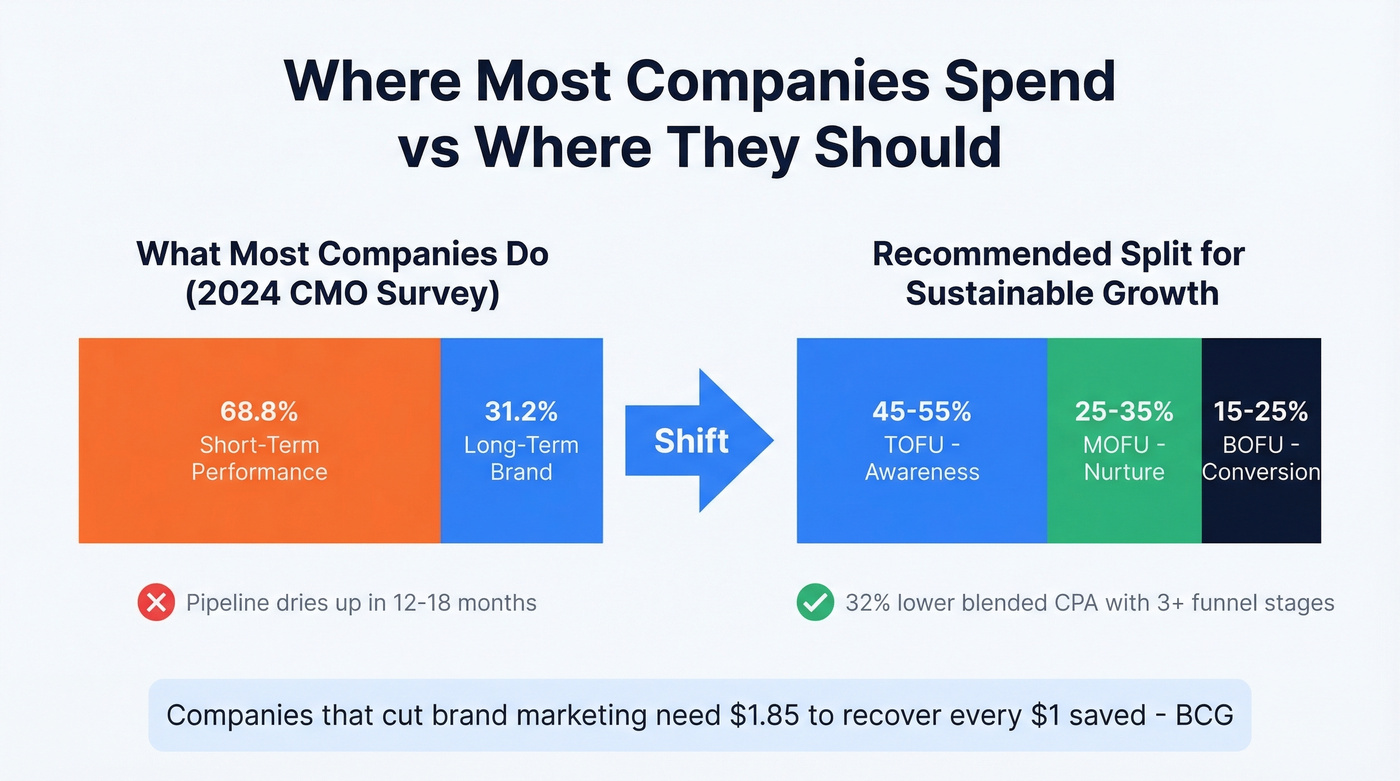
- Allocate 45-55% of budget to awareness. Most companies pour 60-70% into bottom-funnel performance campaigns. That works until pipeline dries up - which takes about 12-18 months.
- Stop measuring TOFU with last-click attribution. The three metrics that matter: branded search lift, assisted conversions, and post-purchase surveys. Everything else is noise.
What Is Top of Funnel?
It's the awareness stage of your marketing and sales engine - every touchpoint that introduces your brand to someone who doesn't know you yet. Content, ads, events, outbound, podcasts, organic search. All of it.
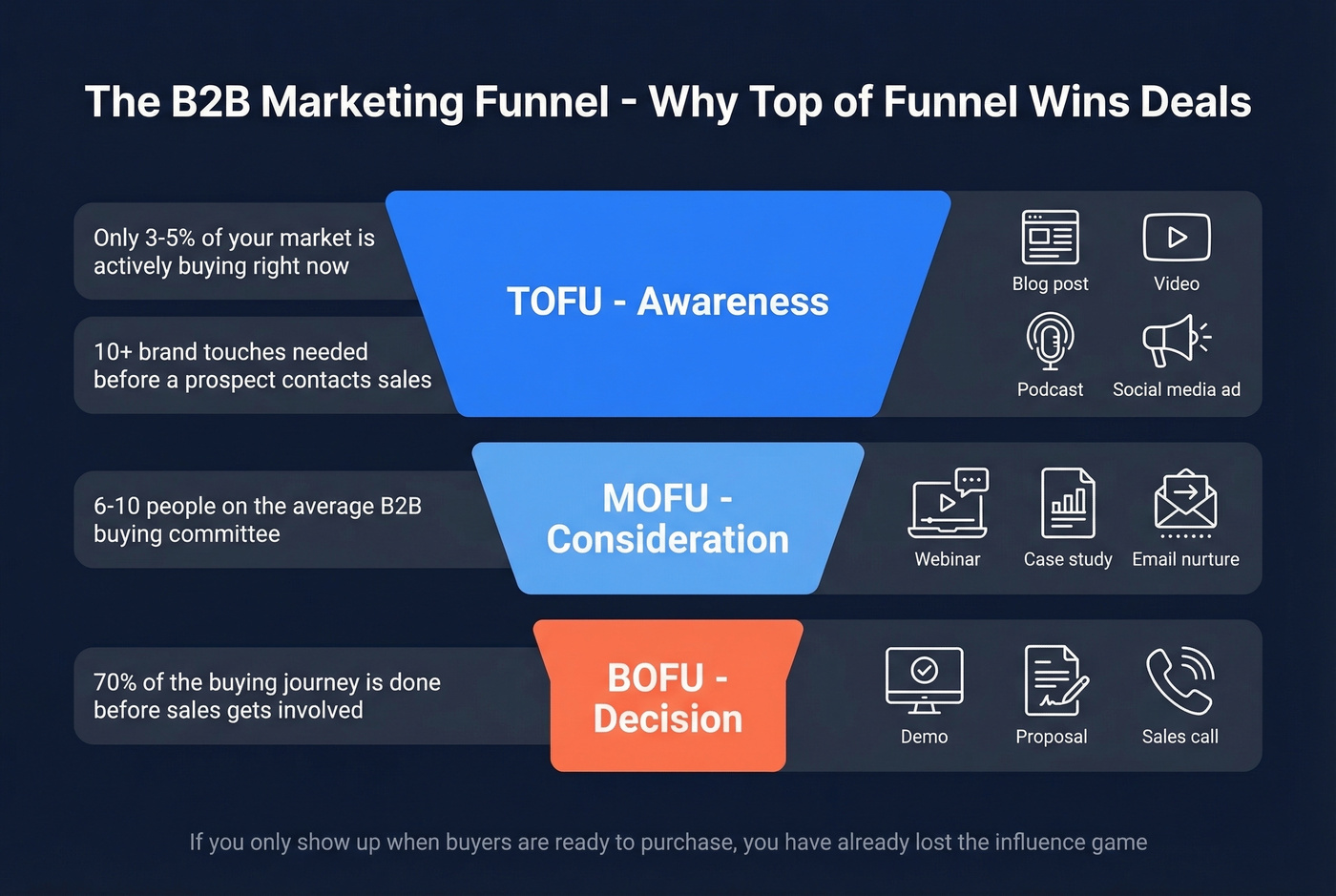
The classic framework breaks the funnel into three stages: TOFU (awareness), MOFU (consideration), and BOFU (decision). Only about 3% of a market is actively buying at any given time, and it takes somewhere around 10 brand interactions before a prospect is motivated enough to contact sales. In B2B, you're not convincing one person - you're reaching a buying committee of 6-10, each with different priorities.
That math is why awareness matters. If you only show up when someone's ready to buy, you've already lost the influence game.
Why TOFU Matters - The Math
70% of the B2B buying journey is complete before a buyer ever talks to sales. By the time your SDR gets a hand raise, the shortlist is already set. The top of funnel is where you earn a spot on it.
The financial case is just as stark. A BCG analysis found that companies cutting brand marketing later needed $1.85 in spend for every $1 saved to regain lost market share. Bottom-quartile brand spenders saw 13% lower sales growth and 6% weaker awareness-to-purchase conversion than top-quartile spenders. That damage doesn't show up this quarter. It shows up 12-18 months later when pipeline craters and nobody can explain why.
The demand-side numbers reinforce this: 72% of B2B buyers start with a generic Google search, not a branded one. If you haven't built awareness before that search happens, you're not in the consideration set. And 65% of buyers say B2B content works better when it's not trying to sell them anything.
TOFU isn't a nice-to-have brand exercise. It's the compound interest of your pipeline. Every dollar you spend building awareness today reduces your cost per opportunity six months from now.
How Much to Spend on Awareness
The most cited framework is Binet & Field's 60/40 guideline - 60% of budget toward long-term brand building, 40% toward short-term activation. Almost nobody follows it. A 2024 CMO survey found the actual split is inverted: 31.2% long-term brand building vs. 68.8% short-term performance.
Keen's analysis of $42B in media investment across 400+ brands found that top of funnel investment rose to 58% among enterprise brands. The enterprises are getting this right. Mid-market and growth-stage companies are the ones still over-indexing on bottom-funnel spend.
| Stage | % of Budget | Primary Objective |
|---|---|---|
| TOFU | 45-55% | Awareness, reach, brand |
| MOFU | 25-35% | Engagement, nurture |
| BOFU | 15-25% | Conversion, demos, close |
Brands using 3+ funnel stages report 32% lower blended CPA. That's the difference between a sustainable acquisition engine and one that gets more expensive every quarter.
For channel-level planning:
| Channel | Est. CPM | Est. CTR |
|---|---|---|
| Programmatic Display | $3-8 | 0.05-0.10% |
| YouTube (pre-roll) | $10-20 | 0.40-0.70% |
| Meta (awareness) | $8-15 | 0.80-1.50% |
| LinkedIn (sponsored) | $25-45 | 0.40-0.65% |
| CTV/OTT | $20-35 | N/A |
| Podcast sponsorship | $15-30 | N/A |
If your average deal size is under $10K, LinkedIn's CPMs are probably burning money. Put that budget into YouTube pre-roll or programmatic and save LinkedIn for retargeting warm accounts.

Stop paying for bounced emails. Prospeo verifies every contact with 98% accuracy, refreshed every 7 days.
Start free and only pay for verified contacts
TOFU Tactics That Actually Work
Every awareness guide tells you to "create blog posts and run social ads." That's not a playbook. Here's what actually works, broken down by channel.
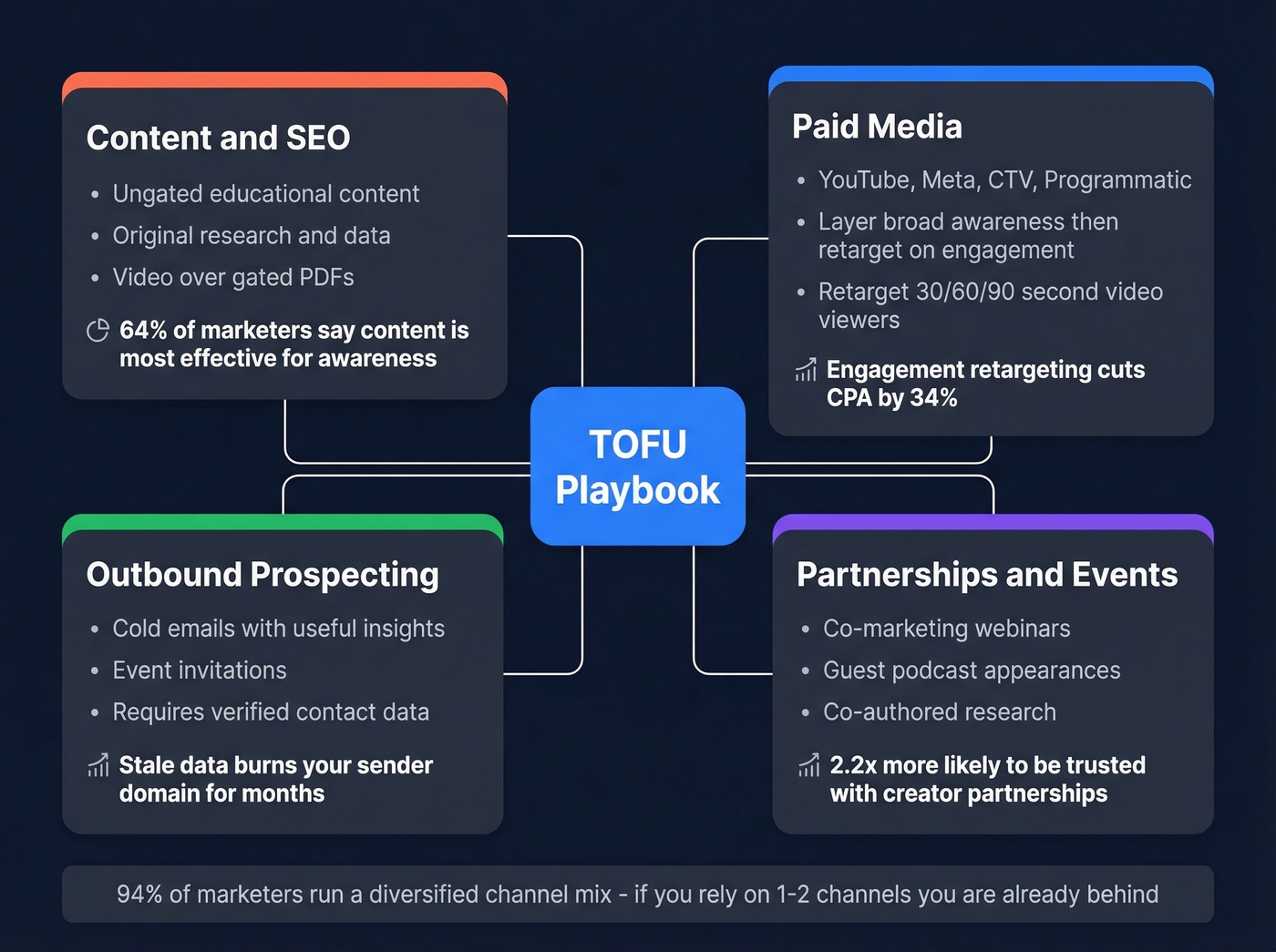
Content and SEO
64% of marketers say content marketing is most effective at the awareness stage. The winning formats: ungated educational content, original research, and video. Gating your best content in 2026 is counterproductive - AI answer engines surface open content, and gated PDFs block that flow entirely.
Publish the research. Build trust before you ask for an email.
B2C awareness content leans on emotional triggers and mass reach - think viral video and influencer partnerships. B2B needs to be useful. Original research, expert frameworks, and data-driven guides outperform everything else we've tested.
Paid Media
Awareness campaigns on YouTube, Meta, CTV, and programmatic display are the workhorses. The key is layering: run broad awareness, then retarget people who watched 30, 60, or 90 seconds of your video content. Retargeting based on engagement decreases CPA by 34% on average - that's where TOFU starts feeding MOFU without a hard handoff.
Outbound Prospecting
This is the awareness channel nobody talks about. A well-crafted cold email that shares a relevant insight or invites someone to an event is top of funnel. But outbound only works with accurate contact data. If your emails bounce, you're not building awareness - you're burning your sender domain. We've watched teams invest heavily in creative outbound sequences only to torch their deliverability with a stale database, and the recovery takes months.
Partnerships, Events, and Community
55% of B2B marketers now partner with creators, SMEs, and industry voices. Brands that do are 2.2x more likely to be trusted. Co-marketing webinars, guest podcast appearances, and co-authored research are the highest-leverage plays - one strong partnership generates months of follow-on content.
Conferences and community sponsorships remain underrated. They're expensive per-touch but generate trust no ad can replicate. HubSpot built 500,000+ certified professionals through HubSpot Academy - a TOFU engine disguised as education. Salesforce's early "No Software" positioning is another masterclass: they didn't sell CRM features at the awareness stage, they sold a category shift. That's the level of ambition your awareness content should aim for.
Channel Diversification Matters
One stat worth internalizing: only 6% of marketers rely on 1-2 channels. 94% run a diversified channel mix, and 45% allocate 10-20% of budgets specifically to testing new channels. If your entire awareness strategy is "blog posts and Google Ads," you're already behind.
TOFU Benchmarks for 2026
Knowing what "good" looks like prevents you from killing campaigns too early. Here are funnel conversion benchmarks from a dataset spanning 2017-2025, roughly 65% B2B:
| Industry | Lead-to-MQL | MQL-to-SQL | SQL-to-Opp | SQL-to-Closed Won |
|---|---|---|---|---|
| B2B SaaS | 39% | 38% | 42% | 37% |
| Cybersecurity | 32% | 27% | 38% | 33% |
| Fintech | 35% | 29% | 40% | 35% |
| IT Services | 36% | 31% | 41% | 36% |
If your Lead-to-MQL rate is significantly below these ranges, the problem is targeting, not volume. You're reaching the wrong people.
For awareness-specific KPIs, track unique reach, engagement rate, video view duration, CPM, and cost per landing page view. For brand lift, expect 5-15% ad recall lift and 2-5% awareness lift from a well-run campaign. Anything below those floors means your creative or targeting needs work.
Measuring Top of Funnel Results
The CFO asks "what did our awareness spend produce?" and marketing shows impressions. That conversation never goes well.
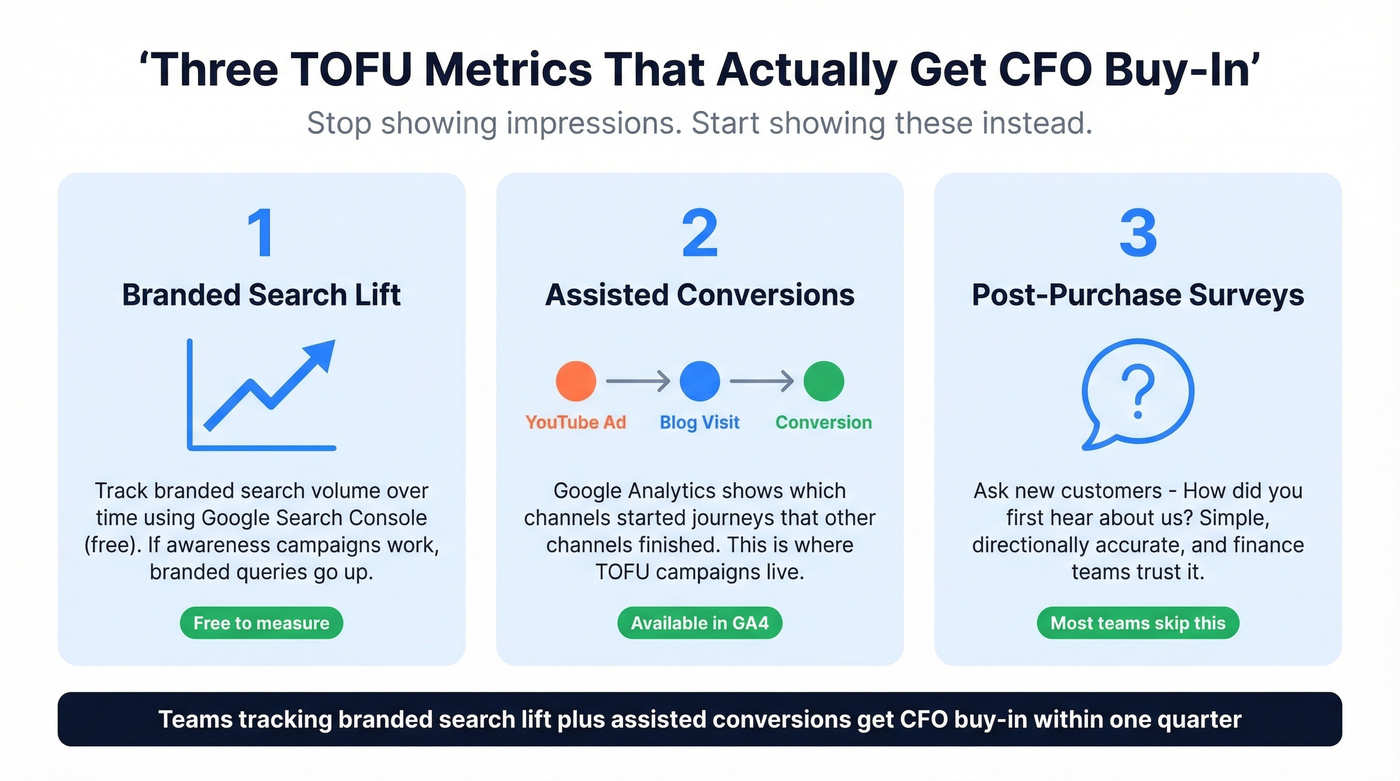
The attribution trap is real. Someone sees your YouTube ad, reads your blog post two weeks later, clicks a retargeting ad a month after that, and then Googles your brand name and converts. Last-click gives all the credit to branded search. First-click gives it to YouTube. Neither tells the full story.
Three metrics that actually work for a board presentation:
Branded search lift. Track branded search volume over time. If your awareness campaigns are working, branded queries go up. Google Search Console gives you this for free.
Assisted conversions. Google Analytics shows which channels assisted conversions without getting last-click credit. This is where TOFU campaigns live - they start journeys that other channels finish.
Post-purchase surveys. Ask new customers "how did you first hear about us?" It's the simplest measurement tool most teams ignore. The data isn't perfect, but it's directionally accurate and finance teams trust it.
In our experience, teams that track branded search lift alongside assisted conversions get CFO buy-in within one quarter. For teams with bigger budgets, geo lift tests and marketing mix modeling give you incrementality data - run an awareness campaign in five markets, hold it back in five matched markets, and measure the pipeline difference.
Beyond the Linear Funnel
Let's be honest: the funnel is a reporting framework, not a strategy framework. BCG's influence maps research argues that marketers force-fit touchpoints into a linear sequence that doesn't match how people actually buy. Their core insight: reach doesn't guarantee influence. Influence depends on attention, relevance, and trust - which is why a $5 CPM impression that nobody notices is worth less than a $35 CPM impression that changes a shortlist.
The practitioner version of this is "surround sound." As one marketing director put it on r/sales: "We stopped calling it top of funnel and started calling it surround sound - show up everywhere, consistently, and become the obvious choice." A podcast mention, a retargeting ad, a cold email with a useful insight - none of these is "the" touchpoint. All of them are.
AI is accelerating this shift. Ungated, high-quality content gets surfaced by AI answer engines. Gated PDFs don't. Predictive scoring is replacing static lead scoring, combining behavior signals, intent data, and account context to identify who's actually moving through a buying process - regardless of which "stage" they're in. 58% of marketers already say AI referral traffic has higher intent than traditional organic, which makes the case for open, authoritative awareness content even stronger.
Stop optimizing your funnel. Start optimizing your surround sound.
Building Your Prospect List
Every tactic above depends on one invisible piece of infrastructure: data quality. If 35% of your outbound emails bounce, you're not building awareness - you're destroying your sender reputation and wasting budget. We've seen this pattern repeatedly: teams invest in great TOFU content and creative, then undermine it all with a stale contact database.
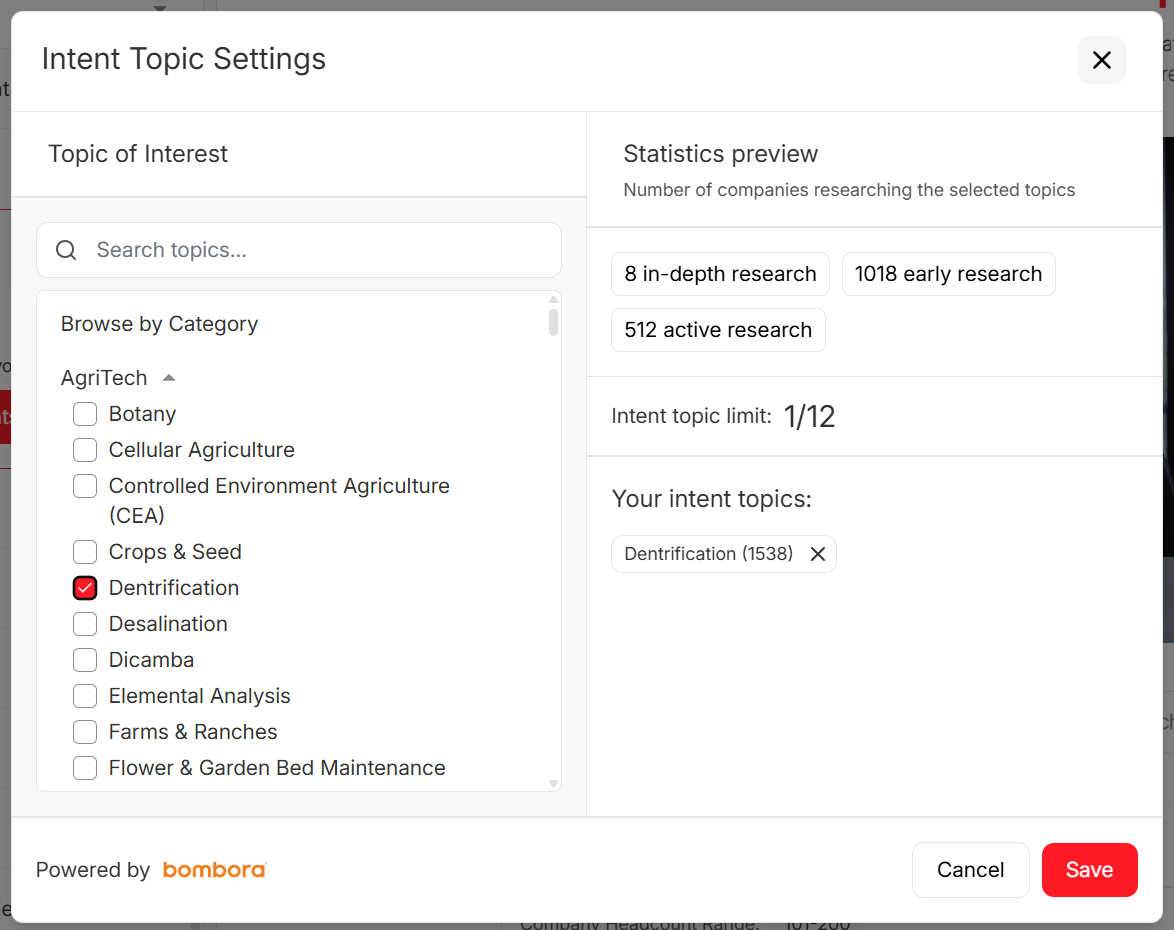
Prospeo's B2B database covers 300M+ professional profiles with 98% email accuracy and a 7-day data refresh cycle - compared to the 6-week industry average. Layer in intent data tracking 15,000 topics via Bombora, and you're targeting accounts that are actually showing buying signals. Meritt tripled their pipeline from $100K to $300K/week after switching, with bounce rates dropping from 35% to under 4%. The free tier gives you 75 verified emails per month with no contract and no sales call required.
Your outbound is only as good as your data. With 300M+ profiles and verified emails at ~$0.01 each, Prospeo keeps your pipeline full.
Try it free - no credit card required
FAQ
What's the difference between top of funnel and demand generation?
Top of funnel is a stage - the awareness layer where prospects first encounter your brand. Demand generation is the strategy spanning all stages, from awareness through conversion. Every demand gen program needs a strong TOFU component, or it starves for pipeline within 6-12 months.
How long does TOFU take to show results?
Expect 3-6 months for measurable brand lift and 6-12 months for pipeline impact. Cutting awareness spend early is expensive - it costs $1.85 later to recover every $1 saved, per BCG's analysis of brand marketing cuts.
Is top of funnel different for B2B vs B2C?
Yes. B2B has longer sales cycles, buying committees of 6-10 people, and heavier reliance on trust and education. B2C awareness leans on emotional triggers and mass reach. B2B needs original research, expert content, and targeted outreach - not viral campaigns.
What's the best TOFU metric for a board presentation?
Branded search lift. It's simple, credible, and directly tied to awareness growth. Pair it with assisted conversions to show how awareness campaigns start journeys that bottom-funnel channels finish. Together, they tell a story finance teams actually believe.
How do I build a prospect list for outbound awareness campaigns?
Start with a verified B2B database that layers intent data on firmographic filters. Verify emails before sending and keep your list refreshed weekly to protect domain reputation. Skip this step if you want to spend the next three months rebuilding a burned sender domain.