

Typo Spam Traps: The Silent Deliverability Killer on Your List
Your deliverability just dropped overnight. Bounce rates look fine. Content looks fine. But buried in your contacts are a dozen addresses ending in gmial.com - and some of them are live traps quietly flagging you as a sender with poor list hygiene.
Here's the short version: a typo spam trap is an email address with a misspelled domain that ISPs, blocklist operators, and anti-spam organizations configure to accept mail silently, signaling that the sender isn't validating data. They don't hard bounce, so you won't spot them the way you spot invalid addresses. Check your list against the typo domain table below, and prevent them at signup with real-time email validation that catches misspellings before they hit your database.
What Are Typo-Based Spam Traps?
These traps are email addresses built on misspelled versions of legitimate domains - think gnail.com instead of gmail.com, or hotnail.com instead of hotmail.com. Mailbox providers, blocklist operators, and anti-spam organizations register these domains and configure them to receive mail. When your emails land there, it tells the world you're not validating your data.
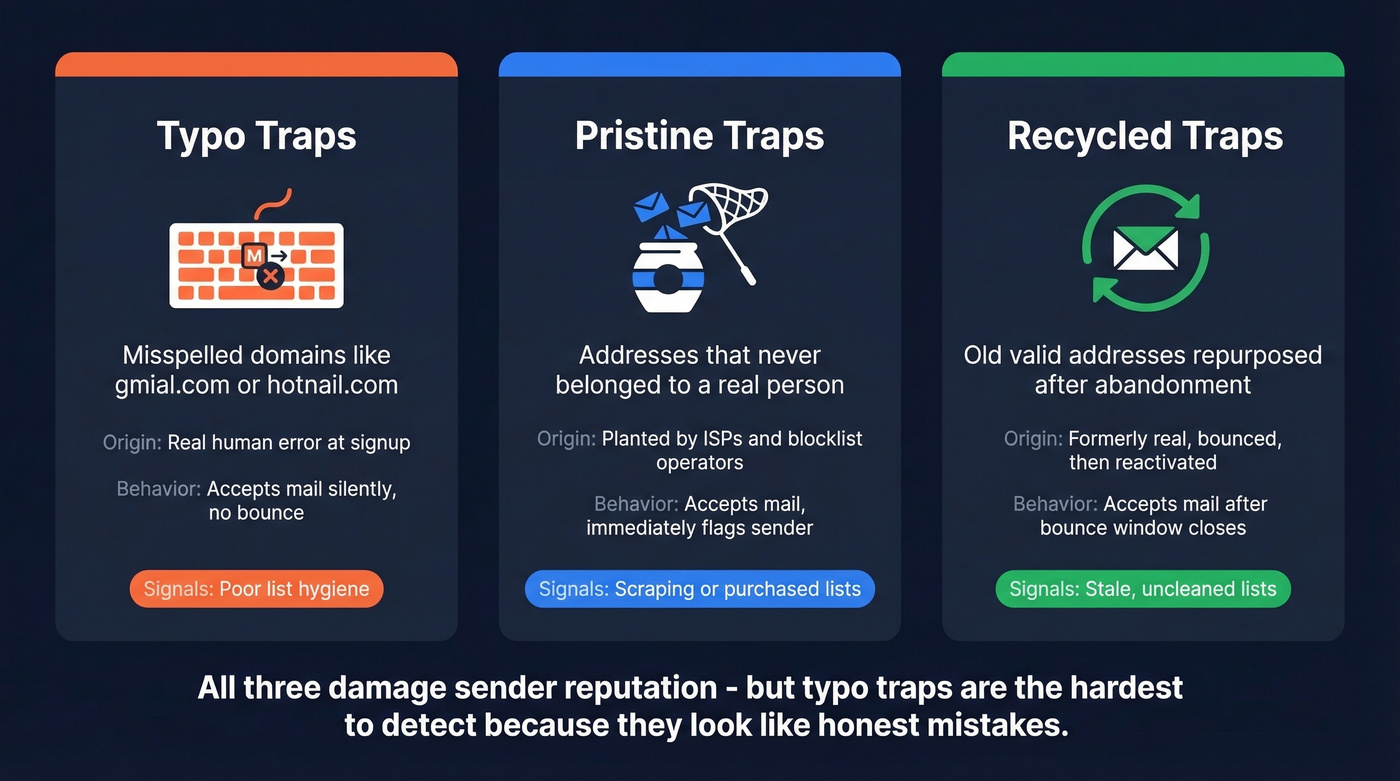
They're different from the other two major trap types. Pristine traps are addresses that never belonged to a real person - planted to catch scrapers and purchased-list users. Recycled traps are formerly valid addresses that first hard-bounce, then get repurposed as active traps once the bounce window closes. Typo-based traps sit in a frustrating middle ground: they originate from real human error, but inbox providers still treat them as evidence of negligent list hygiene.
How Typo Traps Actually Work
Someone fat-fingers "gmial.com" at a checkout counter, and months later your domain lands on a blocklist. The punishment doesn't fit the crime - but inbox providers don't care about intent.
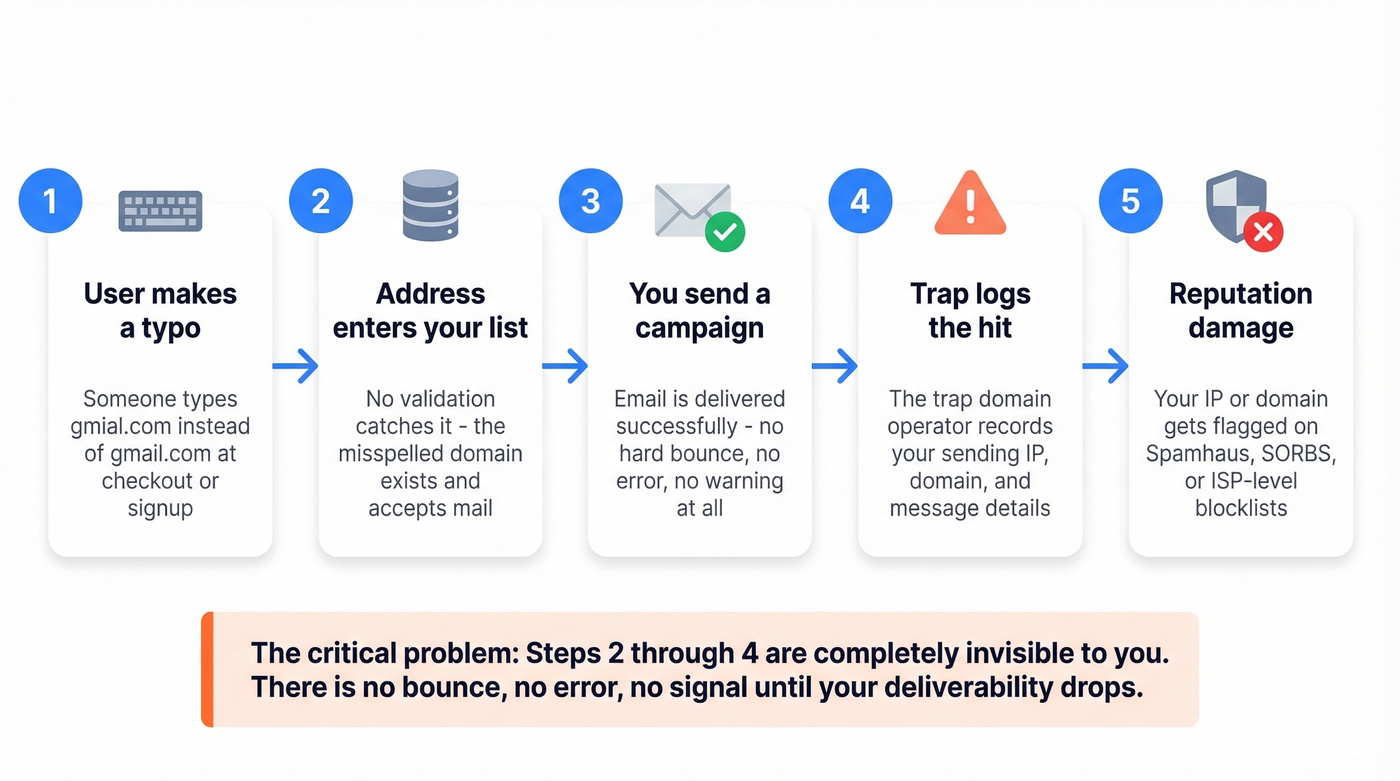
Anti-spam organizations register misspelled domains and configure them to accept incoming mail without bouncing. A normal invalid address returns a hard bounce, which your ESP removes automatically. A typo trap? It accepts the message, logs it, and reports the sender. No error, no warning, no signal that anything went wrong.
The scale is bigger than most people realize. Krebs on Security, citing Infoblox research, documented that gmai.com - just one missing letter - runs a live mail server actively accepting misaddressed email. A single operator tied to torresdns.com controls nearly 3,000 lookalike domains. These aren't edge cases. They're industrial-scale email collection operations, and any one of them can torch your sender reputation without you ever knowing it happened.
Why They Matter More in 2026
Deliverability is getting harder across every major inbox provider. The margin for error is basically gone.
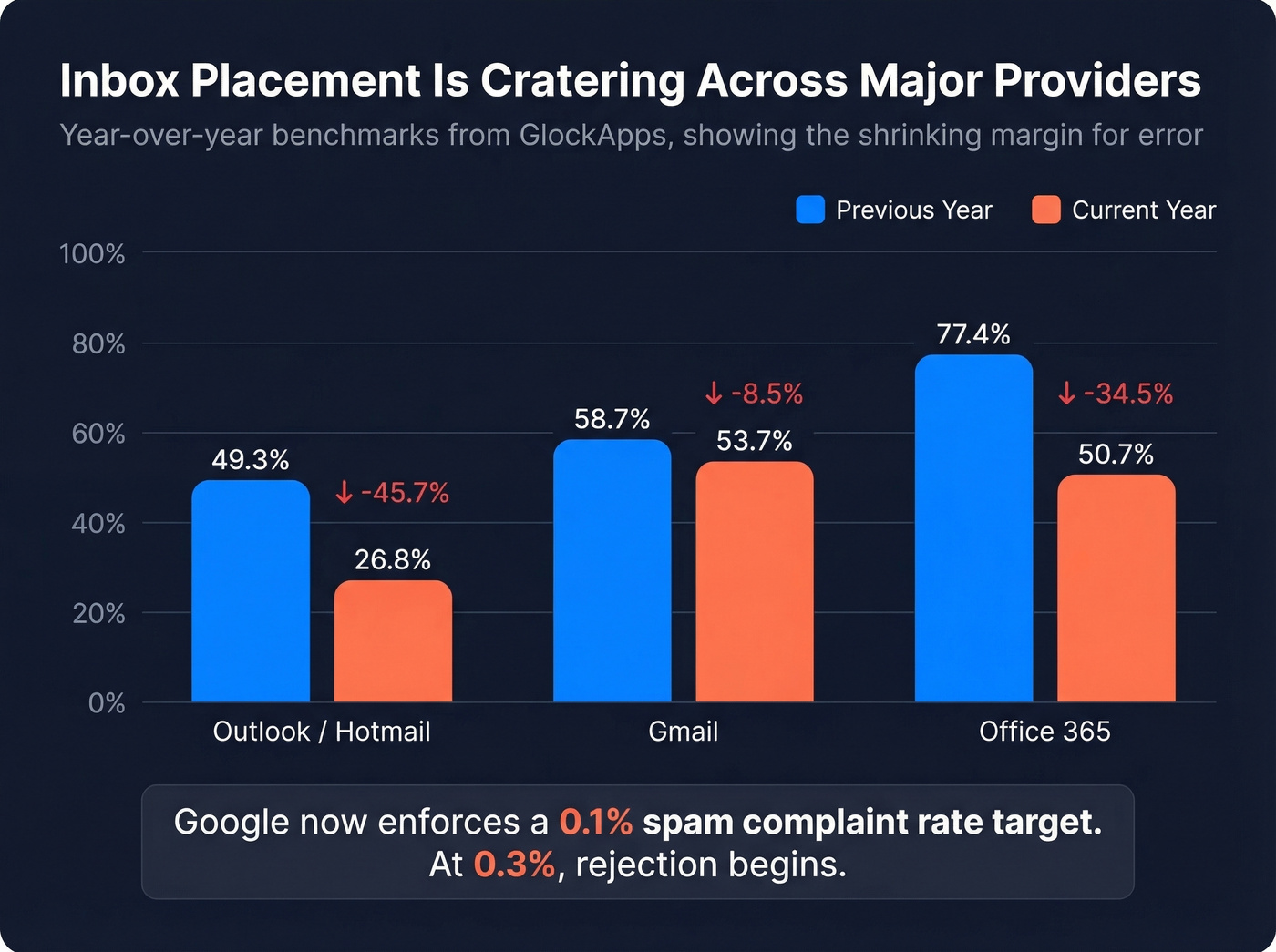
GlockApps benchmarks showed Outlook/Hotmail inbox placement cratering from 49.33% to 26.77% year-over-year. Gmail dropped from 58.72% to 53.70%. Office 365 fell from 77.43% to 50.70%. Those aren't subtle shifts - that's a deliverability crisis for senders who aren't running clean lists.
In our testing, lists with even 3-5 misspelled-domain traps saw measurable inbox placement drops within a week. Google now targets a 0.1% spam complaint rate, with 0.3% as the threshold where rejection kicks in. Microsoft's DMARC requirement adds another layer. And email lists decay by roughly 22% every year naturally. In this environment, a handful of trap hits can push a borderline sender reputation over the edge.

Typo traps slip past basic verifiers because they don't hard bounce. Prospeo's 5-step verification catches them before they reach your list - with dedicated spam-trap removal, honeypot filtering, and catch-all domain handling built into every record. 98% email accuracy, refreshed every 7 days.
Stop auditing typo domains manually. Start with data that's already clean.
Common Typo Trap Domains
Bookmark this table. We've compiled the most common misspellings that show up as active traps on real lists.
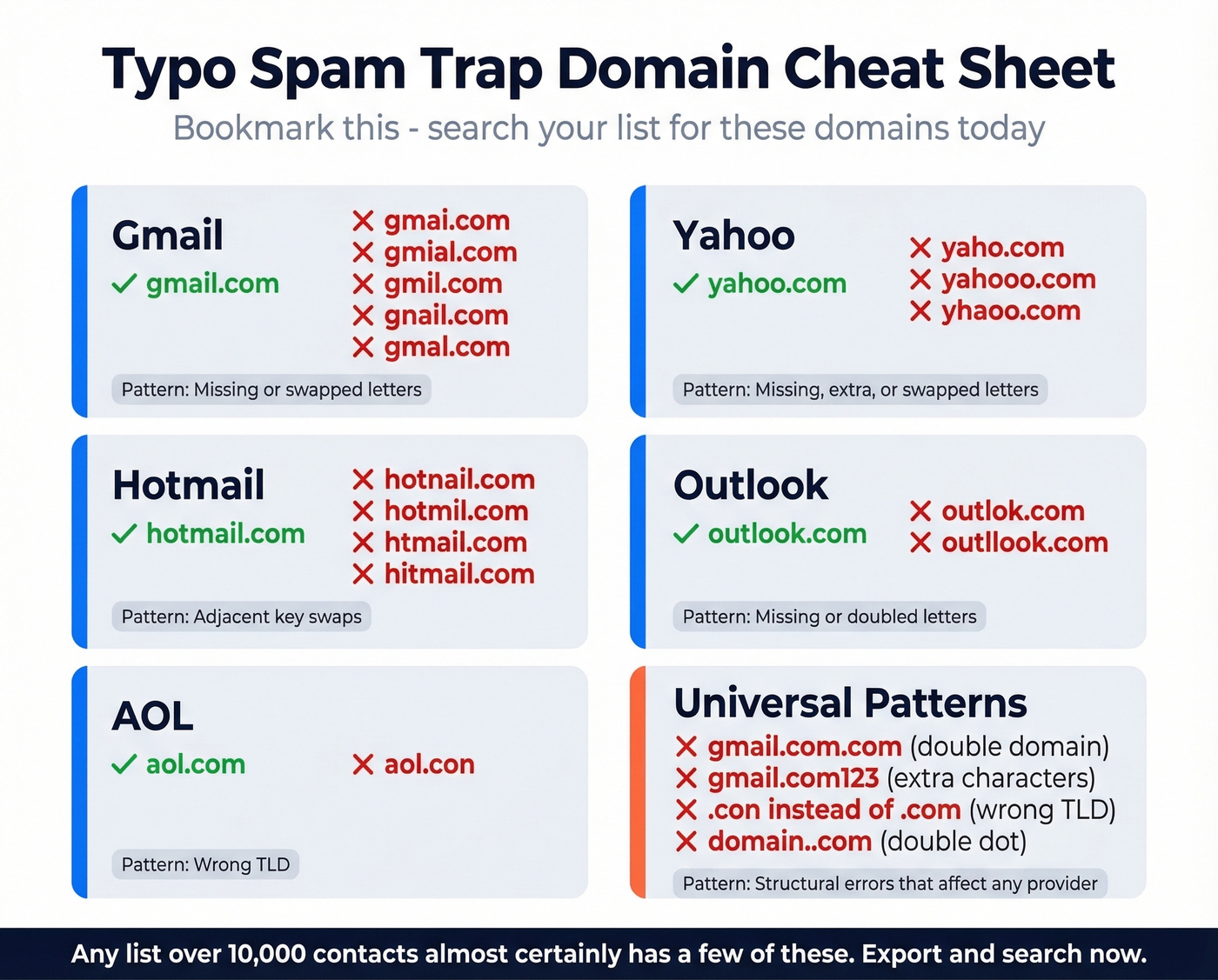
| Provider | Common Typo Domains | Pattern |
|---|---|---|
| Gmail | gmai, gmial, gmil, gnail, gmal | Missing/swapped letter |
| Yahoo | yaho, yahooo, yhaoo | Missing/extra/swapped |
| Hotmail | hotnail, hotmil, htmail, hitmail | Adjacent key swap |
| Outlook | outlok, outllook | Missing/doubled letter |
| AOL | aol.con | Wrong TLD |
| iCloud | iclod, icoud | Missing letter |
| Any | gmail.com.com, yahoo.com.com | Double domain |
| Any | gmail.com123, yahoo.com1 | Extra characters |
| Any | .con instead of .com | Wrong TLD |
| Any | user@domain..com | Double dot |
Any list over 10,000 contacts almost certainly has a few of these. Export your contacts and run a search now - it takes five minutes with a spreadsheet filter.
How to Find and Remove Them
Search for known typo domains first. Use the table above as your checklist. A basic regex or spreadsheet filter catches most of these in minutes, and it's the single highest-ROI cleanup step you can take.
Flag zero-engagement addresses. Look for contacts with no clicks across 3-5 consecutive campaigns over 30-90 days. Use clicks, not opens - Apple's Mail Privacy Protection inflates open rates so badly that open-based segmentation is essentially useless for hygiene purposes.
Run your list through a verifier with spam-trap detection. A Hunter benchmark of 15 tools found overall verification accuracy ranged from the mid-50s to around 70%, and trap-specific detection varies even more. When evaluating verifiers, check for explicit spam-trap detection and auto-suggestion features; not all tools include them. If your verifier offers toxicity scoring, remove only the highest-severity entries to avoid false positives.
Clean on a schedule. Microsoft recommends cleaning lists monthly or quarterly. One Reddit user in r/coldemail shared that a "basic, cheap verifier" caught bounces but missed traps entirely - deliverability plummeted overnight and took weeks to recover. Another reported that cleaning dead emails and typos from a long-neglected list improved open rates immediately.
We've seen this pattern repeatedly: teams trust their verifier, skip the typo-domain audit, and wonder why inbox placement keeps sliding. The verifier is necessary but not sufficient.
How to Prevent Them at the Source
Every spam trap guide tells you to clean your list. That's damage control, not prevention. Let's talk about actually stopping traps from entering in the first place.
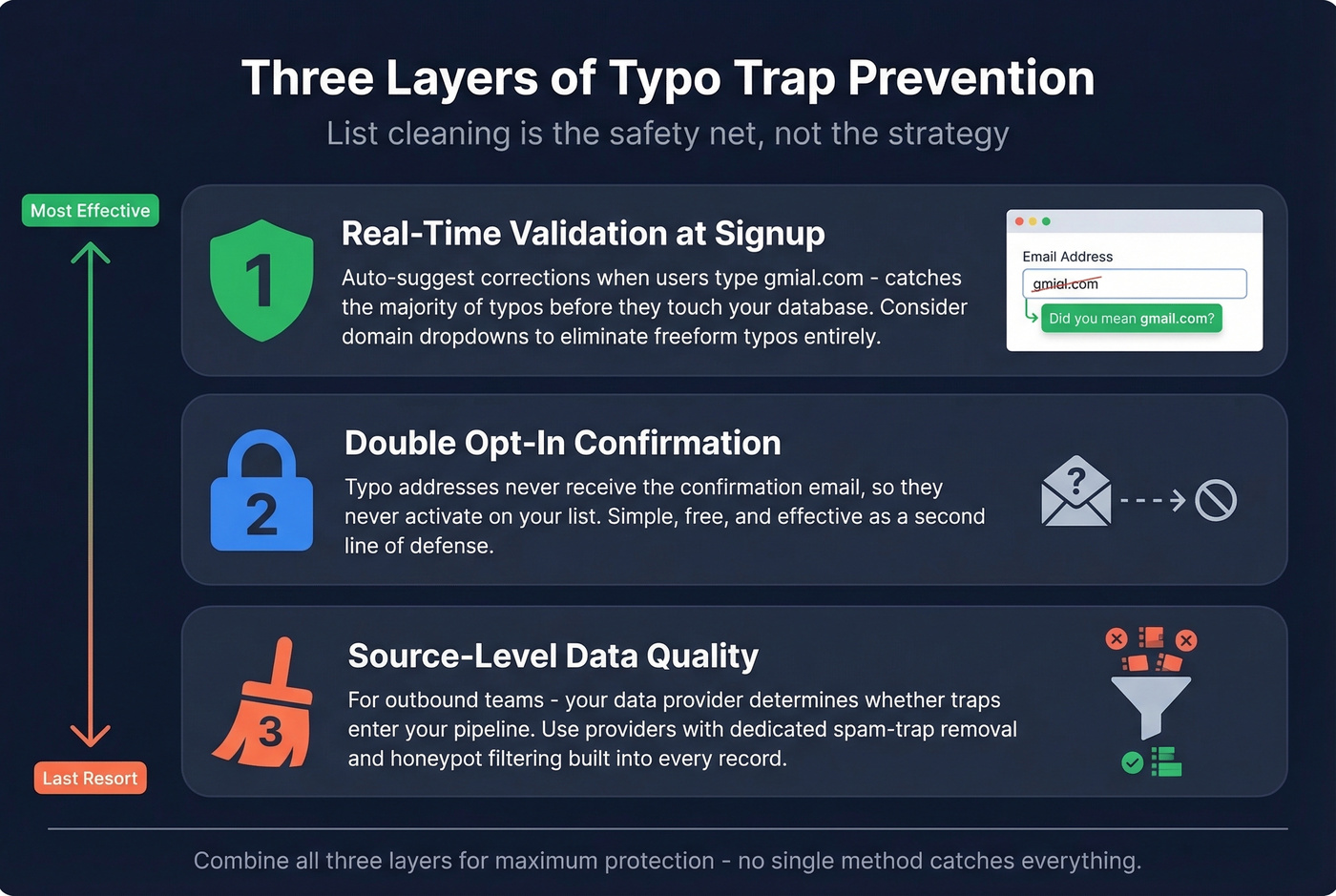
Real-time validation at signup is the single most effective prevention measure. A "did you mean gmail.com?" auto-suggestion when someone types gmial.com catches the vast majority of misspelled-domain traps before they ever touch your database. Litmus recommends address validation on enrollment pages for exactly this reason. Some teams go further with a domain dropdown on signup forms, restricting the domain field to known providers and eliminating freeform typos entirely.
Double opt-in is the second layer. Confirmed opt-in means a typo address never confirms, so it never makes it onto your active list. It's simple, it's free, and it works.
Source-level data quality is where outbound teams need to pay attention. If you're building prospect lists, your data provider determines whether traps enter your pipeline. Prospeo's 5-step verification process includes dedicated spam-trap removal and honeypot filtering, stripping traps before data ever reaches your CRM. With 98% email accuracy and a 7-day data refresh cycle, the trap never makes it into your workflow.
List cleaning is the safety net, not the strategy.
Your data provider is either preventing trap hits or causing them. Prospeo verifies 300M+ profiles through proprietary infrastructure - no third-party email providers, no recycled data. Spam traps, honeypots, and catch-alls are stripped at the source, not after they've already damaged your sender reputation.
Clean lists start with clean data. Prospeo delivers both at $0.01 per email.
FAQ
Can typo spam traps bounce?
No. Typo trap domains are configured to accept mail silently - they don't return hard bounces, so they sit on your list undetected indefinitely. The only way to catch them is proactive auditing against known misspelled domains or using a verifier with dedicated trap detection.
How many trap hits cause blocklisting?
There's no published threshold, but even 2-3 hits on a pristine or typo trap within a short window can trigger a Spamhaus or SORBS listing. Senders with lower volume and newer domains are especially vulnerable - one bad send can undo months of warm-up.
Will email verification catch all misspelled-domain traps?
Not always. Many typo trap domains are configured as accept-all, so verifiers return "unknown" instead of "invalid." Look for tools with explicit spam-trap detection - standard verification alone won't cut it. Pair automated verification with a manual typo-domain audit using the table above for the best coverage.