

Upsell Opportunities: A Data-Backed Playbook to Find and Convert Them
Your CS team flagged 40 accounts showing expansion signals. Marketing built a "ready to upsell" segment last quarter. Expansion revenue is flat.
The problem isn't finding upsell opportunities - it's having a system that scores them, times them, and delivers them with clean data so outreach actually lands. On r/CustomerSuccess, practitioners keep asking for templates and playbooks, not theory. That's what this guide delivers: a scoring model with a worked example, benchmarks by channel, email frameworks, objection-handling talk tracks, and two case studies with real revenue numbers. Upselling and cross-selling drive 10-30% of total revenue for companies that do it well.
What Is an Upsell Opportunity?
When a customer hits a usage limit, asks for admin controls, or adds a second team - that's an upsell opportunity. It's the moment an existing customer is primed to buy a higher-tier version of what they already use. Cross-selling, by contrast, pushes a complementary product. The distinction matters because the tactics, timing, and conversion rates differ significantly.
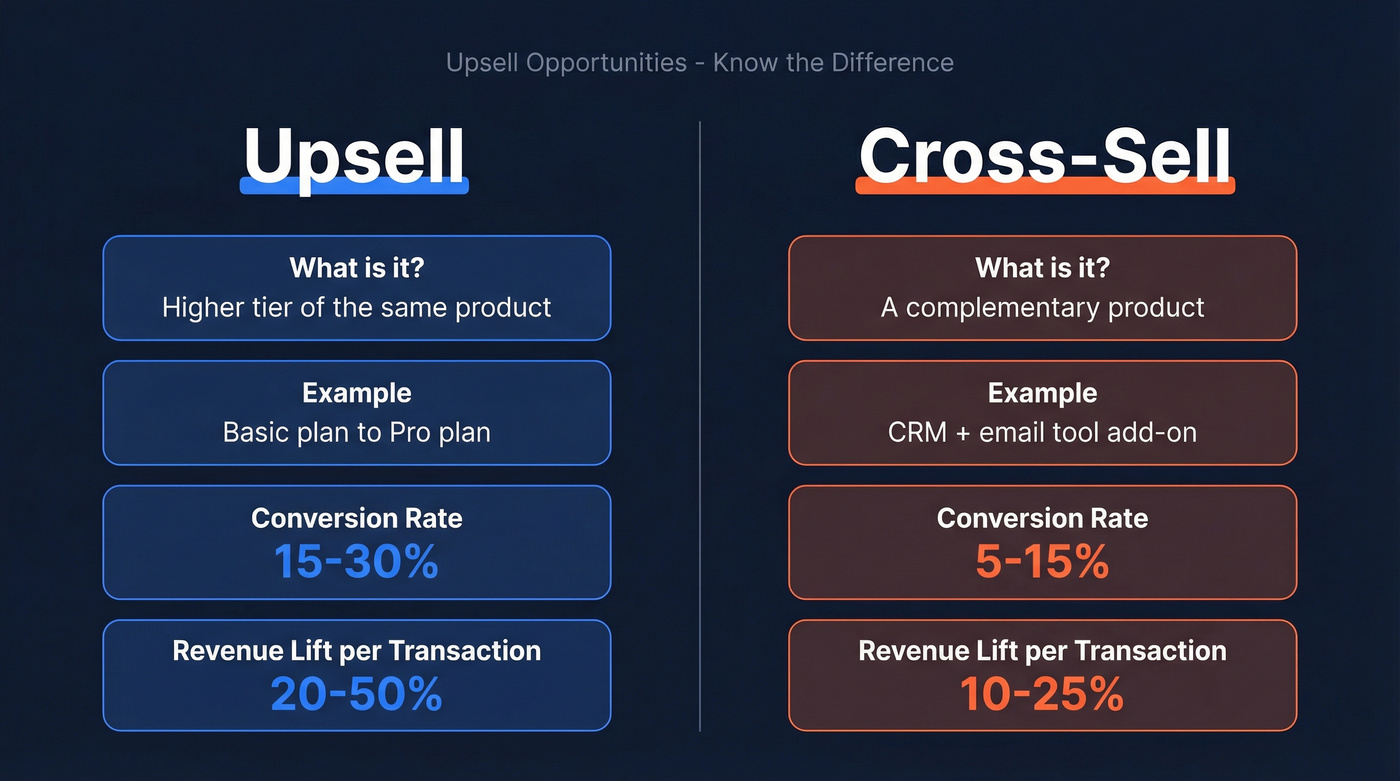
| Upsell | Cross-Sell | |
|---|---|---|
| Definition | Higher-tier of same product | Complementary product |
| Example | Basic to Pro plan | CRM + email tool add-on |
| Conversion range | 15-30% | 5-15% |
| Revenue lift/txn | 20-50% | 10-25% |
In SaaS, an upsell looks like a team moving from a starter plan to an enterprise tier. In ecommerce, it's a customer choosing the premium version of a product already in their cart. For service businesses, it's a marketing agency expanding a client from an SEO audit into a full retainer. The mechanics change, but the core principle doesn't: you're increasing value within an existing relationship.
Why Expansion Revenue Deserves Top-Three Priority
Selling to existing customers is 50-80% easier than acquiring new ones. That alone should make upselling a top-three priority for any revenue team.
Upselling generates over 4% of total sales on average and can be 20x more effective than cross-selling at driving incremental revenue per transaction, according to AdRoll's analysis. An Aftersell/Rokt report analyzing 40,000+ brands found that simple cart tweaks drive nearly $93K in extra revenue per brand. And 72% of SaaS companies already employ upsell or cross-sell strategies - if you're not, you're leaving expansion revenue to competitors who are.
Here's the thing: acquisition costs keep climbing. Upselling is the counterweight. It compounds on a customer base you've already paid to acquire.
Benchmarks by Channel and Vertical
Without a baseline, you can't tell whether a 15% conversion rate on expansion offers is a win or a problem.
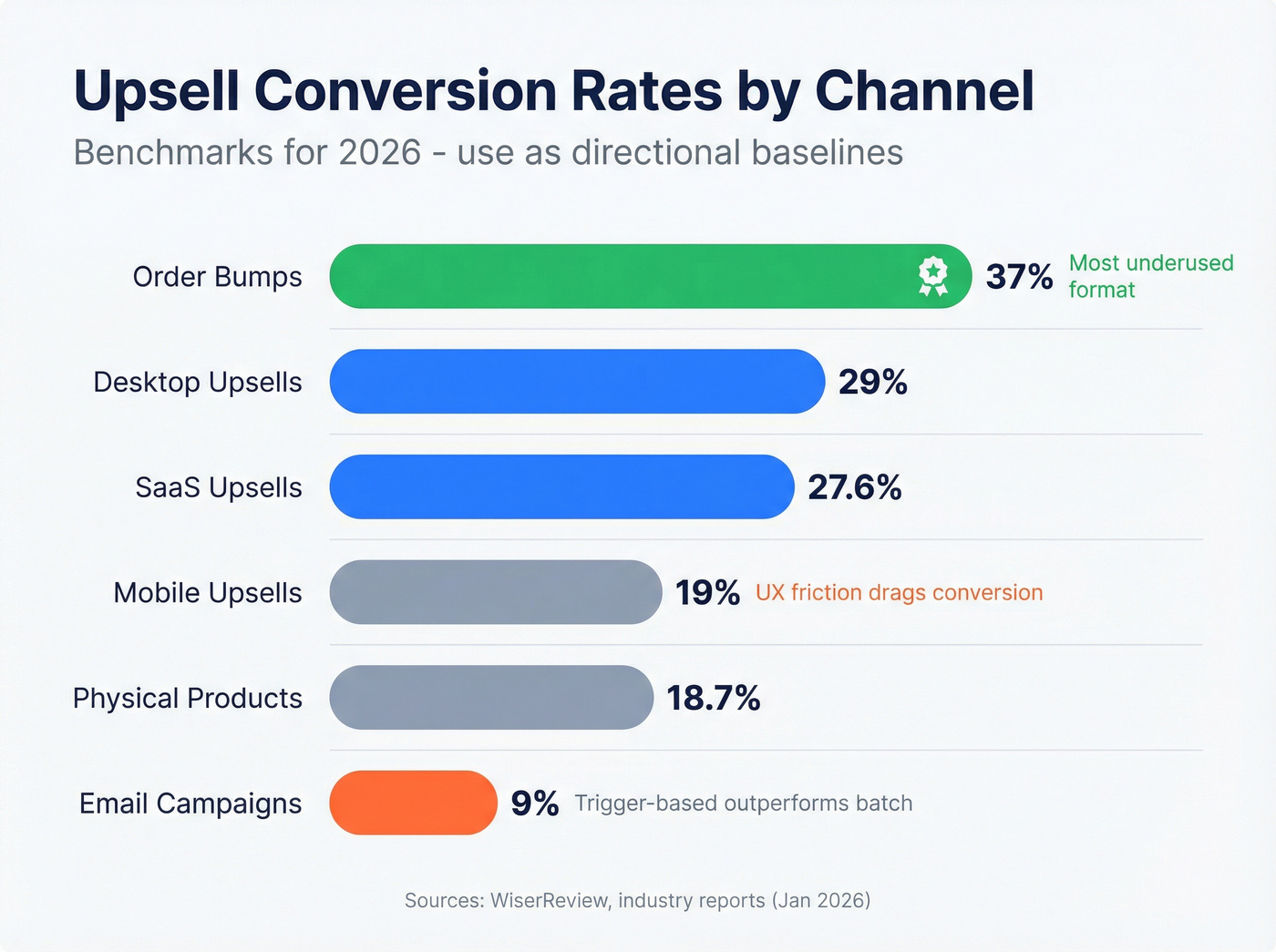
| Channel / Format | Conversion Rate | Notes |
|---|---|---|
| SaaS upsells | ~27.6% | Highest among digital |
| Physical products | ~18.7% | In-cart and post-purchase |
| Order bumps | 37-38% | Most underused format |
| Email campaigns | ~9% | Trigger-based outperforms batch |
| Desktop | 28-30% | Consistently beats mobile |
| Mobile | 18-20% | UX friction drags conversion |
Benchmarks compiled from WiserReview (updated Jan 6, 2026) and selected industry reports; use as directional baselines, not guarantees.
Order bumps at 37-38% are the most underused upsell format we've encountered. They're low-friction, appear at the moment of highest purchase intent, and require minimal design work. If you're running ecommerce and haven't tested order bumps, stop reading and start there.
For SaaS, AOV benchmarks by tier help calibrate expectations: low-tier products see $10-$50 per upsell order, mid-tier runs $100-$500, and enterprise upsells clear $1,000+.
Let's be honest - batch upsell campaigns are almost always a waste. Trigger-based sequences outperform them by such a wide margin that any time spent on batch campaigns is time stolen from building proper triggers. If you can't measure feature adoption, don't pretend you have expansion signals. Fix instrumentation first.
How to Identify Upsell Opportunities
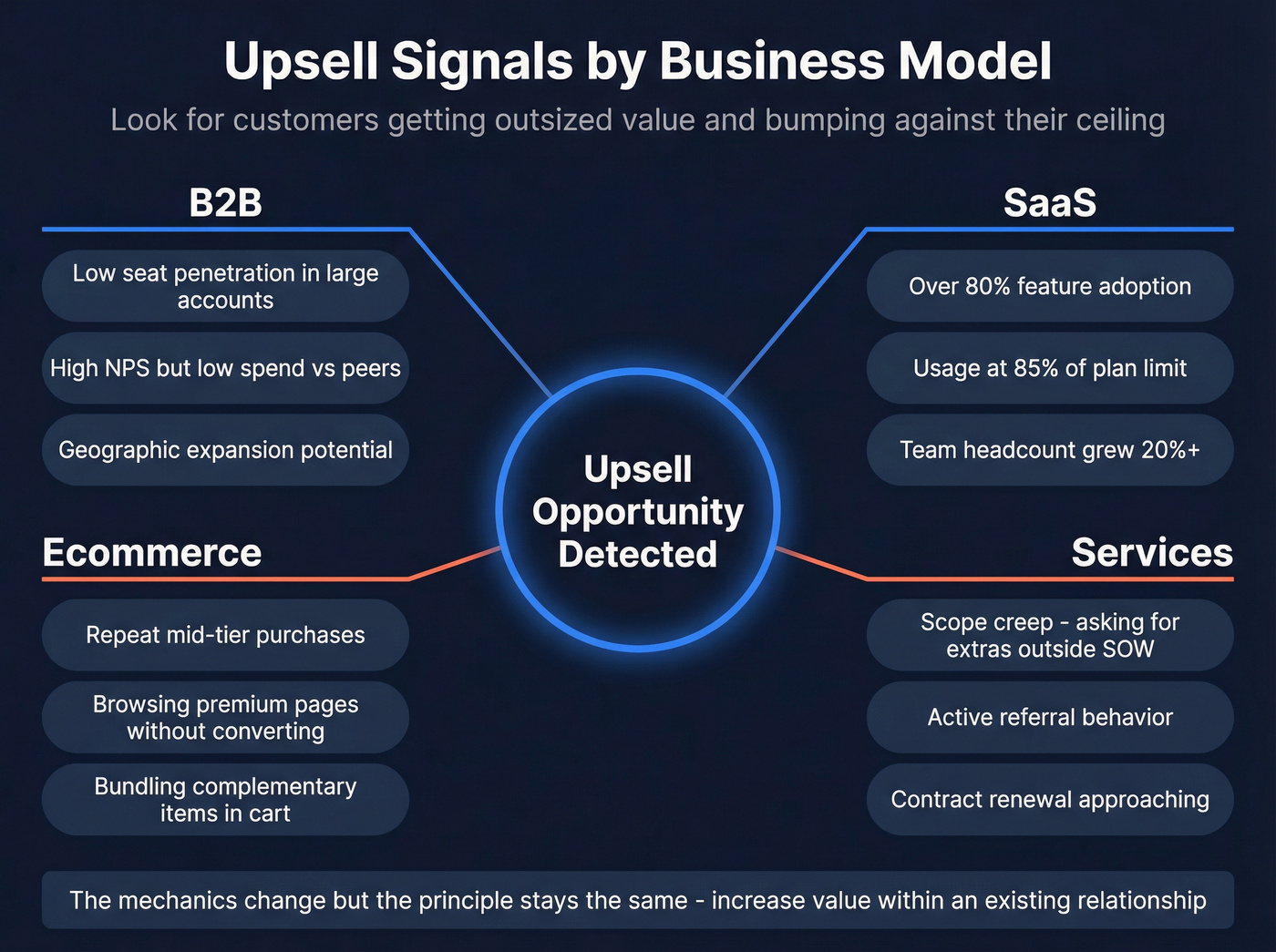
The signals differ by business model, but the principle is universal: look for customers getting outsized value from what they have and bumping against the ceiling of their current plan or purchase.
B2B Signals
The CustomerGauge framework nails this. Map account characteristics against positive experience signals. A large company where only a small percentage of potential users are on the platform? That's a seat expansion play. A global corp using your product in one geography? Geographic expansion. High NPS but low spend relative to peers? Share-of-wallet gap.
Cross-analyze account size with NPS scores to find the "happy but low revenue" quadrant - customers with the best experience spend 140% more. QBR conversations are the natural trigger point. If an account manager can't articulate the expansion play before a QBR, the scoring model isn't working.
SaaS Signals
Accounts with more than 80% core feature adoption across departments indicate strong fit and growth potential. Watch for usage limit proximity - when a team hits 85% of their plan's capacity, that's a buying signal, not a support ticket. Team growth is another reliable indicator: if headcount in the account jumped 20% last quarter, they'll need more seats.
The subtlest signal is support ticket themes shifting from "how do I do X?" to "can I also do Y?" That's a customer outgrowing their tier. Customer success teams that track these patterns can identify expansion opportunities weeks before the customer formally requests a change.
Ecommerce Signals
Purchase history patterns reveal upsell readiness better than any survey. Repeat buyers who consistently choose mid-tier products are primed for premium versions. Browsing behavior on higher-tier product pages without converting suggests price sensitivity - a targeted discount on the upgrade can close the gap.
Cart composition matters too. Customers bundling complementary items are already thinking in terms of value, not just price.
Service Business Signals
Project scope creep is the clearest upsell signal in services. When a client keeps asking for "one more thing" outside the SOW, they're telling you they need a bigger engagement. Referral activity signals satisfaction and trust - both prerequisites for expansion conversations.
Contract renewal timing is the natural upsell window. The key is having the conversation before renewal, not during it.
Find Bundles with Product Affinity Analysis
If you sell multiple products or tiers, affinity analysis reveals which combinations customers naturally gravitate toward. The framework uses three metrics from Ecosire's research:
Support measures how often two products appear together in orders. If Product A and Product B co-occur in 8% of transactions, that's your support score. Confidence measures the conditional probability: of customers who bought A, what percentage also bought B? Lift measures whether the co-occurrence is stronger than random chance - a lift above 1.0 means the combination is meaningful, not coincidental.
Filter aggressively: drop any pair with support below 3% (too rare to act on) and lift below 1.5 (not meaningfully correlated). What survives is your shortlist of bundles worth testing.
Say your CRM data shows that customers who buy your analytics module also buy the reporting add-on with 12% support, 45% confidence, and 2.3 lift. That's a strong candidate for a bundled offer at the analytics purchase moment.
Build a Scoring Model That Works
This is where most teams fall apart. They identify signals but don't weight them, so every "opportunity" looks the same in the CRM.
Weight Tiers
| Action Category | Weight | Examples |
|---|---|---|
| Critical | 8-10 | Core feature usage, team onboarding |
| Important | 5-7 | Integration setup, admin actions |
| Supporting | 2-4 | Help doc visits, webinar attendance |
| Basic | 1 | Login, passive page views |
Time Decay Multiplier
Recent activity counts more than something from three months ago:
| Recency | Multiplier |
|---|---|
| Last 7 days | 1.0 |
| 8-30 days | 0.7 |
| 31-90 days | 0.4 |
| 90+ days | 0.1 |
Engagement Thresholds
| Level | Feature Adoption | WAU (% of seats) | Task Completion |
|---|---|---|---|
| High | >75% | >80% | >90% |
| Medium | 50-75% | 50-80% | 70-90% |
| Low | <50% | <50% | <70% |
Businesses using account scoring see a 77% boost in lead generation ROI. Adobe reported a 30% improvement in sales acceptance rates after implementing shared lead definitions between sales and marketing.
Worked Example: Scoring One Account
Account: Acme Corp (Mid-Market SaaS Customer, Team Plan)
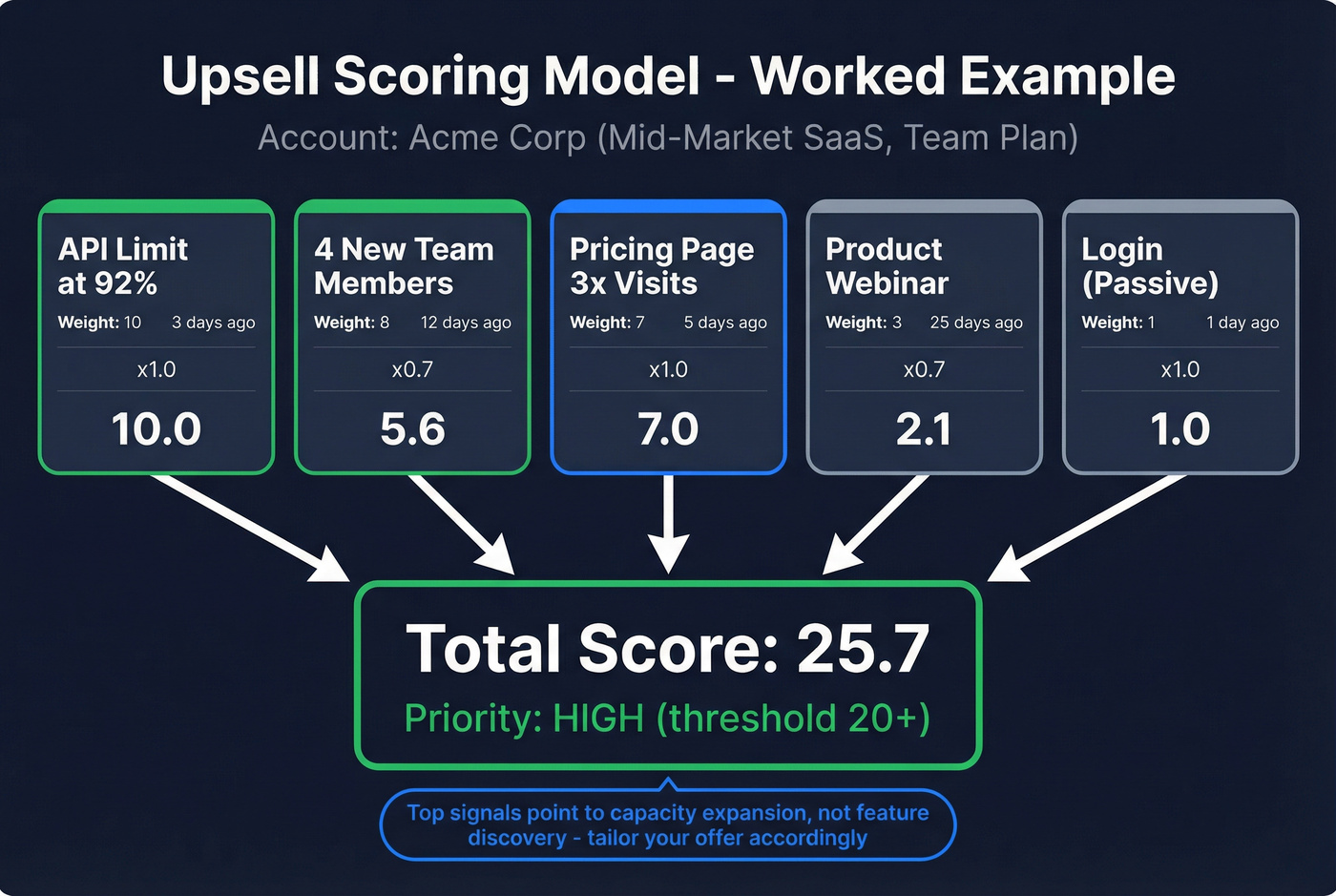
| Signal | Weight | Recency | Multiplier | Score |
|---|---|---|---|---|
| Used 92% of API limit | 10 | 3 days ago | 1.0 | 10.0 |
| Added 4 new team members | 8 | 12 days ago | 0.7 | 5.6 |
| Attended product webinar | 3 | 25 days ago | 0.7 | 2.1 |
| Visited pricing page 3x | 7 | 5 days ago | 1.0 | 7.0 |
| Logged in (passive) | 1 | 1 day ago | 1.0 | 1.0 |
| Total | 25.7 |
With a threshold of 20+ for "High Priority," Acme Corp qualifies. The dominant signals - API limit proximity and pricing page visits - tell you the offer should focus on capacity expansion, not feature discovery.
Copy This Into a Spreadsheet
Set up your scoring sheet with these columns:
Account Name | Signal | Weight (1-10) | Days Since Event | Multiplier | Weighted Score | Total Score | Priority Tier
Formula for Weighted Score: =Weight * IF(Days<=7, 1.0, IF(Days<=30, 0.7, IF(Days<=90, 0.4, 0.1)))
Priority Tier: =IF(Total>=20, "High", IF(Total>=10, "Medium", "Low"))
Start with three to five signals. I've run scoring implementations where the first version was embarrassingly simple - three signals, two weight tiers, no time decay. It still outperformed gut-feel prioritization by a wide margin. Recalibrate quarterly and add complexity only when you have the data to support it.
Upsell Journey Map
Every scored account needs a defined path from signal to outcome:
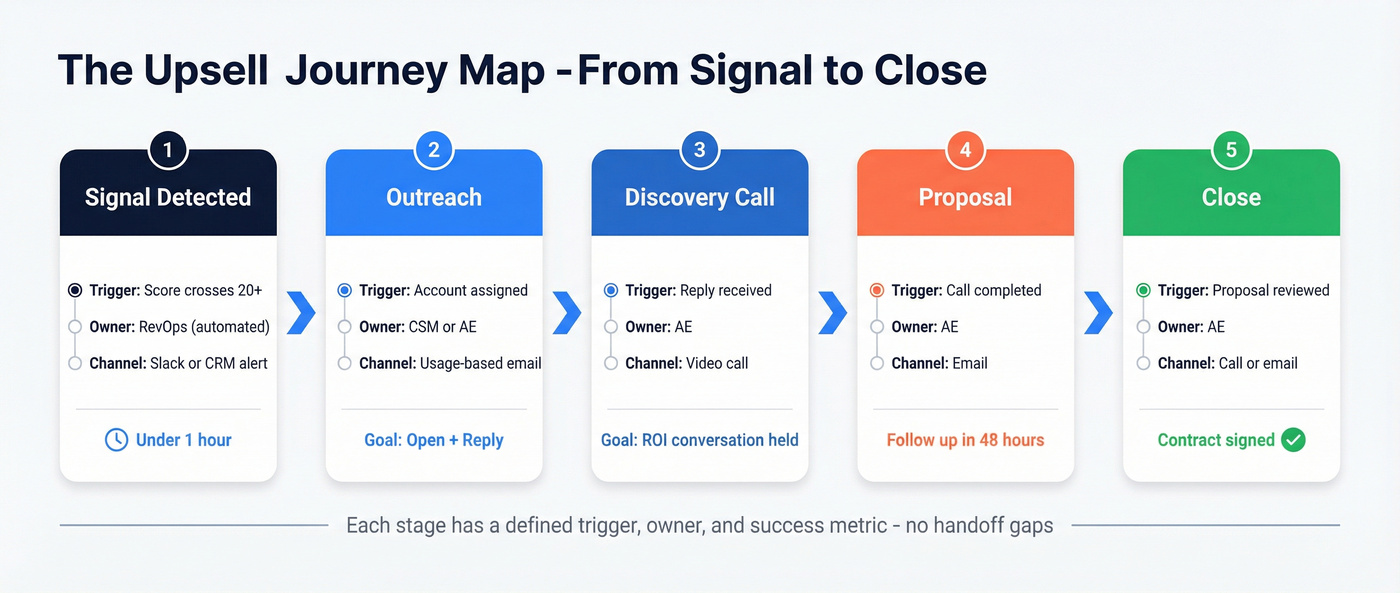
| Stage | Trigger | Owner | Message | Offer | Channel | Success Metric | Next Step |
|---|---|---|---|---|---|---|---|
| Signal detected | Score crosses 20+ | RevOps (automated) | Internal alert | - | Slack/CRM | Alert delivered <1hr | Route to owner |
| Outreach | Account assigned | CSM or AE | Usage-based email | Tier upgrade | Open + reply | Schedule call | |
| Discovery call | Reply received | AE | ROI conversation | Custom proposal | Call | Meeting held | Send proposal |
| Proposal | Call completed | AE | Expansion quote | Upgrade + discount | Proposal opened | Follow up 48hrs | |
| Close | Proposal reviewed | AE | Negotiation | Final terms | Call/email | Contract signed | Onboard to new tier |
| Post-upgrade | Contract signed | CSM | Onboarding kickoff | - | Call | Feature adoption >50% in 30 days | QBR review |

Your scoring model flagged 40 accounts for expansion. But if 15% of your emails bounce, those upsell conversations never happen. Prospeo delivers 98% email accuracy with a 7-day refresh cycle - so your expansion outreach reaches the right stakeholder, not a dead inbox.
Stop losing upsell revenue to bad contact data.
When Expansion Offers Convert Best
Timing is the difference between an upsell and an annoyance.
| When TO Upsell | When NOT to Upsell |
|---|---|
| After value delivery milestone | During active support crises |
| At usage limit proximity (85%+) | Right after a price increase |
| During scheduled QBRs | With at-risk or churning accounts |
| Within 48 hrs post-purchase (ecom) | Mid-checkout (interrupts flow) |
| At add-to-cart moment (ecom) | When NPS is declining |
One insight from Reddit that keeps proving true: ecommerce upsells perform better at add-to-cart than at checkout. Checkout interruption kills conversion. The customer has already committed mentally at ATC - that's when they're most receptive to "want the premium version instead?"
For B2B, the anti-patterns are worth memorizing. Never upsell during a support crisis, never after a price increase, and never with accounts showing churn signals. We've seen teams blast expansion campaigns to their entire install base - including accounts with open P1 tickets. Don't be that team.
The 7-Step Operating Loop
- Ingest signals - pipe product usage, support tickets, and CRM data into your scoring model nightly.
- Score and tier - run the scoring formula; auto-tag accounts as High / Medium / Low.
- Route to owner - High-priority accounts go to the assigned CSM or AE via Slack or CRM task within one hour.
- Choose the offer - match the dominant signal to the right upsell (capacity upgrade, seat expansion, feature tier).
- Send trigger email - fire the relevant template (see next section). Verify the contact is still at the company first. Stale data kills expansion sequences more often than bad copy.
- Follow-up task - if no reply in 48 hours, create a call task. If no engagement after two touches, move to nurture.
- Log outcome and recalibrate - record win/loss reason. Review weights quarterly and adjust based on which signals actually predicted conversions.
Email Templates That Convert
The best upsell emails are trigger-based, not batch-and-blast. They fire when a specific behavior occurs, which means the offer feels relevant rather than random.
Template 1: Usage Limit Hit
Subject: You're at 90% of your [plan feature] limit
Reference the specific metric ("You've used 4,500 of your 5,000 API calls this month"), explain what happens at the limit, and present the upgrade as continuity - not a sales pitch. One CTA button.
Template 2: Milestone Reached
Subject: [Name], you just hit [milestone] - here's what's next
Celebrate the achievement, then connect the next tier to their demonstrated trajectory. Zapier does this brilliantly - their emails include personalized usage metrics like "You've automated 229 tasks" and recommend a plan based on actual activity.
Template 3: New Team Member Added
Subject: [Company] is growing - make sure your plan keeps up
Reference the new user, highlight collaboration features only available on higher tiers, and offer a team-plan comparison.
Objection-Handling Talk Tracks
Even warm upsell conversations hit resistance. Here are the three objections we hear most, with responses that work:
"We don't have the budget right now."
Reframe around cost of inaction: "You're currently at 92% of your API limit. If you hit the cap, your team loses access for the rest of the billing cycle. The upgrade is $X/month - less than the productivity cost of one day of downtime."
"We're not using all the features we already have."
Pivot to adoption support: "That's fair. Let's schedule a 20-minute session to unlock the features your team hasn't explored yet. If after that you're still not seeing value, we'll revisit." This builds trust and often reveals the real upsell - they need training, not a cheaper plan.
"I need to get approval from [someone else]."
Arm your champion: "Totally understand. I'll send you a one-page ROI summary you can forward - it shows the usage data and projected savings. Want me to include anything specific for [approver's name]?"
Step zero before any expansion email goes out: verify the recipient still works at the company. Tools like Prospeo can enrich records and verify emails so your outreach actually reaches the right inbox instead of bouncing into the void.
If you want a deeper framework for scoring and routing these signals, start with lead scoring and adapt it to expansion.
Case Studies with Real Numbers
Foria (Ecommerce - Pre-Purchase Upsells)
Foria added pre-purchase upsell offers and went from $0 to $21,370 in upsell revenue in the first month. That run rate sustained at $10,000-$20,000/month for 12 consecutive months. They then added a buy-one-get-one post-purchase offer that lifted post-purchase conversion by 16%. The result: 90X ROI on their upsell investment, with cumulative upsell revenue approaching $1 million.
What to copy: The opportunity signal was pre-purchase intent. The trigger was the cart/checkout moment. Offer type was bundle/BOGO. The metric that mattered was revenue per visitor.
Restaurant Voice AI (AOV Lift Across 12 Locations)
A 90-day analysis across 12 restaurants using AI-powered upselling during phone orders showed consistent AOV lifts:
| Restaurant Type | Before | After | Lift |
|---|---|---|---|
| Quick service | $12.50 | $15.25 | +22% |
| Fast casual | $18.75 | $22.10 | +18% |
| Full service | $28.40 | $32.85 | +16% |
| Average | $19.88 | $23.40 | +18.7% |
The average $3.52 per-order lift translated to $3,000-$18,000/month per location. These aren't theoretical projections - they're measured over 90 days with a clear before-and-after.
What to copy: The opportunity signal was order placement (high intent). The trigger was the phone interaction. Offer type was item-level upgrade ("make it a large"). The metric that mattered was AOV lift per transaction.
How to Measure Expansion Revenue
A scoring model without measurement is just a spreadsheet that makes you feel productive. Track these metrics weekly.
Expansion MRR is the north star - net new recurring revenue from existing customers, excluding new logos. If this number isn't climbing month over month, nothing else matters.
Attach rate measures the percentage of eligible accounts that accept an upsell offer. Below 10% means your targeting or timing is off. Above 20% means your scoring model is working. Track attach rate separately for upsell and cross-sell so you can diagnose which motion needs attention.
Upgrade rate tracks how many accounts move to a higher tier within a given period. Pair this with downgrade rate to get the net picture - if upgrades and downgrades are roughly equal, you're churning expansion revenue as fast as you create it.
Upsell cycle time measures days from signal detection to closed upgrade. Shorter is better, but watch for quality: if you're closing fast but seeing high downgrade rates 90 days later, you're pushing upgrades on accounts that weren't ready.
Cohort expansion revenue is the most revealing metric. Group customers by signup quarter and track how much each cohort's revenue grows over 6, 12, and 18 months. Healthy SaaS businesses see 110-130% net dollar retention; if your cohorts are flat or declining, your expansion program isn't compensating for churn.
Every Monday, pull expansion MRR, attach rate, and pipeline by tier. Flag any High-priority accounts that have been in pipeline for more than 14 days without movement. Quarterly, review scoring weights against actual conversion data and adjust.
If you’re building a measurement cadence, it helps to pair expansion reporting with pipeline health so you can spot stuck deals early.
Common Mistakes That Kill Conversions
1. Too many options. Limit upsell suggestions to 2-3 choices max. Choice overload doesn't just reduce conversion - it increases cart abandonment. On r/ecommerce, a Shopify store owner reported that adding more options at checkout made things worse, not better.
2. Breaking the 25% rule. For ecommerce order bumps and simple upgrades, keep the upsell price within ~25% of the original purchase. Push beyond that and the mental math shifts from "upgrade" to "entirely different purchase decision." In SaaS, price jumps can be larger - enterprise upgrades routinely exceed 25% - but you need to anchor on ROI and usage limits rather than sticker price.
3. Skipping A/B tests. Every upsell offer - the copy, the placement, the discount structure - should be tested. The Foria case study above? They split-tested their way to a 16% conversion lift on post-purchase offers. Without testing, you're guessing.
4. Wrong timing. Interrupting checkout with upsell popups is the fastest way to tank conversion. Present offers at add-to-cart or post-purchase - never mid-payment flow.
5. Ignoring data quality. This is the silent killer. Your scoring model identified 200 high-potential accounts, but if 30% of contact data is outdated, expansion emails bounce and the entire scoring effort was wasted. In our experience, stale contacts kill expansion sequences more often than bad copy does. Prospeo's CRM enrichment returns verified data on a 7-day refresh cycle at ~$0.01 per email - 83% of records come back with contact data, and found emails verify at 98% accuracy. If you’re evaluating vendors, compare options in our guide to data enrichment services.
6. Treating upsell and cross-sell identically. An upgrade conversation centers on depth - more capacity, more features within the same product. A cross-sell conversation centers on breadth - solving an adjacent problem. Conflating the two leads to confused offers and lower conversion across both motions. If you need a clean breakdown, see cross selling vs upselling.

Upsell timing depends on reaching decision-makers fast - before the buying window closes. Prospeo gives you 125M+ verified mobile numbers with a 30% pickup rate and 30+ filters to pinpoint accounts showing growth signals like headcount expansion and new funding.
Turn expansion signals into booked meetings at $0.01 per email.
FAQ
What's the average upsell conversion rate?
Overall upsell conversion rates run 15-30%. SaaS upsells average ~27.6%, physical products ~18.7%, and order bumps lead at 37-38%. Desktop converts at 28-30% vs. mobile at 18-20%. If you're below 15%, fix your timing or targeting before optimizing the offer itself.
When's the best time to upsell a customer?
After they've experienced measurable value - not during checkout or support crises. For ecommerce, the add-to-cart moment outperforms checkout interruption. For B2B, QBRs and usage-limit proximity (85%+) are the highest-converting windows. The worst times: right after a price increase, during an open support ticket, or with accounts showing churn signals.
How do you identify which customers to upsell?
Build a weighted scoring model using feature adoption, engagement frequency, and time decay. Prioritize accounts with high product usage but low spend relative to peers - that's your share-of-wallet gap. Cross-analyze NPS with account size to find the "happy but under-monetized" segment. Before outreach, verify contact data so expansion emails actually reach decision-makers.
What's the difference between upselling and cross-selling?
Upselling moves a customer to a higher tier of the same product - more storage, more seats, premium features. Cross-selling introduces a complementary product that solves a different problem. Upsells typically convert at 15-30%, while cross-sells convert at 5-15%. The best revenue teams run both motions in parallel using a shared scoring model but separate playbooks.
How should CS teams handle upsell conversations?
Customer success teams should lead with value, not quota. When a CSM spots expansion signals - usage limits, new team members, feature requests - they should frame the conversation around solving the customer's emerging problem rather than pitching a higher price. Arm CSMs with scoring data and ROI talk tracks so the conversation feels consultative, not transactional.