


Best Valona Intelligence Alternatives (With Real Pricing)
Valona Intelligence earned a Leader spot in The Forrester Wave for Market and Competitive Intelligence Platforms in Q4 2024, pulling highest possible scores for AI capabilities and global reach. It monitors 200,000+ sources in 115+ languages across 150 countries. Serious platform for serious enterprises.
But here's the problem: when you go looking for peer validation, you find a 4.3/5 on G2 based on 5 reviews and a 4.6/5 on Gartner Peer Insights from 12 ratings. That's not enough signal to justify a six-figure commitment. Running a bake-off against alternatives isn't just smart - it's the responsible move before signing anything.
Why Teams Switch From Valona
Valona scores a 4.6/5 on Gartner Peer Insights from 12 ratings, and the people who like it genuinely like it - SSO accessibility, easy distribution of competitor intel, flexible consumption. But the dislikes keep surfacing in the same areas.
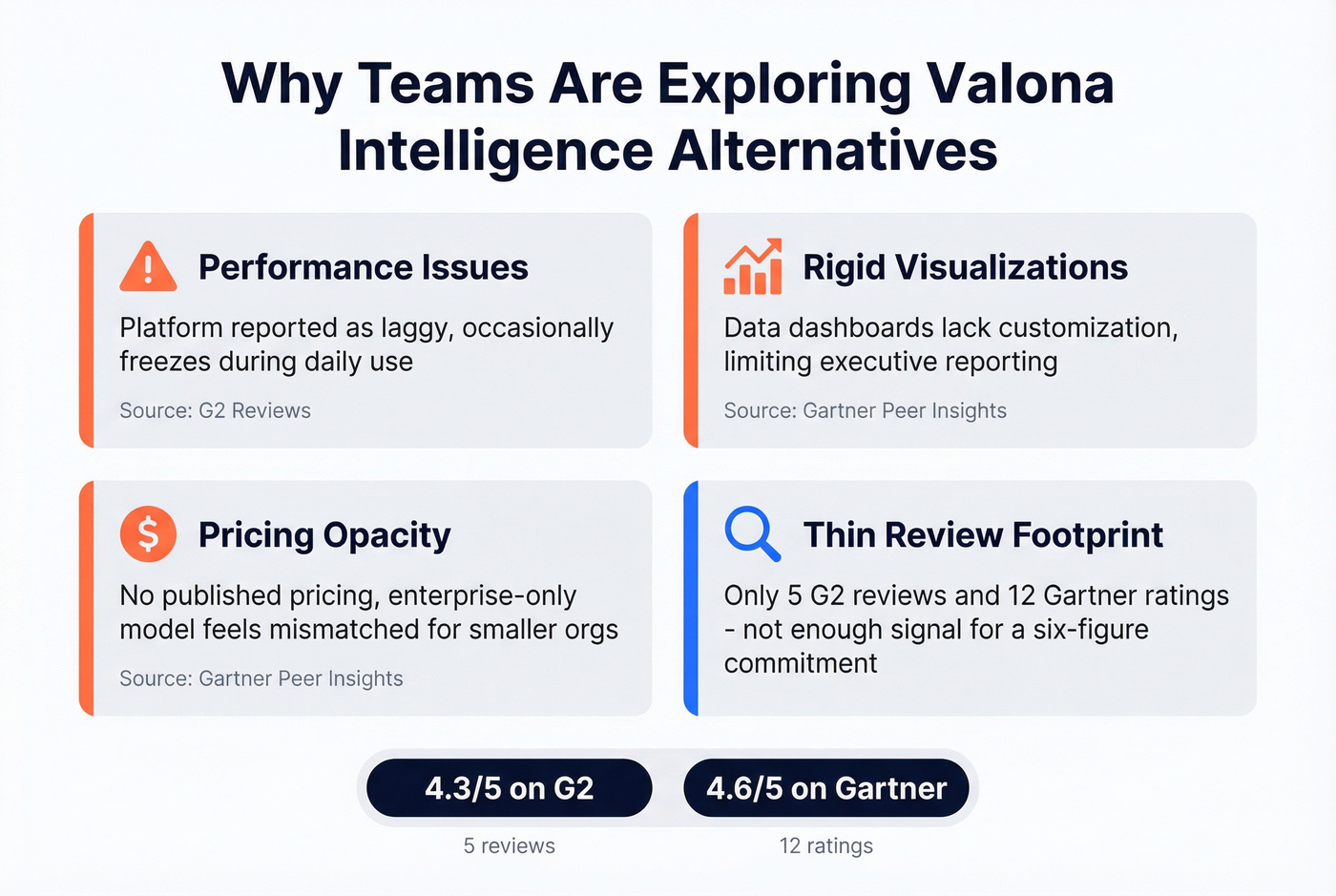
Performance issues. G2 reviewers report the platform is "laggy at times" and "occasionally freezes during use." For a tool you're supposed to live in daily, that's a dealbreaker for some teams. Visualization rigidity is another recurring theme - Gartner reviewers flag that data visualizations lack customization, which means if your leadership team wants tailored dashboards, you'll hit walls fast. The workflow for managing saved searches also gets called out as clunky. Not fatal, but a daily friction point that adds up.
And then there's pricing opacity. At least one Gartner reviewer explicitly called out cost. Valona doesn't publish pricing, and for smaller orgs, the tailored enterprise model feels mismatched.
The thin review footprint is the real trigger, though. When you can't find enough independent validation, exploring alternatives becomes table stakes.
Our Picks (TL;DR)
| Use Case | Pick | Why |
|---|---|---|
| Best overall CI alternative | Crayon | Deepest tracking, strong integrations |
| Best for sales enablement | Klue | Battlecards and win-loss built in |
| Best for acting on intel | Prospeo | Verified emails + phones from CI signals |
| Best for strategic research | AlphaSense | Financial intel and expert calls |
| Best for mid-market budgets | Contify | Strong G2 scores, fast ROI |
Feature Comparison
| Capability | Crayon | Klue | AlphaSense | Contify | Kompyte |
|---|---|---|---|---|---|
| Battlecards | ✅ (add-on) | ✅ (core) | ❌ | ✅ | ✅ |
| Expert Calls / Interviews | ❌ | ❌ | ✅ (240K+) | ❌ | ❌ |
| Source coverage | Strong | Moderate | 10,000+ sources | 1M+ sources, 117+ languages | Moderate |
| AI summarization | ✅ (Sparks) | ✅ | ✅ | ✅ | Basic |
| Workflow integrations | Salesforce, MS Teams | Salesforce, HubSpot | Limited | SharePoint, Gong, Slack, MS Teams | Salesforce |
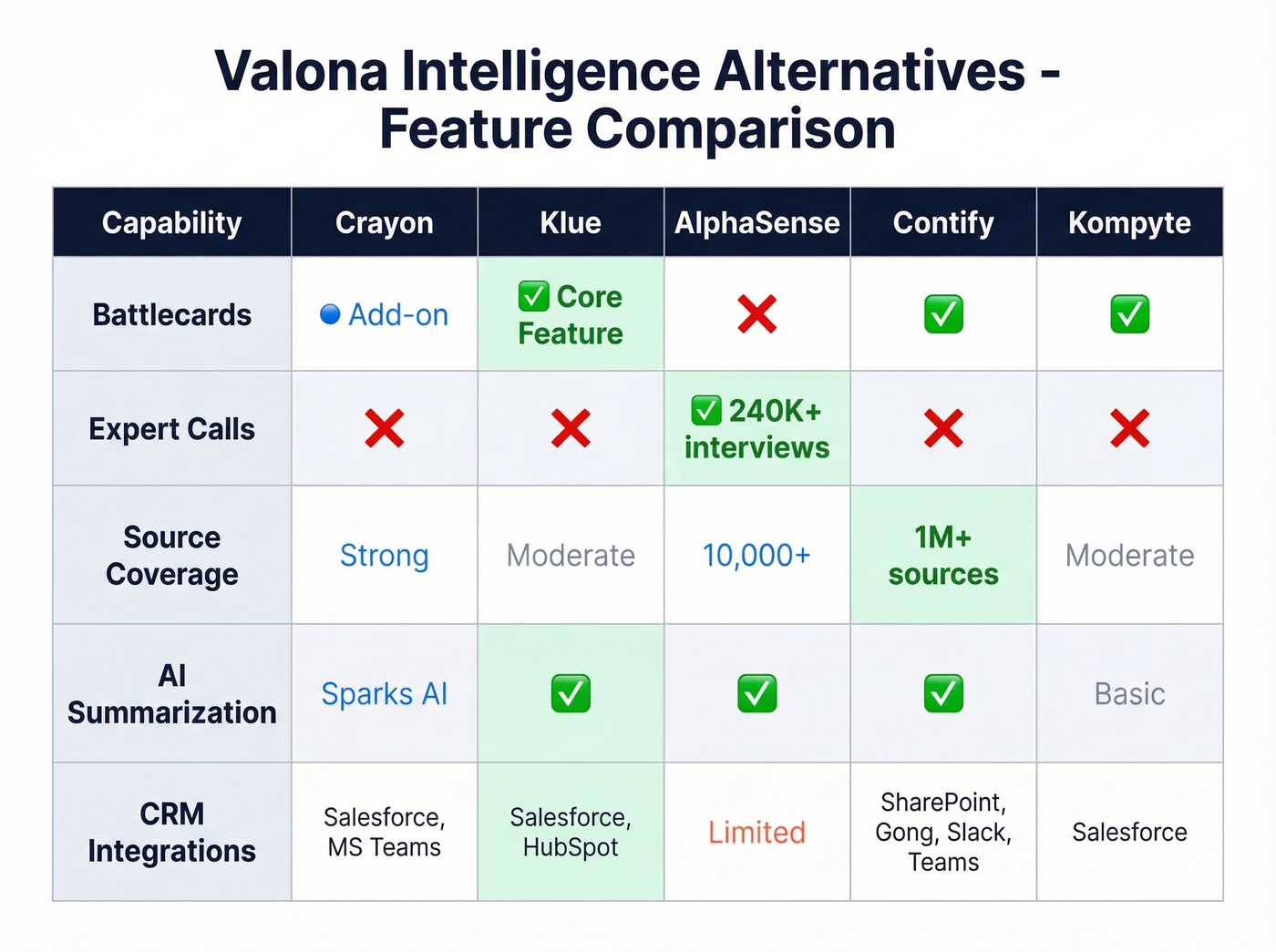
Winner by row: Klue takes battlecards. AlphaSense owns expert calls by a mile. Contify wins on source volume.

CI platforms surface the signals. Prospeo gives you the verified emails and direct dials to act on them. 300M+ profiles, 98% email accuracy, 125M+ mobile numbers - refreshed every 7 days so you're never reaching stale contacts.
Stop monitoring competitors. Start closing their customers.
Top Valona Intelligence Alternatives for 2026
Prospeo - Best for Acting on Intelligence
CI platforms tell you what's happening. Prospeo tells you who to call about it.
When your competitive intelligence surfaces a trigger - a competitor losing a key account, a target company switching tech stacks, a new funding round - you need verified contact data to act on that signal immediately, not next week. Prospeo's B2B database covers 300M+ professional profiles with 98% email accuracy and 125M+ verified mobile numbers delivering a 30% pickup rate. Data refreshes every 7 days, compared to the 6-week industry average, so you're not reaching out to people who changed roles last quarter.
With 30+ search filters - buyer intent powered by Bombora across 15,000 topics, technographics, job changes, headcount growth - you can pinpoint the exact decision-makers your CI flagged. The Chrome extension (40,000+ users) pulls verified emails and direct dials from any company website or professional profile in one click. CRM enrichment returns 50+ data points per contact at a 92% API match rate, feeding directly into Salesforce, HubSpot, Smartlead, Instantly, and more.
Real results back this up. Snyk's 50 AEs cut bounce rates from 35-40% to under 5% and generated 200+ new opportunities per month. Stack Optimize built from $0 to $1M ARR while maintaining 94%+ deliverability across all clients.
Pricing starts with a free tier - 75 emails and 100 Chrome extension credits per month - with paid plans running roughly $0.01 per email. No contracts, no sales calls required.
Crayon - Best Overall CI Alternative
Crayon is the most direct Valona replacement for teams focused on competitive monitoring. It tracks 100+ insight types - product updates, pricing changes, ad campaigns, hiring patterns - and surfaces them through an AI tool called Sparks. Integrations with Salesforce and Microsoft Teams mean intel flows where reps already work.
The median buyer pays $28,750/year based on 90 verified purchases, with a range of $12,450-$47,100 depending on competitors tracked, seats, and tier. Enterprise deployments push past $100k. Add-ons like battlecards and dedicated CSMs tack on another 15-30%.

Here's the thing about Crayon: the common practitioner complaint is signal-to-noise ratio. You'll get a firehose of insights, but filtering down to what actually matters takes effort. If your team has the bandwidth to curate, Crayon's depth is unmatched. Lean teams will drown in the noise. We've seen this play out repeatedly - the teams that succeed with Crayon dedicate someone to owning the filtering workflow, while teams that treat it as a set-and-forget tool end up frustrated within 90 days.
Klue - Best for Sales Enablement
Klue approaches competitive intelligence from the sales floor up. Where Crayon excels at broad monitoring, Klue's strength is turning intelligence into battlecards, win-loss analysis, and rep-ready deliverables.
Use this if your primary goal is arming reps with competitive positioning before calls. Klue's module-based packaging - Klue Access, Competitive Intelligence, and Win-Loss - lets you buy what you need. Klue Access alone has four tiers (Starter, Pro, Plus, Essentials), so there's flexibility for different team sizes and budgets.
Skip this if you need deep market monitoring beyond direct competitors. Klue is built for sales enablement first, strategic research second. Teams that buy it expecting Valona-level market scanning will be disappointed.

Pricing is negotiated and module-dependent. Expect ~$25,000-$75,000/year for a mid-market deployment. Klue integrates with Salesforce and HubSpot, and the battlecard workflow is genuinely best-in-class - the consensus on r/sales threads consistently backs this up.
AlphaSense - Best for Strategic Research
AlphaSense isn't a 1:1 Valona replacement. It's a different animal entirely.
The platform provides an out-of-the-box content library of 10,000+ sources and 240,000+ expert interviews via Tegus, making it the go-to for financial intelligence, earnings analysis, and deep strategic research. 88% of the S&P 100 use it. If you need broker research, sentiment analysis, and expert calls, AlphaSense is overkill in the best way. If you only need competitor tracking, it's overkill in the expensive way.
The median contract runs $18,375/year based on 34 purchases, with a range of $12,000-$51,000. No battlecards - this isn't a sales enablement tool. Know what you're buying before you sign.
Contify - Best for Mid-Market Budgets
Contify pulls from 1M+ vetted sources across 117+ languages and delivers a 4.5/5 on G2 from 114 reviews - dramatically more social proof than Valona's 5. G2's aggregated data shows a 2-month implementation timeline and 5-month ROI, which is fast for this category.
The platform includes battlecards, dashboards, newsletters, and an AI assistant. It integrates with SharePoint, Gong, Slack, and MS Teams for internal knowledge sharing - a real differentiator for distributed teams. A 7-day free trial lets you validate before committing. Pricing isn't public, but expect $15,000-$60,000/year depending on scope. For mid-market teams that want Valona-like capabilities without the enterprise-only pricing model, Contify is the value pick. In our experience, it's the tool that gets recommended most often by CI practitioners who've actually used multiple platforms.
Kompyte - Budget-Friendly Option
Kompyte is often one of the more affordable dedicated CI tools in the category. Three tiers based on the number of companies tracked, with pricing in the $10,000-$30,000/year range. It covers the basics - competitor tracking, battlecards, automated alerts - without the depth of Crayon or Klue. Good enough for teams tracking 5-10 competitors. Not enough for global market intelligence.
Comintelli - Niche Pick for Structured Intelligence
Comintelli targets mid-market teams that want structured intelligence workflows - taxonomy-driven organization and systematic analysis rather than AI-generated summaries. Expect $15,000-$40,000/year. It's a solid pick for teams that value process over flashy features, but the user community is small and you won't find much independent validation online.
Every Valona alternative on this list tells you what's happening in the market. None of them hand you a verified phone number for the decision-maker you need to call next. Prospeo does - at $0.01 per email with no contracts.
Turn competitive intelligence into pipeline today.
Pricing at a Glance
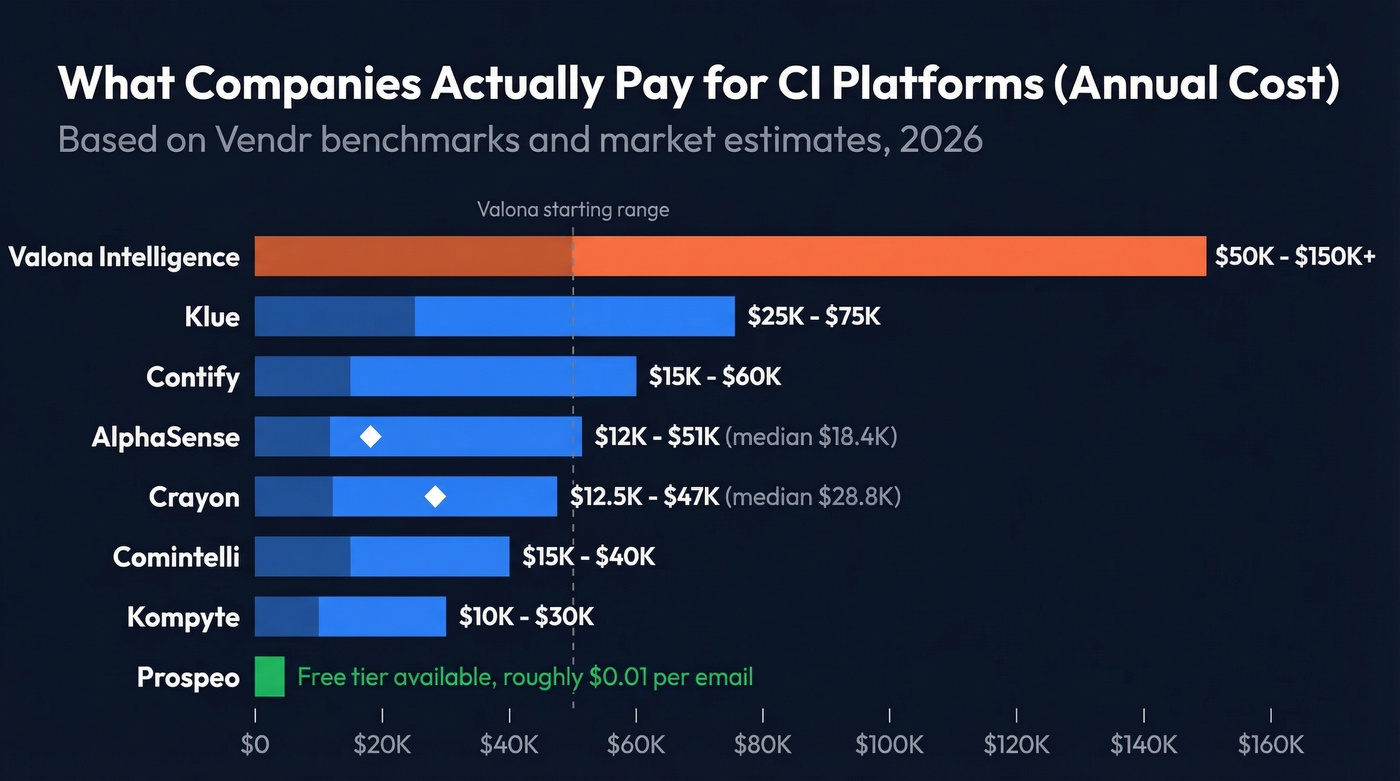
Most CI platforms don't publish pricing, which makes comparison shopping painful. Here's what companies actually pay, based on Vendr benchmarks and market estimates:
| Tool | Typical Annual Cost | Pricing Model |
|---|---|---|
| Valona Intelligence | ~$50K-$150K+ (est.) | Annual, tailored |
| Crayon | $28.8K median ($12.5K-$47K) | Quote-based, annual |
| Klue | ~$25K-$75K (est.) | Module-based, negotiated |
| AlphaSense | $18.4K median ($12K-$51K) | Quote-based, per-seat |
| Contify | ~$15K-$60K (est.) | Quote-based, tiered |
| Kompyte | ~$10K-$30K (est.) | Tiered by companies |
| Comintelli | ~$15K-$40K (est.) | Quote-based |
| Prospeo | ~$0.01/email; free tier | Self-serve, credits |
How to Choose the Right Alternative
You don't need to replace Valona with another Valona. Build a lean stack instead.

For sales enablement first, go with Klue. Battlecards and win-loss analysis are core, not bolt-ons. For broad competitive monitoring, Crayon has the deepest tracking, but budget for the noise-filtering learning curve. When the need is strategic and financial research, AlphaSense sits in a different category but overlaps with Valona's quantitative intelligence. Teams on a mid-market budget should look at Contify - fastest time-to-value with the strongest review footprint in this list.
Some teams skip the dashboard entirely. A data backbone like Veridion can feed custom intelligence workflows - 130M+ companies, 320+ attributes, weekly updates. Worth exploring if your team has engineering resources and wants full control.
Let's be honest: most teams overspend by buying one monolithic platform that does everything at 70%. A focused CI tool plus a contact data layer plus your CRM covers the full intelligence workflow - discovery, analysis, visualization, action - and usually costs less than a single enterprise suite. We've tested this stack approach with multiple teams and the results consistently beat the all-in-one play.
FAQ
Is Valona Intelligence worth the price?
Valona is a Forrester Wave Leader with genuine strengths in global monitoring across 150 countries, 115 languages, and 200,000+ sources. But with only 5 reviews on G2 and 12 Gartner ratings, it's hard to validate without running a hands-on demo. Worth it for enterprises needing broad multilingual coverage and structured distribution workflows. Not worth it if you can't get a reference customer in your industry.
Crayon or Klue - which is better?
Crayon for broad competitor monitoring and insight volume. Klue for sales enablement, battlecards, and win-loss analysis. Both are five-figure annual commitments. We've seen teams run both - Crayon for the strategy team, Klue for sales - and that split actually works well when the budget supports it.