

The Value-Based Selling Framework You Can Actually Run Tomorrow
Your pipeline is full, but nothing closes. Reps demo, propose, and get ghosted - because nobody on the buying side can justify the change internally. 40% of B2B purchase attempts end in "no decision", and a value-based selling framework is the only reliable fix.
Everything below shows you how to build one by the end of this week.
What You Need Before Anything Else
Build these three artifacts first:
- A value hypothesis per target account - one paragraph, not a deck.
- A two-sheet ROI spreadsheet - internal inputs on one tab, customer-facing one-pager on the other.
- A cost-of-inaction talk track for every active deal in your pipeline.
That's it. Don't overthink the tooling. A Google Sheet and a clear sentence beat a polished slide deck that nobody reads.
What Value-Based Selling Actually Is
Value-based selling means quantifying business impact in the buyer's language - their KPIs, their dollars, their risk. If you can't put a number on the impact, you're not doing it. You're doing consultative selling and hoping the buyer does the math themselves.
96% of buyers say seller focus on value is the #1 most influential factor in their purchase decision. That's not a soft preference. It's the single biggest lever you control.
Why Quantified Selling Matters in 2026
Only 43.5% of sales professionals hit quota as of recent benchmarks. Ebsta's data shows win rates dropped 27% versus 2021 and sales cycles stretched 38% over the same period - and those trends haven't reversed.
Meanwhile, 87% of high-growth companies use a value-based selling approach versus 45% of negative-growth companies. Teams that consistently quantify value see 5-15% win-rate improvement and 10-30% less discounting. The correlation isn't subtle.

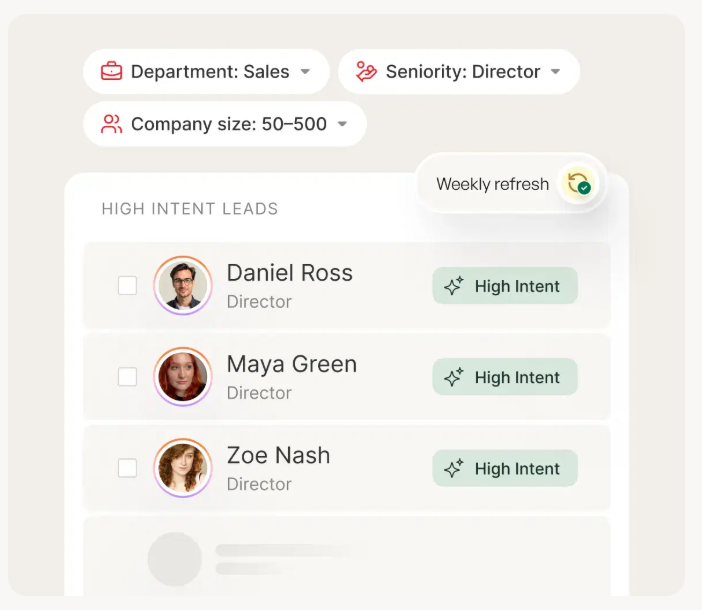
Your value hypothesis is worthless if it never reaches the economic buyer. Prospeo's 30+ search filters - including buyer intent, job change, and department headcount - let you skip gatekeepers and land directly in the inbox of the person who signs. With 98% email accuracy and a 7-day data refresh, your outreach hits real people with real budget authority.
Stop building business cases for contacts who can't approve them.
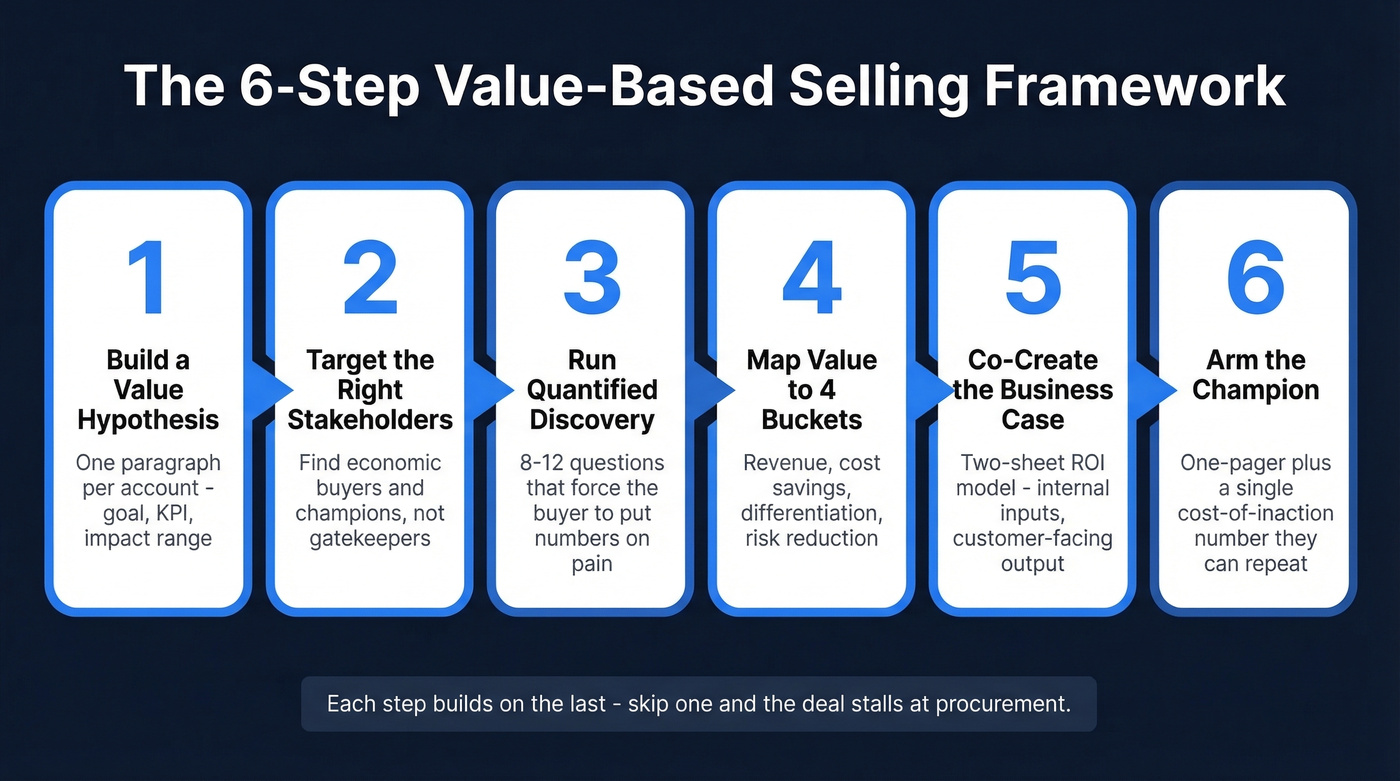
The 6-Step Framework
Step 1: Build a Value Hypothesis
Before you reach out, write one paragraph per target account. Name the buyer's goal, the KPI your solution affects, and an estimated impact range.
Template - copy and fill in the brackets:
We help [Job Title] teams [reduce/increase] [specific metric] from [current state] to [target state], which at [company's scale/headcount] [saves/generates] roughly [$X] per [time period].
Here's what that looks like in practice: "We help VP Sales teams reduce ramp time from 90 to 60 days, which at your headcount saves roughly $180K/year in unproductive comp." That's a hypothesis, not a promise - and it's infinitely better than "I'd love to show you a demo."
Step 2: Target the Right Stakeholders
Value selling fails when reps burn discovery cycles on friendly contacts who can't sign anything. You need the economic buyer and at least one champion who'll carry your business case into rooms you'll never enter.
This is where bad data kills deals before they start. We've seen teams waste entire weeks chasing bounced emails to the wrong people. A platform like Prospeo with 30+ search filters and 98% email accuracy lets you reach economic buyers directly instead of playing email roulette with gatekeepers.
Step 3: Run Discovery That Quantifies
8-12 thoughtful questions per call is the practical range. The key distinction: qualification questions confirm fit, discovery questions expose impact.
Discovery questions that force numbers:
- "What's the cost of staying as you are for another 12 months?"
- "How much does this problem cost your company - in dollars, time, or both?"
- "What happens if nothing changes by Q3?"
- "What metrics is your leadership tracking against this initiative?"
- "Who else is involved in making the final decision?"
Every question pushes the buyer to quantify. That's the difference between a discovery call and a product tour.
Step 4: Map Value to Four Buckets
Every value message falls into one of four categories. Make more money - your solution drives new revenue or expands existing accounts. Save money - you reduce headcount needs, tool costs, or operational waste. Differentiate - you give the buyer a competitive edge their rivals lack. Reduce risk - you lower compliance exposure, churn, or downtime probability.
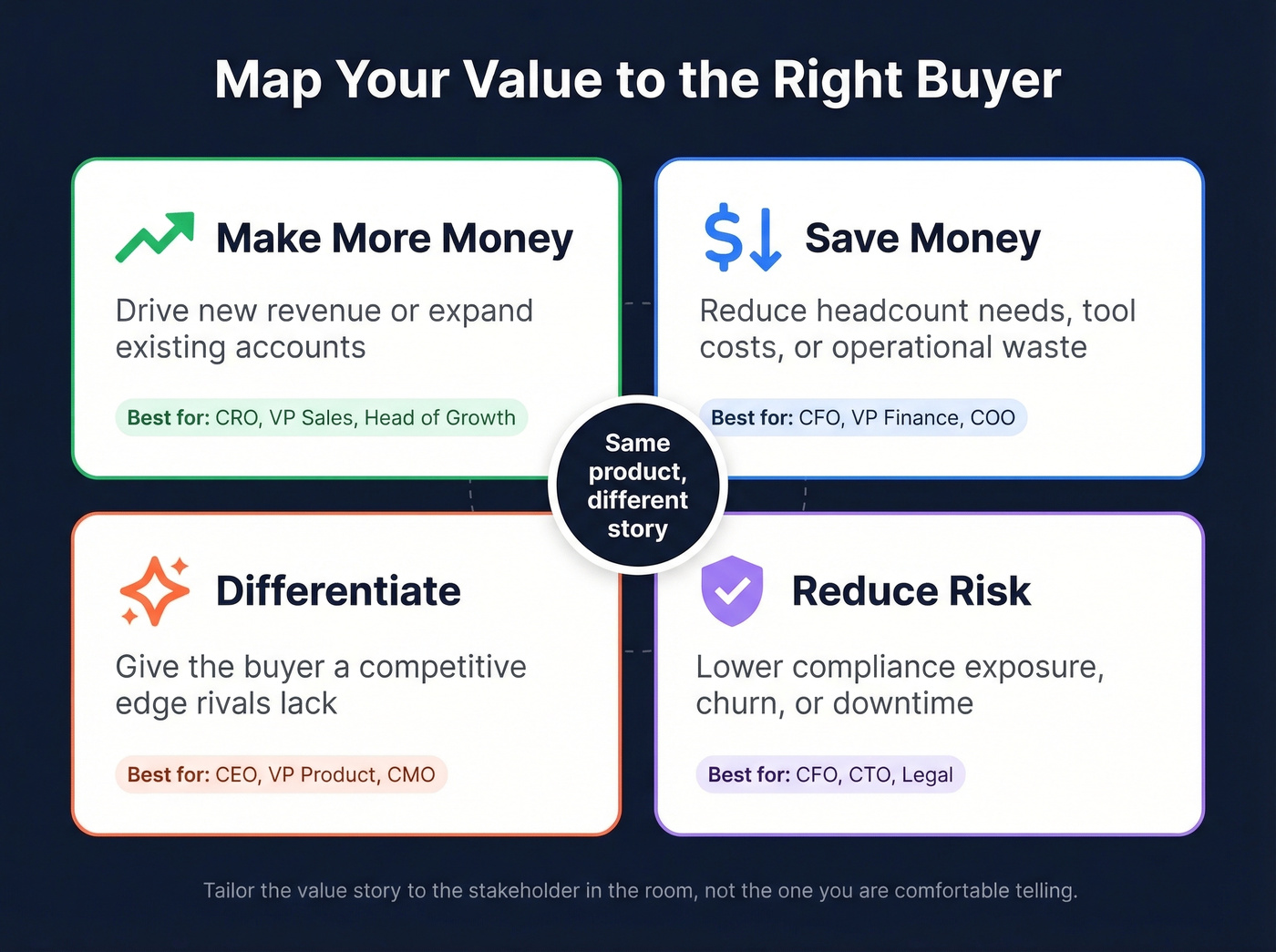
A CFO cares about cost reduction and risk. A CRO cares about revenue and differentiation. Same product, different value story. Let's be honest - most reps default to the story they're comfortable telling rather than the one the buyer needs to hear, and that mismatch is where deals stall.
Step 5: Co-Create the Business Case
If you leave the business case to the customer, it won't get built. MIT Sloan Review found that value-selling initiatives regress to discounting when the tools feel "theoretical and complex." The fix is a dead-simple two-sheet model.
ROI Calculator Structure:
| Internal Sheet (Your Inputs) | Customer-Facing Sheet (Output) |
|---|---|
| Hours saved per week | Total annual time savings |
| Fully loaded labor cost | Dollar value of time saved |
| Current error/failure rate | Risk reduction estimate |
| Operational volume | Total ROI percentage |
| Baseline conversion metrics | Payback period in months |
ROI = (Return - Price) / Price. Export the output sheet to PDF for the prospect and keep the input sheet internal. A first usable version takes 4-12 hours. Start rough and iterate after every deal - by your third or fourth cycle, the model stabilizes and updates take under an hour.
If you want a tighter call flow for this step, use a structured set of discovery questions to lock inputs before you build the spreadsheet.
Step 6: Arm the Champion
Your champion sells when you're not in the room. Give them the one-pager and a single cost-of-inaction number they can repeat in any meeting.
"Every quarter we delay costs us $47K in lost productivity" moves budget conversations. A 30-slide deck does not.
Mistakes That Kill Value Selling
Pitching before you've quantified impact. A demo without a value hypothesis is just a product tour - and product tours get price-shopped. Use a simple product demo checklist so value leads the walkthrough.
Assuming customer priorities. What you think matters and what keeps the VP up at night are rarely the same thing. Discovery exists for a reason.
Letting the customer build the business case alone. They won't. Or they'll build a weak one that dies in procurement.
Letting price lead the conversation. When a buyer pushes on price early, redirect: "Happy to discuss price - but it'll only make sense in the context of outcomes." We've watched reps lose margin simply because they answered the price question before establishing value.
Value Selling vs. SPIN, Challenger, and MEDDPICC
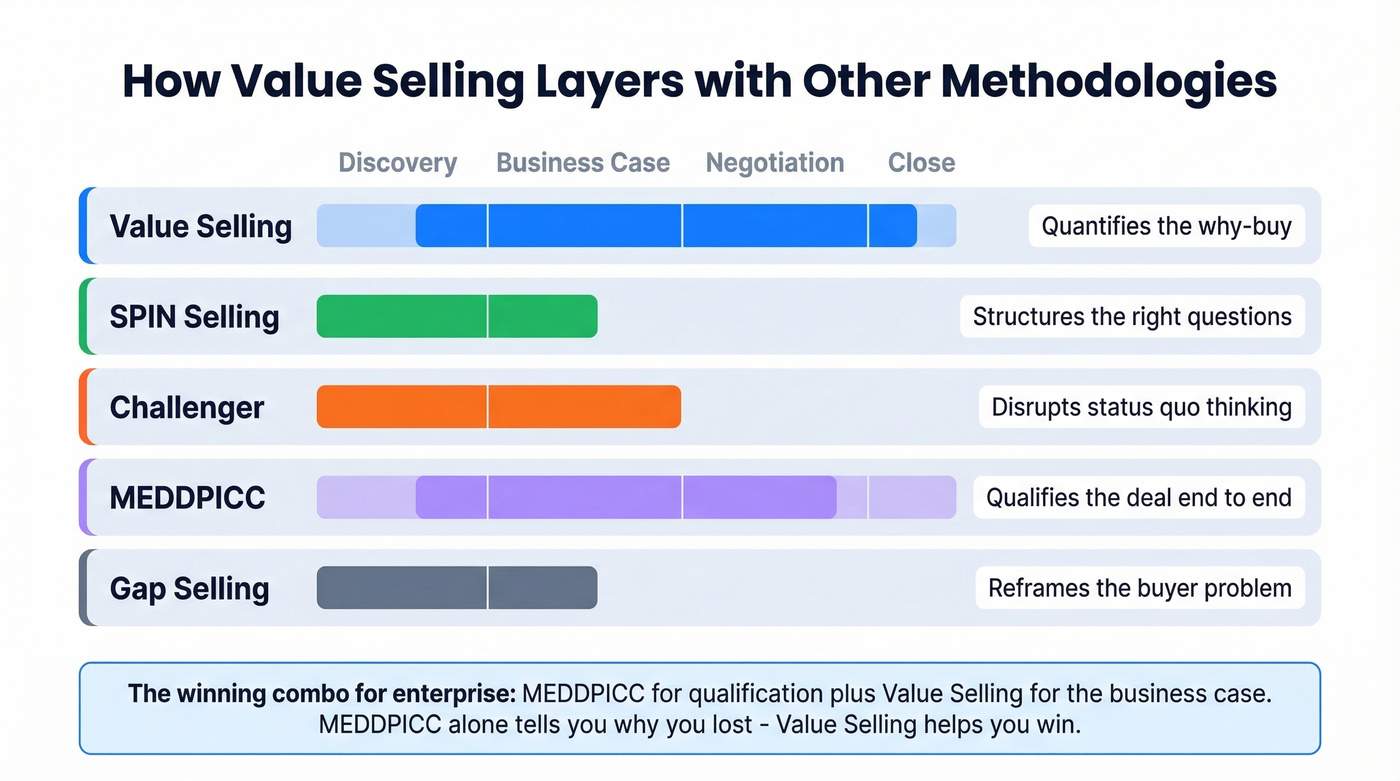
The consensus on r/sales is that no single methodology wins alone. They solve different problems and layer well together.
| Methodology | Core Focus | Best For |
|---|---|---|
| Value Selling | Quantified business case + ROI | Justifying change internally |
| SPIN | Structured questioning | Deep discovery conversations |
| Challenger | Teach-tailor-take control | Disrupting status quo thinking |
| MEDDPICC | Deal qualification | Complex enterprise sales |
| Gap Selling | Current-to-future state gap | Reframing buyer's problem |
Here's the thing: MEDDPICC without a value-selling layer is just expensive deal hygiene. You'll know exactly why you lost the deal, but you'll still lose it. Run MEDDPICC for qualification and a value-based selling framework for the business case - the combination is stronger than either alone. (If you need the qualification layer, start with MEDDIC sales qualification.)
Proof It Works
Named results from companies using structured value-selling frameworks, as reported by ValueSelling Associates:
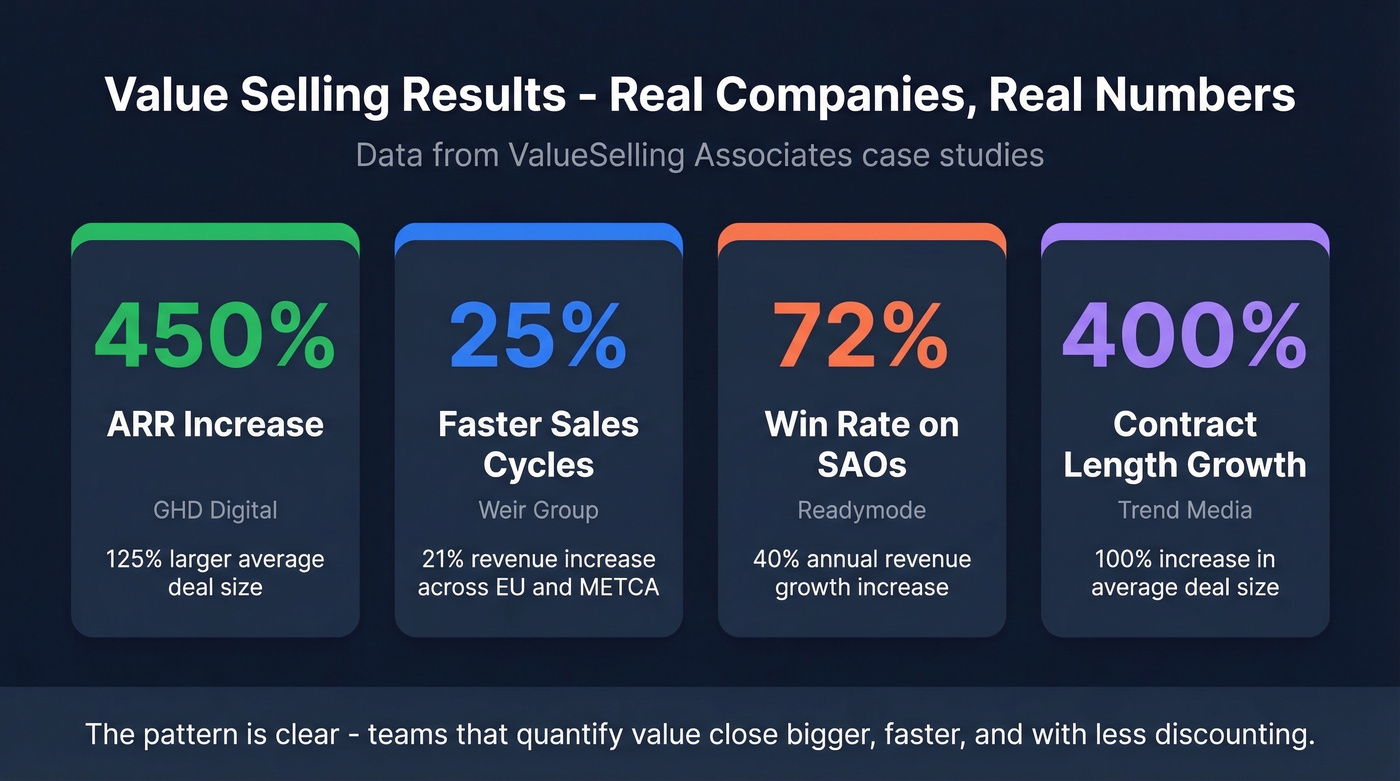
- GHD Digital: 450% increase in ARR over two years; 125% increase in average deal size.
- Weir Group: 25% faster sales cycles, 21% revenue increase across European and METCA teams.
- Readymode: 40% increase in annual revenue growth, 72% win rate on sales-accepted opportunities.
- Trend Media: 400% growth in average contract length, 100% increase in average deal size.
The pattern is consistent: teams that systematically quantify value close bigger, faster, and with less discounting. Skip this approach if you're selling low-ACV products where the buying process is a single credit card swipe - the ROI on building business cases doesn't justify itself below roughly $5K ACV. If you're selling complex deals, this is standard enterprise B2B sales hygiene.
Step 2 of this framework only works with accurate contact data. Teams using Prospeo book 26% more meetings than ZoomInfo users and 35% more than Apollo - because 98% verified emails and 125M+ direct dials mean your quantified value pitch actually gets delivered. At $0.01 per email, bad data is no longer an excuse for stalled deals.
Deliver your ROI story to the right person on the first try.
FAQ
How long does it take to build an ROI calculator?
A first usable spreadsheet takes 4-12 hours. Start with two sheets - internal inputs and a customer-facing one-pager - then iterate after each deal. By your third or fourth cycle, the model stabilizes and updates take under an hour.
Can value selling work alongside MEDDPICC or SPIN?
Yes. Value selling is a quantification layer, not a replacement. Use SPIN for discovery structure, MEDDPICC for deal qualification, and value selling to build the business case that closes the deal. Most high-performing enterprise teams run at least two in tandem.
What's the fastest way to find economic buyers for a value conversation?
Use a B2B data platform to filter by job title, buyer intent signals, and company growth indicators, then verify emails before outreach. The goal is spending discovery time on decision-makers instead of chasing bounced messages to people who can't sign off on anything.