

How to Verify an Existing Email Address Without Sending a Single Message
An SDR sends 200 cold emails on Monday morning. By Tuesday, 30 have bounced. Domain reputation takes a hit, open rates crater across the board, and the next campaign lands in spam before it gets a chance.
That's the cost of skipping verification. And sending a "test email" to check addresses is just as dangerous - bounces and spam complaints compound fast, torching your sender score in ways that take weeks to recover from.
If you need to verify an existing email address, there's a better path than gambling your domain. Here's how verification actually works under the hood, why tools sometimes can't give you a straight answer, and which verifiers are worth paying for in 2026.
What You Need (Quick Version)
- Spot-checking a few addresses? Use a free single-email verifier. Hunter gives you 100 verifications/month; Email Hippo offers 100 checks/day.
- Cleaning an existing list? Use a bulk verifier like ZeroBounce, NeverBounce, or Bouncer. Expect to pay roughly $7-10 per 1,000 emails on pay-as-you-go credits.
How Email Verification Works (Step by Step)
Every verification tool runs some version of the same five-step pipeline. Understanding it helps you interpret results, especially when a tool returns "unknown" instead of a clean pass/fail.
If you're building a full outbound stack, it also helps to compare where verification sits among other SDR tools and outbound lead generation tools.
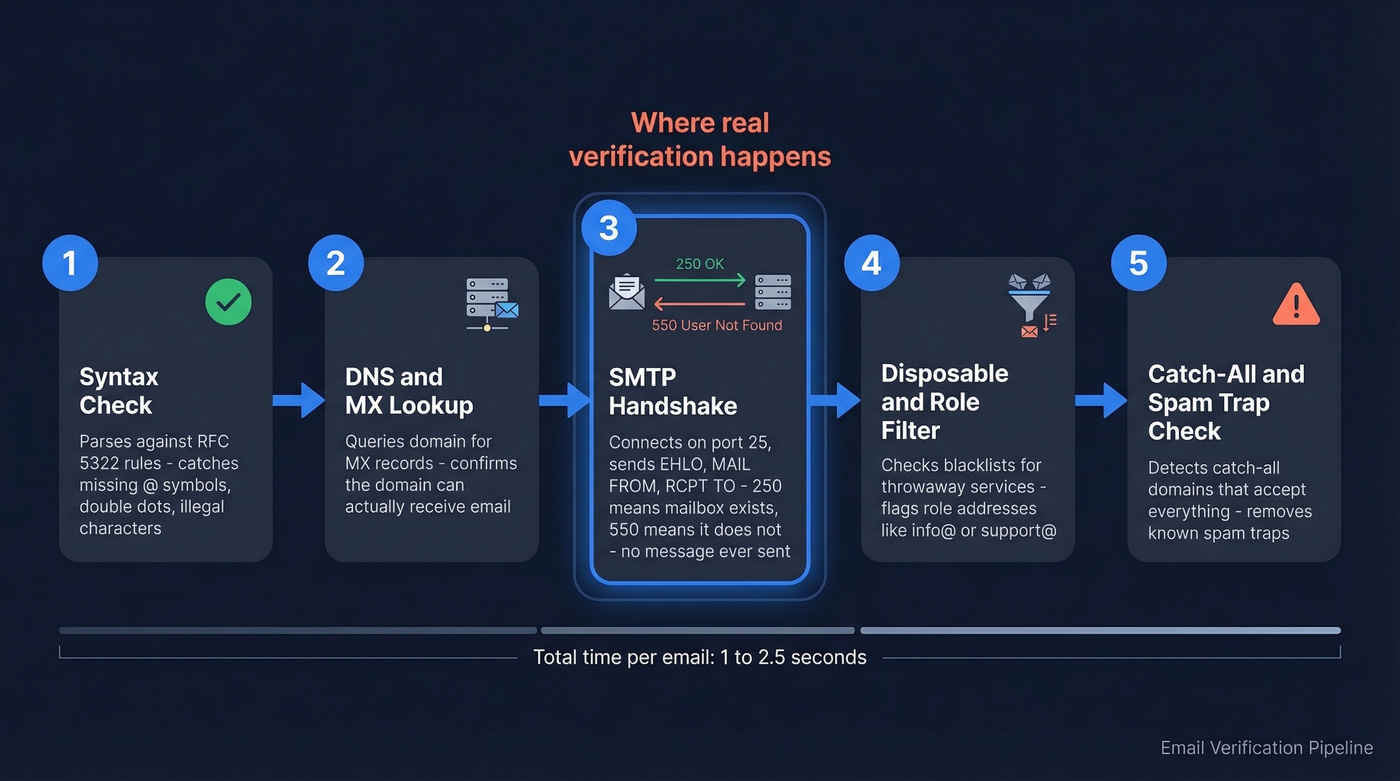
Step 1: Syntax check. The tool parses the address against RFC 5322 formatting rules. Missing @ symbol, double dots, illegal characters - caught instantly.
Step 2: DNS and MX lookup. The tool queries DNS for MX records on the domain. If example.com has no MX records, it can't receive email. This is distinct from a simple A/AAAA lookup; MX records specifically indicate mail reception capability.
Step 3: SMTP handshake. This is where real verification happens. The tool connects to the mail server on port 25 and initiates a partial SMTP conversation: EHLO then MAIL FROM then RCPT TO. A 250 response means the mailbox likely exists. A 550 means it doesn't. The tool sends QUIT and no message is ever delivered. The whole exchange takes 1-2.5 seconds.
Step 4: Disposable and role-based filtering. The address gets checked against blacklists of known disposable email services and flagged if it's a role-based address like info@ or support@ - addresses that rarely belong to a real decision-maker.
Step 5: Catch-all handling and spam-trap removal. The hardest step, and where tools diverge most in quality. Catch-all domains accept mail for any address, so the SMTP handshake always returns 250 - even for completely fabricated mailboxes.
You can also run DNS and MX checks yourself using nslookup, dig, or MXToolbox. But manual checks only cover steps 1-2. For the full pipeline - SMTP probing, disposable filtering, catch-all handling - you need a dedicated verification tool.
If you're trying to reduce bounces specifically (not just "validity"), use bounce-rate benchmarks and fixes from our email bounce rate guide, and pair it with a broader email deliverability guide so verification isn't your only line of defense.

Catch-all domains, stale records, and greylisting make verification unreliable - unless your data is fresh. Prospeo's 5-step verification with catch-all handling and 7-day refresh cycle catches what other tools miss. 75 free emails/month, no credit card.
Verify emails that were actually checked this week, not last month.
Why Tools Return "Unknown"
Here's the thing: about 30-40% of B2B email addresses sit on Catch-all domains. That number skews even higher in enterprise environments running Microsoft 365, Google Workspace, or secure email gateways like Proofpoint, Mimecast, and Barracuda.
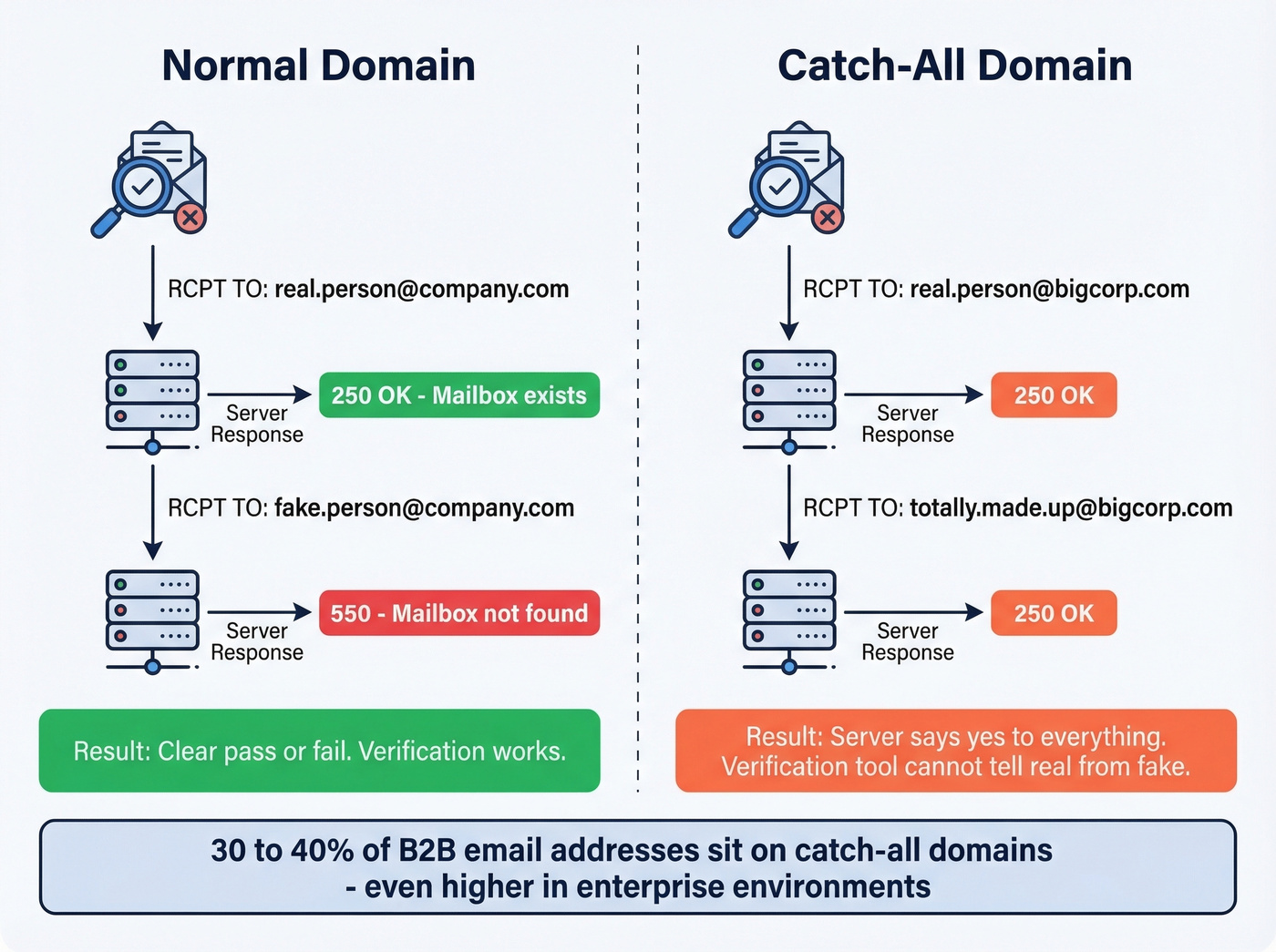
When a domain is configured as catch-all, the mail server accepts email for any local-part. Send to totally.fake.person@bigcorp.com and the server says 250 - sure, come on in. The verification tool has no way to distinguish a real inbox from a fabricated one using SMTP alone.
Even when an address technically "passes" verification on a catch-all domain, you can still hit late bounces, silent drops, deferred bounces, and sinkhole filtering. Deferred bounces start as temporary 4xx errors, then fail permanently - the server accepted the message during the SMTP handshake, then quietly discarded it afterward. In our testing, enterprise domains with Proofpoint gateways returned "unknown" for over half the addresses we checked.
Secure email gateways greylist verification probes, rate-limit connections, or reject them outright. The skepticism on r/coldemail about vendors claiming to "bypass email firewalls" is well-founded. No tool fully solves this.
What Verification Can't Guarantee
Let's be honest about the numbers. Most tools advertise 98-99%+ accuracy. None can prove it independently - no true third-party benchmark with auditable methodology exists in 2026. Those figures are self-reported and measured against non-catch-all domains where SMTP verification is straightforward.
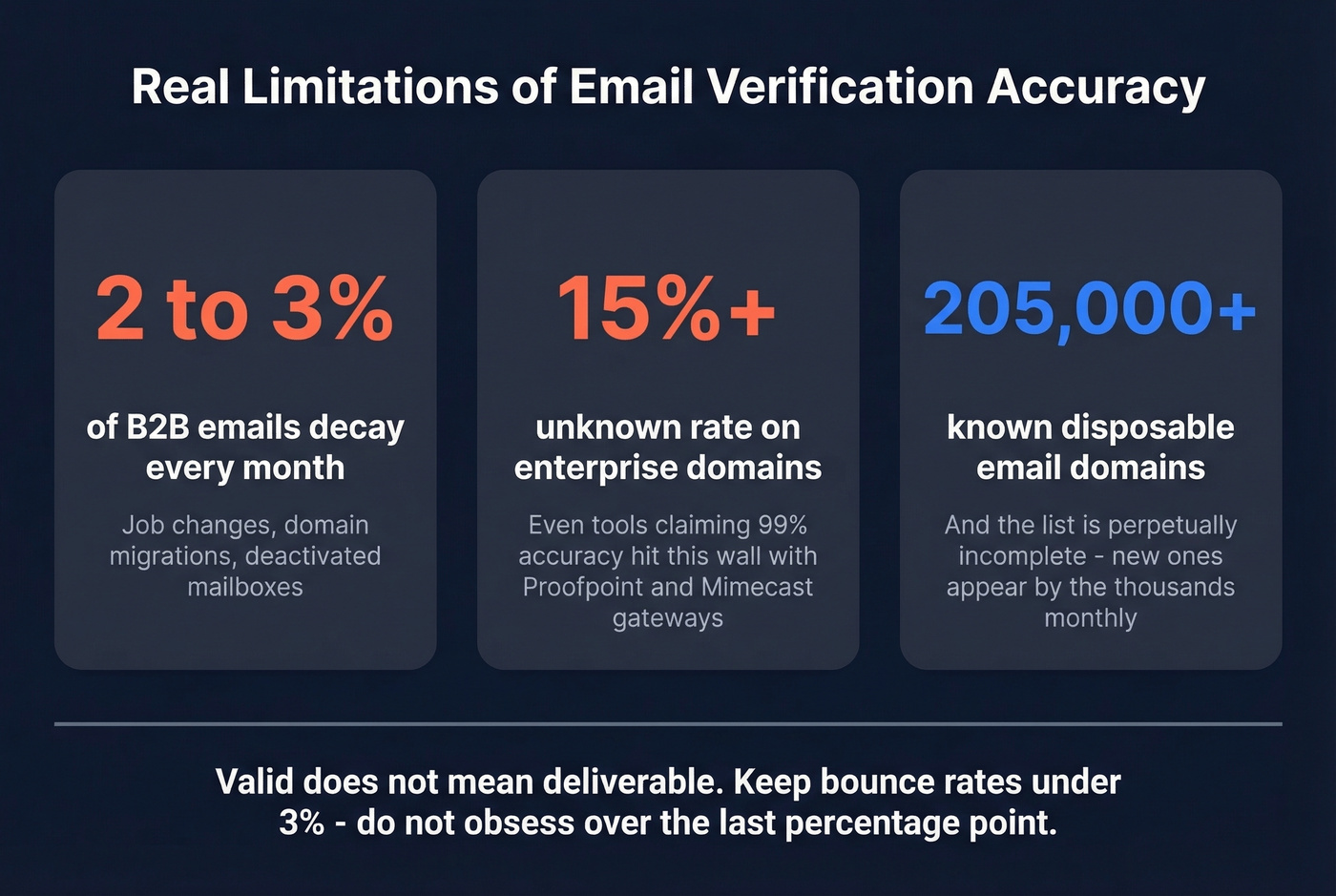
We've seen tools that claim 99% accuracy still produce 15%+ unknown rates on enterprise domains. Take the claims directionally, not literally.
Disposable email detection has similar blind spots. Blacklists cover only 60-80% of active disposable services, and new domains appear by the thousands every month. One open-source project tracks over 205,000 known disposable domains, and that list is perpetually incomplete.
Skip self-hosted verification unless you have a dedicated email infrastructure team. You'll hit the same catch-all and blacklist limitations as any SaaS tool, plus you'll burn engineering hours maintaining SMTP connections and IP reputation.
Look, "valid" doesn't mean "deliverable." If you're running deals under $15k, you probably don't need 99.9% verification accuracy - you need a tool that handles catch-alls well enough to keep your bounce rate under 3%. Obsessing over the last percentage point costs more than the occasional bounce.
If you're also tightening authentication to protect deliverability, see DMARC alignment and SPF record examples.
Verification Tools Compared
| Tool | Free Tier | PAYG Price | Best For |
|---|---|---|---|
| Prospeo | 75 emails/mo | ~$0.01/email | Find + verify in one step |
| Hunter | 100/mo | Plans from ~$49/mo | Quick single-email checks |
| ZeroBounce | 100 free credits/mo | ~$20 per 2,000 | Bulk cleaning + analytics |
| Bouncer | None | ~$7 per 1,000 | Budget bulk verification |
| NeverBounce | None | ~$8 per 1,000 | High-volume + integrations |
| Email Hippo | 100 checks/day | Not public | Free daily spot checks |
| Verifalia | Free single-email checker | ~$15.80 per 2,000 | API-first workflows |
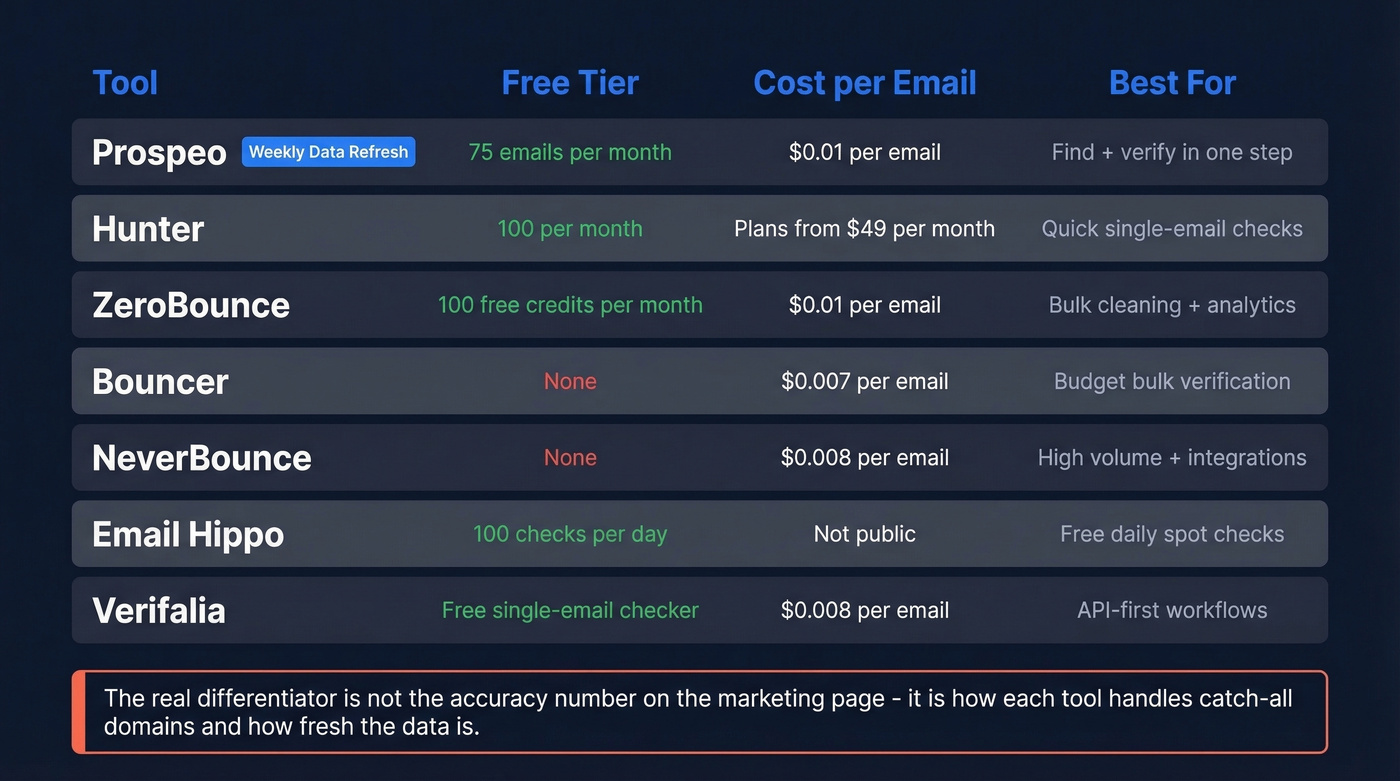
The real differentiator isn't the accuracy number on the marketing page. It's how each tool handles catch-all domains and how fresh the underlying data is. Prospeo refreshes records on a 7-day cycle; most competitors update every 4-6 weeks. Weekly refresh generally beats month-old records, even if both tools claim the same accuracy rate.
One scenario we see constantly: an outbound agency cleans a list with a bulk verifier, loads it into a sequencer, and still gets 5-8% bounces because the list was verified against stale data. The addresses were valid three weeks ago. They aren't anymore. B2B emails decay at roughly 2-3% per month from job changes, domain migrations, and deactivated mailboxes alone. Freshness matters more than most teams realize.
If you're choosing between vendors, start with a shortlist like our Bouncer alternatives and Hunter alternatives, then map the winner into your broader sales prospecting techniques.
Why verify after the fact? Prospeo finds and verifies in a single step - 98% email accuracy, spam-trap removal, and catch-all handling built in. At $0.01 per email, one bounced campaign costs more than a month of verified data.
Skip the cleanup. Get verified emails from the start.
FAQ
How do I verify an existing email address without sending a message?
Verification tools use SMTP handshake probing - they connect to the mail server, check if the mailbox exists via RCPT TO, and disconnect without delivering anything. Single checks complete in 1-2.5 seconds. For bulk lists, most tools process thousands of addresses in minutes.
Why does my verification tool return "unknown" or "risky"?
The email likely sits on a catch-all domain, which accepts all incoming mail regardless of whether the specific mailbox exists. About 30-40% of B2B addresses are on catch-all domains. Secure email gateways like Proofpoint and Mimecast can also block verification probes entirely, producing "unknown" results even when the mailbox is perfectly valid.
Is there a tool that finds and verifies emails simultaneously?
Yes. Prospeo finds professional emails from 300M+ profiles and runs 5-step verification - including catch-all handling and spam-trap removal - before the email reaches your list. Free tier: 75 emails/month, no credit card required.
How often should I re-verify my email list?
Re-verify every 30-60 days. Employee turnover, domain changes, and deactivated mailboxes cause roughly 2-3% of B2B emails to decay each month. Tools with weekly data refresh cycles catch stale addresses faster than those updating monthly.