

Visitor Intelligence: The Honest Guide to Match Rates, Tools, and ROI
10,000 people visit your site this month. 47 fill out a form. The other 9,953 leave without a trace - and your marketing team calls it a "good month" because traffic is up.
That's the gap visitor intelligence promises to close. The market's grown to $3.55B and is projected to hit $9.99B by 2032, fueled by the reality that 97% of B2B website visitors remain completely anonymous. But the promise and the reality don't always match, and we've spent enough time testing these tools to know where the gaps are.
The Quick Version
- Company-level match rates: 30-65% of visitors identified by organization
- Person-level match rates: 5-20% - the number that actually matters for outbound
- Cost range: $79-$199/mo for entry-level person-level tools, ~$99/mo+ for company-level SMB tools, and $12,000+/yr for enterprise suites that can run $25,000-$60,000+/yr
- The real value isn't identification - it's what happens after
Start with Leadfeeder or RB2B to test the concept cheaply. Identification without verification is expensive guesswork.
How Website Visitor Intelligence Works in 2026
A JavaScript snippet captures visitor IP addresses, then a reverse-IP database maps them to companies. That's company-level identification - the foundation every B2B website tracking tool builds on.
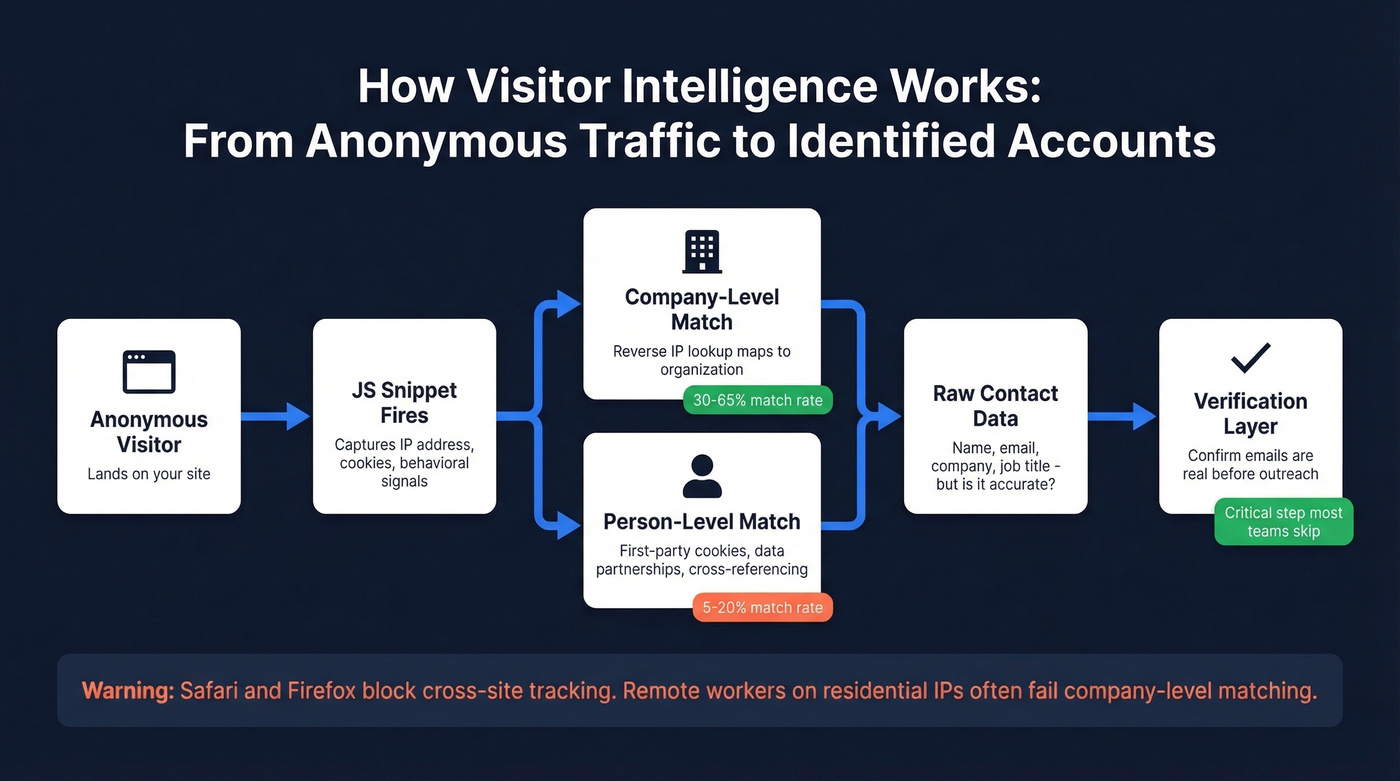
Person-level identification goes further. These tools use first-party cookies, behavioral signals, and cross-referenced data partnerships to match individual visitors to names and emails. Some use browser fingerprinting, identifying returning visitors with up to 90% accuracy - but that's returning visitors, not first-time anonymous traffic. Big difference.
Here's the thing: the cookie landscape has shifted hard. Safari and Firefox block cross-site tracking by default. Chrome pivoted to a user-choice model rather than killing cookies outright, but the trend is clear - less tracking data, not more. Add remote work to the mix, and IP-based matching gets murkier. When your target buyer works from a home office on a residential ISP, that IP often won't map cleanly to a company.
Realistic Match Rates for 2026
When a vendor says "80% match rate," they almost always mean companies, not people. The actual ranges:
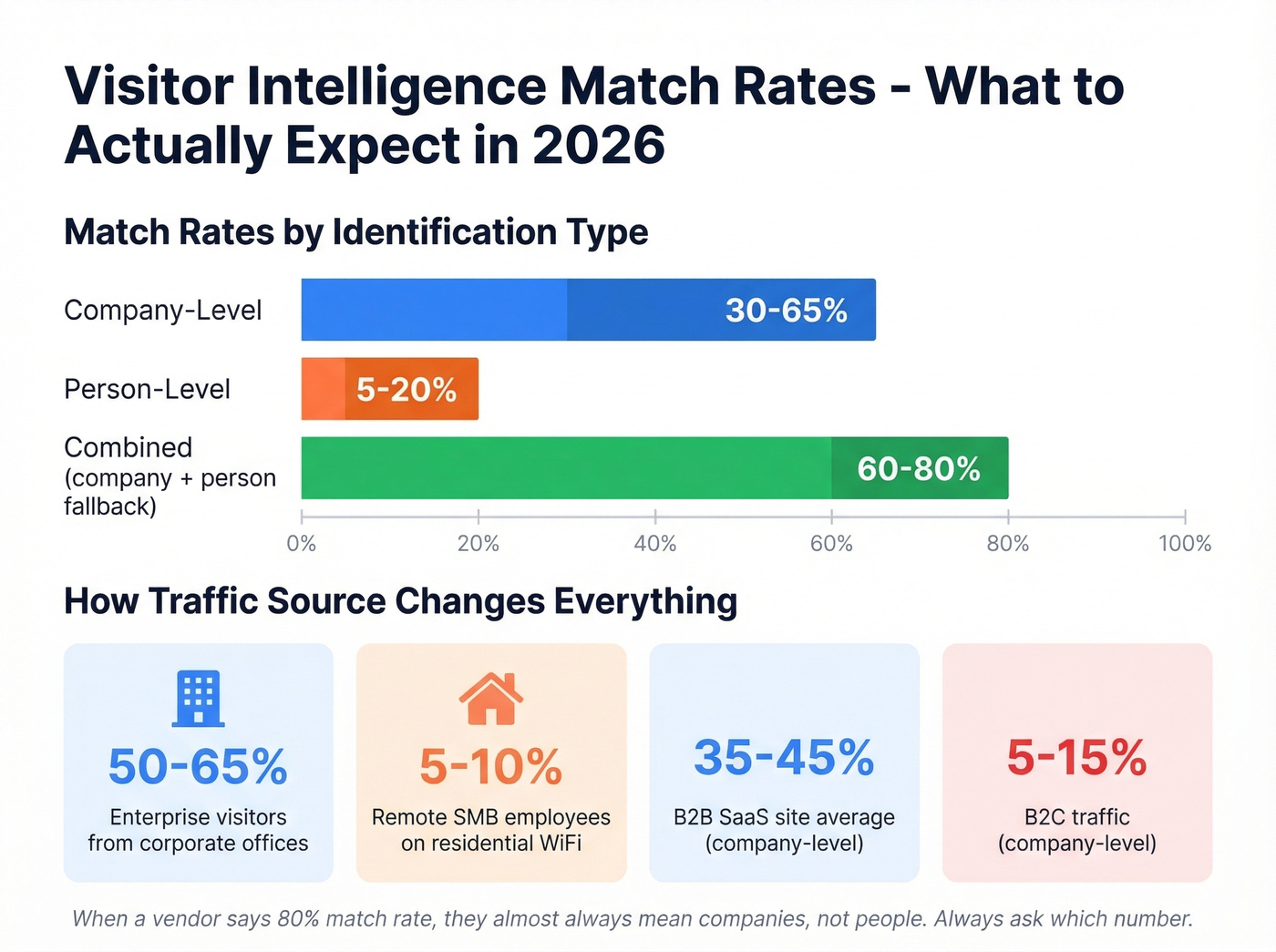
| Identification Level | Realistic Range |
|---|---|
| Company-level | 30-65% |
| Person-level | 5-20% |
| Combined (company + person fallback) | 60-80% |
Those ranges swing wildly by traffic source. Enterprise visitors from corporate offices? You'll hit 50-65% company match rates. Remote SMB employees on residential Wi-Fi? Expect 5-10%. Match rates also vary by vertical - B2B SaaS sites typically see 35-45% company-level identification, while B2C traffic drops to 5-15%.
G2 reviews tell the same story. Lead Forensics (4.4/5, 1,048 reviews) gets praised for ease of use but dinged for outdated contacts. Leadfeeder (4.3/5, 744 reviews) earns similar marks - strong on insights, weak on data accuracy. Data quality is the category's Achilles' heel, and it's the reason we keep coming back to verification as the missing step.
Let's be honest: most teams don't have a visitor identification problem. They have a verification problem. Knowing "someone from Acme Corp visited your pricing page" is worthless if the email you pull for their VP of Sales bounces. The tools that identify visitors are table stakes. The step that actually books meetings is confirming the contact data is real before your SDRs burn sequences on it.

Visitor ID tools tell you who's browsing. But 30-40% of the contact data they surface bounces. Prospeo's 5-step verification and 143M+ verified emails close the gap between "identified visitor" and "booked meeting" - at $0.01 per email, no contracts.
Stop burning sequences on unverified visitor data.
Turning B2B Visitor Insights Into Pipeline
Identification alone doesn't book meetings. Here's the workflow that converts:
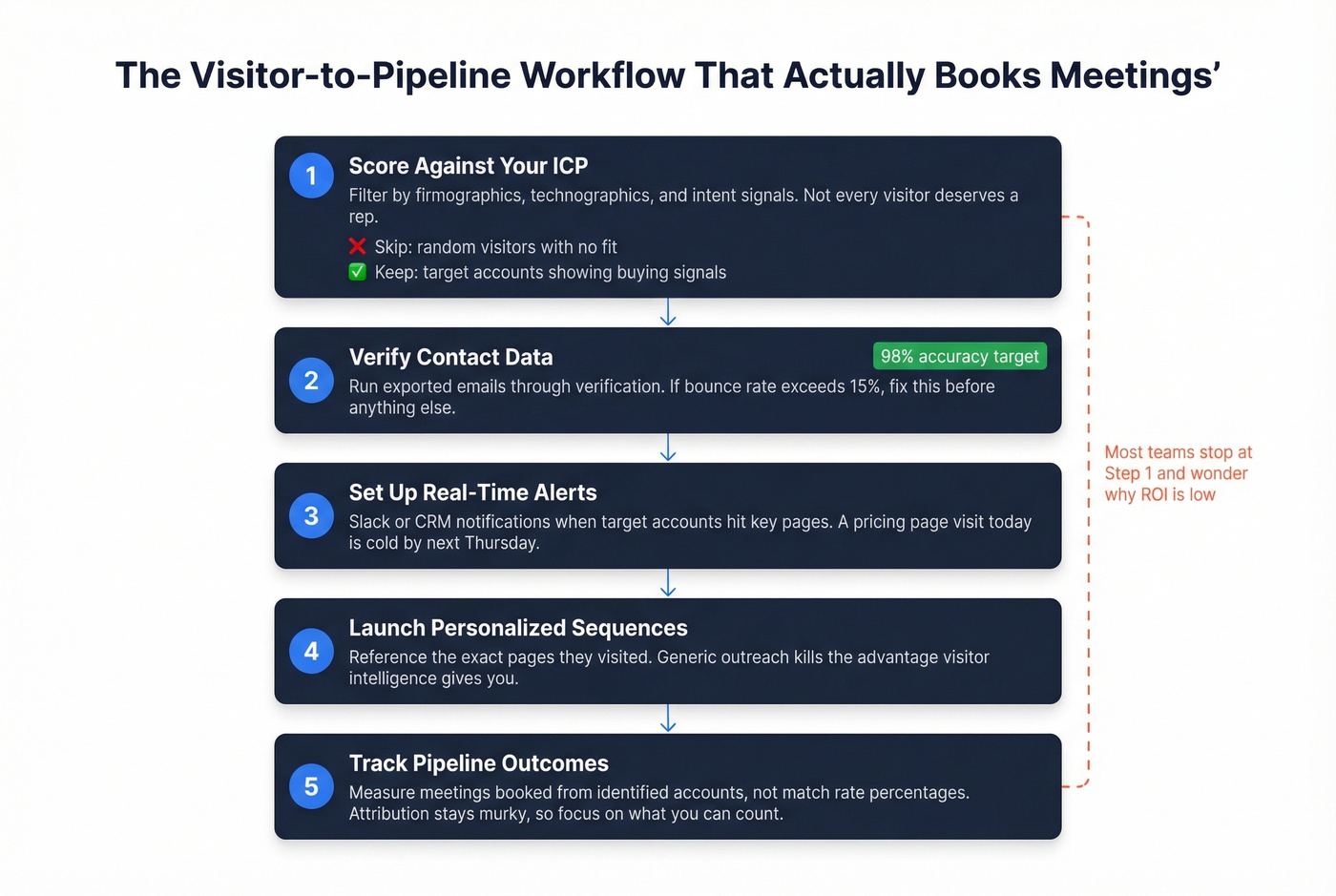
- Score identified accounts against your ICP - firmographics, technographics, intent signals. Not every visitor deserves a rep's time.
- Set up real-time alerts via Slack or your CRM. A prospect researching your pricing page today is cold by next Thursday.
- Launch targeted sequences personalized to the pages they visited.
- Track pipeline outcomes. The consensus on r/sales is that attribution from these tools stays "murky." Measure meetings booked from identified accounts, not match-rate percentages.
The teams getting the most from visitor insights are the ones layering company-level traffic data with CRM activity - connecting anonymous browsing behavior to existing deal stages so reps know which accounts are heating up before a hand-raise. We've seen this workflow cut response time from days to hours, which is where the real ROI lives.
Your visitor intelligence stack surfaces accounts. Your SDRs need verified contacts. Prospeo delivers 98% email accuracy with a 7-day refresh cycle - so the VP who hit your pricing page yesterday gets a real email today, not a bounce.
Turn anonymous traffic into pipeline that actually connects.
Tool Comparison
| Tool | Best For | Starting Price | Match-Rate Range |
|---|---|---|---|
| Leadfeeder | SMB testing | Free; $99/mo paid | 30-65% (company) |
| Prospeo | Verification + enrichment | Free; ~$0.01/email | 98% email accuracy |
| RB2B | Person-level | $79-$199/mo (free tier) | 10-20% (person) |
| Leadpipe | Mid-market | $149/mo | 30-40% (contact-level) |
| Warmly | Enterprise warm leads | $900/mo | 15-25% (person) |
| Lead Forensics | Sales teams (UK/EU) | ~$500-$2,000+/mo | 30-50% (company) |
| Clearbit | Product-led growth | $12,000+/yr | 15-20% (enrichment) |
| 6sense | ABM enterprise | $25,000+/yr | 10-20% (person) |
| ZoomInfo WebSights | Full GTM stack | ~$15,000-$40,000+/yr | 30-50% (company) |
| Demandbase | ABM + advertising | $25,000-$60,000+/yr | 20-40% (company) |
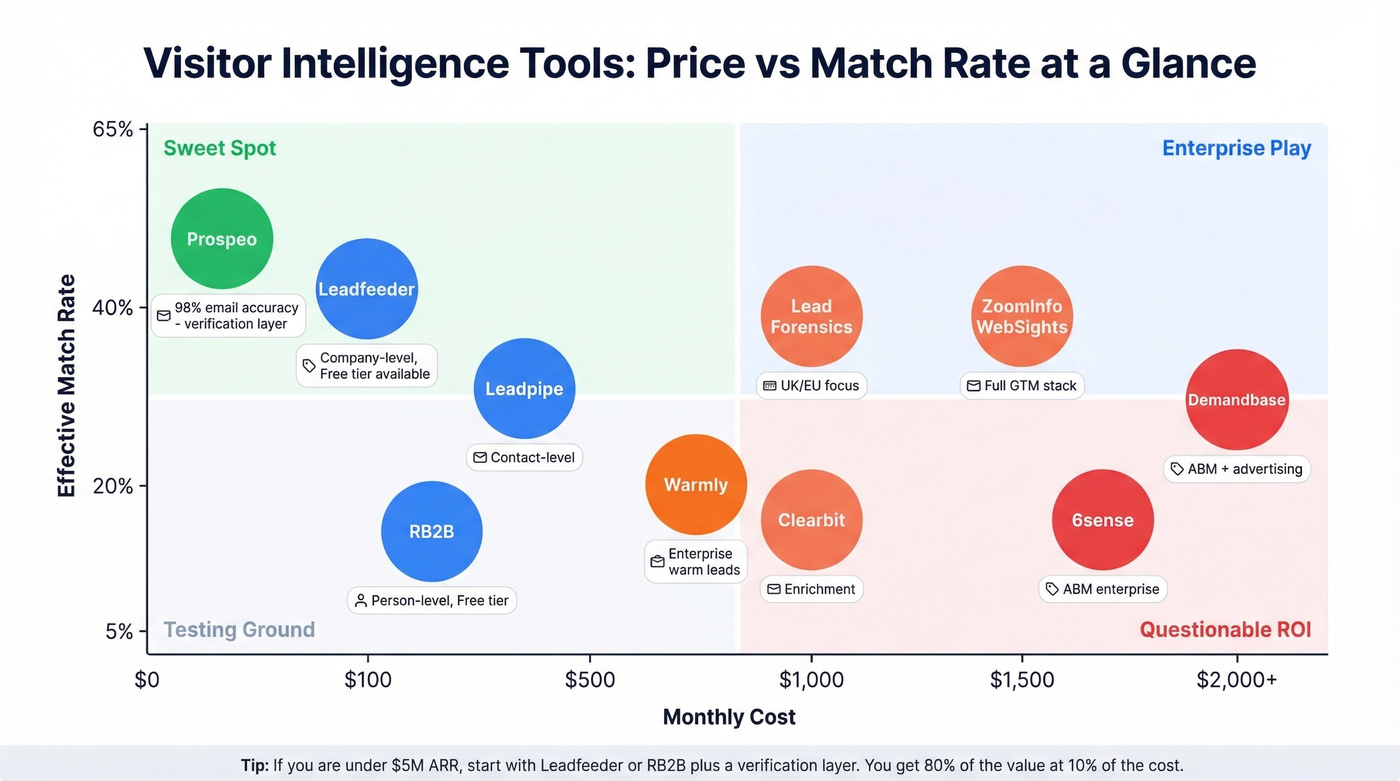
Skip Warmly, 6sense, and Demandbase if you're under $5M ARR - the pricing doesn't pencil out until you've got enough traffic volume and deal size to justify five-figure annual contracts. For most teams, Leadfeeder plus a verification layer gets you 80% of the value at 10% of the cost.
If you're evaluating the verification layer itself, compare options in our guide to data enrichment services and keep an eye on email bounce rate as the fastest quality signal.
Privacy and Compliance in 2026
CCPA revisions took effect January 1, 2026, expanding obligations around sensitive personal information and transparency. The CPPA has approved a $1.35M settlement with enforcement focused on opt-out mechanisms for cookies and tracking. GDPR still requires opt-in consent for most analytics cookies.
If you're running visitor identification scripts without proper consent banners, you're accumulating legal risk. Audit now, not after the fine. This isn't hypothetical - enforcement actions are accelerating on both sides of the Atlantic, and "we didn't know" stopped being a viable defense years ago.
How to Measure ROI
Skip the dashboard metrics. Use this formula:
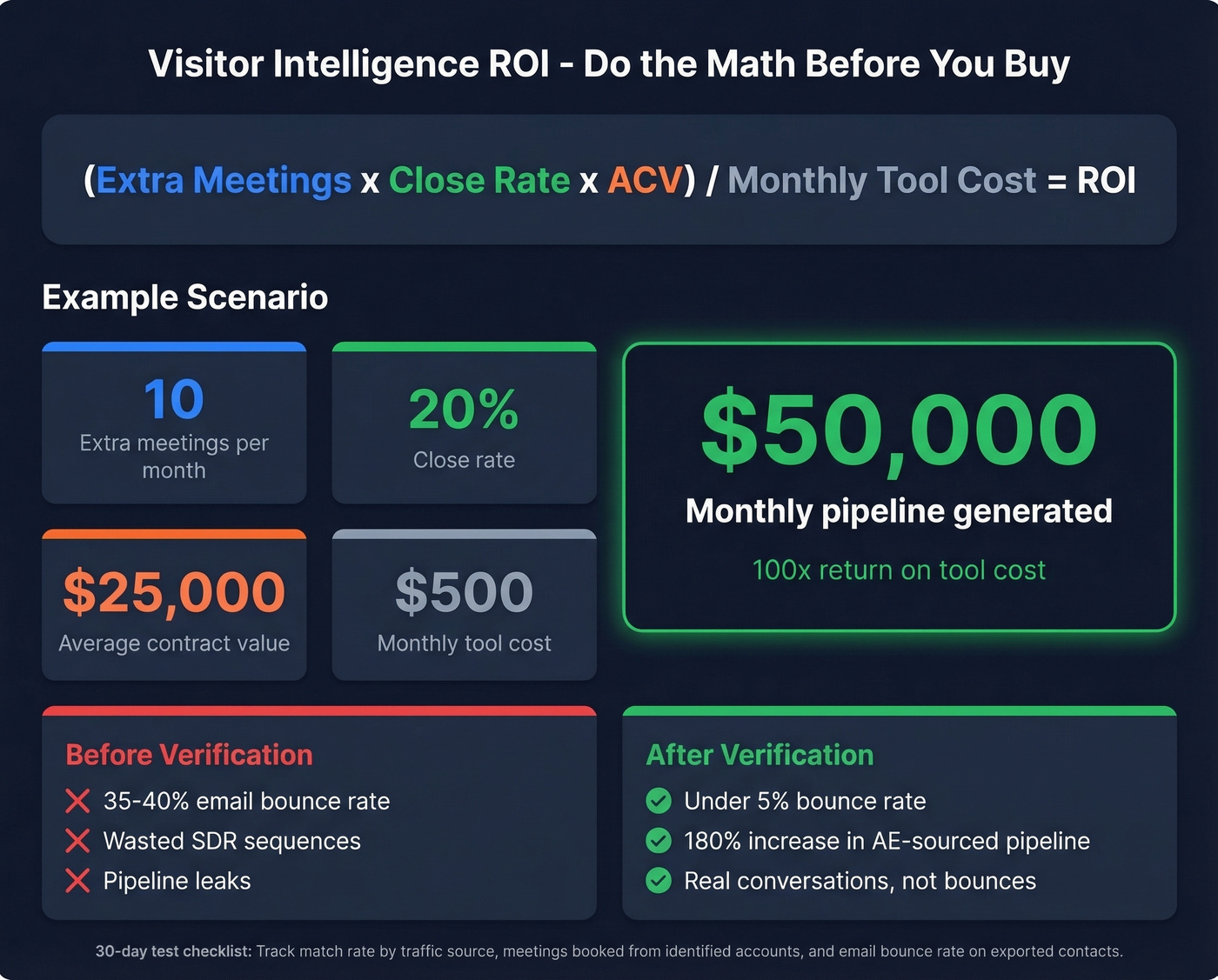
(Additional meetings booked x close rate x ACV) / monthly tool cost
Say your visitor ID stack surfaces 10 extra meetings per month. At a 20% close rate and $25K ACV, that's $50K in monthly pipeline against a $200-$900/mo tool cost. The math works even at modest match rates - the key variable is contact data quality, not identification volume. Snyk's team cut their bounce rate from 35-40% to under 5% after adding a verification step, and AE-sourced pipeline jumped 180%.
Run a 30-day test before committing annually. Track match rate by traffic source, meetings booked from identified accounts, and email bounce rate on exported contacts. If your bounce rate on identified contacts exceeds 15%, the identification tool isn't the problem - the data behind it is.
To tighten measurement, align this with your broader lead generation metrics and monitor pipeline health instead of tool-reported attribution.
FAQ
What's the difference between company-level and person-level identification?
Company-level uses reverse IP to identify the organization, hitting 30-65% match rates. Person-level identifies the individual by name and email, landing at 5-20%. Most vendor "80% match rate" claims refer to company-level only - always ask which number they're quoting.
Is visitor intelligence GDPR compliant?
It can be, but compliance depends entirely on implementation - consent banners, data processing agreements, and honoring opt-outs. The CPPA's $1.35M settlement shows enforcement is real. Run a consent audit before deploying any tracking script.
How do I verify contacts from identification tools?
Export identified accounts and run them through a verification service. Prospeo checks emails with 98% accuracy on a 7-day refresh cycle, which eliminates bounces before your SDRs send a single email. That verification step is the difference between a 35% bounce rate and a sub-5% one.
How is B2B visitor intelligence different from standard analytics?
Google Analytics shows aggregate traffic patterns - page views, session duration, bounce rates. Visitor identification de-anonymizes that traffic to reveal which companies and, in some cases, which individuals are browsing your site. That context turns passive traffic data into actionable sales intelligence your reps can work the same day.