

Vocodia Review: Pricing, Pros & Cons for 2026
Vocodia pitches an AI-powered "Digital Intelligence Sales Agent" that cold-calls, qualifies leads, and never takes a sick day. Sounds great on paper. But anyone researching this company hits a wall fast - there's no published pricing, virtually no verified customer reviews, and serious financial red flags that are hard to ignore. The gap between the promise and the evidence is the whole story here.
What Is Vocodia?
Vocodia Holdings Corp is a Wyoming-incorporated public company selling DISA - the Digital Intelligence Sales Agent. It's a conversational AI product designed to automate outbound calling, lead qualification, appointment scheduling, and payment reminders. Think of it as an AI SDR that works the phones around the clock using natural-sounding voices, managed through a dashboard called DISA Master Control.
Don't confuse Vocodia with Vodia PBX - Capterra's results for "Vocodia" actually show Vodia PBX, a completely different traditional phone system.
The Quick Verdict
The DISA concept is sound. AI voice agents are a legitimate and growing category. But Vocodia reported $1,339 in cash against $3,281,696 in current liabilities as of March 31, 2025, was delisted from Cboe in September 2024 and moved to OTC Markets, and has zero verified customer reviews on G2, Capterra, or TrustRadius. Proceed with extreme caution.
If you need AI outbound calling today, Ringg AI and Autocalls both offer transparent pricing and clearer public documentation.
Vocodia Pricing Breakdown
Vocodia doesn't publish pricing. Their website says "our affordable plans are customized to the specific needs of your business." That's it - no tiers, no per-minute rates, no calculator.
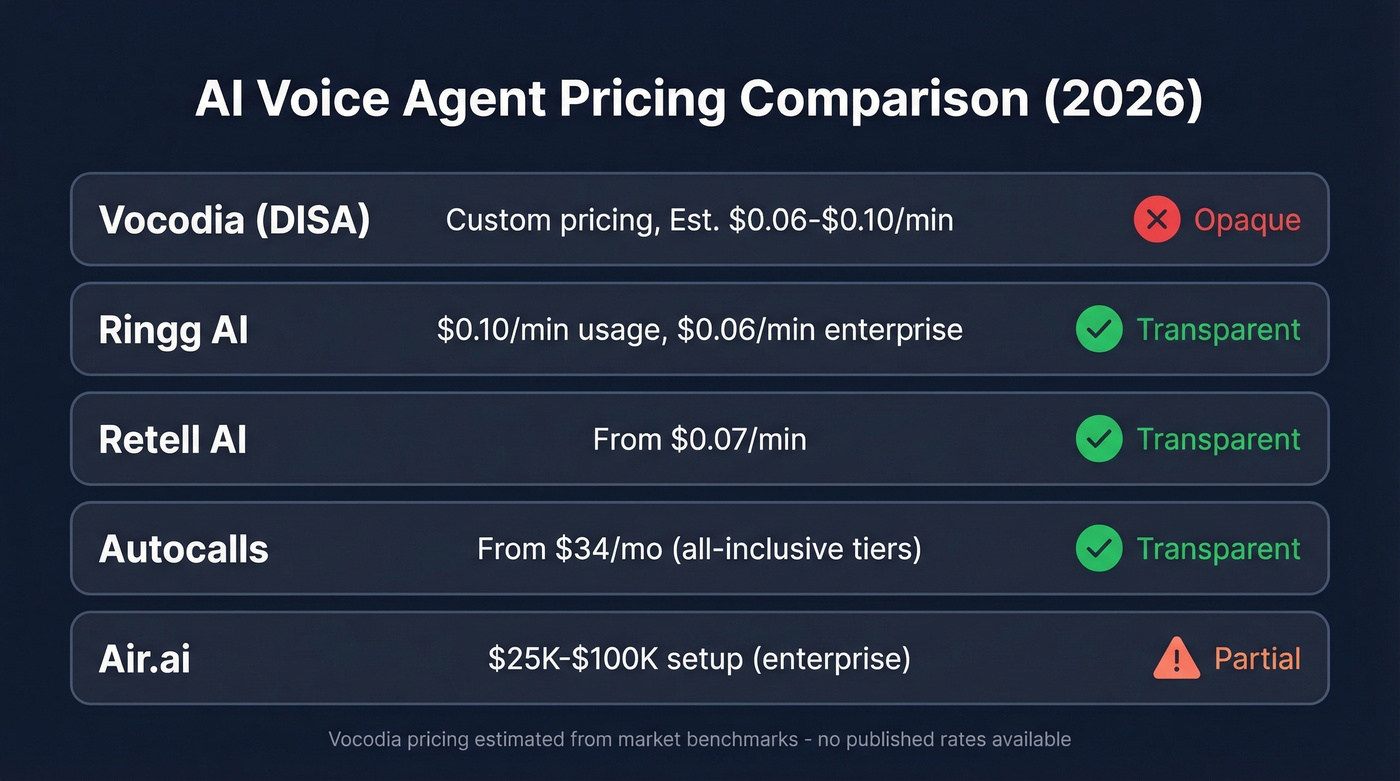
We can estimate based on where the AI voice agent market sits in 2026. Per-minute voice agent pricing commonly lands around $0.06-$0.10/min depending on volume and plan structure. If you're building a BYOK-style stack, the all-in cost can hit $0.25-$0.50/min once you add telephony, LLM inference, and speech-to-text. Setup and onboarding fees vary widely too: expect $5K-$50K for typical mid-market onboarding, and $25K-$100K for high-touch enterprise setups.
Here's how that stacks up against platforms that actually publish numbers:
| Platform | Pricing Model | Starting Price | Transparent? |
|---|---|---|---|
| Vocodia (DISA) | Custom | Est. $0.06-$0.10/min (market benchmark) | ❌ |
| Ringg AI | Per-minute | $0.10/min (usage) / $0.06/min (enterprise) | ✅ |
| Retell AI | Per-minute | From $0.07/min | ✅ |
| Autocalls | Monthly tiers | From $34/mo | ✅ |
| Air.ai | Enterprise | $25K-$100K setup | ⚠️ |
When your competitors publish pricing and you don't, that's a signal.
Features & Capabilities
DISA handles outbound calling with scripted conversation control, lead qualification, appointment scheduling, and payment reminders. The Master Control dashboard lets you set up scripts, adjust call flows, and scale volume. Vocodia says you can get up and running in under a month, and the CEO has described DISA as something that can be modified and pushed back out at scale within minutes.
Insurance is their most-cited vertical - DISAs pre-qualify prospects so licensed agents only handle ready-to-buy customers. The company positions DISA around compliance management, including automated adherence to TCPA and DNC rules, and emphasizes that the AI stays on-script. DISA is also positioned as operating 24/7/365.

Before you invest in any AI calling platform, you need numbers that actually connect. Prospeo gives you 125M+ verified mobile numbers with a 30% pickup rate - 3x the industry average. At $0.01/email and 10 credits per mobile, you'll spend less on data than a single minute of AI voice time.
Feed your AI dialer numbers that pick up, not numbers that bounce.
Pros and Cons
Pros:
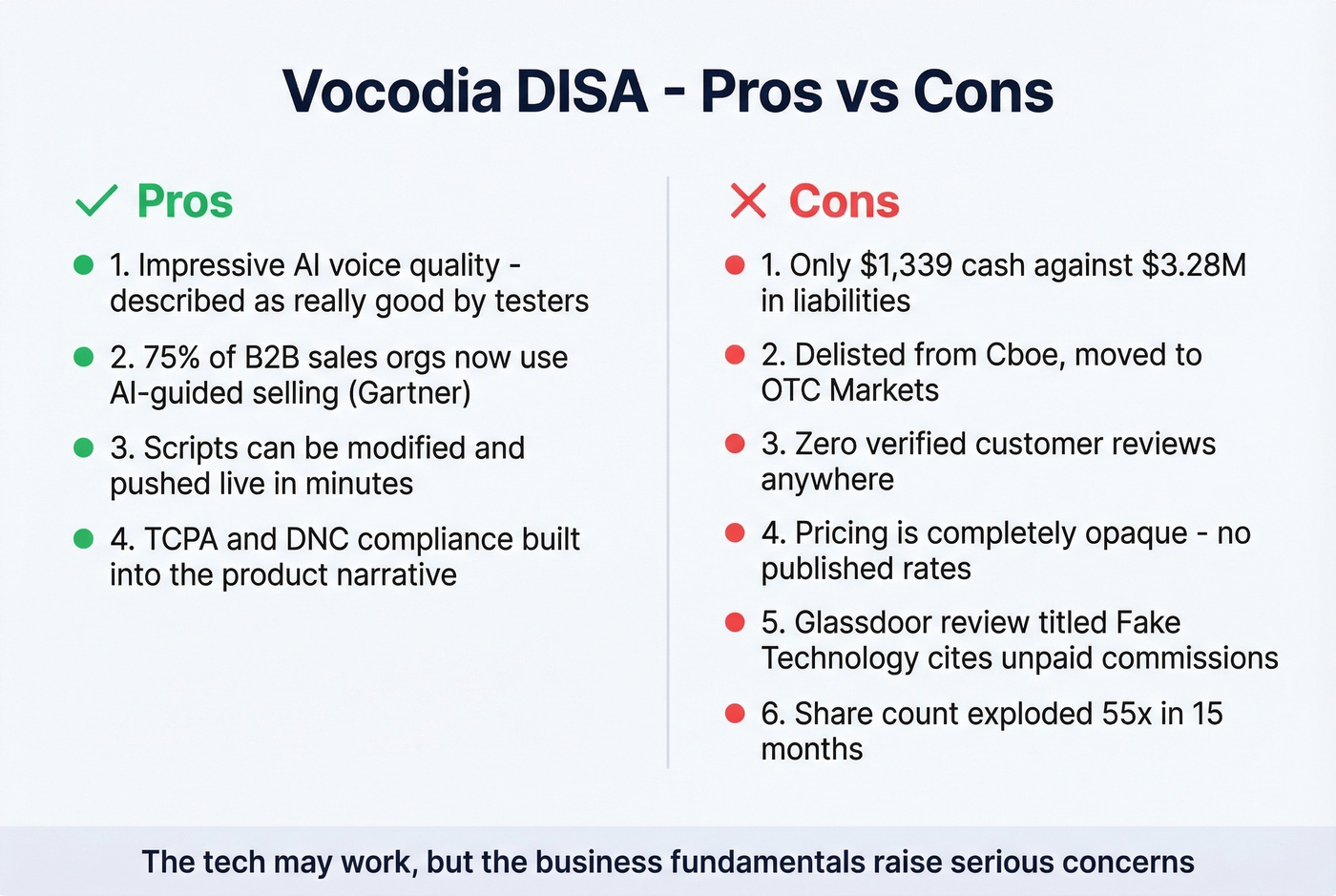
- The AI voice quality is genuinely impressive. A Reddit user on r/VHAI who called Vocodia's number described DISA as "actually very good... I mean really good."
- AI voice agents are a real growth category - 75% of B2B sales organizations now augment with AI-guided selling, per Gartner.
- Scripts can be modified and pushed live within minutes.
- TCPA/DNC compliance is a core part of the product narrative.
Cons:
- $1,339 in cash against $3.28M in liabilities. That's a company running on fumes.
- Delisted from Cboe in September 2024, now on OTC Markets.
- No verified customer reviews on any major software review platform.
- Pricing is completely opaque.
- A Glassdoor review titled "Fake Technology" from a former Marketing Director cites commission non-payment.
- Share count jumped from 22,735,237 shares (Apr 12, 2024) to 1,256,214,474 shares (July 7, 2025) - about 55.2x dilution.
Vocodia Reviews: What Actually Exists
Almost nothing. At least, nothing buyer-verified.
We couldn't find verified customer reviews on G2, Capterra, or TrustRadius. What does exist is employee and investor chatter, and it paints a mixed picture at best.
Three Glassdoor employee reviews tell the story. A former Marketing Director left a 1-star review titled "Fake Technology," calling out "Not getting paid on commissions." A current Customer Success Manager gave 4 stars but added "Not sure on long term reliability." A former Client Success Manager gave 4 stars, calling the team "Fabulous bunch of people" while noting "None really, they're just figuring things out."
On Reddit's r/VHAI, one poster was impressed by DISA's voice quality - but this was an investor who then bought more stock, not a paying customer reporting ROI. A separate thread is harsher: the company "lacks the infrastructure to secure large clients" and is "relying solely on an affiliate program."
Here's the thing: the absence of buyer-verified customer reviews in 2026 - for a product that's been marketed for over two years - isn't something you can explain away with "we're early stage."
Financial Health & Vendor Risk
You're not just buying software. You're betting your outbound operation on a vendor's ability to stay alive.
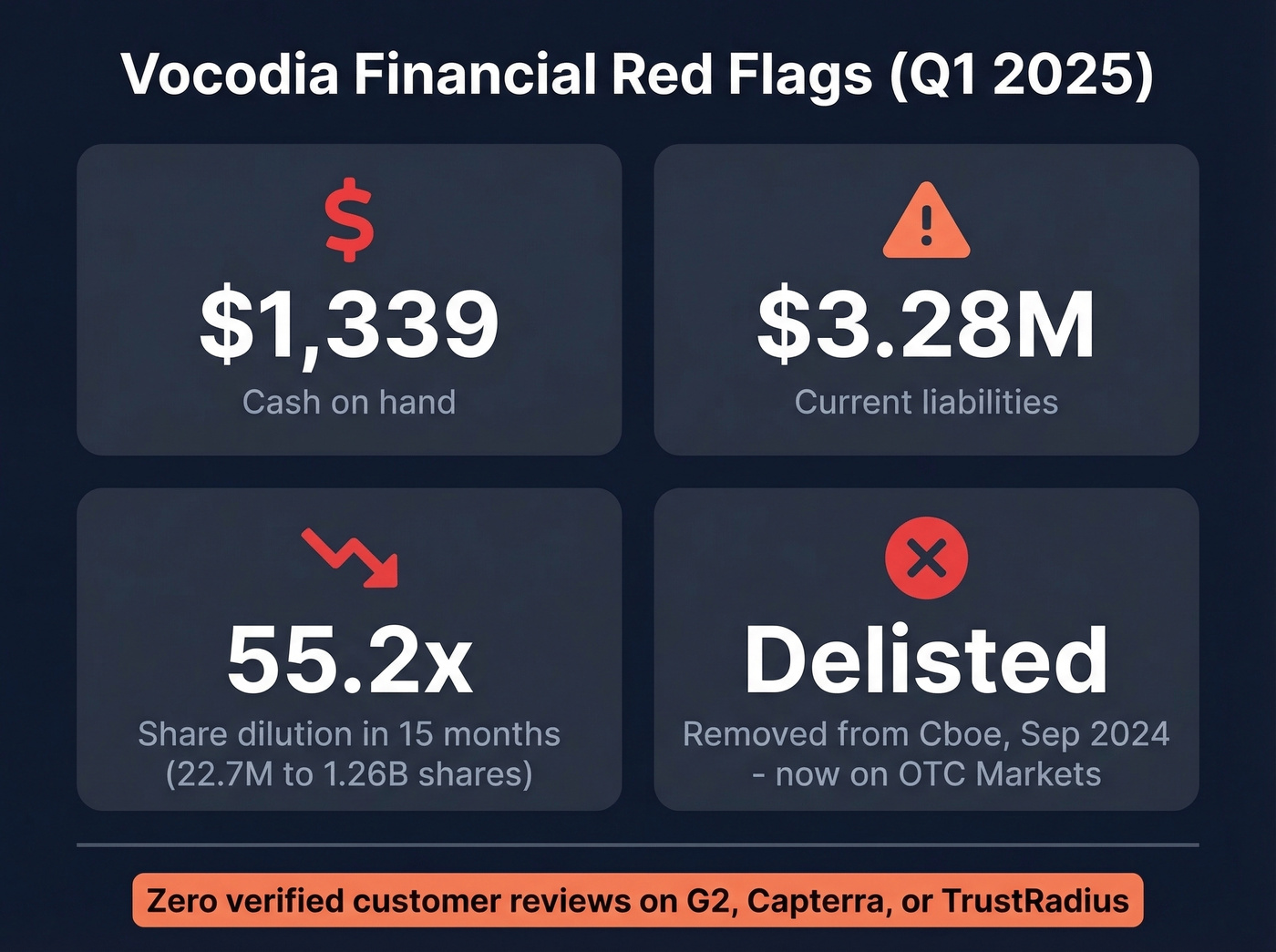
Vocodia's Q1 2025 10-Q filing shows $1,339 in cash and $61,317 in total assets against $3.28M in current liabilities - including $2.09M in accounts payable, $587K in liquidated damages, and $364K in convertible notes. The IPO in 2024 raised roughly $6M, and the CEO described 2024 as the "most difficult" year.
The share dilution is staggering. From 22,735,237 shares on April 12, 2024 to 1,256,214,474 shares by July 7, 2025. Paul Taylor acquired 1,151,240,000 shares (roughly 28.78%) and was appointed Chairman and Interim COO. The company announced a temporary pause on conversions of Series B and Series C warrants.
Let's be honest: AI voice agents are genuinely the future of outbound at scale. But Vocodia isn't the company that'll deliver that future. A vendor with $1,339 in cash can't guarantee uptime, support, or product development next quarter - let alone next year. We've seen enough vendors flame out mid-contract to know what that looks like for the teams left holding the bag.
If you're building an outbound stack, it helps to map the full workflow end-to-end - from sales prospecting techniques to lead scoring to the actual dialer.
Alternatives Worth Considering
Ringg AI is the pick if you want transparent per-minute pricing and an enterprise-ready AI calling platform. At $0.10/min for usage tiers and $0.06/min at enterprise scale, you know exactly what you're paying. Skip it if you need an all-inclusive monthly plan with bundled minutes.
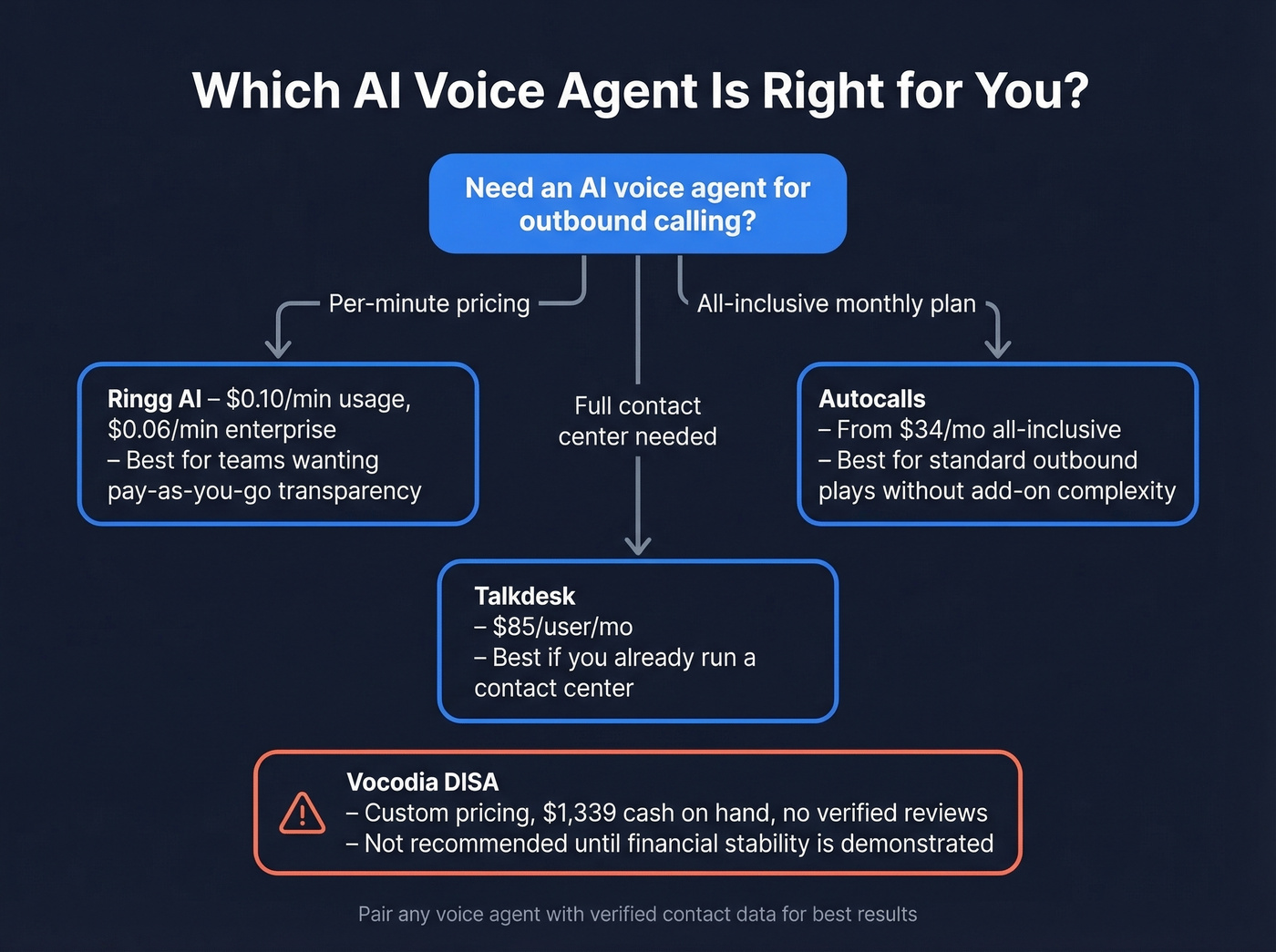
Autocalls takes a different approach with all-inclusive monthly tiers starting at $34/mo. Everything's bundled in a way that avoids BYOK-style add-ons. The trade-off is less enterprise customization than Ringg AI, but for most teams running standard outbound plays, that won't matter.
Talkdesk is the established CCaaS vendor in the room, starting at $85/user/month. It's a full contact center platform with AI features bolted on, not a pure AI voice agent. If you already run a contact center and want AI augmentation without ripping out your stack, Talkdesk makes sense. For teams that just want an AI caller, it's overkill.
If you're comparing calling vendors, it can also help to benchmark adjacent stacks like Dialpad alternatives and MightyCall alternatives.

Opaque pricing and $1,339 in cash aren't the only vendor risks in outbound. Bad contact data burns through your dialer budget and tanks deliverability. Prospeo's 98% email accuracy and 7-day data refresh mean your outbound stack - voice or email - starts with contacts that are real, current, and reachable.
Don't let bad data be the next vendor risk in your outbound stack.
Should You Buy Vocodia in 2026?
Not yet. Until Vocodia publishes transparent pricing, produces verified customer results, and demonstrates financial stability beyond $1,339 in cash, signing a contract is a risk most teams shouldn't take. Look at Ringg AI or Autocalls for the voice agent piece, and build your outbound data foundation with a provider you can actually verify.
If you're tightening the rest of your outbound motion, pair calling with sales follow-up templates and a clean data layer via data enrichment services.
FAQ
Is Vocodia DISA a legitimate product?
DISA exists as a working AI voice agent - a Reddit user who called the demo line described the voice quality as "really good." But Vocodia has no verified customer reviews on G2, Capterra, or TrustRadius, and a Glassdoor review from a former Marketing Director is titled "Fake Technology." The technology may work, but there's no independent proof of customer ROI.
Why doesn't Vocodia publish pricing?
Vocodia uses a "customized plans" model with no public tiers, per-minute rates, or calculators. This isn't unusual among early-stage AI voice vendors, but competitors like Ringg AI ($0.10/min) and Autocalls ($34/mo) publish pricing openly. Opaque pricing combined with $1,339 in reported cash makes it harder to evaluate total cost of ownership.
What are the best Vocodia alternatives in 2026?
Ringg AI offers transparent per-minute pricing starting at $0.10/min, while Autocalls bundles everything into monthly plans from $34/mo. For the data layer, Prospeo provides 300M+ profiles with 98% email accuracy and 125M+ verified mobiles at roughly $0.01 per email - essential for any AI calling workflow.
Is Vocodia financially stable enough to trust as a vendor?
No. Vocodia's Q1 2025 10-Q filing shows $1,339 in cash against $3.28M in current liabilities. The company was delisted from Cboe in September 2024, and share count ballooned from 22.7M to 1.26B in roughly 15 months. These are serious going-concern indicators for any team evaluating a multi-year vendor commitment.