

What Are the Advantages of Personal Selling? The Data Behind Why It Still Works
Every article on this topic tells you personal selling "builds trust" and "creates relationships." Thanks for nothing. What none of them tell you is what close rates you can actually expect, or when spending $50-200 per contact is worth it. Understanding the real advantages of personal selling requires actual numbers - not platitudes. We've watched teams triple their pipeline by deploying this approach at the right stage, and waste six figures deploying it at the wrong one.
The Quick Version
Here's the paradox:
- 61% of B2B buyers prefer a rep-free buying experience. Self-service is real.
- But sales-call close rates run 13-25% compared to a 2.9% average digital conversion rate. That's a 5-8x gap.
- The advantage holds - but only when you deploy one-to-one selling at the right moments, with the right data, against the right accounts.
What Is Personal Selling?
Personal selling is direct, one-to-one communication between a salesperson and a prospect - over phone calls, video meetings, in-person visits, or targeted email exchanges. The defining feature isn't the channel. It's the two-way interaction.
It fits best in high-consideration, complex, and high-ticket sales cycles: enterprise software demos, medical device evaluations, financial advisory meetings. Think consultative selling and solution selling, not impulse purchases. When buying committees have competing priorities and evaluation timelines stretch across months, this approach earns its cost.
Core Benefits of Personal Selling
Here's where the data separates one-to-one sales from everything else in your go-to-market toolkit.
Higher Conversion Rates
This is the headline advantage, and the numbers aren't close. Sales-call conversion rates - SQLs converting to closed deals - range from 13% to 25% depending on industry and deal size. Compare that to the 2.9% average digital lead conversion rate Ruler Analytics found across 100M+ data points and 14 industries.
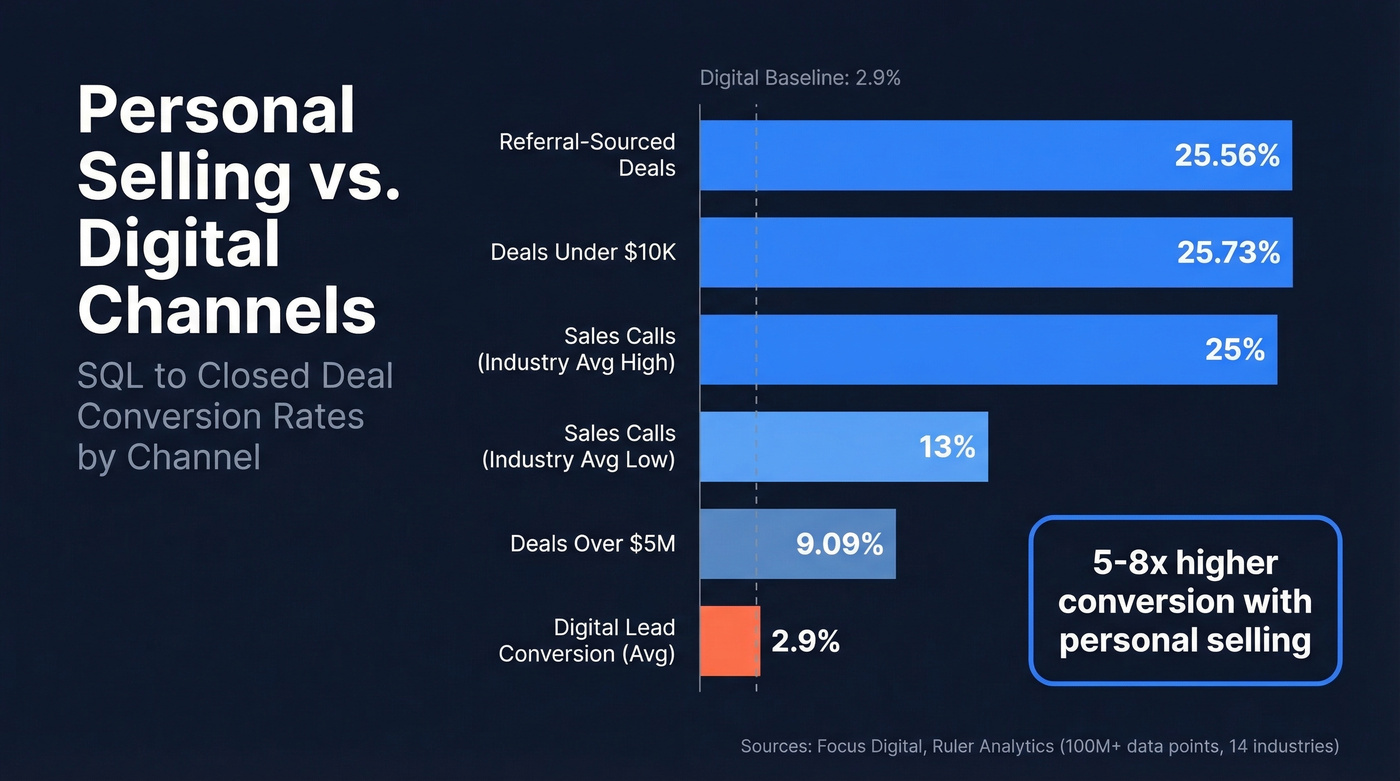
Deal size matters. Deals under $10K convert at 25.73% at the sales-call stage. Deals over $5M drop to 9.09% - still roughly 3x the digital average. Channel matters too: referral-sourced deals convert at 25.56%, while direct sales and cold calling convert at 9.38%.
Even the low end of sales-call conversion beats the 2.9% cross-industry digital average by about 3x.
Personalization Buyers Actually Demand
McKinsey's numbers are clear: 71% of consumers expect personalized interactions, and 76% get frustrated when it doesn't happen. And 65% of customers cite targeted promotions as a top reason to purchase.
A skilled rep adjusts messaging, pacing, examples, and objection handling in real time based on what the buyer actually cares about. Salesforce built its entire go-to-market on this principle - consultative reps who tailor demos to each prospect's tech stack and pain points. No algorithm matches that level of contextual adaptation, and we don't think one will anytime soon.
Real-Time Objection Handling
When a prospect raises a concern, the rep addresses it immediately using frameworks like LAER (Listen, Acknowledge, Explore, Respond). A landing page can't hear hesitation. An email sequence can't pivot when priorities shift mid-evaluation. This real-time adaptability is why direct selling dominates in complex sales where buying committees have competing priorities and no two conversations unfold the same way.
Relationship-Driven Retention
A Fortune 100 medical device company in a $5B category learned this the hard way. Their survey research told them sales relationships ranked low in buyer priorities. So they pulled back on field sales investment. Competitors did the opposite - they hired more reps.
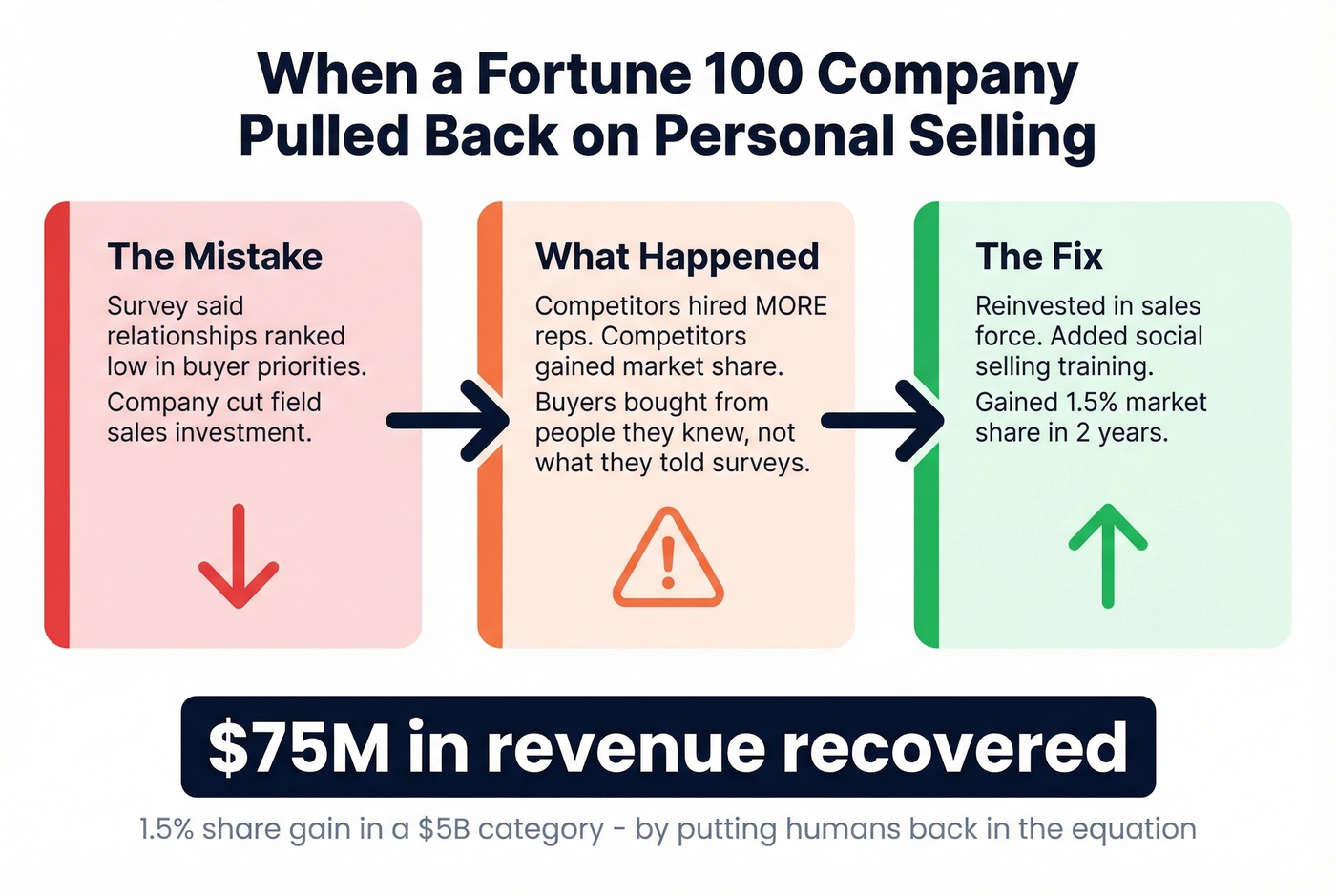
Competitors gained share. The survey was wrong. Buyers said relationships didn't matter, but their purchasing behavior told a completely different story - they bought from the people they knew. After reinvesting in the sales force and adding social selling training, the company gained 1.5% market share over two years. In a $5B category, that's $75M in revenue recovered by putting humans back in the equation.
Let's be honest: personal selling is still the highest-ROI channel in B2B. But most companies don't have a selling problem - they have a deployment problem. They spray reps across every account instead of concentrating firepower on the deals where human interaction actually moves the needle.

You just read that misidentifying decision-makers kills personal selling ROI. Prospeo's 300M+ profiles with 30+ filters - including job title, department headcount, and buyer intent - let your reps walk into every call knowing exactly who owns the budget. 98% email accuracy and 125M+ verified mobiles mean your $50-200 per contact actually reaches someone who can say yes.
Stop burning personal selling budget on the wrong contacts.
The Disadvantages (and When They Don't Matter)
Cost per contact is the obvious drawback. One-to-one selling runs $50-200 per meaningful interaction versus $0.10-5 for mass marketing.
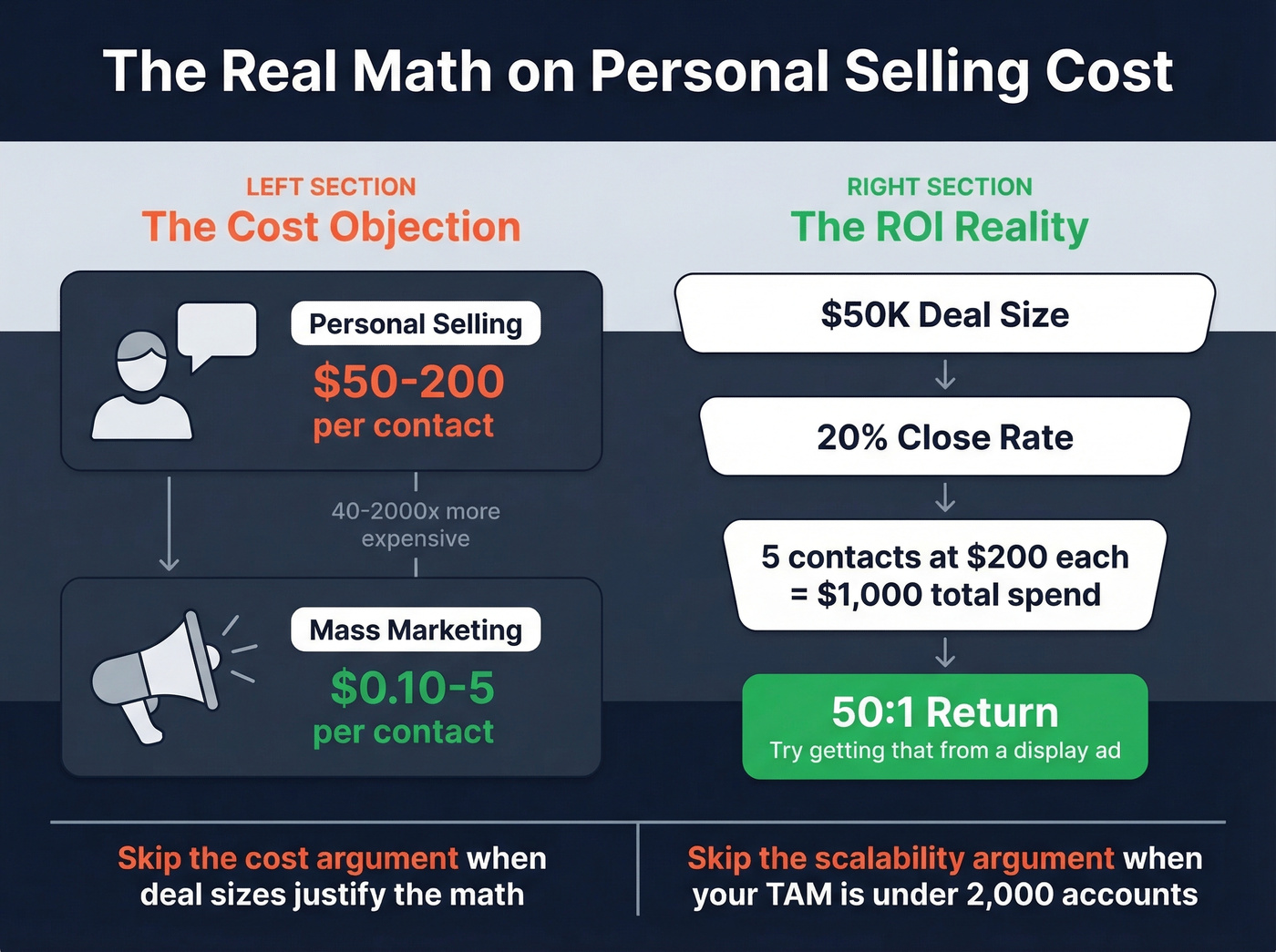
Scalability is the other constraint. A rep can only handle so many meaningful 1:1 conversations per week. A marketing automation platform can touch thousands.
There's also a trust risk that cuts both ways. 69% of B2B buyers report inconsistencies between what a company's website says and what sellers tell them. Worse, 73% of buyers actively avoid suppliers whose outreach feels irrelevant or generic. Bad reps don't just fail to convert - they actively damage your brand.
Skip the cost argument if your deal sizes justify the math. $200 per contact sounds expensive until you run the numbers: on a $50K deal with a 20% close rate, you're spending $1,000 in sales touches to close a $50K deal. That's a 50:1 return. Try getting that from a display ad campaign.
Skip the scalability argument if you're selling to a defined universe of accounts. If your total addressable market is 2,000 companies, you don't need mass marketing scale. You need depth.
Mistakes That Kill the Advantages
The benefits above only hold if your team avoids these failure modes:
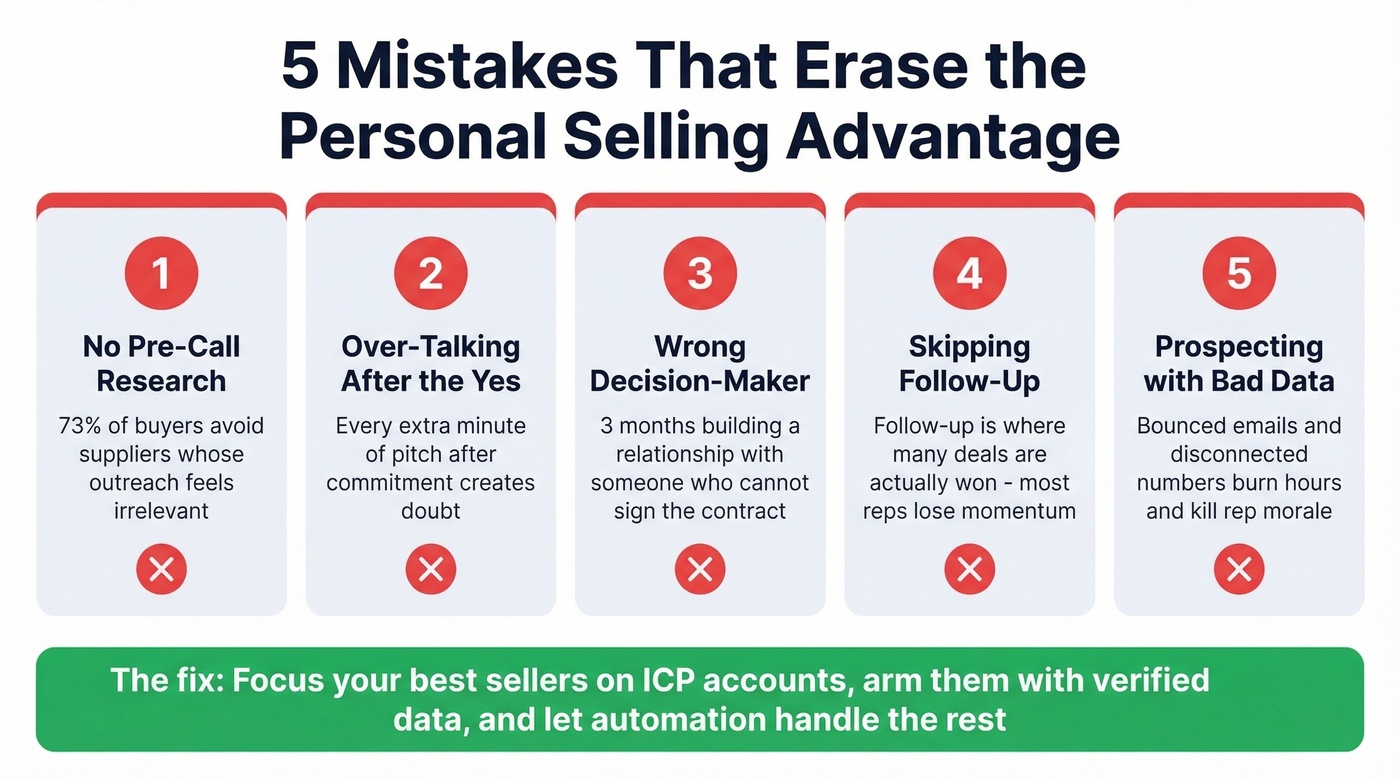
- Not researching the prospect before the call. Winging it is the fastest way to become one of those irrelevant suppliers 73% of buyers avoid. In our experience, even five minutes of pre-call research - checking recent funding, job changes, tech stack - separates good reps from forgettable ones.
- Over-talking after the buyer says yes. When the customer agrees, stop selling. Every extra minute of pitch after commitment creates doubt.
- Misidentifying decision-makers. Spending three months building a relationship with someone who can't sign the contract is the most expensive mistake in sales. We've seen it kill deals that were otherwise won.
- Skipping follow-up. Follow-up is where many deals are actually won, and it's one of the most common places reps lose momentum. (If you need a system, start with proven sales follow-up templates.)
- Prospecting with bad data. Personal selling fails when reps burn hours on bounced emails and disconnected numbers. Fix the data first - tools like Prospeo deliver verified emails at 98% accuracy with data refreshed every 7 days, so reps spend time in conversations instead of chasing dead leads.
The Future: AI + Human Hybrid
Gartner predicts that by 2030, 75% of B2B buyers will prefer sales experiences that prioritize human interaction over AI. That's not a rejection of technology - it's a signal about where humans add irreplaceable value.
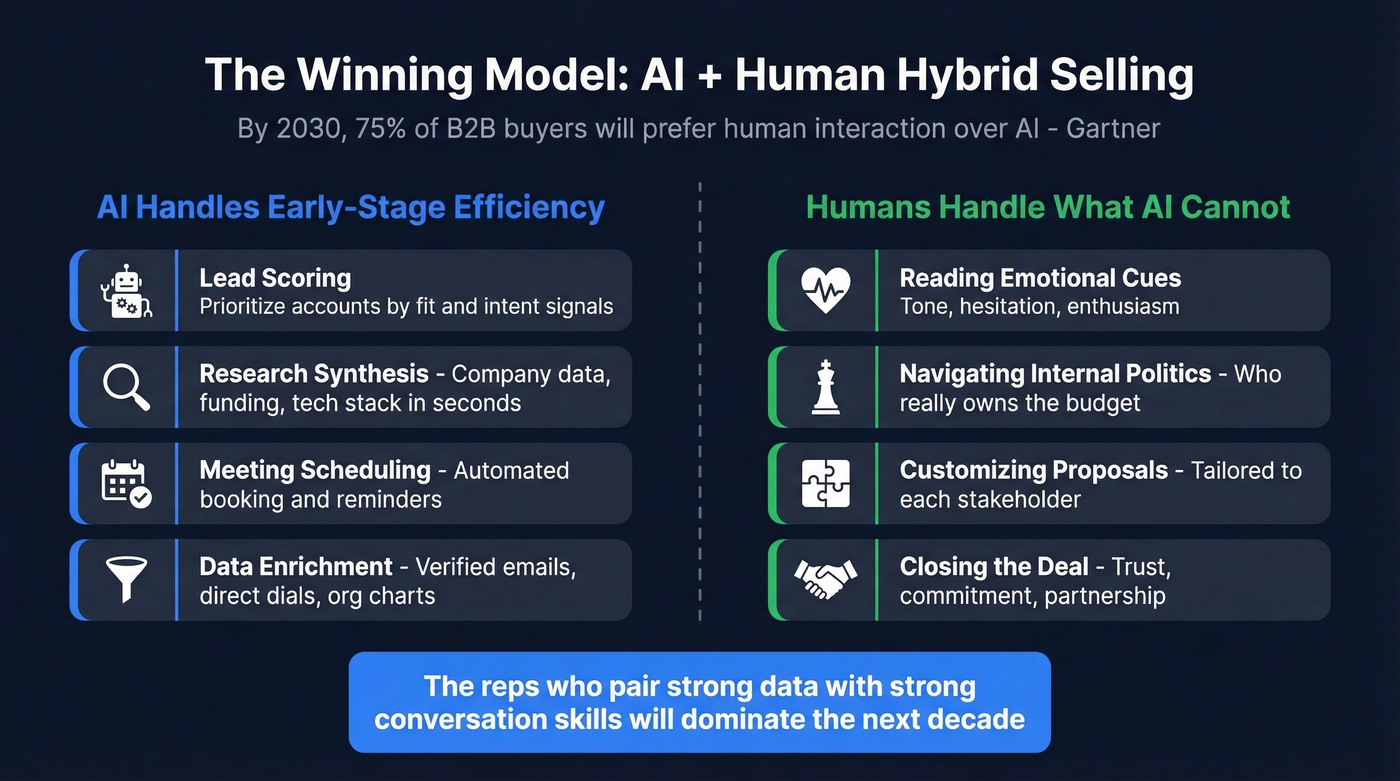
The winning model is hybrid. AI handles early-stage efficiency: lead scoring, research synthesis, meeting scheduling. Humans handle what AI can't: reading emotional cues, navigating internal politics, customizing proposals, and closing. The advantages of personal selling aren't going away. They're getting more focused - and the reps who pair strong data with strong conversation skills will dominate the next decade.
If you're building the motion, align it to your ideal customer profile and focus on account-based selling where one-to-one effort pays off.
Personal selling converts at 13-25% - but only when reps do their homework. Prospeo gives your team pre-call intelligence in seconds: tech stack, recent funding, headcount growth, job changes, and intent signals across 15,000 topics. Five minutes of research becomes one click.
Arm every rep with the data that makes personal selling actually work.
FAQ
Is personal selling still effective in 2026?
Yes - sales-call close rates (13-25%) outperform digital lead conversion (2.9%) by 5-8x. Gartner predicts 75% of B2B buyers will prefer human interaction over AI by 2030. Real-time, personalized, two-way communication remains unmatched by any automated channel.
When is the cost of personal selling worth it?
When deal sizes exceed roughly $5K and involve complex buying committees. A 20% close rate on a $50K deal means approximately $1,000 in sales touches per closed deal - a 50:1 return that no display ad or email blast can match.
How does personal selling compare to digital marketing?
Direct selling converts at 13-25% (SQL to closed deal) versus 2.9% for digital channels - a 5-8x gap. Digital scales cheaply but lacks two-way interaction. The best B2B teams use digital for awareness and lead generation, then deploy reps for high-value accounts where conversion rates justify the cost.
What's the biggest mistake teams make with personal selling?
Deploying it everywhere instead of where it matters. Reps burning time on unqualified leads or contacts with bad data is the fastest way to erase the conversion advantage. Focus your best sellers on accounts that match your ICP, arm them with verified contact data, and let automation handle the rest of the funnel.