

What Does "Bookings" Mean in Sales? Definitions, Formulas, and Examples
Your VP just asked for Q3 bookings and three people in the room are thinking about different numbers. The SDR lead is counting meetings booked - on r/sales, that's almost always what "bookings" means. The AE is tallying signed contracts. Finance is pulling committed contract value from the CRM. Same word, three different numbers.
So what does bookings mean in sales when your CFO and board are the ones asking? Let's clear it up. This article covers the financial definition - the one that actually matters for forecasting and compensation.
Sales Bookings Defined
Bookings represent the total value of signed contracts during a specific period. When a customer signs a deal, that committed dollar amount becomes a booking. It's the top of the financial waterfall - the first signal that revenue is coming, even though cash hasn't moved yet.
Here's the thing: bookings aren't a GAAP-defined term. There's no universal standard, and every company defines them slightly differently. That ambiguity is exactly why the same word causes so many arguments in pipeline reviews.
The core formulas are straightforward:
- TCV Bookings = sum of all committed contract values
- ACV Bookings = TCV / contract term in years
Bookings get recorded on the date the agreement is formalized - not when you invoice, not when cash hits the bank, and not when the service is delivered. That distinction trips up more teams than you'd expect.
Types of Bookings
Three categories cover most scenarios:
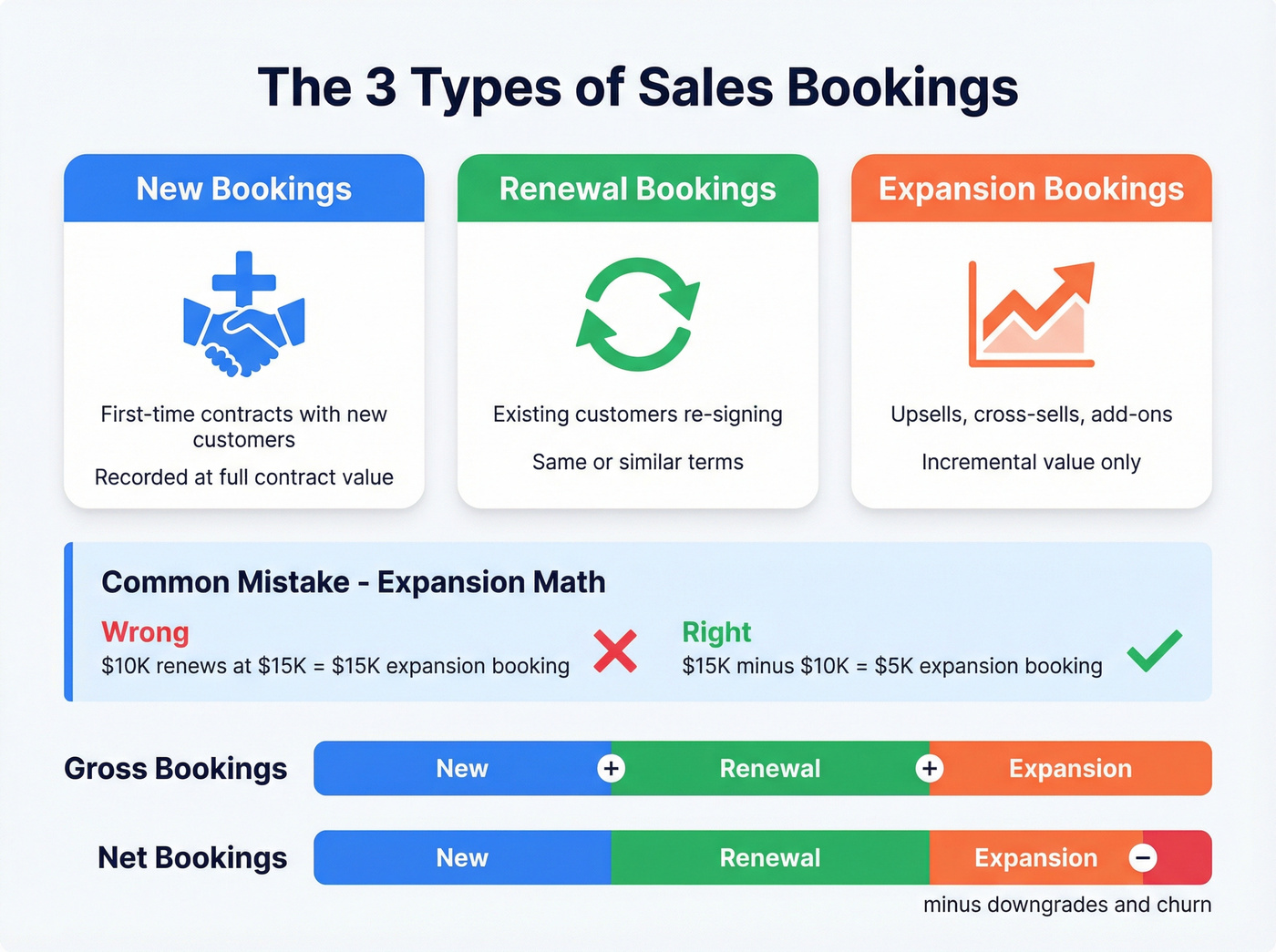
New bookings are first-time contracts with new customers, recorded at full value. Renewal bookings capture existing customers re-signing at the same or similar terms. Expansion bookings cover upsells, cross-sells, or add-ons - and this is where the critical rule lives: expansion bookings are incremental only. If a customer renews from $10K/year to $15K/year, the expansion booking is $5K, not $15K. Double-counting this is one of the most common reporting mistakes we see across the teams we work with.
Gross bookings are your total new + renewal + expansion bookings before adjusting for downgrades and churn. Net bookings subtract those losses. Document which definition your company uses, and do it before comp plans go out.
Bookings vs. Revenue vs. Billings
A $48,000 booking doesn't hit your P&L on signing day.
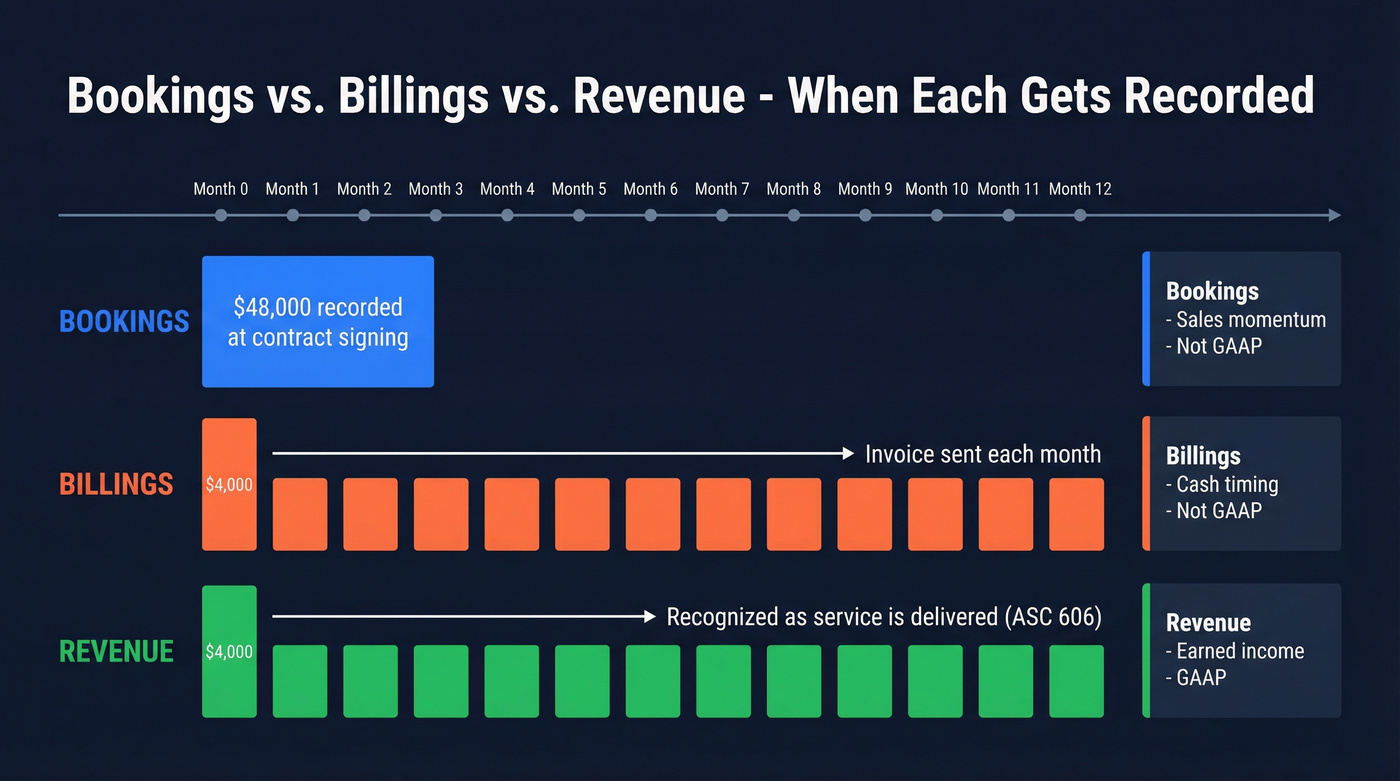
| Bookings | Billings | Revenue | |
|---|---|---|---|
| When recorded | Contract signed | Invoice sent | Service delivered |
| What it measures | Sales momentum | Cash timing | Earned income |
| GAAP status | Not GAAP | Not GAAP | GAAP (ASC 606) |
Revenue recognition follows the ASC 606 five-step framework: identify the contract, identify performance obligations, determine the transaction price, allocate it, and recognize revenue as obligations are satisfied. For monthly-billed SaaS, bookings typically convert to recognized revenue monthly over the contract term.
If you're only tracking revenue, you're driving by looking in the rearview mirror. Bookings tell you what's coming.

Bookings start with pipeline, and pipeline starts with reaching real buyers. Prospeo's 98% email accuracy and 7-day data refresh mean your reps connect with verified decision-makers - not bounced addresses that inflate forecasts and deflate close rates.
Stop booking phantom pipeline. Start reaching real buyers.
A Worked Example
You close a 3-year SaaS contract at $1,200/year billed monthly, plus $1,000 in professional services upfront.
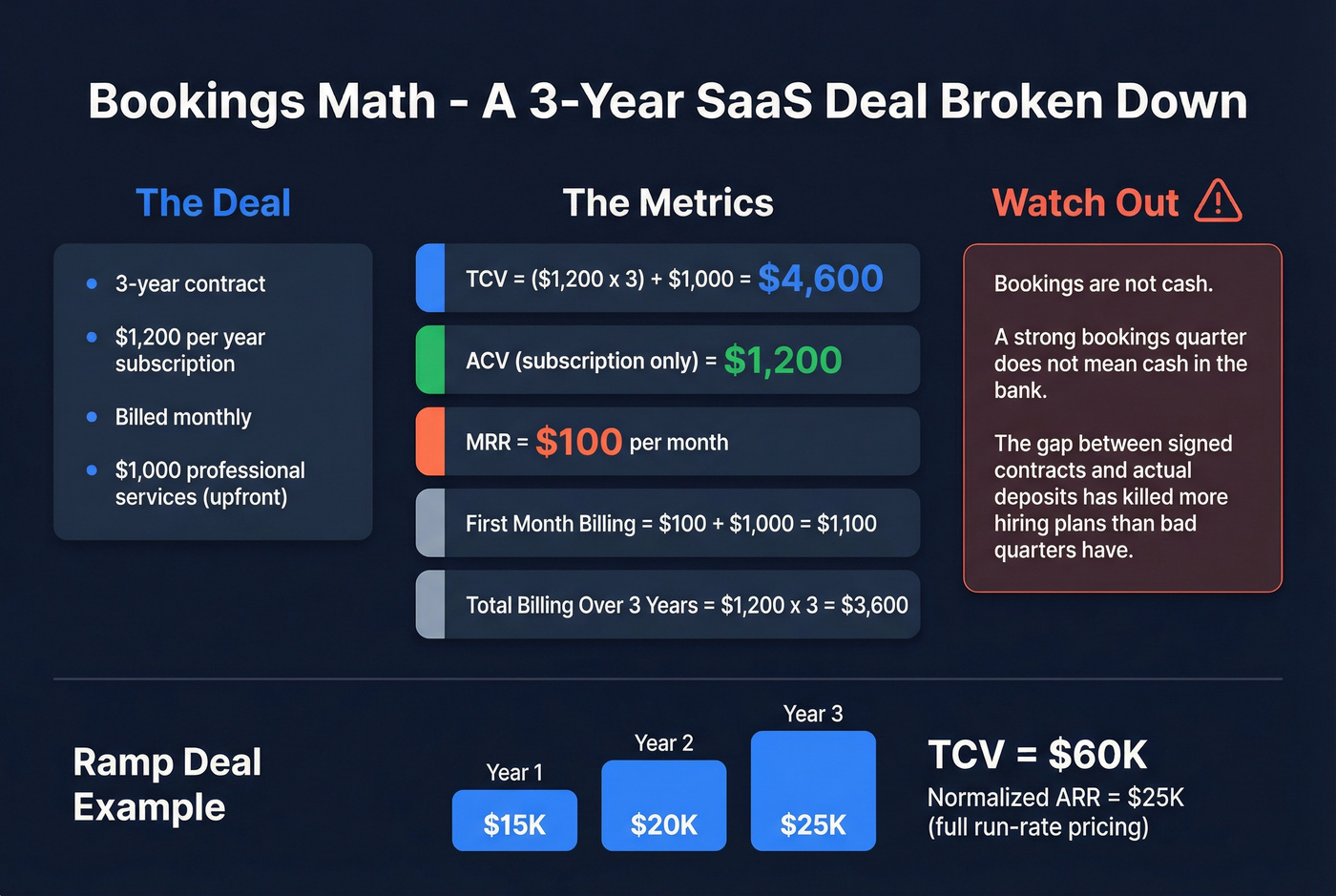
- TCV = ($1,200 x 3) + $1,000 = $4,600
- ACV (subscription only) = $1,200
- MRR = $100/month
- First-month billing = $100 subscription + $1,000 services = $1,100
Now consider a ramp deal: $15K in year one, $20K in year two, $25K in year three. TCV is $60K. One common approach for bookings purposes: record $25K ARR as the normalized run-rate at full pricing, which avoids understating the deal's long-term value.
One warning we've given to multiple teams after watching it happen: confusing bookings with cash creates "phantom runway." We've seen companies hire aggressively off strong bookings quarters, only to realize the cash doesn't arrive for months. That gap between a signed contract and actual bank deposits has killed more hiring plans than bad quarters have.
Why Bookings Matter
Bookings are the leading indicator for forecasting and investor communication - and for sales compensation at companies that pay reps on bookings rather than recognized revenue. They tell you whether the sales engine is accelerating or stalling, months before revenue reflects the same story.
Recent SaaS benchmarks paint a useful picture: median growth rate hit 26%, NRR sat at 101%, and expansion ARR accounted for 40% of total new ARR according to KeyBanc's 2025 SaaS Survey. Most companies screw up bookings reporting because sales, finance, and RevOps each use a different definition. Align on one before you build a single dashboard - and decide early whether reps get paid on bookings or revenue recognition.
Let's be honest: if your average deal size is under $15K and you don't have a dedicated RevOps function, skip the elaborate bookings taxonomy. Track new vs. expansion, reconcile monthly with finance, and move on. The companies that spend six months building a perfect bookings framework are the same ones that miss quota while doing it.
Edge Cases That Trip Teams Up
Cancellations reverse bookings. If a deal signed in Q2 cancels in Q3, your net bookings take the hit. NYSE and Nasdaq-listed companies have been required to implement formal clawback policies since December 2023, which adds another layer of complexity to how cancelled bookings flow through comp plans.
Downgrades reduce net bookings in the period they occur, not retroactively.
Hybrid pricing complicates everything. According to OpenView's usage-based pricing report, 51% of companies now combine subscription with usage-based models, meaning the "committed" portion of a booking might only be a fraction of actual spend. If you're running a hybrid model, define upfront what counts as a booking - the committed minimum, the expected spend, or something else entirely.
Tracking Bookings Accurately
If your CRM close dates are a mess, your bookings report is fiction. Three fixes that actually work:
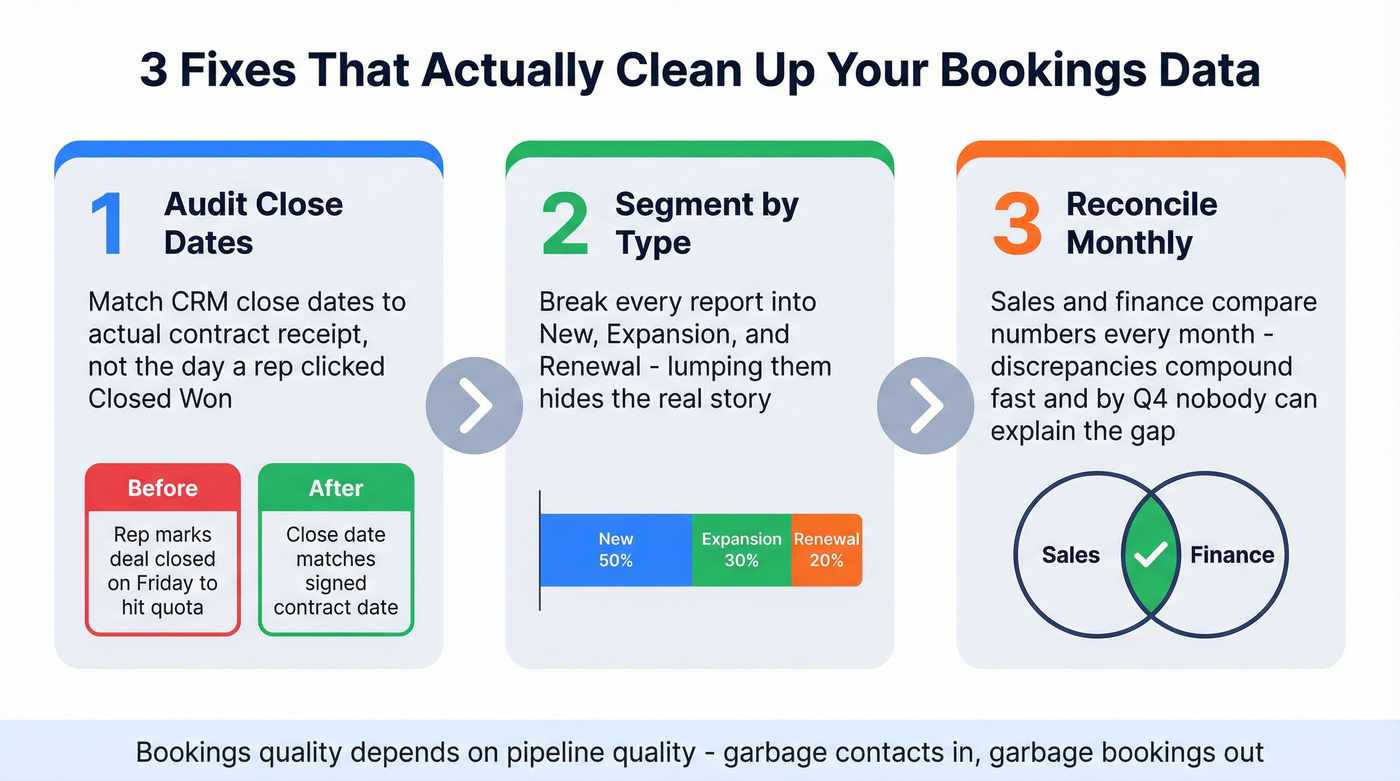
Audit close dates to match actual contract receipt, not the day a rep marked it "Closed Won." This single change cleaned up more reporting discrepancies than any dashboard overhaul we've seen.
Segment by type - new, expansion, renewal - in every report. Lumping them together hides the story. A quarter that looks flat on total bookings might actually show strong new business offset by churn, which is a very different problem than weak pipeline.
Reconcile monthly between sales and finance. Discrepancies compound fast, and by Q4 you're staring at a gap nobody can explain.
Bookings quality depends on pipeline quality - and pipeline quality gets a lot better when reps can actually reach the right people. If reps are chasing bounced emails and dead leads, your pipeline inflates with deals that never close. Tools like Prospeo, with 98% email accuracy and a 7-day data refresh cycle, keep the contacts feeding your pipeline real so the bookings numbers that come out the other end actually mean something.
If you want to tighten the inputs, start with data enrichment and a clean contact management process, then standardize your sales operations metrics so finance and sales are reading the same scoreboard.
FAQ
Do bookings include one-time fees?
Most companies include professional services and setup fees in TCV bookings but exclude them from ACV and ARR calculations. The key is documenting your approach and applying it consistently across every reporting period.
Can bookings be negative?
Yes. Net bookings turn negative when downgrades and churn exceed new and expansion bookings in a given period. That's a serious retention red flag - typically signaling product-market fit erosion or pricing misalignment that warrants immediate investigation.
How do I build pipeline that converts to real bookings?
Start with accurate contact data so reps spend time selling, not chasing bounced emails. Verified emails and direct dials mean fewer dead ends and more conversations with actual decision-makers. Clean pipeline in, reliable bookings out.
Teams using Prospeo book 26% more meetings than ZoomInfo users - because every contact in their CRM is verified and current. When your pipeline is built on 300M+ verified profiles refreshed weekly, the bookings that come out the other end actually convert to revenue.
Clean data in, real bookings out. It starts at $0.01 per email.