

What Is a CPQ? The Vendor-Neutral Guide for 2026
Your VP of Sales just told you the team spends more time building quotes in Excel than actually selling. Someone mentioned CPQ. So what is a CPQ, and does your team actually need one?
Most CPQ guides are written by companies that sell CPQ software. We don't. We're a data company, which means we can tell you when you don't need configure, price, quote software - and no CPQ vendor will ever say that.
The short version: CPQ stands for Configure, Price, Quote - software that automates product configuration, pricing logic, and quote generation. The market hit $3.63 billion in 2026 and is growing at 15.74% CAGR through 2031. Most companies under 50 employees with simple product lines don't need it. And the #1 reason CPQ fails isn't the software - it's automating broken processes.
CPQ Definition and Core Concept
CPQ stands for Configure, Price, Quote - software that automates how businesses configure complex products, calculate pricing with rules-based logic, and generate professional sales quotes. It replaces manual spreadsheet-based quoting with an automated system, cutting pricing errors by around 45% and compressing quote delivery from days to minutes.
That growth rate tells you something. Companies aren't adopting this technology because it's trendy - they're adopting it because manual quoting breaks at scale, and the cost of broken quotes compounds faster than most finance teams realize. Cloud deployments already account for 58.21% of the market. If you're evaluating CPQ today, you're looking at SaaS, not on-prem.
How CPQ Software Works
The name is the workflow: Configure, then Price, then Quote.
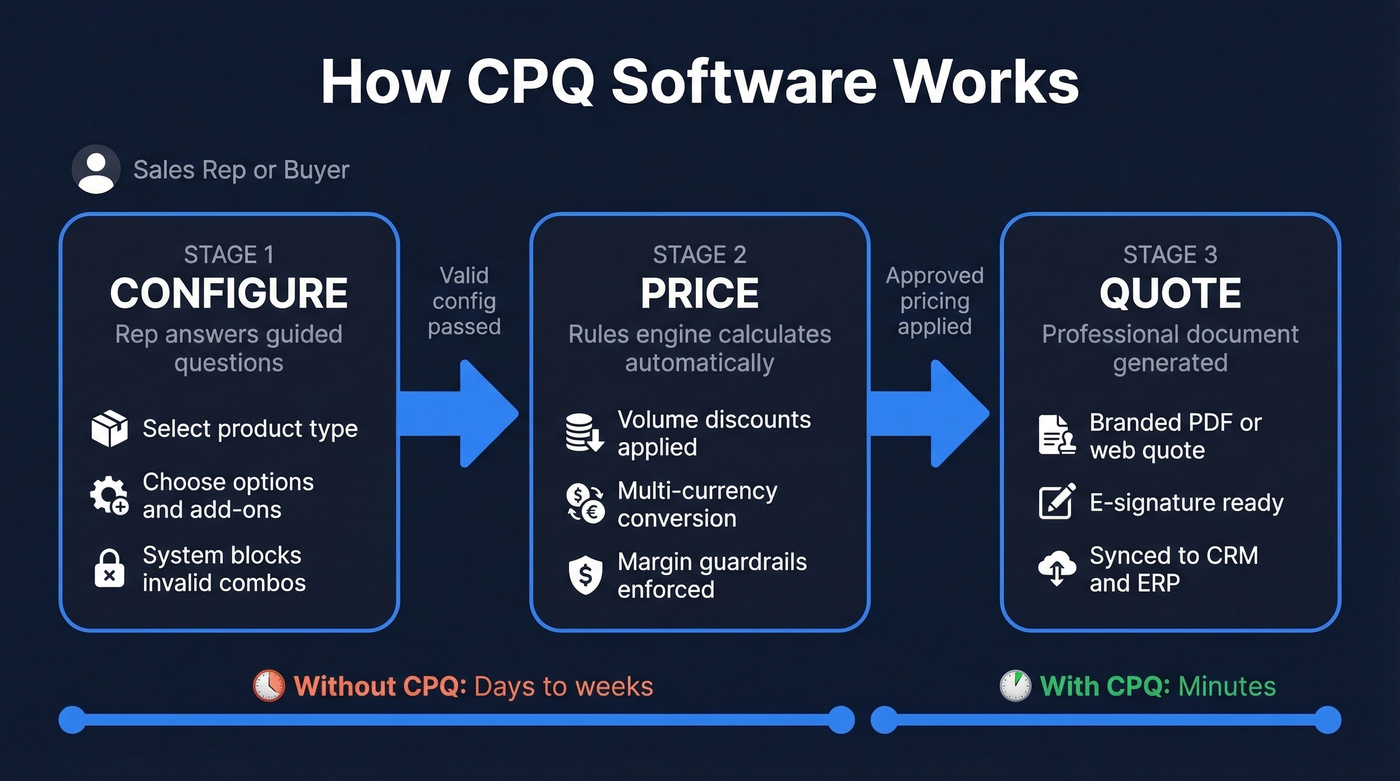
Think about ordering a pizza online. You pick a size, choose a crust, add toppings, and the price updates in real time. Invalid combinations are blocked - no deep-dish crust on a personal size. That's CPQ logic at its simplest.
Now scale that to industrial equipment. A manufacturer selling hydraulic systems might offer 5 frame sizes, 12 pump configurations, 8 valve types, 4 control packages, and 3 warranty tiers - that's over 5,700 valid combinations, and real-world catalogs often reach tens of thousands. The system enforces which combinations work, applies correct pricing, and generates a quote document in minutes instead of days.
A "guided selling" layer sits on top. Instead of expecting reps to memorize the catalog, the system asks questions - "What's the application environment? What throughput do you need?" - and narrows the configuration automatically. The rep focuses on the customer's problem. The software handles the combinatorics.
CPQ vs. Spreadsheets
Spreadsheets work until they don't. And when they break, they break silently.
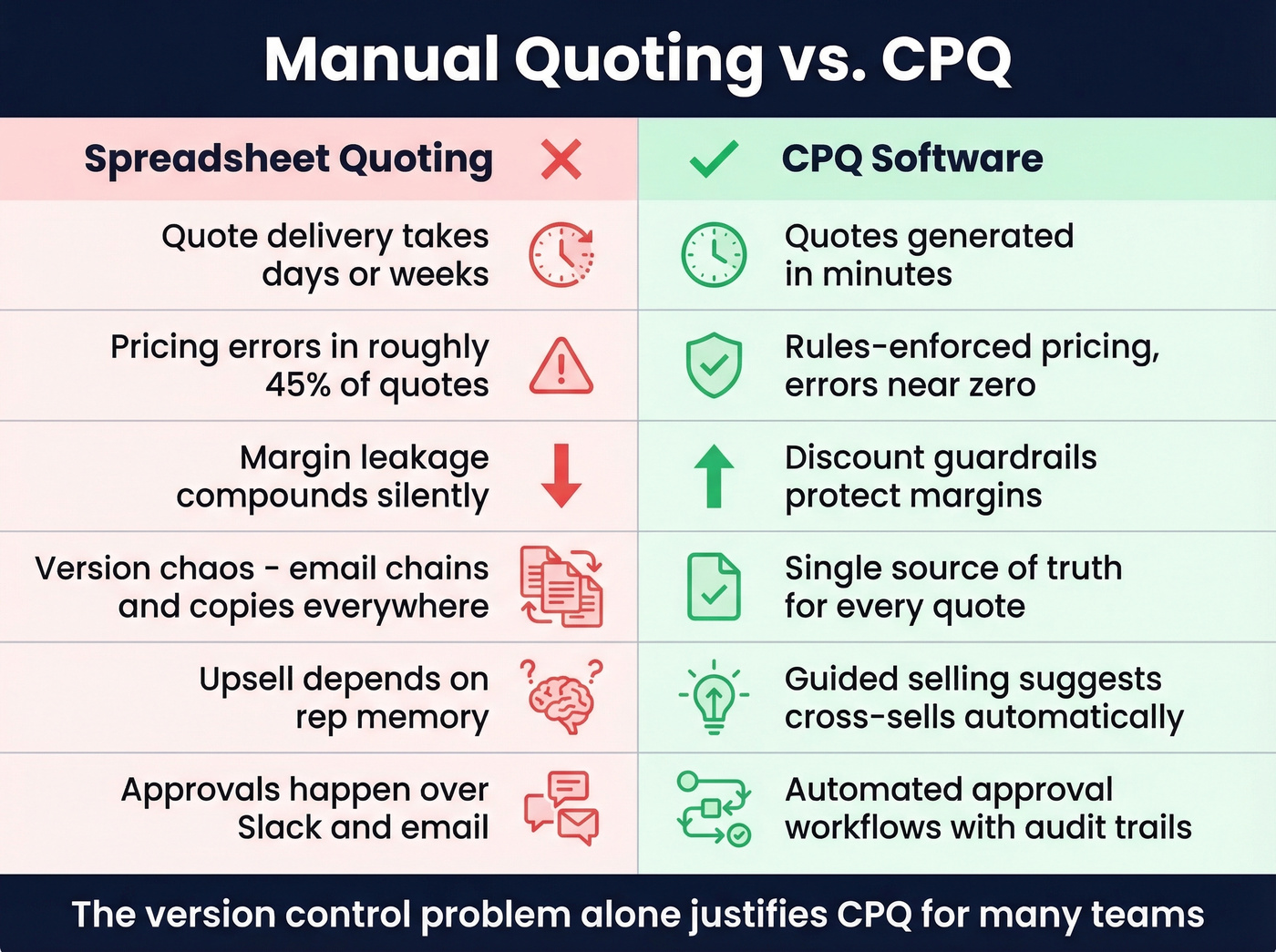
A wrong formula, a stale price list, a discount that shouldn't have been approved - these errors compound into tens of thousands in margin leakage per quarter. We've seen it firsthand working with sales teams on data quality: three different reps sending three different prices for the same product in the same week, all working from different spreadsheet versions.
| Dimension | Manual Quoting | CPQ |
|---|---|---|
| Quote delivery | Days | Minutes |
| Pricing errors | ~45% higher without CPQ | Rules-enforced, materially lower |
| Margin leakage | Compounds silently | Guardrails prevent it |
| Version control | Email chains, copies | Single source of truth |
| Upsell/cross-sell | Relies on rep memory | Guided selling suggests |
The version control problem alone justifies the investment for many teams. Configure, price, quote software eliminates spreadsheet chaos by enforcing one source of truth for pricing, discounting rules, and product configurations.
Key Features to Evaluate
Guided selling walks reps through needs-based questions instead of forcing them to navigate a product catalog. It's the difference between "pick from 5,700 configurations" and "answer 6 questions."
Rules-based pricing automates volume discounts, tiered pricing, contract-specific rates, and multi-currency calculations. Dynamic pricing goes further, adjusting based on deal history, competitive pressure, or margin targets.
Approval workflows route non-standard discounts to the right manager automatically. No more Slack messages asking "can I give them 15% off?"
Quote and proposal generation produces branded, professional documents - PDFs, interactive web quotes, or e-signature-ready proposals - directly from the configured deal. CRM and ERP integration syncs quotes with Salesforce, HubSpot, SAP, or whatever your stack runs.
Compliance and audit trails provide audit-ready approval logging, permissioned access to pricing rules, and change-tracking for regulated environments.
Subscription and usage billing handles multi-year ramps, co-terming, midterm expansions, proration, and renewals. For manufacturing, bill of materials generation turns a configured product into a buildable parts list.
Who Needs CPQ (and Who Doesn't)
The answer depends entirely on your quoting complexity.
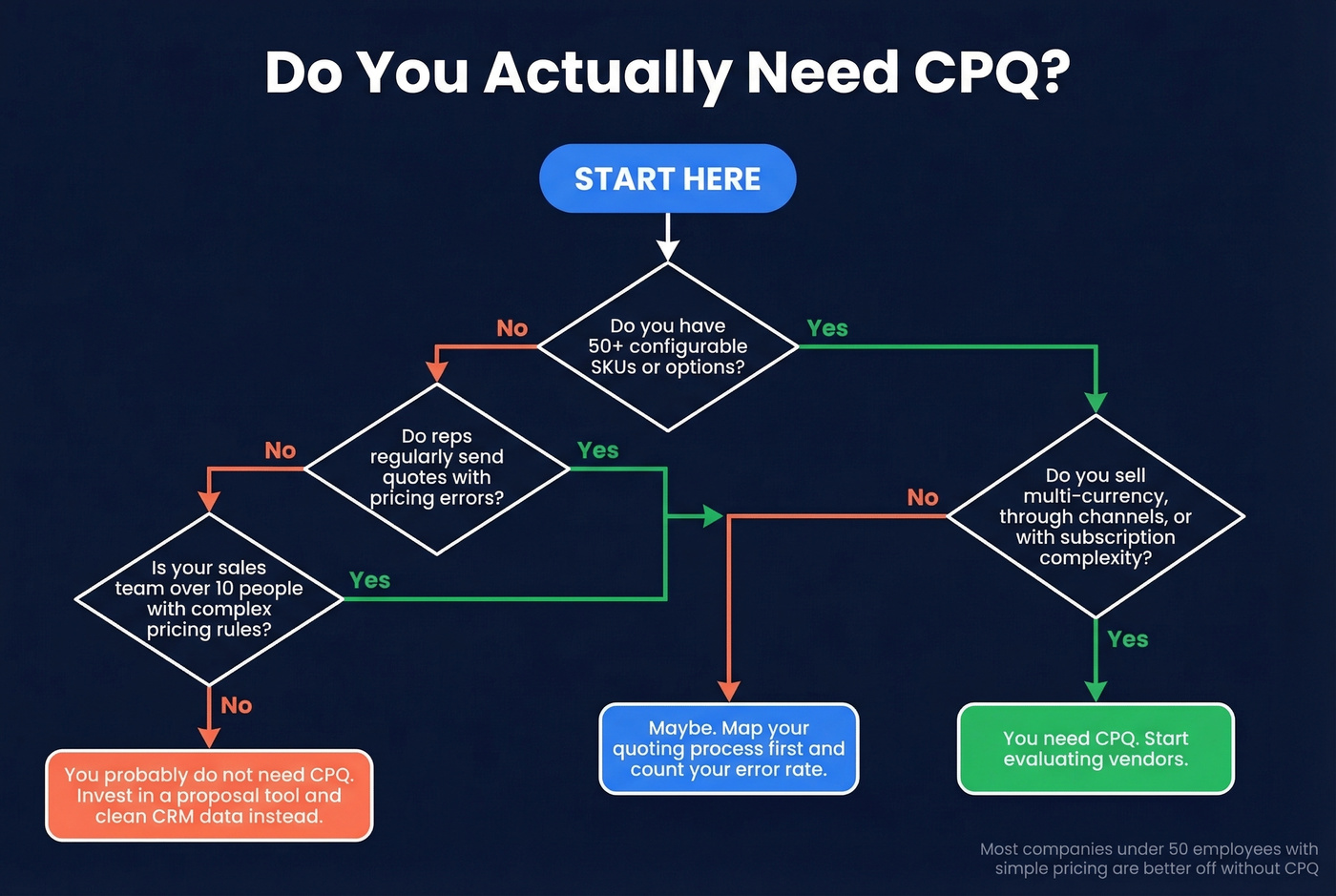
Signs you need it:
- Your product catalog has 50+ configurable options or SKUs
- Pricing involves custom rules, volume tiers, or channel-specific rates
- You sell in multiple currencies or through channel partners
- Subscription complexity is creating manual workarounds
- Reps regularly send quotes with pricing errors
Signs you don't:
- Fewer than 20 SKUs with flat, published pricing
- Your sales team is under 10 people
- Quotes are simple enough that a proposal tool like PandaDoc handles them
Here's the thing: most companies under 50 employees with straightforward product lines are better off with a good proposal tool and clean CRM data. CPQ adds value when complexity creates errors. If your quoting process isn't complex enough to generate errors, you're buying a solution for a problem you don't have. Skip it and invest in your data instead.
In buying threads on r/salesengineering, buyers consistently flag API flexibility, SOC 2 compliance, and standalone SaaS deployment as must-haves - especially for partner-facing use cases where CRM-native plugins fall short.

Every CPQ guide says the same thing: garbage in, garbage out. Your configure-price-quote system is only as good as the contact data feeding it. Prospeo gives you 300M+ profiles with 98% email accuracy on a 7-day refresh cycle - so your quotes reach real buyers, not dead inboxes.
Fix your data before you automate your quotes.
Industries That Benefit Most
Manufacturing dominates adoption, accounting for 32.12% of market revenue. Thousands of product variables, custom configurations, and BOM generation make this technology nearly essential at scale. 3D visualization - letting buyers see their configured product before ordering - is becoming a competitive differentiator.
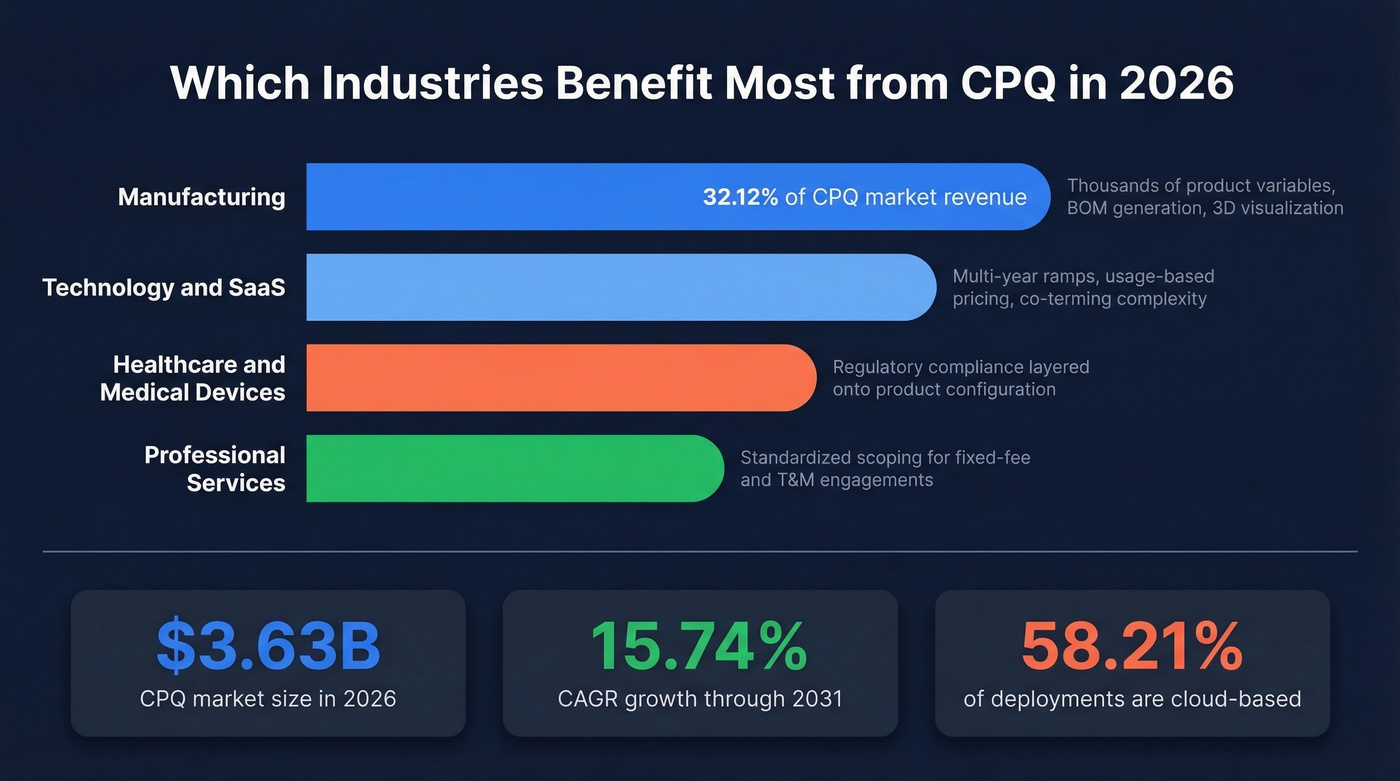
Technology and SaaS companies face subscription billing complexity: multi-year ramps, usage-based pricing, midterm expansions, and co-terming create a quoting nightmare that spreadsheets can't handle reliably.
Healthcare and medical devices layer regulatory compliance onto product configuration. When a wrong configuration isn't just a pricing error but a compliance violation, rules-based guardrails become critical.
Professional services firms use configure-price-quote tools to standardize scoping and pricing for engagements combining fixed-fee and time-and-materials components.
Why Implementations Fail
This is the section no vendor wants to write. But in our experience working with sales teams on data quality, the implementation stage is where most projects stall - and the root cause is rarely the software itself.
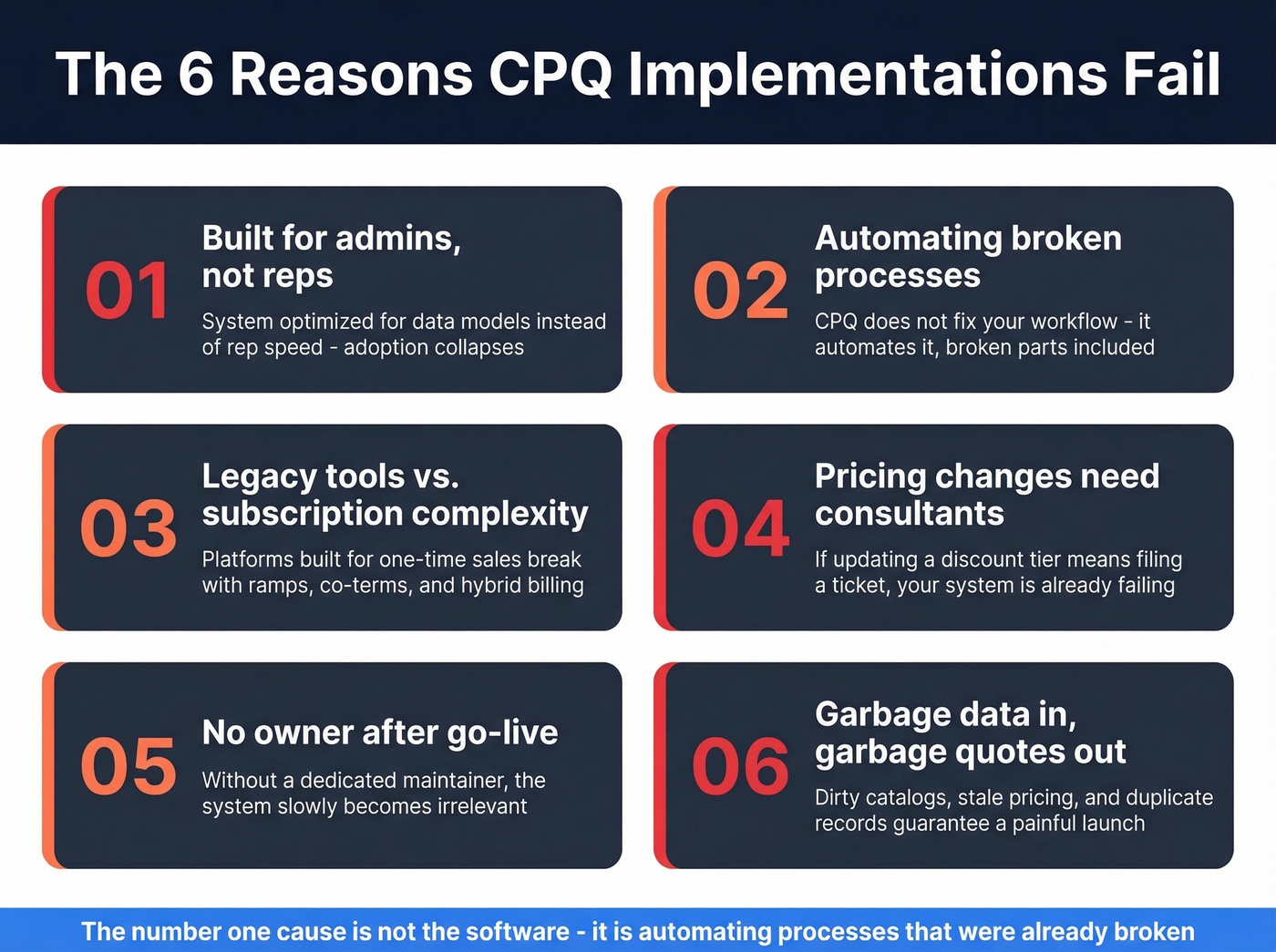
Built for admins, used by reps. Platforms get configured by RevOps teams who think in data models and pricing rules. Daily users are sales reps who think in "how fast can I get this quote out?" When the system is optimized for administrative elegance instead of rep speed, adoption collapses. Reps revert to spreadsheets within weeks.
Automating broken processes. Your quoting process is messy, inconsistent, and undocumented - so you buy software to "fix" it. But CPQ doesn't fix processes. It automates them. Automate a broken process and you get broken quotes faster.
Subscription complexity breaks legacy tools. Many platforms were built for one-time product sales. When SaaS companies force multi-year ramps, co-terming, and hybrid usage/subscription models into these tools, the logic breaks.
Pricing changes require code or consultants. If updating a discount tier means filing a ticket with your implementation partner, your system is already failing. We've talked to RevOps teams who spent more on consultants post-launch than on the software itself.
No defined ownership post-go-live. Without a designated owner who maintains rules, trains new reps, and audits configurations, the system slowly becomes irrelevant. This one kills more rollouts than bad software ever will.
Per-user licensing breaks for channel-heavy businesses. If you have hundreds of resellers who each generate a few quotes per year, per-seat pricing becomes economically absurd. Look for usage-based or embedded licensing models - this is a pain point that almost no vendor addresses upfront.
Garbage data in, garbage quotes out. Migrating dirty product catalogs, stale pricing, and duplicate records into a new system guarantees a painful launch.
Symptoms of a failing rollout: Reps avoid the system for complex deals. Pricing changes require outside help. Renewals are still manual. If any of these sound familiar, the problem probably isn't the software.
AI in CPQ - Real vs. Hype
Let's be honest about what actually works versus what's still marketing.
Natural language configuration is genuinely useful. A rep types "heavy-duty crane for outdoor marine environments, 50-ton capacity" and the system configures the right product. This eliminates the guided-selling questionnaire for experienced reps who already know what they need.
Predictive pricing and discount recommendations analyze quote history, win rates, and competitive data to suggest optimal pricing. This is where AI adds real margin - nudging reps away from unnecessary discounts.
AI-triaged approvals auto-approve low-risk deals and flag high-risk ones for human review. This cuts approval bottlenecks without removing oversight.
Self-service portals are growing fast. One Oracle case study cited on CPQ.se shows self-generated quotes jumping from 2% to 79% after integrating AI-powered quoting - a shift that suggests buyers want to configure and quote without talking to a rep.
Here's our take on AI in this space: AI should sit above pricing rules, not replace them. Deterministic guardrails for finance and compliance are non-negotiable. An AI that "recommends" a discount below your margin floor isn't helpful - it's dangerous. Any vendor selling you "AI-powered pricing" without explaining the guardrails is selling you risk.
Vendor Landscape in 2026
The market has no single dominant player, which is actually good news for buyers. Here's a snapshot based on Gartner Peer Insights ratings:
| Vendor | Gartner Rating | Reviews | Approx. Pricing | Notes |
|---|---|---|---|---|
| Conga CPQ | 4.7/5 | 267 | ~$75-$150/user/mo | Customers' Choice (most recent) |
| PandaDoc | 4.6/5 | 190 | From ~$49/user/mo | Document-focused; CPQ in higher tiers |
| DealHub CPQ | 4.5/5 | 114 | ~$100/user/mo (15-user min) | Strong mid-market option |
| HubSpot Sales Hub | 4.5/5 | - | ~$100/user/mo (Professional) | Basic quoting built into CRM |
| Infor CPQ | 4.5/5 | 80 | $50K+/year | Manufacturing-focused |
| Salesforce Agentforce Revenue Mgmt | 4.3/5 | 271 | ~$150-$300/user/mo | Salesforce's newer direction |
| SAP CPQ | 4.3/5 | 107 | $50K-$200K+/year | Enterprise |
| Oracle CPQ | 4.2/5 | 148 | $50K-$200K+/year | Enterprise, strong AI |
Salesforce CPQ is effectively end-of-sale - new customers are being pushed toward Agentforce Revenue Management. If you're a Salesforce shop, this transition matters. Teams with heavy customization face a near-reimplementation.
One buying framework that works: shortlist three vendors - one CRM-native option like Salesforce Agentforce or HubSpot's built-in quoting, one standalone specialist like Conga or DealHub, and one industry-specific tool like Infor for manufacturing. Run a proof of concept with your actual product catalog, not a demo dataset.
The Data Problem Upstream of CPQ
Configure, price, quote software automates the quote. But if your CRM contacts are wrong, you're sending perfect quotes to dead inboxes.
This is the failure mode nobody talks about at vendor demos. Stale emails, outdated job titles, and duplicate records don't just create messy CRM hygiene - they break the entire quote-to-cash chain. A beautifully configured quote that bounces or lands in the wrong inbox is worse than a slow manual quote that reaches the right person.

Tools like Prospeo can verify your contact database before migration - 98% email accuracy on a 7-day refresh cycle, with native Salesforce and HubSpot integrations. Clean your CRM data in place before the implementation starts. The quoting engine is only as good as the data feeding it.
If you want a broader view of options, compare data enrichment providers and build a simple lead enrichment workflow before rollout.
You read it above: the #1 reason CPQ fails is automating broken processes. That starts with bad CRM data. Prospeo's enrichment API returns 50+ data points per contact at a 92% match rate - so your reps configure quotes for verified decision-makers, not outdated records.
Clean CRM data costs $0.01 per email. Broken quotes cost thousands.
FAQ
What Does CPQ Stand For?
CPQ stands for Configure, Price, Quote - software that automates product configuration, pricing calculations, and professional quote generation for B2B sales teams. It replaces manual spreadsheet-based quoting with rules-enforced logic, reducing errors and compressing deal cycles from days to minutes.
How Much Does CPQ Software Cost?
Mid-market tools like DealHub start at roughly $100/user/month with a 15-user minimum; Conga runs $75-$150/user/month. Enterprise platforms like SAP and Oracle range from $50,000-$200,000+/year. HubSpot includes basic quoting in Sales Hub Professional at around $100/user/month - a lighter entry point for simpler catalogs.
What's the Difference Between CPQ and CRM?
CRM manages customer relationships and pipeline; CPQ automates the quoting process within that pipeline. Most configure-price-quote tools integrate with CRMs like Salesforce or HubSpot - they're complementary, not competing. You need both; the question is whether your quoting complexity justifies a dedicated tool.
How Long Does Implementation Take?
Simple deployments take 4-8 weeks. Complex enterprise rollouts with custom integrations, data migration, and subscription logic can stretch to 6-15 months. The biggest variable is internal process clarity, not the software. Teams that document pricing rules and clean their data before kickoff finish faster.
How Do I Clean CRM Data Before a CPQ Rollout?
Use an email verification platform to flag invalid emails and outdated records before migration. Bad contact data is the most common and most preventable cause of implementation problems - a few hours of cleanup saves weeks of post-launch firefighting. Prospeo's free tier gives you 75 verifications per month to start auditing your database right away.