

What Is a SaaS Sales Funnel? Data-Backed Guide (2026)
You're spending $15K a month on ads, running three outbound sequences, and your CRM shows three closed deals. The CEO wants to know where the leads go. The honest answer? You don't have a funnel. You have a series of disconnected activities with no conversion math behind them.
A SaaS sales funnel maps how strangers become paying subscribers and - critically - how they stay. The model you choose depends on your average deal size, your product's complexity, and whether buyers can experience value without a sales rep holding their hand. Let's break this down stage by stage with real conversion benchmarks, the metrics that separate healthy funnels from money pits, and the mistakes we see kill most funnels before they ever scale.
SaaS Sales Funnel Defined
A SaaS sales funnel is the structured journey a prospect takes from first discovering your product to becoming a paying subscriber and then expanding their usage over time. It's the framework you use to measure, diagnose, and improve how efficiently you turn attention into recurring revenue.
Here's what makes it different from a traditional sales funnel: it doesn't end at the sale. A SaaS funnel treats the closed deal as the starting line, not the finish. Because revenue is recurring, retention and expansion are built-in stages, not afterthoughts. A customer who churns after three months cost you money. A customer who expands into a second team paid for themselves twice over. That math changes everything about how you design each stage.
Three Funnel Models: PLG, Sales-Led, or Hybrid
Not every SaaS company runs the same funnel. The model you pick should match your deal size, product complexity, and buyer expectations.
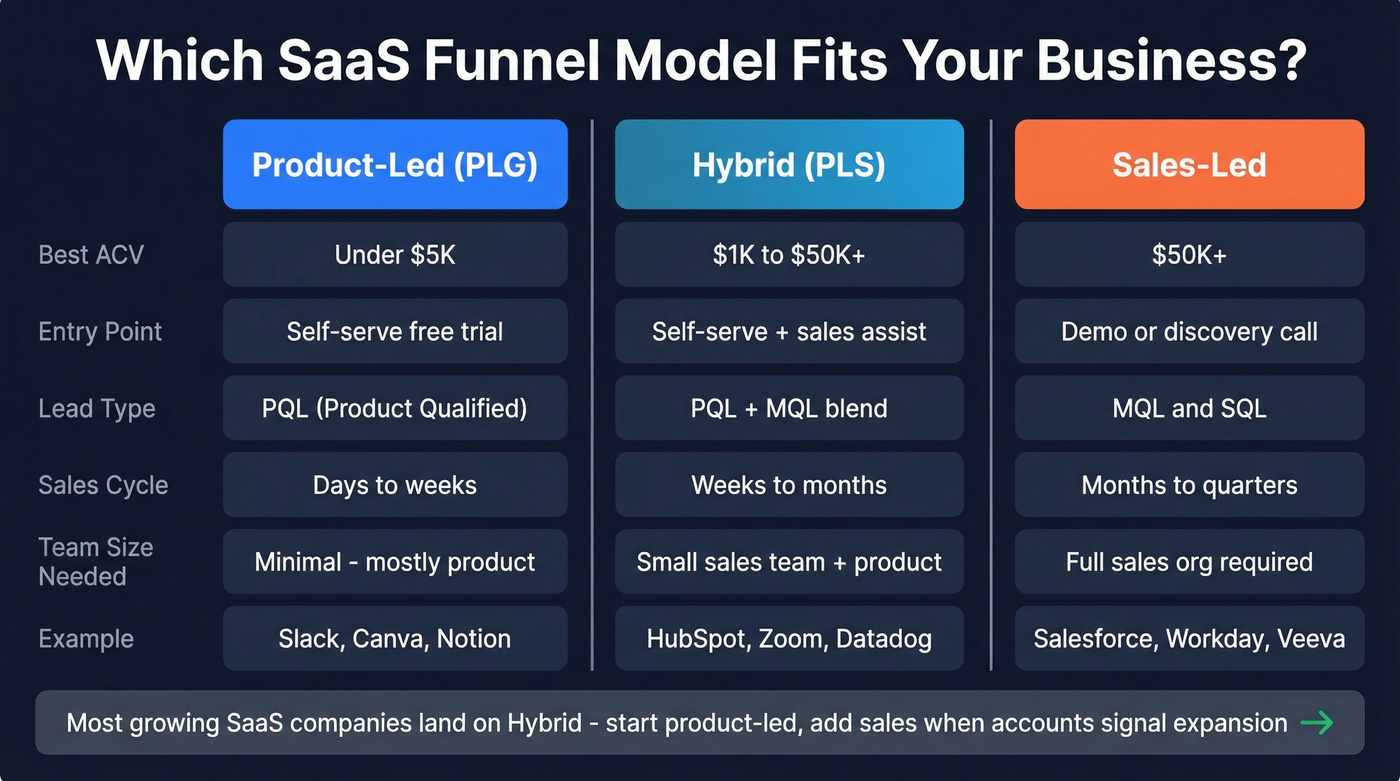
| PLG | Hybrid (PLS) | Sales-Led | |
|---|---|---|---|
| Best ACV | <$5K | $1K-$50K+ | $50K+ |
| Entry point | Self-serve trial | Self-serve + sales | Demo/discovery call |
| Lead type | PQL | PQL + MQL | MQL/SQL |
| Sales cycle | Days-weeks | Weeks-months | Months-quarters |
| Example | Slack, Canva | HubSpot, Zoom | Salesforce, Workday |
Product-led growth (PLG) works when your product is simple enough to demonstrate value without a human. 97% of buyers want to try before buying, and launching a free offer typically drives 20-30% more signups than gated access alone. For sub-$5K deals, there's no economic justification for a sales team to hand-hold every prospect through a demo cycle. Product-qualified leads convert 5-10x faster than MQLs because the user has already experienced the value firsthand.
Sales-led is the right call for complex, high-ACV deals where the buyer needs a business case, security review, and executive alignment before signing. Think $50K+ contracts with multi-month procurement cycles. The funnel is slower but the revenue per deal justifies the cost of a dedicated rep.
Hybrid (product-led sales) is where most growing SaaS companies land today. As Jason Eubanks, CRO at Harness, put it on SaaStr: "It doesn't really matter where you start because you'll need to do both." Users come in through self-serve; sales steps in when the account hits expansion triggers. For early-stage teams unsure which model fits, hybrid gives you the most flexibility to learn what works.
Here's our take: if your average contract value sits below $10K, you almost certainly don't need a sales-led funnel. A $10K deal can't absorb $3K in sales time plus $1,200 in CAC and still produce healthy margins. Start product-led. Add sales when accounts signal expansion.
Six Core Funnel Stages
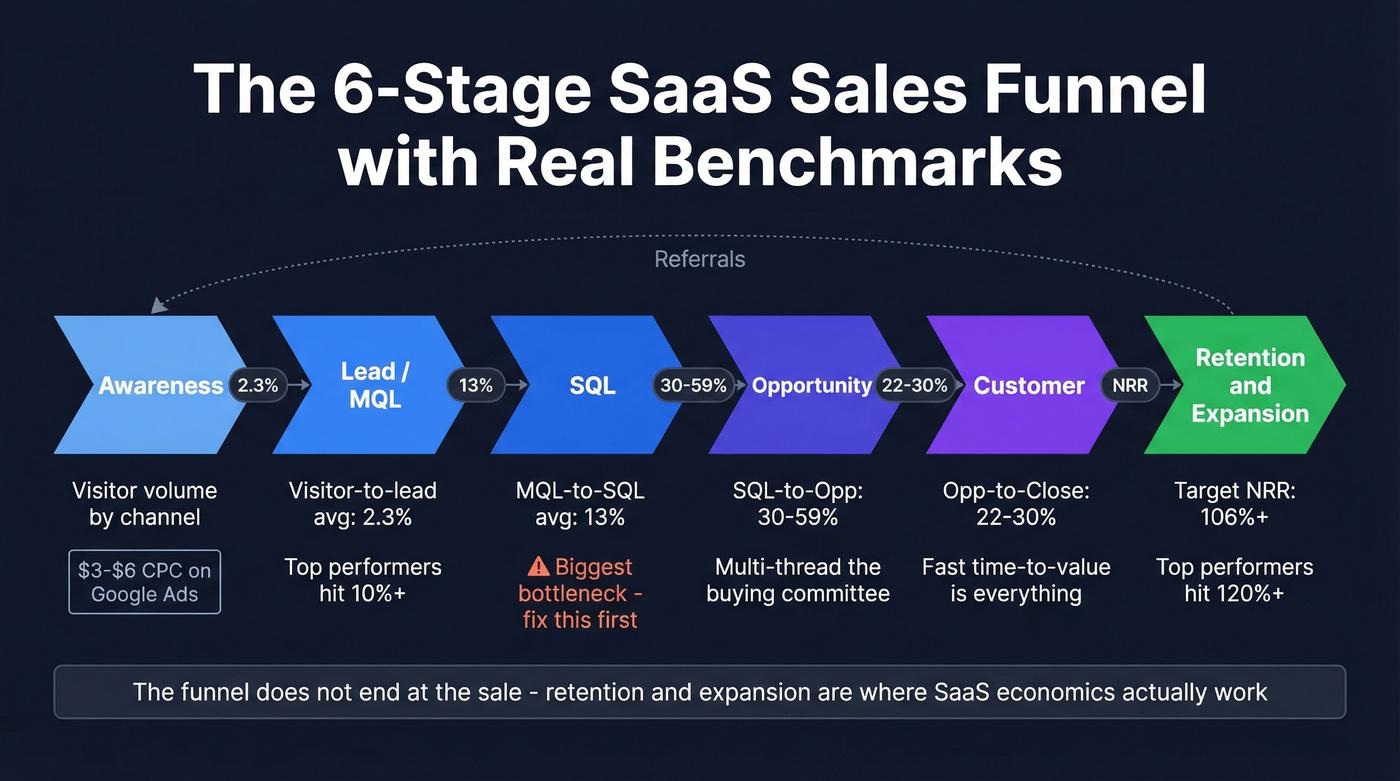
Here are the stages of a SaaS sales funnel, with conversion benchmarks and the tactics that improve each transition.
1. Awareness
The prospect discovers you exist. Track visitor volume by channel. Tactics include SEO, content marketing, paid ads, and social. For paid channels, expect to pay $3-$6 per click on Google Ads for B2B SaaS keywords (enterprise terms exceed $15), and LinkedIn ads average a 0.62% CTR - budget accordingly. For outbound, data quality at this stage determines everything downstream. Bad contact data here cascades into every stage below it.
2. Lead / MQL
The prospect engages meaningfully: downloads a resource, signs up for a trial, attends a webinar. The average visitor-to-lead rate is 2.3%, with top performers hitting 10%+. Gated content, free tools, and webinar registration drive this transition.
3. SQL - The Biggest Bottleneck
The average MQL-to-SQL conversion is just 13%. We've seen early-stage teams sit closer to 8%. The fix isn't more leads - it's tighter alignment between marketing and sales on what "qualified" actually means. Lead scoring, behavior triggers like pricing page visits and repeated logins, and honest MQL definitions make the difference here. If your marketing team counts every whitepaper download as an MQL, your SQL rate will always look terrible because it is.
4. Opportunity
An active deal with a defined next step. SQL-to-opportunity rates run 30-59% depending on channel. Tailored demos, proof-of-concept trials, and multi-threading into the buying committee push this number up.
5. Customer
Closed deal, first payment. Opportunity-to-close rates average 22-30%. Frictionless onboarding and fast time-to-value are everything at this stage. For enterprise deals, dedicated implementation support cuts churn risk dramatically.
6. Retention & Expansion
This is where SaaS economics actually work - or don't. Target net revenue retention of 106%+; top performers hit 120%+. Quarterly business reviews, usage-based expansion triggers, and referral programs compound growth from your existing base. If you're losing more than you're expanding, no amount of top-of-funnel spend will save you.
For PLG companies, the AARRR framework (Acquisition, Activation, Retention, Referral, Revenue) - originally coined by Dave McClure - maps more naturally to product-driven motions. Some teams extend this to AAARRR, adding an explicit Awareness stage to track micro-conversions like newsletter signups and first visits. The core idea is the same: measure stage-to-stage conversion and find your bottleneck.

Your MQL-to-SQL rate is 13% on average - and bad contact data makes it worse. Prospeo delivers 98% email accuracy and 125M+ verified mobile numbers with a 30% pickup rate, so every lead entering your funnel actually connects to a real buyer. Stop bleeding pipeline to bounced emails and dead numbers.
Feed your SaaS funnel data that actually converts.
Benchmarks by Acquisition Channel
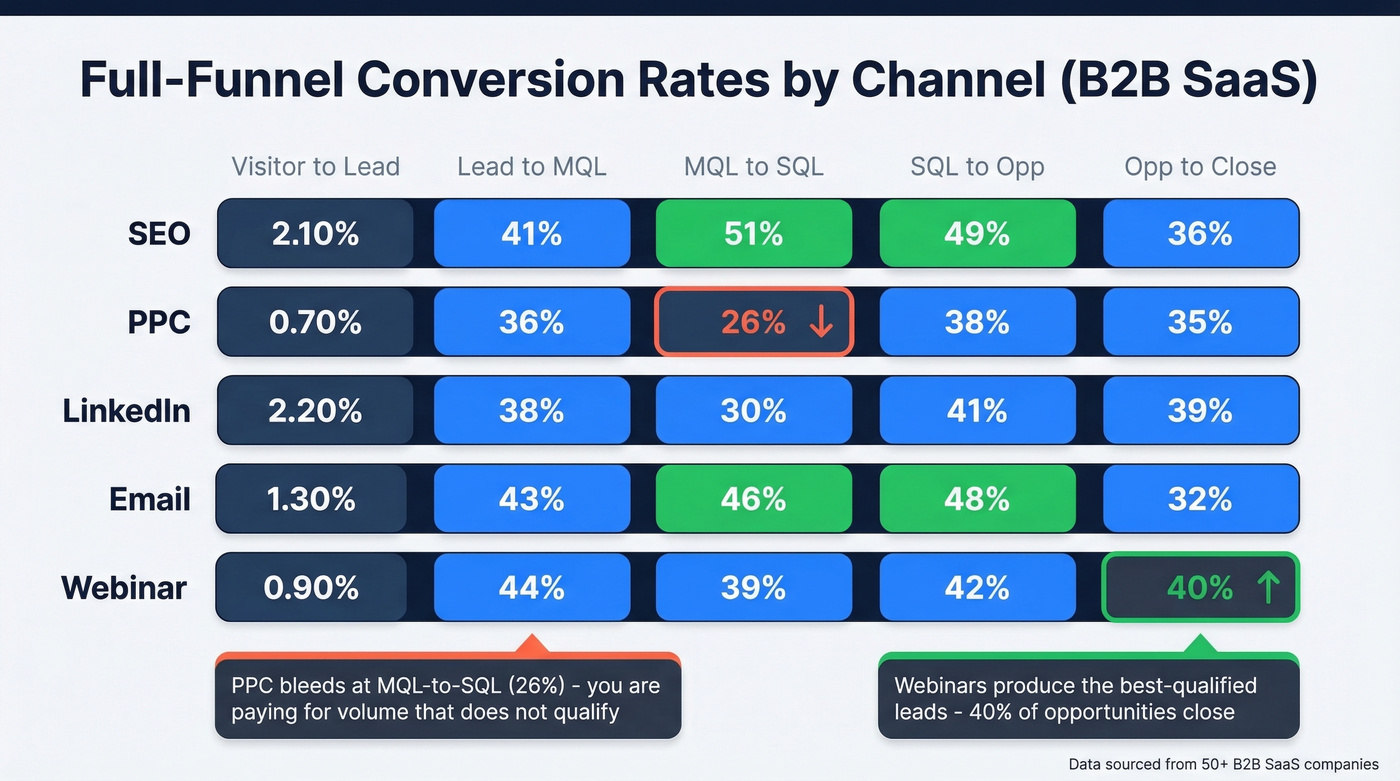
Not all traffic converts equally. Here's how the full funnel plays out by channel, based on aggregated data from 50+ B2B SaaS companies.
| Channel | Visitor-to-Lead | Lead-to-MQL | MQL-to-SQL | SQL-to-Opp | Opp-to-Close |
|---|---|---|---|---|---|
| SEO | 2.10% | 41% | 51% | 49% | 36% |
| PPC | 0.70% | 36% | 26% | 38% | 35% |
| 2.20% | 38% | 30% | 41% | 39% | |
| 1.30% | 43% | 46% | 48% | 32% | |
| Webinar | 0.90% | 44% | 39% | 42% | 40% |
SEO drives the highest visitor-to-lead rate at 2.1%, but webinars produce the best-qualified leads - 44% of webinar leads become MQLs, and 40% of webinar opportunities close. PPC looks cheap at the top but bleeds out at MQL-to-SQL (26%), which means you're paying for volume that doesn't qualify. If your PPC funnel is underperforming, the problem usually isn't your ads. It's your qualification criteria.
Now the trial model benchmarks, because this is where PLG economics get real.
| Model | Visitor-to-Signup (Organic) | Signup-to-Paid (Organic) |
|---|---|---|
| Opt-in free trial | 8.5% | 18.2% |
| Opt-out (CC required) | 2.5% | 48.8% |
| Freemium | 13.3% | 2.6% |
The tradeoff is clear. Opt-out trials requiring a credit card convert nearly 49% of signups to paid, but far fewer people sign up in the first place. Freemium casts a wide net (13.3% signup rate) but converts just 2.6% to paid. Your choice depends on whether you're optimizing for volume or conversion efficiency - and there's no universally right answer. We've seen freemium work brilliantly for companies with strong network effects and fail completely for niche tools with small TAMs.
Metrics That Actually Matter
Six numbers tell you whether your funnel is healthy or hemorrhaging cash.
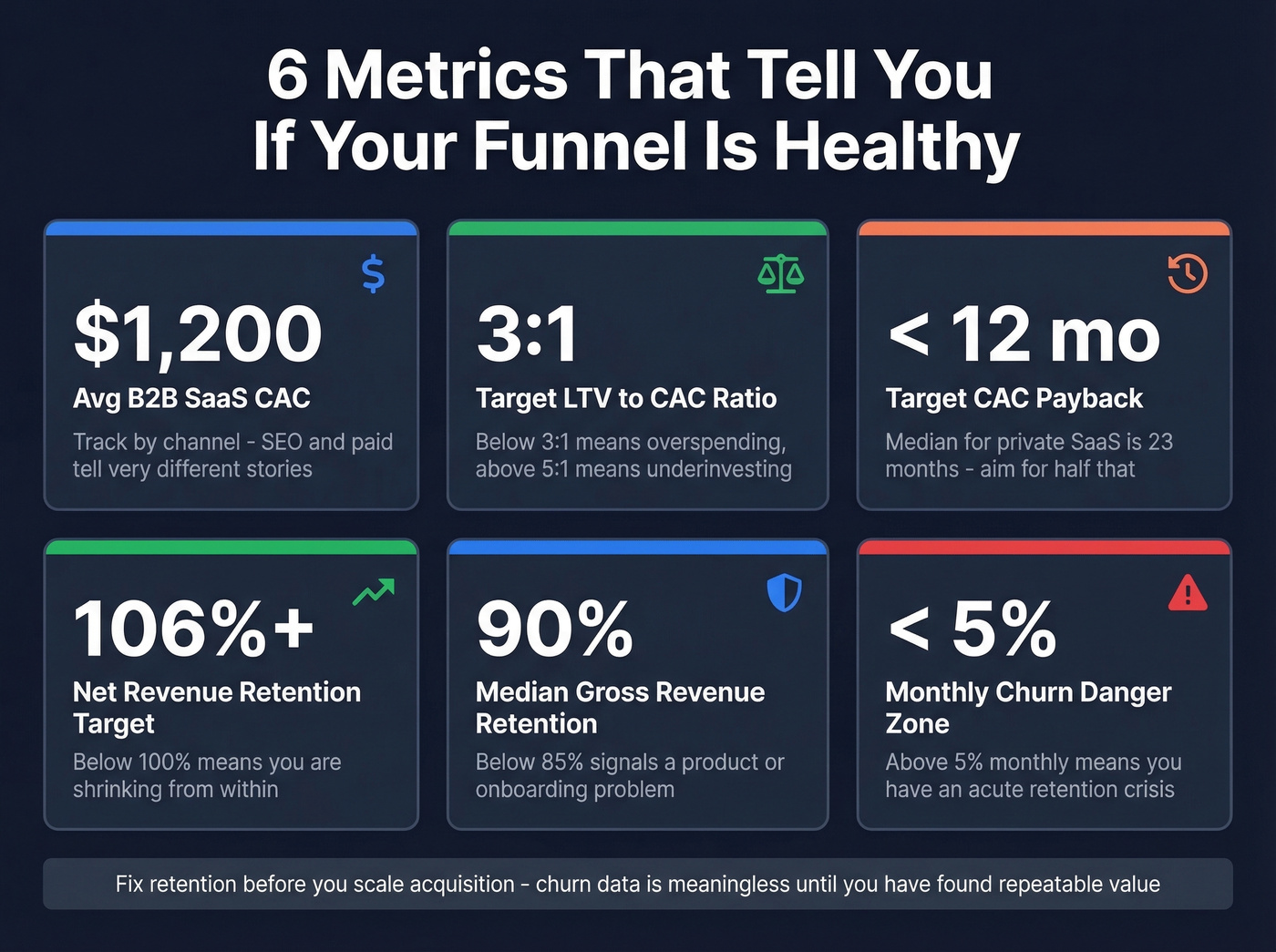
CAC (Customer Acquisition Cost): Total sales and marketing spend divided by new customers acquired. The average B2B SaaS CAC is $1,200, but this varies wildly by ACV. Track it by channel - your SEO CAC and your paid CAC are telling very different stories.
LTV:CAC Ratio: Target 3:1 or better. Below 3:1, you're spending too much to acquire customers relative to what they're worth. Above 5:1, you're probably underinvesting in growth.
CAC Payback Period: CAC divided by monthly gross profit per customer (monthly ARPU times gross margin %). The median for private SaaS is 23 months. Target under 12. Worked example: if your ACV is $30K, your CAC is $10K, and gross margin is 80%, your monthly gross profit is $2,000. Payback = $10K / $2,000 = 5 months. That's healthy. If payback exceeds 18 months, your unit economics are fragile - one churn spike and you're underwater.
Net Revenue Retention (NRR): Median is 106%, meaning the average SaaS company grows revenue from existing customers by 6% annually before adding new logos. Below 100% means you're shrinking from within.
Gross Revenue Retention (GRR): Median is 90%. This strips out expansion - it's pure retention. Below 85% and you've got a product or onboarding problem, not a sales problem.
Monthly Churn Rate: The median annual churn for B2B SaaS is around 3.5%, but if your monthly churn exceeds 5%, you have an acute retention crisis. Skip this if you're pre-product-market-fit - churn data is meaningless until you've found repeatable value. But once you have, fix retention before you scale acquisition.
Common Mistakes That Kill Funnels
Three patterns destroy more SaaS funnels than bad marketing ever will.
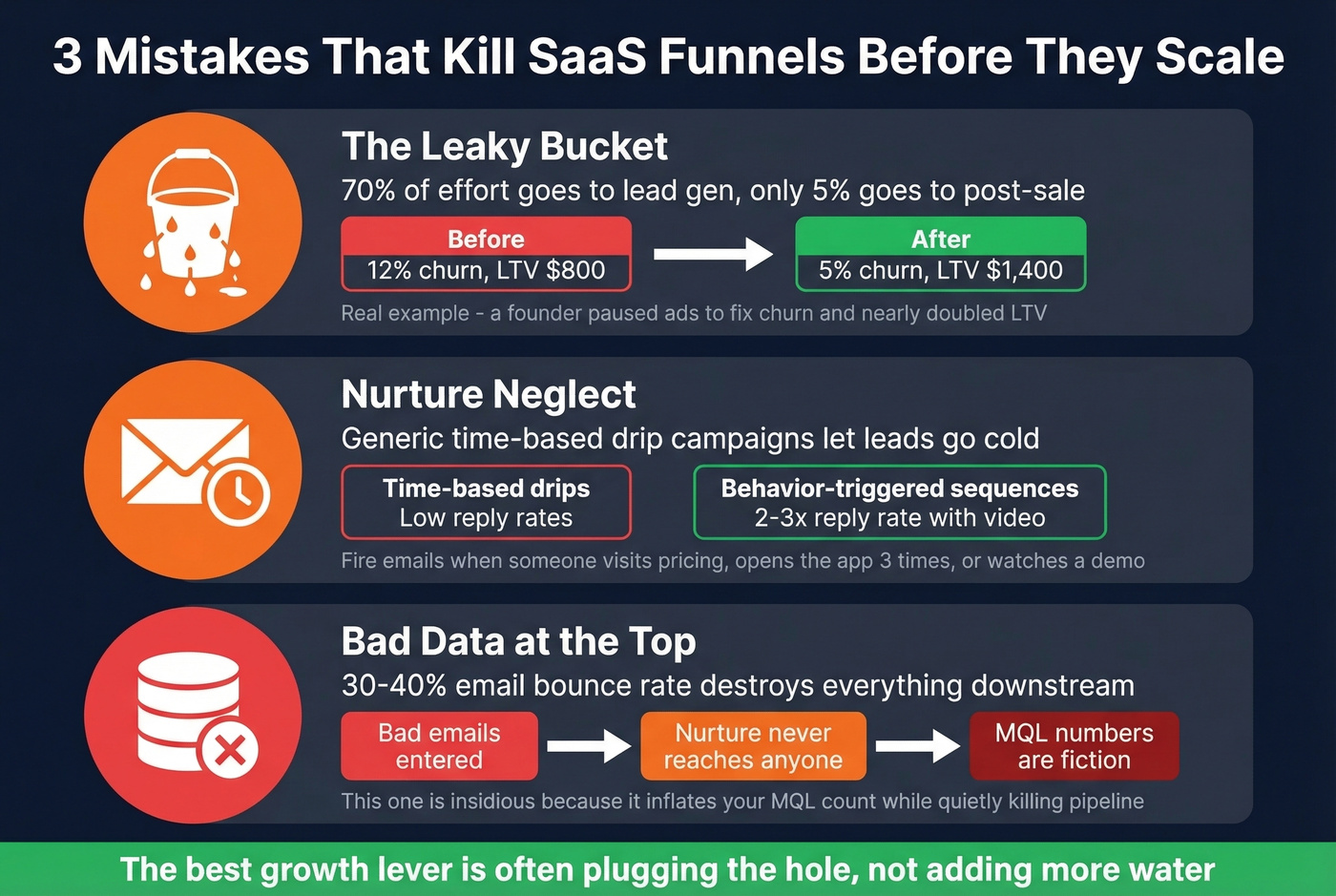
The leaky bucket. Most founders allocate roughly 70% of effort to lead generation, 25% to demo conversion, and 5% to post-sale - but 50%+ of revenue leverage sits in retention and expansion. A founder on r/SaaS shared a telling example: they paused ads entirely to fix churn, brought it down from 12% to 5%, and watched LTV jump from $800 to $1,400. Sometimes the best growth lever is plugging the hole, not adding more water.
Nurture neglect. Leads go cold after signup because the only follow-up is a generic drip campaign sent on a timer. Behavior-triggered sequences - firing when someone visits the pricing page, opens the app three times in a week, or watches a demo video - outperform time-based drips dramatically. Video-first emails using Loom walkthroughs pull 2-3x the reply rate of plain text in mid-funnel sequences. The teams that nail this transition treat nurture as a product experience, not a marketing afterthought.
Bad data at the top. This one's insidious because it inflates your MQL count while quietly destroying everything downstream. If 30-40% of your emails bounce, your nurture sequences never reach anyone, your MQL numbers are fiction, and you're burning CAC on ghosts. I've watched a team celebrate hitting their MQL target three months in a row while pipeline actually shrank - because half those "leads" were invalid contacts from a cheap data vendor. Clean, verified data isn't a nice-to-have. It's the foundation every other metric depends on.
Tools by Funnel Stage
The average B2B sales rep spends 28% of their week actually selling. The rest goes to research, admin, and data wrangling. The right stack at each stage buys that time back.
| Funnel Stage | Tool | Starting Price |
|---|---|---|
| Prospecting & Data | Apollo | Free; from ~$49/mo |
| CRM & Pipeline | HubSpot | Free CRM; paid from ~$20/user/mo |
| CRM & Pipeline | Salesforce | From ~$25/user/mo |
| Analytics | Mixpanel | Free; paid from ~$20/mo |
| Analytics | Google Analytics | Free |
| Nurture | Intercom | From ~$39/seat/mo |
| Revenue Intelligence | Gong | ~$100-$150/user/mo |
| Subscription Metrics | ChartMogul | From ~$100/mo |
| Enrichment & Workflows | Clay | From $134/mo |
For prospecting and data enrichment, Prospeo covers 300M+ professional profiles with 98% email accuracy and a 7-day refresh cycle. The free tier gives you 75 verified emails per month to test data quality before committing - and at roughly a penny per email, it's one of the cheapest ways to make sure your funnel starts with contacts that actually exist.
If you're building outbound sequences, start with proven sales prospecting techniques and a clean lead generation workflow so you can diagnose where leads drop off.
Outbound is your awareness stage - and data quality there cascades into every funnel stage below it. Prospeo refreshes 300M+ profiles every 7 days (not 6 weeks like competitors), so your sequences hit real inboxes. Teams using Prospeo book 35% more meetings than Apollo users and see bounce rates under 4%.
Bad data at the top kills every stage beneath it. Fix that now.
FAQ
How is a SaaS funnel different from a regular sales funnel?
A SaaS sales funnel includes retention and expansion as core stages because revenue is recurring. Traditional funnels end at the sale; a SaaS funnel treats the closed deal as the starting line. Churn, NRR, and expansion revenue matter as much as - often more than - initial acquisition metrics.
How many stages should a SaaS funnel have?
Most effective SaaS funnels use 5-7 stages: Awareness, Lead/MQL, SQL, Opportunity, Customer, Retention & Expansion. PLG companies often prefer the AARRR framework (Acquisition, Activation, Retention, Referral, Revenue), which emphasizes product engagement over sales handoffs. Don't overthink the number of stages - pick a model, instrument it, and iterate.
How do I fix bad data at the top of my funnel?
Start with verified contact data. If 30%+ of your emails bounce, your nurture sequences never reach anyone and your MQL numbers are fiction. Tools like Prospeo (98% email accuracy, 7-day refresh cycle) and Apollo let you validate contacts before they enter your funnel, so every downstream metric reflects reality instead of noise.