

What Is a Sales Target - and How Do You Set One That's Actually Hittable?
It's January. Your VP just announced a 20% growth target. Nobody asked how many qualified leads that requires, what the conversion rates look like, or whether the team even has enough pipeline coverage to get there. You've been handed a number with no math behind it - and that's not a sales target, it's a guess with consequences.
Most sales targets are set backward. Companies start with what they want to earn, not what their pipeline can actually deliver. 84% of reps missed quota last year. The problem isn't talent. It's calibration.
What Is a Sales Target?
A sales target is a quantifiable, time-bound goal assigned to a salesperson, team, or entire company. It defines what "success" looks like for a specific period - usually a month, quarter, or year - and it's measured in revenue, units sold, or specific activities like meetings booked or calls made.
The key word is quantifiable. "Grow revenue" isn't a target. "$750,000 in new ARR by Q4" is. These goals give reps a finish line and give leadership a way to measure whether the go-to-market motion is working. Without them, you're flying blind, and so is every rep on your floor.
The Short Version
- A sales target is a specific, time-bound revenue or activity goal assigned to a rep, team, or company.
- It's not the same as a quota or a goal - those are different instruments with different consequences (see Sales Forecast vs Sales Goal).
- Good targets are built from pipeline math, not board wishes.
- 84% of reps missed quota last year, and only ~41% of software reps are hitting quota based on a RepVue chart shared on r/sales. Most targets are set wrong.
Sales Target vs. Quota vs. Goal
These three terms get used interchangeably, and that causes real problems.
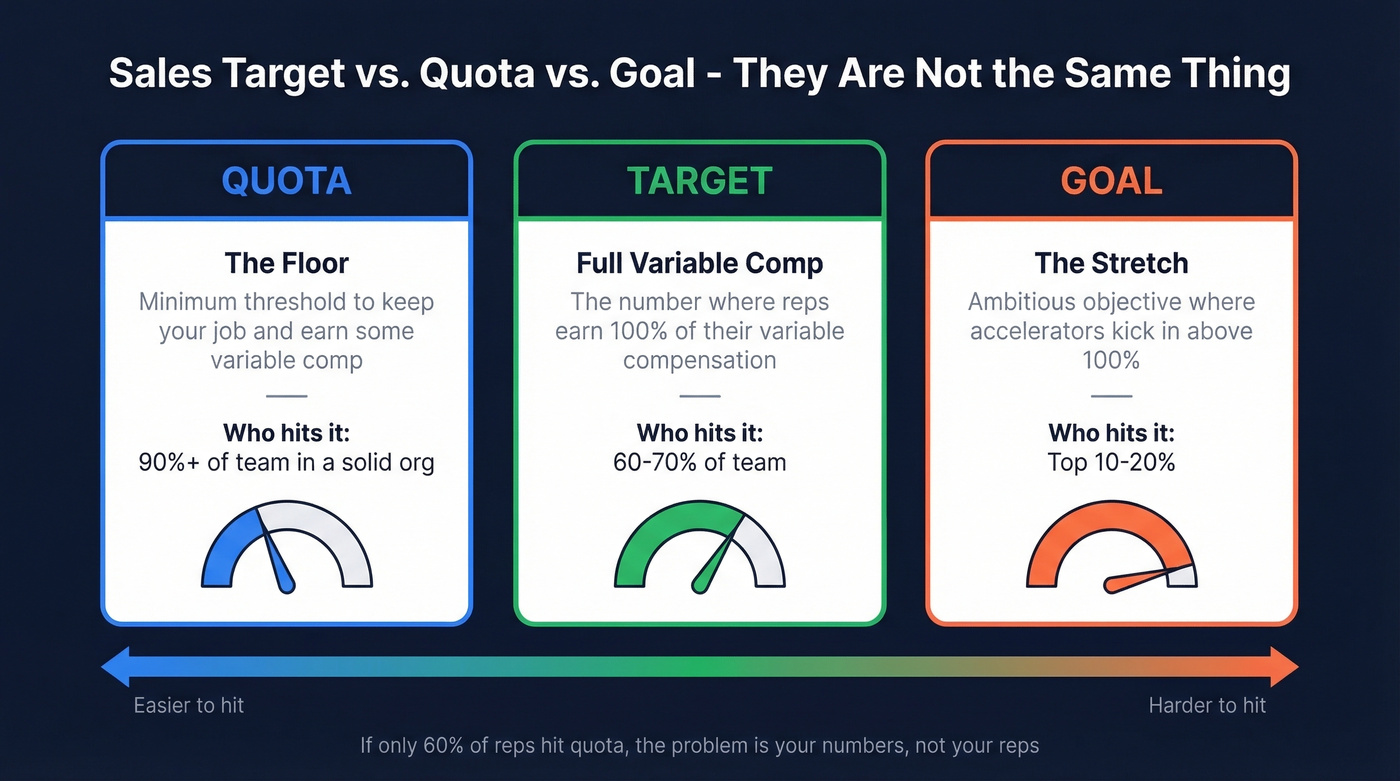
| Target | Quota | Goal | |
|---|---|---|---|
| Definition | Full variable-comp number | Minimum threshold | Stretch objective |
| Time horizon | Annual/quarterly | Monthly/quarterly | Flexible |
| Comp linkage | 95-100% variable | >0% but <100% | >100% (accelerators) |
| Who should hit it | 60-70% of team | 90%+ in a solid org | Top 10-20% |
A quota is the floor - the minimum a rep needs to keep their job and earn some variable comp. A target is the number where they earn full variable compensation. A goal is the stretch above 100% where accelerators kick in.
In a well-run org, 90%+ of reps should hit quota. If only 60% are making it, the problem isn't your reps. It's your numbers.
Why Sales Targets Matter
Sales targets aren't just motivational tools. They drive direction-setting, performance evaluation, resource allocation, and motivation. Without a clear target, you can't forecast (see sales forecasting solutions), you can't coach, and you can't tell whether your GTM motion is working or burning cash.
Here's the uncomfortable truth: only 22% of firms saw an increase in quota attainment in 2023. That means nearly 4 out of 5 companies watched attainment stagnate or decline - and most of them responded by raising targets anyway. Targets set without data don't motivate. They demoralize.

84% of reps miss quota because their pipeline math starts with bad data. A 30% bounce rate turns 1,000 leads into 700 - and your target into fiction. Prospeo's 98% email accuracy and 7-day refresh cycle mean every contact in your funnel is real, verified, and reachable.
Build pipeline math on data that actually converts.
Types of Sales Targets
Not every target is a revenue number. The best orgs layer multiple target types to give reps clarity on both outcomes and inputs.
Revenue targets are the classic: hit $500K in closed-won ARR this quarter. Activity targets cover calls made, meetings booked, and demos run - and they matter because sales professionals spend only a third of their time actively selling. If you don't target the activity, the revenue won't follow (more sales activities examples). Unit targets measure deals closed or logos acquired, regardless of deal size.
Waterfall targets break a large yearly number into progressively larger monthly or quarterly chunks, front-loading easier months while reps ramp and back-loading heavier months when pipeline matures. Weighted targets assign different multipliers to product lines or deal types - a new-logo deal might count 1.5x while an expansion counts 1x - so reps prioritize what the business actually needs.
Then there are time-based targets (monthly keeps urgency high, annual gives room for larger deals), individual vs. team targets (individual drives accountability, team prevents sandbagging), and stretch targets tied to accelerators that should be ambitious but not delusional.
The mistake most managers make is giving reps a revenue target with no activity plan underneath it. Revenue is an outcome. Activity is the lever.
How to Calculate a Sales Target
The Pipeline Math Formula
The core formula is straightforward:
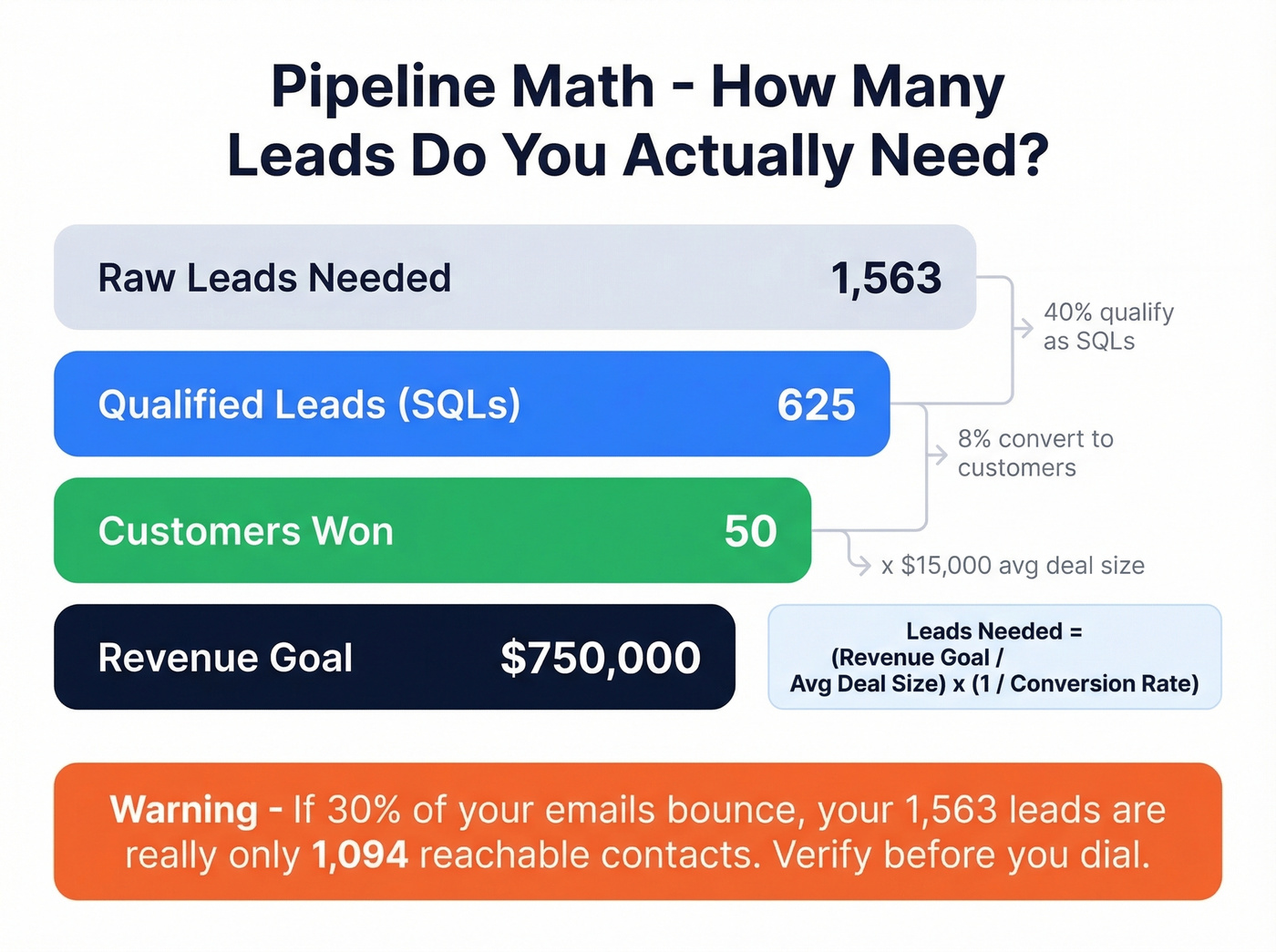
Leads Needed = (Revenue Goal / Average Deal Size) x (1 / Conversion Rate)
Here's a worked example from AgentiveAIQ: say your annual goal is $750,000 and your average deal size is $15,000. That's 50 customers. If your lead-to-customer conversion rate is 8%, you need 625 leads.
But that's total leads that actually enter the pipeline. If only 40% of your raw leads become SQLs, you need 1,563 total leads to produce 625 qualified ones. A common benchmark is around 10% for B2B lead-to-customer conversion (see average B2B lead conversion rate), but your number will vary - and using the wrong conversion rate is how targets become fiction.
Before you set call targets, audit your data. A list of 1,000 leads with a 30% bounce rate is really 700 leads. Prospeo's real-time email verification - 98% accuracy on a 7-day refresh cycle - catches this before your reps waste a single dial, so your pipeline math starts with contacts that actually exist (and helps reduce email bounce rate).
Turning Revenue into Daily Activity
Once you have the lead number, work backward through your funnel stages using a 220-working-day assumption.
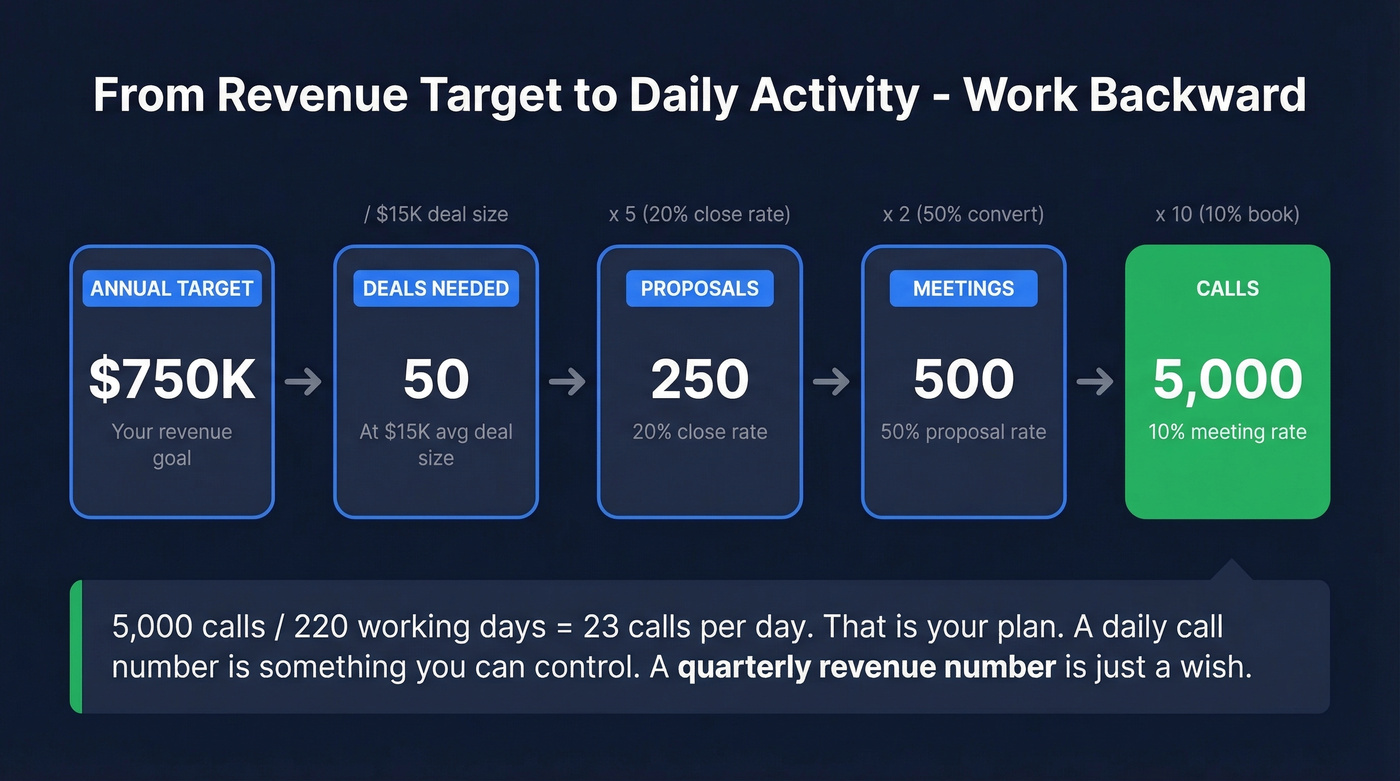
Say you need 50 deals. Your close rate on proposals is 20%, so you need 250 proposals. Your meeting-to-proposal rate is 50%, so you need 500 meetings. Your call-to-meeting rate is 10%, so you need 5,000 calls. That's roughly 23 calls per day.
Now the rep has something they can actually control. A daily call number is a plan. A quarterly revenue number is a wish.
Setting Revenue Targets for Sales Teams
Top-Down vs. Bottom-Up Planning
Every org argues about this. Here's what the data says:
| Top-Down | Bottom-Up | |
|---|---|---|
| Who prefers it | 64% managers, 60% directors | 60% of C-suite |
| Strength | Fast, aligned to board goals | Realistic, field-validated |
| Risk | Disconnected from rep capacity | Coordination complexity |
| Satisfaction | Standard | 86% of "most satisfied" orgs use it |
The right answer is both. Set the ceiling top-down, validate the floor bottom-up. If leadership wants 20% growth but the field data says 13% is realistic given rep capacity and ramp times, you land somewhere in between - and everyone understands why.
We've watched this play out dozens of times. Leadership wanted 20% growth ($6M to $7.2M). But 3 of 12 reps were still ramping, a product sunset removed $200K in recurring revenue, and the market was flat. Bottom-up math said 13% ($6.78M). They landed on 16% with a hiring plan to close the gap. That's how target-setting should work - negotiation grounded in data, not a number handed down from the boardroom.
Salesforce recommends a baseline of 15-20% YoY growth for most companies, adjusted for context. That context is where the ROPE checklist comes in.
The ROPE Checklist
Before you finalize any target, pressure-test it against four factors:
- Resourcing - do you have enough reps, and are they ramped?
- Onboarding - how many new hires are still in ramp? Their capacity isn't 100% (use a 30-60-90 day plan for sales reps to model ramp).
- Product - any launches, sunsets, or pricing changes that affect deal velocity?
- Economy - macro headwinds or tailwinds in your target market?
Skip this step and you'll set growth targets that assume full productivity from reps who haven't finished onboarding. That's how you get a 20% target that should've been 13%.
Attainment Benchmarks (2026)
"What's a good attainment rate?" depends entirely on your industry. The most recent RepVue data, shared on r/sales, paints a sobering picture:
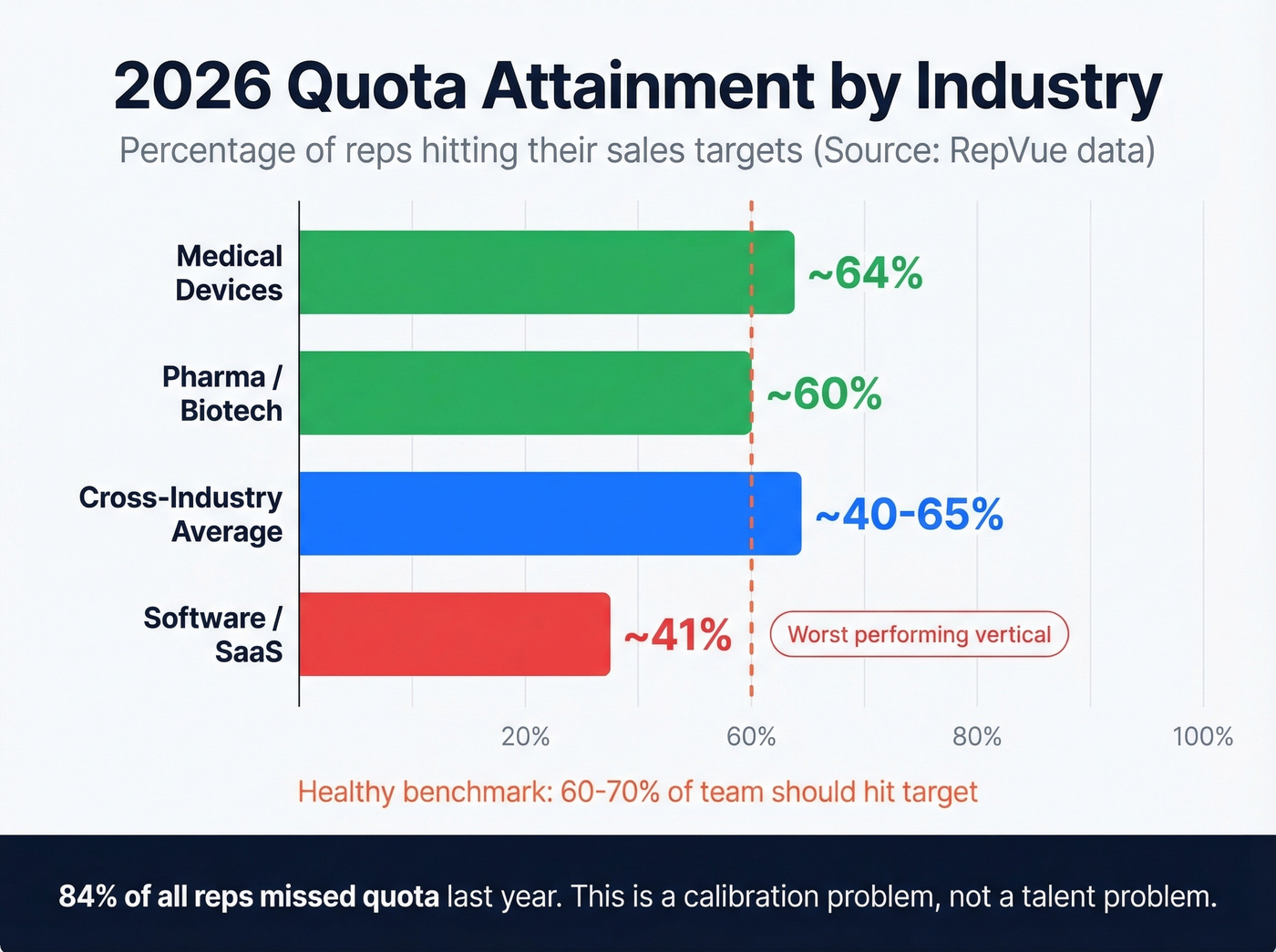
| Industry | Quota Attainment |
|---|---|
| Software / SaaS | ~41% |
| Medical Devices | ~64% |
| Pharma / Biotech | ~60% |
| Cross-industry range | ~40-65% |
Software is the worst-performing vertical, which tracks with the saturation and budget tightening most SaaS teams are feeling (see SaaS Sales).
The DealHub rule of thumb is that 60-70% of your team should hit their targets. If you're well below that, the problem isn't coaching - it's the numbers themselves. And with 84% of reps missing quota last year, this is an industry-wide calibration problem, not a talent problem.
Let's be honest: if your average deal is under $15K and fewer than half your reps are hitting target, you don't have a training problem or a hiring problem. You have a math problem. Fix the inputs before you fire anyone.
Five Target-Setting Mistakes That Kill Morale
1. The Outlier Trap. One rep had a monster year - closed a whale deal, hit 200% of plan. Leadership sets next year's quota based on that outlier. That was 1 out of 26 reps, and the deal took 18 months to close. Now everyone's measured against an anomaly. This pattern shows up constantly on r/sales - reps describing targets reverse-engineered from one person's outlier year. As HBR put it: "When 10-20% of salespeople miss their goals, the problem is the salespeople. When the majority miss, the problem is the goals."
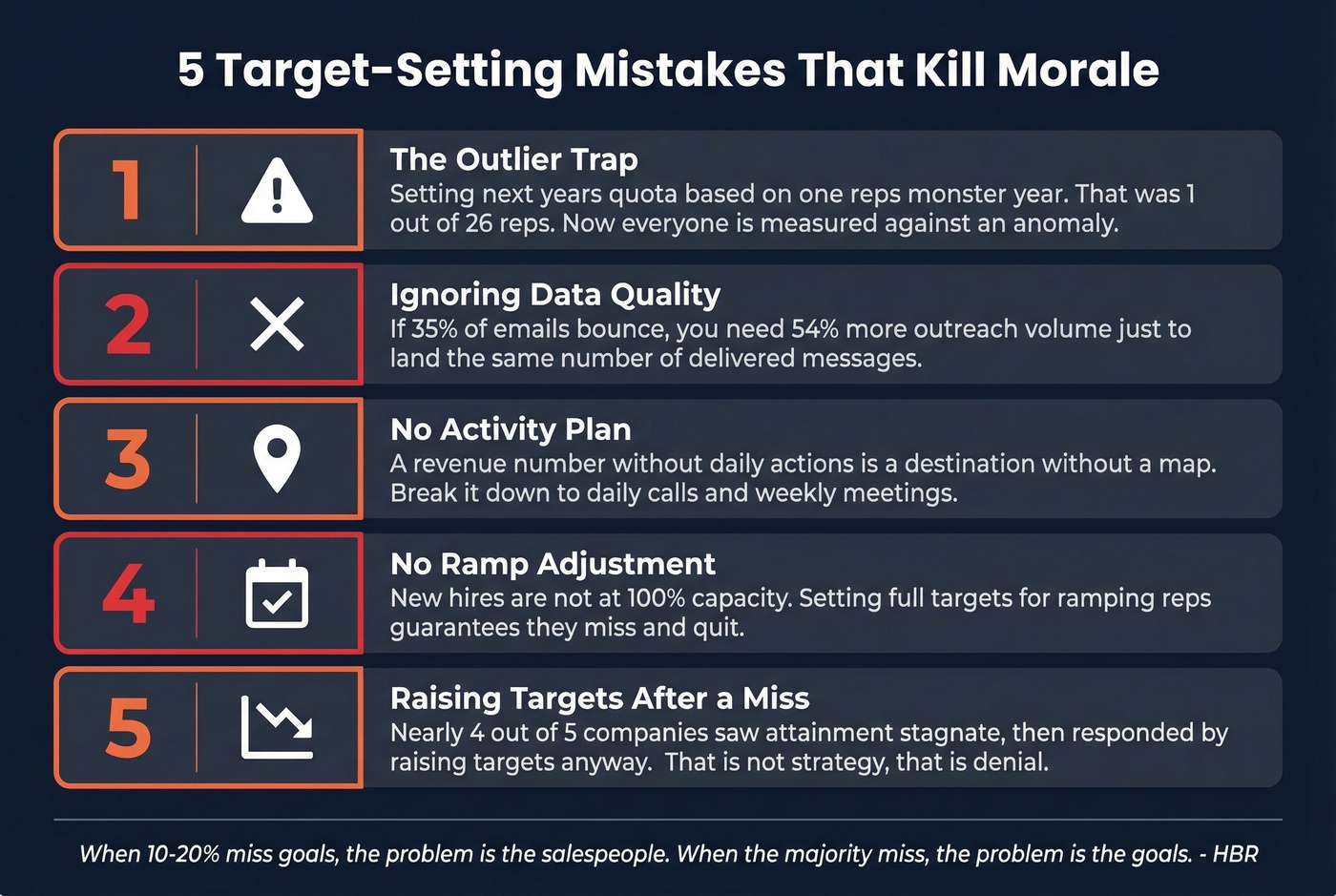
2. Ignoring data quality. Your pipeline math assumes every lead is reachable. If 35% of your emails bounce, you need about 54% more outreach volume just to land the same number of delivered messages. This is the silent killer of quota attainment - reps are doing the activity, but half their outreach never lands.
When Snyk rolled out email verification across 50 AEs, their bounce rate dropped from 35-40% to under 5%, and AE-sourced pipeline jumped 180%. That's what happens when your activity targets are based on contacts that actually exist.
3. No activity plan. Giving a rep a revenue number without reverse-engineering daily actions is like giving someone a destination without a map. Break it down to daily calls, weekly meetings, monthly pipeline generated. On r/sales, reps regularly describe being handed targets they suspect are designed to cap commissions rather than drive growth. An activity plan at least makes the path transparent.
4. Static annual targets. Markets shift. Reps leave. Products launch. If you set targets in January and don't recalibrate by June, you're managing to a fantasy. Build in quarterly check-ins at minimum, or better, use rolling forecasts that update monthly based on actual pipeline data (track pipeline health). If attainment drops below 40% at the halfway mark, convene a pipeline review and adjust targets to reflect current reality.
5. Measuring the wrong thing. Revenue is an outcome. Reps control activity. If you're only measuring closed-won and ignoring leading indicators like meetings booked and proposals sent, you won't know you're off track until it's too late to fix it.
Get the data right first. Everything else follows.
You just calculated that you need 5,000 calls to hit 50 deals. Now imagine half those numbers bounce or go to voicemail. Prospeo gives you 125M+ verified mobile numbers with a 30% pickup rate and 300M+ profiles filtered by buyer intent, so every dial counts toward your daily activity target.
Stop wasting dials on dead numbers - hit your activity targets faster.
FAQ
What is a realistic sales target?
A realistic sales target is one where 60-70% of your team can hit it. Industry attainment varies widely - software reps hit quota at roughly 41%, while medical device reps land around 64%. If fewer than half your team is making their number, recalibrate the targets before adding more coaching.
How do you calculate a monthly sales target?
Divide your annual revenue target by 12, then reverse-engineer pipeline math. If you need $62,500/month and your average deal is $15,000 with an 8% conversion rate, you need roughly 52 new leads per month. Layer in your SQL conversion rate to get the true top-of-funnel number.
What's the difference between a sales target and a quota?
A quota is the minimum threshold - hit it and you keep your job and earn partial variable comp. A target is the number where you earn full variable compensation (95-100%). A goal is the stretch above target where accelerators kick in.
How often should you review sales targets?
Quarterly at minimum. Markets shift, reps turn over, and product changes affect deal velocity. The best orgs use rolling forecasts that update monthly based on actual pipeline data rather than locking in a January number and hoping for the best. If attainment trends below 40% at the midpoint, recalibrate rather than doubling down.
What is a good attainment rate?
The standard benchmark is 60-70% of your team hitting target. Above that range, your targets may be too conservative - you're leaving growth on the table. Well below it, the targets are probably disconnected from pipeline reality. Cross-industry attainment runs about 40-65%, with software consistently at the low end.