

What Is Expansion Revenue - and Why It's 40% of New SaaS ARR
Your board deck shows 80% of growth from new logos. Pipeline coverage drops from 4x to 2x, and suddenly the whole revenue plan is at risk. The companies that weather pipeline droughts are the ones where existing customers already generate growth on their own.
So what is expansion revenue? It breaks down into four parts:
- Expansion revenue = revenue from existing customers beyond their original contract - upsells, cross-sells, add-ons, seat expansion, usage overages.
- Median expansion ARR hit 40% of total new ARR in 2024, up from 25% in 2022 per Benchmarkit's 2025 benchmarks report.
- The benchmark to chase isn't a rate number - it's whether expansion exceeds churn (negative net MRR churn).
- Usage-based pricing and in-product upgrade triggers are the highest-leverage tactics right now.
Definition and Scope
Expansion revenue is any recurring revenue generated from existing customers above what they originally contracted for. It's the clearest signal that your product is getting more valuable over time, not less.
What counts: upsells to higher tiers, cross-sells of new products, add-on purchases, seat expansion, and usage-based overages. What doesn't count: renewals at the same price - that's retention - and reactivations of churned customers. We've seen teams misclassify reactivations as expansion, which inflates numbers and hides the real growth rate. Track them separately.
How to Calculate Expansion MRR
Two formulas matter here.
Expansion MRR = End-of-period MRR from existing customers minus start-of-period MRR from the same cohort. That gives you the raw dollar amount of expansion in a given month.
Expansion MRR Rate = Expansion MRR divided by total MRR at start of period. This tells you how fast expansion is adding revenue relative to your base.
Worked example: you start the month with $750K in MRR. Existing customers generate $22.5K in upgrades, add-ons, and seat expansion. Your expansion MRR rate is 3.0% monthly - which annualizes to roughly 36% if the pace holds. That's strong. Most companies aren't there yet.
MRR vs. ARR - Which to Track?
If you're early-stage with monthly contracts, track expansion MRR monthly for fast signal. Once you're past $10M ARR with mostly annual contracts, switch to expansion ARR on a quarterly cadence. Match the metric to your contract structure, not your ambition.
GRR, NRR, and the Metric Family
These three metrics get confused constantly. Let's clear it up.
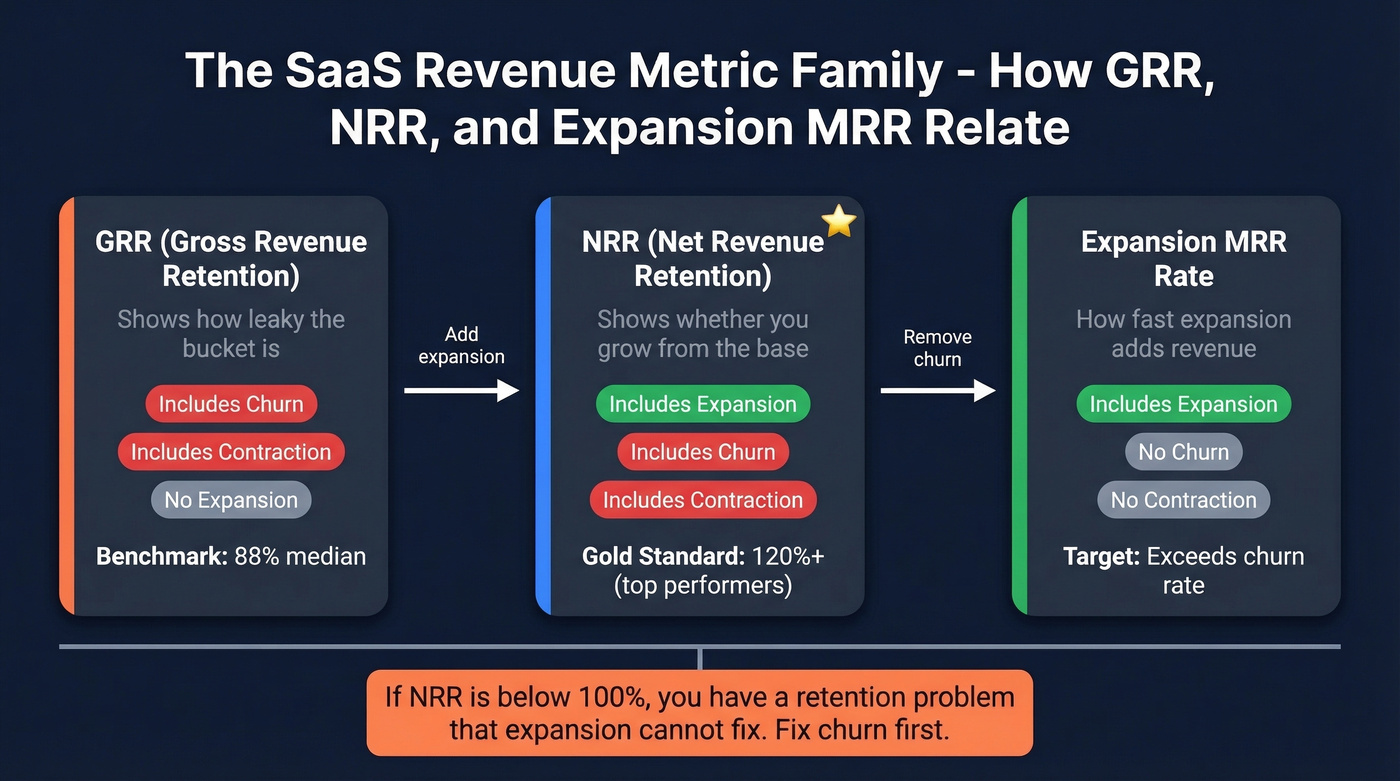
| Metric | Includes Expansion? | Includes Churn/Contraction? | What It Tells You |
|---|---|---|---|
| GRR | No | Yes | How leaky the bucket is |
| NRR | Yes | Yes | Whether you grow from the base |
| Expansion MRR Rate | Yes | No | How fast expansion adds revenue |
GRR shows you the floor - how much revenue you'd retain if nobody upgraded. NRR shows the full picture, expansion included. The gold standard is negative net MRR churn, which means expansion revenue exceeds churn and contraction in a given period. Your existing customer base is literally growing on its own.
Here's the hard truth: if NRR is below 100%, you have a retention problem that expansion can't fix. Pouring upsell motions on top of a leaky bucket just masks the bleed. Fix churn first, then build expansion.

Expansion signals are worthless if your CS team can't reach the decision-maker. Prospeo enriches your CRM with verified emails and direct dials - 98% accuracy, 7-day refresh - so your upsell conversation happens while intent is hot, not weeks later with a bounced email.
Stop losing expansion deals to stale contact data.
2026 Benchmarks - What Good Looks Like
Many guides on this topic cite the same 2016 Pacific Crest Survey. It's 2026. You deserve current numbers.
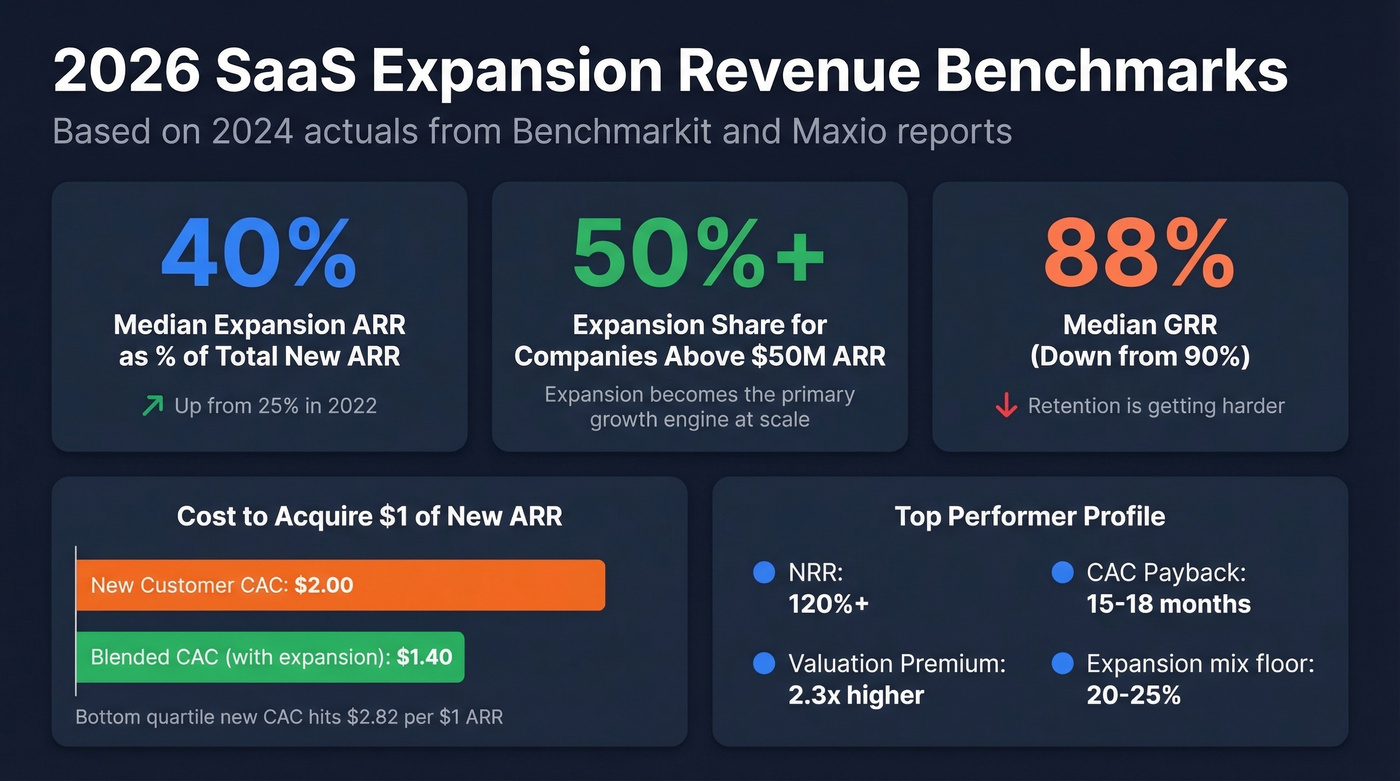
Benchmarkit's 2025 report covering 2024 actuals tells the real story: expansion ARR represents 40% of total new ARR at the median, up five points year-over-year. For companies above $50M ARR, expansion drives over 50% of new ARR. GRR has drifted from 90% to 88% over three years - retention is getting harder, which makes expansion even more critical.
The cost-efficiency case is stark. Median New CAC Ratio hit $2.00 of S&M per $1 of new customer ARR in 2024, with the bottom quartile at $2.82. Yet blended CAC improved to roughly $1.40 because more "new ARR" is coming from expansion, which carries lower top-of-funnel cost and a shorter sales cycle. If you're budgeting for 35% growth but actual is 26%, expansion is the fastest lever to close the gap.
Phoenix Strategy Group reports that top performers hit 120%+ NRR and command 2.3x higher valuations, with median CAC payback at 15-18 months. Reddit founders hit 20-25% expansion mix "almost by accident" with basic usage tiers. That's the floor, not the target.
Stop chasing a rate number. What matters is the delta against churn. 8% expansion with 3% churn beats 15% expansion with 20% churn every time.
How to Increase Expansion Revenue
Usage-Based Pricing
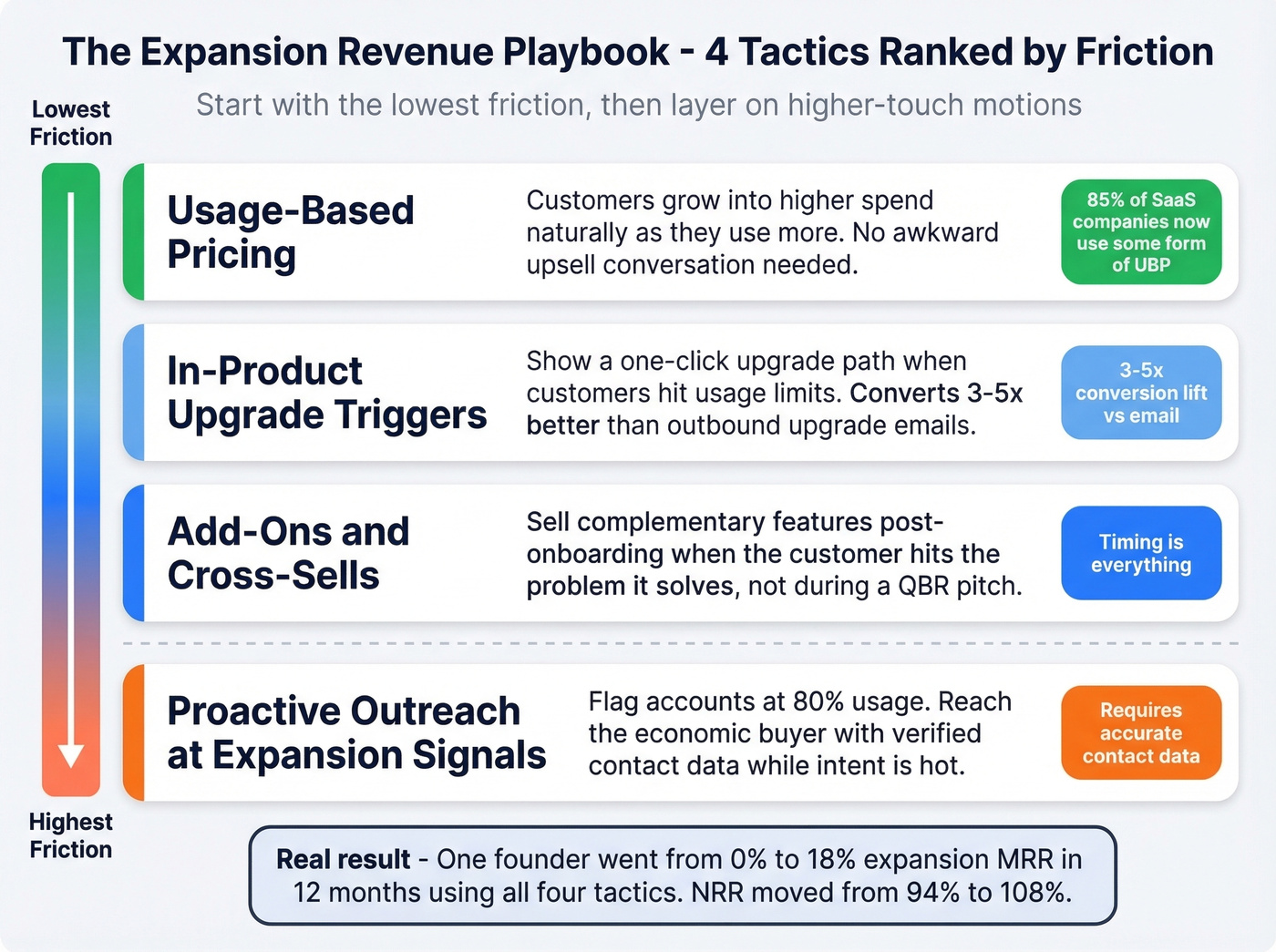
85% of SaaS companies have now adopted some form of usage-based pricing. It's the default expansion mechanism - customers grow into higher spend naturally as they use more of your product. No awkward upsell conversation required.
Here's the thing, though: if you don't have product instrumentation for usage limits, don't attempt UBP yet. Start with tiered packaging and manual upgrade triggers. Bad usage metering creates billing disputes, not growth from existing accounts.
In-Product Upgrade Triggers
When a customer hits a usage limit, show them a one-click upgrade path right there. Frictionless expansion converts at dramatically higher rates than outbound "time to upgrade" emails sent weeks later. We've tested this across multiple SaaS products and the difference isn't marginal - it's often 3-5x.
Add-Ons and Cross-Sells
Complementary features sold post-onboarding, once the customer already trusts the core product, are the lowest-friction expansion path after usage overages. The key is timing: sell the add-on when the customer hits the problem it solves, not during a quarterly business review where it feels like a pitch.
Proactive Outreach at Expansion Signals
Flag accounts when they cross 80% of their usage limit - that's the signal. Your CS team needs to reach the economic buyer while intent is hot, not three weeks later with a stale CRM email. Accurate contact data for the right decision-maker makes or breaks this motion; tools like Prospeo can return verified emails and direct dials on a 7-day refresh cycle, so the expansion conversation happens while the need is still fresh.
The Real Playbook: 0% to 18% in 12 Months
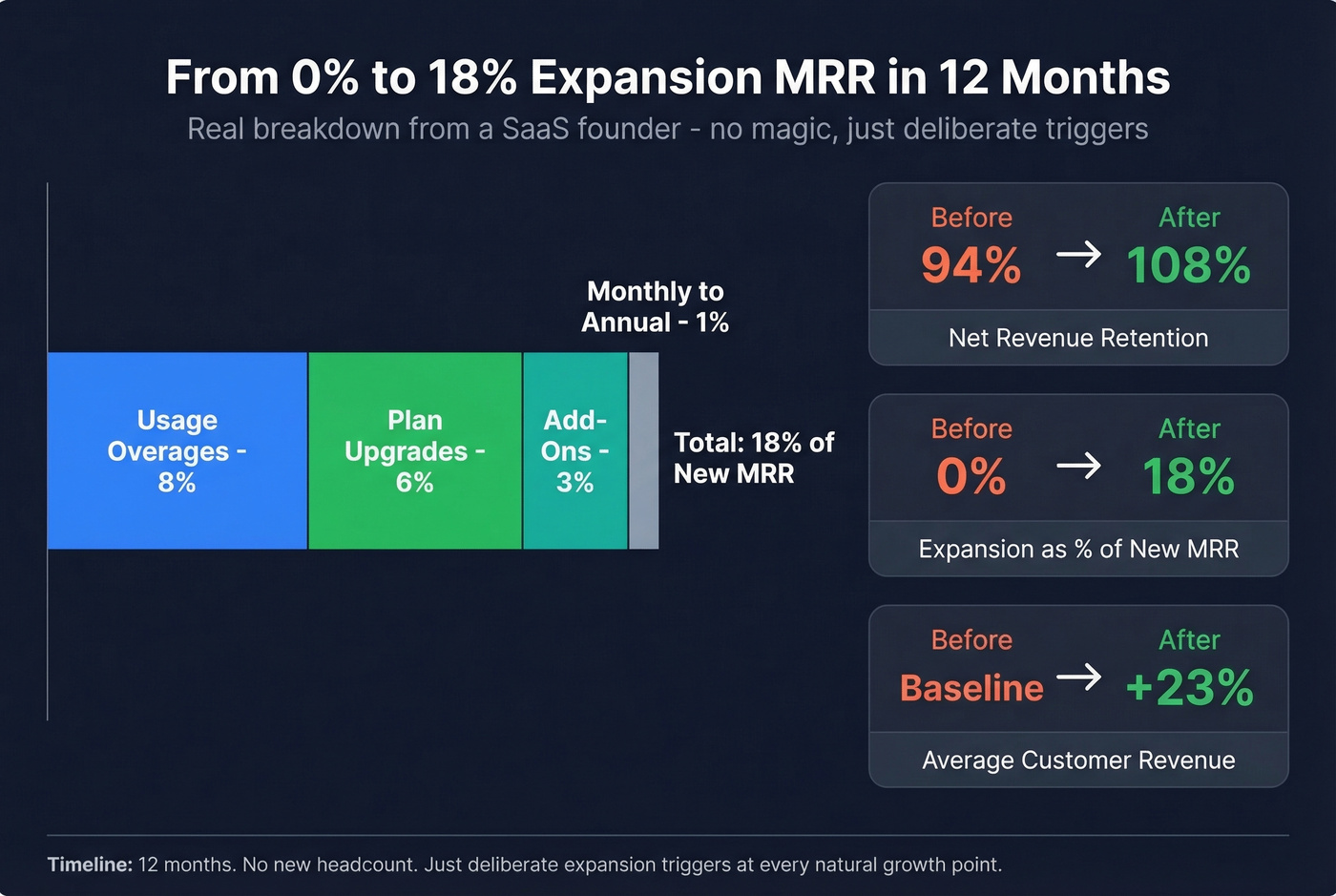
One Reddit founder took expansion from 0% to 18% of new MRR in 12 months. NRR moved from 94% to 108%. Average customer revenue climbed 23%. The breakdown: usage overages drove 8%, plan upgrades 6%, add-ons 3%, and monthly-to-annual conversions 1%. No magic - just deliberate triggers at every natural expansion point.
Mistakes That Kill Expansion Revenue
Treating expansion as just renewals. Renewal is retention. Expansion is growth. Different motions, different skills, different comp plans. Conflating them is the fastest way to under-invest in both.
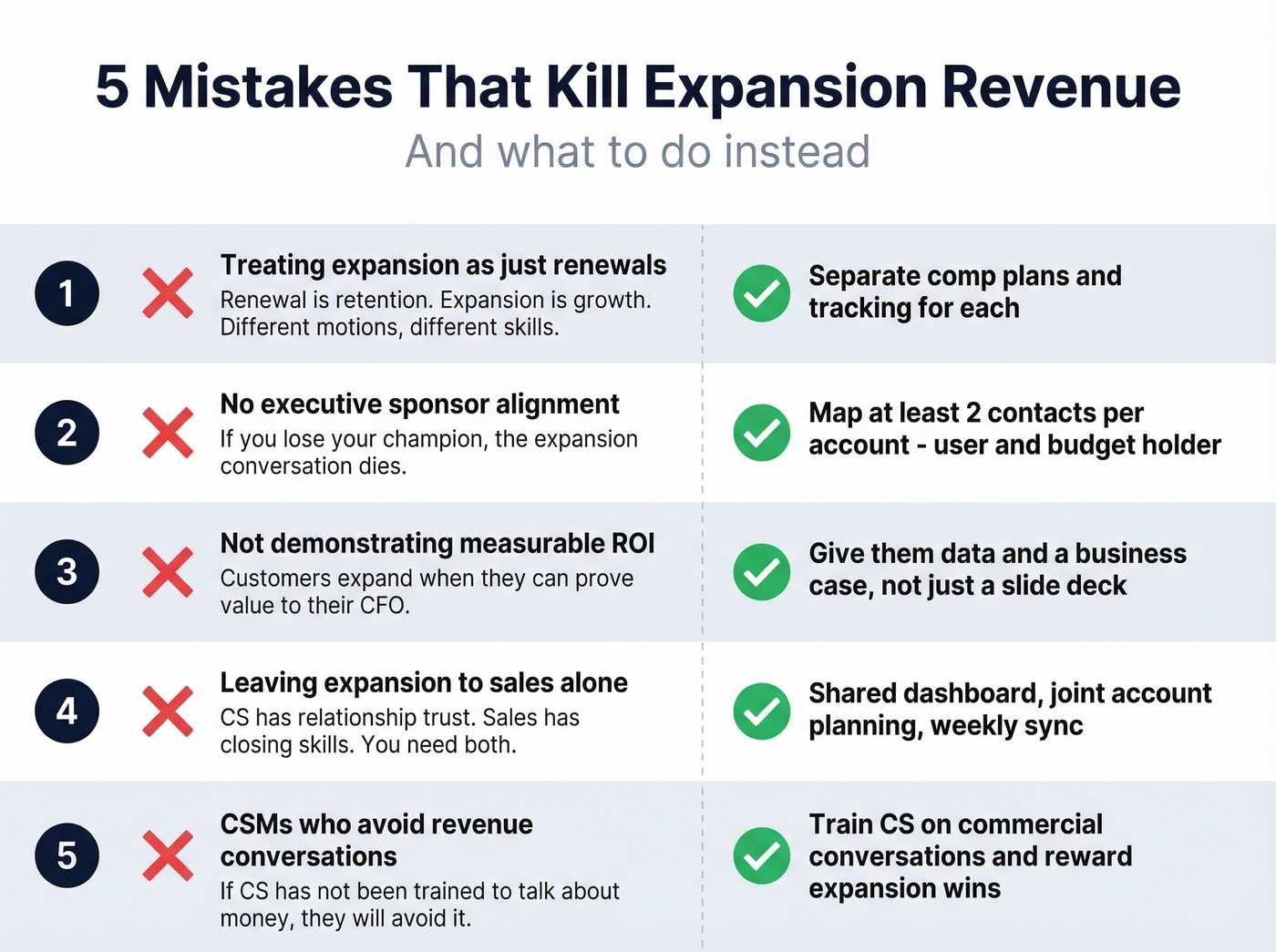
No executive sponsor alignment. If you lose your champion and haven't built relationships higher, the expansion conversation dies. CS should map at least two contacts per account - the day-to-day user and the budget holder. (If you need a framework for this, use a multi-threaded sales approach.)
Not demonstrating measurable ROI. Customers expand when they can prove value internally. Give them the data to make the case to their CFO, not just a slide deck for their manager.
Leaving expansion to sales alone. CS has the relationship trust and usage insights. Sales has deal-closing skills. You need both - and you need them sharing a dashboard, not a spreadsheet emailed on Fridays. (This is where a clean sales to CS handoff matters more than most teams admit.)
CSMs who avoid revenue conversations. Look, if your CS team hasn't been trained to talk about money, they'll avoid it and leave revenue on the table. Expansion is a team sport, but someone has to ask for the order.
What to Do Next
If expansion revenue isn't a named line item in your revenue plan, it should be by next quarter. Start by measuring expansion MRR separately from renewals. Benchmark against the 40% median. Then pick one tactic - usage triggers, add-on timing, or proactive outreach - and run it for 90 days. The math favors you: expansion is cheaper than acquisition, faster to close, and compounds on a base that already trusts you. If you want a dedicated motion, build it like expansion sales, not like net-new.
When an account crosses 80% usage, the clock starts. Every day without reaching the economic buyer is a missed expansion opportunity. Prospeo returns 50+ data points per contact at a 92% match rate - for roughly $0.01 per email. That's enterprise-grade data at a fraction of ZoomInfo's cost.
Turn expansion signals into revenue for a penny per contact.
FAQ
Is renewal revenue the same as expansion revenue?
No. Renewal means a customer continues at the same spend level - that's retention. Expansion means they increase spend through upsells, cross-sells, add-ons, or usage growth. Conflating the two masks whether your base is actually growing or just not leaving.
What is negative net MRR churn?
Negative net MRR churn occurs when expansion revenue exceeds churn and contraction revenue in a period. It means your existing customer base is growing on its own - the gold standard for SaaS unit economics and a signal investors weight heavily in valuation multiples.
Who should own expansion - sales or CS?
Both. CS has the relationship trust and real-time usage insights; sales has deal-closing skills and commercial instincts. The best motions pair CS signals with sales execution and arm both teams with accurate, up-to-date contact data so they can reach the economic buyer while intent is hot.
When should I track expansion MRR vs. expansion ARR?
Track expansion MRR monthly if you're early-stage with monthly contracts - it gives you the fastest feedback loop. Switch to expansion ARR on a quarterly cadence once you're past $10M ARR with mostly annual deals. Match the metric to your contract structure.