

The Sales to CS Handoff Playbook That Stops Silent Churn
It's Monday morning. Your newest CSM opens their inbox to find a forwarded email from an AE - subject line "Intro to your new CSM!" - with zero context, no stakeholder names, and a customer who already sounds confused about what happens next. That forwarded email is where retention starts dying.
The math is brutal. Companies running 90% net revenue retention trade at roughly 1.5x revenue multiples. Hit 130% NRR and you're looking at 6x+. The gap between those two numbers often traces back to a single moment: the account transition from sales to customer success.
What You Need (Quick Version)
Three things fix broken handoffs. Everything else is decoration.
- Fix your comp plan first. Your handoff breaks because of incentives, not missing templates.
- Use the 9-section handoff doc below - with AI, it takes 10 minutes per deal.
- Gate Closed-Won on a completed handoff doc in your CRM, or the process stays optional and dies.
Jump to: The Template | AI Workflow | SLAs | Metrics
Four Anti-Patterns That Kill the Handoff
These aren't edge cases. They're the norm at most SaaS companies, and each one erodes customer trust before CS even gets a chance.
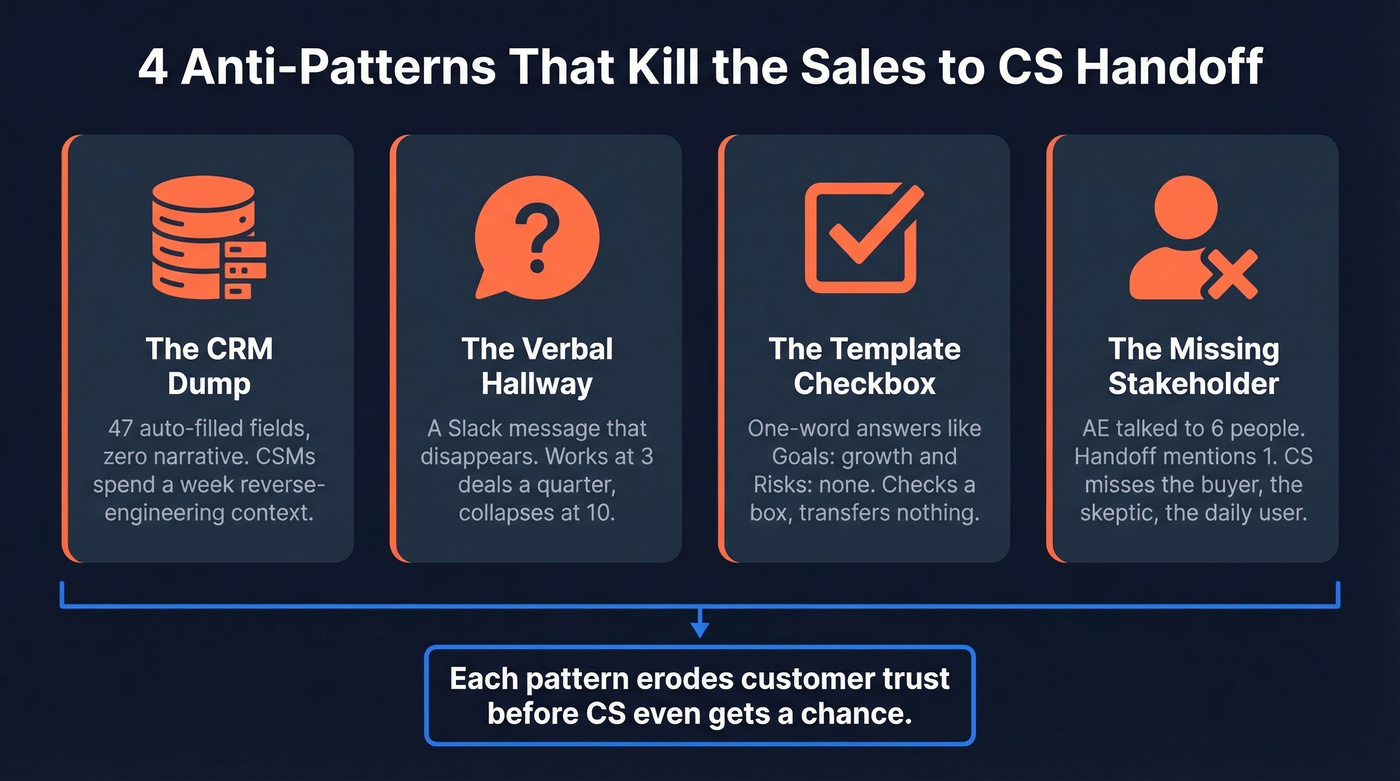
The CRM Dump. AE marks the deal Closed-Won, and CS gets a Salesforce record with 47 fields - most of them auto-populated junk. No narrative, no context on why they bought. We've watched CSMs spend their entire first week reverse-engineering deal context that should've been handed over in a single doc.
The Verbal Hallway. "Hey, I just closed Acme - you've got it, right?" No doc. No email. Just a Slack message that disappears into the scroll. This works at three deals a quarter. It collapses at ten.
The Template Checkbox. A handoff form exists, technically. AEs fill it out in 90 seconds with one-word answers. "Goals: growth." "Risks: none." It checks a box without transferring any real knowledge.
The Missing Stakeholder. The AE talked to six people during the sales cycle. The handoff mentions one. CS shows up to kickoff missing the economic buyer, the skeptic, and the person who'll actually use the product daily. As one AE put it on r/CustomerSuccess: "My job is to sell... I don't remember details... it's not my issue!" The thread blew up, and the consensus was clear - this attitude is common, and it's a structural problem, not a personality flaw.
The Root Cause: Your Comp Plan
You can build the most beautiful handoff template in the world, and AEs still won't fill it out if their comp plan screams "close and move on." The AE to CSM handoff fails at the incentive layer long before it fails at the process layer.
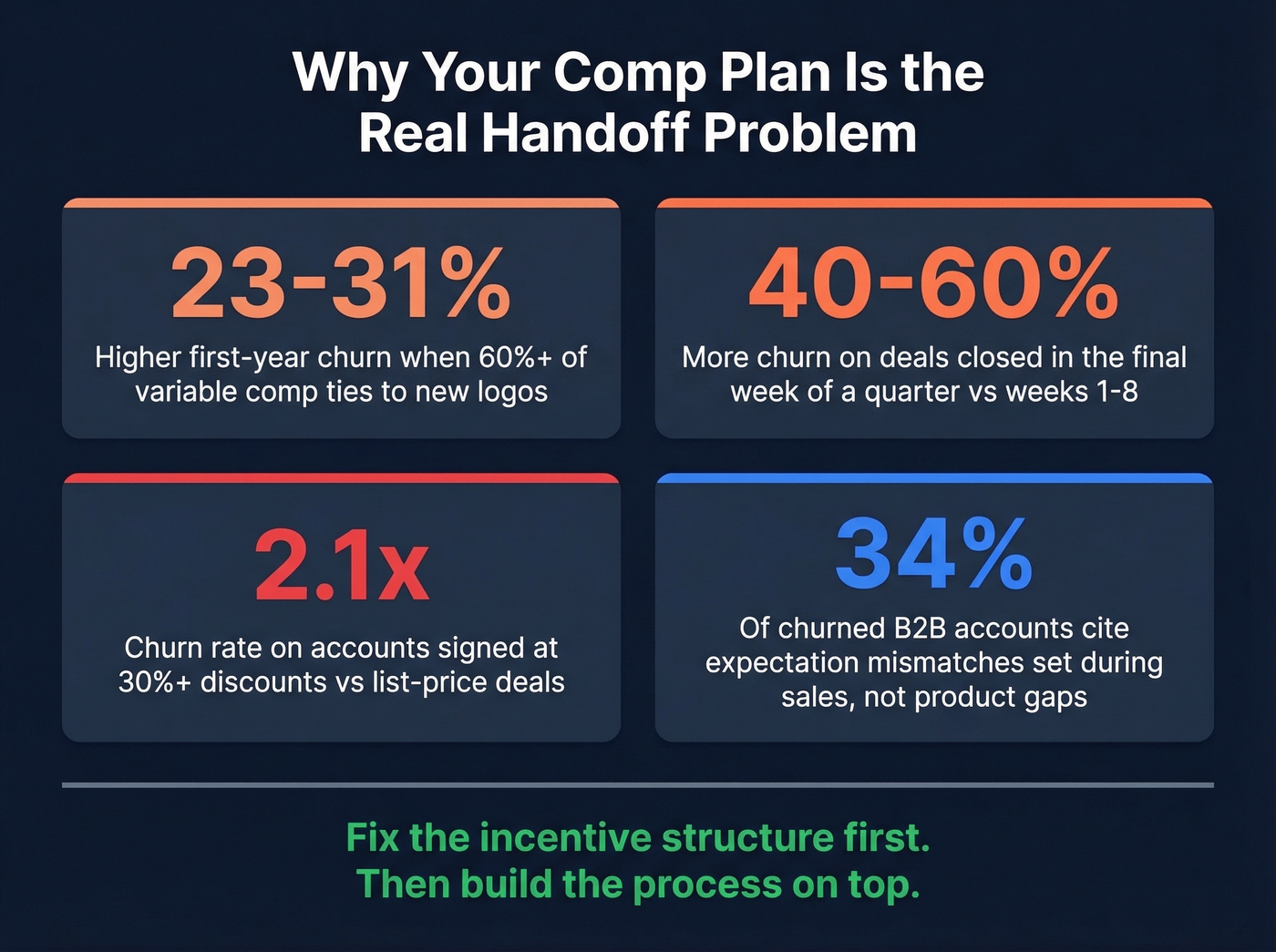
Sales comp typically allocates 70-80% of variable pay to new bookings. When more than 60% of that variable comp ties to new logo acquisition, first-year churn rates run 23-31% higher than orgs with balanced structures. Deals closed in the final week of a quarter churn 40-60% more than deals closed in weeks one through eight. And accounts signed at more than 30% discounts churn at 2.1x the rate of list-price deals.
Here's the thing: 34% of churned B2B accounts cite expectation mismatches established during the sales cycle. Not product gaps. Not support failures. Mismatches set during sales.
If your deal sizes sit below $15k and first-year churn exceeds 20%, stop building handoff templates and go audit your comp plan. The template isn't the bottleneck - the incentive to rush deals through is. Fix the incentive structure, then build the process on top of it. Real AE and CSM collaboration starts with aligned incentives, not shared Slack channels. If you need a framework for diagnosing retention issues, start with a proper churn analysis.
The 9-Section Handoff Template
A real handoff doc isn't a CRM dump with extra steps. It's a narrative brief that lets CS walk into kickoff as if they'd been part of the sales process from day one.
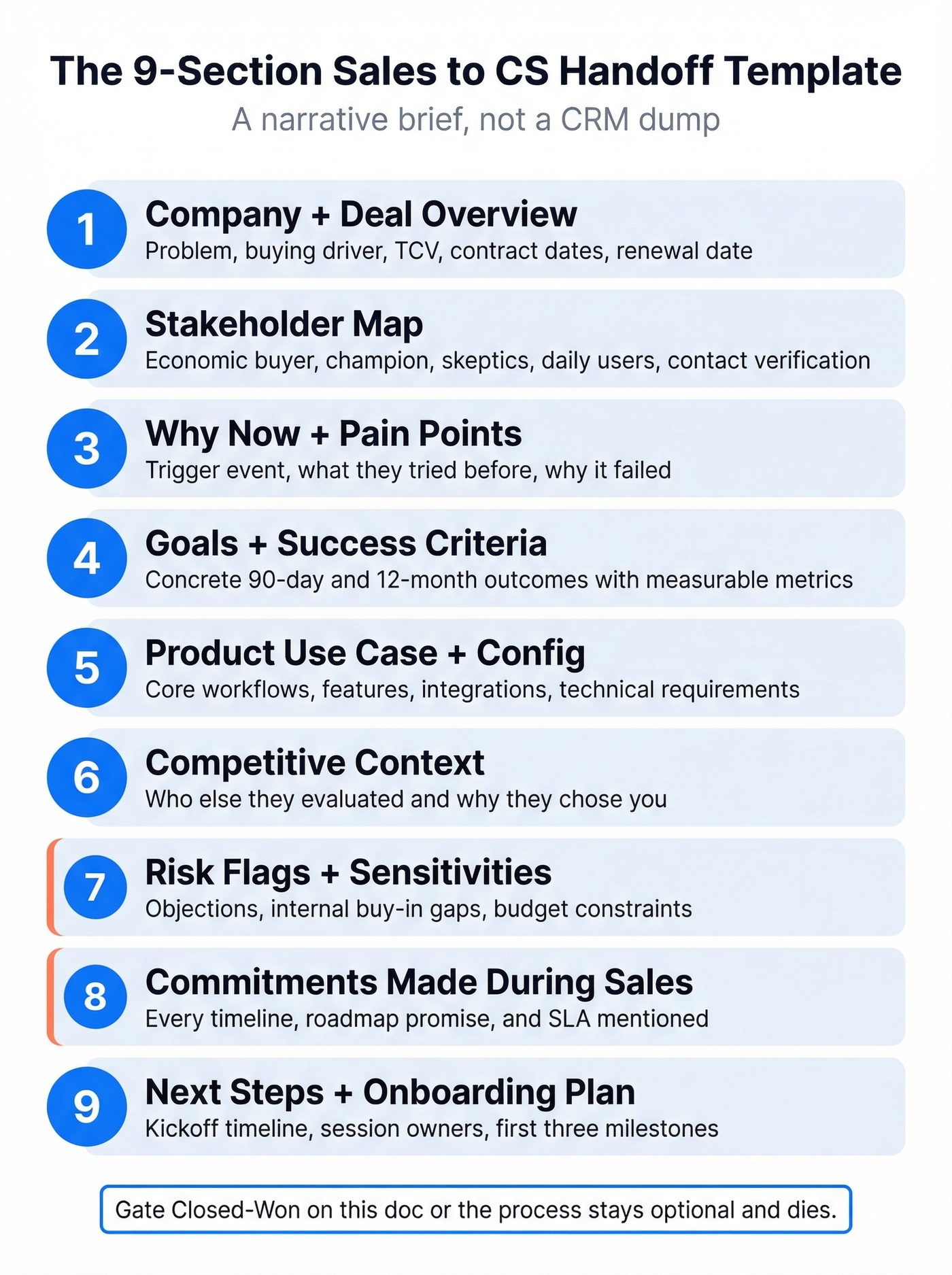
Company + deal overview. The problem, buying driver, TCV, contract dates, renewal date, and commercial terms that matter. Two paragraphs, not a field dump. (If your team still debates what belongs in the CRM vs. the doc, align on a few examples of a CRM setups.)
Stakeholder map. Economic buyer, champion, skeptics, day-to-day users. Relationship dynamics and communication preferences. One step most teams skip: verifying that every stakeholder's contact info still works. Sales cycles often run for months, and people change roles, switch emails, leave companies entirely. Run the list through Prospeo's email finder before every kickoff - a bounced kickoff invite is an embarrassing way to start a relationship. (If you’re standardizing this step, it helps to understand lead enrichment basics.)

"Why now" + pain points. The trigger event. What they tried before and why it failed.
Goals + success criteria. Concrete 90-day and 12-month outcomes with measurable metrics. "Reduce churn" isn't a goal. "Cut first-year churn from 18% to 12% by Q3" is. (For retention definitions and benchmarks, see what is churn.)
Product use case + configuration notes. Core workflows, features they care about, integrations and technical requirements.
Competitive context. Who else they evaluated and why they chose you. This tells CS what the customer values most - and what they'll compare you against at renewal. (If you want a repeatable way to capture this, build lightweight sales battle cards.)
Risk flags + sensitivities. Objections that surfaced, internal buy-in gaps, budget constraints, timeline pressure. (If objections are a recurring theme, tighten your discovery with discovery questions.)
Commitments made during sales. Every timeline, roadmap promise, support SLA, and exec intro that was mentioned. This prevents "but your sales rep said..." conversations three months later.
Next steps + onboarding plan. Kickoff timeline, session owners, first three milestones.

A bounced kickoff invite kills customer confidence before CS even starts. Prospeo's email finder verifies every stakeholder on your handoff doc with 98% accuracy - across 300M+ profiles refreshed every 7 days. Sales cycles run months. People change roles. Emails break. Don't let your handoff doc become a list of dead addresses.
Verify every stakeholder email before kickoff - not after the bounce.
Build the Handoff Doc in 10 Minutes with AI
The number one reason AEs don't complete handoff docs is time. If it takes 45 minutes, it won't happen. This is the single most actionable change you can make this quarter.
Step 1: Pull call recordings. Grab transcripts from discovery, demo, and negotiation calls. Fireflies runs $10-18/user/month, Fathom starts at $19/user/month, and Gong sits at $160-250/user/month.
Step 2: Pull CRM data. Connect HubSpot or Salesforce to your AI tool. ChatGPT and Claude both have native connectors now, eliminating manual copy-paste. (If you’re operationalizing this, a RevOps owner usually helps - see what a RevOps Manager typically owns.)
Step 3: Prompt AI to populate each section. Feed the transcripts and CRM data into a prompt structured around the nine sections above. The output is more objective than rep memory because it's grounded in what the customer actually said, not what the AE remembers saying.
Step 4: AE reviews and adds nuance. This is the 3-minute human layer - sensitivities that didn't surface on calls, off-record commitments, competitive intel shared in confidence. AI handles the 80% that's mechanical; the AE adds the 20% that's judgment.
In our experience, the stakeholder map and commitments sections are where AE review adds the most value. AI captures what was said. AEs know what was implied. We've seen teams hit the 10-minute benchmark consistently after the second or third deal.
Set SLAs or Nothing Changes
Without timing commitments, handoffs drift. The internal briefing happens "when we get to it," the customer intro slips a week, and momentum dies.
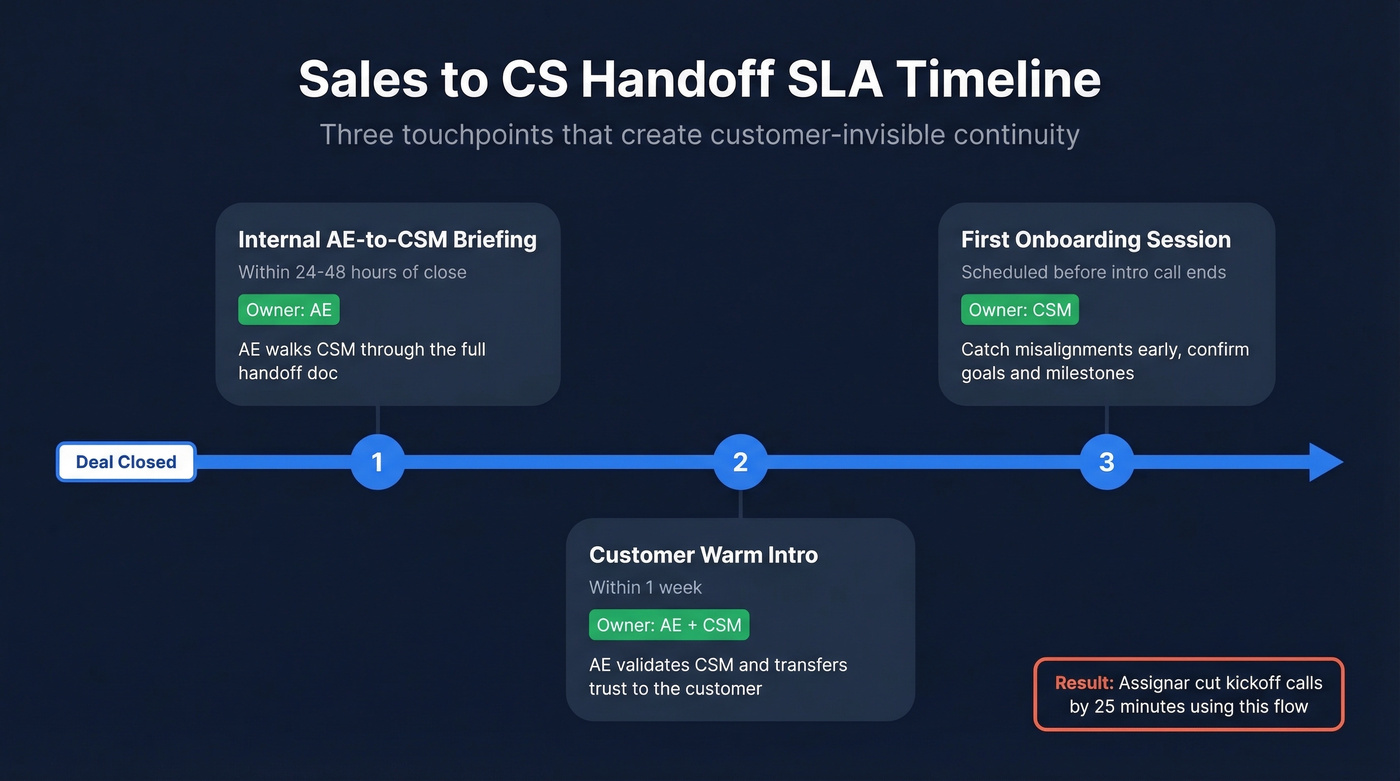
| Milestone | Timing Target | Owner |
|---|---|---|
| Internal AE-to-CSM briefing | Within 24-48 hrs of close | AE |
| Customer warm intro | Within 1 week | AE + CSM |
| First onboarding session | Scheduled before intro call ends | CSM |
Three touchpoints, in order: internal briefing where the AE walks the CSM through the handoff doc, a customer-facing warm intro where the AE validates the CSM and transfers trust, and a week-one check-in to catch misalignments early. Assignar standardized this flow and cut kickoff calls by 25 minutes on average.
The design principle behind all three is what Dock calls "customer-invisible continuity" - the handoff shouldn't feel like a handoff to the customer. When the CSM walks into kickoff already knowing the champion's priorities, the skeptic's objections, and the timeline pressures, the customer experiences seamless continuity rather than a jarring reset.
Choose the Right Handoff Model
Not every deal needs the same handoff. Match the model to your GTM motion.
| Model | Best For | Breaks When |
|---|---|---|
| Single-contact | SMB, low-touch, self-serve | Multi-stakeholder deals |
| Multi-contact | Enterprise, 6+ stakeholders | No shared framework exists |
| Manual | Early-stage, <10 deals/mo | Volume exceeds 15-20/mo |
| Automated | Scale-stage, 20+ deals/mo | Required fields are optional |
Skip the manual model if you're doing more than 15 deals a month - you'll drown in inconsistency. Automated is the target state for any team at scale.
The enforcement mechanism is simple: block the Closed-Won stage in your CRM until the handoff doc is attached and required fields are populated. If your CRM lets deals close without a handoff doc, your process is optional. Optional processes die. (If you need a customer-facing version of the transition, keep a few handoff email templates ready.)
Metrics That Prove It's Working
Track these five, and segment every one by handoff completeness score.
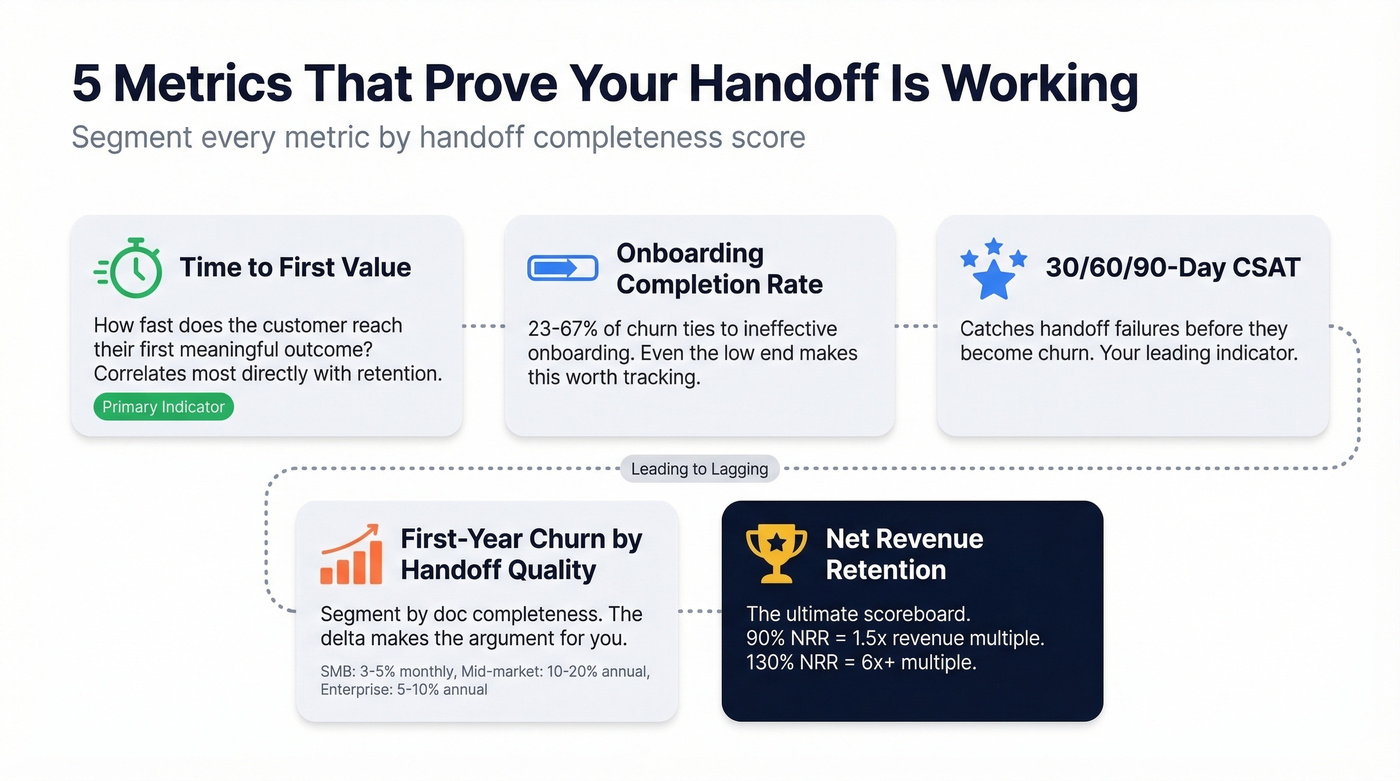
Time to first value is the metric that correlates most directly with retention. How fast does the customer reach their first meaningful outcome? If TTV improves after you standardize the handoff, you have your proof point.
Onboarding completion rate tells you what percentage of customers finish the full onboarding sequence. Industry estimates tie 23-67% of churn to ineffective onboarding - a wide range, but even the low end makes this worth tracking.
30/60/90-day CSAT catches handoff failures before they become churn. Early satisfaction scores are your leading indicator. Don't wait for renewal conversations to discover the relationship was broken from day one.
First-year churn by handoff quality is where the business case lives. Segment accounts by handoff doc completeness. The delta will make the argument for you. For benchmarks: SMB typically runs 3-5% monthly logo churn, mid-market 10-20% annual, and enterprise 5-10% annual. If your numbers are worse, the sales-to-CS transition is a likely culprit.
NRR is the ultimate scoreboard. If handoff improvements don't move NRR within two to three quarters, something upstream is still broken. (If you’re aligning leadership on the definition, use a standard net revenue retention explainer.)
Your 9-section handoff doc is only as good as the contact data inside it. Prospeo enriches every stakeholder with 50+ data points - verified emails, direct dials, job titles, and reporting structure - so your CSM walks into kickoff knowing exactly who to reach and how. 92% match rate. $0.01 per email.
Enrich your entire stakeholder map in one click before every handoff.
FAQ
What should a sales to CS handoff doc include at minimum?
Four sections prevent 80% of "I had no context" complaints: stakeholder map, commitments made during sales, goals with success criteria, and risk flags. Everything else is valuable, but these four are non-negotiable. Start here if you're building from scratch.
How do I get AEs to actually complete the handoff doc?
Block the Closed-Won stage in your CRM until the handoff doc is attached. Pair that gate with AI-assisted generation so the doc takes 10 minutes, not 45. Removing the time excuse while adding a real consequence is the only combination that works consistently.
How long should the end-to-end handoff process take?
From Closed-Won to first onboarding session, aim for seven business days or fewer. The internal briefing happens within 48 hours, the customer warm intro within a week, and the first onboarding session gets scheduled before that intro call ends. Anything beyond ten business days and you're losing the momentum the AE built.
How do I keep stakeholder contact data accurate during the transition?
Sales cycles run months, and people change roles or leave companies. Before every kickoff, verify your stakeholder list with a tool that refreshes data frequently - stale CRM records are one of the most common causes of botched kickoff invites. At 98% email accuracy and roughly $0.01 per lookup, Prospeo handles this well, and the free tier covers smaller deal volumes.