

Expansion Sales: Turn Existing Customers Into Your Biggest Growth Engine
Your best customers are already growing. They're adding headcount, launching new departments, rolling out adjacent initiatives - and most sales teams find out about it months late, if at all. Meanwhile, the cost of acquiring a net-new logo keeps climbing.
Expansion sales is the motion that fixes this.
The quick version: This discipline grows revenue from existing customers through upsells, cross-sells, seat expansion, and new buying centers. It now represents 40% of new SaaS ARR at the median, and companies maintaining 100%+ net revenue retention grow at 2x the rate of those below that line. To operationalize it, you need usage signals, a trigger-based playbook, and accurate contact data for stakeholders you haven't reached yet.
What Is Expansion Sales?
This practice increases revenue from your existing customer base - not by raising prices arbitrarily, but by delivering more value to accounts that are ready for it.
The distinction from retention matters. Retention preserves existing contracts. Expansion grows them. A customer renewing at the same spend is retention. A customer renewing with two more seats and a new product line is expansion.
The Four Expansion Motions
There are four primary ways to expand an account:
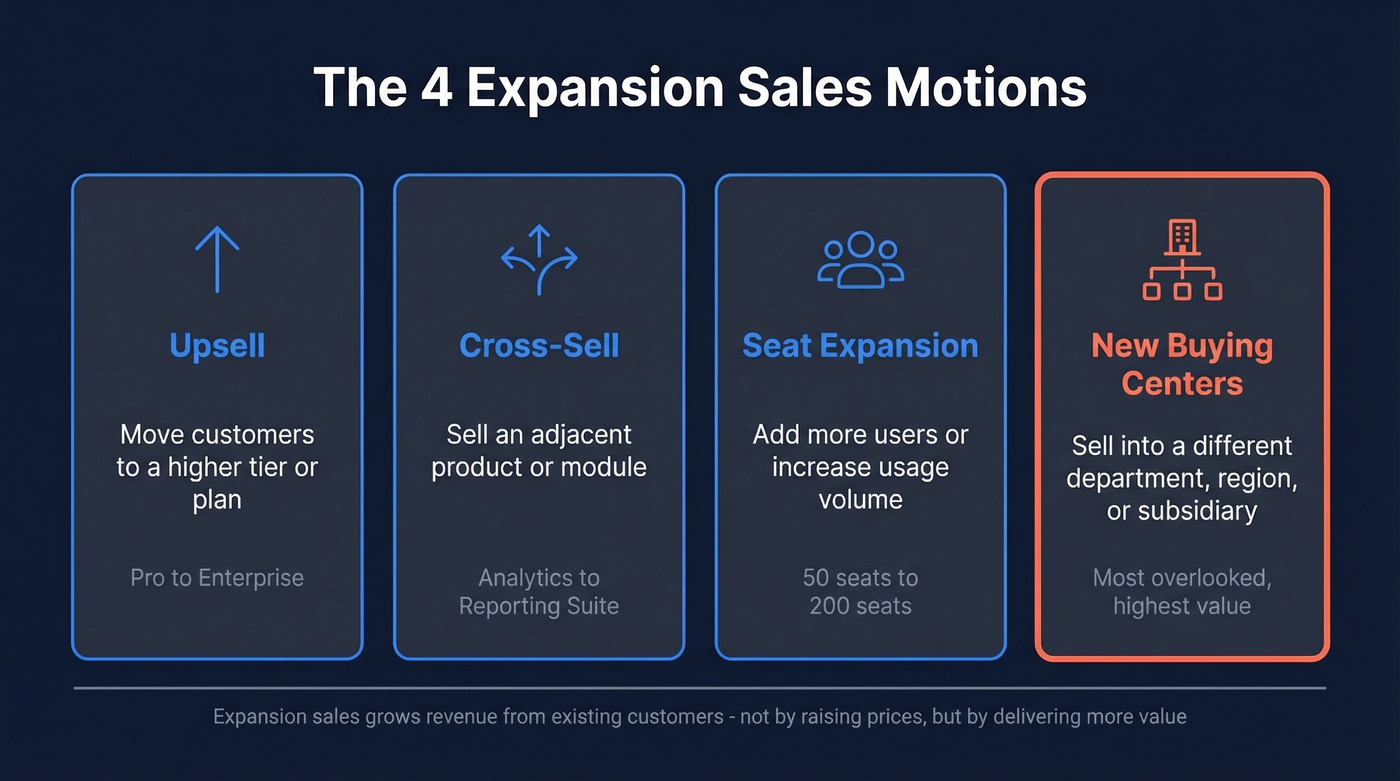
- Upsell - moving a customer to a higher tier or plan. They're on Pro, they need Enterprise.
- Cross-sell - selling an adjacent product. They bought your analytics tool, now they need your reporting suite.
- Seat expansion - adding more users or increasing usage volume within the same product.
- New buying centers - selling into a different department, region, or subsidiary within the same company. This is the most overlooked motion, and often the highest-value one.
Expansion ARR: What It Measures
Expansion ARR captures the incremental annual recurring revenue generated from existing customers. If a customer was paying $50K/year and upgrades to a plan worth $80K/year, the expansion ARR is $30K. It can happen mid-contract or at renewal - and the timing distinction matters because mid-contract expansion signals genuine product-market fit. The customer isn't waiting to be asked.
Why Growing Existing Accounts Matters More Than Ever
The economics have shifted from "nice to have" to survival math. New customer acquisition costs rose 14% in 2024, and the median new-customer CAC ratio sits at $2.00 of sales and marketing spend for every $1.00 of new customer ARR. For companies in the fourth quartile, that ratio balloons to $2.82.
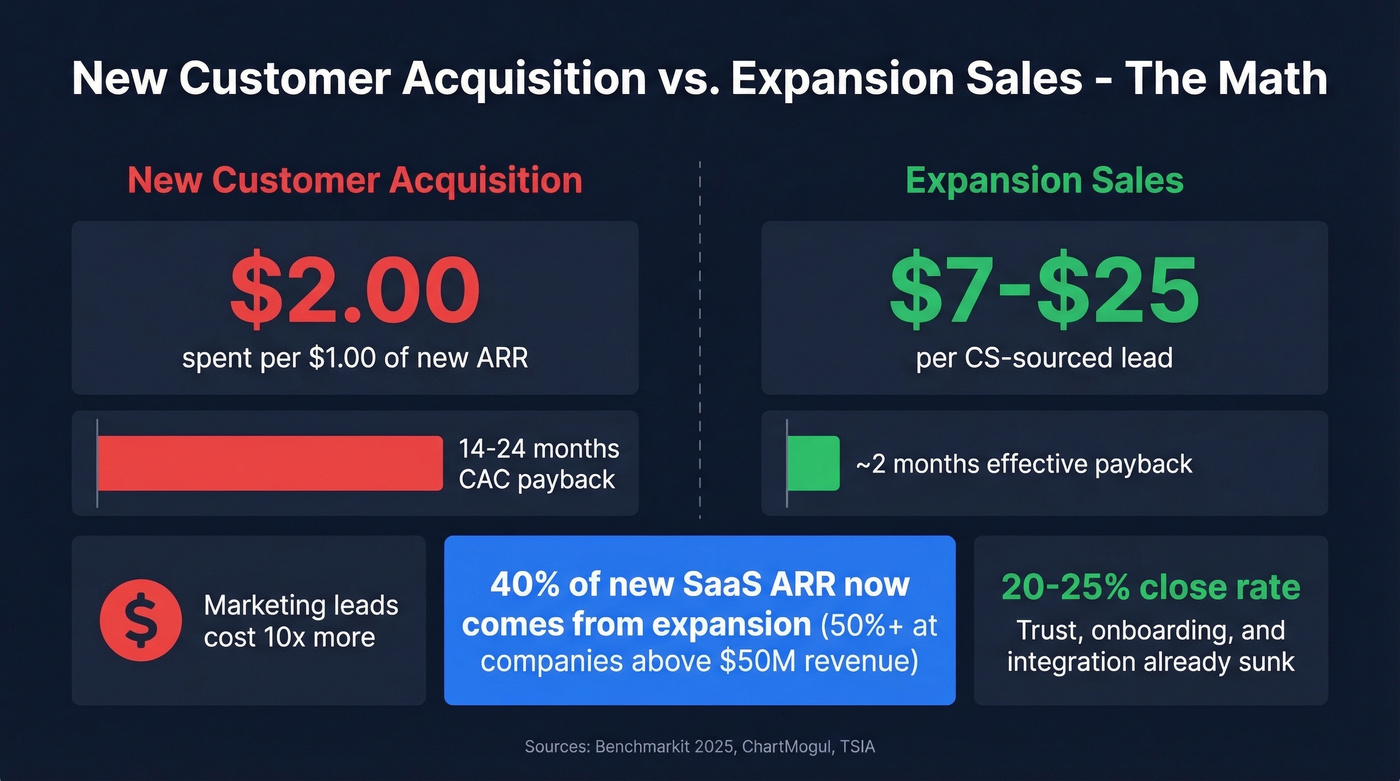
Expansion breaks that math. CS-sourced leads cost $7-$25 per lead and close at 20-25%. Marketing-generated leads cost roughly 10x as much. That's not a marginal difference - it's a structural advantage that makes a deliberate expansion revenue strategy essential for any SaaS business past $5M ARR.
| Metric | Benchmark |
|---|---|
| Median NRR | 101% |
| Expansion as % of new ARR | 40% (50%+ at $50M+ revenue) |
| New customer CAC ratio | $2.00 per $1.00 ARR |
| NRR ≥100% → YoY growth | 48% (2x faster than sub-100%) |
| CS-sourced lead cost | $7-$25 |
| CS-sourced close rate | 20-25% |
Sources: Benchmarkit 2025 SaaS Benchmarks, ChartMogul, TSIA
Across 2,500+ SaaS businesses, companies with $15M-$30M+ ARR now see 40% of their growth driven by expansion - up from 30% in early 2021.
CAC payback periods tell the same story:
| ACV Segment | CAC Payback |
|---|---|
| Sub-$5K | ~8 months |
| $5K-$25K | 14-18 months |
| $25K-$50K | ~22 months |
| $50K+ | ~24 months |
Expansion revenue compresses those payback windows because you're selling into accounts where trust, onboarding, and integration costs are already sunk.
Here's the thing: if your ACV is above $25K and you're not running a deliberate expansion motion, you're essentially subsidizing a two-year payback period with money that could generate returns in two months. This isn't a growth hack. It's the only math that works at scale.
One Reddit operator put it simply: they were seeing 20-25% of new MRR from expansion "almost by accident" and wondered what a deliberate strategy could unlock. The benchmarks suggest 40% is the median target - and the best companies blow past it.
Frameworks Worth Knowing
You don't need a framework to start expanding accounts. But frameworks help when you're scaling the motion across a team and need shared language.
LAER (Land, Adopt, Expand, Renew) is TSIA's model and the most widely referenced. The insight isn't the acronym - it's the sequence. Expansion only works after adoption is solid. Teams that push upsells before the customer has fully adopted the initial purchase create churn risk, not growth.
CSQL (Customer Success Qualified Lead)/About/Overview_of_CSQL) mirrors the MQL/SQL handoff but for existing accounts. A CSM identifies an expansion signal - usage spike, new department request, executive sponsor change - and passes a qualified lead to Sales. The value is in formalizing what most teams do informally or not at all. When account growth and customer success teams share a common qualification language, handoffs stop falling through the cracks.
"Why Stay / Why Pay More / Why Evolve" is a messaging framework from Corporate Visions that addresses something most teams get wrong. Their research found that almost 60% of B2B organizations don't differentiate expansion messaging from acquisition messaging - the fastest way to trigger a competitive evaluation you didn't need to face. Post-sale, customers don't need to hear "why change." They need "why stay" and "why this next step creates more value." Different conversation, different deck, different talk track.
Whitespace mapping is less a named framework and more a planning exercise. Map every account against the full set of products, departments, and geographies you serve. The gaps between what they've bought and what they could buy are your whitespace. Teams that maintain a living whitespace map consistently outperform those running expansion ad hoc.
Building Your Expansion Playbook
Frameworks are thinking tools. These are doing tools.
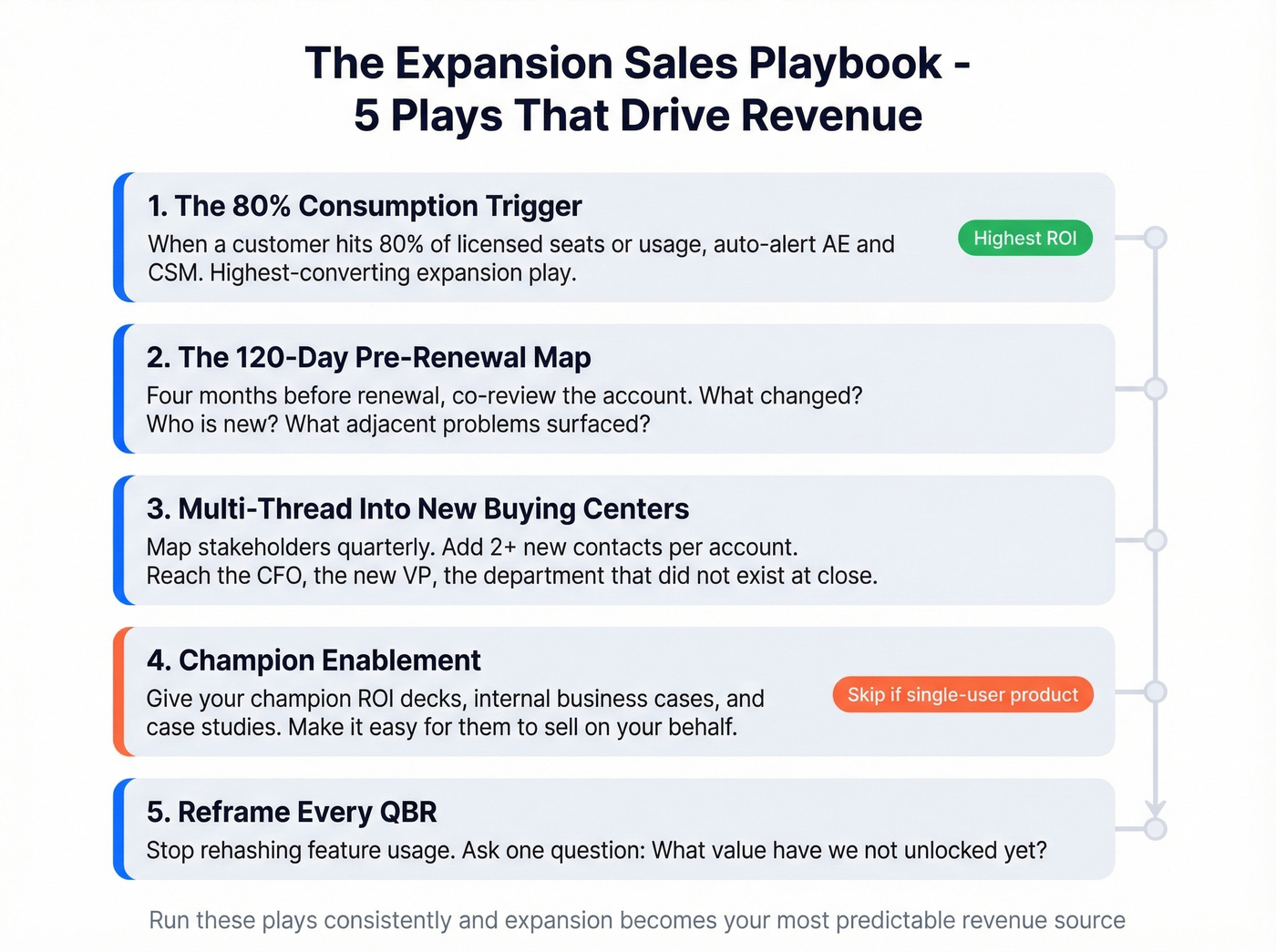
1. The 80% Consumption Trigger
When a customer hits 80% of their licensed seats or usage cap, that's not a billing event - it's a sales signal. Automate the alert, create the opportunity, and notify both the AE and CSM. Waiting until they hit 100% means you're reactive. Catching them at 80% means you're consultative.
In our experience, this is the single highest-converting expansion play.
Here's what it looks like in practice: a $20M ARR company with 200 accounts runs the 80% consumption trigger. In Q1, they surface 35 expansion opportunities, close 8, and add $180K in expansion ARR - a 3.6% lift from one play running on autopilot. That's real money from a rule that took an afternoon to set up.
2. The 120-Day Pre-Renewal Map
Four months before every renewal, Sales and CS should co-review the account. What's changed? Who's new? What adjacent problems have surfaced? This isn't a renewal call - it's an expansion scoping session that happens to coincide with contract timing.
3. Multi-Threading Into New Buying Centers
Most accounts are single-threaded through one champion. That's a churn risk and an expansion ceiling.
Map stakeholders quarterly and add at least two new contacts per account. The CFO you've never met, the new VP of a department that didn't exist when you closed the deal - reaching them requires contact data that's actually current, not six months stale. If you need a system for this, start with contact management basics so stakeholders don’t get lost between CS and Sales.
Skip This If Your Product Is Single-User
Champion enablement works when your champion wants to expand the account internally but needs ammunition. Give them ROI decks customized to their metrics, internal business cases they can forward, case studies from similar companies. Make it easy for them to sell on your behalf. But if your product doesn't have multi-department appeal, skip this play and focus on upsells instead.
Product-led value moments - in-app prompts triggered at usage milestones - sync the product experience with the expansion motion. These work best when coordinated with CS outreach, not as standalone pop-ups.
Let's be honest about QBRs: CS-led reviews that rehash feature usage are a waste of everyone's time. QBRs that quantify business outcomes and map them to unrealized potential are expansion conversations disguised as check-ins. Reframe every QBR around one question: "What value haven't we unlocked yet?" If you want to tighten the structure, use a set of proven QBR questions to keep the meeting outcome-driven.

Expansion sales depends on reaching stakeholders you don't have in your CRM yet - new departments, new hires, new buying centers. Prospeo's 300M+ profiles with 30+ filters like headcount growth, department size, and job changes surface the exact contacts your accounts are adding before your competitors find them. 98% email accuracy means your outreach actually lands.
Stop discovering account growth months late. Surface expansion contacts in real time.
Expansion Signals: When to Sell
Your best customer just added 200 employees and your CSM found out from social media - not your CRM. That's the gap most expansion programs need to close.
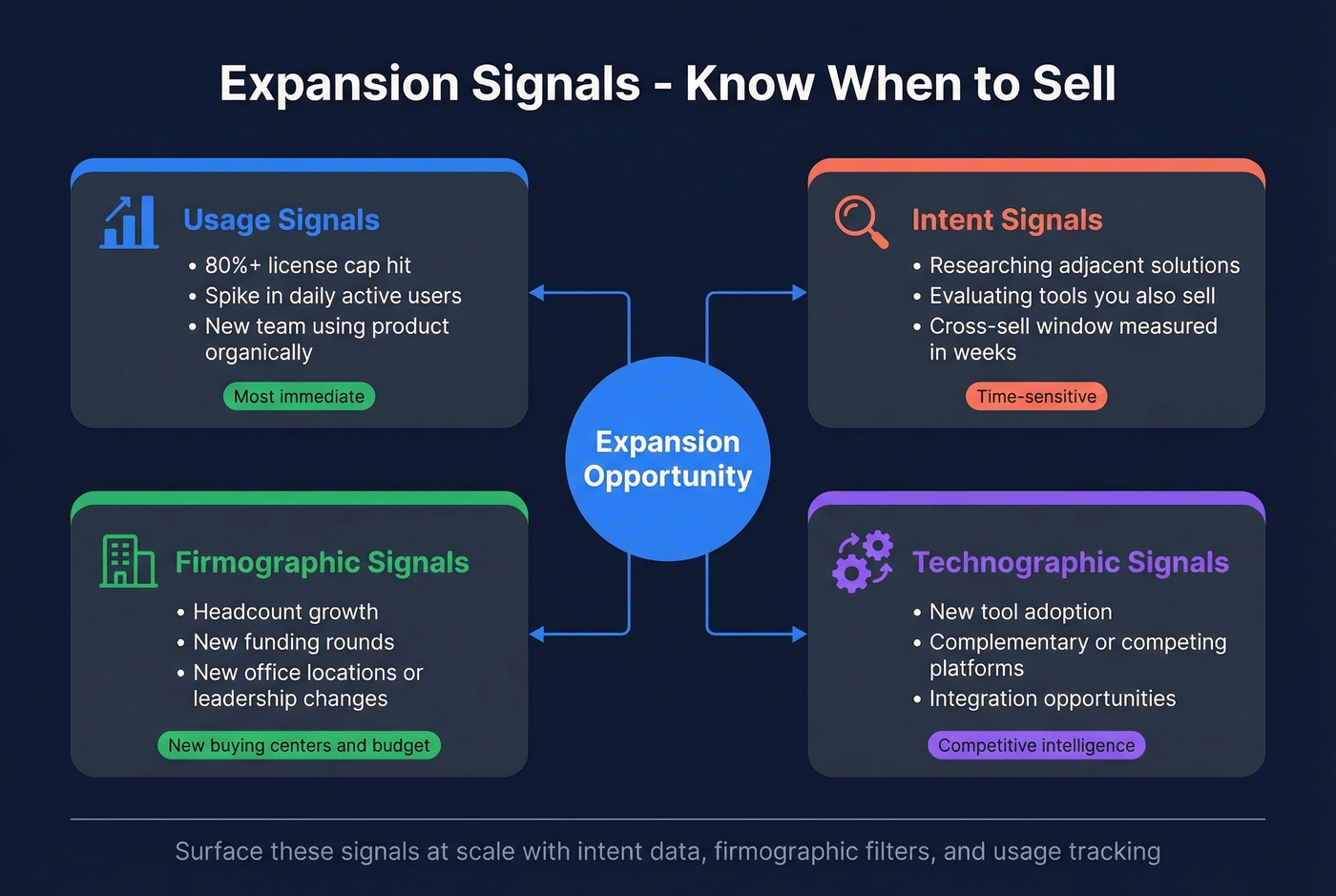
Usage signals are the most immediate: a customer hitting 80%+ of their license cap, a spike in daily active users, a new team starting to use the product without a formal rollout.
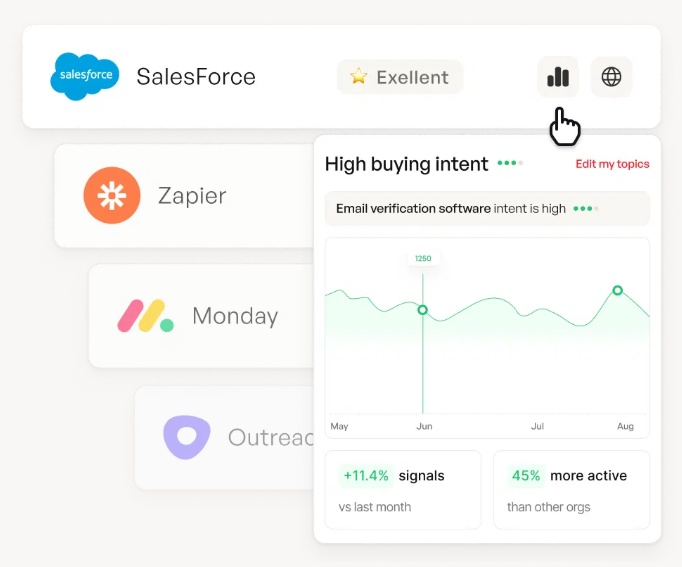
Intent signals reveal when existing accounts are researching adjacent solutions. If your customer is actively evaluating tools in a category you also serve, that's a cross-sell window measured in weeks, not quarters. This is easiest to operationalize with intent based segmentation so your plays match what the account is researching.
Firmographic signals are structural changes - headcount growth, new funding rounds, new office locations, leadership changes. Each one creates new buying centers and new budget. If you’re building filters for this, start with firmographic filters.
Technographic signals show when accounts adopt new tools that complement or compete with yours. A customer adding a new marketing automation platform might need your integration - or might be signaling dissatisfaction. (More on combining these datasets in firmographic and technographic data.)
Surfacing these signals at scale requires a B2B data platform with intent and firmographic filtering. Prospeo tracks 15,000 intent topics and lets you filter by headcount growth, funding rounds, and technographics - so you can flag which existing accounts are researching solutions you sell before your CSM hears about it secondhand.
Who Owns Expansion?
This is where most programs break down - not in strategy, but in org design.
Services and CS teams interact with customers 5-15x as often as Sales. They hear the pain points, see the usage patterns, and build the relationships. But they're rarely compensated to close deals, and most aren't trained to. TSIA's STAR protocol - Simple, Transactional, Analytics-Driven, Repeatable - gives CS teams a closing framework that doesn't require full sales training.
The hybrid model works best: CS identifies signals and qualifies leads, Sales closes. But without comp alignment, you get the worst of both worlds - CSMs who don't surface opportunities because it's not their job, and AEs who ignore existing accounts because new logos pay better. If you’re formalizing ownership, a lightweight RevOps manager function often ends up being the glue.
A r/sales thread captured the dysfunction perfectly: an AE lands a $50K deal in a usage-based model. Eighteen months later, the account is doing $1M+ in consumption. The AE's commission? Still based on the original $50K booking. Zero additional upside for the growth they seeded.
The land-and-expand model isn't broken because the strategy is wrong. It's broken because comp plans actively punish it.
Fix the incentives and the expansion motion follows. The best structures we've seen tie 20-30% of AE comp to expansion within their book, give CSMs a bonus pool for qualified expansion leads that close, and create shared quotas between CS and Sales on renewal + expansion targets.
Growth Account Planning and Tools
You need three categories covered well.
CRM & pipeline management - HubSpot (from ~$45/mo), Salesforce ($25-$165/user/mo depending on edition), or Pipedrive ($14-$99/user/mo). Track expansion opportunities separately from new business so you can measure the motion. Dedicated pipeline stages for account growth make it possible to forecast expansion revenue alongside new-logo revenue. If you’re evaluating options, here are examples of a CRM to sanity-check fit.
Product analytics - Amplitude (from ~$61/mo) or similar. You can't trigger expansion plays without usage data. If you don't know who's at 80% consumption, you're guessing.
B2B data & contact enrichment - this is where most expansion programs have a blind spot. Your CRM has contacts for the people who bought. It doesn't have contacts for the new VP of Engineering or the APAC office that opened last quarter. Prospeo's 300M+ profiles refresh every 7 days, so when your existing account hires a new stakeholder, you can pull a verified email on the next weekly refresh cycle - not six months later. If you’re comparing vendors, start with a shortlist of data enrichment services.
Conversation intelligence - Fireflies.ai (from ~$18/mo) captures expansion signals buried in call recordings. When a customer mentions a new initiative on a routine check-in, that's a trigger your CSM might forget to log.
For teams building from scratch, start with three things: a CRM with health scoring, product analytics for usage signals, and a B2B data platform for reaching new stakeholders. Everything else is optimization. To make the motion measurable, align it to core pipeline health metrics.
Your whitespace map is only as good as the contact data behind it. Prospeo's CRM enrichment returns 50+ data points per contact at a 92% match rate - filling every gap in your account coverage. Layer in intent data across 15,000 topics to know which accounts are actively researching adjacent solutions you sell.
Turn whitespace into pipeline for $0.01 per verified email.
Common Pitfalls
The biggest mistake is using your acquisition pitch on existing customers. They don't need to hear "why change" - they already changed. They need "why stay" and "why this next step makes sense." Corporate Visions found that almost 60% of B2B organizations make this exact error, and it's the fastest way to trigger a competitive evaluation you didn't need to face.
The second killer is comp misalignment. If nobody's comp plan includes expansion, nobody's working on it. We've seen teams lose six-figure deals because their AEs had zero incentive to pursue them. Hope isn't a strategy.
Three more pitfalls worth flagging:
- Pushing expansion before adoption is solid. Upselling a customer who hasn't fully adopted your core product creates churn, not revenue. Sequence matters.
- Bad contact data when expanding into new buying centers. Buying committees run six to twelve decision-makers deep - you need current, verified contacts for people outside your champion's org chart.
- No formal ownership. When CS "sort of" owns it and Sales "sort of" owns it, nobody actually owns it. Pick a model and fund it.
FAQ
What's the difference between expansion sales and upselling?
Upselling is one of four expansion motions. Expansion sales also includes cross-selling adjacent products, adding seats or usage volume, and selling into entirely new buying centers within the same company. Upselling moves a customer up-tier; the broader discipline grows the full account footprint.
What's a good net revenue retention rate?
The median NRR across SaaS is 101%, while top performers maintain 111%+. Companies with 100%+ NRR grow at roughly 2x the rate of those below that line, based on analysis of 2,500+ SaaS businesses.
Should Customer Success or Sales own expansion?
Hybrid models work best: CS identifies signals and qualifies leads (they interact with customers 5-15x more often), and Sales closes. The critical piece is comp alignment - both teams need financial incentive to collaborate on expansion outcomes.
What percentage of revenue should come from expansion?
Benchmarks show 40% of new ARR comes from expansion at the median. For companies above $50M in revenue, that number exceeds 50%. If you're seeing 20-25% without a deliberate strategy, a structured playbook can realistically push you toward 35-40%.
How do you find contacts for new buying centers in existing accounts?
Use a B2B data platform with weekly refresh cycles so new hires and role changes surface quickly. Prospeo's 300M+ profiles update every 7 days with 98% email accuracy, letting you reach new stakeholders within days of their hire - not months.