

B2B Cross Selling: The Data-Backed Playbook for 2026
Your biggest account just renewed, and nobody offered them the two adjacent products that 60% of similar customers already buy. That's not a hypothetical - it's the norm. Fewer than 25% of organizations actually hit their cross-sell objectives, yet a B2B packaging company working with McKinsey drove a tenfold increase in cross-sell revenue in just eight weeks. With 80% of B2B sales interactions now happening in digital channels, the renewal touchpoint is often the only moment a cross-sell gets surfaced. Most teams waste it.
Cross selling in B2B isn't a growth strategy. It's a retention strategy that happens to grow revenue. The gap between the companies that execute it and the companies that talk about it is enormous.
What Is B2B Cross Selling?
Cross selling means offering a complementary product or service to an existing customer. Simple enough. The revenue you quietly lose when those products aren't offered at the right moment? That's cross-sell leakage, and in complex, multi-division B2B orgs, it's rampant.
Don't confuse it with upselling - they're different motions targeting different buying decisions, requiring separate workflows, separate stakeholders, and often separate comp structures. If you want the clean breakdown, see Cross Selling vs upselling.
| Cross Selling | Upselling | |
|---|---|---|
| What changes | New product category | Higher tier, same product |
| Example | Cyber policy + GL renewal | Basic plan to Enterprise plan |
| Buyer | Often a different stakeholder | Usually the same buyer |
| Revenue type | Net-new product revenue | Expansion within product |
When Cross Selling Backfires
Most cross-sell guides tell you to "recommend relevant products" and stop there. That's a platitude, not a strategy. Before you build a cross-sell program, learn who to exclude.
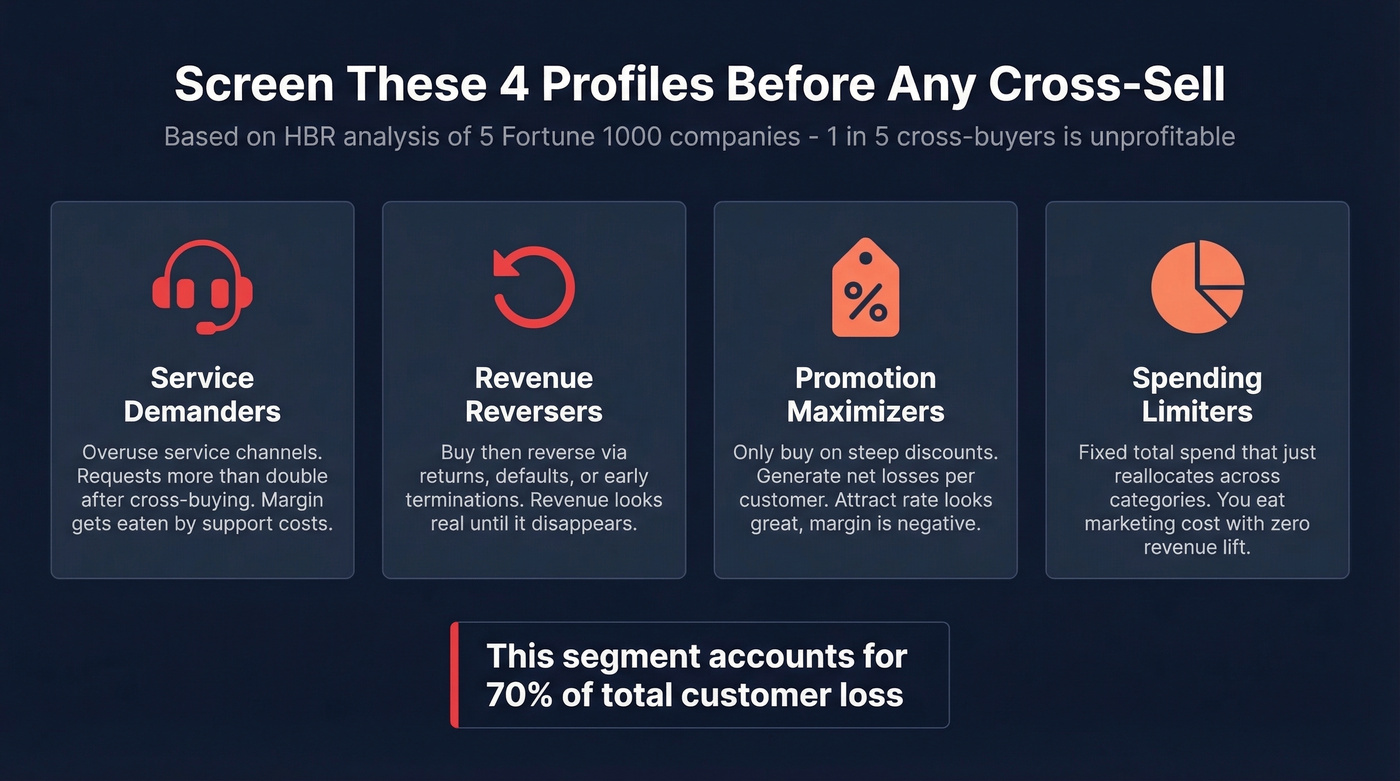
An HBR analysis across five Fortune 1000 companies found that 1 in 5 cross-buying customers is unprofitable. That segment accounts for 70% of a firm's total customer loss. Screen for these four profiles before pushing any cross-sell:
- Service demanders - overuse service channels; requests more than double after cross-buying.
- Revenue reversers - buy then reverse via returns, defaults, or early terminations.
- Promotion maximizers - only buy on steep discounts, generating net losses per customer.
- Spending limiters - fixed total spend that reallocates across categories. You eat marketing cost with zero revenue lift.
If you don't filter these out, your cross-sell program will look great on attach rate and terrible on margin. Behavioral segmentation comes first - segment your base by profitability profile before you segment by product fit. (If you need a framework for defining who you should target, use an ideal customer profile scorecard.)
How to Find Cross-Sell Opportunities
Every guide says "use data to identify opportunities" and then doesn't tell you what data, what method, or what tool. Here's the actual method. It's called whitespace analysis, and it's the foundation of any serious account expansion effort.
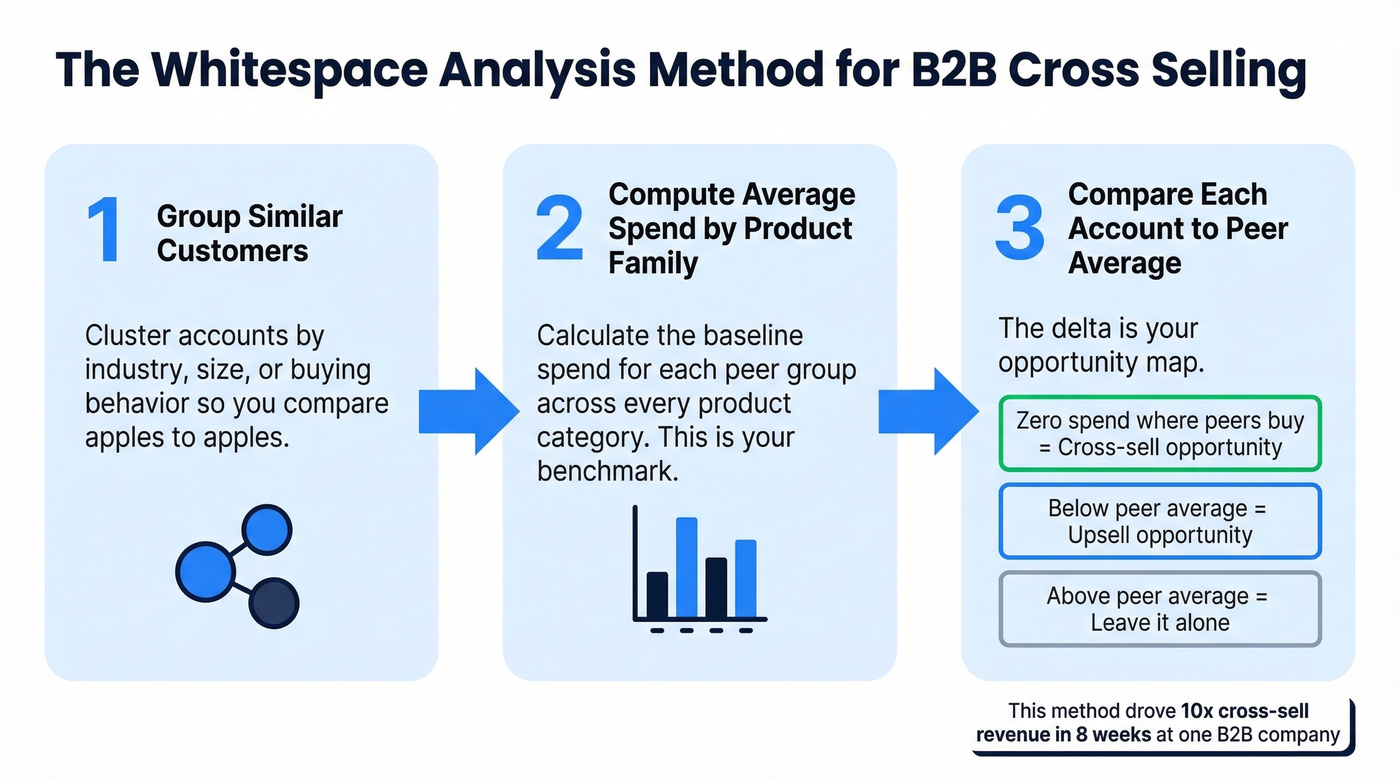
Step 1: Group similar customers. Cluster accounts by industry, size, or buying behavior so you're comparing apples to apples. (This is where firmographic filters and firmographic and technographic data make the model far more accurate.)
Step 2: Compute average spend by product family for each peer group. This is your baseline.
Step 3: Compare each account's spend to the peer-group average. The delta is your opportunity map.
A customer spending less than peers in a product family signals an upsell into existing book of business. Zero spend in a family peers regularly buy signals a cross-sell opportunity. Over-indexing versus peers? Leave it alone.
In our experience, this method surfaces far more actionable opportunities than the typical "let's brainstorm what else we can sell them" meeting. It breaks at scale in a spreadsheet, but the logic works whether you're in Excel or a pricing platform. The companies that treat farming existing accounts as a disciplined, data-driven motion consistently outperform those running ad hoc campaigns - and it's not close.

Whitespace analysis tells you which products to cross-sell. But reaching the right buyer in a different department? That's the real bottleneck. Prospeo enriches your CRM with 50+ data points per contact - 83% match rate, refreshed every 7 days - so your reps land in the inbox of the actual decision-maker, not a dead-end alias.
Stop losing cross-sell deals to missing contacts.
What Actually Drives Cross-Sell Revenue
Two case studies stand out because they include actual numbers, not just "we saw great results."
The insurance automation play. A regional agency cross-sold Cyber coverage alongside every General Liability renewal using an automated workflow. 100% of eligible accounts received Cyber indications. 15% converted. Those accounts generated roughly 30% additional revenue with zero added headcount. The key insight: automation at the renewal touchpoint is the highest-ROI cross-sell motion because the customer is already engaged and the timing is natural. (If you're building this into your lifecycle, start with a clean renewal rate baseline.)
The McKinsey packaging company. They sized full share of wallet for key customers, used analytics to identify whitespace, and ran hyper-personalized outreach to priority accounts. Result: 10x cross-sell revenue in eight weeks compared to the prior ten months. Not magic - structured prioritization replacing scattered effort.
Here's the thing most playbooks skip: cross selling in B2B often means reaching a different decision-maker within the same account. Your original contact bought Product A, but the buyer for Product B sits in a different department entirely. If your CRM only has the original contact, your reps are stuck sending emails into a void. Prospeo's CRM enrichment fills that gap - 83% match rate refreshed every 7 days versus the 6-week industry average - so your cross-sell outreach actually lands with the right person instead of dying in a generic info@ inbox. If you're evaluating vendors, compare data enrichment services and lead enrichment approaches side-by-side.
Metrics That Matter
In SaaS, the clearest signal of cross-sell health is net revenue retention. Directional benchmarks by segment:
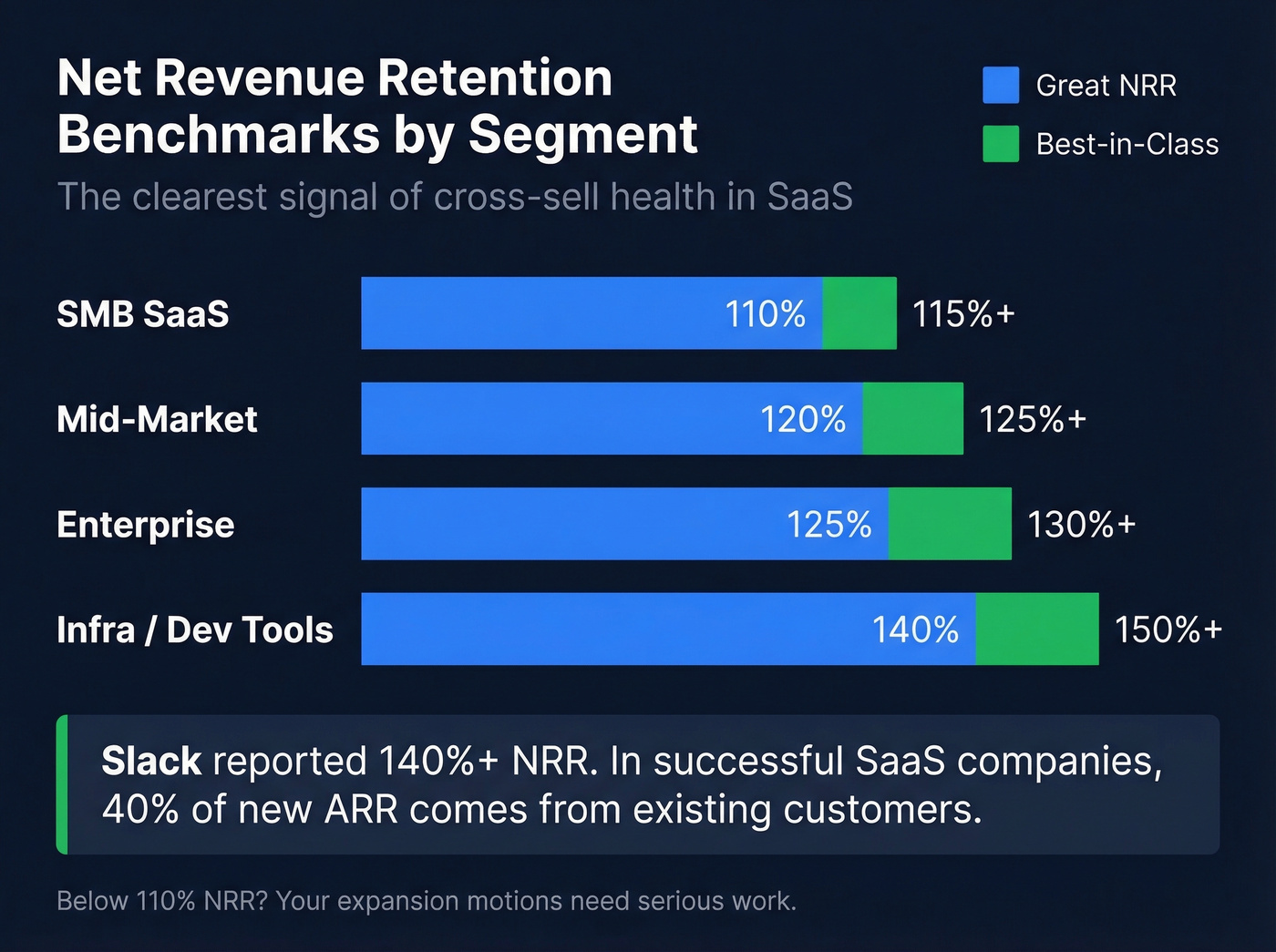
| Segment | Great NRR | Best-in-Class |
|---|---|---|
| SMB SaaS | 105-110% | 115%+ |
| Mid-market | 110-120% | 125%+ |
| Enterprise | 115-125% | 130%+ |
| Infra / dev tools | 125-140% | 150%+ |
Slack reported 140%+ NRR - a benchmark that shows what's possible when account expansion is baked into the product itself. In successful SaaS companies, 40% of new ARR comes from selling to existing customers. If your NRR sits below 110%, your expansion motions need serious work. (To pressure-test your measurement stack, use a funnel metrics checklist.)
Beyond NRR, track attach rate: the percentage of customers buying two or more products within 12 months. Cohort attach rate by the first product purchased to identify natural pairings. We've seen cases where customers who start with Product A convert to Product B at 3x the rate of those who start with Product C - that single insight reshapes your entire cross-sell sequencing and becomes the backbone of any expansion revenue program worth running.
Why Most Programs Fail
If your comp plan doesn't reward cross selling, your program is dead on arrival. Full stop.
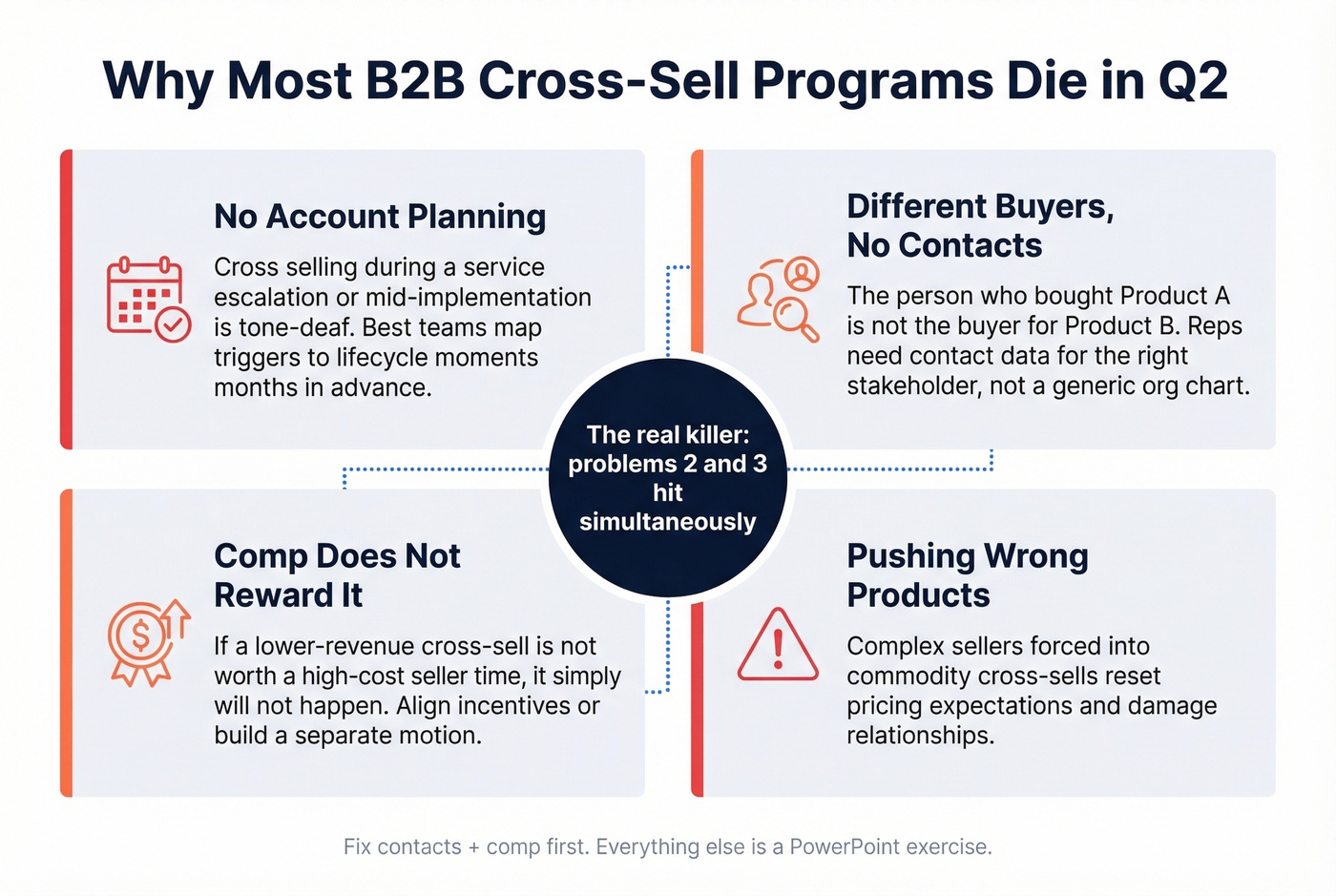
But comp is only one of four failure modes we see repeatedly.
No account planning. Cross selling during a service escalation or mid-implementation is tone-deaf. Timing matters more than the offer itself, and the best teams map cross-sell triggers to specific lifecycle moments months in advance. (If you need a system for this, build it like account-based selling.)
Different buyers across categories. The person who bought your analytics platform isn't the buyer for your security module. Reps need enablement and contact data for the right stakeholder - not a generic org chart.
Comp doesn't reward it. If a lower-revenue cross-sell isn't worth a high-cost seller's time, it won't happen. Align incentives or build a separate motion entirely.
Pushing wrong products. Complex sellers forced into commodity cross-sells reset pricing expectations and damage relationships. Not every product belongs in every bundle.
Let's be honest: most programs fail at the second and third problems simultaneously. Reps don't know who to call, and even if they did, there's no financial reason to bother. The strategy dies in the gap between leadership's PowerPoint and the rep's daily workflow. The consensus on r/sales threads about cross-sell programs is brutal - reps call them "management's pet project that dies in Q2." If you're building one of these programs and you haven't solved the contacts-plus-comp problem first, skip the kickoff meeting and fix those two things instead.
That 10x cross-sell case didn't happen by accident - it happened because reps had verified contact data for every stakeholder in every whitespace account. Prospeo gives you 300M+ profiles with 98% email accuracy at $0.01/email, so scaling personalized cross-sell outreach doesn't require scaling your team.
Find every cross-sell buyer in your accounts for a penny each.
FAQ
What's the difference between cross selling and upselling in B2B?
Cross selling offers a complementary product to an existing customer - a new product category entirely. Upselling moves them to a higher tier of the same product. They require different workflows, often target different stakeholders, and should be tracked with separate metrics. HBR's research on cross-buying profitability is worth reading before you design either motion.
What's a good cross-sell conversion rate?
Expect 10-15% from automated renewal workflows in B2B - the insurance case study above hit 15% with zero added headcount. If your attach rate is below 5%, revisit your targeting, timing, or the profitability filters from the HBR framework. McKinsey's work on commercial excellence has useful benchmarks for packaging and industrial verticals specifically.
How do you identify cross-sell opportunities in a CRM?
Run whitespace analysis: group similar accounts, compare product spend to peer-group averages, and flag gaps where spend is zero. Then enrich your CRM with fresh contact data so reps can actually reach the right buyer in each department. Stale records are the silent killer of cross-sell campaigns - if your data is more than a few weeks old, you're likely reaching people who've already changed roles.
Why do B2B cross-sell programs fail?
The top killer is a missing-contacts problem compounded by misaligned comp. Reps can't reach the decision-maker for the adjacent product, and even if they could, their incentive plan doesn't reward the effort. Fix both simultaneously or the program stalls after the first quarter. Gartner's B2B buying research shows that buying groups now average 6-10 stakeholders - if you only have one contact per account, you're structurally locked out of the cross-sell conversation.