

What Is Predictive Dialing? Complete Guide (2026)
Your caller IDs show "Spam Likely" by Wednesday. Agents sit idle between connects. The list you bought last quarter is 40% disconnected numbers. If you're wondering whether predictive dialing is right for your team, the answer depends entirely on your setup - and most teams get it wrong.
The Short Version
Predictive dialing dials multiple numbers per agent using an algorithm. It's built for 10+ agent teams doing high-volume B2C outreach. The two things that'll kill your campaign: spam-flagged caller IDs and bad phone data. If you have fewer than 10 agents or sell high-value B2B, use a power or preview dialer instead.
Predictive Dialing Defined
Predictive dialing is an automated outbound calling method where software dials multiple phone numbers simultaneously, using statistical algorithms to predict when an agent will become available. The system connects answered calls to free agents in real time, skipping busy signals, unanswered calls, and voicemails.
The concept dates back to the late 1980s when Douglas A. Samuelson filed the foundational patent (US 4,858,120). Early systems were hardware-based - platforms from Davox, Mosaix, and Melita were part of that first wave before software-based dialers took over.
The shift to cloud SaaS changed everything. Cloud deployments now account for 85.52% of the market, and the overall predictive dialer software market was valued at roughly $3.25B in 2025, projected to reach $5.60B by 2030 at an 11.5% CAGR. That growth is driven by AI-enhanced pacing algorithms, lower infrastructure costs, and the simple math that outbound calling still works - 92% of B2C customer interactions still happen over the phone.
How the Algorithm Works
A predictive dialer isn't just an auto-dialer that goes faster. It's a real-time optimization engine built on four core inputs: the current hit rate, the historical hit rate, the number of available agents, and the average call duration.
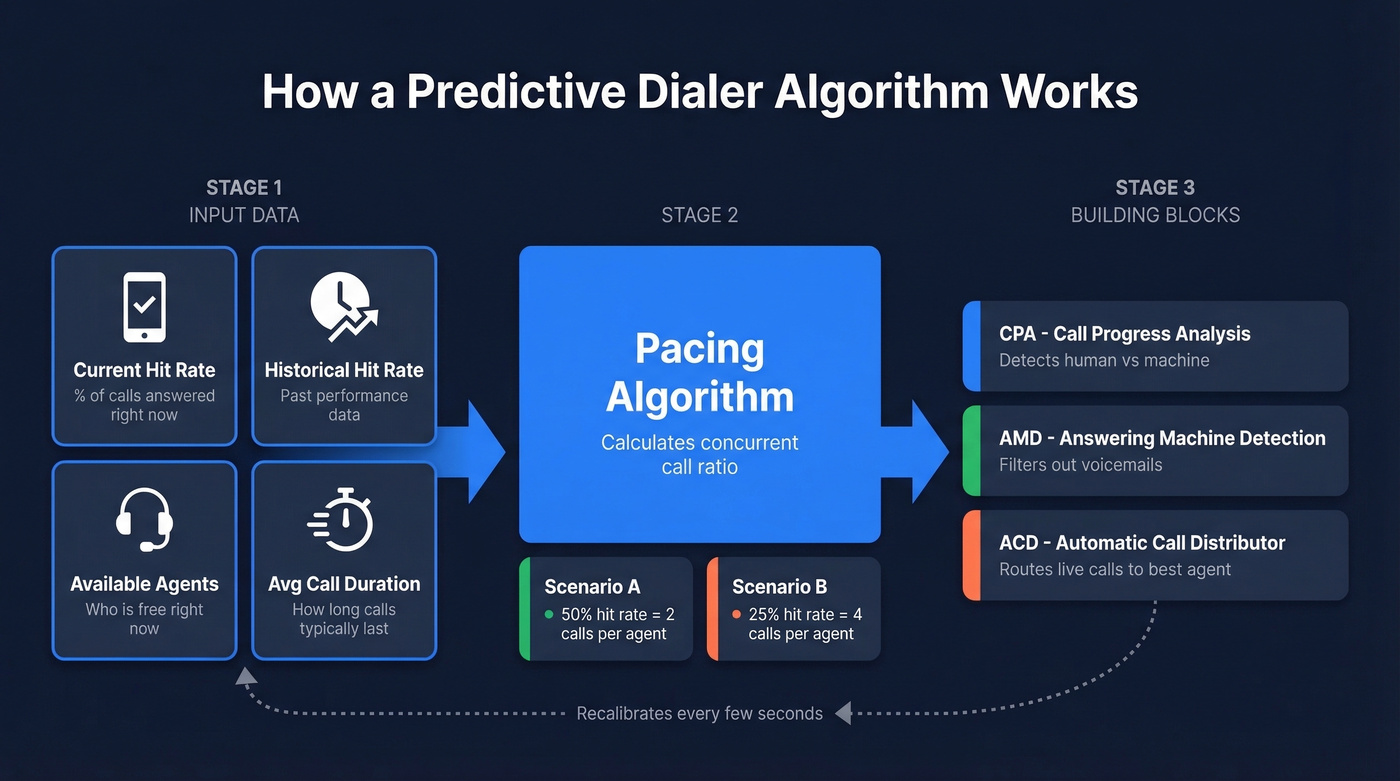
The system uses these inputs to calculate the concurrent call ratio - how many numbers to dial per available agent at any given moment. If your hit rate is 50%, the dialer places roughly 2 calls per agent. Drop to 25% on a cold list full of disconnects, and it ramps up to about 4 calls per agent. The algorithm recalibrates continuously, sometimes adjusting every few seconds.
Three building blocks make this work in modern dialers. Call Progress Analysis (CPA) detects whether a human or machine answered. Answering Machine Detection (AMD) filters out voicemails so agents only get live conversations. And the Automatic Call Distributor (ACD) routes connected calls to the next available agent based on skill, priority, or round-robin logic.
The productivity difference is stark. Manual dialing averages about 4 contacts per hour. A well-tuned predictive dialer pushes that to 16+ contacts per hour in B2C scenarios with short talk times - a 4x improvement before you optimize anything else.
Predictive vs. Other Dialer Types
Picking the right dialer type matters more than picking the right vendor.
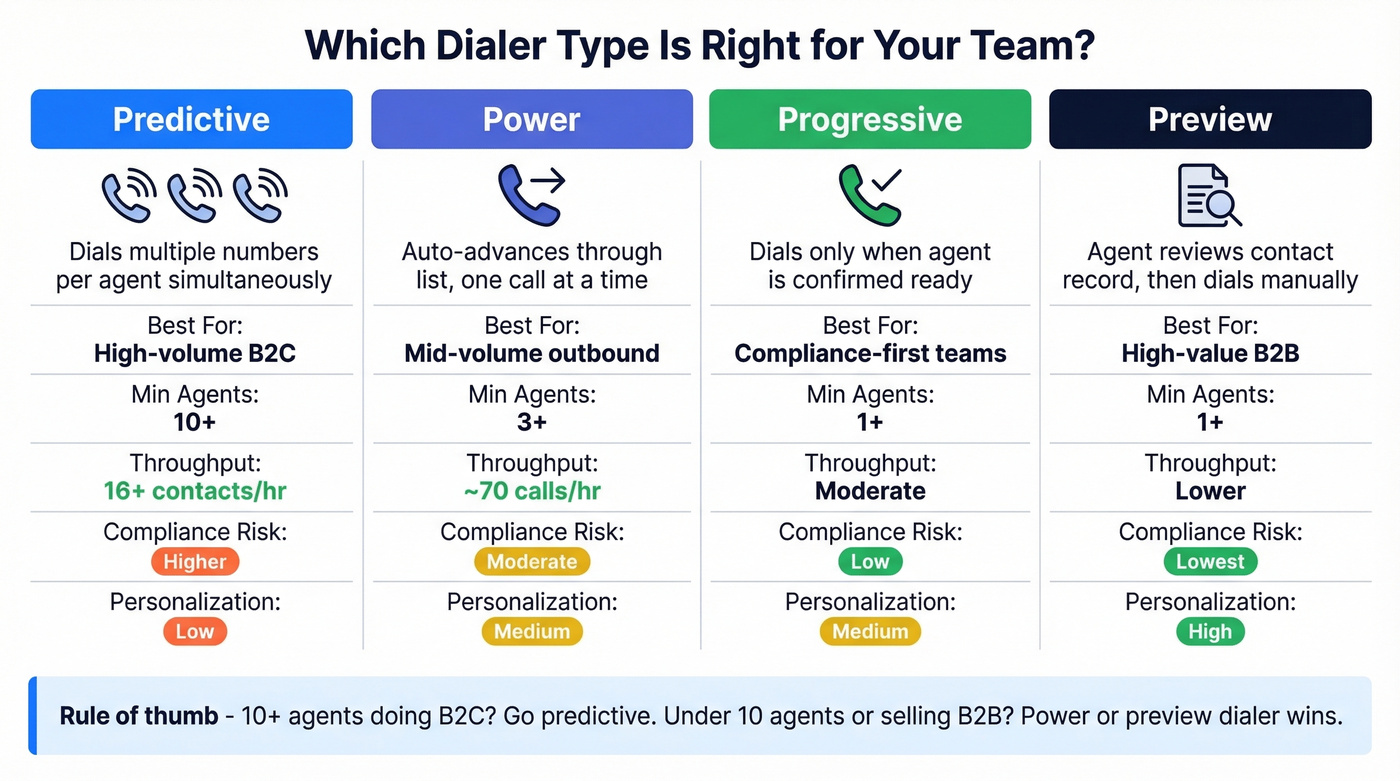
| Dialer Type | How It Dials | Best For | Min Agents | Compliance Risk | Personalization |
|---|---|---|---|---|---|
| Predictive | Multiple per agent | High-volume B2C | 10+ | Higher (abandons) | Low |
| Power | One at a time, auto | Mid-volume outbound | 3+ | Moderate | Medium |
| Progressive | One when agent ready | Compliance-first | 1+ | Low | Medium |
| Preview | Agent reviews, then dials | High-value B2B | 1+ | Lowest | High |
Power dialers auto-advance through a list one number at a time, and reps hit roughly 70 calls per hour - solid throughput without the abandoned-call risk. Progressive dialers only place a call when an agent is confirmed available, virtually eliminating dead air. Preview dialers show the contact's record before connecting, giving reps time to personalize their opener.
Here's the thing: predictive is the right choice for 10+ agent teams running high-volume B2C campaigns. For 3-10 agents, a power dialer gives you most of the speed without the compliance headaches. For high-value B2B, preview wins every time. Popular platforms like Five9, Genesys Cloud, and MightyCall offer cloud-based options, and cloud dialers in this category typically run $50-$150/user/month.
Benefits Worth Knowing
Let's keep this tight since the core benefits are well-documented:
- Up to 300% productivity improvement over manual dialing - agents spend time talking, not waiting for rings
- Dramatically reduced idle time, since the algorithm pre-dials based on predicted availability
- Lower cost per contact as throughput increases without adding headcount
- The algorithm self-tunes over time; the more historical data it ingests, the better its pacing predictions become
- Built-in AMD and CPA mean agents rarely waste time on voicemails or fax machines
These benefits are real, but they only materialize with clean data and proper configuration. Which brings us to the part most vendor pages conveniently skip.

Your predictive dialer is only as good as the numbers it dials. 40% disconnected rates destroy pacing algorithms and torch caller ID reputation. Prospeo delivers 125M+ verified mobile numbers with a 30% pickup rate - refreshed every 7 days, not every 6 weeks.
Stop feeding dead numbers to your dialer. Start with verified data.
The Spam Problem Nobody Mentions
You launch a 20-agent campaign on Monday. By Wednesday, half your caller IDs display "Spam Likely" on the recipient's phone. Answer rates crater. Agents sit idle - not because the algorithm is broken, but because nobody's picking up.
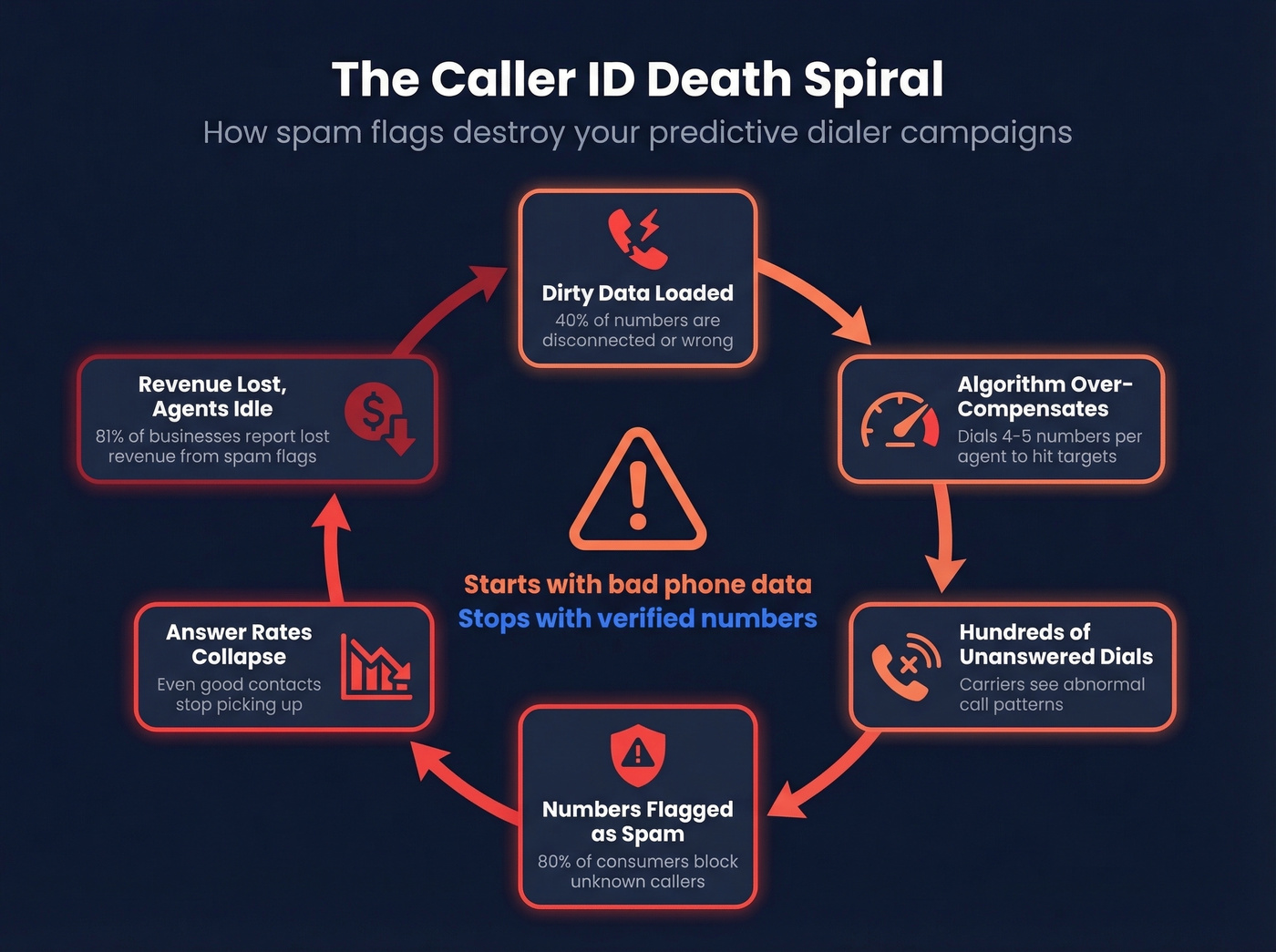
This is the single biggest operational risk in predictive dialing, and it's getting worse. 80% of consumers now block calls from numbers they don't recognize, and the FCC received over 150,000 robocall complaints in 2023 alone. STIR/SHAKEN authentication verifies that your caller ID isn't spoofed, but it doesn't prevent spam labeling - calls with perfect "A" attestation still get flagged based on dialing behavior alone.
The business impact is quantifiable: 81% of businesses report lost revenue from incorrect spam flags, and 25% of business phone numbers are at risk of being mislabeled or blocked outright. Call center operators consistently cite caller ID degradation as their number-one operational headache. In our experience, most teams don't realize it's happening until answer rates have already collapsed.
Your mitigation checklist:
- Register numbers with analytics providers like TNS, Free Caller Registry, and First Orion
- Deploy branded caller ID through services like Numeracle or Hiya Connect
- Rotate numbers across campaigns - don't burn a single number on 500 dials a day
- Cap outbound volume at 100-150 calls per number per day
- Monitor caller ID reputation weekly, not monthly
- Never double-dial the same number in a short window; carriers flag this instantly
TCPA Compliance
Predictive dialing is legal, but the regulatory guardrails are tight. Get any of these wrong and you're looking at $500-$1,500 per violation - per call, not per campaign.
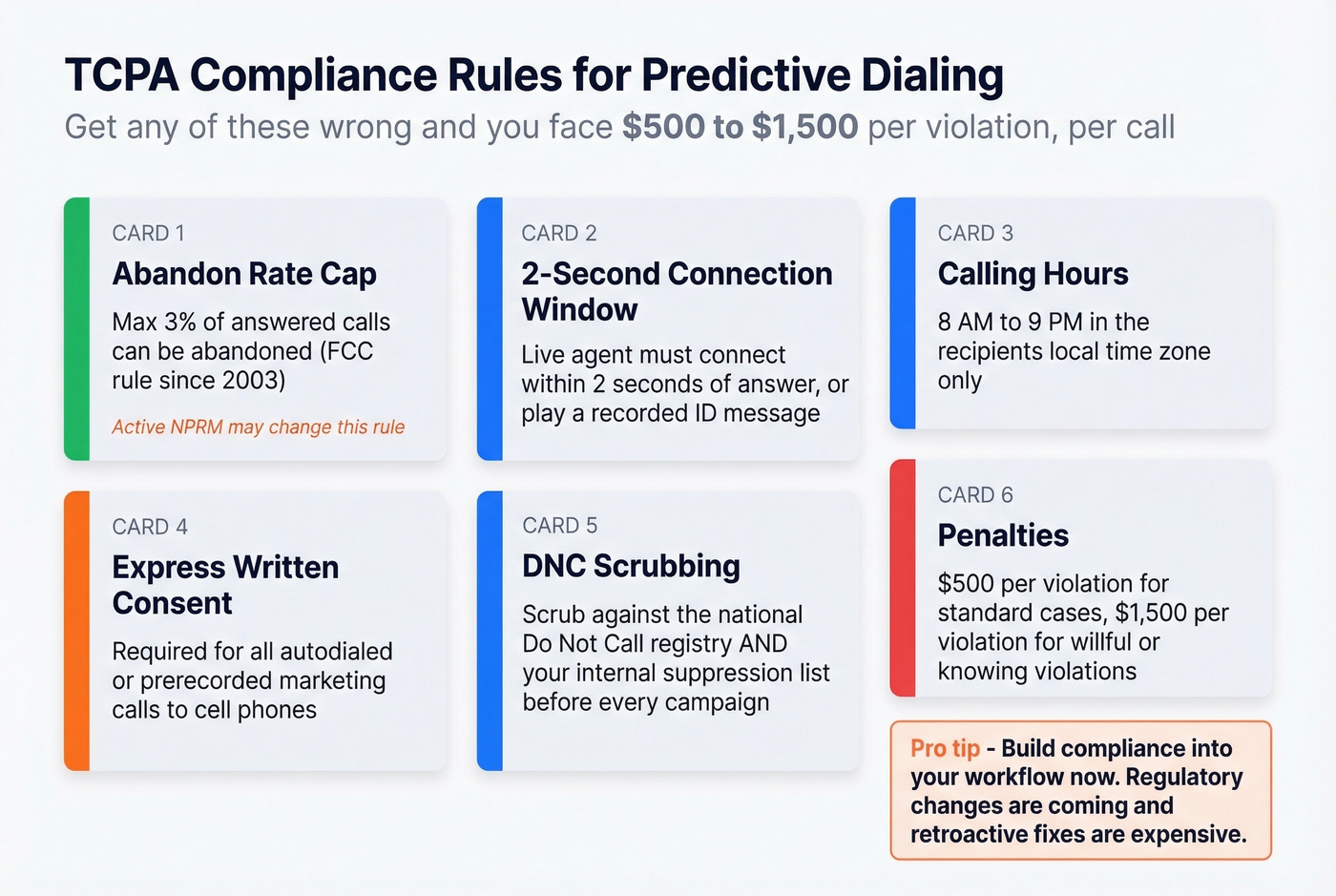
Since 2003, the FCC has required that no more than 3% of answered calls in a campaign result in an abandoned call. When a consumer picks up, a live agent must connect within a 2-second window, or a prerecorded message must identify the caller. Calls can only go out during the 8 a.m.-9 p.m. local time window. Express written consent is required for autodialed or prerecorded marketing calls to cell phones, and you must scrub against both the national DNC registry and your internal suppression lists before every campaign.
The regulatory landscape is shifting. As of late 2025, the FCC has an active NPRM proposing to eliminate the 3% abandonment rule entirely. Whether the final rule loosens or tightens requirements remains to be seen, but smart teams are building compliance into their workflows now rather than scrambling later.
When NOT to Use It
Skip predictive dialing if you have fewer than 10 agents. The algorithm needs a meaningful agent pool to predict availability accurately - with 5 agents, you'll see more abandoned calls and compliance risk than the throughput gains justify. A power or progressive dialer is the better fit.
If you're selling high-value B2B, this is the wrong tool entirely. Preview dialers let reps review the contact record and prep a relevant opener, which matters when you're calling a VP who'll hang up in three seconds if you fumble the intro. For compliance-first industries like healthcare and financial services, progressive dialing with manual initiation is the safer path.
Best Practices That Actually Move the Needle
Right-size lists to agent capacity. Loading 50,000 numbers for a 12-agent team means the dialer burns through contacts faster than agents can handle them. You'll waste good leads.
Feed the dialer historical data before trusting its pacing. A cold start means the algorithm is guessing. Run a day or two at conservative settings, then let it optimize. We've seen teams panic on day one because connect rates look terrible - give the system time to calibrate.
Verify your numbers before every campaign. Stale data degrades fast, and disconnected numbers wreck your pacing algorithm. Prospeo keeps numbers current on a 7-day refresh cycle, which directly protects your caller ID reputation by reducing dead dials.
Call during your audience's best windows. Test by day and time, then double down on what your answer-rate data proves. The generic "Tuesday at 10 a.m." advice isn't wrong, but your data will tell you something more specific.
Optimize the agent environment. Headset quality, low-latency connections, and quiet backgrounds matter more than people think, especially for remote teams where a barking dog can tank a connect.
If you're building a full outbound motion, pair dialing with sales prospecting techniques that keep lists targeted and messaging relevant.
Why Data Quality Makes or Breaks Your Dialer
Look - most teams should spend more on data than on their dialer. We've seen operations drop $15,000/month on dialer software and $0 on data verification. They'd get better results flipping those priorities.
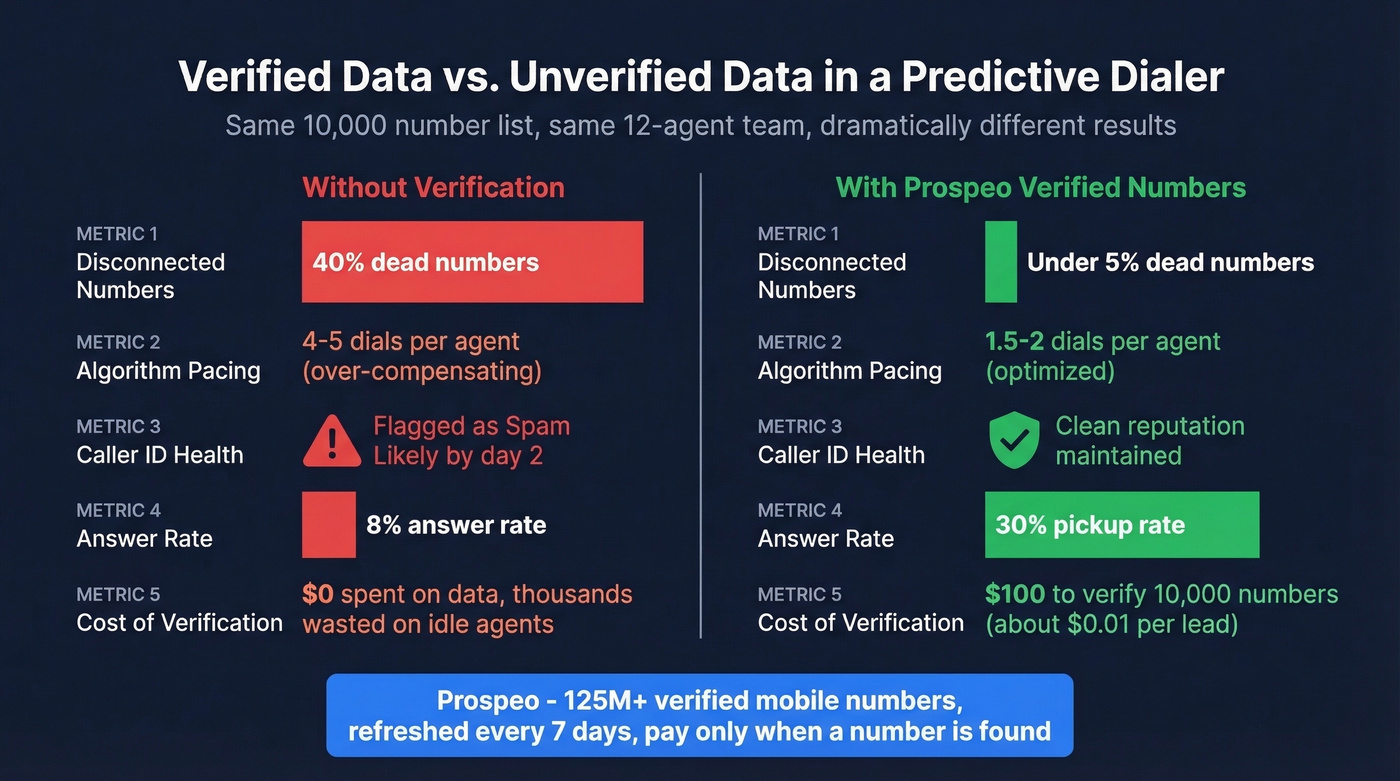
Here's the cascade when you don't verify. You load a 10,000-number list and 40% of those numbers are disconnected. The algorithm sees a terrible hit rate and compensates by dialing 4-5 numbers per agent. Most calls go nowhere. Your caller IDs rack up hundreds of unanswered dials per hour. Carriers flag the behavior. By day two, your numbers show "Spam Likely" and even the good contacts stop answering. Bad numbers feed the algorithm bad data, which triggers aggressive pacing, which burns your caller IDs, which tanks answer rates across every campaign using those numbers. It's a death spiral, and it starts with dirty data.
Verifying a 10,000-number list at roughly $0.01 per lead costs less than one hour of wasted agent time. The math isn't close. Prospeo's Mobile Finder covers 125M+ verified mobile numbers globally with a 30% pickup rate - and you only pay when a number is found. Clean data in, clean calls out. Everything else is downstream.
If you're evaluating vendors, it also helps to compare data enrichment services and broader outbound lead generation tools so your dialer isn't doing all the work.
Spam flags and bad data are the two things that kill predictive dialing campaigns. You can't fix carrier reputation if half your list is disconnected. Prospeo's 5-step verification and weekly data refresh keep your lists clean at $0.01 per contact - 90% cheaper than ZoomInfo.
Clean lists mean fewer spam flags and more live conversations per hour.
Predictive Dialing FAQ
Is predictive dialing legal?
Yes, but heavily regulated under the TCPA. You need express written consent for autodialed marketing calls to cell phones, must maintain a 3% or lower abandonment rate, and can only call between 8 a.m. and 9 p.m. in the recipient's local time. Penalties run $500-$1,500 per violation.
How many agents do I need?
Predictive dialing works best with 10 or more agents. Below that threshold, the algorithm can't accurately predict availability, leading to more abandoned calls and dead air. For 3-10 agents, use a power dialer. Solo reps should use preview.
How much does a predictive dialer cost?
Cloud-based SaaS dialers typically run $50-$150 per user per month. On-premise deployments can cost $5,000-$25,000+ upfront. Budget equally for the dialer and your contact data - skimping on either undermines the other.
How do I keep my numbers from getting flagged as spam?
Cap each number at 100-150 outbound dials per day, rotate caller IDs across campaigns, and register with analytics providers like TNS and First Orion. Most importantly, verify your list before dialing - dead dials are what trigger carrier spam algorithms in the first place.