

What Is a SaaS Business - and How Does It Actually Make Money?
A RevOps lead told me last year that her company pays for 14 SaaS tools. The team actively uses five. That's not a bug in the model - it's the model working exactly as designed.
So what is a SaaS business, really? It's a company that makes money when customers subscribe to cloud software, and makes more money when those customers keep paying month after month and expand over time. The economics are unlike almost any other business type: high margins, compounding revenue, and a cost structure that rewards retention above all else. Here's how it works, the metrics that matter, and a step-by-step playbook if you're building one yourself.
Quick Version
SaaS means cloud software sold on a subscription. The business model runs on recurring revenue, low marginal cost per additional customer, and retention. The three numbers that matter early: MRR growth rate, churn rate, and CAC payback period. If you're starting one, validate the problem before writing a line of code.
SaaS Business Defined
SaaS stands for Software as a Service - software delivered over the internet, paid for on a recurring basis, and maintained entirely by the vendor. No downloads, no installation CDs, no IT team babysitting a server closet. You log in through a browser, and it works.
Most people get the framing wrong: SaaS isn't a product category. It's a business model. A thread on r/SaaS put it bluntly - founders "focus on building a fantastic product rather than a viable business." The product is one piece. The subscription pricing, the onboarding funnel, the retention mechanics, the expansion revenue - that's the business.
Here's the thing: not everything hosted in the cloud qualifies. If it's not delivered and maintained by the vendor as an ongoing service with recurring revenue, it's closer to hosted software than a true SaaS operation. Multi-tenant architecture is also common because it lets one software instance serve many customers efficiently. The core promise to the customer is simplicity - no upfront capital expenditure, predictable monthly costs, automatic updates, and access from anywhere. The core promise to the business owner is even better: predictable, recurring revenue that compounds as long as you keep customers happy.
How Big Is the SaaS Market?
The global SaaS market hit roughly $300 billion in 2025 and is growing at an 18.7% CAGR through 2030. AI is accelerating adoption in categories that were previously too niche for venture-backed companies.
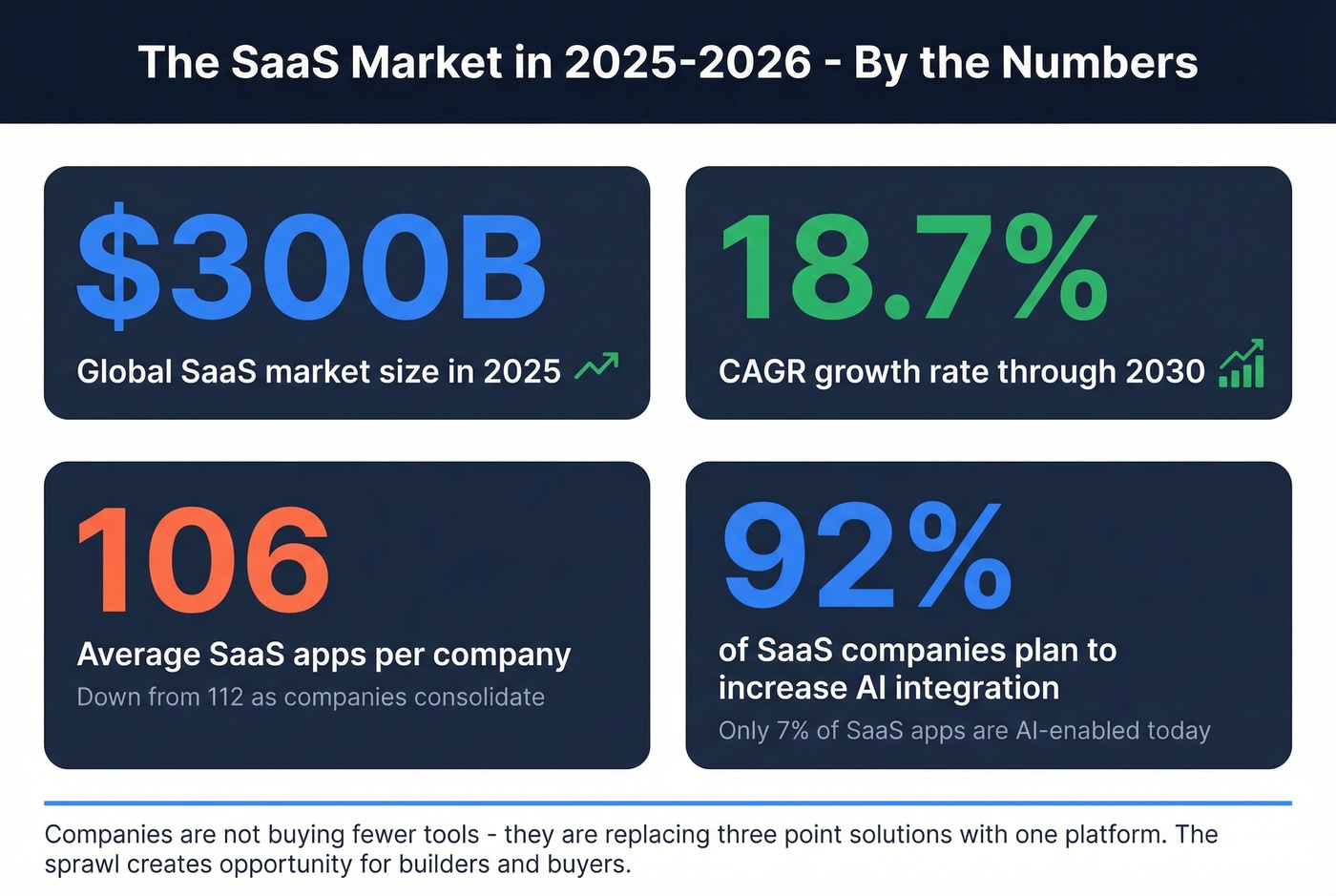
As of 2024, the average company runs 106 SaaS applications, down slightly from 112 the year before. That dip isn't contraction - it's consolidation. Companies aren't buying fewer tools; they're replacing three point solutions with one platform. Only 7% of SaaS apps are AI-enabled today, but 92% of SaaS companies plan to increase AI integration. The sprawl is real, and it creates opportunity for both builders and buyers.
SaaS vs Traditional Software
This comparison explains why the subscription model took over.
| Dimension | SaaS | Traditional Software |
|---|---|---|
| Cost | Monthly/annual subscription | Large upfront license fee |
| Access | Browser, any device | Company network, on-prem |
| Maintenance | Vendor handles updates | Internal IT team |
| Customization | Configurable, not custom | Deeply customizable |
| Deployment | Minutes to hours | Weeks to months |
The subscription model lowers the barrier to entry - a startup can use a modern CRM on a monthly plan instead of funding an on-prem deployment. The tradeoff is real, though: over a multi-year period, TCO can even out. SaaS wins on flexibility and speed. Traditional software wins on deep customization and data control. For most companies under 1,000 employees, SaaS wins outright.
How SaaS Companies Make Money
The Recurring Revenue Engine
The equation is simple: MRR x retention = compounding revenue. Every month, your existing customers pay again. If you retain 95% of them and add new ones on top, revenue compounds without proportional cost increases.
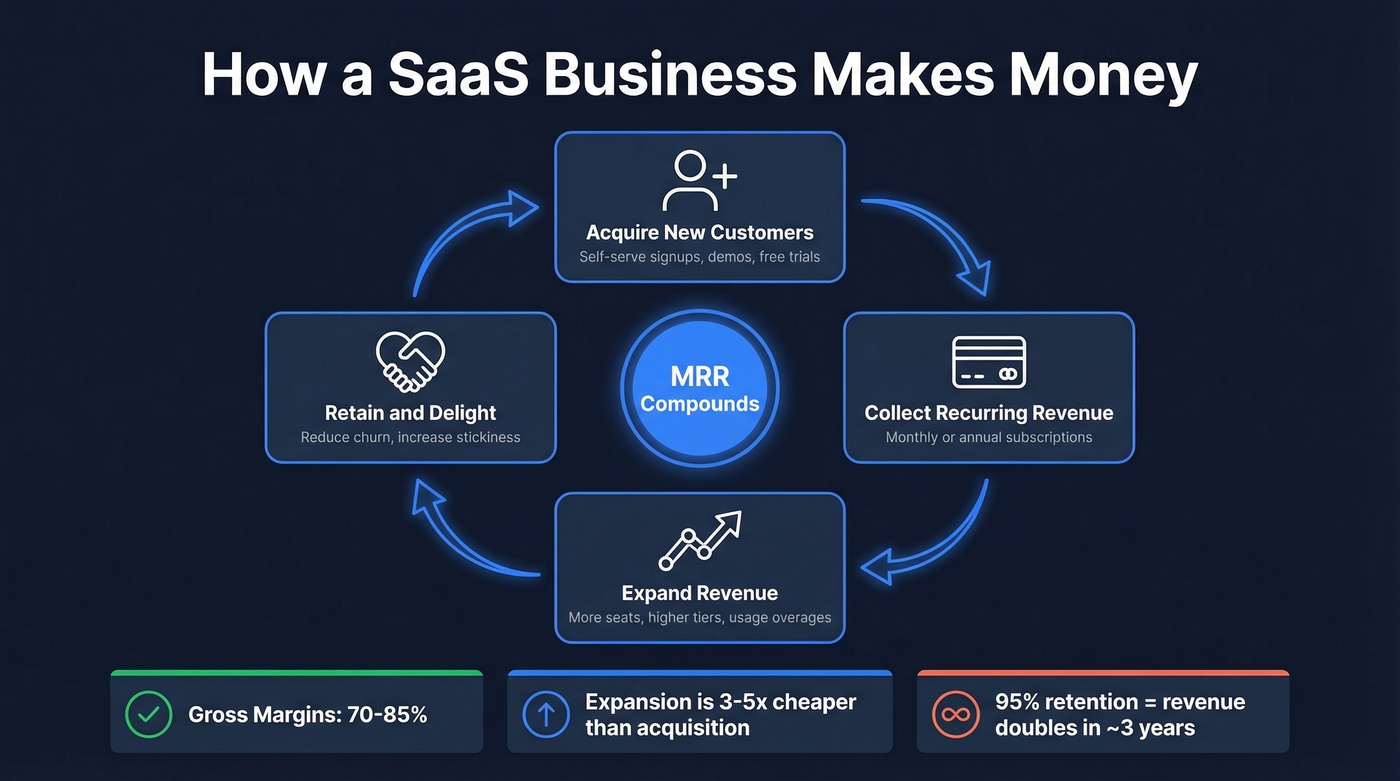
Stripe's framing is apt: SaaS is financialized software - you're selling predictable, forecastable cash flows, not a product with a sticker price. This is what makes margins so attractive. The marginal cost of serving one more customer on shared infrastructure is low compared to services businesses where every new client requires more headcount.
Expansion revenue is the second engine. Once a customer is onboarded, you can grow their spend through additional seats, higher-tier plans, or usage-based overages. It's usually far cheaper than acquiring new customers - and it's the reason net dollar retention matters so much.
Low-Touch vs High-Touch Sales
How you sell determines your entire cost structure.
Low-touch SaaS (Slack, Dropbox, Calendly) relies on self-serve signups, free tiers, and product-led growth. Price points often cluster around ~$10/month for B2C and ~$20 to $500/month for B2B, which corresponds to an average contract value of roughly $100 to $5K.
High-touch SaaS (Salesforce Enterprise, Workday, Veeva) involves demos, pilots, procurement cycles, and dedicated account executives. SMB-focused high-touch deals often land around $6K to $15K ACV and can go much higher. True enterprise deals start in the six figures and have no ceiling.
Most successful SaaS companies start low-touch and layer on high-touch as they move upmarket. Stripe's guide to starting a SaaS business walks through this progression well.

Every SaaS business lives or dies by its pipeline. If you're building one, you need verified contact data to reach buyers - not bounced emails that torch your domain. Prospeo delivers 98% email accuracy with a usage-based model that scales with you, starting at ~$0.01/lead.
Build your SaaS pipeline on data that actually connects you to buyers.
SaaS Pricing Models
Per-seat pricing is no longer the default. Usage-based and hybrid models are where the industry is heading, and the numbers back it up. 38% of SaaS companies now use some form of usage-based pricing. SaaS pricing is up 11.4% year-over-year, and businesses spend roughly $7,900 per employee annually on software subscriptions.
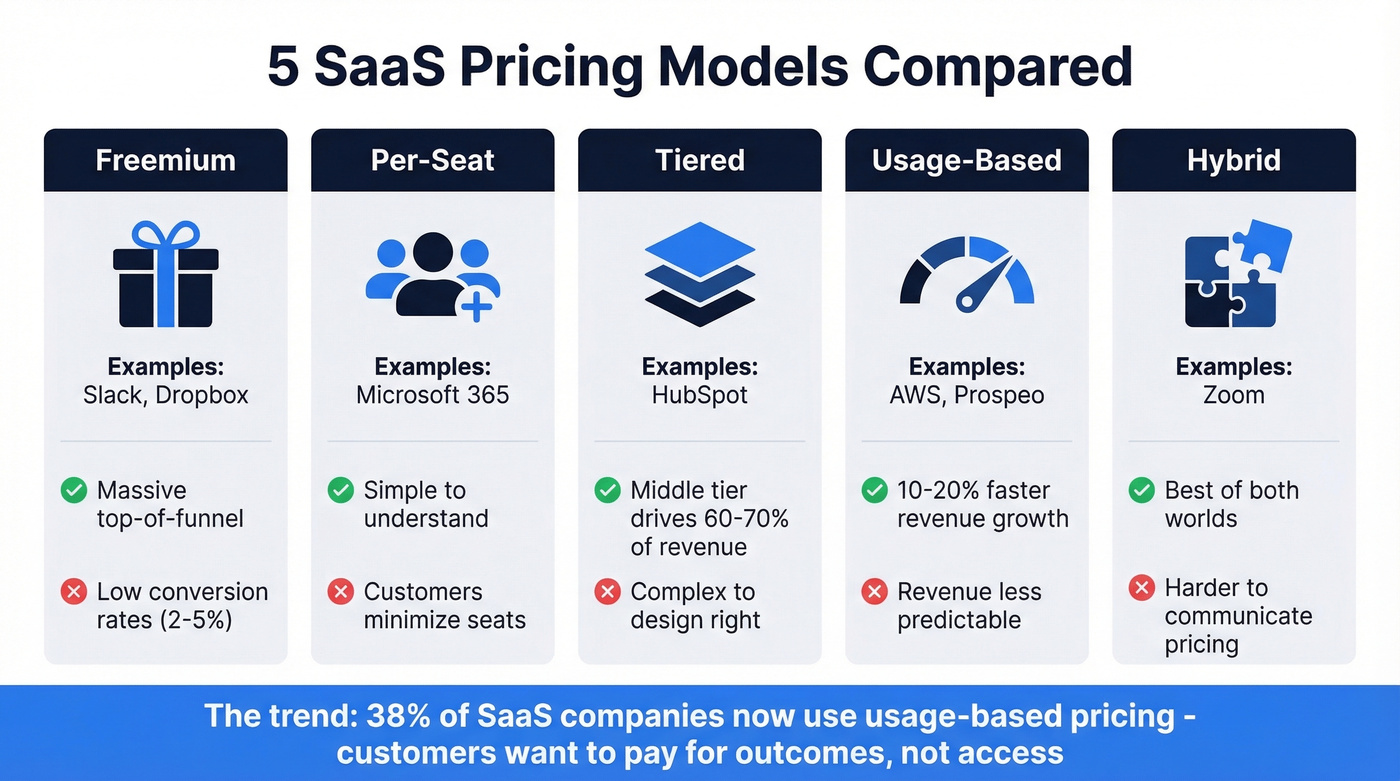
Here are the models that actually work:
- Freemium - Give away a limited version, convert power users. Slack and Dropbox built empires on this. The trick is making the free tier useful enough to create habit, limited enough to create urgency.
- Per-seat - Simple to understand, but creates perverse incentives. Customers minimize seats instead of expanding usage.
- Tiered - HubSpot's Starter/Pro/Enterprise structure. The middle tier typically drives 60-70% of revenue.
- Usage-based / credit-based - You pay for what you consume. AWS charges per compute hour. Prospeo charges per verified email at ~$0.01/lead with a free tier and no contracts - a clean example of aligning cost with value delivered.
- Hybrid - Zoom combines a free tier with per-seat upgrades and usage-based add-ons. Most modern SaaS is moving here.
The trend is clear: customers want to pay for outcomes, not access. Usage-based companies see 10-20% faster revenue growth than those on fixed pricing.
Key SaaS Metrics That Matter
These are the numbers that determine whether a SaaS company survives or scales. We've seen founders obsess over vanity metrics like total signups while ignoring the ones that actually drive the business.
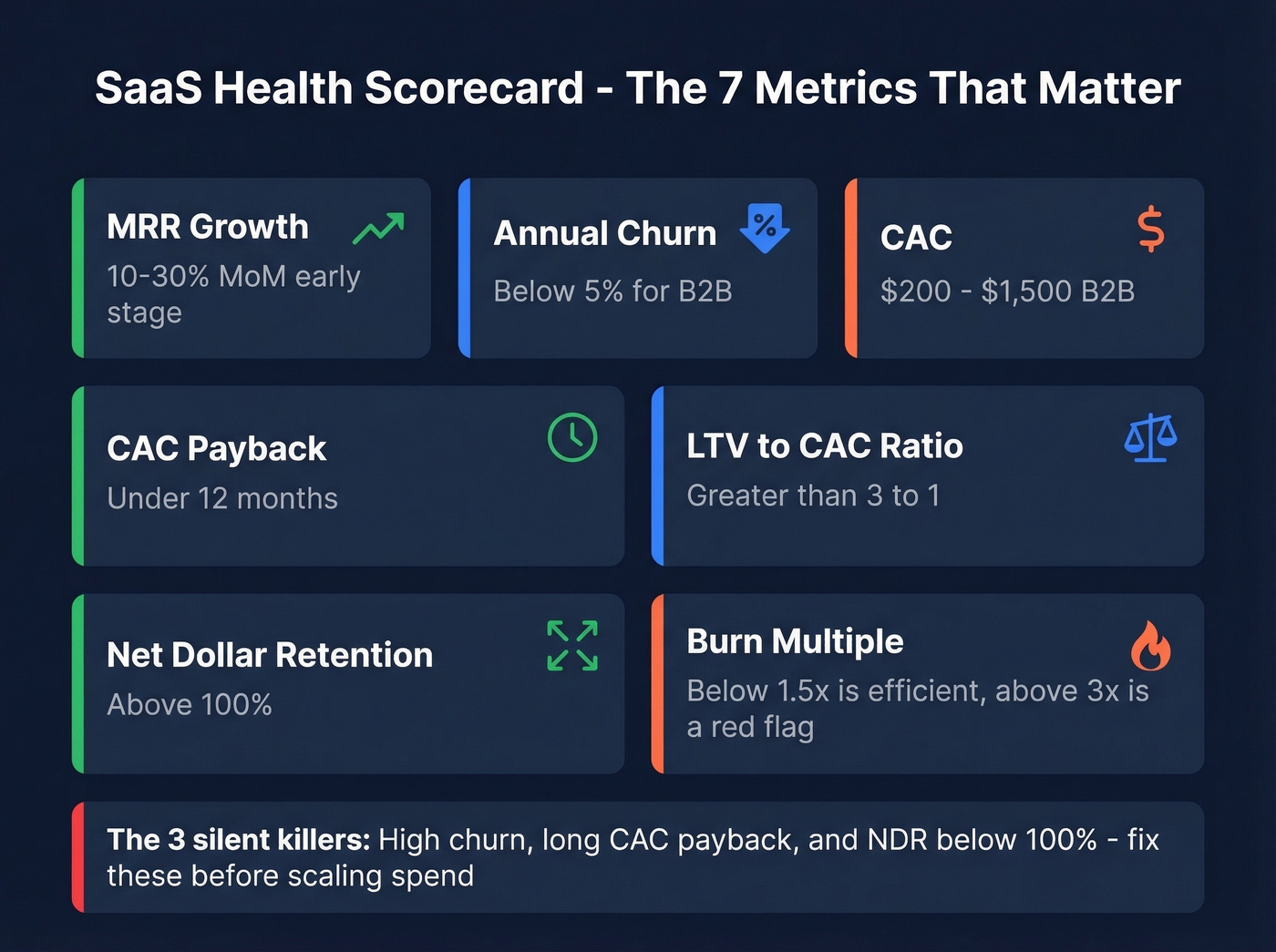
| Metric | Formula | Good Benchmark |
|---|---|---|
| MRR | Sum of monthly subscriptions | 10-30% MoM early stage |
| Annual Churn | Lost customers / starting | B2B: <5% annually |
| CAC | Sales + marketing / new customers | $200-$1,500 (B2B) |
| CAC Payback | CAC / monthly margin per customer | <12 months |
| LTV:CAC | Lifetime value / CAC | >3:1 |
| NDR | (Start ARR + expansion - contraction) / Start ARR | >100% |
| Burn Multiple | Net Burn / Net New ARR | <1.5x efficient; >3x red flag |
Three metrics kill companies when they go wrong.
Churn is the silent killer. The average annual SaaS churn rate is 3.8% overall and 4.9% for B2B. Below 1% monthly is considered good. The visceral math: churn compounds fast, and it forces you to spend more and more just to stay in place.
CAC payback tells you how long until a customer becomes profitable. Under 6 months is excellent. 6-12 months is good. Over 18 months means you're lending money to customers and hoping they stick around long enough to repay it.
Net Dollar Retention is the metric investors care about most. NDR above 100% means your existing customers are spending more over time - you're growing even without new logos.
MRR growth benchmarks shift by stage. Early-stage companies pre-$1M ARR should target 20-30% month-over-month. At $1M-$10M, 10-15% MoM is healthy. Above $10M, 5-7% MoM puts you on a strong trajectory. The milestone framing investors use: $1M ARR proves product-market fit, $10M is Series A territory, $100M puts you on the unicorn path. Paddle's SaaS benchmarks guide is a solid resource for tracking where you stand.
How to Start a SaaS Business
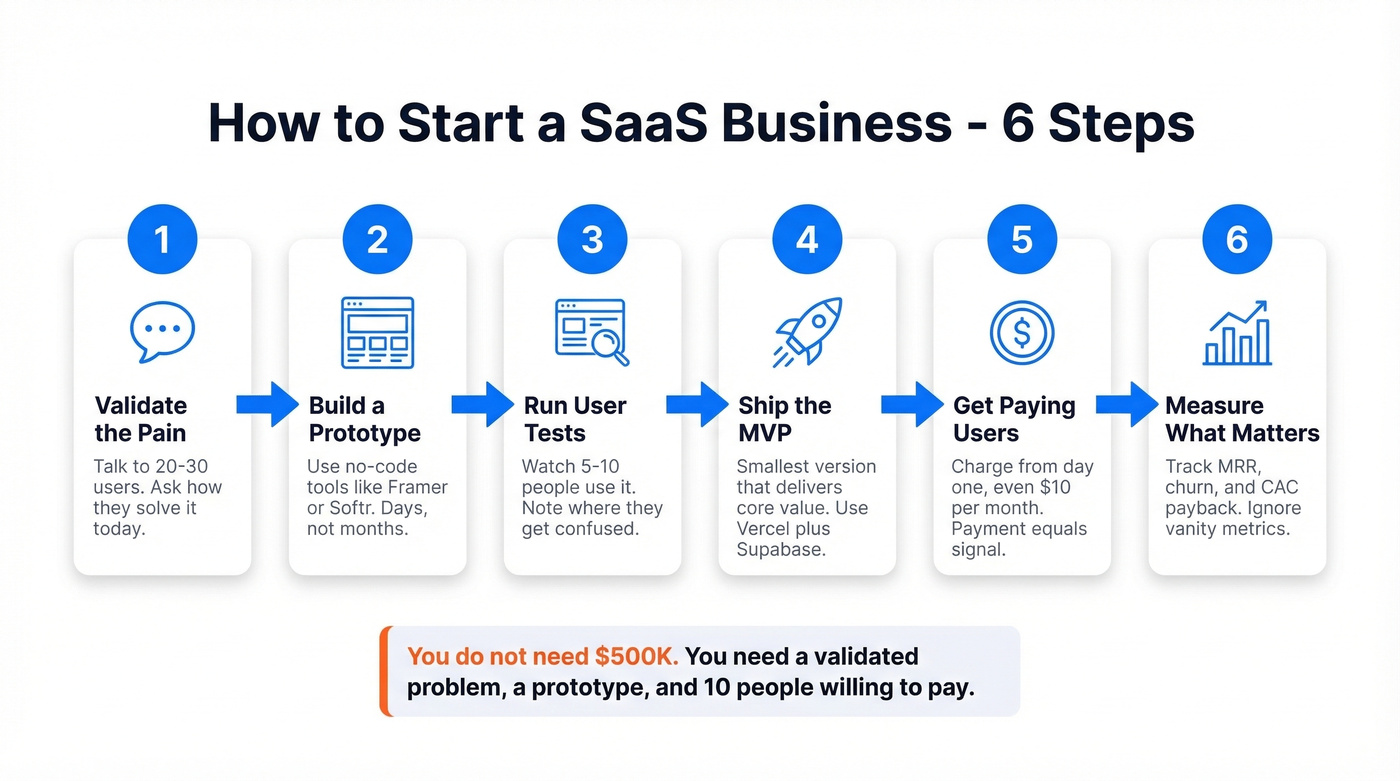
The consensus on r/SaaS is that most guides skip the hard parts and assume you're already funded. You don't need $500K. You need a validated problem, a prototype, and 10 people willing to pay.
Look - if your average deal size is under $5K, you probably don't need a sales team at all. Build the product so well that it sells itself, and spend your energy on distribution instead.
1. Validate the pain. Talk to 20-30 potential users. Don't ask "would you use this?" Ask "how are you solving this today, and what does it cost you?" If they can't articulate the pain, there's no business.
2. Build a clickable prototype. Use Framer, Softr, or Typedream. No code. The goal is to show the workflow, not the technology. This takes days, not months.
3. Run user tests with 5-10 people. Watch them use the prototype. Where do they get confused? What do they try to click that doesn't exist yet? That's your feature priority list.
4. Build the MVP. Now you write code - or use a modern stack like Vercel + Supabase. Ship the smallest version that delivers the core value.
5. Get paying users early. Charge something from day one, even if it's $10/month. Free users give you feedback. Paying users give you signal.
6. Measure what matters. Track MRR, churn, and CAC from month one. If churn is above 5% monthly, you have a product problem, not a marketing problem.
7. Iterate relentlessly. The first version will be wrong. Ship weekly. Talk to customers weekly. The founders who win are the ones who iterate fastest, not the ones who build the most features.
Common SaaS Mistakes
Do this: Launch before you're comfortable. Charge from day one. Treat retention as your primary metric. Set a sustainable pace.
Not that: Chase features endlessly. Ignore churn because acquisition numbers look good. Underprice to avoid rejection. Work 80-hour weeks for 18 months straight.
Most SaaS projects don't fail because the idea is bad. They fail because the founder burns out or gives up. Config chaos is real - integration friction with tools like Slack, Zapier, and Google login will eat weeks of your roadmap. Bug debt multiplies in the dark. And marketing is a habit, not a campaign you run once.
The founders who survive treat the business like a system - product, distribution, retention, and economics all running in parallel - not a product with a payment page bolted on. Skip this if you're just looking for a side project that prints passive income; SaaS doesn't work that way.
SaaS Examples by Category
| Category | Examples | What They Do |
|---|---|---|
| CRM | Salesforce, HubSpot | Manage customer relationships and pipeline |
| Communication | Slack, Zoom | Team messaging and video conferencing |
| Project Management | Jira, Trello, Basecamp | Task tracking and team coordination |
| Cloud Infrastructure | AWS, Azure, Google Cloud | Compute, storage, and networking |
| B2B Data | Prospeo | Verified emails, mobiles, and company data |
| Productivity | Google Workspace, Dropbox | Documents, storage, and collaboration |
| E-commerce | Shopify | Online store creation and management |
| Entertainment | Netflix, Spotify | Streaming content on subscription |
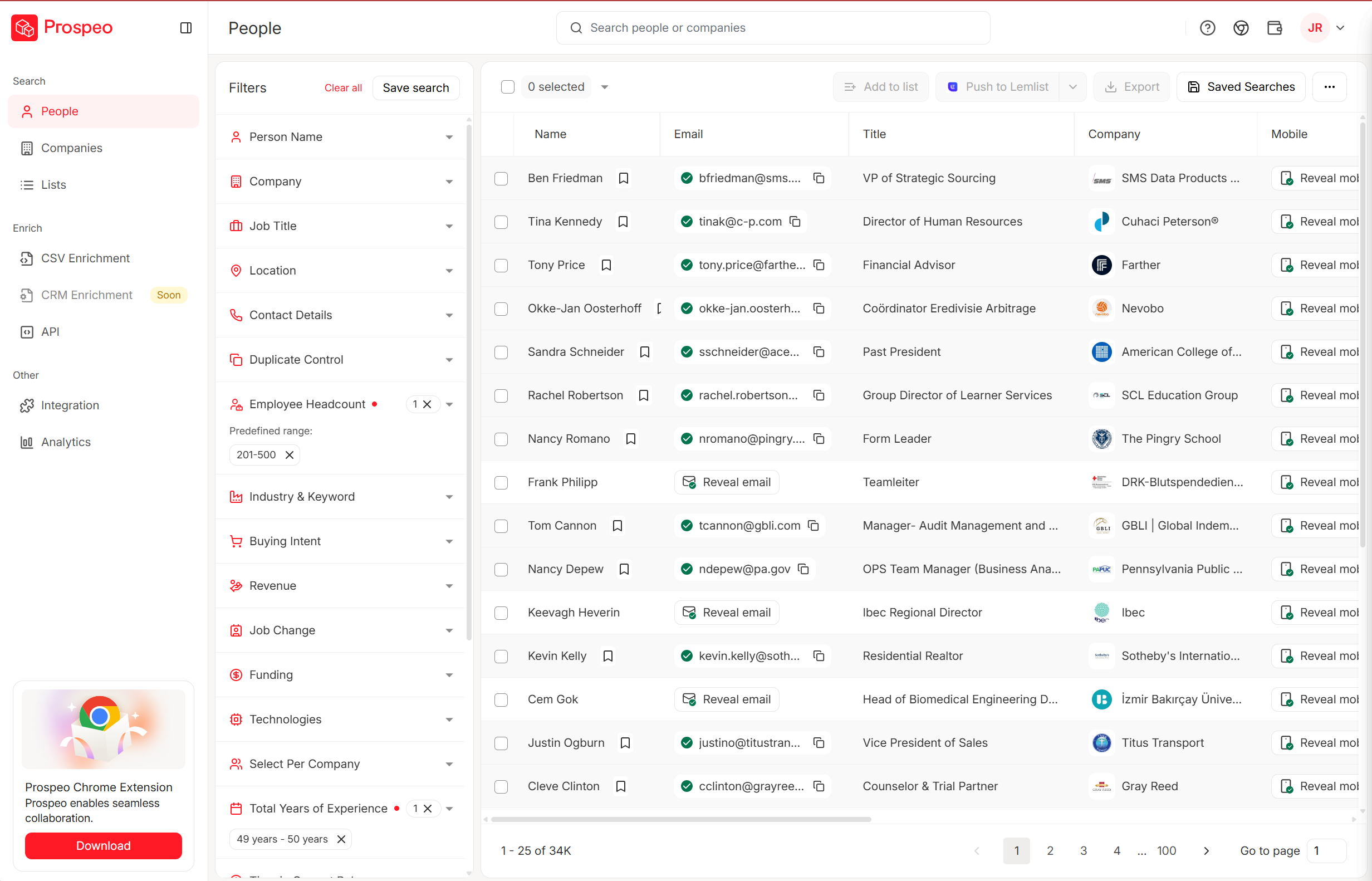
The article mentions usage-based pricing as the future of SaaS - and Prospeo practices what it preaches. No annual contracts, no sales calls required. Pay per verified email, get 75 free emails/month, and scale when you're ready. That's the SaaS model done right.
See usage-based B2B data pricing in action - start with 75 free emails.
The Future of SaaS in 2026
The "build it and they will come" era is over. In 2026, distribution is the product.
AI is reshaping the model from the inside out. 92% of SaaS companies are increasing their use of AI, and the shift isn't cosmetic. Bain's analysis frames five possible futures for any SaaS category: AI enhances the tool, spending compresses as users need fewer seats, standalone AI replicates what the product does at a fraction of the cost, agents handle entire workflows end-to-end making the application layer irrelevant, or - rarely - there's no AI impact at all in regulated categories.
The cost curve is brutal for incumbents. OpenAI's o3 model costs dropped 80% in just two months.
On the product side, AI is already identifying user "aha moments" during onboarding and reducing drop-offs, making product-led growth more precise than ever. The strategic directive from Bain is clear: own the data, lead on standards, and price for outcomes - not log-ons. CIO magazine puts it more bluntly: "AI is no longer an add-on - it's becoming the backbone of how modern SaaS platforms operate."
The winners in 2026 and beyond will be companies that deliver measurable outcomes, not feature checklists. Vertical and micro-SaaS - tools built for a specific industry or workflow - are growing fastest because they can deliver those outcomes more precisely than horizontal platforms. If you're starting a SaaS business today, pick a niche, own the data layer, and price on value. That's the playbook.
FAQ
Is a SaaS business profitable?
Yes - SaaS can be highly profitable because recurring revenue scales efficiently when retention is strong. Profitability depends on keeping CAC payback under 12 months and monthly churn below 1%. Many bootstrapped SaaS companies reach profitability within 18-24 months.
How long does it take to build a SaaS product?
An MVP typically takes 4-12 weeks with modern no-code and low-code tools. Spend time validating that people will pay before writing any code - most failed SaaS products solve problems nobody has.
What's a good churn rate for SaaS?
Below 1% monthly, or roughly under 5% annually, is the benchmark for healthy B2B SaaS. The average annual churn rate is 3.8% overall and 4.9% for B2B. Enterprise contracts with annual billing typically see lower churn than monthly plans.
What tools do SaaS companies use for B2B prospecting?
Most B2B SaaS companies combine a data platform, a CRM like HubSpot or Salesforce, and an outreach tool like Instantly or Lemlist. For contact data, we've found that accuracy matters more than database size - a 98% verified email accuracy rate means fewer bounces and better deliverability from day one.
What's the difference between SaaS, PaaS, and IaaS?
SaaS delivers complete applications users interact with directly (Slack, Salesforce). PaaS provides a platform for developers to build and deploy applications (Heroku, Google App Engine). IaaS offers raw infrastructure like compute and storage (AWS EC2, Azure VMs). Most SaaS businesses run on top of IaaS or PaaS.