

What Is Sales Negotiation? Scripts & Frameworks That Protect Your Margin
Procurement just emailed asking for 30% off. Your manager wants to know why the deal hasn't closed. You've got about 10 seconds before you either protect your margin or give it away.
That moment - the back-and-forth over terms, price, and scope after a buyer's already interested - is sales negotiation. Most reps are terrible at it, not because they lack frameworks, but because they've never practiced under pressure.
The short version: Sales negotiation is the strategic conversation about deal terms after the buyer is interested - it's not the same as selling. Three things matter most: anchor first, trade don't concede, know your walk-away number. RAIN Group research shows top negotiators are 3.1x more likely to achieve target pricing and 12.5x more likely to be satisfied with outcomes. The skill gap is enormous. It's also learnable.
Sales Negotiation Defined
Sales negotiation is the structured process where a seller and buyer agree on deal terms - price, scope, timeline, conditions - after the buyer has expressed interest. It's distinct from selling, which creates desire and communicates value. Negotiation begins when both sides want a deal but disagree on the specifics.
Most reps blur that line, and it costs them. If you're still pitching features when the buyer's asking about payment terms, you've lost the thread. Selling gets you to the table. Negotiation determines what you leave with.
Why Negotiation Skills Matter More Than You Think
That RAIN Group data bears repeating: top sales negotiators are 12.5x more likely to be satisfied with outcomes and 3.1x more likely to hit target pricing. That's not a marginal edge. It's a different sport.
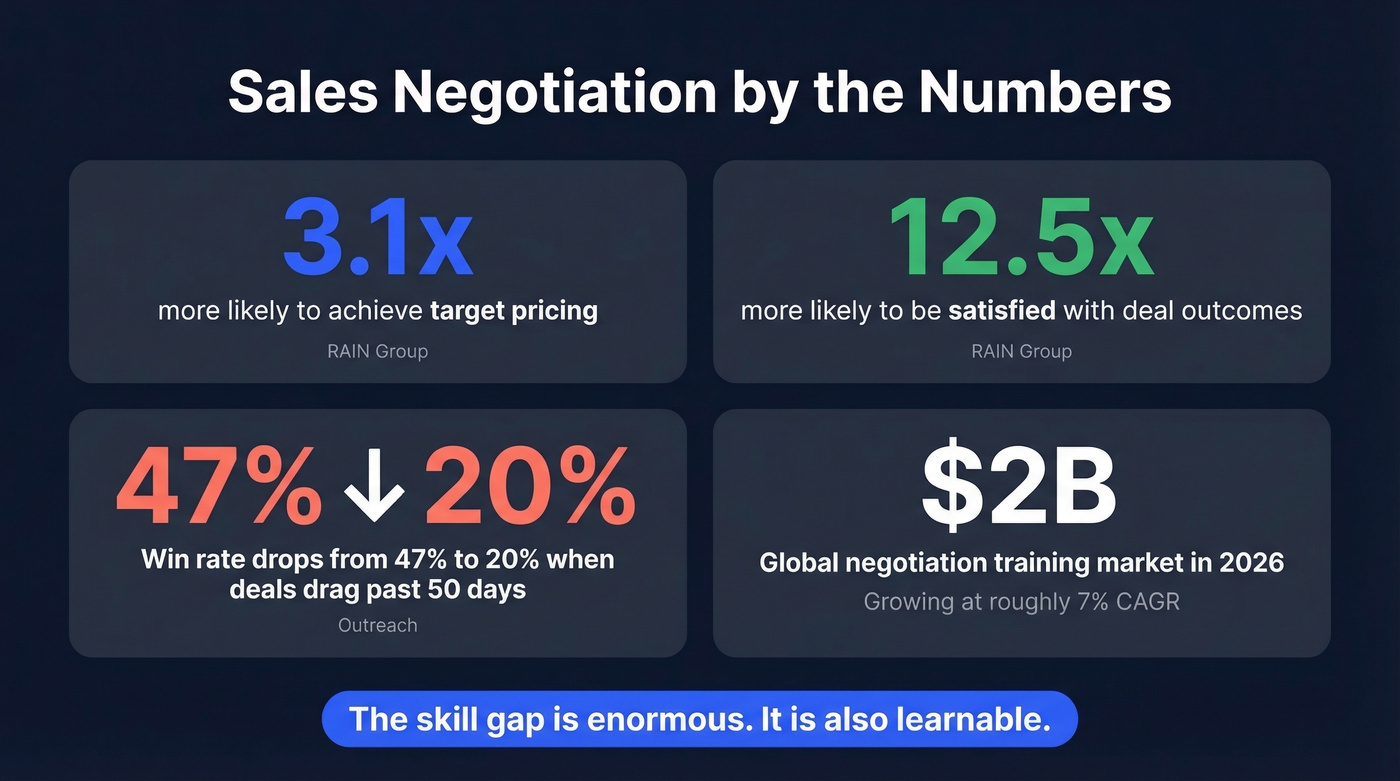
Timing compounds the stakes. Outreach's analysis found that opportunities closed within 50 days hit a 47% win rate, while deals running past that threshold drop to 20% or lower. With roughly a third of revenue teams reporting sales cycles spanning one to two full quarters, every unnecessary negotiation round bleeds money. The global negotiation training market sits at roughly $2B in 2026 and is growing at about 7% CAGR - companies are investing because the margin impact is real.
The Psychology Behind Every Deal
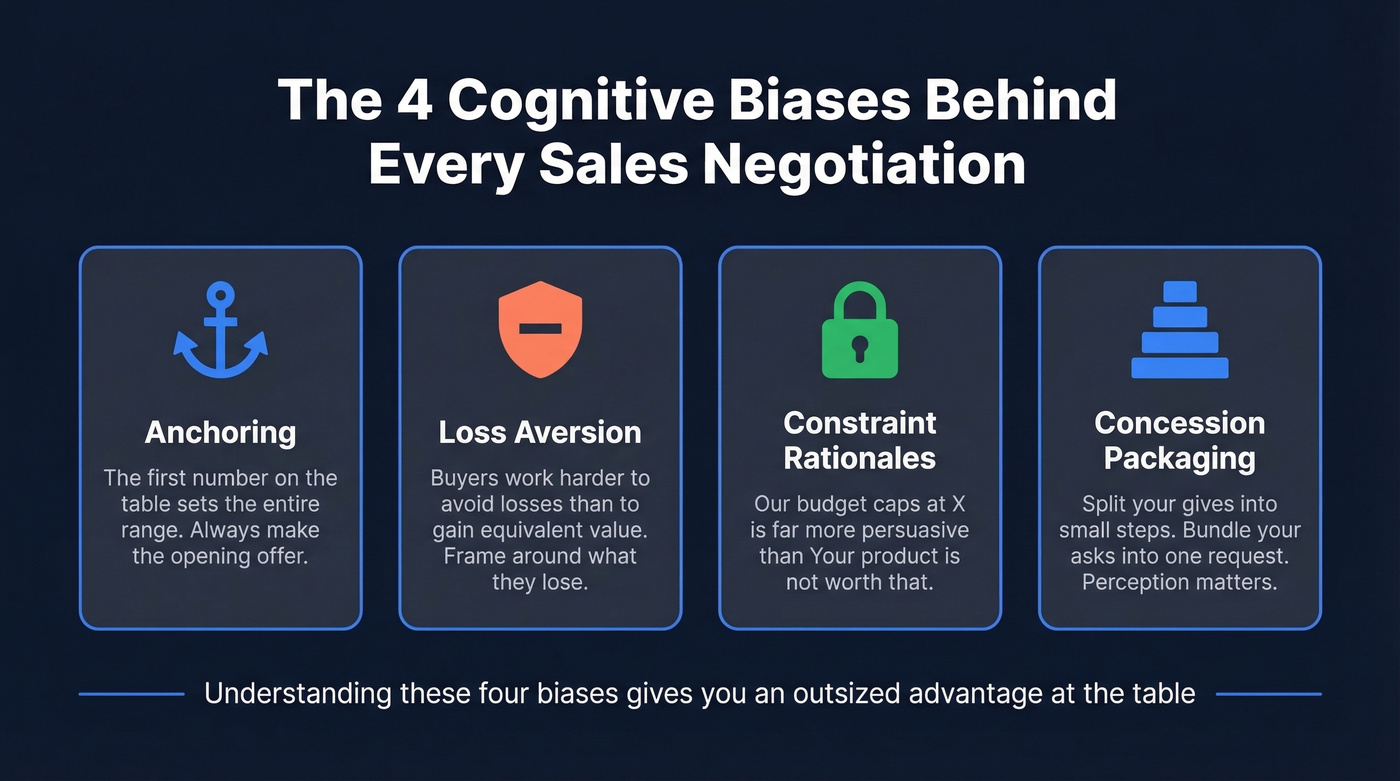
Every negotiation runs on cognitive biases. Understanding four of them gives you an outsized advantage.
Anchoring
The first number on the table sets the range. Let the buyer anchor at 30% below list price, and every counter-offer orbits their number - not yours. Make the first offer whenever possible. Apple's 2014 negotiations with major record labels for Apple Music are often cited as a case where opening positions and revenue-share terms shaped the entire outcome.
Loss Aversion
People work harder to avoid losses than to achieve equivalent gains. A sales-pitch study found that framing insulation as "avoiding future energy losses" increased purchase likelihood over "saving on energy costs." Frame your proposals around what the buyer loses by staying with their current vendor.
Constraint Rationales
A Columbia University study by Lee and Ames found that sellers are far more persuaded by constraint rationales ("Our budget caps at X") than disparagement ("Your product isn't worth that"). Flip this when you push back on discounts: say "We can't go lower given the implementation scope" - not "Your ask undervalues what we deliver."
Concession Packaging
Split your concessions into smaller steps - people perceive multiple small gains as more valuable than one big one. Bundle your asks into a single request - combined losses feel less painful than separate hits.

The best negotiators walk in knowing the buyer's funding, tech stack, and the direct line of the decision-maker. Prospeo gives you 98% accurate emails, 125M+ verified mobiles, and intent data across 15,000 topics - so you anchor every conversation from a position of strength.
Stop negotiating blind. Start every deal with verified data.
Three Frameworks You Actually Need
| Framework | What It Is | When to Use It |
|---|---|---|
| BATNA | Your best walk-away alternative | Before every call - defines your floor |
| ZOPA | Overlap where a deal exists | Mid-negotiation - find the range |
| Anchoring | First number sets the range | Opening offer - always go first |
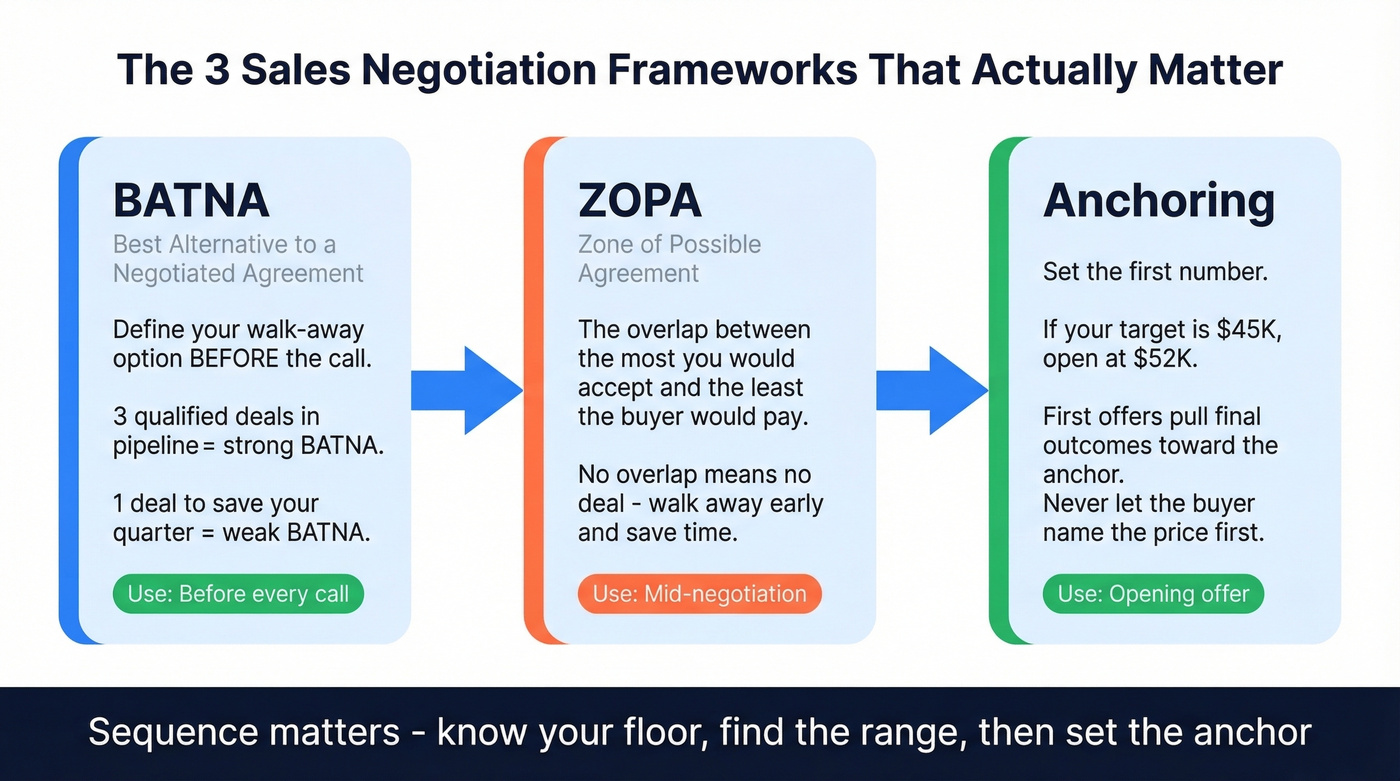
BATNA is your Best Alternative to a Negotiated Agreement. If your pipeline has three similar opportunities at the same stage, your BATNA is strong - and you negotiate differently than a rep staring at an empty quarter.
ZOPA is the Zone of Possible Agreement - the overlap between the most you'd accept and the least the buyer would pay. No overlap, no deal. Knowing this early saves everyone time.
Anchoring means you set the first number. First offers pull final outcomes toward the anchor. Don't wait for the buyer to name a price.
Strategies That Protect Your Margin
Prepare obsessively. In our experience, the reps who negotiate best aren't the most charismatic - they're the most prepared. They walk in knowing the buyer's company size, funding status, tech stack, and the direct line of the decision-maker. Tools like Prospeo surface verified contact data with 98% email accuracy and intent signals across 15,000 topics, so you're never negotiating blind or reaching the wrong person.
Anchor first. If your target is $45K, open at $52K. The final number gravitates toward your anchor.
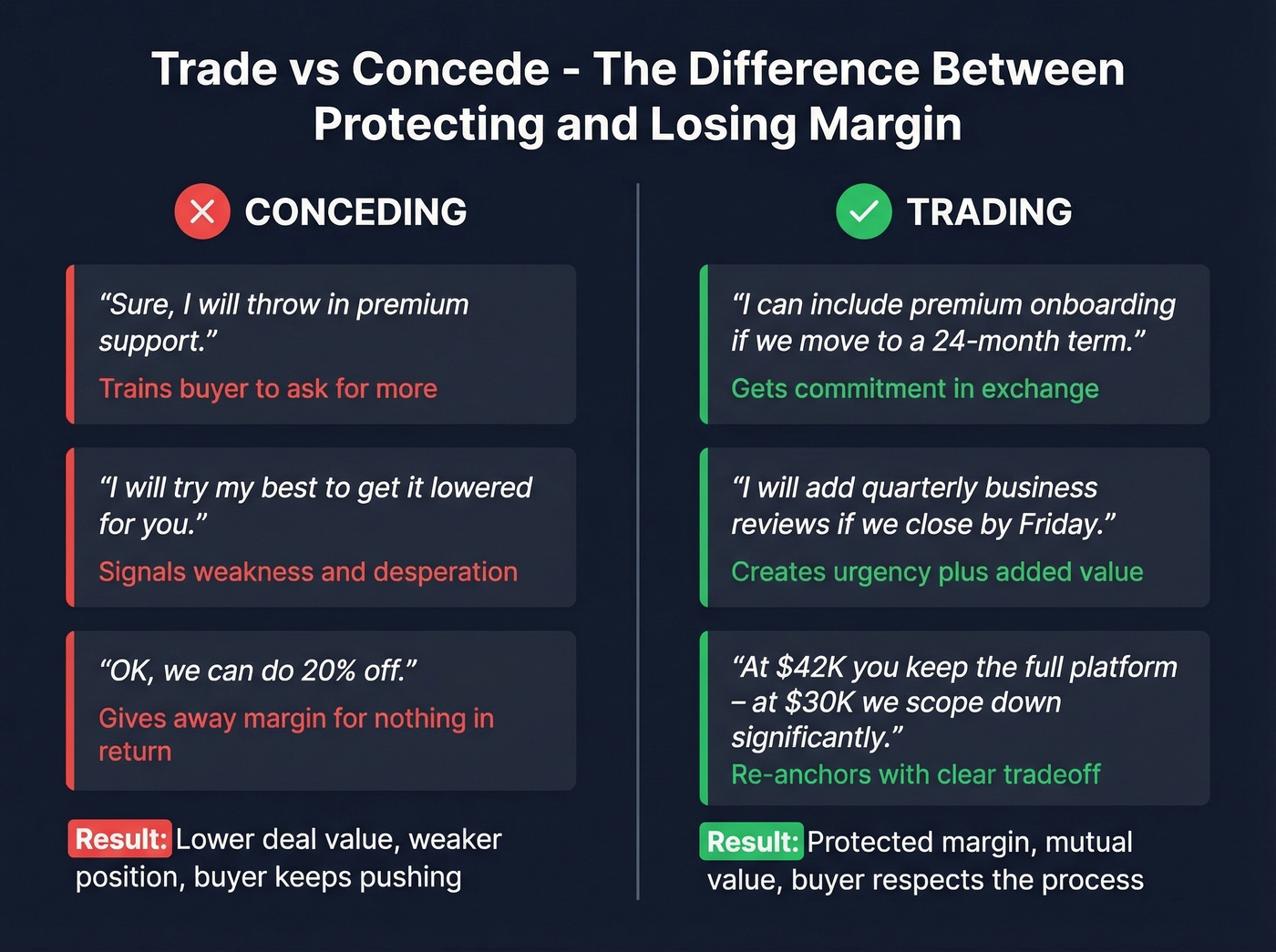
Trade, don't concede. Never give something without getting something back. "I can include premium onboarding if we move to a 24-month term" is a trade. "Sure, I'll throw that in" trains the buyer to ask for more.
Segment your buyer type. Price buyers grind on cost and need benchmark data. Value buyers care about ROI. Partners think long-term and trade flexibility for commitment. Tailor your approach to who's across the table. CEB research found that "challengers" who build constructive tension outperform relationship builders in complex B2B sales - negotiation is where that tension pays off.
Manage your emotions. Anxiety is the most common emotion associated with negotiation, and it's the reason most reps cave on price. It's not a missing framework - it's fear of losing the deal. Recognize the feeling, pause, return to your preparation.
Know your walk-away number. Define it before the conversation, not during it. If you don't have a floor, the buyer will find it for you.
Common Mistakes That Erode Deals
Overvaluing your own product. The endowment effect makes sellers overestimate worth. Build your pricing rationale around the buyer's ROI, not your internal cost structure.
Focusing only on price. Add variables - implementation timeline, payment terms, support tiers, contract length. More levers mean more room for creative deal structures.
Using weak justifications. Don't say "this is our best price" without evidence. Say "our pricing is 8% below the category average for this scope - here's the benchmark."
Ignoring how procurement thinks. One procurement manager put it bluntly in a Freqens interview: "The first thing I look at is price." They also noted that email negotiations don't work - "it's very easy to say no via email. By phone, it's more complicated." If you're negotiating over email with procurement, you're playing their game on their turf.
Scripts You Can Use This Week
Handling a Lowball Offer
Buyer: "We need this at $30K, not $48K."
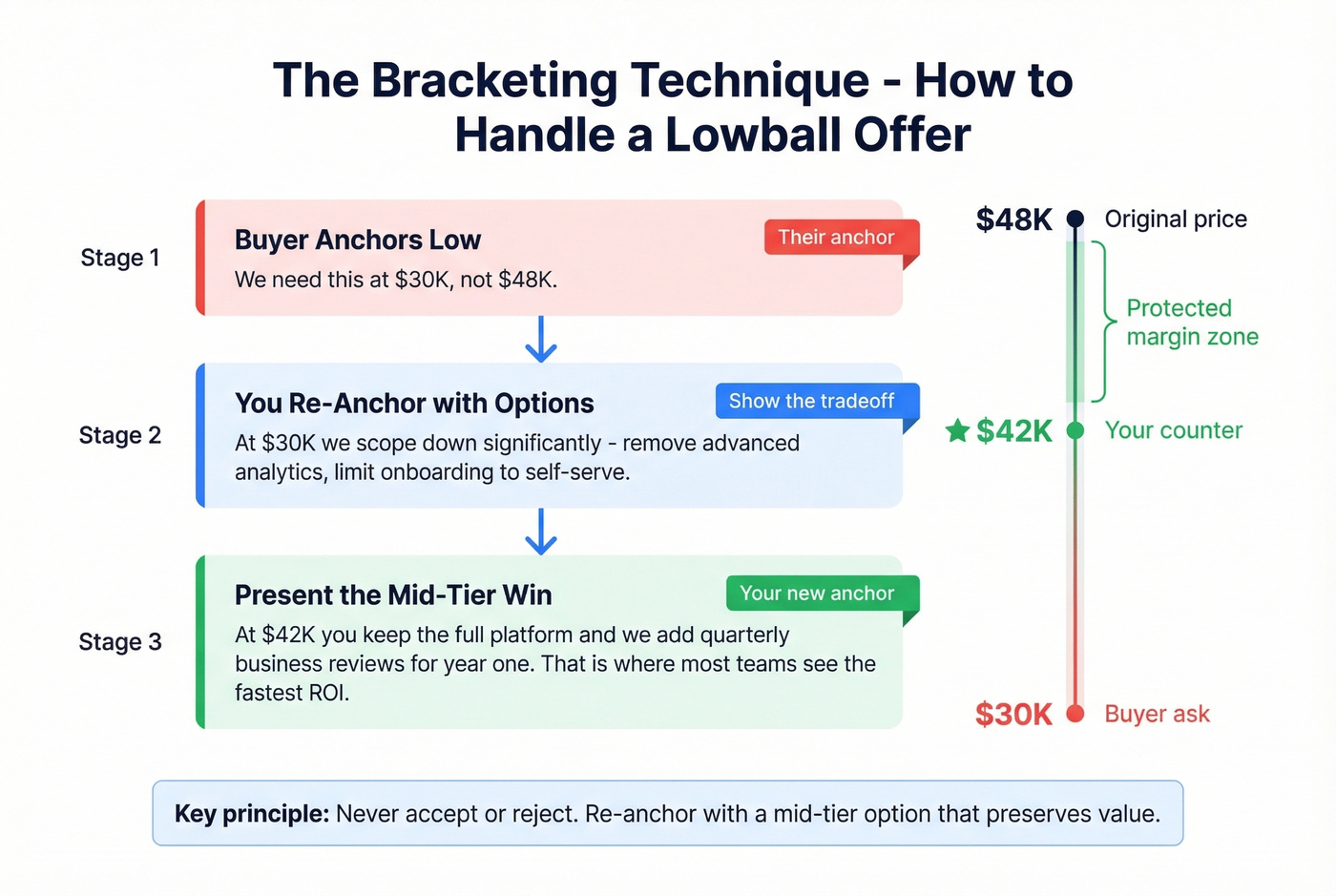
You: "At $30K, we'd scope down significantly - remove advanced analytics, limit onboarding to self-serve. Here's what I'd suggest: at $42K, you keep the full platform and we add quarterly business reviews for year one. That's where most teams see the fastest ROI."
This is bracketing. You don't accept or reject. You re-anchor with a mid-tier option that preserves value.
"Throw in X for Free"
Buyer: "Can you throw in premium support?"
You: "Absolutely - if we extend to 24 months, I'll add it at no extra cost. That also locks in your current rate before our Q3 pricing update."
Compare that to a line you'll hear from weaker reps: "I'll try my best to get it lowered for you, but would you be against meeting me at X?" That's a concession disguised as a question. It signals weakness. Trade instead.
Here's the thing: you don't need negotiation training. You need to practice negotiating. Frameworks take 10 minutes to learn. The real gap is reps who never roleplay. Grab a colleague, run these scripts for 15 minutes, and debrief what felt awkward. We've seen teams that practice regularly boost close rates by roughly 30% - the consensus on r/sales backs this up too, with reps consistently saying live practice beats any course.
Skip the $2,000 negotiation workshop if you haven't done 10 roleplays first. The workshop won't stick without muscle memory.
Your BATNA is only as strong as your pipeline. Prospeo's 300M+ profiles with 30+ filters - buyer intent, job changes, headcount growth - let you fill your pipeline so you never negotiate from desperation. At $0.01 per email, preparation costs less than a single discount concession.
A full pipeline is the best negotiation leverage that exists.
FAQ
What's the difference between selling and negotiating?
Selling communicates value and generates interest. Negotiation happens after the buyer's interested, when both parties finalize terms like price, scope, and timeline. Think of selling as earning a seat at the table and negotiation as deciding what's on it.
How do you negotiate without discounting?
Trade instead of conceding - offer extended contract terms, faster onboarding, or additional seats in exchange for something you need, like a longer commitment or faster signature. Expanding the deal variables beyond price gives you three to five levers that cost less than a straight discount.
What is BATNA in sales?
BATNA stands for Best Alternative to a Negotiated Agreement - it's your walk-away option if the current deal collapses. Reps with three qualified opportunities at the same stage carry significantly more leverage than those relying on a single deal to hit quota. Define your BATNA before every call.
How does better prospect data improve negotiation outcomes?
Reaching the actual decision-maker - not a gatekeeper - eliminates rounds of back-and-forth that stall deals. When you enter a negotiation knowing who has budget authority and whether they're actively evaluating solutions, you skip the "let me check with my boss" loop entirely. That's the difference between a two-week close and a two-month one.