

What Percentage of Sales Professionals Ask for Referrals? The Real Data
You've seen the stat a hundred times: "91% of customers would give referrals, but only 11% of sales professionals ask." It gets dropped into slide decks, LinkedIn posts, and sales kickoff presentations like gospel. There's just one problem - nobody can find the original study.
The number is often attributed to Dale Carnegie, but no one has ever produced the sample size, methodology, or publication date. It's been circulating since at least 2014 without a single primary, verifiable source. And the question framing - "would you refer if asked?" - likely inflates willingness, since hypothetical intent rarely matches real behavior.
So if you're wondering what percentage of sales professionals ask for referrals based on traceable research, let's replace the myth with data that actually holds up.
Quick Summary: Real Referral Ask Rates
The 91%/11% stat isn't traceable to an original study. Better data from Sales Insight Lab's 2021 study: 47% of top performers ask for referrals consistently. Meanwhile, 40.4% of all salespeople rarely ask, and only 18.6% make it a standard part of their process. The fix isn't motivation - it's method.
Sales Referral Statistics That Hold Up
Sales Insight Lab's 2021 Sales Data Study gives us the best breakdown available. Among top-performing salespeople, 47% ask for referrals consistently. Across all reps, 40.4% rarely ask, and just 18.6% say they ask every person they're in front of.
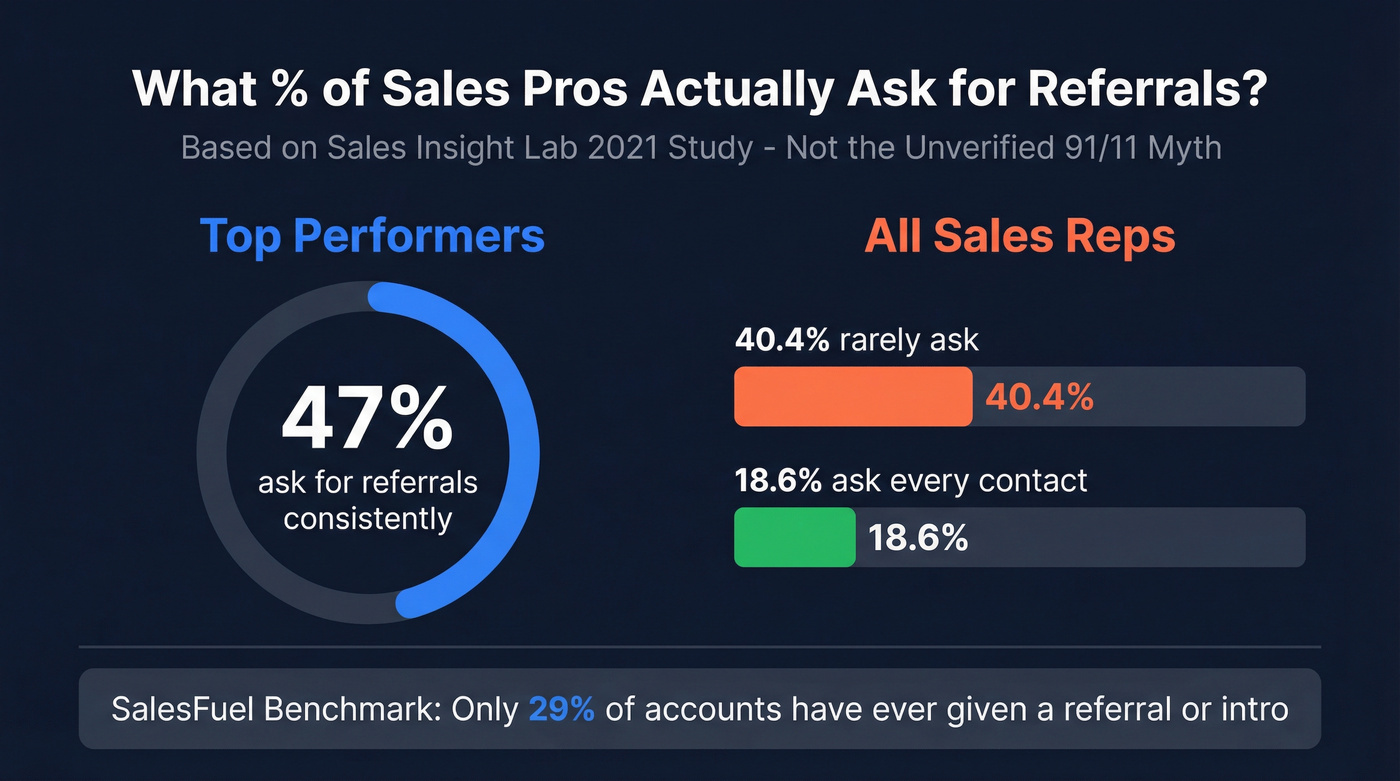
SalesFuel's Voice of the Sales Rep benchmark adds another angle: on average, only 29% of a seller's prospects or accounts have ever given a referral or introduction. That's not because clients don't want to help - it's because nobody's asking them in a way that makes it easy.
The real picture is messier and more interesting than "91 vs 11." Roughly half of top performers have figured out the referral habit, but the vast majority of reps haven't built it into their process at all. The gap is still enormous, and it's fixable.
Why Reps Don't Ask
Research across 21,000+ salespeople found the primary barrier isn't fear of rejection. It's fear of being perceived as pushy or intrusive. That's a meaningful distinction - and one that changes how you solve the problem.
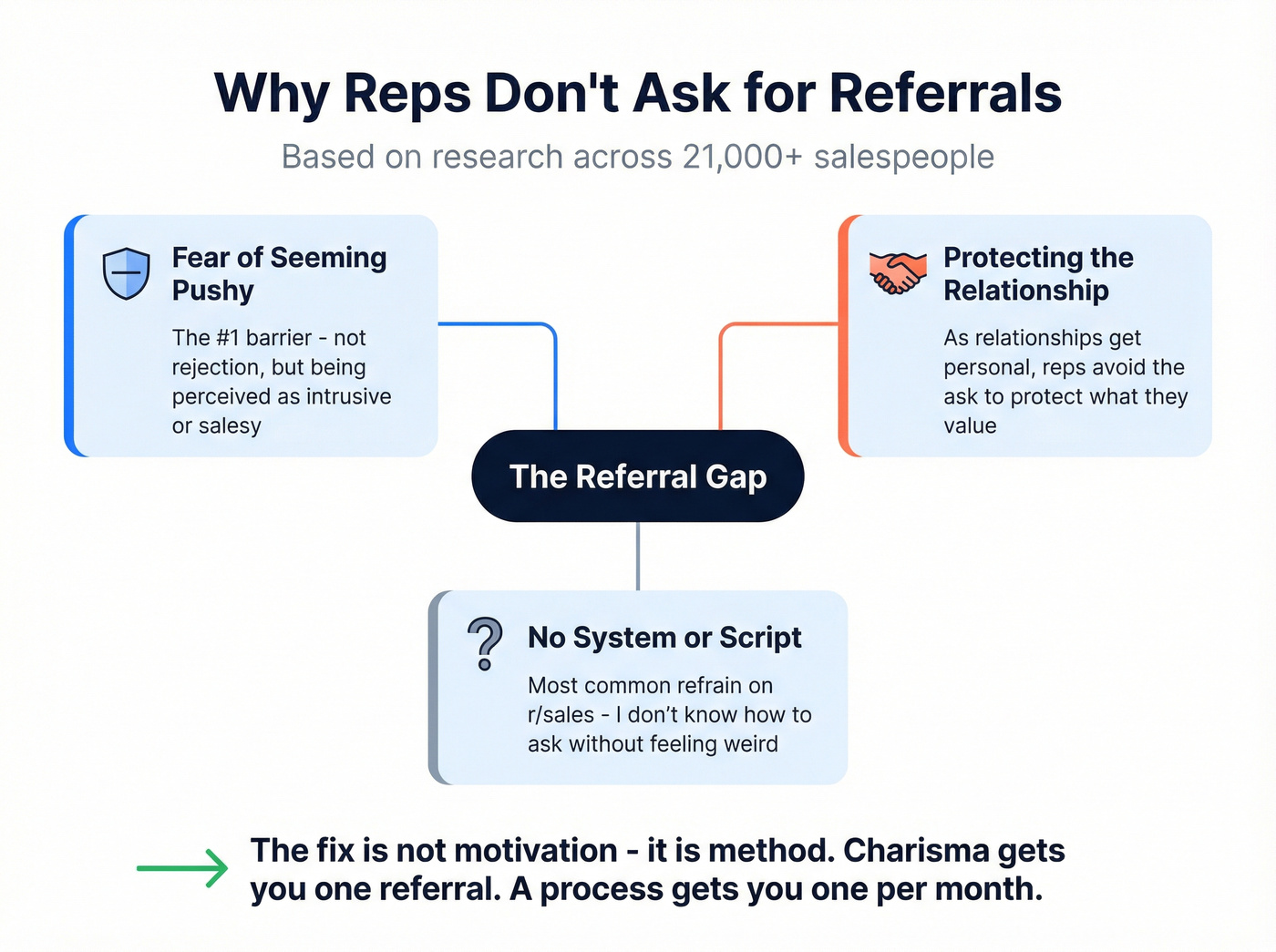
There's another dynamic at play, too. As client relationships become more personal, many sellers avoid referral asks because they don't want to jeopardize something they value. They're protecting the relationship rather than putting it to work.
Here's the thing: on r/sales, the most common refrain isn't "I don't want to ask." It's "I don't know how to ask without feeling weird." That tracks. The discomfort is real, but it's misplaced. A client who genuinely values you is the exact person who'd be happy to connect you with a peer.
The reps who close the most referral-sourced deals aren't the most charismatic - they're the most systematic. Charisma gets you one referral. A process gets you one per month.
If you're building that process, it helps to map it into your sales activities and keep it consistent inside your sales process optimization work.

You just got a referral name. Now what? 40% of reps lose momentum because they can't find accurate contact info fast enough. Prospeo gives you 98% verified emails and 125M+ direct dials so you can reach that warm intro before it goes cold.
Turn every referral into a conversation - not a bounced email.
Why Clients Hesitate (Even Happy Ones)
Even satisfied clients have their own barriers. They don't want to feel like they're "selling" a friend on a vendor relationship. They worry that if the referred person has a bad experience, they'll be the one who looks bad. And in industries where trust is currency, sharing a colleague's contact info can feel intrusive.
These aren't objections you overcome with persistence. They're concerns you design around.
The Inner Circle Method
The Sandler "Inner Circle" strategy is the best referral framework we've seen in practice. It works because it replaces the vague ask with a specific, low-friction one.
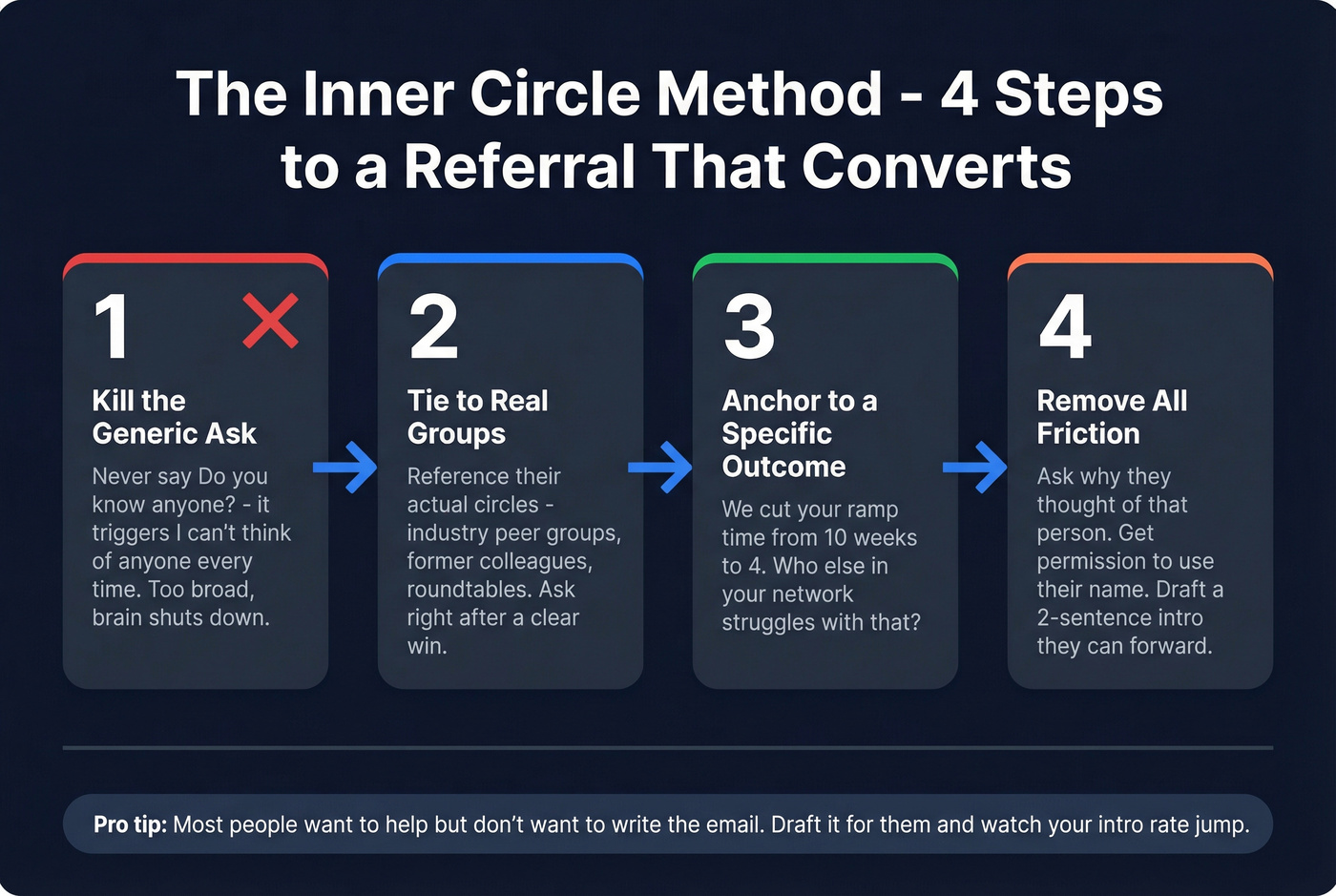
Stop Asking "Do You Know Anyone?"
That question triggers "I can't think of anyone right now" every single time. Too broad. The client's brain shuts down.
Tie the Ask to Real Groups
Reference the client's actual circles - their industry peer group, their former colleagues, their golf buddies. Ask immediately after the client has experienced a clear win: "You mentioned you're in a CFO roundtable. Any of them dealing with the same ramp-time problem we just solved for you?"
Anchor to a Specific Outcome
Don't ask generically. Anchor the ask to a result you delivered: "We cut your team's ramp time from 10 weeks to 4. Who else in your network is struggling with that?" This gives the client a concrete reason to think of a specific person, not a vague category.
After You Get a Name
Ask why they thought of that person - this gives you intel for the outreach. Get explicit permission to use the client's name.
Then make it effortless: draft a two-sentence intro message the client can forward. Most people want to help but don't want to write the email. Remove that friction and you'll get dramatically more intros.
After the Referral: Speed Wins
Warm intros go cold fast. Every day you wait, the referral loses its edge.
If you want to tighten this step, use proven sales follow-up templates and a repeatable sales meeting follow-up email workflow.
Only 18.6% of reps ask for referrals systematically. Even fewer follow up fast enough with verified contact data. Prospeo's Chrome extension lets you pull verified emails and mobile numbers the moment you get a name - no list building, no guessing, no bounces.
Close the referral gap with data that's refreshed every 7 days.
The Business Case for Referrals
If you need to justify investing time in a referral process, the numbers are hard to argue with:
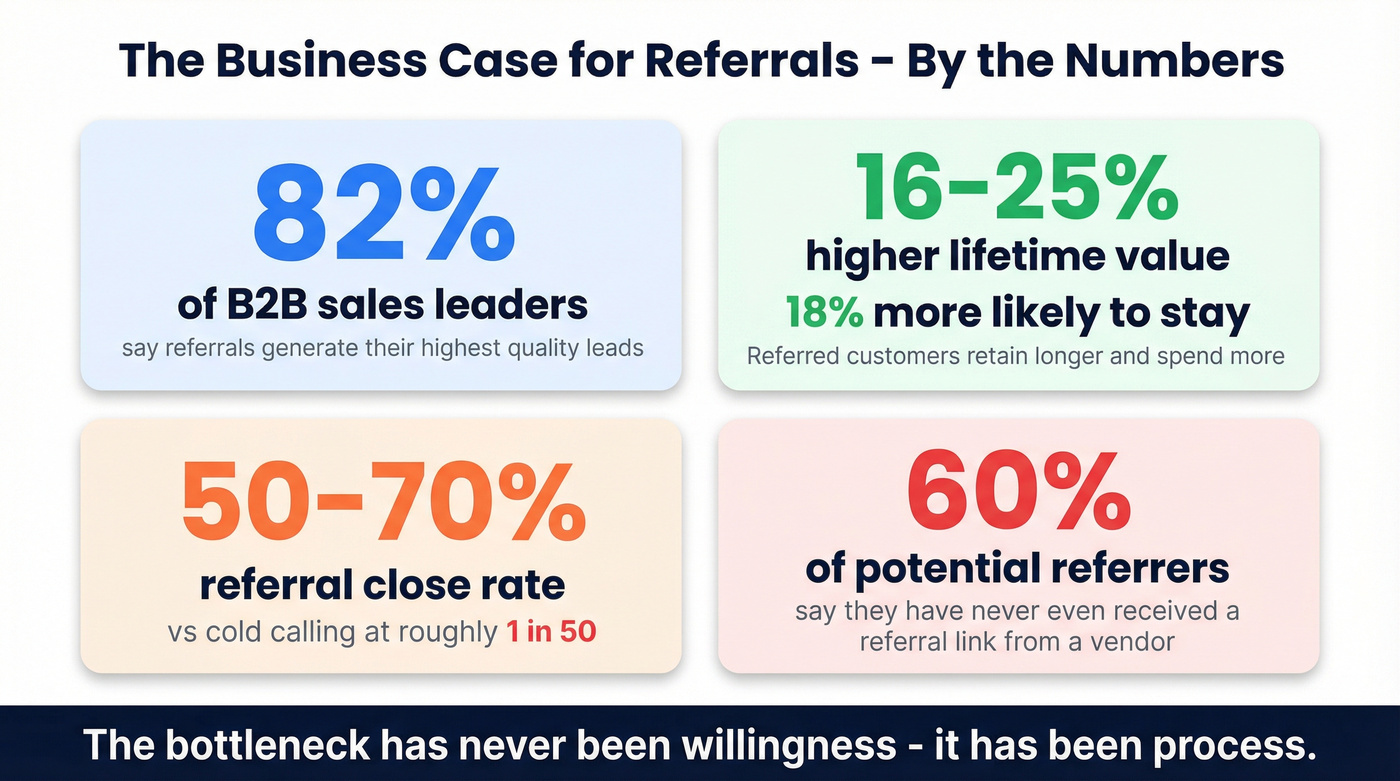
- 82% of B2B sales leaders say referrals generate their highest-quality leads
- Referred customers carry 16-25% higher long-term value and are 18% more likely to stick
- Referral leads close at 50-70%, while traditional cold calling converts roughly 1 out of 50 attempts
- 78%+ of referral programs are double-sided, yet 60% of potential referrers say they've never even received a referral link
The math is overwhelming. Referrals convert better, retain longer, and cost almost nothing to generate. The bottleneck has never been willingness - it's been process. Knowing what percentage of sales professionals ask for referrals is step one. Building a repeatable system to close that gap is what actually moves pipeline.
This is also why teams that lean into data-driven selling and track pipeline health tend to operationalize referrals faster than teams that rely on vibes.
Let's be honest: if you're reading this and you don't have a referral step baked into your post-close workflow, you're leaving the easiest revenue on the table. Skip the motivational posters about "just ask more." Build the system instead.
FAQ
Where does the "91% would give referrals" stat come from?
It's widely attributed to Dale Carnegie, but no one has produced the original study, sample size, or methodology. The stat has circulated since at least 2014 without a primary, verifiable source. Use the Sales Insight Lab 2021 data instead - it's specific, recent, and traceable.
What percentage of top performers ask for referrals?
According to Sales Insight Lab's 2021 study, 47% of top sales performers ask consistently. Across all reps, 40.4% rarely ask, and only 18.6% make it standard practice with every contact. These numbers paint a much more nuanced picture than the viral 91%/11% claim.
Why don't more salespeople ask for referrals?
Research across 21,000+ salespeople found the primary barrier is fear of being perceived as pushy - not fear of rejection. Structured frameworks like the Inner Circle method reduce this friction by replacing vague asks with specific, outcome-anchored requests tied to the client's real network.
How do I follow up quickly after getting a referral name?
Act within 24 hours - warm intros decay fast. Use a tool like Prospeo to find the person's verified email and direct dial instantly, then reach out referencing the mutual connection by name. Speed and accurate contact data are what separate referrals that close from referrals that die in your CRM.