

When to Hire a CRO (And When You're Definitely Too Early)
Your board just floated the idea. "Have we thought about a Chief Revenue Officer?" It sounds like progress - a senior hire who'll unify sales, marketing, and customer success under one leader. The data backs the ambition: companies with a CRO-like role show 1.8x higher revenue growth than peers, per McKinsey's analysis of US Fortune 100 companies plus 100 SaaS and hardware unicorns across the US and Europe. US scale-ups bring one on roughly two years earlier than their European counterparts.
But "should we hire a CRO?" and "should we hire a CRO now?" are completely different questions. Get the timing wrong and you'll burn $400K+ on a leader who churns in around 15 months - a pattern so common it's practically a meme in SaaS circles.
(In ecommerce, "CRO" usually means Conversion Rate Optimization - a completely different discipline. This guide covers the Chief Revenue Officer role.)
The Quick Decision Shortcut
- Under $10M ARR - You need a VP of Sales, not a CRO.
- $10M-$50M ARR and growing fast - Consider a fractional CRO first.
- $50M+ ARR with cross-functional complexity - Hire a full-time CRO.
- Exception: ~$10M at 300%+ YoY growth - A CRO makes sense earlier to build infrastructure ahead of scale.
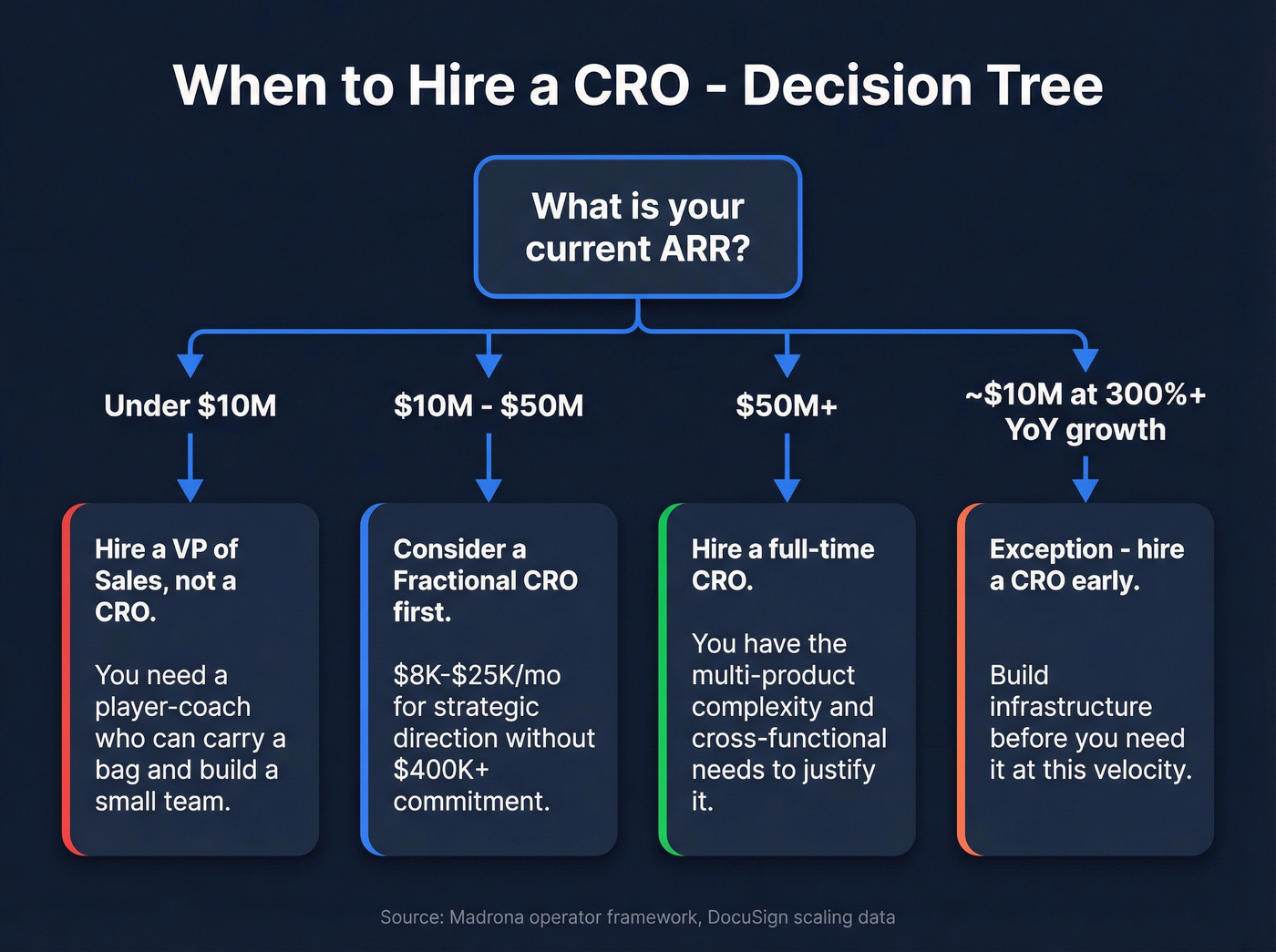
If you're below $10M and your board is pushing for a CRO, push back. The rest of this piece explains why - and what to do instead at every stage.
What a CRO Actually Does
The CRO architects the revenue engine - not just the sales engine. That distinction matters more than most founders realize.
A VP of Sales owns quota attainment and team management. They're focused on this quarter's number. A CRO operates on a longer horizon, building predictable, scalable revenue systems across the full customer lifecycle: qualified trials, new business, expansion, churn, contraction, and renewals. Their primary KPIs are revenue growth, LTV, and net revenue retention - metrics that span departments.
The scope typically includes oversight of sales, marketing, customer success, and RevOps. Sometimes partnerships and product-adjacent revenue streams too. The CRO-RevOps relationship is one of the defining features of the modern chief revenue officer - they need a strong RevOps function to operationalize strategy across every revenue-touching team.
Here's the thing: a CRO without authority over marketing and CS is just a VP of Sales with a fancier title. If you're not ready to give someone cross-functional control, you're not ready for this hire.
The Revenue-Stage Playbook
The best framework we've seen comes from Madrona's operator perspective, built from Loren Alhadeff's journey scaling DocuSign from $2.5M to $2.5B in revenue.
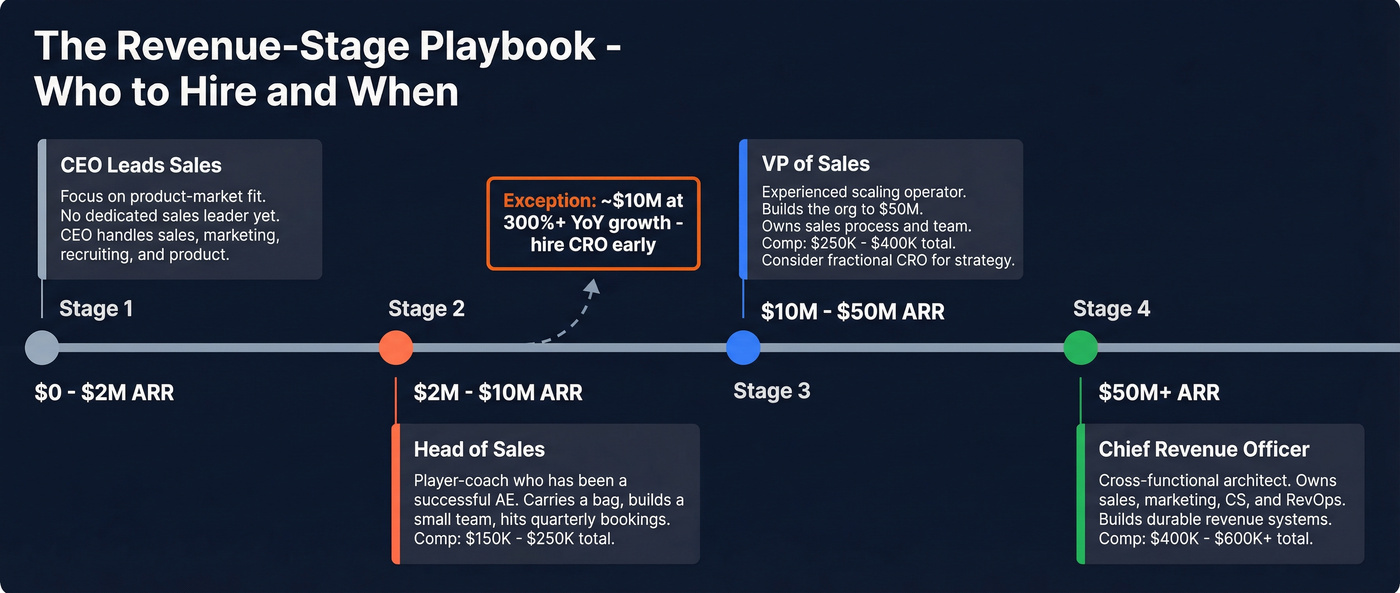
$0-$2M ARR: The CEO leads sales, marketing, recruiting, and product. You don't need a sales leader yet. You need product-market fit.
$2-$10M ARR: Hire a scrappy Head of Sales - someone who can carry a bag, build a small team, and hit quarterly bookings targets. One Reddit operator's hard rule: never hire a sales leader who hasn't been a successful AE themselves. This person is a player-coach, not a strategist.
$10-$50M ARR: Bring in an experienced VP of Sales who can build the org to $50M. Keep networking and recruiting continuously. This is where most companies live for years, and a strong VP of Sales is the right leader for this stage.
$50M+ ARR: Now you need a CRO. The business has multi-product complexity, multiple ICPs, and cross-functional dependencies that require someone thinking about durable, long-term revenue architecture. In SaaS especially, expansion revenue and net retention are as important as new logos.
The big exception: if you're around $10M but growing at 300%+ year-over-year, hiring a CRO earlier makes sense. At that velocity, you'll hit $50M faster than you can recruit for it. Build the infrastructure before you need it - one of the hardest lessons for high-growth companies.
| Role | Revenue Stage | Scope | Total Comp Range | Ideal Profile |
|---|---|---|---|---|
| Head of Sales | $2-$10M | Quota + small team | $150-$250K | Player-coach, scrappy |
| VP of Sales | $10-$50M | Sales org + process | $250-$400K | Scaling operator |
| CRO | $50M+ | Sales + Mktg + CS | $400-$600K+ | Cross-functional architect |
| Fractional CRO | $10-$50M | Targeted strategy | $8-$25K/mo | Interim, project-based |
What a CRO Actually Costs
Founderpath's February 2026 dataset - covering 147 SaaS CRO salary benchmarks - puts the median base at $160,000, with a typical range of $100K to $225K. GoFractional pegs the average CRO base higher at $237K with ~$410K total comp, likely reflecting a skew toward later-stage roles. Base is only part of the story.
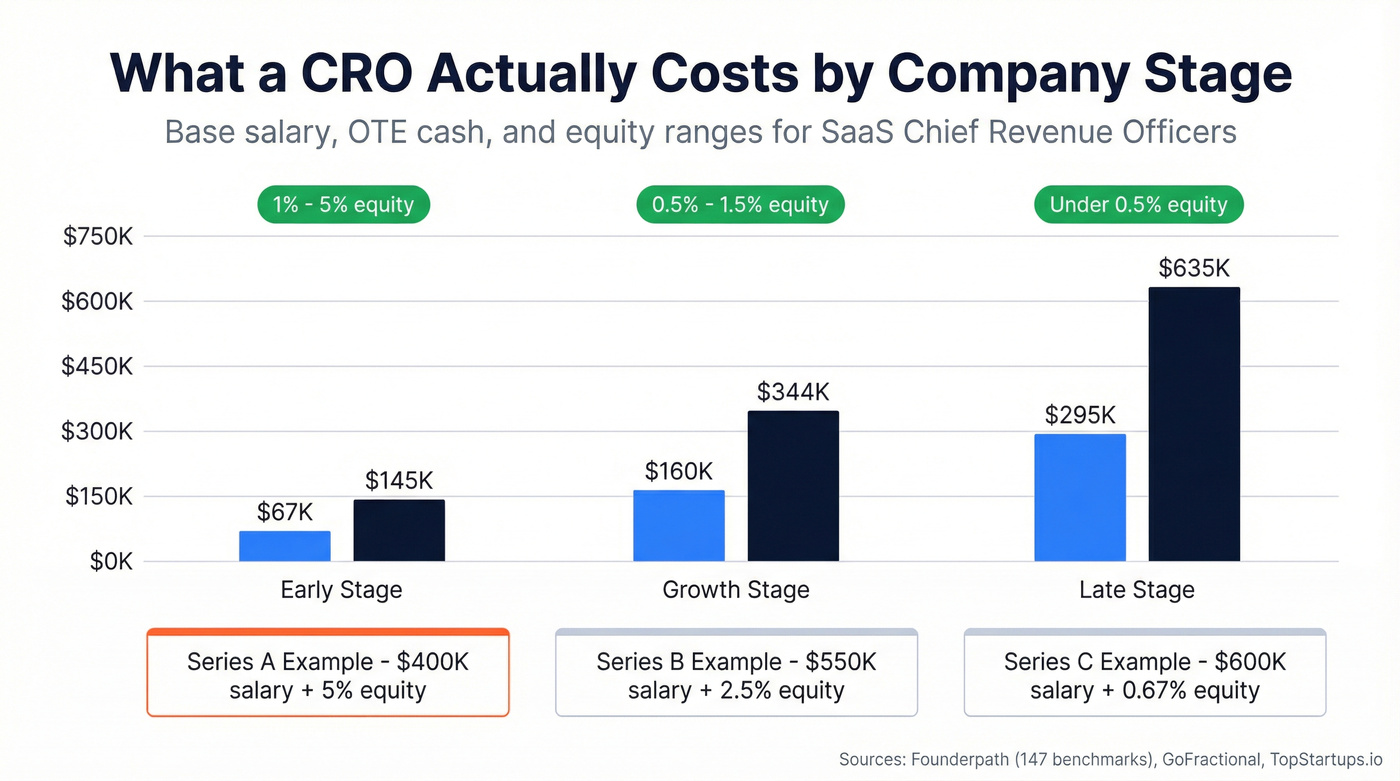
OTE typically runs 1.8-2.5x base salary. Equity at growth-stage companies falls in the 0.5-1.5% range. The stage bands tell the real story:
| Stage | Avg Base | OTE (Cash) | Equity |
|---|---|---|---|
| Early-stage | ~$67K | ~$121-$169K | 1-5% |
| Growth | ~$160K | ~$288-$400K | 0.5-1.5% |
| Late-stage | ~$295K | ~$531-$739K | <0.5% |
Real-world packages from TopStartups.io submissions paint an even richer picture: a Series A CRO at $400K salary plus 5% equity, a Series B CRO at $550K plus 2.5%, a Series C CRO at $600K plus 0.67%. For UK-based companies, Scalewise benchmarks put CRO base salary at £180K-£300K, with "double OTE" implying £360K+ in total cash, plus equity.
CROs typically earn 30-50% more in total compensation than VPs of Sales. That premium buys you cross-functional scope - but only if the role is scoped correctly.

A CRO's first 90 days live or die on pipeline quality. Bad data is the #5 reason CRO hires fail - bounced emails, stale contacts, and forecasts built on ghost leads. Prospeo's 7-day data refresh and 98% email accuracy mean your new revenue leader inherits infrastructure that actually works.
Set your CRO up to win - not churn in 15 months.
Why Most CRO Hires Fail
The average tenure for a first CRO in venture-backed SaaS hovers around 15 months. That's not a success story. It's a pattern of expensive misalignment, and the failures cluster around five predictable modes.
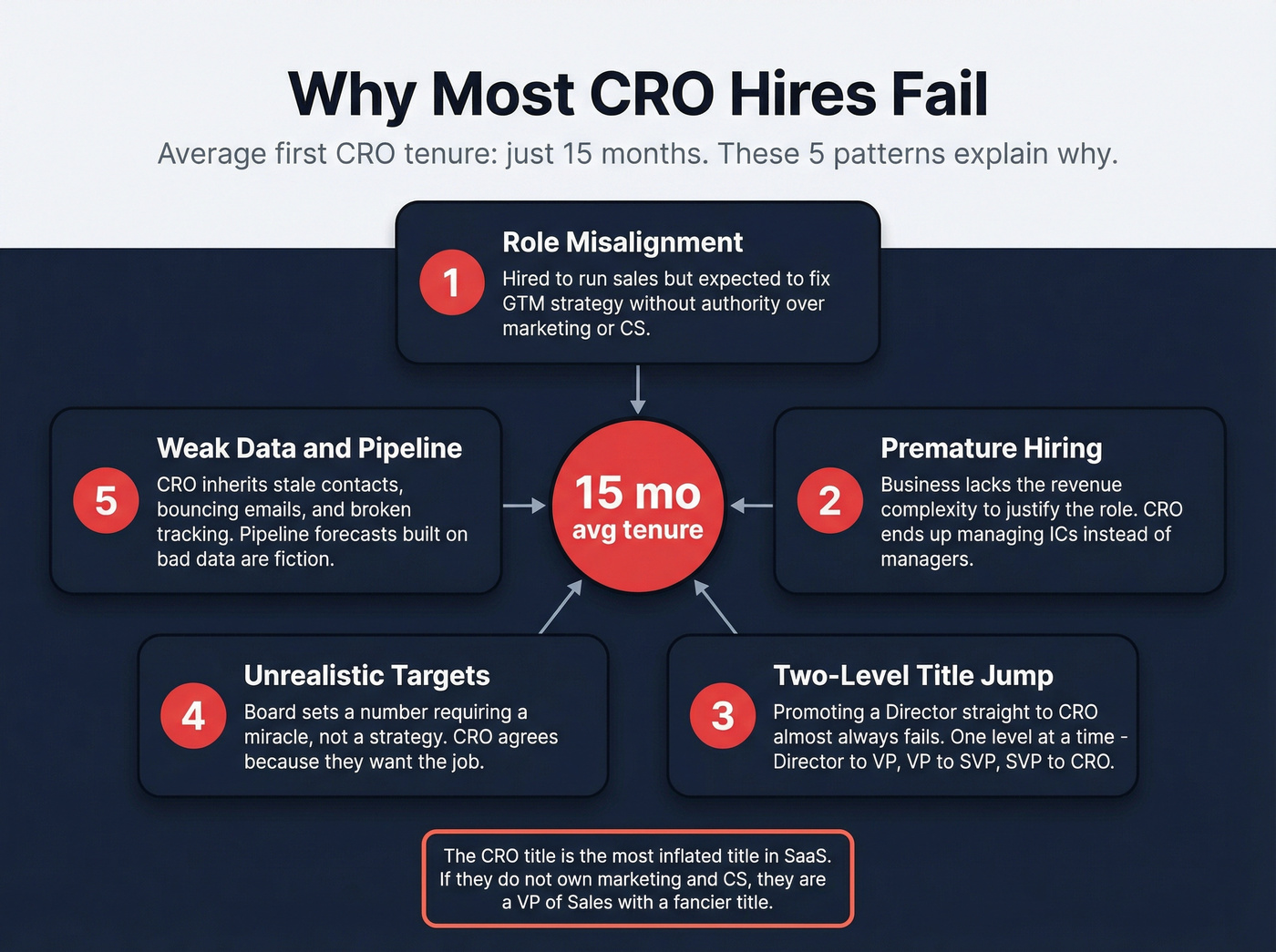
Role misalignment. The company hires someone to "run sales" but expects them to fix GTM strategy, forecasting, and cross-functional growth - without giving them authority over marketing or CS.
Premature hiring. The business doesn't have the revenue complexity or org structure to justify the role. The CRO ends up managing ICs instead of managing managers.
The two-level title jump. SaaStr's Jason Lemkin has warned about this repeatedly: promoting a Director to CRO, or hiring someone who's only been a VP into a C-suite cross-functional role, almost always fails. One level at a time. Director to VP, VP to SVP, SVP to CRO - with each step proving cross-functional capability.
Unrealistic targets. The board sets a number that requires a miracle, not a strategy. The CRO agrees to it because they want the job.
Weak data and pipeline infrastructure. The CRO inherits bad data, no operating rhythm, and no accountability metrics. Pipeline forecasts built on stale contacts and bouncing emails aren't forecasts - they're fiction. No chief revenue officer can build strategy fast enough to overcome that.
Let's be honest: the CRO title is the most inflated title in SaaS. We've seen companies hand it to their first sales hire at $3M ARR. That's not a CRO - that's a Head of Sales who negotiated well.
The Fractional CRO Alternative
Use a fractional CRO if:
- You're between $10M and $50M and need strategic direction but can't justify $400K+ in total comp
- Sales have stagnated and you need a diagnostic, not a full-time executive
- You're expanding into new markets and need GTM architecture
- Sales and marketing are siloed and finger-pointing
- You're preparing for a fundraise and need the revenue story cleaned up
Skip fractional if you're above $50M with genuine cross-functional complexity. You need someone full-time in the seat.
Fractional CROs typically run $8K-$25K per month on a 3-6 month initial engagement. One SaaS scale-up saw +35% close rates and -22% CAC within six months of bringing in a fractional CRO to redesign the sales process. Over 40% of growth-stage companies are expected to use fractional leadership models in some capacity by 2026. It's not a consolation prize - it's often the smarter move.
CRO Readiness Checklist
Before you write the job description, run through these signals. If you can't check most of them, you're not ready.
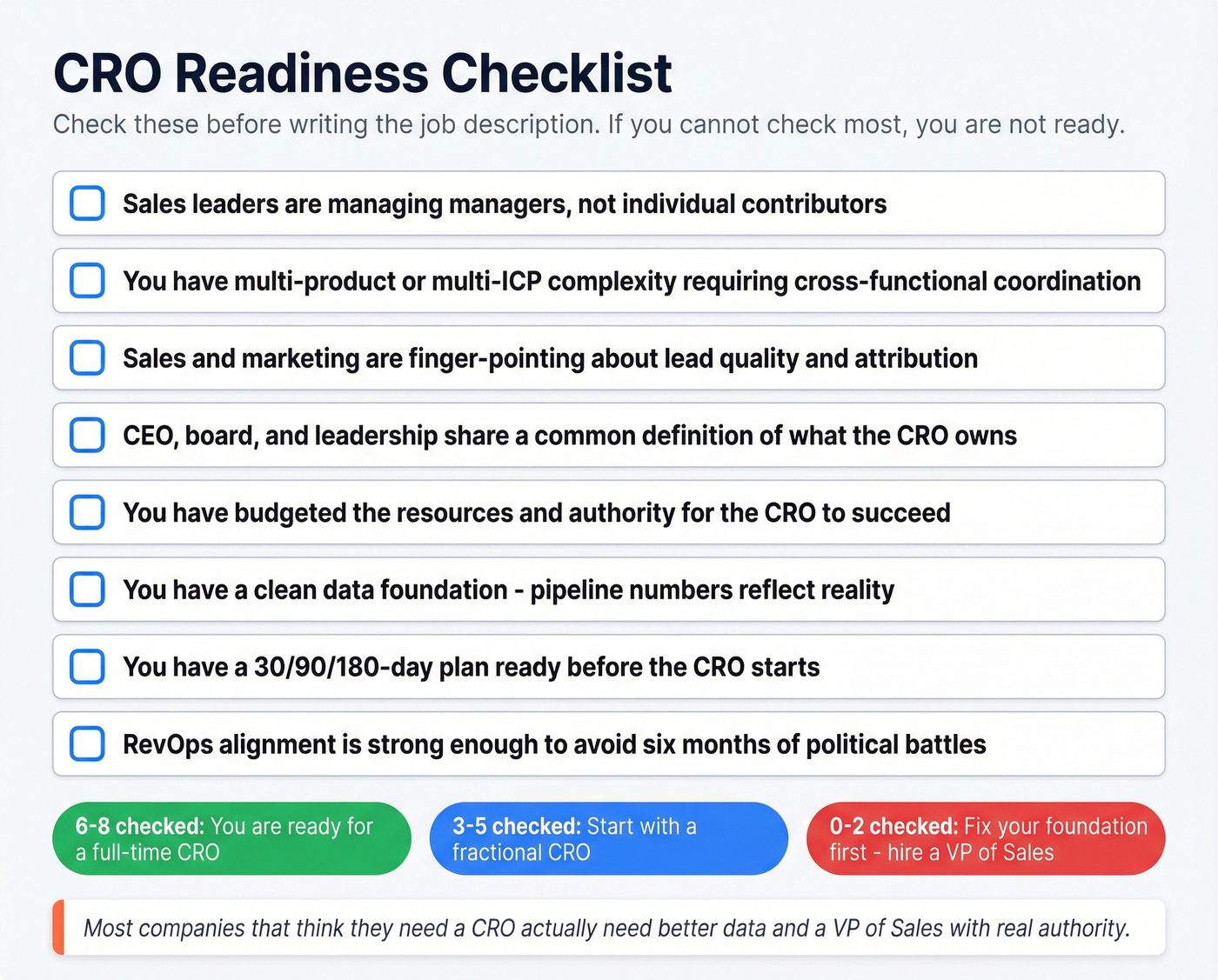
- ✅ Your sales leaders are managing managers, not individual contributors
- ✅ You have multi-product or multi-ICP complexity that requires cross-functional coordination
- ✅ Sales and marketing are finger-pointing about lead quality, attribution, or handoff
- ✅ Your CEO, board, and leadership team share a common definition of what the CRO role means and owns
- ✅ You've budgeted the resources and authority for the CRO to actually succeed
- ✅ You have a clean data foundation - your pipeline numbers reflect reality, not wishful thinking
- ✅ You have a 30/90/180-day plan ready before the CRO starts - not a vague mandate to "fix revenue"
- ✅ You have a RevOps alignment is strong enough that the CRO won't spend their first six months fighting political battles instead of building systems
That last point about clean data deserves emphasis. The consensus on r/Entrepreneurs echoes it: fix your funnel first before paying for expensive leadership. Even the best CRO can't build strategy on a foundation of stale contacts and broken tracking.
Our take: Most companies that think they need a CRO actually need better data and a VP of Sales with real authority. A $400K CRO layered on top of a broken pipeline is just an expensive way to discover the same problems your reps already know about.
Tips for Founders Hiring Their First CRO
If you've decided the timing is right, a few things can prevent the 15-month churn cycle:
Define scope in writing before you start interviewing. If the CRO doesn't own marketing and CS, call the role what it is. Align the board on a realistic 12-month plan, not a hockey-stick fantasy. Give the CRO 90 days to audit before expecting strategic output - demanding a new GTM plan in week two is a recipe for failure. And ensure they have a direct line to the CEO and a real seat at the table, not a dotted-line reporting structure that undermines their authority from day one.
Your CRO's Day-One Data Problem
A new CRO's first 30-day audit will expose every data quality problem you've been ignoring. Stale emails, dead phone numbers, duplicate records, phantom pipeline - it all comes out. If your contact data bounces in the mid-teens or higher and your reps can't reach decision-makers by phone, your CRO's pipeline forecasts are fiction from day one.
Fix this before you spend $400K on a hire. The industry average data refresh cycle is about six weeks - long enough for contacts to change jobs, emails to bounce, and phone numbers to go dead. Tools like Prospeo refresh every 7 days, with 98% email accuracy and a 30% mobile pickup rate, so your CRO's forecasts reflect reality instead of last quarter's org chart.
If you're rebuilding your pipeline foundation, start with data enrichment and a clear lead generation workflow so your CRM doesn't rot between refreshes.

Scaling from $10M to $50M ARR? Your VP of Sales or fractional CRO needs verified contacts across every ICP segment. Prospeo delivers 300M+ profiles with 30+ filters - buyer intent, technographics, headcount growth - at $0.01 per email. Enterprise-grade data without the enterprise contract.
Give your revenue leader the data infrastructure to actually scale.
FAQ
What's the average CRO salary in 2026?
Median base is $160K per Founderpath's 147-company dataset. OTE runs 1.8-2.5x base, putting growth-stage total cash at ~$288K-$400K. Late-stage total comp with equity can exceed $600K.
CRO vs VP of Sales - what's the difference?
A VP of Sales owns quota and the sales team. A CRO architects the full revenue engine across sales, marketing, and customer success. If the role doesn't include authority over marketing and CS, it's a VP of Sales regardless of the title. The distinction comes down to scope: one manages a department, the other orchestrates the entire revenue lifecycle.
How much does a fractional CRO cost?
Expect $8K-$25K per month, typically on a 3-6 month initial engagement. That's $96K-$300K annualized versus $400K-$600K+ for a full-time CRO - a meaningful savings for companies between $10M and $50M ARR.
Can a startup under $10M ARR hire a CRO?
Almost always too early. The exception is companies at ~$10M growing 300%+ YoY, where building infrastructure ahead of scale makes sense. Everyone else should start with a VP of Sales or fractional CRO.
What should a new CRO prioritize on day one?
A CRO's first move is auditing pipeline data quality. They need verified emails and direct dials they can trust, a CRM that reflects reality, and intent signals to identify in-market buyers immediately. Without that foundation, every strategic decision they make is built on guesswork.