

Where to Buy Leads in 2026 (and What They Should Actually Cost)
$653 per lead in financial services. $92 in HVAC. The spread is enormous, and most teams have zero idea whether they're overpaying or getting a bargain.
That's the real problem with figuring out where to buy leads - not finding a vendor, but knowing what a fair price looks like before you sign anything. We've watched teams blow $30K on a contract that delivered worse data than a tool costing a tenth of that. Price transparency in this space is terrible, and vendors like it that way.
"Buying leads" covers two very different things. B2B contact data means purchasing access to databases of verified emails, phone numbers, and firmographic details for people matching your ICP. Pay-per-lead marketplaces sell you inbound inquiries from people who filled out a form or requested a quote - warmer, but plagued by inconsistent quality and murky exclusivity terms. Always get exclusivity guarantees in writing.
Quick Picks
- Best free tier for outbound: Apollo.io - generous free plan, paid from $49/user/month
- Best for European markets: Cognism - phone-verified mobiles, strong EMEA coverage
One warning: skip any vendor selling 10,000 unverified leads for $99. That's a domain reputation time bomb, not a deal.
What Should Leads Cost?
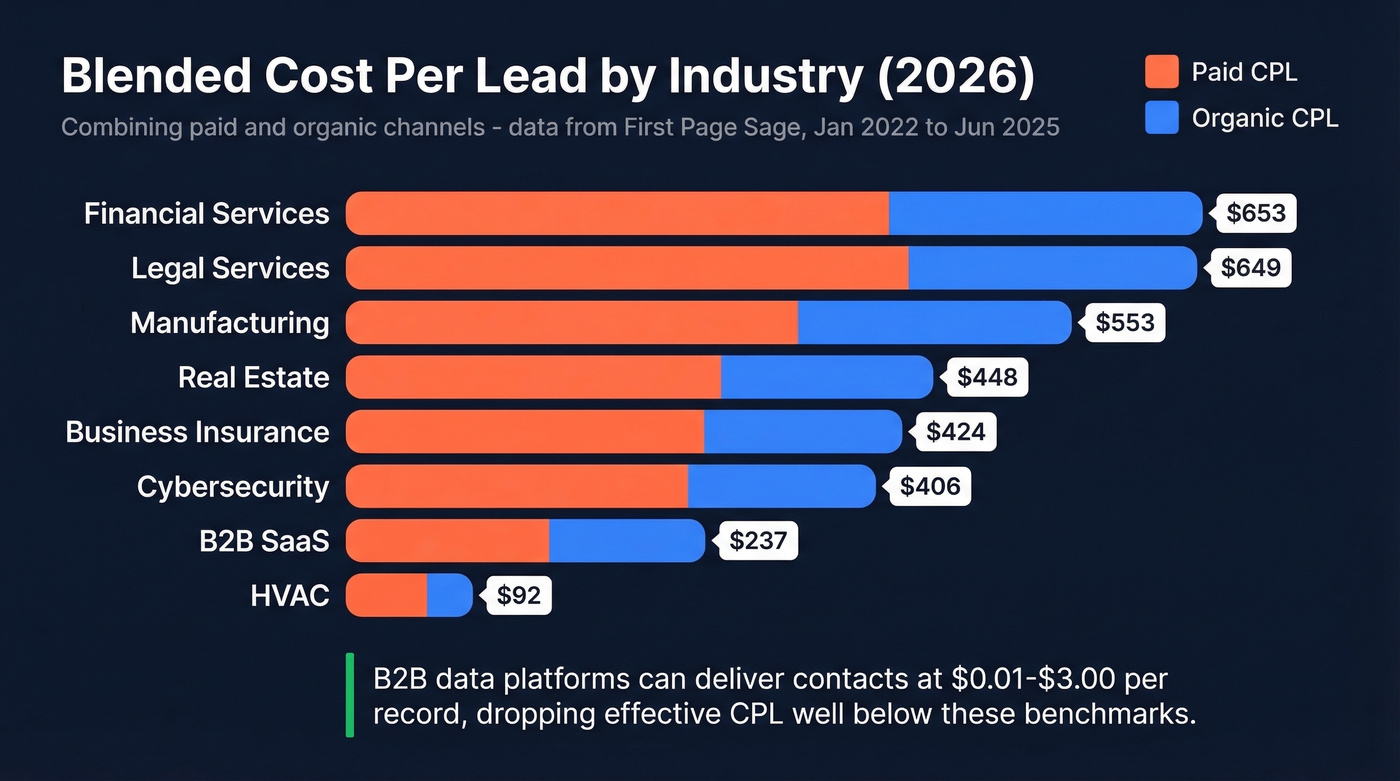
Here are blended CPL benchmarks across eight verticals, combining paid and organic channels:
| Industry | Paid CPL | Organic CPL | Blended CPL |
|---|---|---|---|
| B2B SaaS | $310 | $164 | $237 |
| HVAC | $115 | $69 | $92 |
| Business Insurance | $460 | $388 | $424 |
| Cybersecurity | $411 | $404 | $406 |
| Real Estate | $480 | $416 | $448 |
| Manufacturing | $691 | $415 | $553 |
| Legal Services | $784 | $516 | $649 |
| Financial Services | $761 | $555 | $653 |
Data from First Page Sage's dataset spanning January 2022 through June 2025. HubSpot references similar benchmarks and recommends a healthy LTV:CAC ratio of 3:1 as the baseline for sustainable growth.
These are blended averages across all acquisition channels. If you're buying contact data at $0.01-$3.00 per record and converting even a fraction, your effective CPL drops well below these benchmarks. That's the math that makes B2B data platforms attractive compared to pay-per-lead marketplaces.
Buying Leads vs. Generating Them
| Factor | Buying Leads | Generating In-House |
|---|---|---|
| Speed to pipeline | Days | Weeks to months |
| Conversion rate | Lower (cold) | Higher (warm) |
| Data ownership | Vendor-dependent | Full control |
| Compliance risk | Higher | Lower |
| Cost structure | Per-lead or credits | Fixed + variable |
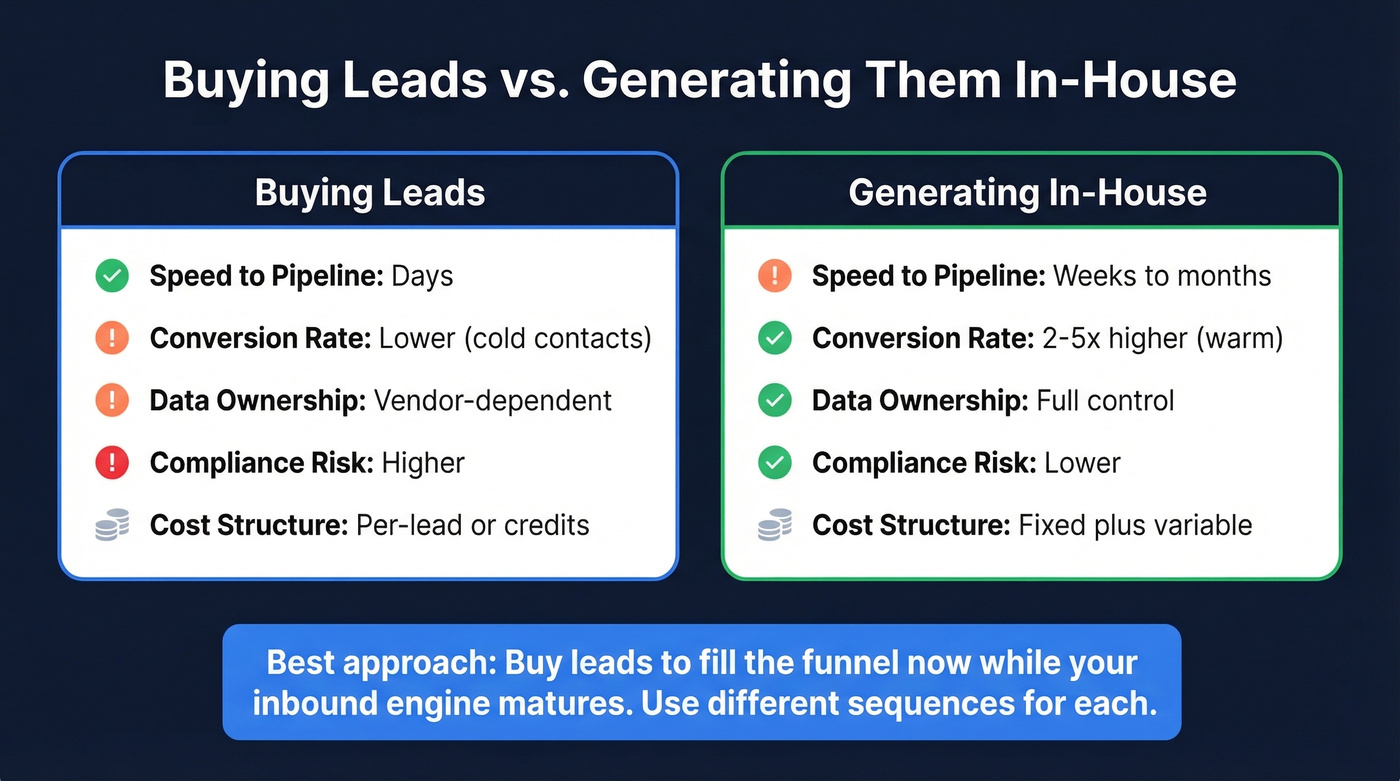
Purchasing leads gets you moving fast - you can have 500 decision-makers in your ICP by tomorrow morning. But these are cold contacts who didn't ask to hear from you, and conversion rates reflect that. Generating leads in-house through content, SEO, and paid campaigns takes longer but produces prospects who've already engaged with your brand, with conversion rates typically 2-5x higher.
Most teams need both. Buy leads to fill the top of the funnel while your inbound engine matures. The mistake is treating purchased leads like inbound inquiries - they require different sequences, different messaging, and more touchpoints before anyone books a call.

You just saw that blended CPL in B2B SaaS is $237. Prospeo's database gives you verified emails at $0.01 each - 98% accurate, refreshed every 7 days. Meritt tripled their pipeline to $300K/week after switching. That's the math that breaks CPL benchmarks.
Buy leads that actually convert - starting at zero dollars.
Best Places to Buy Business Leads
B2B Contact Databases
Prospeo
Use this if you care about data accuracy more than feature bloat and want to stop paying enterprise prices for mid-market results.
Prospeo's B2B database covers 300M+ professional profiles with 143M+ verified emails and 125M+ verified mobile numbers. The 98% email accuracy rate speaks for itself - Meritt saw their bounce rate drop from 35% to under 4% after switching, and their pipeline tripled from $100K to $300K per week. The 30% mobile pickup rate across all regions means reps actually get conversations, not voicemail graveyards.

The 7-day data refresh cycle is the real differentiator. Most competitors refresh around every 6 weeks, which means you're calling people who changed jobs last month. Prospeo also layers in intent data across 15,000 topics via Bombora, so you can filter for companies actively researching your category.
Pricing starts free with 75 emails and 100 Chrome extension credits per month. Paid plans run ~$0.01 per email with no contracts and no sales calls required - 90% cheaper than ZoomInfo per lead.
Skip this if you need a built-in dialer or sequencing tool. Pair it with Instantly, Lemlist, or Outreach for that.
ZoomInfo
ZoomInfo is the 800-pound gorilla, and its pricing reflects that. ZoomInfo Lite gives you 10 credits per month and WebSights Lite with up to 10 company-level visitor reveals per day - enough to test, not enough to prospect. Real-world contracts start at $15,000/year for Professional with 5,000 annual credits, jump to $24,000+ for Advanced with intent data, and hit $40,000+ for Elite.
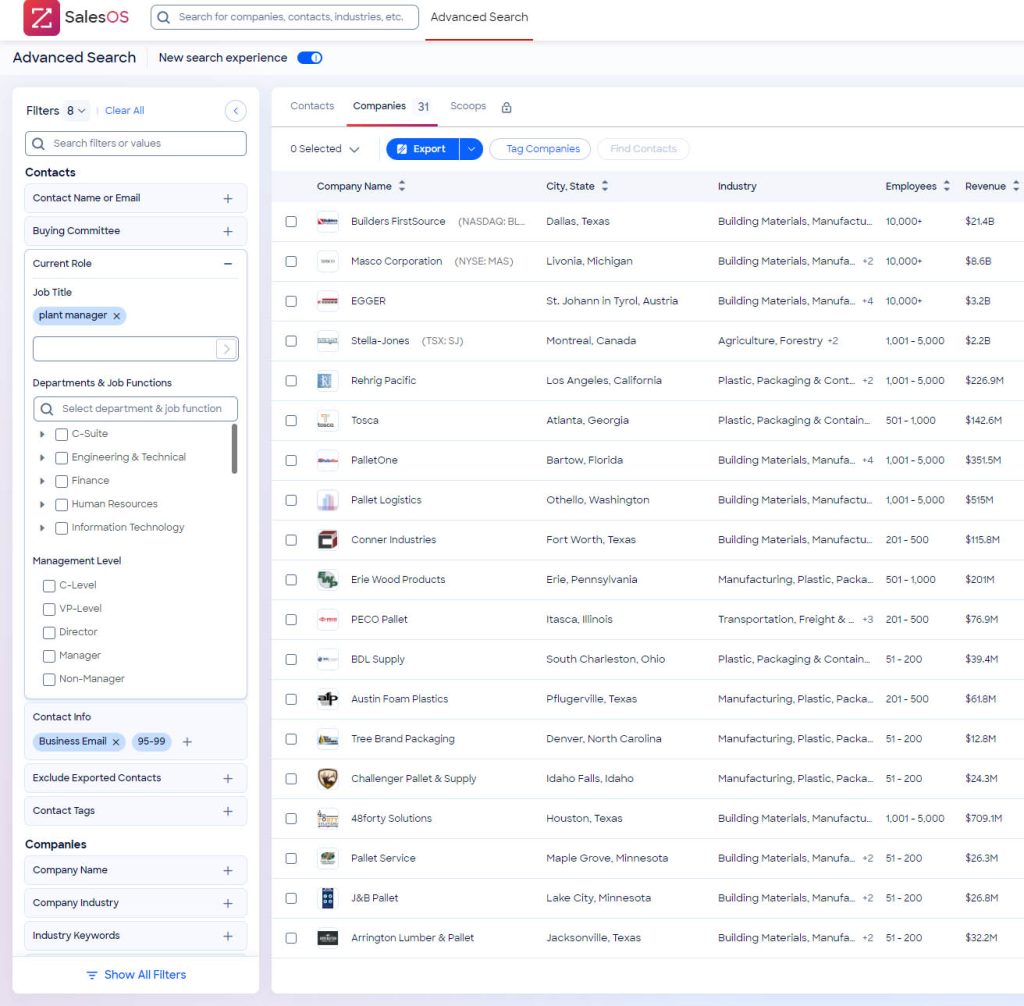
The add-on math is where it gets painful. Extra credits run ~$3,000 per 5,000. NeverBounce email verification adds ~$3,000. Global Data runs $9,995. Additional seats cost ~$1,500/user/year. ZoomInfo pushes 2-3 year contracts with 60-90 day auto-renewal windows that are easy to miss. A common complaint on r/sales: teams sign thinking they're getting $15K/year, then discover the real cost is double once add-ons stack up.
The database is massive - 500M+ profiles and 200M+ business emails. But size doesn't equal accuracy. We've seen teams run bake-offs where ZoomInfo's volume advantage disappeared once you filtered for verified, current contacts. A 10-seat contract with intent data can run $40K+/year. That's real money for a Series A company, especially when cheaper tools match or beat the data quality on the metrics that actually matter.
Here's the thing: ZoomInfo is still the most feature-rich all-in-one platform. But most teams don't need all-in-one - they need accurate data and a separate sequencer, which costs a fraction of the price.
Apollo.io
Apollo has the best free tier in B2B data. Period. You get meaningful database access without spending a dollar, which makes it the obvious starting point for founders testing outbound for the first time. Paid plans start at $49/user/month on annual billing.
The built-in sequencing tools mean you can find leads and email them from one platform, which is convenient. The tradeoff is data accuracy at scale - if you're doing high-volume outbound where deliverability matters, verify everything before sending. (If you need a starting point, use these sales prospecting techniques to structure your outreach.)
Cognism
Cognism positions itself as the European leader in GTM intelligence. If you're selling into the UK, DACH, or Nordics, it's a strong option for GDPR-compliant, phone-verified mobile numbers with an 87% success rate on mobile verification. Pricing is custom - expect ~$1,000-$3,000/month for small teams, more for enterprise. Cognism wins on EMEA compliance and mobile verification; ZoomInfo still wins on US database depth.
Lusha
Lusha works best as a quick enrichment tool rather than a primary database. Limited free plan available, paid from $36/user/month on a credit-based model. The Chrome extension is fast for grabbing contacts during research - good for individual reps, less suited for bulk list building. If you're doing enrichment at scale, compare data enrichment services before you commit.
UpLead
UpLead offers a 7-day free trial and paid plans from $99/month. The standout feature is real-time email verification on export - you don't download a contact unless the email checks out. Solid mid-market option if ZoomInfo's pricing makes you flinch but you want something more capable than a Chrome extension.
Quick Mentions
- Kaspr - EUR 45/month. Strong for European prospecting with a focus on mobile numbers.
- Seamless.AI - ~$147/month. Real-time B2B contact search. Aggressive sales process - be ready.
- Lead411 - ~$99/month with intent data included. Decent for US mid-market.
- SalesIntel - ~$200-$400/month. 90M+ contacts with human-verified records.
- D&B Hoovers - $10,000+/year. Enterprise-grade firmographic data, best for account-level research.
- MegaLeads - ~$60/month. Smaller database, basic filtering. You get what you pay for.
Website Visitor Identification
Leadfeeder (Dealfront)
Leadfeeder identifies companies visiting your website and turns anonymous traffic into sales opportunities. This isn't a contact database - it's an intent signal layer for inbound-heavy teams. Used by 60,000+ companies, with free and paid tiers based on how many companies you identify per month. Pair it with a contact data tool to actually reach the right people at those companies.
Consumer & Vertical Marketplaces
If you're in insurance, real estate, or home services, the model shifts to pay-per-lead. EverQuote sells insurance leads at $15-$50 shared, $50-$150 exclusive. HomeAdvisor/Angi charges $15-$75 per home services lead. In real estate, Market Leader runs $189/month plus $30-$50/lead, Zillow Premier Agent charges $20-$60/lead, and REDX starts from $60/month for expired listing data.
Pricing Comparison
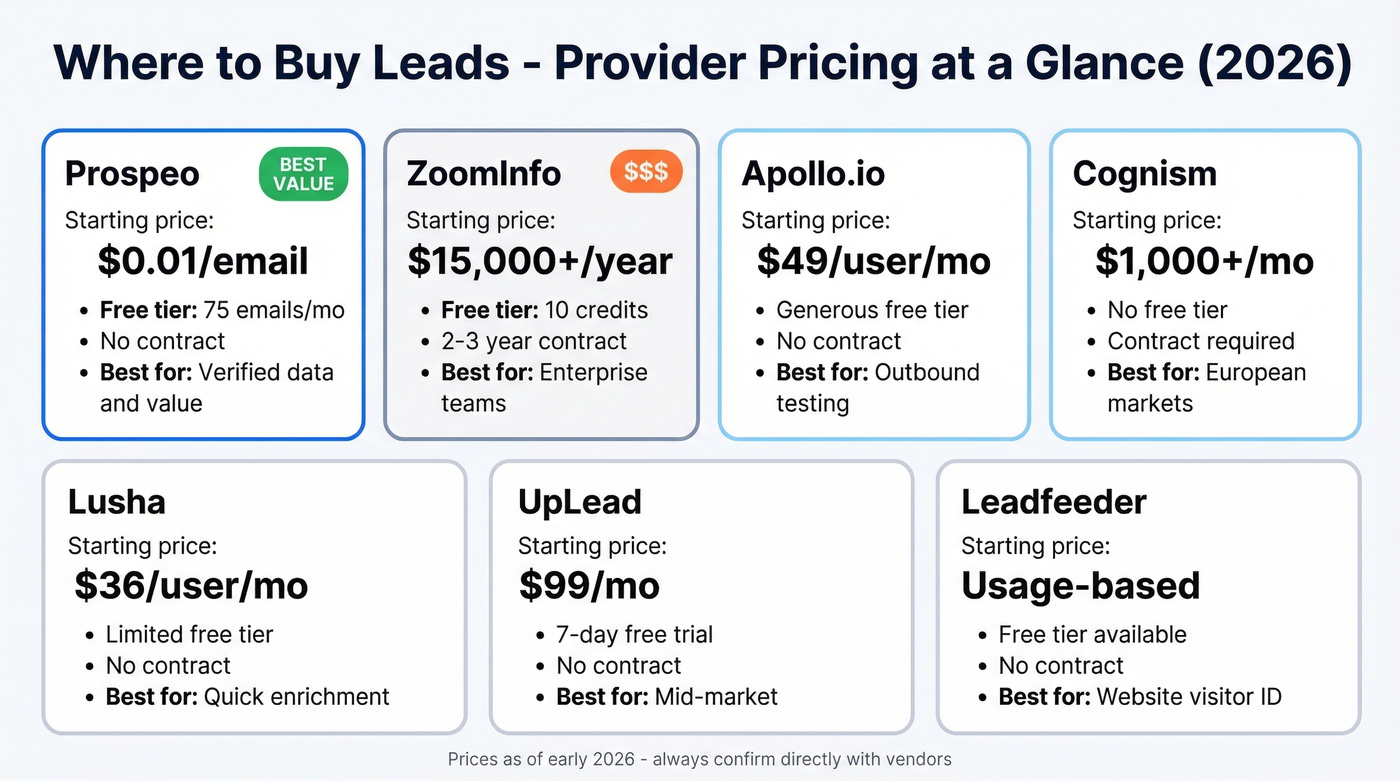
| Provider | Starting Price | Free Tier | Contract | Best For |
|---|---|---|---|---|
| Prospeo | ~$0.01/email | Yes (75/mo) | No | Verified data, value |
| ZoomInfo | $15,000+/year | Yes (10 credits) | Yes (2-3 yr) | Enterprise teams |
| Apollo.io | $49/user/mo | Yes | No | Outbound testing |
| Cognism | ~$1,000+/mo | No | Yes | European markets |
| Lusha | $36/user/mo | Yes (limited) | No | Quick enrichment |
| UpLead | $99/mo | 7-day trial | No | Mid-market |
| Leadfeeder | Usage-based | Yes | No | Website visitor ID |
How to Evaluate a Lead Provider
Coresignal's framework lays out a useful hierarchy of lead data value: verified email, then direct phone, firmographics, decision-maker attributes, technographics, and finally intent signals. The more layers a provider covers, the more precisely you can target - and the fewer wasted dials your reps make. (If you're building a stack, start with these SDR tools and work backward from your workflow.)
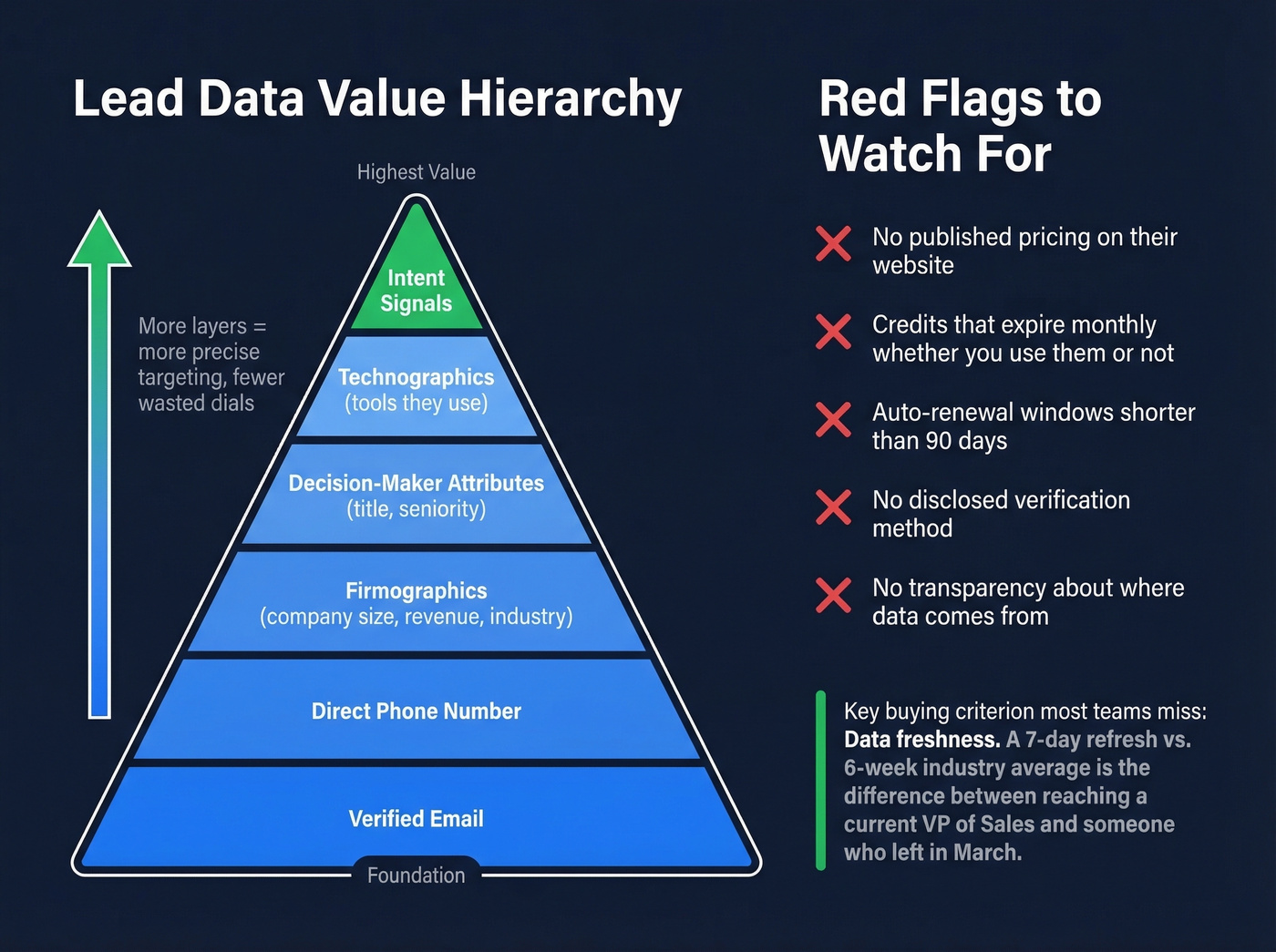
Data freshness is the buying criterion most teams overlook. A 7-day refresh cycle versus the 6-week industry average is the difference between calling a current VP of Sales and calling someone who left the company in March. In our experience, stale data is the single biggest reason purchased lead lists underperform.
Red flags when evaluating any provider: no published pricing, credits that expire monthly whether you use them or not, auto-renewal windows shorter than 90 days, no disclosed verification method, and no transparency about data sourcing. The fact that several major providers still won't publish pricing in 2026 tells you the number changes based on how desperate you look on the sales call.
Compliance Risks You Can't Ignore
TCPA violations are counted per message. Send 10,000 texts without proper consent and you're looking at $5 million in exposure at $500 per violation - or $15 million if a court rules it was willful.
TCPA lawsuits surged ~95% year-over-year in 2025, with class actions up 285% in September alone. The FCC's one-to-one consent rule, effective January 27, 2025, means each marketer needs seller-specific written consent - blanket "partner" consent doesn't cut it anymore. Expanded revocation rights kicked in April 11, 2025, requiring you to honor opt-outs within 10 business days, and the broader "revoke all" provision takes effect April 2026. The FCC also classified AI-generated voices as "artificial/prerecorded" in February 2024, so AI-powered cold calling carries the same TCPA exposure as robocalls. Texas SB 140, effective September 1, 2025, expanded solicitation definitions to include texts and images, with treble damages under the DTPA.
Let's be honest - most sales teams don't think about compliance until something goes wrong. Don't be that team. Request TrustedForm certificates from any lead vendor to document consent. Scrub every list against DNC registries. Use routing tools like LeadConduit to validate and dedupe before leads hit your CRM. If you're unsure where the line is, read our guide on is it illegal to buy email lists.
How to Convert Purchased Leads
Buying the leads is the easy part. Converting them is where most teams fail, and speed matters more than anything else.
You have a 10-15 minute window before a competitor calls the same lead - after two hours, your chances of connecting drop by 70%. One services firm reported conversion jumping from 4% to 11% simply by cutting response time. That alone should tell you everything about how you need to structure your workflow around purchased data.
Plan for 6-8 touchpoints before conversion. One email and one call isn't a sequence - it's a coin flip. Mix channels: email, phone, and social touches spread across 2-3 weeks. Before loading any purchased list into your CRM, verify the data. A post on r/b2bmarketing put it bluntly: 70% of phone numbers in large databases are wrong. Even if that number's inflated, the underlying problem is real - bad data tanks your domain reputation, wastes rep time, and poisons your CRM. Run every list through verification first. (Use these sales follow-up templates to keep touchpoints consistent.)
Get exclusivity proof in writing. "Exclusive" leads that arrive in three competitors' inboxes simultaneously aren't exclusive. Ask for documentation.
Most teams buying leads end up paying twice: once for the data, again when bad emails torch their domain reputation. Prospeo's 5-step verification delivers 98% email accuracy and under 4% bounce rates - 90% cheaper than ZoomInfo per lead, with no contracts.
Stop choosing between cheap leads and accurate ones. Get both.
FAQ
Is it legal to buy leads?
Yes, but compliance hinges on how leads were collected. The FCC's one-to-one consent rule requires seller-specific written consent for robocalls and texts. Always verify consent documentation from your vendor and scrub lists against DNC registries. Penalties run $500-$1,500 per violation, counted per message.
How much do leads cost by industry?
CPL ranges from $92 blended in HVAC to $653 in financial services. B2B contact data platforms charge ~$0.01-$3.00 per record, while consumer pay-per-lead marketplaces run $15-$150 per lead depending on exclusivity and vertical.
What's the difference between shared and exclusive leads?
Shared leads get sold to multiple buyers simultaneously, so you're racing competitors to call the same person. Exclusive leads cost 2-5x more but give you sole access. Always get exclusivity guarantees in writing - "exclusive" is one of the most abused terms in lead gen.
What's a good lead provider for small businesses?
Apollo.io's free plan includes database access and sequencing - ideal for testing outbound at zero cost. For reliable data without annual contracts, Prospeo offers 75 free verified emails per month and paid plans at ~$0.01/email, while UpLead starts at $99/month with real-time verification. Avoid enterprise platforms unless your budget exceeds $15K/year.