


10 ZeroBounce Alternatives That Won't Burn Your Credits
You uploaded 50,000 contacts and watched 8,000 come back as catch-all - with double credits charged for each one. That's not a verification result. That's a billing event disguised as a feature.
If you're shopping for ZeroBounce alternatives, you're probably tired of exactly this. ZeroBounce earns its 4.7/5 on G2 across 1,361 reviews, but the double-credit catch-all charge is one of the most common complaints on Capterra. On G2, 159 reviewers flag pricing as too expensive - more than any other issue - and 54 cite inaccuracy where valid emails get flagged as invalid.
ZeroBounce isn't bad. But if you're running high-volume lists heavy on catch-all domains, or you're a smaller team where every credit matters, you're overpaying for ambiguity. The best alternative depends on your use case: Prospeo for pre-verified prospecting data, Bouncer for transparent standalone verification, and NeverBounce for simple bulk cleaning.
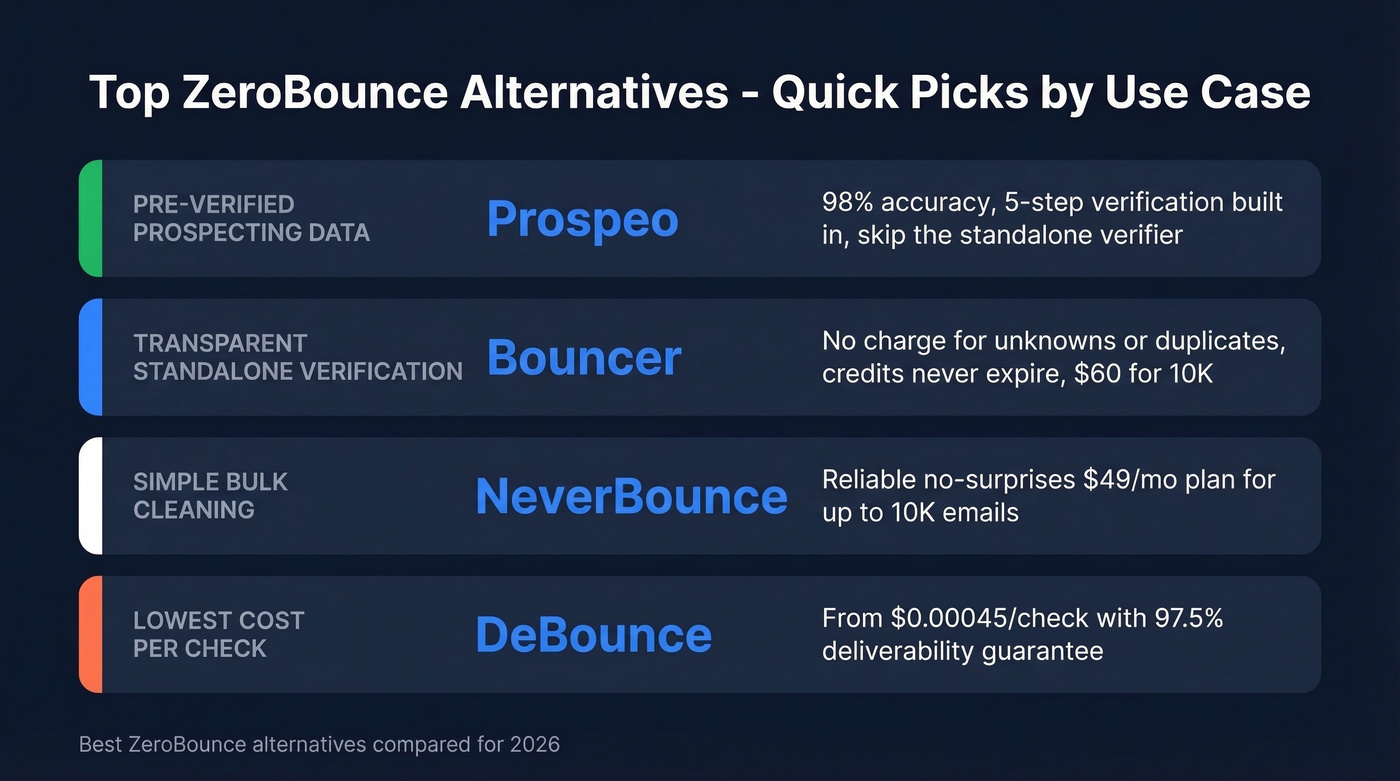
Quick Picks
| Use Case | Pick | Why |
|---|---|---|
| Pre-verified prospecting data | Prospeo | 98% email accuracy with 5-step verification built in - skip the standalone verifier entirely |
| Transparent standalone verification | Bouncer | No charge for unknowns or duplicates, credits never expire, $60 for 10K |
| Simple bulk cleaning | NeverBounce | Reliable, no-surprises $49/mo plan for up to 10K emails |
| Lowest cost per check | DeBounce | From $0.00045/check with 97.5% deliverability guarantee |
Best ZeroBounce Alternatives in 2026
Prospeo
Use this if you're prospecting and verifying in the same workflow. Prospeo's 300M+ professional profiles and 143M+ verified emails come pre-verified through a 5-step process that includes catch-all handling, spam-trap removal, and honeypot filtering. You're not buying a list and then paying a separate tool to clean it - the verification happens at the source.
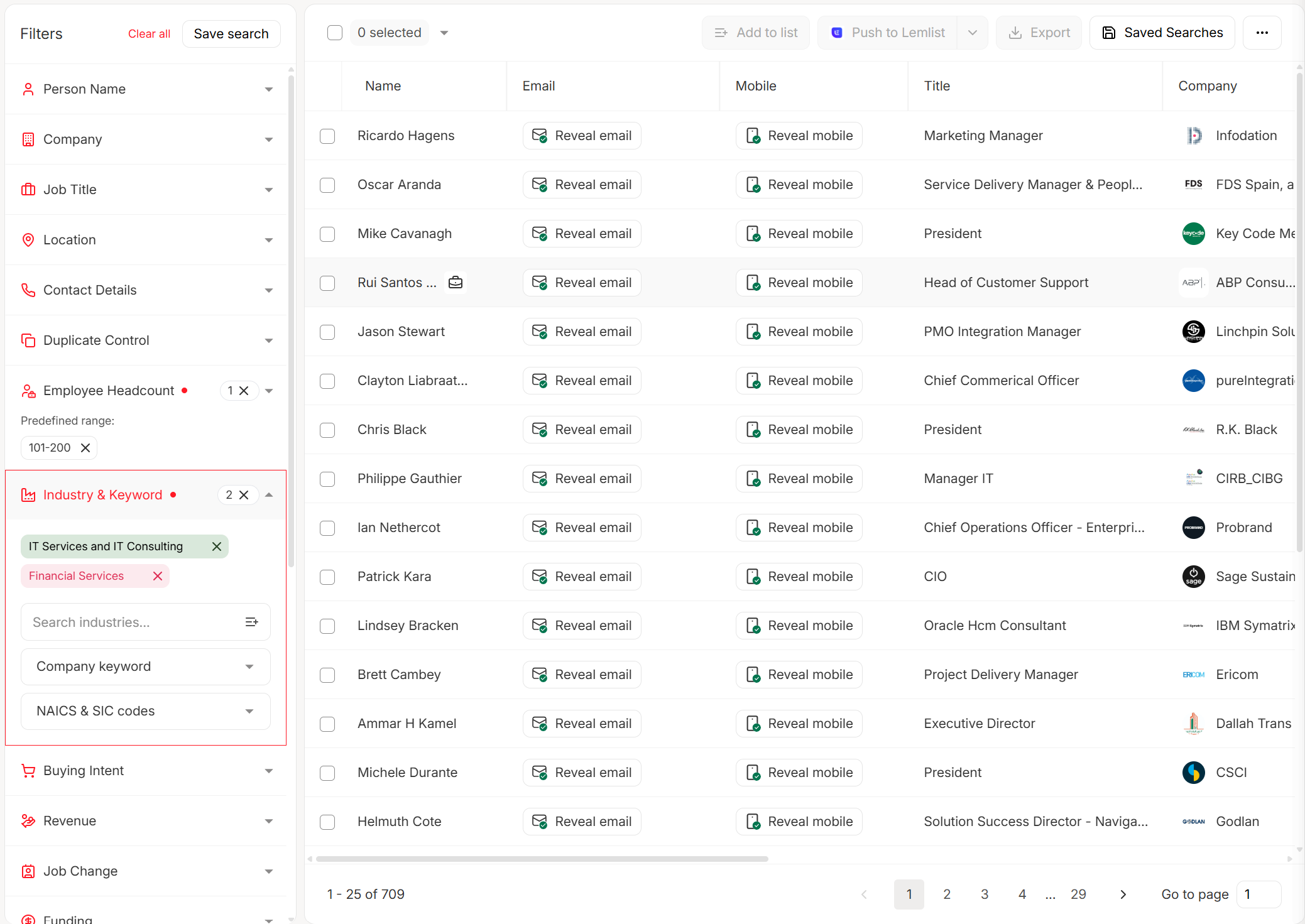
Snyk moved 50 AEs onto Prospeo and saw bounce rates drop from 35-40% to under 5%, with AE-sourced pipeline up 180%. Data refreshes every 7 days - compared to the 6-week industry average - so contacts who changed jobs last month don't sit in your list rotting. That freshness gap matters more than most people realize, and we'll come back to it later.
The free tier gives you 75 emails and 100 Chrome extension credits per month. Paid plans run about $0.01 per email with native integrations into HubSpot, Salesforce, Instantly, Lemlist, and Smartlead. For teams that are both finding and verifying contacts, this replaces two tools with one.
Skip this if you already have a clean list from another source and just need a standalone verifier.
Bouncer
Bouncer's "no charge for unknowns" policy should be the industry standard, not a differentiator. The fact that it is a differentiator tells you everything about how most verifiers think about billing.

Pricing is straightforward: $60 for 10,000 credits, credits never expire, and they don't charge for unknown results or duplicates. When ZeroBounce charges double credits for catch-all scoring, you're paying extra for ambiguity. Bouncer returns unknowns as unknowns and doesn't bill you for the privilege. It's EU-based, GDPR-compliant, with a deliverability kit add-on at $25-$250/mo for inbox placement testing and blocklist monitoring.
In community discussions, Bouncer gets recommended by practitioners who've been burned by hidden verification costs. One Reddit thread on cheaper alternatives features a user calling out MillionVerifier's misses and looking for a tool with similar accuracy and better API access. Bouncer keeps coming up in those conversations.
Skip this if you need an all-in-one platform with email finding and sequences. Bouncer is verification-only - pair it with a prospecting tool.
NeverBounce
On Reddit, NeverBounce is the tool practitioners actually name when someone asks "what do you use for verification?" It ranks above MillionVerifier in practitioner threads, and the reason is simple: it works without surprises.
Pricing is easy to understand - $0.008 per credit on pay-as-you-go, or $49/mo for up to 10,000 emails on the Growth plan. One caveat: credits expire after 12 months. If you're verifying quarterly or less frequently, that expiry clock will bite you. For teams running regular campaigns, it's a non-issue. For infrequent users, Bouncer's never-expire credits are the better fit.
If you're also tightening your outbound stack, pair verification with better email deliverability fundamentals so you’re not “fixing” problems downstream.
DeBounce
Starting at $0.00045 per check, DeBounce is the cheapest per-verification option on this list by a wide margin. You get 100 free credits on signup, credits never expire, and the API is included at every tier - no separate pricing tiers to navigate. They back it with a 97.5% deliverability guarantee and claim 10,000 emails verified in 10 minutes. The 4.8/5 Trustpilot rating across 1,340 reviews suggests the guarantee isn't empty.
For high-volume teams where cost-per-check is the primary decision driver, DeBounce is the obvious pick.
If you’re trying to reduce bounces systematically, it helps to track your email bounce rate and treat it like a KPI, not a one-off cleanup task.
Clearout
Clearout sits in the middle of the market - not the cheapest, not the most feature-rich, but flexible. The Starter plan runs $23/mo for 3,000 credits, Pro is $58/mo for 10,000, and unused credits roll over. A Sparkle test of 2,500 emails returned 88% valid, 7% invalid, and 5% catch-all. Reasonable numbers, though the 26-minute processing time for that batch size suggests speed isn't Clearout's priority. Worth a trial for mid-market teams that want subscription flexibility with rollover.
MillionVerifier
The budget play - with a catch. At $37 for 10,000 credits, MillionVerifier undercuts nearly everyone. You get 500 free credits to start, and they refund credits for catch-all/risky emails rather than attempting to verify them.
Here's the thing: saving $23 over Bouncer means nothing if it misses obvious invalids. In a Reddit post from someone switching from ZeroBounce, the user reported MillionVerifier failing to flag unregistered domains and invalid TLDs - emails that any verifier should catch. If you're budget-constrained and willing to stack a second verifier for edge cases, MillionVerifier works. As your only line of defense, it's risky.
Emailable
Emailable's billing model is genuinely fair: 250 free credits, credits never expire, unknowns get credited back, and subscriptions save 15% over pay-as-you-go. Expect roughly $0.003-0.006 per email at mid-volume tiers.
The catch is that deliverability features eat credits fast. Inbox reports cost 100 credits each and blocklist monitors run 5 credits per check. If you're only verifying, the economics are solid. When you want the full deliverability suite, budget accordingly.
If you’re comparing verification tools more broadly, see our breakdown of Bouncer alternatives for more verification-only options.
Snov.io
Snov.io bundles email finding, verification, and drip campaigns into one platform at $0.0085 per verification. The 50+ free monthly verifications let you test the workflow. It covers the full outbound workflow but won't match dedicated verifiers on accuracy or dedicated finders on database depth. Best for small teams that want everything in one dashboard and don't need the deepest verification engine.
If you’re building a full outbound workflow, it’s worth comparing outbound lead generation tools alongside verifiers.
Kickbox
Enterprise-leaning verifier with strong API documentation and pricing around $0.008/email. Best for dev teams building verification into custom workflows rather than using a UI. Skip this if you're not building custom integrations - the UI isn't the selling point.
Verifalia
Developer-first API with configurable quality levels, a small free daily allowance, and paid plans from around EUR 8/month. Niche pick for low-volume or API-heavy use cases where granular control matters more than throughput. Skip this if you need bulk processing - Verifalia is built for precision, not volume.
Pricing Compared
Here's what you'd pay at 10K and 100K volumes - the two benchmarks that matter for most teams. These are based on common published tiers; some tools discount heavily at higher volumes.
| Tool | Cost / 10K | Cost / 100K | Free Tier | Credits Expire? |
|---|---|---|---|---|
| ZeroBounce | $75 | $750 | 100/mo | Never |
| NeverBounce | $80 | $800 | Free trial | 12 months |
| Bouncer | $60 | $400 | None | Never |
| DeBounce | ~$4.50 | ~$45 | 100 credits | Never |
| MillionVerifier | $37 | ~$370 | 500 credits | Never |
| Clearout | $58 (Pro) | Custom | 100 lifetime | Never (roll over) |
| Emailable | ~$50 | ~$400 | 250 credits | Never |
| Snov.io | $85 | $850 | 50+/mo | Plan-based |
| Kickbox | ~$80 | ~$800 | 100 credits | Never |
| Verifalia | From ~EUR 8/mo | Custom | Free daily credits | Plan-based |
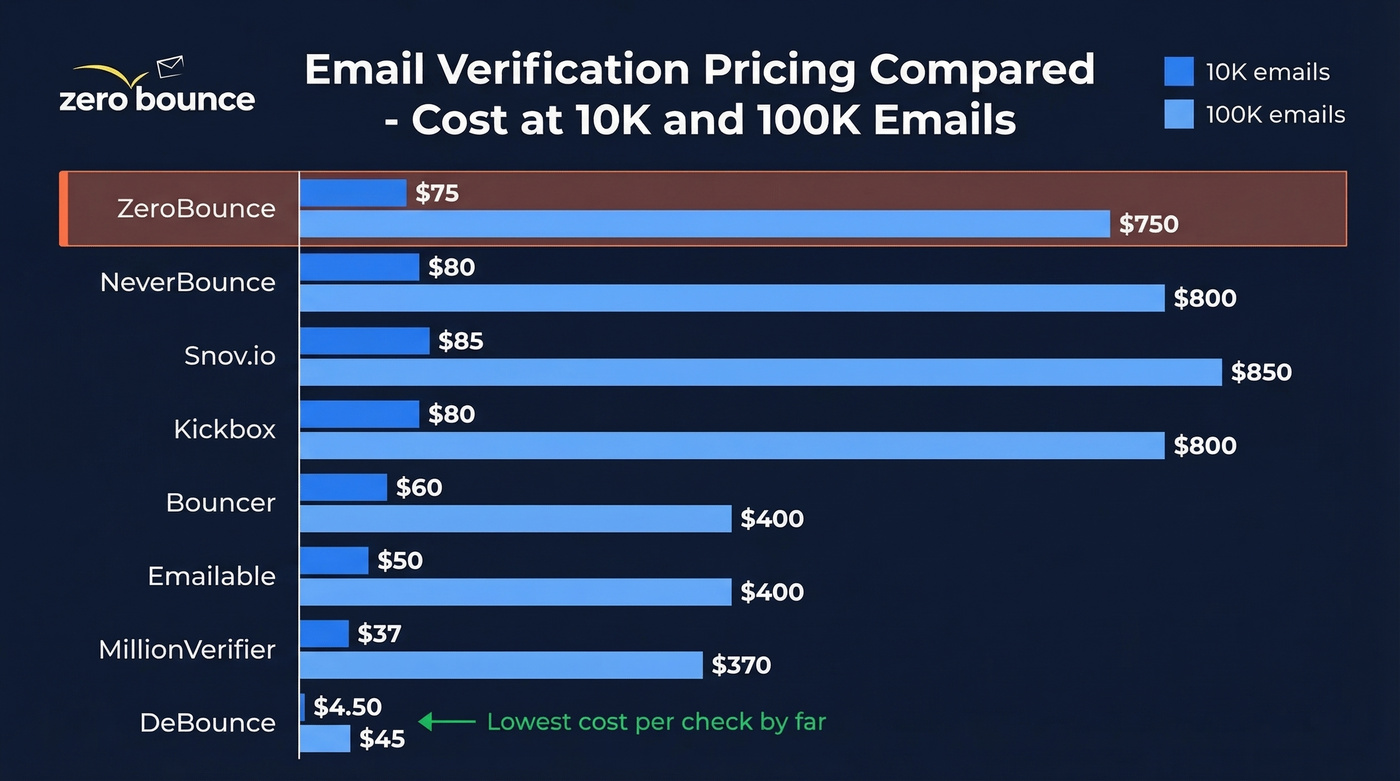
DeBounce is the clear winner on pure cost-per-check. Bouncer offers the best value at scale among standalone verifiers with transparent billing.
Let's be honest: if your average deal size is modest - say sub-$10K contracts - you probably don't need ZeroBounce-level pricing. A tool like Bouncer or DeBounce paired with a quality data source will get you 95% of the way there at a fraction of the cost.

ZeroBounce charges double credits for catch-all domains. Prospeo eliminates the problem entirely - 143M+ emails come pre-verified through 5-step verification with catch-all handling, spam-trap removal, and honeypot filtering built in. No separate verifier needed.
Stop cleaning lists you shouldn't have to clean.
How Catch-All Handling Differs
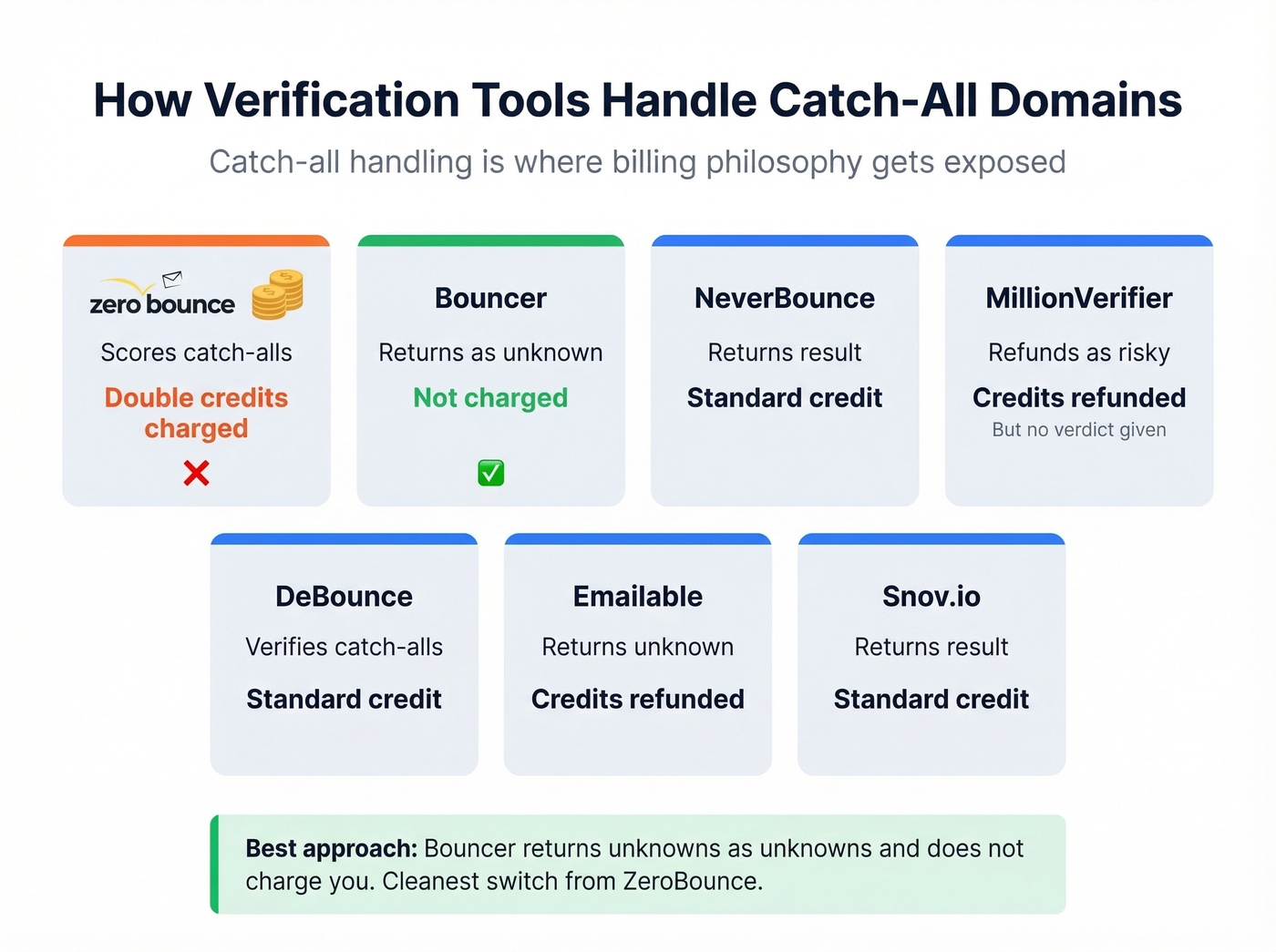
Catch-all domains are where verification tools reveal their true billing philosophy. ZeroBounce charges double credits - one for the initial check, another for AI scoring. That's the specific pain point driving most people to look for alternatives.
| Tool | Catch-All Approach | Charged? |
|---|---|---|
| ZeroBounce | Scores catch-alls | Double credits |
| Bouncer | Returns as unknown | Not charged |
| NeverBounce | Returns result | Standard credit |
| MillionVerifier | Refunds as "risky" | Credits refunded |
| DeBounce | Verifies catch-alls | Standard credit |
| Emailable | Returns unknown | Credits refunded |
| Snov.io | Returns result | Standard credit |
Bouncer's approach is the most transparent - unknowns come back as unknowns, no charge. MillionVerifier refunds the credits but doesn't give you a verdict, which means you still don't know if the email works. If catch-all handling is your primary frustration, Bouncer is the cleanest switch.
Why Your Data Source Matters More
Most guides compare 10 verification tools as if the only variable is the verifier. In our experience, the bigger variable is where your emails came from in the first place.
If your contact data is 6 weeks old, even perfect verification won't prevent bounces when people change jobs. We've seen teams stack two verifiers and still hit 8-10% bounce rates because the underlying data was stale. The consensus on r/sales backs this up - one practitioner noted that using multiple providers works better than relying on one, but even that's a band-aid if the source data is decaying.
If you’re sourcing contacts from multiple places, consider adding data enrichment services to standardize and refresh records before verification.
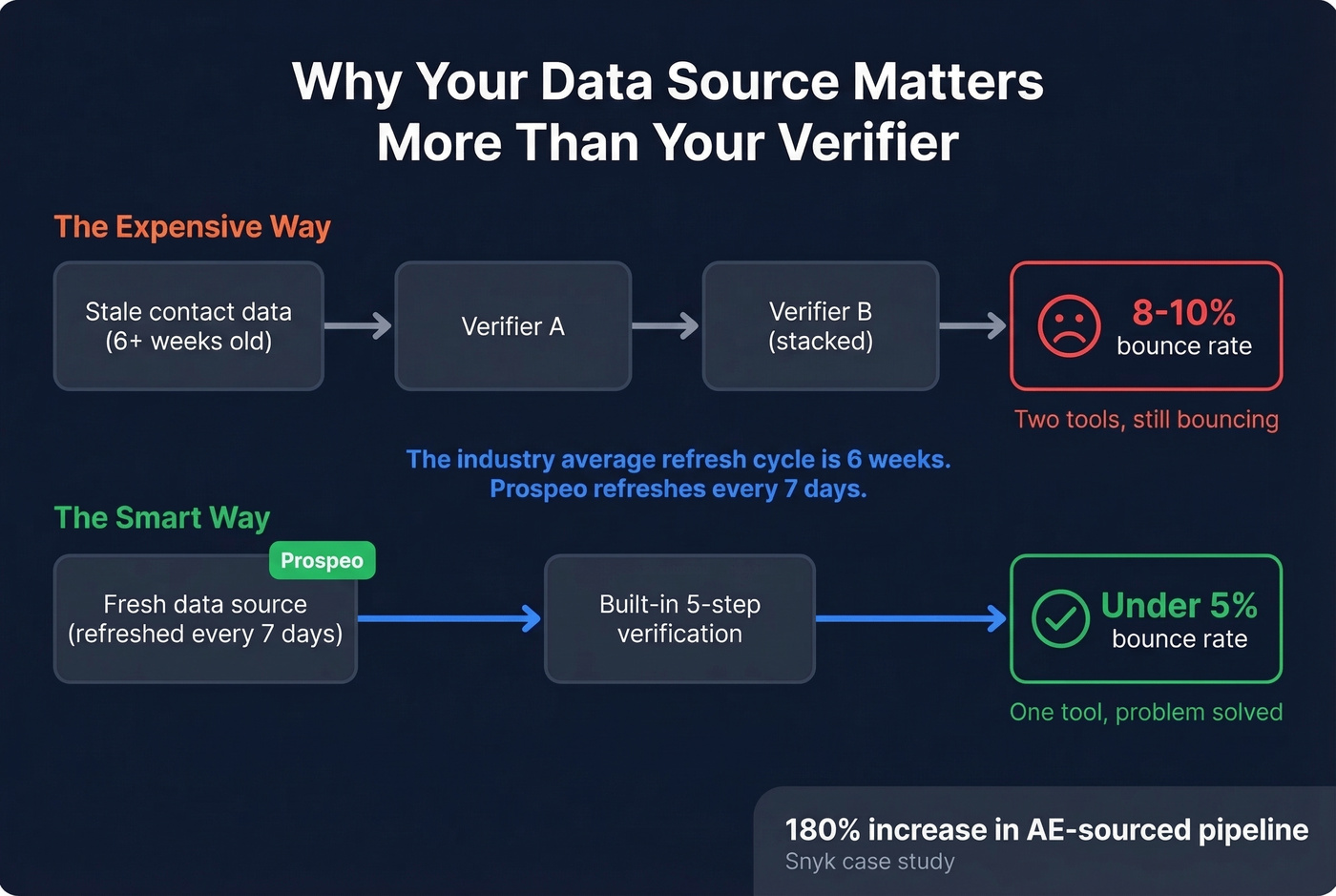
If you're spending $400/year on a verifier to clean data from a source that refreshes monthly, you're solving the wrong problem. Fix the data source first, then pick a verifier.
How to Migrate from ZeroBounce
Switching verifiers doesn't need to be a project:
- Export your ZeroBounce lists. Results often download as a zip with multiple CSVs, not a single clean file. Budget 10 minutes for cleanup.
- Run a small batch first. Take 500-1,000 emails from your last ZeroBounce verification and re-verify them with your new tool. Compare results side by side.
- Check for discrepancies. If your new tool flags 5%+ of ZeroBounce's "valid" emails as invalid, investigate before committing.
- Swap API keys in your ESP, CRM, or Zapier workflows. Most verifiers use similar REST API patterns, so migration is usually a key swap, not a rebuild.
- Monitor bounce rates for 2-4 weeks. Track deliverability closely after switching. If bounce rates spike, you'll know within the first few sends.
If you’re also improving outbound performance, tighten your sales prospecting techniques so you’re not scaling bad targeting with “clean” emails.
Snyk's 50 AEs dropped bounce rates from 35-40% to under 5% with Prospeo - no standalone verifier in the stack. Data refreshes every 7 days, so you're never emailing contacts who left three weeks ago. At $0.01 per email, that's 90% cheaper than stacking a finder plus a verifier.
Replace your finder and your verifier with one tool.
FAQ
Is there a free alternative to ZeroBounce?
Several tools offer free tiers: MillionVerifier gives 500 credits, Emailable offers 250, and Clearout provides 100 lifetime credits. Prospeo's free tier - 75 emails/month with built-in 5-step verification - is the most generous for teams that also need to find contacts, not just verify them.
Does ZeroBounce charge for catch-all emails?
Yes. ZeroBounce charges double credits for catch-all scoring: one credit for the initial verification, another for the AI scoring pass. Bouncer doesn't charge for unknown results at all, making it the cleanest switch for catch-all-heavy lists.
What's the cheapest email verifier?
DeBounce starts at $0.00045 per check - the lowest per-verification cost available. MillionVerifier is also budget-friendly at $37 for 10,000 credits, though Reddit users have flagged accuracy gaps with unregistered domains and invalid TLDs.
Can I use multiple verification tools together?
Yes, and some practitioners recommend it. Running a list through two verifiers catches edge cases one tool might miss. That said, using a data source with built-in verification reduces the need for stacking since contacts arrive pre-verified.
How accurate is ZeroBounce?
ZeroBounce scores 4.7/5 on G2 with 1,361 reviews and 434 mentions praising accuracy. But 54 reviewers specifically cite inaccuracy - valid emails flagged as invalid. No verifier is 100% accurate, which is why data freshness matters as much as the verification algorithm itself.