

The 30-60-90 Day Plan for Sales Managers (2026 Guide)
Replacing a sales rep costs somewhere between $97,000 and $115,000 when you factor in recruiting, onboarding, lost productivity, and the revenue gap while the seat sits empty. Most 30-60-90 day plans won't help you avoid that fate - they're written for reps, not managers. Your job isn't to hit personal activity metrics. It's to build a system that makes an entire team produce.
This guide walks through a complete 30-60-90 day plan for sales manager roles - whether you're onboarding into a new position or presenting one in an interview.
The Quick Version
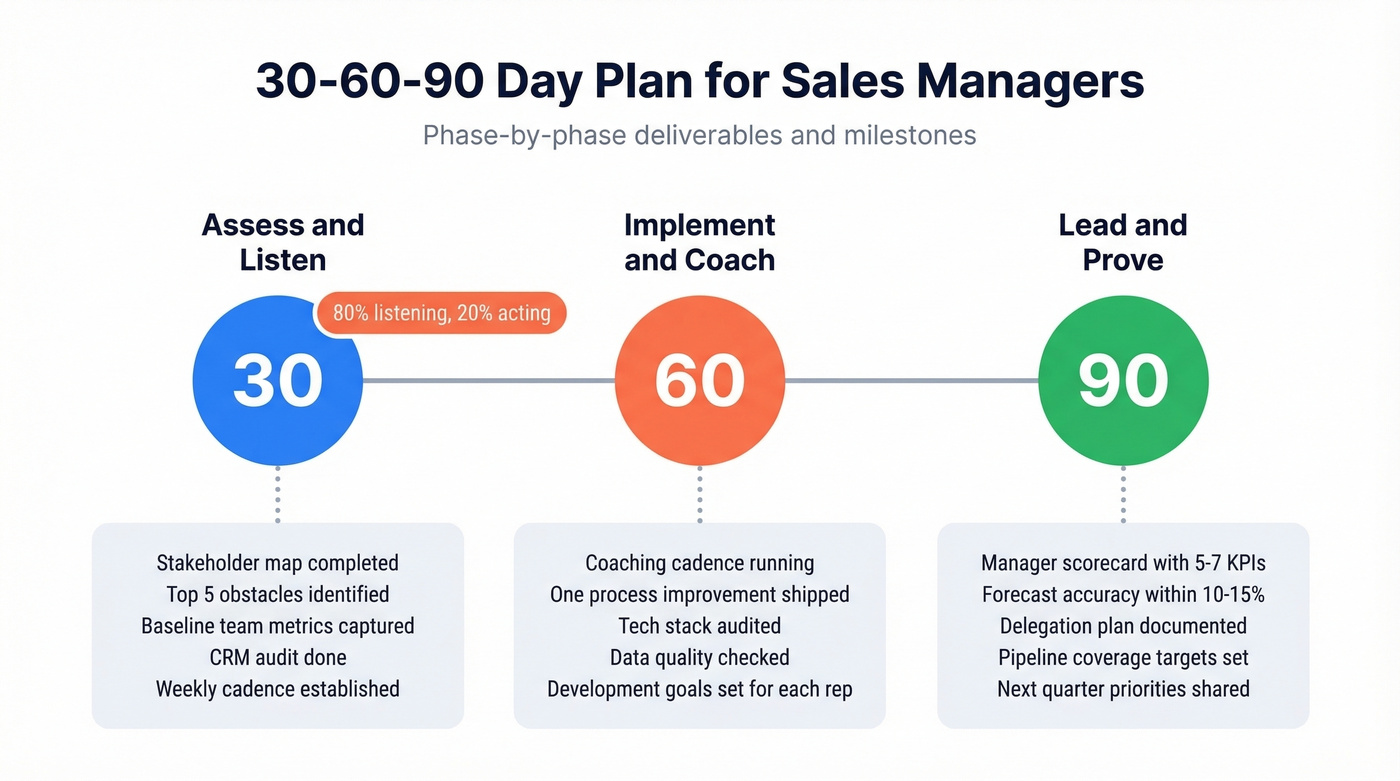
- Days 1-30: Listen, map stakeholders, audit the pipeline. Change nothing yet.
- Days 31-60: Build your coaching cadence, audit the tech stack and data quality, implement one process improvement.
- Days 61-90: Deliver a working forecast, a manager scorecard, and a delegation plan.
- Track 5-7 metrics, not 25. If it doesn't fit on one page, it's not a priority.
- Presenting this in an interview? Lead with a SWOT slide and skip the activity metrics - you're not a rep anymore.
Why a Sales Manager's Plan Differs From a Rep's
A rep's 30-60-90 plan is about personal ramp: learn the product, make calls, close a deal. A manager's plan is about building the machine that produces revenue at scale. The deliverables are fundamentally different. (If you need the rep version, see our 30-60-90 day plans.)
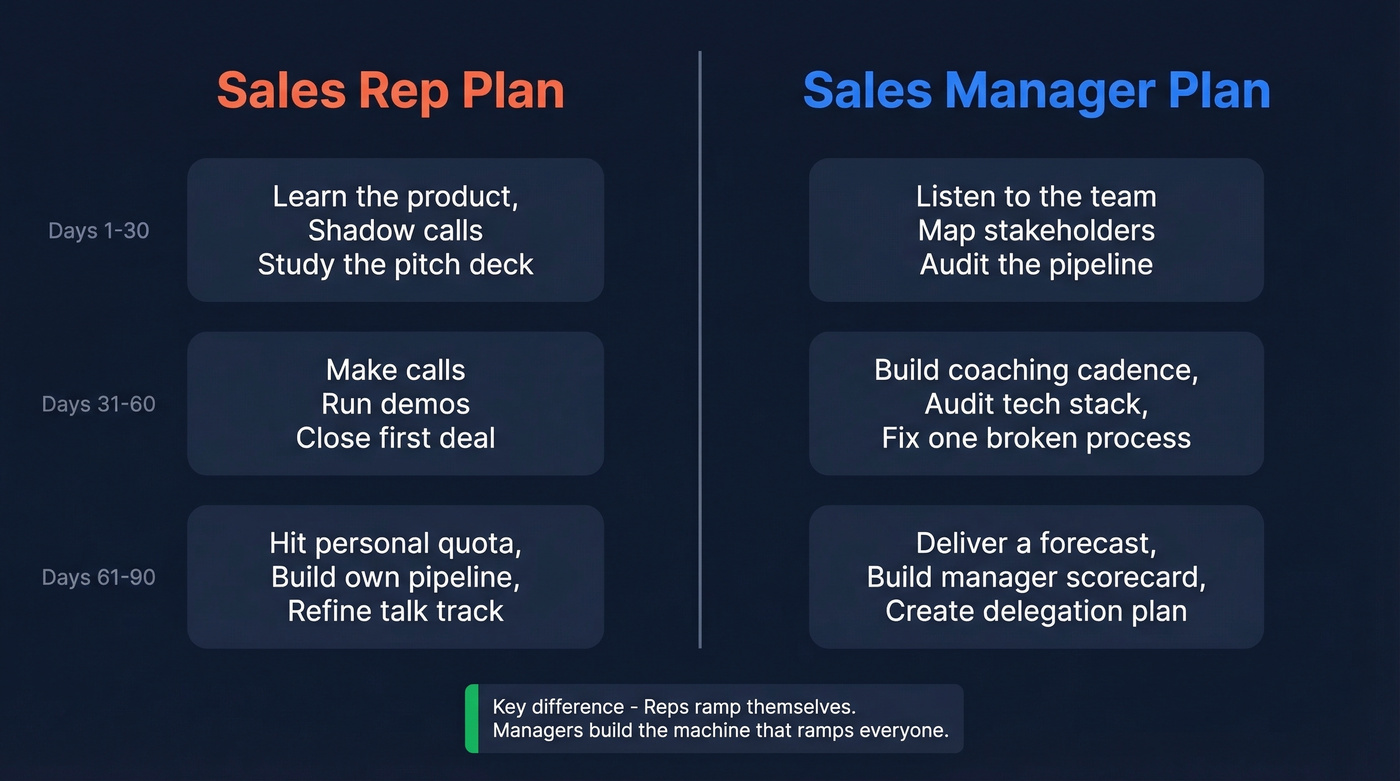
Your core responsibilities as a new manager break into five buckets: setting direction and priorities, building systems and routines, developing talent and performance, communicating up/down/across the org, and removing obstacles. None of those involve personally running discovery calls.
There's also a critical fork most guides ignore. If you're inheriting an existing team, Phase 1 is almost entirely listening and trust-building. If you're building from scratch, Phase 1 includes hiring and onboarding - which changes the entire timeline. Know which scenario you're walking into before you write a single deliverable.
The Three Phases
Days 1-30: Assess and Listen
The single most important rule for your first month: 80% listening, 20% acting. Change nothing yet. You don't have enough context, and premature changes destroy trust with a team that's already nervous about the new boss.
Run structured 1:1s with every direct report. Ask these questions:
- What's going well?
- What's frustrating?
- What should we stop doing?
- What should we start?
- What do you need from me?
- What are your goals for the next 3-6 months?
Write down the answers. You'll reference them for months. These initial conversations also help you build a 1:1 meeting action plan for each rep - a running document of commitments, blockers, and development items you'll revisit every week.
Your Day 30 deliverables: a stakeholder map identifying allies and blockers, a top-5 obstacles list with named owners, and baseline team metrics covering conversion rates, pipeline value, average deal size, and win rates. You should also complete a CRM audit flagging stale deals and contacts that haven't been updated in far too long, plus establish a provisional weekly team cadence.
Here's the thing: new managers often try to "fix people" when the real issue is broken workflows, bad handoffs, or misaligned incentives. Map how work actually gets done before you decide what's broken.
Days 31-60: Implement and Coach
Now you've earned enough context to start making changes - but surgically, not wholesale. Pick one process improvement and execute it well. Trying to overhaul everything simultaneously is the fastest way to lose your team's confidence.
Build your weekly operating rhythm: 1:1s with each rep for 30 minutes, a 60-minute team pipeline review, and deal reviews for your top 5-10 opportunities every two weeks. Set development goals for each direct report based on what you learned in Phase 1. A development goal isn't "get better at discovery." It's "Ask 3+ open-ended questions per discovery call by Day 45, measured via call recording review." Clarify decision rights using a RACI or DRI framework so everyone knows who owns what.
This is also when you audit the tech stack. The AI sales tools market hit $3B in 2025, and sellers who effectively partner with AI are 3.7x more likely to meet quota. But most teams are drowning in tools they barely use. Your job isn't to add more - it's to figure out what's actually driving pipeline and cut the rest.
One concrete deliverable that pays for itself immediately: a data quality audit. Pull your CRM contacts and check bounce rates. We've seen teams discover that a huge chunk of their contact database is stale or invalid, and reps are burning hours chasing dead leads without realizing it. Tools like Prospeo can verify emails at 98% accuracy on a 7-day refresh cycle, and the free tier lets you test on your first 75 contacts without a procurement request. (If you want a deeper benchmark-and-fix breakdown, start with bounce rates and email deliverability.)
One of the most common questions about these plans: what KPIs do you include when you don't have internal data yet? Focus on process metrics like cadence adherence and pipeline audit completion for Phase 1, then shift to outcome metrics like forecast accuracy and coverage ratio by Phase 3.

Days 61-90: Lead and Prove
By Day 61, you should be shifting from learning mode to leadership mode. The organization is watching to see if you can forecast, delegate, and drive results through your team - not through personal heroics.
Your Day 90 deliverables:
- Manager scorecard with 5-7 metrics you'll review weekly
- Forecast accuracy within +/-10-15% at the commit level - one of the main metrics your VP of Sales will judge you on (see sales forecasting tools)
- Delegation plan - explicitly document what you'll stop doing yourself and hand to your team or cross-functional partners
- Pipeline coverage targets - 3-4x for SMB/mid-market, 4-6x for enterprise (use a pipeline health lens)
- Next-quarter priorities written and shared with leadership
Block 2 hours per week for your own development - industry reading, peer manager groups, or leadership coaching. Your team's ceiling is your ceiling.
For quota ramp expectations, a reasonable trajectory is 25% of quota in month 1, 50% by month 2, 75% by month 3, and full quota by months 4-5. The average rep ramp is 5.3 months - if your team's significantly slower, that's a coaching or enablement problem to diagnose.

Your Phase 2 data quality audit shouldn't take weeks. Upload your CRM contacts to Prospeo and instantly see how much of your pipeline is built on stale or invalid emails. 98% accuracy, 7-day refresh cycle, and 75 free verifications - no procurement needed.
Run your first CRM audit in minutes, not sprints.
Sales Manager KPI Dashboard
Track these metrics weekly. If you're tracking more than seven, you're tracking noise.
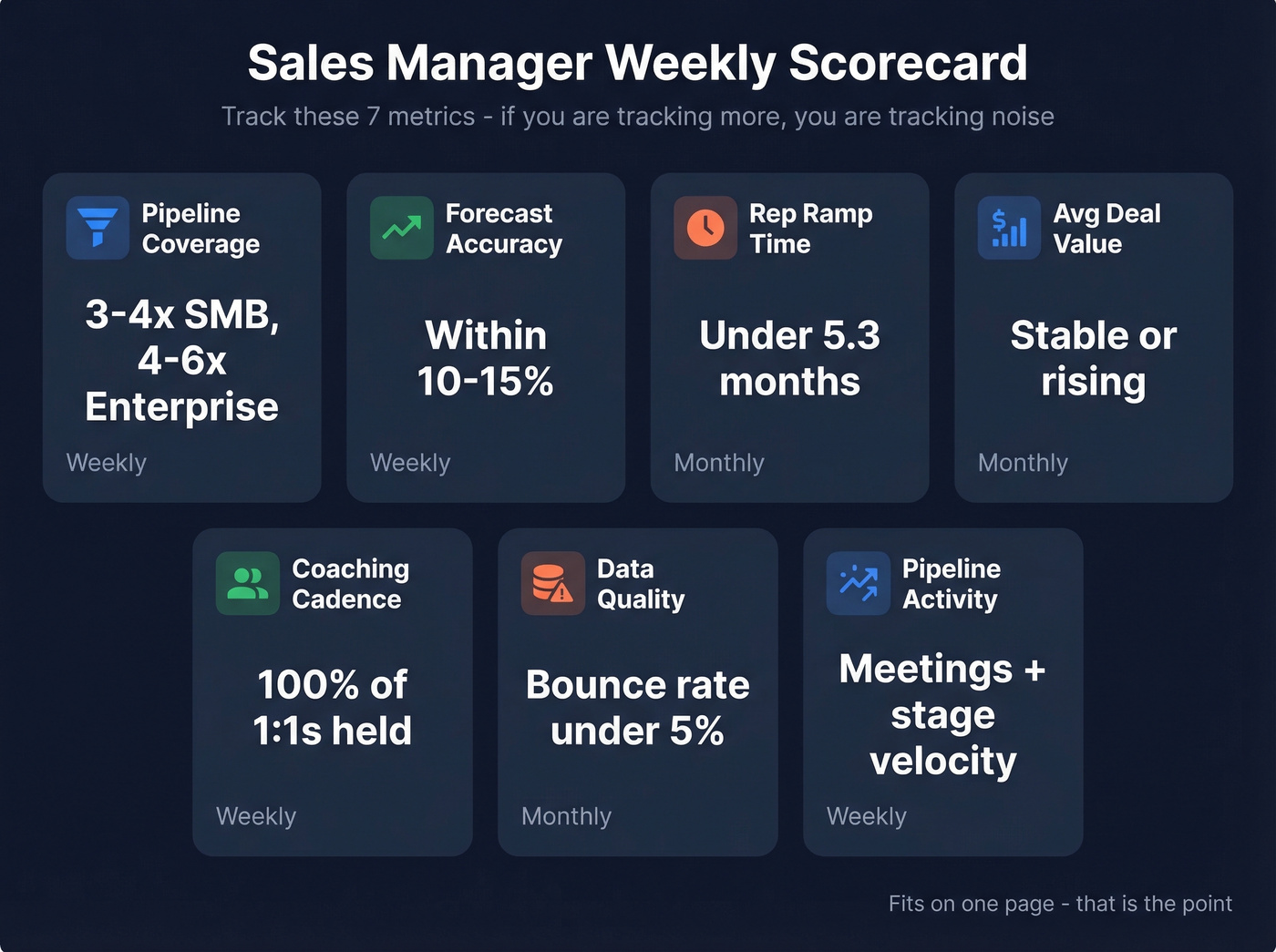
| Metric | Target | Frequency |
|---|---|---|
| Pipeline coverage | 3-4x (SMB), 4-6x (ent.) | Weekly |
| Forecast accuracy | +/-10-15% | Weekly |
| Rep ramp time | < 5.3 months | Monthly |
| Average deal value | Trend stable or rising | Monthly |
| Coaching cadence | 100% of 1:1s held | Weekly |
| Data quality (bounce rate) | < 5% | Monthly |
| Pipeline activity | Meetings + stage velocity | Weekly |
The data quality row matters more than most new managers realize. Reps spend 28-30% of their time actually selling. If a chunk of that limited selling time goes toward contacts that bounce or don't pick up, you're compounding an already painful efficiency problem. (If you're diagnosing why pipeline is stalling, see sales pipeline challenges.)
Presenting Your Plan in an Interview
If you're building a 30-60-90 day plan for a sales manager interview, the rules change. You don't have internal data, so you can't set specific pipeline targets. What you can do is demonstrate strategic thinking.
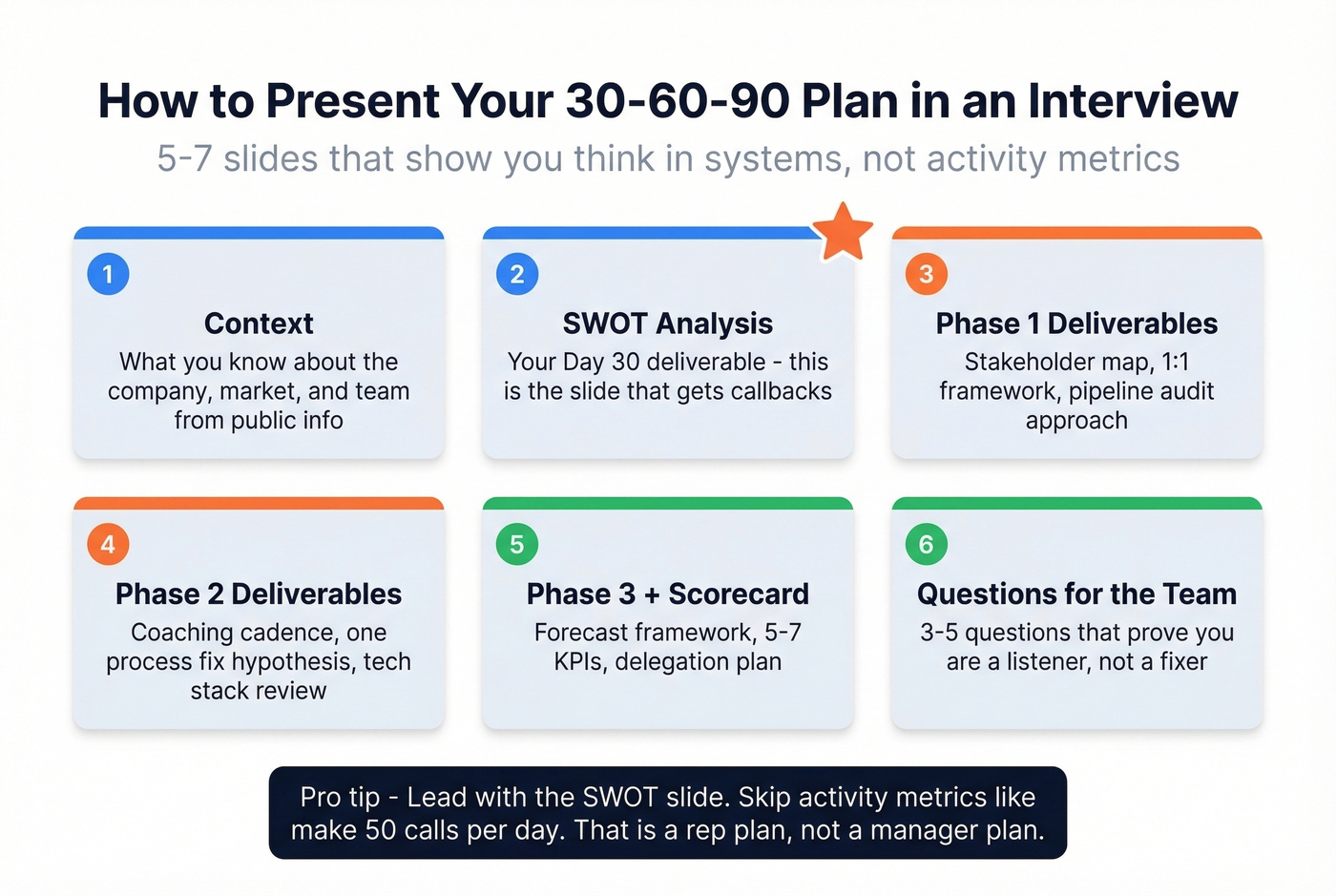
Structure your presentation in 5-7 slides:
- Context - what you know about the company, market, and team from public information
- SWOT analysis - your Day 30 deliverable; shows you think strategically, not tactically
- Phase 1 deliverables - stakeholder map, 1:1 framework, pipeline audit approach
- Phase 2 deliverables - coaching cadence, one process improvement hypothesis, tech stack review
- Phase 3 deliverables + scorecard - forecast framework, 5-7 KPIs, delegation plan
- Questions for the team - not a slide, but prepare 3-5 questions that show you're a listener
In our experience, the SWOT slide is what separates candidates who get callbacks from those who don't. Use the 80/20 rule to frame how you'd evaluate team performance: in most sales orgs, 20% of reps drive 80% of revenue. Your plan should address both groups - accelerating the top performers and diagnosing what's holding back the rest.
Interviewers don't want to see activity metrics like "make 50 calls per day." That's a rep plan. They want to see that you think in systems - coaching frameworks, pipeline governance, cross-functional communication rhythms. (If you want a systems-first lens, see sales leadership.)
Five Mistakes That Get Managers Fired
1. "Random acts of execution." No focused priorities, no sequenced plan - just reacting to whatever's loudest. This is the most common failure pattern for new managers, and it's almost always fatal to credibility.
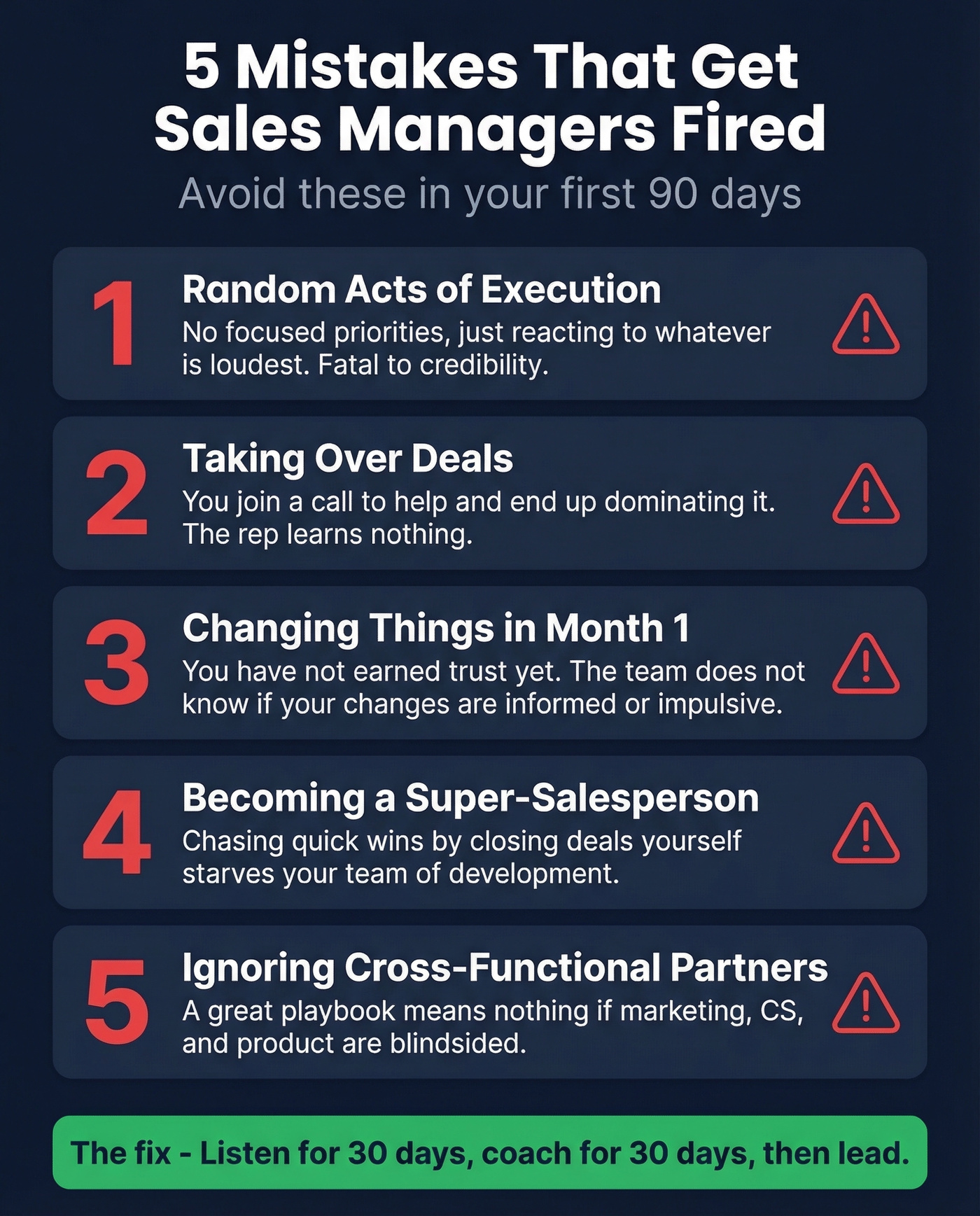
2. Taking over deals instead of coaching. You join a customer call to "help" and end up dominating the conversation. The rep learns nothing. Play the support role. Coach, don't commandeer.
3. Making changes in the first 30 days. You haven't earned trust yet. The team doesn't know if your changes are informed or impulsive. Wait until you've listened enough to make changes that stick.
4. Becoming a "super-salesperson." Chasing quick revenue spikes by personally closing deals feels productive, but it sets unrealistic expectations and starves your team of development. Your job is to build a team that produces without you on every call.
5. Ignoring cross-functional relationships. Look, I've watched a leader build a genuinely strong sales playbook, then cause operational chaos because they never talked to marketing, CS, or product. Schedule weekly 1:1s with cross-functional partners starting in your first month. Bosses hate surprises - and so do the teams that have to clean up after a sales org operating in a silo.
Free 30-60-90 Day Sales Manager Template
This is a manager template, not a rep template. Copy it, customize the targets for your org, and use it as your operating document.
Days 1-30: Assess
| Deliverable | Success Metric |
|---|---|
| 1:1s with all reports | Completed by Day 14 |
| Stakeholder map | Reviewed with your manager |
| Top 5 obstacles list | Owners assigned |
| CRM/pipeline audit | Stale deals flagged |
| Weekly cadence set | First team meeting held |
Days 31-60: Implement
| Deliverable | Success Metric |
|---|---|
| Coaching cadence running | 100% 1:1 adherence |
| Data quality audit | Bounce rate < 5% |
| One process improvement | Metric improved >=10% |
| RACI/DRI documented | Shared with team |
| Dev goals per rep | One measurable goal each |
Days 61-90: Lead
| Deliverable | Success Metric |
|---|---|
| Manager scorecard live | 5-7 metrics tracked weekly |
| Forecast delivered | +/-10-15% accuracy |
| Delegation plan written | Stop doing 2+ tasks |
| Pipeline coverage targets | 3-4x SMB, 4-6x enterprise |
| Next-quarter priorities | Shared with leadership |
Let's be honest about why most managers fail: it's not because they lack sales skills. It's because they never stop selling. If you're still the top closer on your team at Day 90, you haven't done this job. The best sales managers make themselves dispensable on deals and indispensable on strategy. (If you're building the coaching layer, see sales training tips.)
Keeping bounce rates under 5% is on your Day 90 scorecard. Prospeo verifies emails at 98% accuracy for ~$0.01 each - so your reps stop burning hours on dead leads and start hitting the pipeline coverage targets you just set.
Give your team clean data before you ask them to hit quota.
FAQ
How does a sales manager's 30-60-90 plan differ from a rep's?
A manager's plan centers on building systems - coaching cadences, pipeline governance, forecast accuracy, and team development - not personal activity like calls and demos. If your plan reads like an activity tracker, you're thinking about the wrong job.
What KPIs should a new sales manager track by Day 90?
Track seven metrics: pipeline coverage ratio, forecast accuracy within +/-10-15%, rep ramp time with a 5.3-month benchmark, coaching cadence adherence, average deal value, data quality under 5% bounce rate, and pipeline stage velocity. More than seven dilutes focus.
Should I adjust the plan for an inherited team vs. building from scratch?
Yes. With an inherited team, Phase 1 is almost entirely listening and trust-building. Building from scratch means Phase 1 includes hiring and onboarding, which compresses coaching into a tighter Phase 2 window. The core three-phase structure stays the same either way.
How do I clean up bad CRM data during my first 90 days?
Run your contact database through a verification tool during Days 31-45 and target under 5% bounce rate before scaling outbound. Prospeo's bulk verification checks contacts at 98% accuracy with a 7-day refresh cycle - the free tier covers 75 emails so you can audit a sample without budget approval.
Does this framework work for SDR team leaders?
The structure translates, but emphasis shifts toward activity metrics, outbound messaging audits, and prospecting coaching. SDR teams have shorter cycles, so you'll see the impact of Phase 2 changes faster and can iterate more aggressively. The listening-first approach in Phase 1 still applies.