

The 30 Second Elevator Pitch: 6 Examples You Can Steal Right Now
You're at a networking event. Someone asks, "So, what do you do?" Your mind goes blank. You fumble through a rambling answer about your job title, your company, and something vague about "driving cross-functional alignment." By the time you finish, they're already scanning the room for someone else to talk to.
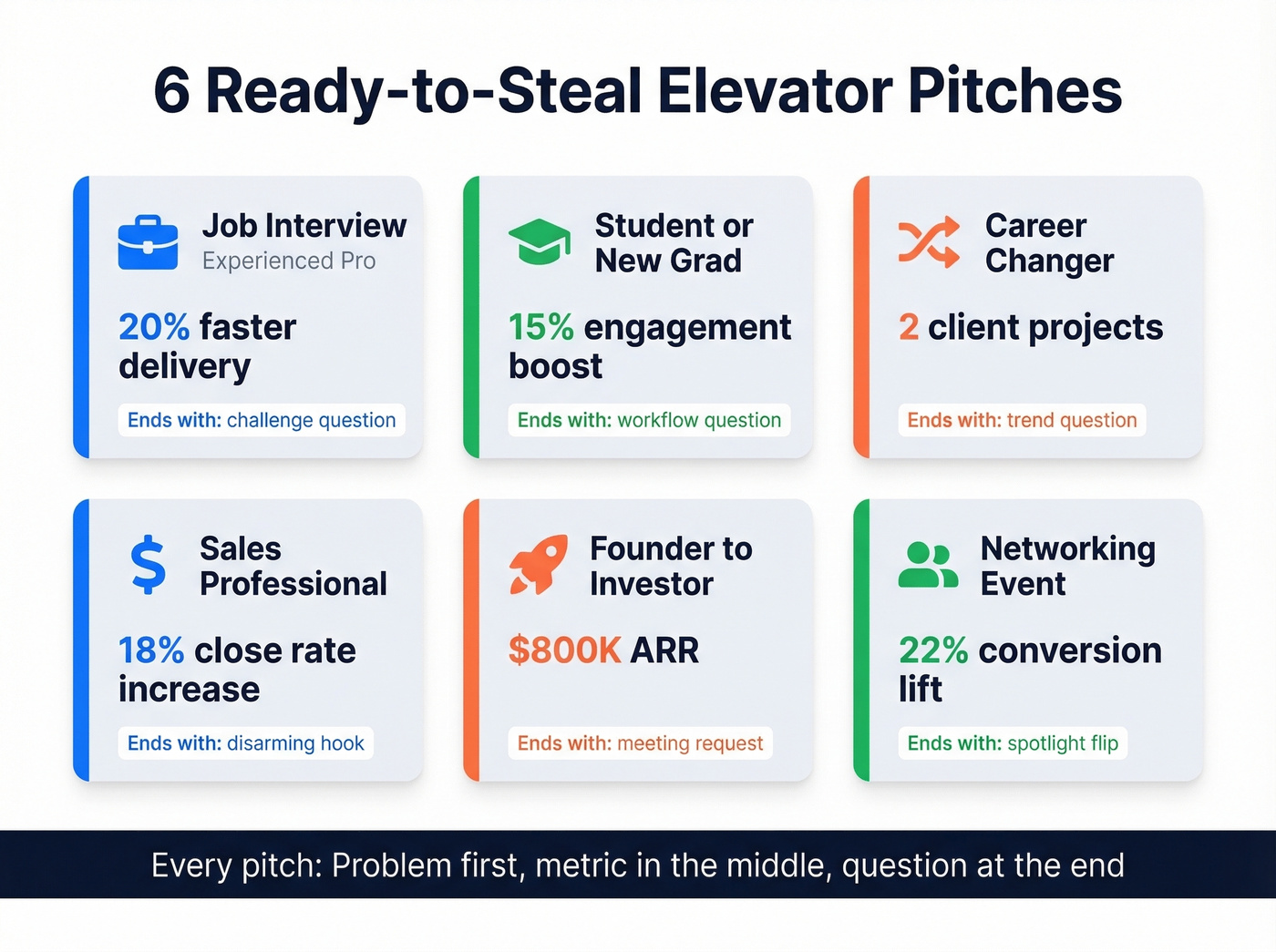
That's the cost of not having a 30 second elevator pitch ready. The often-cited stat puts the average human attention span at around 8 seconds - roughly the time it takes to read this sentence. Your pitch needs to land before that window closes. On Reddit, you'll find panicked posts from people who just got told they need one for tomorrow's sales interview. This article is for them - and for you. Stop overthinking it. It's around 75 words. You've written longer text messages.
What You Need (Quick Version)
Here's everything you need to deliver a solid pitch tonight. The structure is four parts: Hook (8s) → Value (10s) → Proof (7s) → Ask (5s). Your target is 65-85 words at a conversational pace. If it runs longer than 30 seconds, it's not a 30-second pitch.
One you can steal right now for a general professional context:
"Most growing companies lose deals because their sales team can't reach the right decision-makers fast enough. I run revenue operations for a mid-market SaaS company, where I built a prospecting workflow that cut our team's research time by 40% and doubled our qualified pipeline in one quarter. If you're scaling an outbound team, I'd love to compare notes - what's your biggest bottleneck right now?"
That's 68 words. It opens with a problem, delivers a result, and ends with a question that keeps the conversation alive. Copy it, swap in your details, and you're ready.
The checklist:
- 65-85 words (time yourself - conversational pace, not auctioneer speed)
- Opens with a pain point or hook, not your name and title
- Includes one specific, quantified result
- Ends with a question or clear next step
How Many Words Fit in 30 Seconds?
A practical benchmark is 65-85 words. That's 4-6 sentences. Not a lot of room, which is exactly the point.
For a 60-second pitch, you're working with 130-170 words. But context matters more than a stopwatch. In a job interview, "tell me about yourself" often gives you 30-60 seconds. A marketing pitch should land under 30. And those round-robin introductions on video calls? You've got 10-15 seconds - roughly 25-40 words. Know your venue before you write your pitch.
The Structure, Second by Second
A practical framework breaks 30 seconds into four distinct beats:
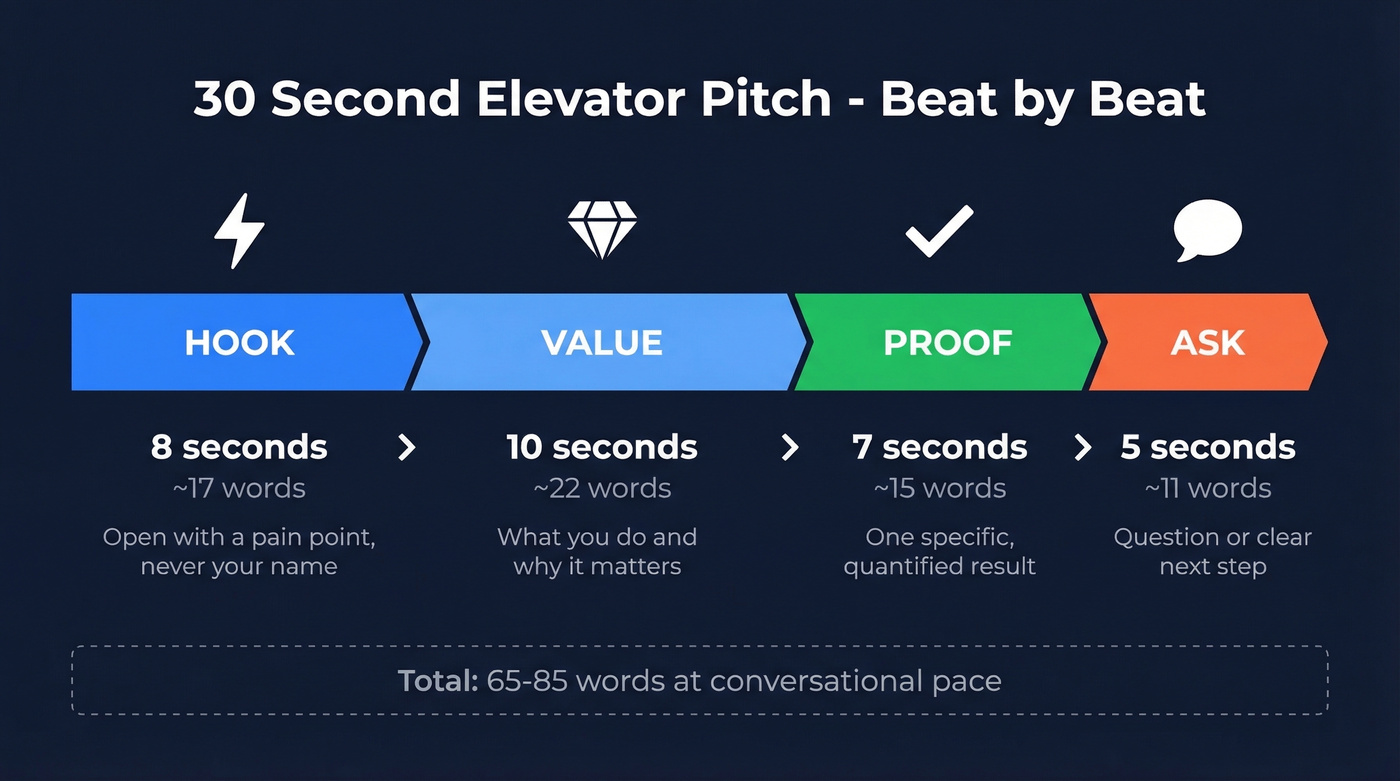
| Beat | Time | Words (~) | Job |
|---|---|---|---|
| Hook / Problem | 8 sec | ~17 | Grab attention with a pain point |
| Solution / Value | 10 sec | ~22 | What you do and why it matters |
| Proof | 7 sec | ~15 | One specific result or credential |
| Ask | 5 sec | ~11 | Question or clear next step |
The single most important rule: never start with your company name - start with the pain point. "I'm Sarah from Acme Corp" tells the listener nothing about why they should care. "Most B2B teams waste 30% of their outreach budget on bad contact data" tells them everything.
Here's a good test borrowed from communication research: can the listener repeat your pitch back in one sentence? If they can't, you've packed in too much. Think of it as distilling your value into a single sentence pitch that anyone could relay to a colleague. The APA's work on research pitching calls this the "curse of knowledge" - you know your work so deeply that you forget what's obvious and what isn't. Strip it down until a stranger could summarize it.

A perfect 30-second pitch is useless if you're delivering it to the wrong person. Prospeo gives you 300M+ profiles with 30+ filters - buyer intent, job changes, technographics - so you pitch decision-makers who actually have the problem you solve. 98% email accuracy means your follow-up lands, not bounces.
Nail the pitch. Nail the prospect list. Start free today.
6 Examples You Can Steal
Every example below is copy-ready. Swap in your specifics, practice it twice out loud, and you're set.
Job Interview (Experienced Professional)
"Companies lose millions when product launches slip behind schedule. I'm a senior project manager with eight years in SaaS, and I specialize in getting cross-functional teams aligned fast. At my last company, I restructured our sprint process and cut delivery time by 20% while boosting team productivity by 30%. I'd love to bring that same approach here - what's the biggest delivery challenge your team faces right now?"
Why it works: Opens with a business problem, not a resume summary. The two metrics give the interviewer something concrete to remember - and something to ask about next.
Student or Recent Graduate
The biggest mistake new grads make is leading with their degree. Nobody cares where you went to school until they care about what you can do.
"I just finished a digital marketing internship at a consumer health startup where I managed their entire social content calendar. I redesigned the posting strategy around audience engagement data and boosted interaction rates by 15% in three months. I'm finishing my marketing degree this spring and looking for a full-time role where I can combine analytics and creative strategy. What does your team's content workflow look like?"
That 15% metric is what separates this from every other entry-level candidate who says "I'm a hard worker." Measure your own impact, even if it's small, and you'll never sound junior.
Career Changer
"I spent six years in financial analysis, building models and translating complex data into executive decisions. Now I'm pivoting into data analytics - I've completed certifications in Python, SQL, and machine learning, and I've already built predictive models for two nonprofit clients. My finance background means I understand what stakeholders actually need from data, not just what's technically interesting. Are you seeing more demand for analysts with business context?"
Transferable skills aren't a consolation prize. They're the selling point.
Sales Professional: The 30-Second Commercial
This one follows Sandler's 4-part commercial structure: who you are, who you help, their pain, and a hook question. In sales circles this format is often called the 30 second commercial reps use to open discovery calls and networking conversations alike.
"I work with VP-level sales leaders at mid-market tech companies. The teams I help are usually dealing with two things: reps spending too much time researching prospects instead of selling, and pipeline numbers that look healthy but don't convert. We've helped teams cut prospecting time in half and increase close rates by 18%. I don't suppose either of those is keeping you up at night?"
The hook question at the end ("I don't suppose...") is disarming. It invites the listener to self-identify without feeling sold to. We've seen this format work especially well in round-robin introductions at sales meetups, where everyone else is reciting their title and company name.
Founder Pitching an Investor
The Hyde Park Angels framework boils the investor pitch down to three questions: What's your business? Why should this person care? What are you asking for?
"B2B sales teams waste $4 billion a year on contact data that bounces. We built a verification engine that checks emails and phone numbers in real time - our customers see bounce rates drop from 35% to under 4%. We're doing $800K ARR with 200% year-over-year growth, and the market's shifting toward data quality right now. I'd love to set up 30 minutes to walk you through the model."
The elevator pitch isn't a compressed pitch deck - it's the first slide. Its job is to get you the meeting, not close the deal. That's why this one asks for 30 minutes, not a check.
Networking Event (Casual)
Most people dread the casual networking pitch because it feels like selling at a dinner party. The trick is to flip the spotlight. In our experience, the pitches that get the best reactions always end by asking about the other person:
"I help companies figure out why their marketing campaigns get clicks but not customers. Basically, I'm the person who looks at the gap between 'people visited our website' and 'people actually bought something' and fixes what's broken in between. Last quarter I helped a DTC brand increase their conversion rate by 22%. What kind of work are you in?"
Zero jargon. No acronyms. And the closing question shifts the spotlight - which is what good networkers do.
Three Frameworks to Build Your Own
If you'd rather build from scratch than adapt an example, these three frameworks give you a reliable skeleton.
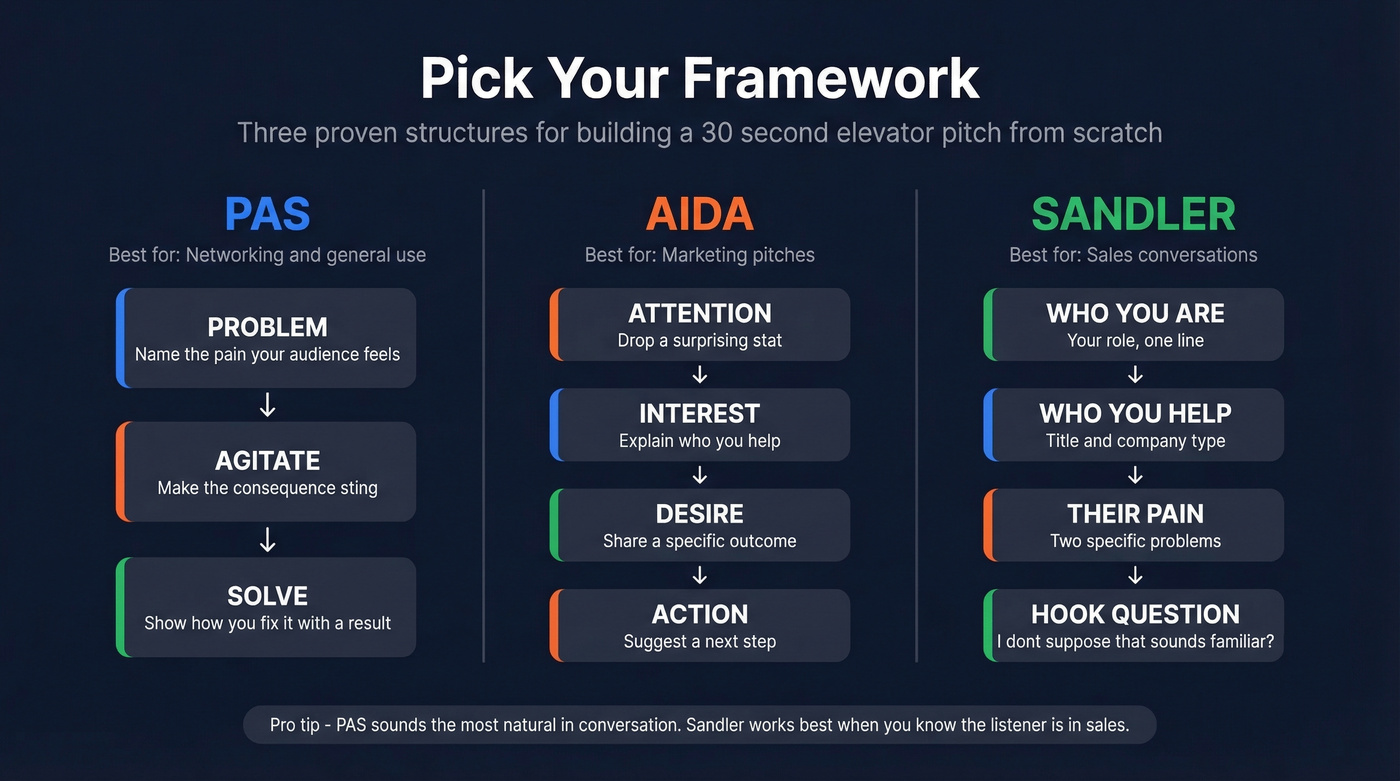
| Framework | Best For | Structure |
|---|---|---|
| PAS | General / networking | Problem → Agitate → Solve |
| AIDA | Marketing / pitches | Attention → Interest → Desire → Action |
| Sandler | Sales conversations | Who you are → Who you help → Pain → Hook question |
PAS (Problem-Agitate-Solve) is the simplest way to keep your pitch listener-focused. Template: "[Audience] struggles with [problem]. That means [consequence - make it sting]. I [solve it by doing X], which [result]." It's one of the most natural-sounding frameworks for casual conversations because it mirrors how people actually tell stories: something's wrong, it's getting worse, here's how I fix it.
AIDA (Attention-Interest-Desire-Action) is more structured and works well when you need to move someone from total stranger to "tell me more" in a single exchange. Template: "Did you know [surprising stat]? I help [audience] achieve [outcome] by [method]. My clients typically see [specific result]. Let's grab coffee and I'll show you how." (If you want to go deeper, map it to a full AIDA sales funnel.)
Sandler's 4-Part Commercial is purpose-built for sales. Template: "I work with [role/title] at [company type]. They're usually dealing with [pain 1] and [pain 2]. We help them [outcome]. I don't suppose any of that sounds familiar?" The hook question is the secret weapon. Variants that work: "Any of those hitting home for you?" or "Who do you know dealing with this?"
Five Mistakes That Kill Your Pitch
1. Talking too long. If your pitch runs over 85 words, it's a monologue. Cut ruthlessly.
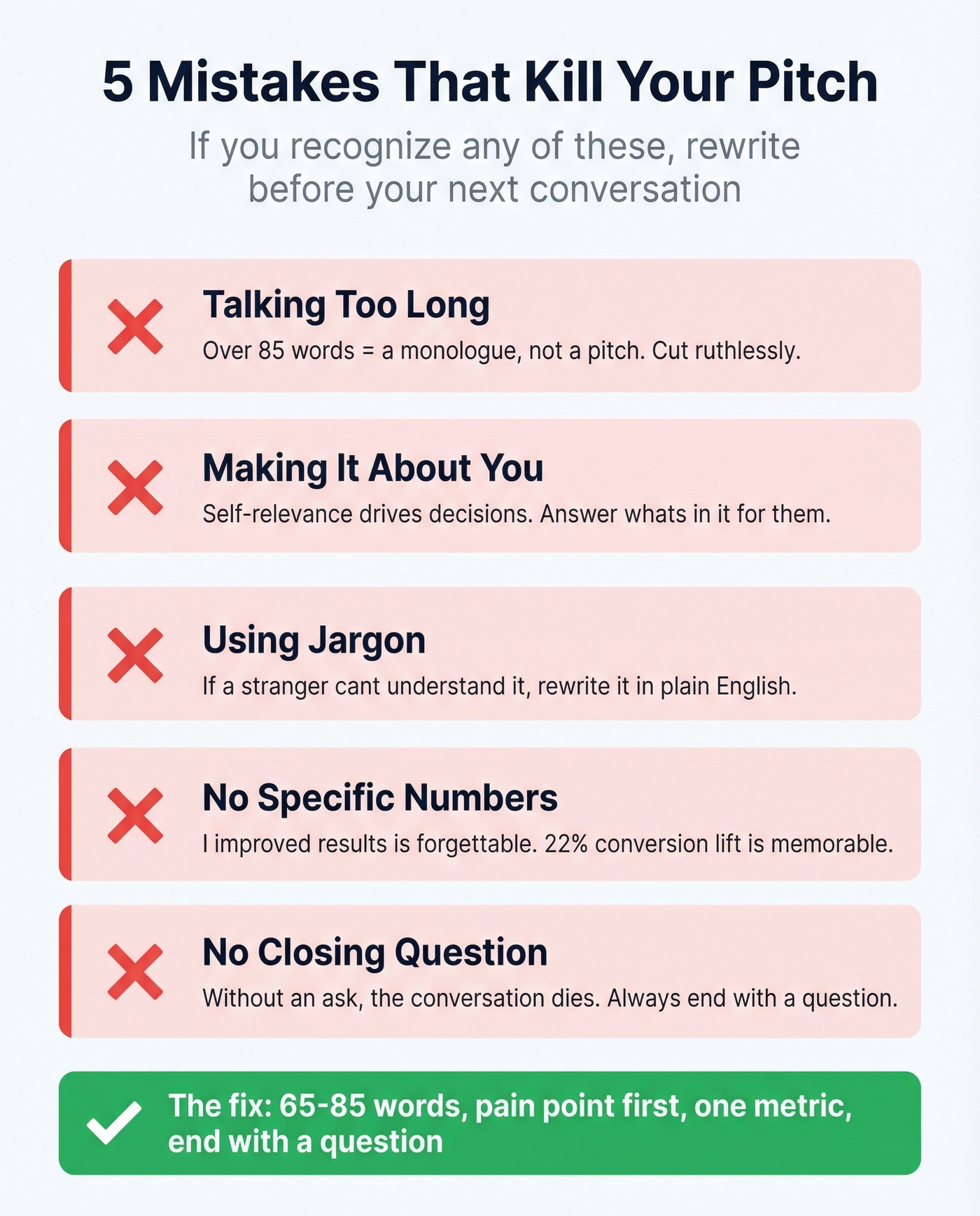
2. Making it about you instead of the listener. Persuasion research consistently shows that self-relevance drives decision-making. Your pitch should answer "what's in it for them," not "here's my resume."
3. Using jargon. A real before-and-after from Antler's pitch guide: "I work on nanotechnology to deliver medical therapies to targeted cells" becomes "We're using the manufacturing techniques of the computer industry to make better vaccines." Same idea. Ten times more accessible.
4. No call to action. A pitch without a next step is just a fun fact about yourself. Always end with a question, a meeting request, or a specific ask.
5. Sounding memorized. Memorize the structure, not the exact script. If you've rehearsed every syllable, you'll sound robotic the moment someone interrupts with a question. I once watched a sales rep at a conference freeze mid-pitch because someone asked a clarifying question and it threw off his word-for-word recitation. Practice enough that the key points flow naturally in any order.
Digital Versions of Your Pitch
Your pitch doesn't just live at networking events. It adapts to three digital channels that matter.
Cold Email Pitch Paragraph
The core value paragraph in a cold email should run 40-70 words. That's your pitch, stripped of pleasantries and compressed for scanning:
"Your SDR team is probably spending 30%+ of their time finding contact data instead of selling. We built a verification engine that cuts that to near-zero - customers typically see bounce rates drop from 35% to under 4% in the first week."
Of course, your pitch is only as good as the inbox it reaches. Before sending cold emails, verify you're reaching a real address. Tools like Prospeo check emails with 98% accuracy, and the free tier gives you 75 verifications a month - enough to test whether your pitch actually lands. (If you're building sequences, pair this with cold email follow-up templates.)
Connection Request Message
Professional networking platforms cap connection messages at around 300 characters. That's roughly 40-50 words. 72% of professionals are more likely to accept a request that includes a personal message, and the baseline acceptance rate sits at 30-40%. Don't skip it.
Your pitch becomes one sentence of context plus one sentence of relevance: "Saw your post on outbound sequencing - we're solving a similar problem for mid-market teams. Would love to connect and compare notes." If you want more options, start from a proven connection email structure.
Virtual Intro (Video Calls)
Round-robin introductions on video calls give you 10-15 seconds. That's 25-40 words. Don't try to cram your full pitch in - deliver the hook and one proof point. Save the rest for when someone follows up in the chat or after the call. Opening with "Let me give you the 10-second version..." signals confidence and respect for everyone's time.
Let's be honest: if your deal sizes are under five figures, you probably don't need a polished investor-style pitch. But you absolutely need a casual networking version and a cold email version. Most people over-invest in the pitch they'll use once a year and ignore the one they need every week. If you're doing outbound, tighten the pitch and then upgrade your sales prospecting techniques so it reaches the right people.
You just read how cutting prospecting time transforms pipeline. Teams using Prospeo cut research time by hours per week and book 26% more meetings than ZoomInfo users - at $0.01 per verified email. That's the kind of metric worth dropping into your next elevator pitch.
Stop researching prospects. Start pitching them.
FAQ
How long should a 30 second elevator pitch be?
Aim for 65-85 words at a natural conversational pace - that's 4-6 sentences. For job interviews where "tell me about yourself" invites a longer answer, stretch to 60 seconds (130-170 words). For virtual round-robin intros, cut to 25-40 words and 10-15 seconds.
What's the difference between a 30- and 60-second pitch?
A 30-second version is the hook - enough to spark interest and earn a follow-up question. A 60-second version adds a deeper proof point and a more specific ask. Always write the shorter version first; expand to 60 only if the context gives you room and the listener is clearly engaged.
How do you start an elevator pitch?
With a pain point, never your name. "I'm Sarah from Acme Corp" tells the listener nothing. "Most B2B teams waste 30% of their outreach budget on bad data" tells them everything. Lead with a problem your audience recognizes, then introduce yourself through the solution you provide.
How do I use my pitch in cold outreach emails?
Compress it to 40-70 words focused on one pain point and one result - skip the pleasantries. The bigger issue is deliverability: a great pitch means nothing if it bounces. Verifying addresses before you hit send saves your domain reputation and your time.
Can you give single sentence pitch examples?
A single sentence pitch distills your value into one line - ideal for connection requests or email subject lines. Example: "I help mid-market sales teams double their qualified pipeline by fixing the prospecting workflow no one wants to touch." Nail the one-liner first, and expanding to 30 seconds becomes easy.