

The ABCs of Selling Have Changed - Here's What Actually Works in 2026
Your new sales manager just dropped "always be closing" in the Monday standup, and half the room rolled their eyes. The other half didn't know what it meant. On r/sales, the phrase is openly associated with aggressive reps who make clients hate them - and that reputation is earned. The old ABCs of selling are dead. The replacement is better, backed by behavioral science, and it actually works on modern buyers.
The Quick Version
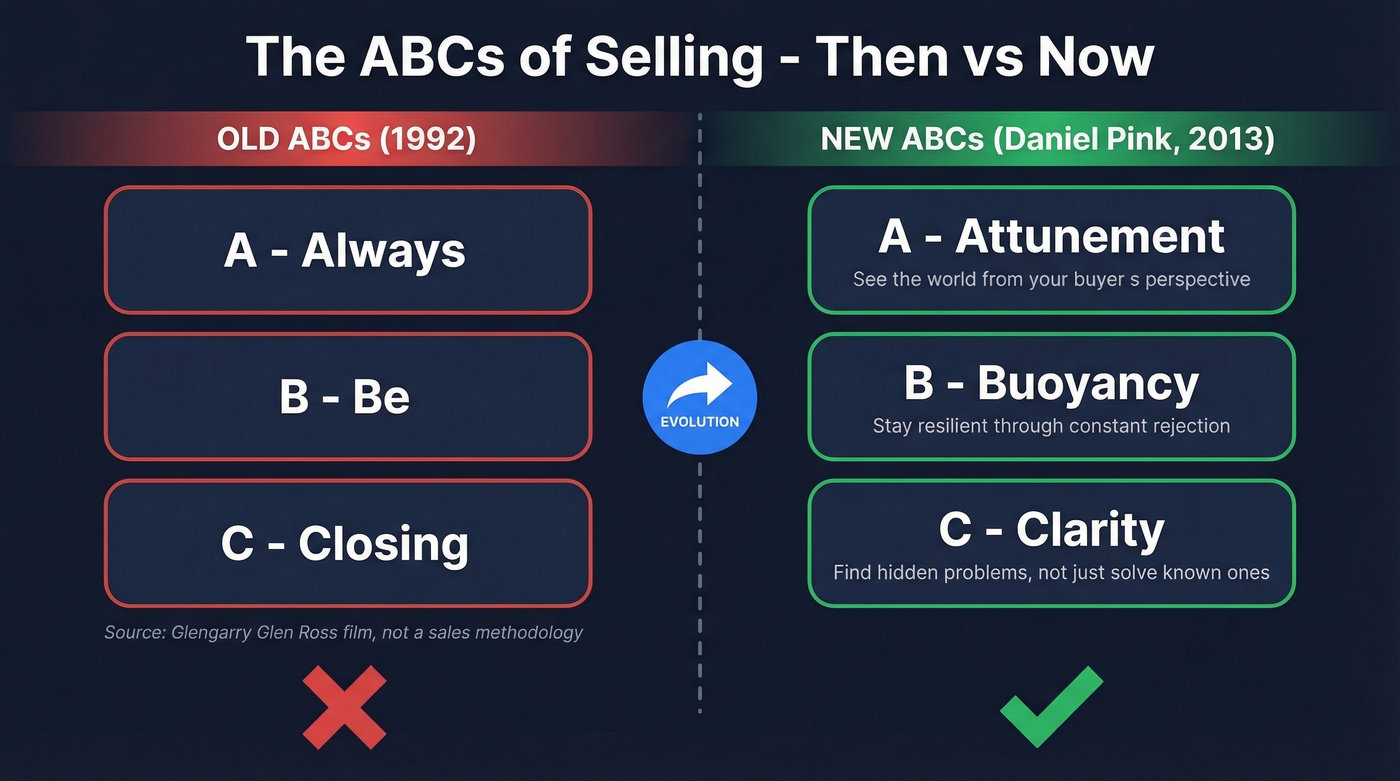
The original "Always Be Closing" comes from a 1992 movie where the guy saying it is the antagonist - an abrasive corporate enforcer, not a role model. Daniel Pink's modern framework replaces it with Attunement, Buoyancy, and Clarity, three qualities that map to how people actually buy today. Below: where the old mantra came from, why it fails, the science behind each of Pink's three qualities, and one behavioral change you can test on your very next call.
Where "Always Be Closing" Came From
It's 2026 and sales trainers are still quoting a movie from 1992 as if it's a playbook. Alec Baldwin's character is the antagonist. That was the point.
The phrase entered sales culture through Glengarry Glen Ross, a 1992 film) based on David Mamet's 1984 Pulitzer Prize-winning play. Baldwin's character, Blake - written specifically for the film adaptation - delivers a now-iconic monologue threatening salesmen with termination unless they close. Under that pressure, the story depicts salesmen resorting to deceitful tactics: lying to prospects, stealing leads, backstabbing colleagues. So what does ABC stand for in sales, historically? A threat disguised as motivation.
Somewhere along the way, the warning became the curriculum.
Why the Old ABC Approach Fails
The hard-sell playbook assumed the salesperson held all the information. The buyer had to talk to a rep to learn about the product, compare options, or get pricing. That information asymmetry is gone.
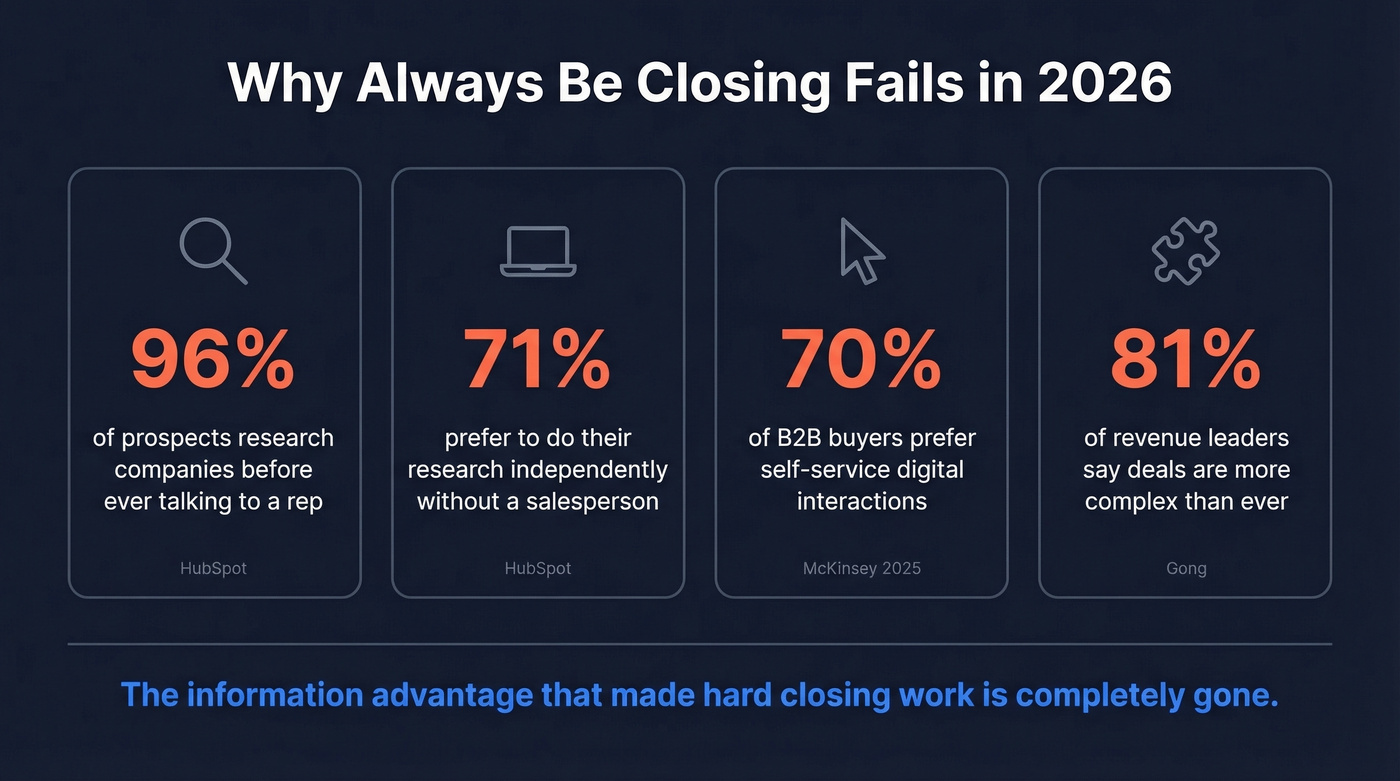
Today, 96% of prospects research companies before engaging with a sales rep, and 71% prefer doing that research independently rather than talking to someone. McKinsey's 2025 B2B Pulse found that 70% of corporate buyers prefer self-service digital interactions for research and evaluation.
Deals themselves are getting harder, too. According to Gong research, 81% of revenue leaders say deals are more complex than ever. In enterprise sales, buying committees often include many stakeholders - pressuring one person to "close" doesn't work when multiple people have veto power.
Even experienced reps can't agree on what "closing" actually means. One r/sales thread from a rep with years of experience called the term "pedantic," and the replies proved the point with conflicting definitions all over the place. When your core concept is that ambiguous, it's not a framework. It's a bumper sticker.
Pink's New ABCs: Attunement, Buoyancy, Clarity
Most sales training overcomplicates this. You need three mindset shifts and a handful of behavioral changes, not 26 letters. In To Sell is Human, Daniel Pink replaced the old mantra with three qualities grounded in behavioral science. If you read one book on modern selling, make it that one.
Attunement
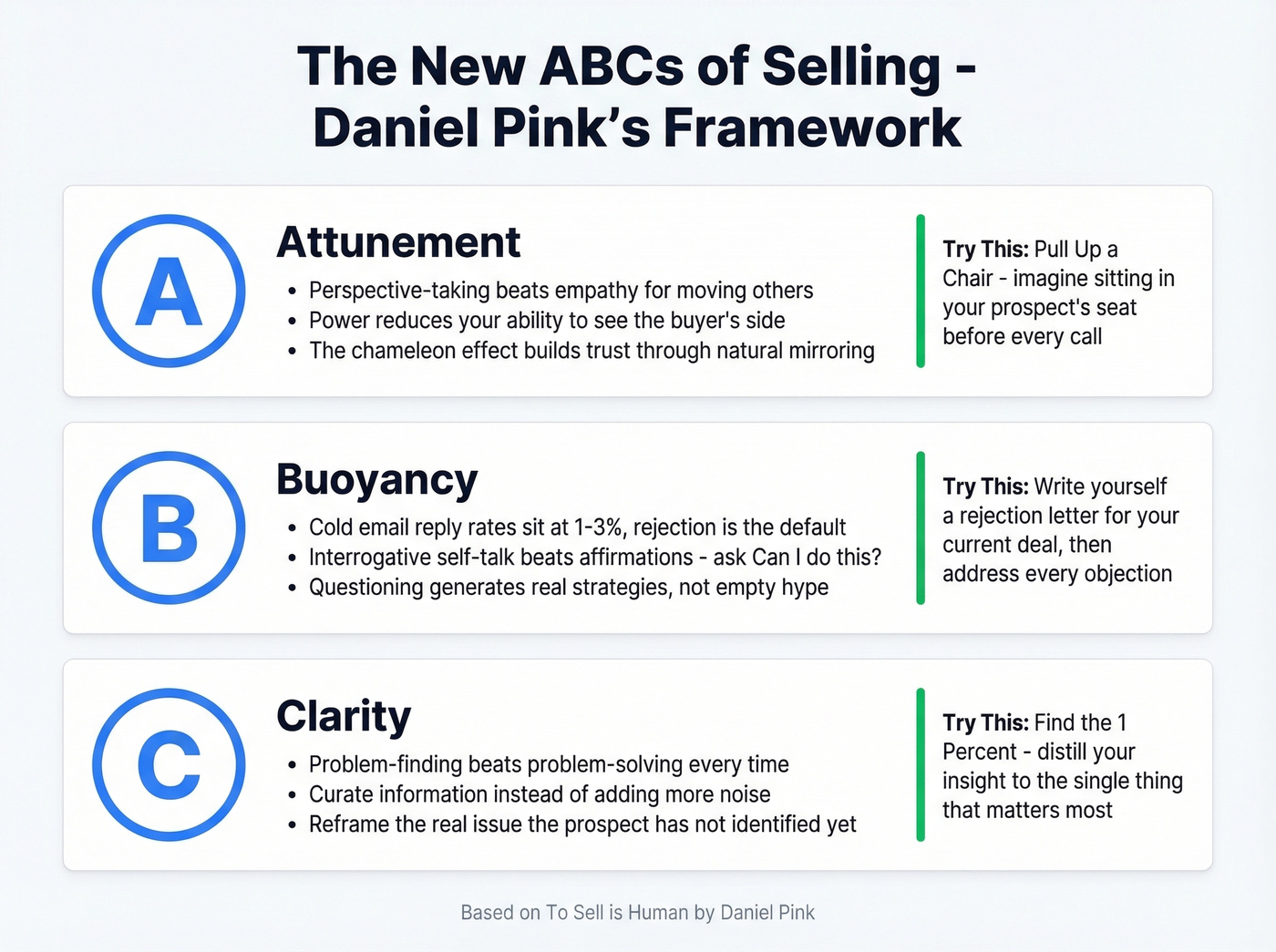
Attunement is the capacity to take another person's perspective - to see the world from their vantage point. Pink draws a critical distinction here: perspective-taking is cognitive, empathy is emotional. Research shows that perspective-taking is more effective than empathy, because it helps you understand what someone thinks, not just what they feel.
There's a catch. Power reduces perspective-taking ability. The more authority you feel in a conversation, the worse you get at seeing the other side. This is why the best discovery calls feel like conversations between equals, not interrogations run by someone reading from a script.
Pink also points to the "chameleon effect" - humans naturally mirror accents, speech patterns, and facial expressions, and scientists treat this strategic mimicry as social glue that builds trust without either party noticing.
Exercise - "Pull Up a Chair": Attributed to Jeff Bezos, this practice means leaving an empty chair in meetings to represent the customer. Before every call, mentally sit in that chair. What does this prospect's day look like? What pressure are they under? What would make them a hero internally?
Buoyancy
Selling means swimming in what Pink calls an "ocean of rejection." The average cold email reply rate sits around 1-3%, which means 97 out of every 100 outreach attempts go unanswered. Cold calls aren't much better. Buoyancy is the quality that keeps you afloat through all of it.
A practical way to build buoyancy is interrogative self-talk. Instead of pumping yourself up with "I'm going to crush this call," ask yourself "Can I do this?" The question forces your brain to generate actual reasons and strategies instead of relying on empty affirmation.
Exercise - "Send Yourself a Rejection Letter": Write yourself a rejection letter for a deal you're working. Spell out every reason the prospect might say no. Then read it out loud. This sounds counterintuitive, but it does two things: it desensitizes you to the worst outcome, and it forces you to address objections before they surface. We've seen reps who do this exercise weekly handle live objections with noticeably less flinch.
Clarity
In a world where buyers have access to more information than they can process, the seller's job isn't to add more. It's to curate.
Clarity means making sense of murky situations - and, critically, moving from solving existing problems to finding hidden ones. Problem-finding beats problem-solving every time. The prospect who says "we need a better CRM" has already self-diagnosed. The rep who can say "your CRM isn't the issue - your lead routing is costing you 40% of inbound response time" has found the real problem. That's clarity.
Exercise - "Find the 1 Percent": Borrowed from law school, this exercise asks you to distill any situation down to the one thing that matters most. Before a call, write down the single most important insight you can offer this prospect. Not three. Not five. One. If you can't identify it, you're not ready for the conversation.

Attunement means knowing your buyer before the call. Prospeo's 30+ search filters - including buyer intent, job changes, and technographics - give you the context to sit in that empty chair and see the world from your prospect's perspective. 300M+ profiles, refreshed every 7 days.
Stop guessing what your buyers care about. Look it up.
What Closing Looks Like in 2026
Here's the thing: the problem with "Always Be Closing" isn't the "closing" part - it's the "always" part. Relentless pressure at every touchpoint exhausts buyers instead of converting them.
Closing is a real skill. Guiding a buyer toward a decision, removing friction, creating urgency - these are legitimate. The issue is treating every interaction as a closing opportunity. Discovery calls aren't for closing. First meetings aren't for closing. Trying to close before you've earned the right to ask is what makes clients hate you.
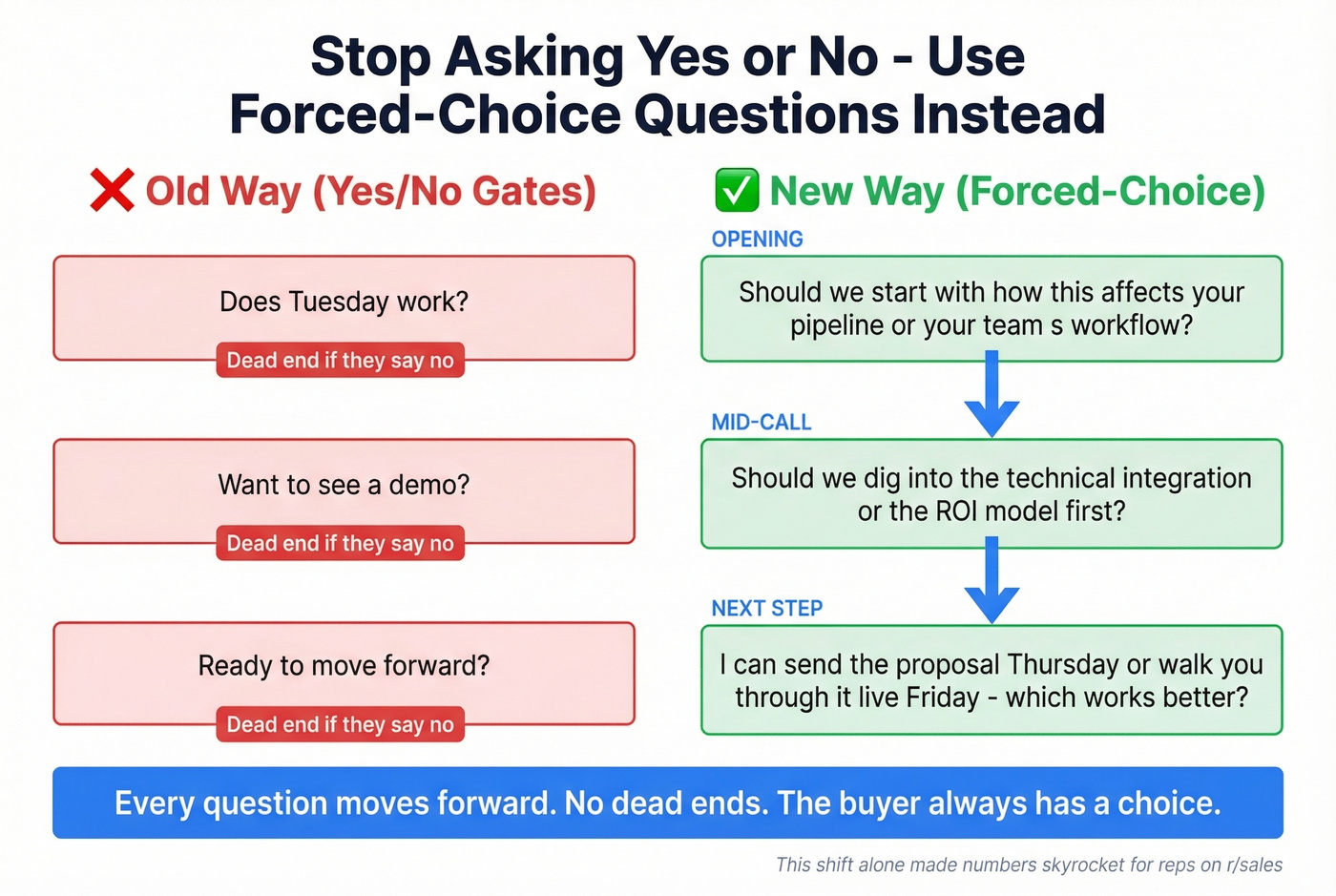
Use forced-choice questions instead of yes/no. Instead of "Does Tuesday work?" try "7 or 7:30 - which works better?" One Reddit poster described this shift as making their numbers skyrocket. It works because you're guiding a decision, not demanding one. Here's a sequence you can steal for your next discovery call:
Opening: "Would it be more useful to start with how this affects your pipeline or your team's workflow?" Mid-call: "Should we dig into the technical integration or the ROI model first?" Next step: "I can send the proposal by Thursday or walk you through it live on Friday - which do you prefer?"
Every question moves the conversation forward without a single yes/no gate.
Skip the close on a first discovery call. Follow the 90/10 coaching heuristic - let the prospect talk 90% of the time, and spend your 10% asking questions. Micro-commitments like agreeing to a next step, introducing a stakeholder, or sharing internal docs are the real closes in complex B2B deals. The signature on the contract is just the last one in a chain.
Other Modern Reframings
Pink's framework isn't the only update. The sales community has generated several alternatives, all pointing in the same direction:
- Always Be Helping - position yourself as a resource, not a closer
- Always Be Connecting - focus on relationships and referrals over transactions
- Always Be Adding Value - every touchpoint should leave the prospect better informed
These aren't competing frameworks. They're different ways of saying the same thing. The old ABC was about the seller's agenda. Every modern version centers the buyer's experience. Buyers reward sellers who make the buying process easier, not sellers who make it faster.
If you want a practical way to operationalize "Always Be Adding Value," start with a stage-by-stage approach to add value in sales.
ABCs vs. Full Sales Methodologies
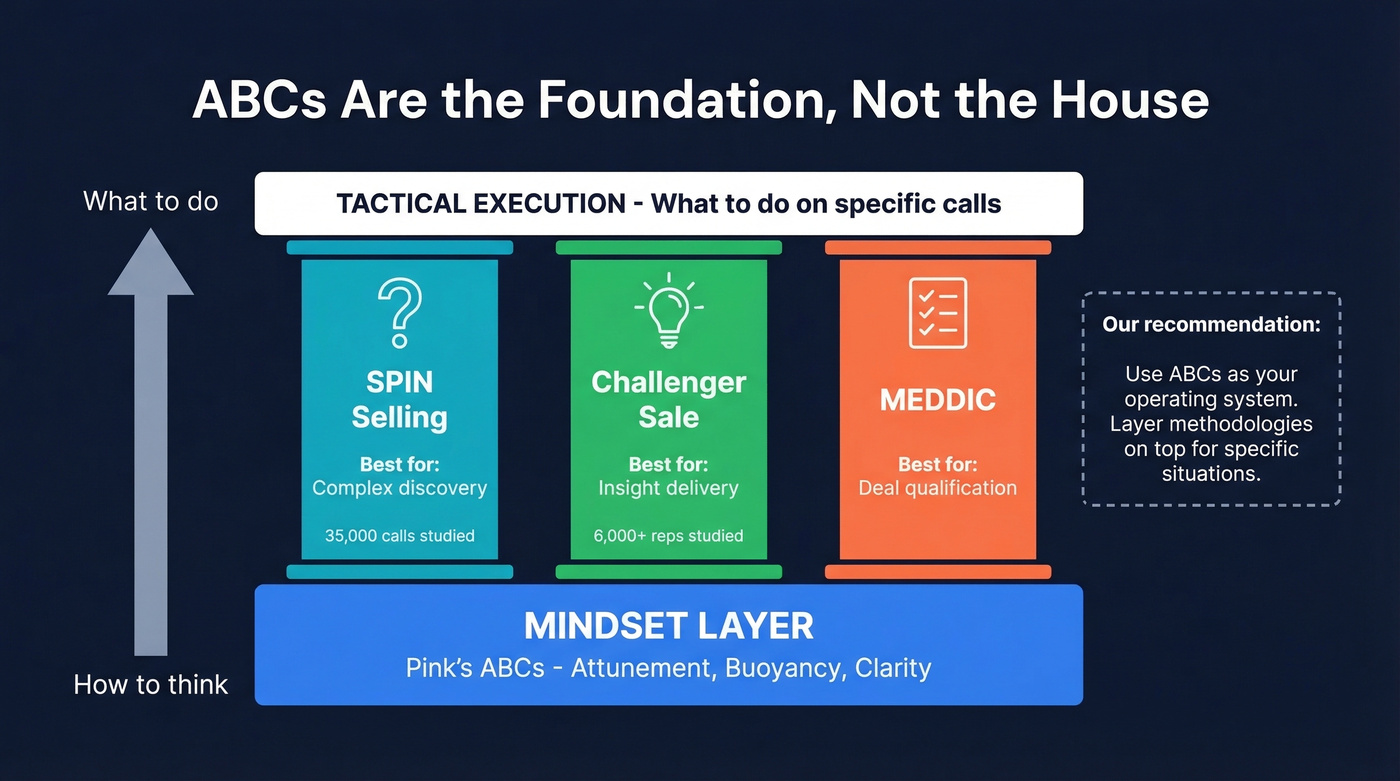
ABC - old or new - is a mindset layer, not a methodology. It tells you how to think, not what to do on a specific call. Full methodologies give you the tactical playbook. Here's how they stack up:
| Dimension | Old ABC | Pink's ABCs | SPIN Selling | Challenger Sale |
|---|---|---|---|---|
| Core idea | Pressure to close | Attune, stay buoyant, clarify | 4-stage question framework | Teach, tailor, take control |
| Type | Mantra | Mindset framework | Discovery methodology | Insight-delivery method |
| Research basis | None (film quote) | Behavioral science | 35,000 sales calls | 6,000+ reps studied |
| Best for | - | Any sales role | Complex discovery | Challenging assumptions |
| Weakness | Alienates buyers | Conceptual, not tactical | Slow in transactional sales | Requires deep expertise |
SPIN Selling is built on 35,000 sales calls analyzed over 12 years across 20+ countries. The Challenger Sale studied 6,000+ reps, and Xerox increased sales by 17% and added $65M in contract value after implementing it.
Our recommendation: use Pink's ABCs as your operating mindset. Layer SPIN for discovery calls, Challenger for insight delivery, and MEDDIC for deal qualification. The ABC framework sits underneath all of them - it's the foundation, not the house.
Putting the New ABCs Into Practice
Attunement doesn't start when the call begins. It starts before.
You can't take a prospect's perspective if you're calling the wrong person, emailing a dead address, or walking in blind to their company's situation. Pre-call research is the operational layer that makes Pink's framework work. Know the prospect's role, their company's trajectory, recent funding rounds, tech stack, and likely pain points before you dial. The "Pull Up a Chair" exercise is useless if the chair represents a generic persona instead of a real human with real context. In our experience, the reps who nail attunement aren't more empathetic - they're better prepared.
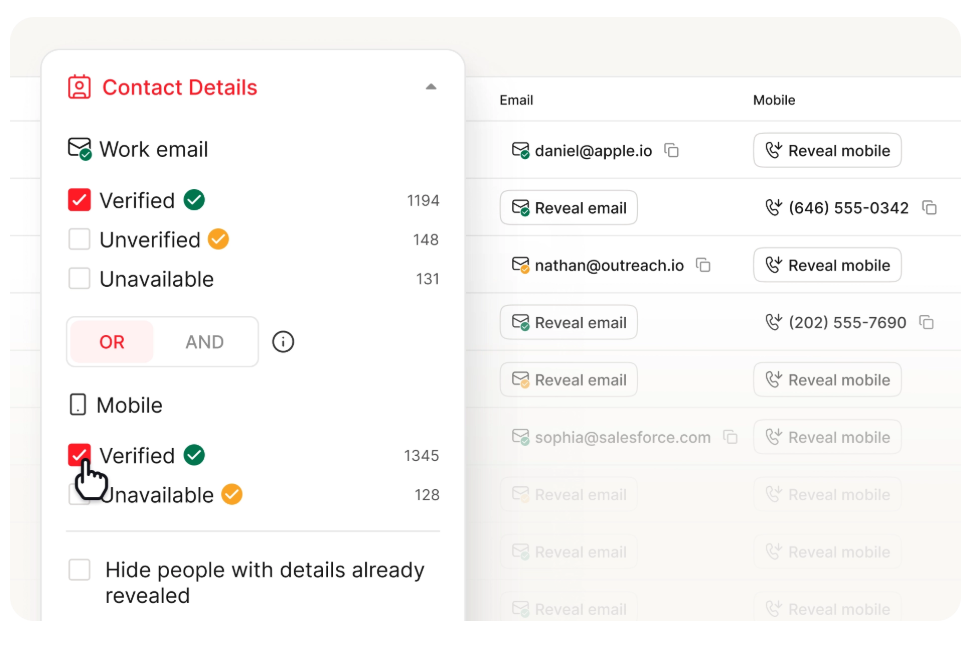
This is where your tools matter. A platform like Prospeo can surface 50+ data points per contact and track intent signals across 15,000 topics, so you're walking into conversations with current intelligence - not stale records from a database that refreshes every six weeks.
Clarity requires the same preparation. Pull intent signals data to see what topics prospects are actively researching. Check headcount growth signals to understand where they're investing. The one percent insight you bring to the call should be grounded in data, not a guess.
Let's be honest: if your deals average under $15K, you probably don't need a complex methodology stack. Pink's three qualities plus solid pre-call research will outperform any enterprise framework applied half-heartedly. Complexity isn't sophistication.
If you want to systematize the prep work, build a repeatable sales prospecting workflow and keep your records clean with data enrichment.
Buoyancy gets a lot easier when 97% of your emails actually land. Bad data turns rejection into bounces - and bounces destroy your domain. Prospeo's 98% email accuracy and 5-step verification keep you in inboxes, not spam folders. At $0.01 per email, the math works even at scale.
Swim through rejection, not bounce notifications.
FAQ
What does ABC mean in sales?
Originally "Always Be Closing" from Glengarry Glen Ross (1992). Daniel Pink reframed it as Attunement, Buoyancy, and Clarity - three qualities grounded in behavioral science that replace pressure tactics with perspective-taking, resilience, and problem-finding.
Is "Always Be Closing" still effective?
No. With 96% of buyers researching independently before engaging a rep, pressure-based closing alienates prospects. Modern selling rewards guided decisions and micro-commitments over hard closes.
How do I practice attunement before a sales call?
Research the prospect's role, company trajectory, and likely pain points using a B2B data platform that surfaces detailed contact and company intelligence. On the call, follow the 90/10 heuristic: let them talk 90% of the time and spend your 10% asking targeted questions.