

How to Set ABM Goals That Drive Pipeline (Not Dashboards)
A marketing team runs ABM for six months. They've got opens, clicks, and impressions across 700 target accounts - and 40 SQLs to show for it. The dashboards look great. The pipeline doesn't.
We've seen this pattern across dozens of ABM programs, and it's always the same gap: measuring activity instead of movement. Setting the right ABM goals from day one is what separates programs that produce revenue from ones that produce reports. Demandbase's benchmark study of 300+ global marketers found ABM delivers 81% higher ROI than traditional marketing - but that ROI only materializes when you set the right targets, and most teams don't.
Start With Three Metrics
Before anything else, nail these: account penetration rate (are you reaching target accounts?), meetings booked from target accounts (is engagement converting?), and pipeline sourced from your TAL (is any of this turning into money?).
Everything else is noise until these three work.
The ABM Goal Hierarchy
Five stages separate ABM programs that generate revenue from ones that generate slide decks. Defining clear account-based marketing objectives at each stage keeps your team focused on outcomes instead of outputs.
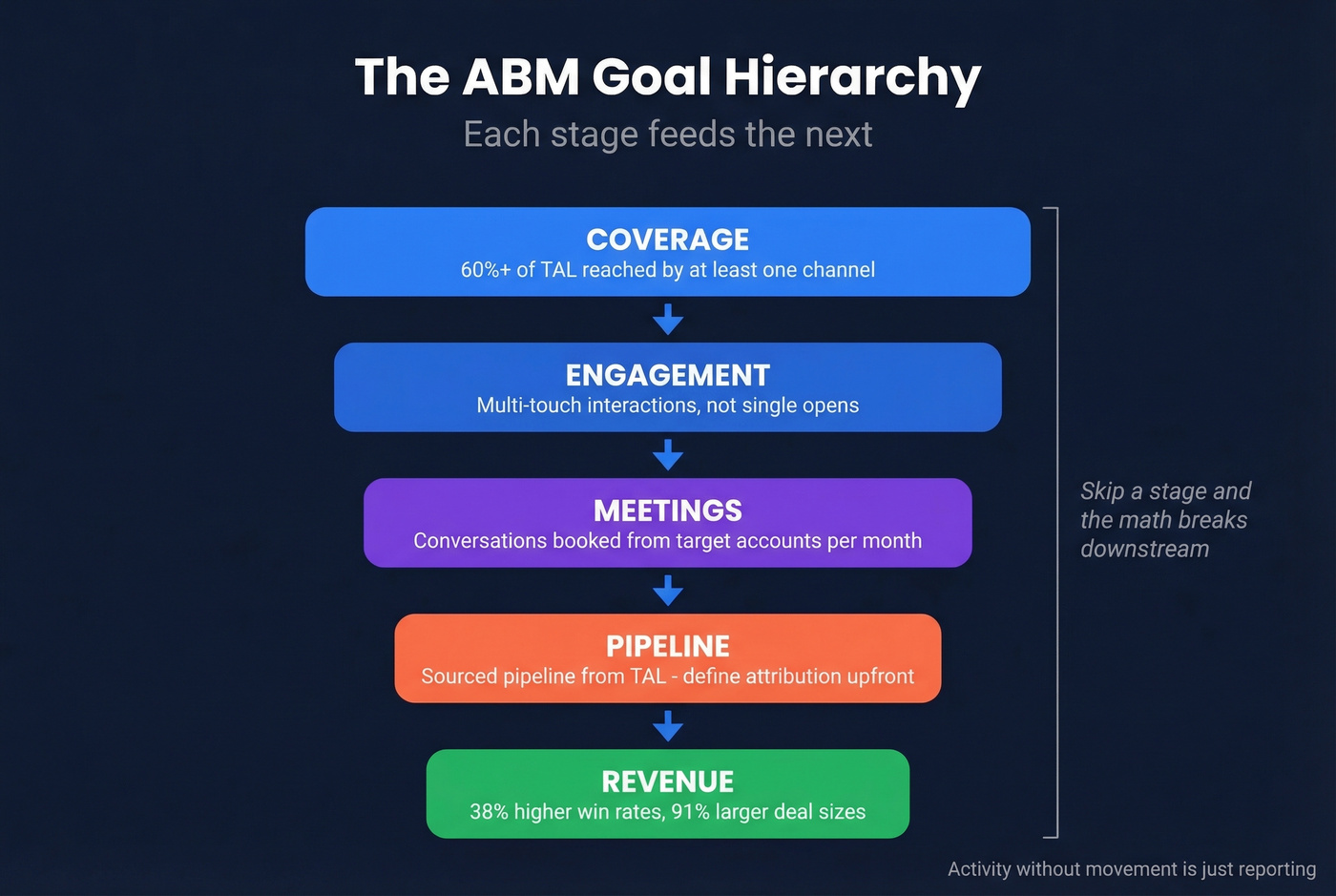
Stage 1 - Coverage. What percentage of your TAL knows you exist? Measure the percentage reached by at least one channel. If you're below roughly 60%, treat it as a targeting or distribution problem, not a messaging one.
Stage 2 - Engagement. Are target accounts interacting with your content, ads, or outreach? Track engaged accounts as a share of TAL - multi-touch engagement, not single opens. A single ad impression doesn't count.
Stage 3 - Meetings. Engagement that doesn't convert to conversations is content marketing with a fancier name. Contact-level ABM can lift meeting conversion by up to 74%, according to TOPO research. Count meetings booked from target accounts per month.
Stage 4 - Pipeline. Define sourced pipeline versus influenced pipeline upfront, or you'll spend Q3 arguing attribution with sales leadership while the quarter slips away. Companies with strong sales-marketing alignment see 118% higher pipeline conversion and 67% better deal close rates.
Stage 5 - Revenue. Win rate, deal size, and velocity within your TAL. ABM programs report 38% higher win rates and 91% larger deal sizes - but only when targets push accounts through every stage above.
Each stage feeds the next. Skip one, and the math breaks downstream.
Goals by ABM Tier
Your targets should match your motion.
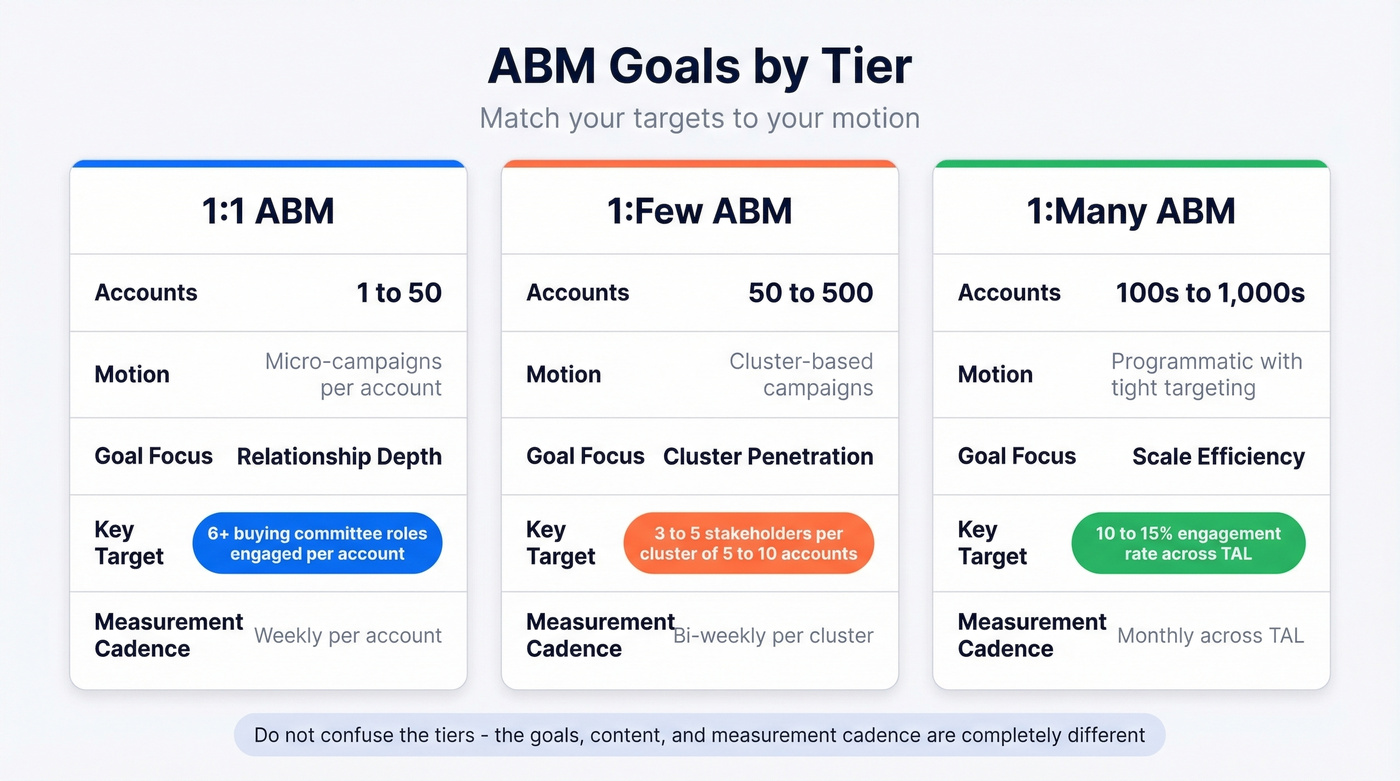
| Tier | Account Volume | Goal Focus | Example Target |
|---|---|---|---|
| 1:1 | 1-50 | Relationship depth | 6+ buying committee roles engaged per account |
| 1:few | 50-500 | Cluster penetration | 3-5 stakeholders per cluster of 5-10 accounts |
| 1:many | 100s-1,000s | Scale efficiency | 10-15% engagement rate across TAL |
For 1:1, you're basically running micro-campaigns per account. For 1:many, you're running programmatic with tight targeting. Don't confuse the two - the goals, the content, and the measurement cadence are completely different.

Multi-threading 3-5 stakeholders per account requires verified contact data for every role. Prospeo gives you 98% accurate emails and 125M+ direct dials across 300M+ profiles - with 30+ filters to match your exact TAL criteria, from buyer intent to department headcount.
Stop building ABM campaigns on contacts that bounce.
ABM Goals by Timeline
This question comes up constantly in r/b2bmarketing threads: what does "good" look like at 3, 6, and 12 months?
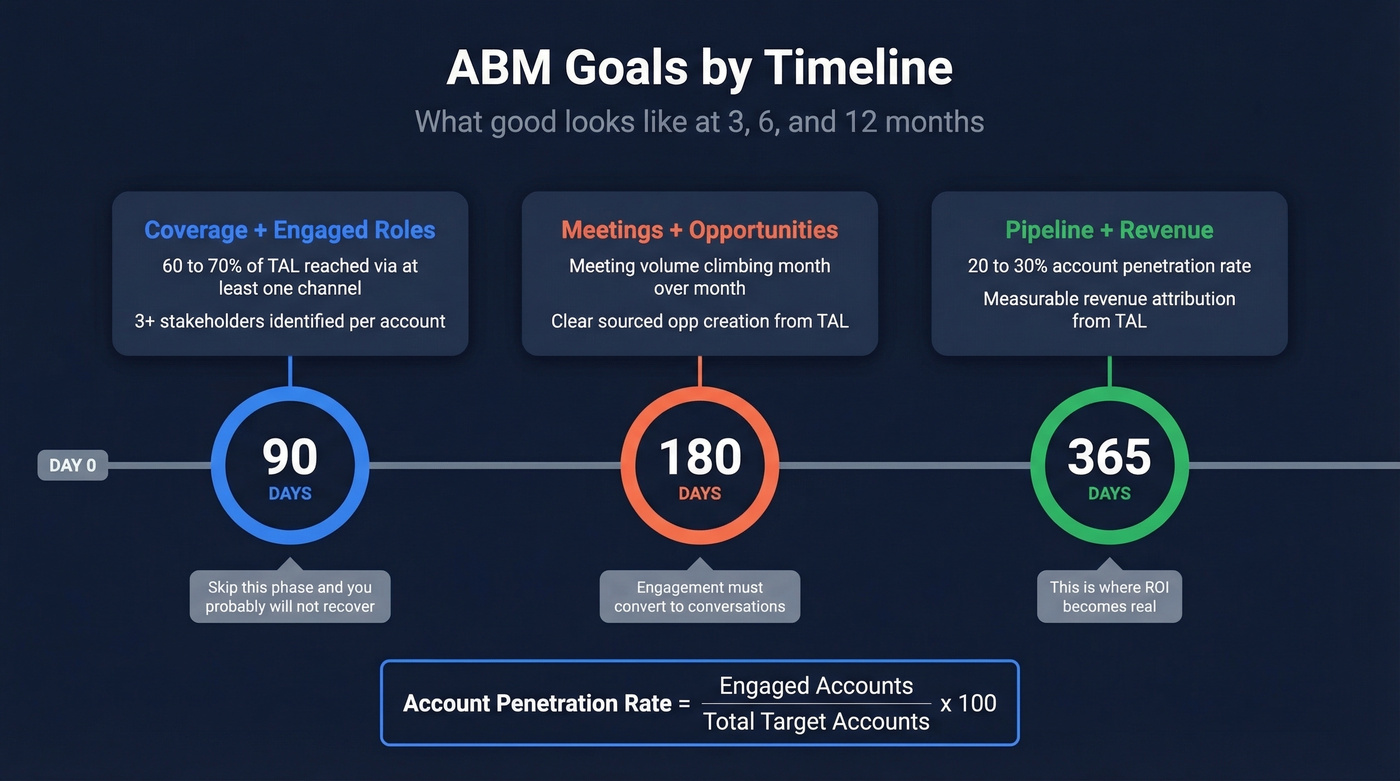
| Timeframe | Primary Goal | Target |
|---|---|---|
| 0-90 days | Coverage + engaged roles | 60-70% of TAL reached via at least one channel; 3+ stakeholders identified per account |
| 90-180 days | Meetings + opportunities | Meeting volume climbing MoM; clear sourced opp creation from TAL |
| 180-365 days | Pipeline + revenue | 20-30% account penetration rate; measurable revenue attribution |
Account Penetration Rate = Engaged Accounts / Total Target Accounts x 100
Teams that skip the first 90 days of coverage work usually don't recover. HubSpot cut its sales cycle by 18% by focusing resources on accounts with the highest engagement scores. Atheer generated 754 leads with a 15-35% acceptance rate using a structured ABM timeline - proof that patience in the early stages pays off.
Here's the thing: if your average deal size is under $15k, you probably don't need a five-stage ABM program. Run 1:many with tight targeting and call it a day.
ABM OKR Template
Customize these numbers to your TAL size and sales cycle.
Objective: Accelerate pipeline from top-tier target accounts
KR1: Book 15 meetings from Tier 1 accounts per month
KR2: Increase account penetration rate from 12% to 25% by end of quarter
KR3: Source $500K in new pipeline from TAL (sourced, not influenced)
Initiative: Multi-threaded outreach to 3+ roles per account; personalized content tracks by industry cluster
Keep it to 3-4 objectives with 3-4 key results each. More than that and nobody tracks anything.
Five Goal-Setting Mistakes
| Mistake | Fix |
|---|---|
| Measuring MQLs instead of account engagement. MQLs count individual leads; ABM counts account movement. | Replace MQL targets with engaged account counts. |
| TAL sprawl. Adding "just a few more" accounts dilutes every metric. | Cap your TAL and defend the cap. 2,000 accounts with a five-person team doesn't work. |
| No shared sales-marketing scoreboard. Only 11% of companies handle handoffs effectively; aligned teams see 58% better retention. | One dashboard, shared KPIs, weekly syncs. |
| Tracking vanity metrics without pipeline connection. Opens and clicks mean nothing without a next conversion step. | Every engagement metric needs a "so what" that ladders to meetings or pipeline. |
| Ignoring data quality. A bounce rate above 5% breaks deliverability fast. | Verify your TAL contact data before launching. Non-negotiable. |
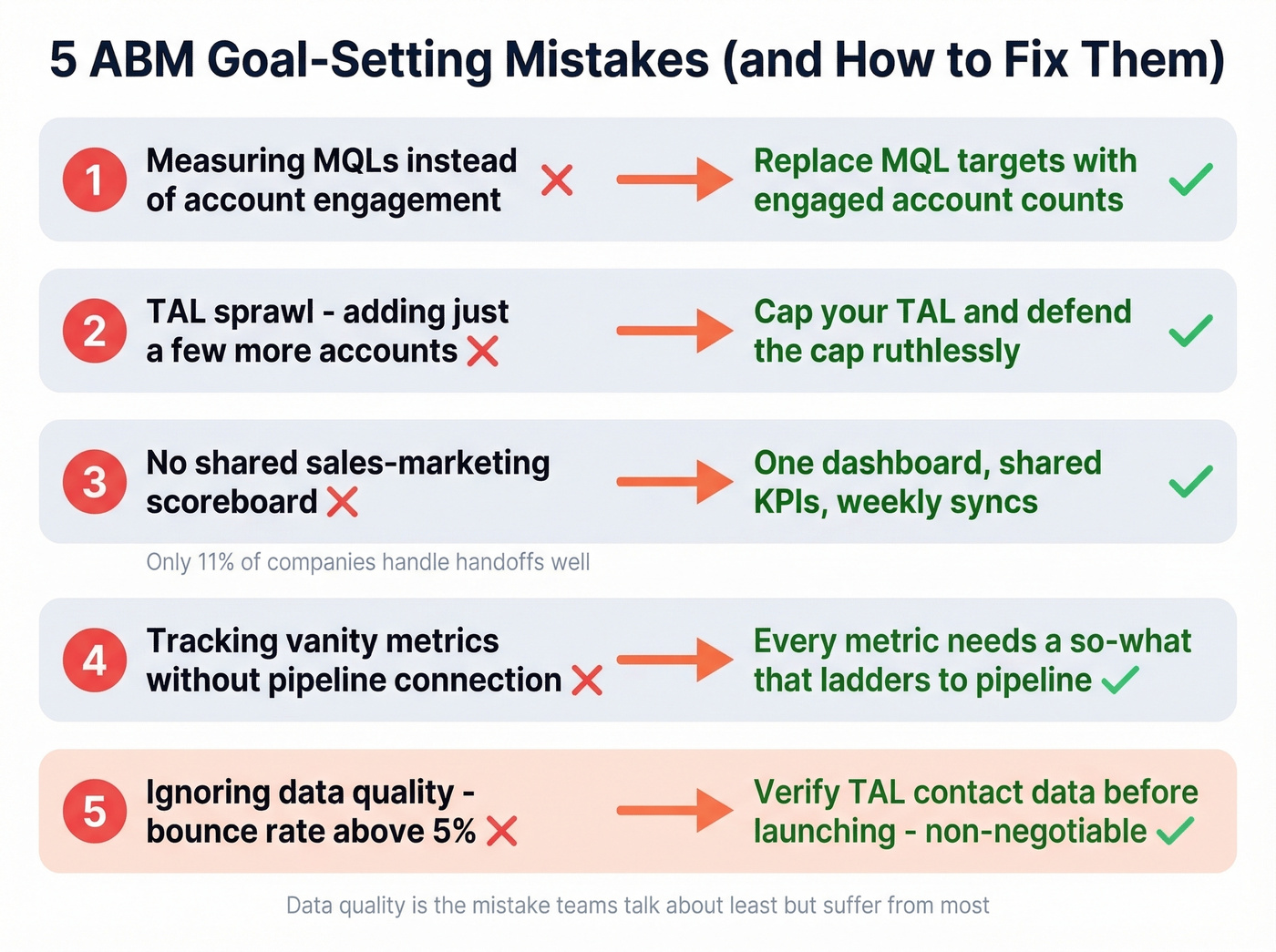
Let's be honest about that last one - it's the mistake we see most often, and it's the one teams are least willing to talk about because it feels like grunt work compared to campaign strategy.
Data Quality: The Goal Nobody Sets
Every goal in this article assumes your contact data is accurate. You can't penetrate accounts you can't reach. You can't book meetings with emails that bounce.
Set a hard rule: outbound bounce rate stays under 5%. Snyk ran into this exact problem - bounce rates of 35-40% were tanking their outreach before it even started. After switching to Prospeo for real-time verification, they brought bounce rates under 5% and saw AE-sourced pipeline jump 180%. That's what clean data does for ABM execution. With a 7-day data refresh cycle (versus the 6-week industry average), your TAL contact data stays current so your coverage and engagement numbers actually mean something.

Skip this step if your TAL is under 50 accounts and you're manually verifying each contact. But for anything at scale, automated verification isn't optional - it's the foundation your ABM goals sit on.
Snyk's 50 AEs hit 35-40% bounce rates before switching to Prospeo. After: under 5% bounces, 180% more AE-sourced pipeline, and 200+ new opportunities per month. A 7-day data refresh cycle keeps your TAL current so coverage and engagement goals actually convert to meetings.
Your account penetration rate is only real if your data is.
FAQ
What's the most important ABM KPI?
Account penetration rate. It measures whether you're actually reaching target accounts, not just running campaigns at them. Formula: engaged accounts / total target accounts x 100. Aim for 20-30% for enterprise programs.
How is ABM different from lead gen?
Lead gen counts individual leads regardless of account. ABM measures movement within specific target accounts - coverage, engagement depth, and pipeline sourced from your TAL. The account-based marketing objectives you set reflect this: instead of chasing lead volume, you're optimizing for account-level progression through the stages we outlined above.
What tools help hit ABM data quality targets?
Pair a data platform that keeps contact records fresh with an ABM orchestration platform like Demandbase or 6sense for intent signals and campaign coordination. The key is verifying contacts before outreach, not after bounces tank your domain reputation.