


Abstract API vs Generect: Different Tools, Different Jobs
You're probably searching for the wrong comparison. When people look up Abstract API vs Generect, they expect two competing products - but these tools serve completely different buyers. Abstract API is a developer utility platform that validates emails, geolocates IPs, and enriches company data through REST APIs. Generect is a sales tool that finds B2B leads, verifies email deliverability in real time, and pushes contacts into your CRM through integrations and API workflows.
Comparing them head-to-head is like comparing a spell-checker to a word processor. Let's break it down anyway, because the overlap in email verification is real enough to cause confusion.
30-Second Verdict
Choose Abstract API if you're a developer embedding email validation or geolocation into an application.
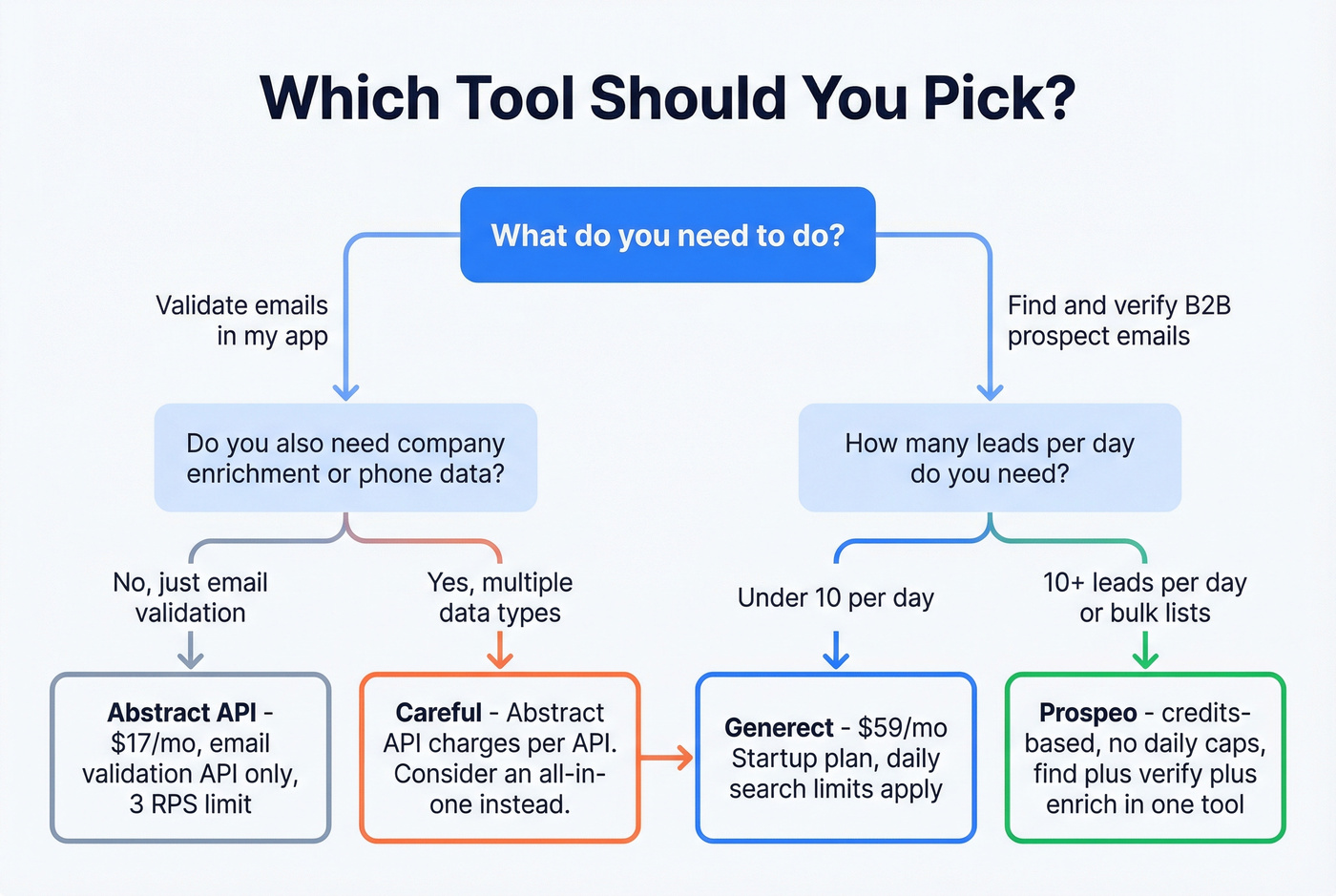
Choose Generect if you're a sales team that needs to discover and verify prospect contact data.
What Each Tool Actually Does
Abstract API
Abstract API offers 12+ utility APIs - email validation, phone validation, IP geolocation, company enrichment, website scraping, and more. It powers 100,000+ organizations and has processed 3B+ email validations with sub-50ms response times. SOC 2 Type II certified and GDPR-ready.
If you're evaluating it mainly for validation, it helps to understand the broader email deliverability picture too.
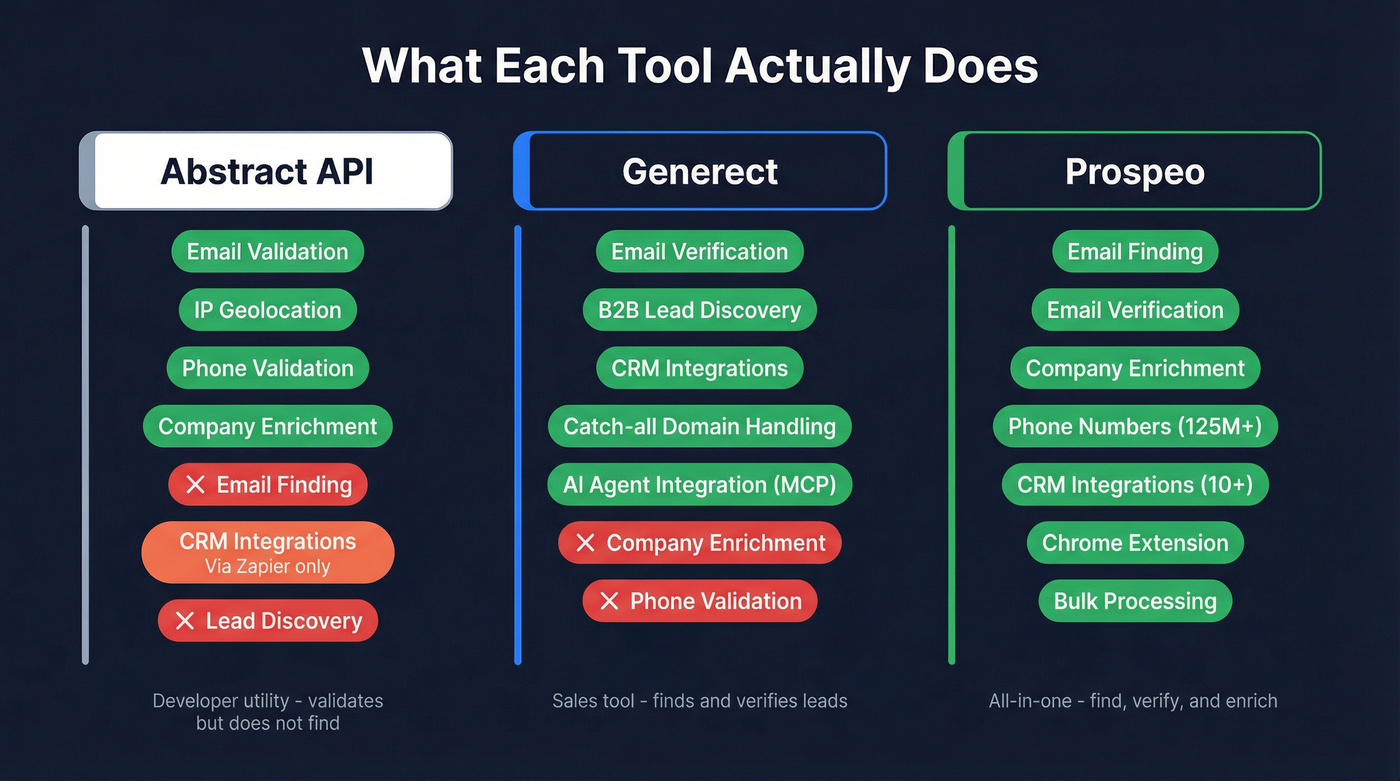
Here's the catch: each API is a separate subscription. Need email validation and company enrichment and phone validation? That's three separate bills, and they stack up faster than you'd expect.
Generect
Real-time email verification and CRM fill workflows are Generect's core selling points. It verifies 97.5% of emails for deliverability and handles 70% of catch-all domains, reducing risky emails to around 5%. Generect connects with Salesforce, HubSpot, and Pipedrive, and can hook into any system that supports a REST API for leads. It also supports MCP (Model Context Protocol) for AI agent integration - a nice differentiator for technical teams building automated outbound workflows. On Product Hunt, Generect holds a 5.0 rating with 495 followers.
If you're building outbound around it, you’ll also want solid sales prospecting techniques so the tool doesn’t become the strategy.

Abstract API validates emails but can't find them. Generect finds leads but caps your daily searches. Prospeo does both - 300M+ profiles, 98% email accuracy, and 125M+ verified mobiles - without stacking subscriptions or hitting rate limits.
Find, verify, and enrich contacts in one workflow. No Frankenstein stack required.
Pricing and Features Compared
| Abstract API (Email) | Generect | Prospeo | |
|---|---|---|---|
| What you get | Email validation API | B2B lead discovery | Find + verify + enrich |
| Free tier | 100 requests/mo | 25 valid leads/mo | 75 emails/mo |
| Entry paid | $17/mo (annual) | $59/mo (Startup) | ~$39/mo (credits) |
| Mid tier | $37-39/mo | $120/mo (Business) | Scales with credits |
| Per-unit cost | ~$0.0003/validation | $0.02-$0.007/valid lead credit | ~$0.01/email |
| CRM integrations | Via Zapier | Salesforce, HubSpot, Pipedrive + REST API | SF, HubSpot + 8 more |
| Rate limit | 3 RPS (all tiers) | 2/day to unlimited/day searches | No published RPS cap |
| Best for | Developers | Sales teams | All-in-one prospecting |
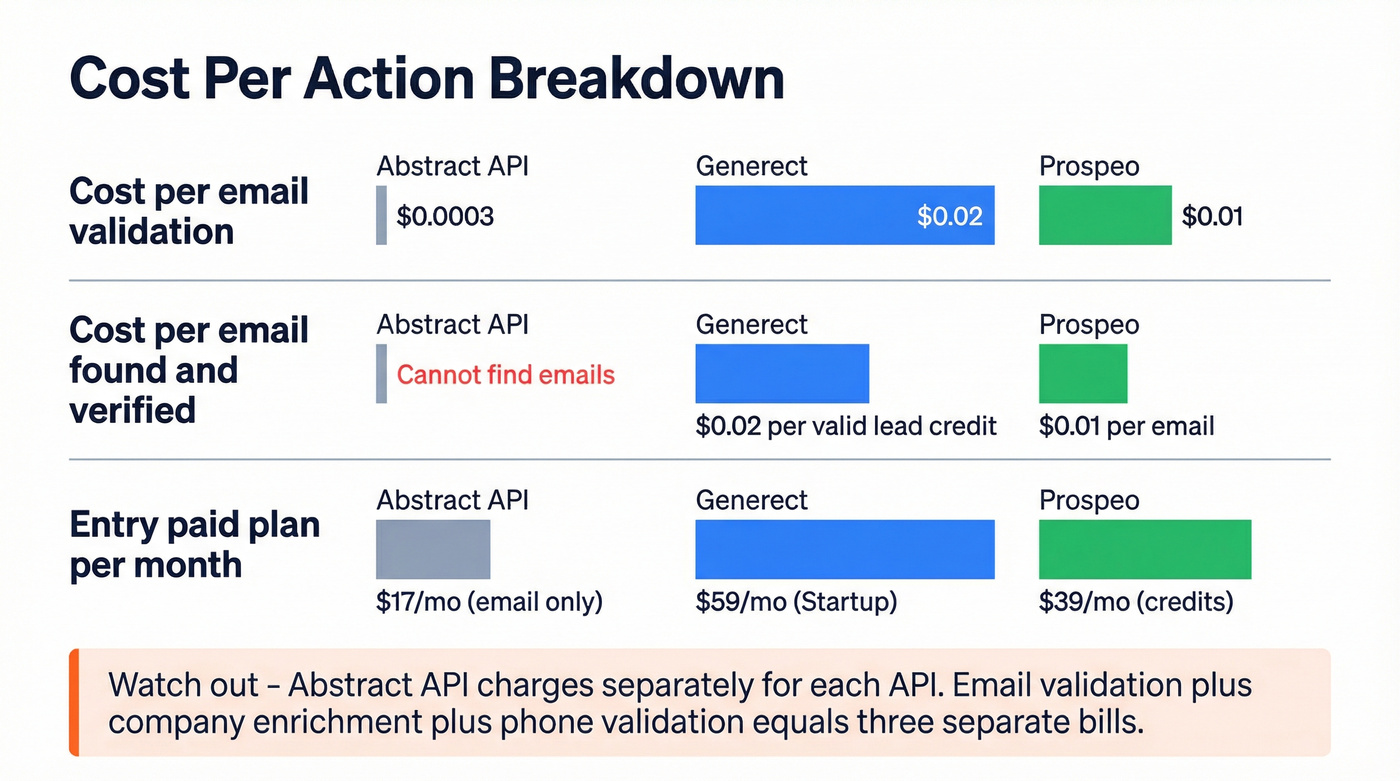
Abstract API is dirt cheap per validation - but it only validates. It doesn't find emails. Generect finds and validates, but daily search limits on lower tiers can bottleneck prospecting fast. And Abstract API's per-API pricing means adding company enrichment or phone validation stacks another separate subscription on top, which is the kind of thing you discover after you've already committed to the architecture.
If you’re validating at scale, keep an eye on your email bounce rate and list hygiene, not just “valid/invalid” flags.
What Real Users Say
Abstract API carries a 4.5/5 on G2 (16 reviews). Developers praise the documentation and integration speed. The complaints hit harder: one reviewer reported Abstract API doubled their price without warning, only discovering it when their card hit spending limits. The hard 3 RPS rate limit frustrates bulk validation workflows, and some users report "UNKNOWN" results on emails other tools identify correctly. In our testing, that rate limit is the real bottleneck - if you're validating a list of 50,000 emails, you're looking at nearly 5 hours of processing time.
If you’re doing bulk checks, it’s worth understanding email velocity limits and operational constraints too.
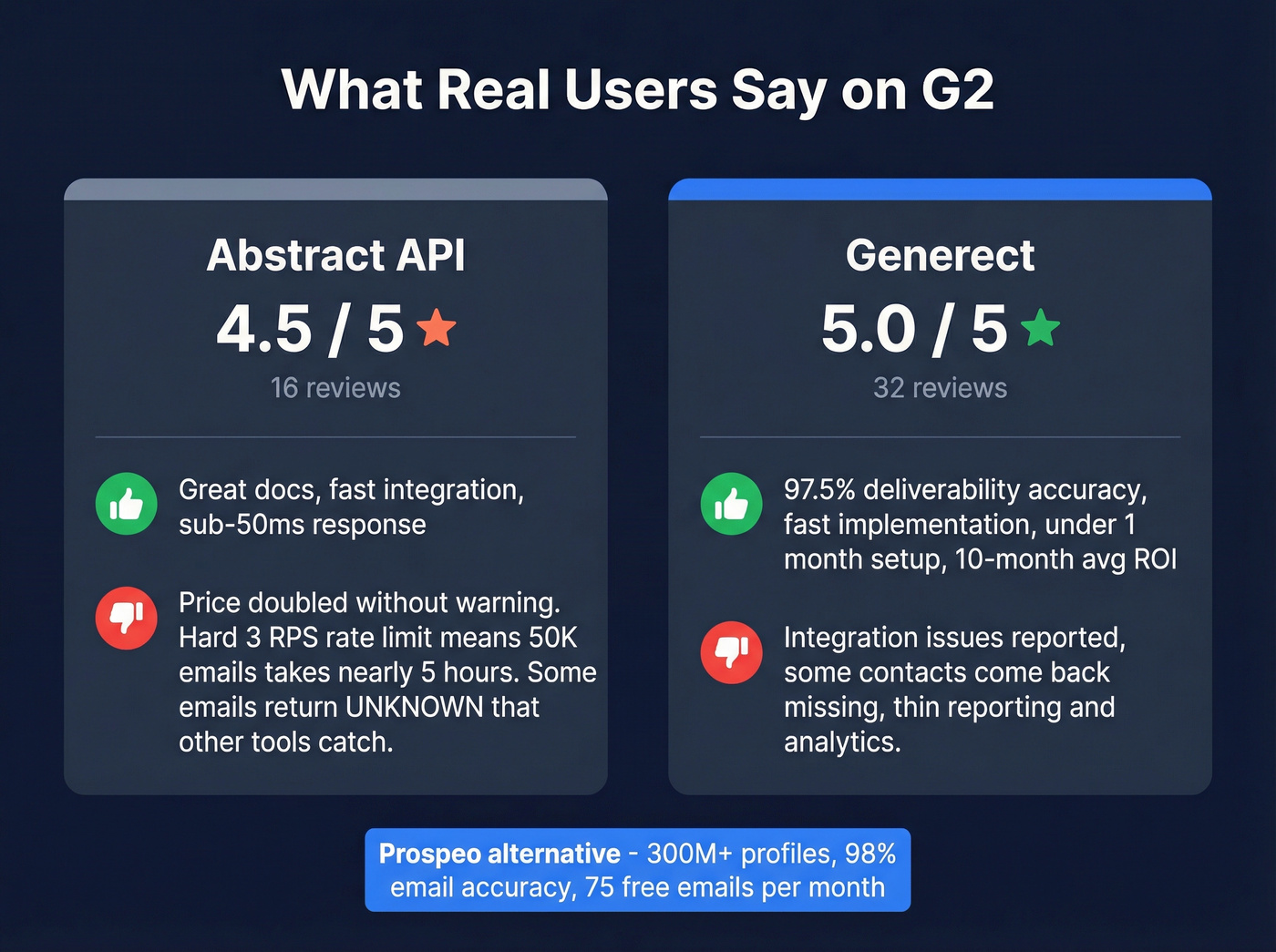
Generect holds a 5.0/5 on G2 (32 reviews). Users love the data accuracy and speed - G2 reports implementation under one month and a 10-month average time to ROI. The downsides: integration issues crop up in reviews, some contacts come back missing, and reporting is thin. For a team that just needs leads flowing into HubSpot, those tradeoffs work. For teams needing deep analytics on their prospecting pipeline, they don't.
If your process depends on clean handoffs, a defined lead generation workflow helps prevent “missing contact” issues from turning into pipeline leakage.
A Simpler Alternative to Both
It starts free with 75 verified emails per month, scales on credits at roughly $0.01/email, and requires no annual contracts.
Look, if your outbound workflow requires two separate tools just to find and verify an email address, you've already lost efficiency. One platform that does both will always beat a Frankenstein stack - and we've seen teams cut their list-building time by 80% after consolidating.
If you’re comparing more options, you can also look at other free lead generation tools to round out your stack.
At ~$0.01 per verified email, Prospeo costs a fraction of Generect's per-lead pricing and actually finds contacts - something Abstract API can't do at all. Data refreshes every 7 days, not 6 weeks. 75 free emails/month, no credit card required.
Stop juggling two tools for a job one platform handles better.