

The 10 Best Account-Based Marketing Solutions (and What They Actually Cost)
Your CMO just greenlit the ABM pilot. Fifty accounts, one quarter to prove it works, and a budget that feels generous until you start pricing platforms. A typical mid-market Demandbase contract lands around $65K/year before you've layered in the modules and services most teams end up adding.
71.2% of B2B organizations already run ABM programs, and the average ROI sits around 137% across a survey of 771 marketers. Nearly half plan to increase ABM budgets this year. The market's projected to grow from $1.8B to over $5.2B by 2035. ABM works. But the gap between "ABM works" and "we picked the right account-based marketing solution at the right price" is where most teams stumble.
Prices range from $9,750/year self-serve platforms to $300K+ enterprise suites that need dedicated ops teams and months of onboarding. We've spent weeks digging into real contract data, community feedback, and platform limitations so you can skip the expensive mistakes.
Our Picks
| Category | Tool | Verdict |
|---|---|---|
| Best for data accuracy | Prospeo | 98% accuracy, free tier, intent data |
| Best all-in-one (enterprise) | Demandbase | Full-stack ABM if you can afford it |
| Best for SMBs | RollWorks | Accessible ABM starting ~$12K/yr |
What Should ABM Software Cost?
The honest range is $12,000 to over $300,000 per year. That's not a typo - it reflects how fragmented this category really is.
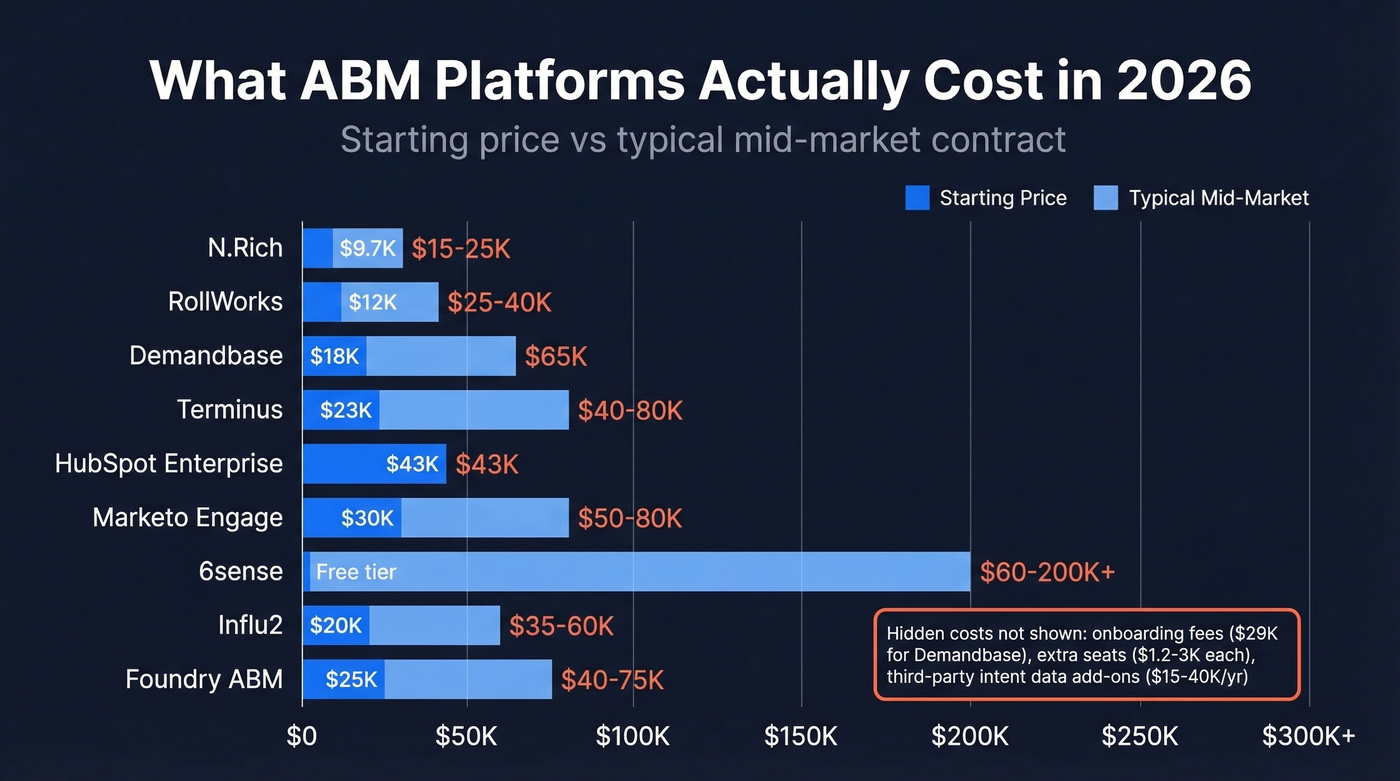
| Tool | Starting Price | Typical Mid-Market | Contract | Free Tier? |
|---|---|---|---|---|
| N.Rich | $9,750/yr | ~$15K-$25K/yr | Annual | 30-day trial |
| RollWorks | ~$12K/yr | ~$25K-$40K/yr | Annual | No |
| Demandbase | $18K-$24K/yr | ~$65K/yr (median) | Annual/multi-year | No |
| Terminus | ~$23K/yr | ~$40K-$80K/yr | Annual | No |
| HubSpot (Enterprise) | $3,600/mo | $43,200/yr | Annual | No |
| Marketo Engage | ~$30K/yr | ~$50K-$80K+/yr | Annual | No |
| 6sense | Free tier (50 credits/mo) | $60K-$200K+/yr | Multi-year | Yes (limited) |
| Influ2 | ~$20K/yr | ~$35K-$60K/yr | Annual | No |
| Foundry ABM | ~$25K/yr | ~$40K-$75K/yr | Annual | No |
Sticker prices don't tell the full story. Demandbase's onboarding fees run around $29K. Third-party intent data add-ons from Bombora or TechTarget tack on $15,000 to $40,000 annually. Additional Demandbase seats cost $1,200-$3,000 per user per year. That "Professional" tier at $45K quickly becomes $80K+ once you add the modules you actually need.
Here's the thing: most teams buying six-figure ABM platforms are overspending on orchestration and underspending on data quality. We've seen teams pour $65K into Demandbase and still bounce 20% of their emails because the contact data underneath was stale. The platform didn't fail - the foundation did.
Do You Actually Need an ABM Platform?
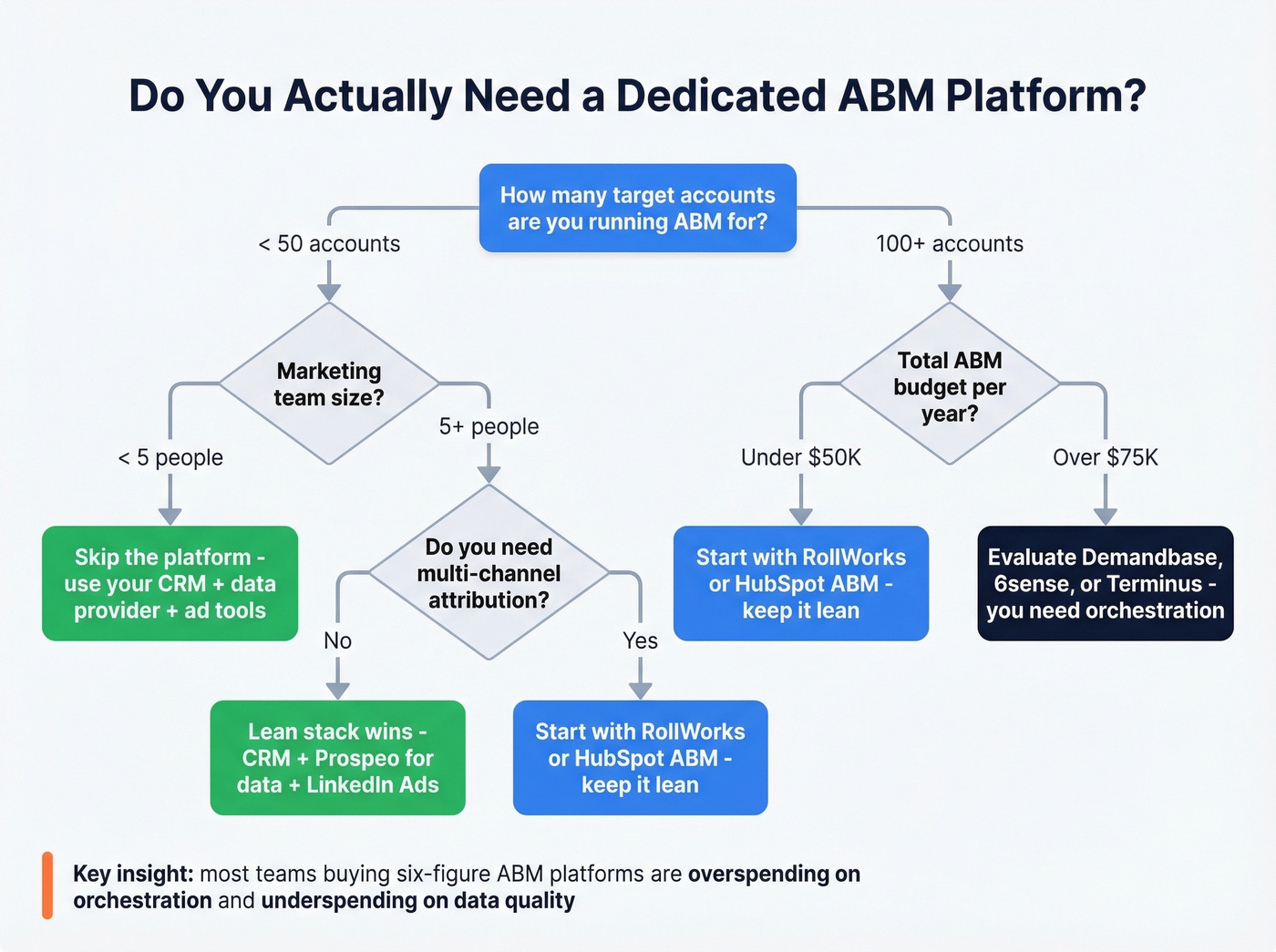
Before you sign a five-figure annual contract, ask yourself whether you actually need one.
A practitioner on r/b2bmarketing evaluated N.Rich, Demandbase, RollWorks, and 6sense and found them all "incredibly expensive" and "not useful" for their niche B2B market. Their actual workflow? Build account lists, run targeted ads, use visitor identification to see which accounts hit the site, and share that data with sales. No predictive AI. No "5% ready to buy" modeling. Just visibility and proof that marketing spend reaches the right companies.
Another ABM manager at a small SaaS company already running HubSpot, Salesforce, and Cognism worried about buying something "beyond what they need." That's a valid concern - and one we hear constantly.
Skip the dedicated platform if you're targeting fewer than 50 accounts, your marketing team is under 5 people, you already have a CRM plus data provider plus ad platforms, or your total ABM budget is under $25K/year. In those cases, a lean stack built on tools you already own will outperform a platform you're paying for but barely using.
You probably do need one if:
- You're orchestrating campaigns across 100+ accounts with tiered engagement
- Sales and marketing need shared account-level analytics
- You're running multi-channel plays (ads + email + direct mail + events) and need attribution
- Your ABM budget exceeds $50K/year and you need to prove ROI to the board

Six-figure ABM platforms can't fix bad data underneath. Prospeo gives you 98% verified emails, 125M+ direct dials, and Bombora intent data across 15,000 topics - refreshed every 7 days, not every 6 weeks. Build your ABM target list on a foundation that actually connects.
Stop overpaying for orchestration and underpaying for data quality.
The 10 Best ABM Platforms Reviewed
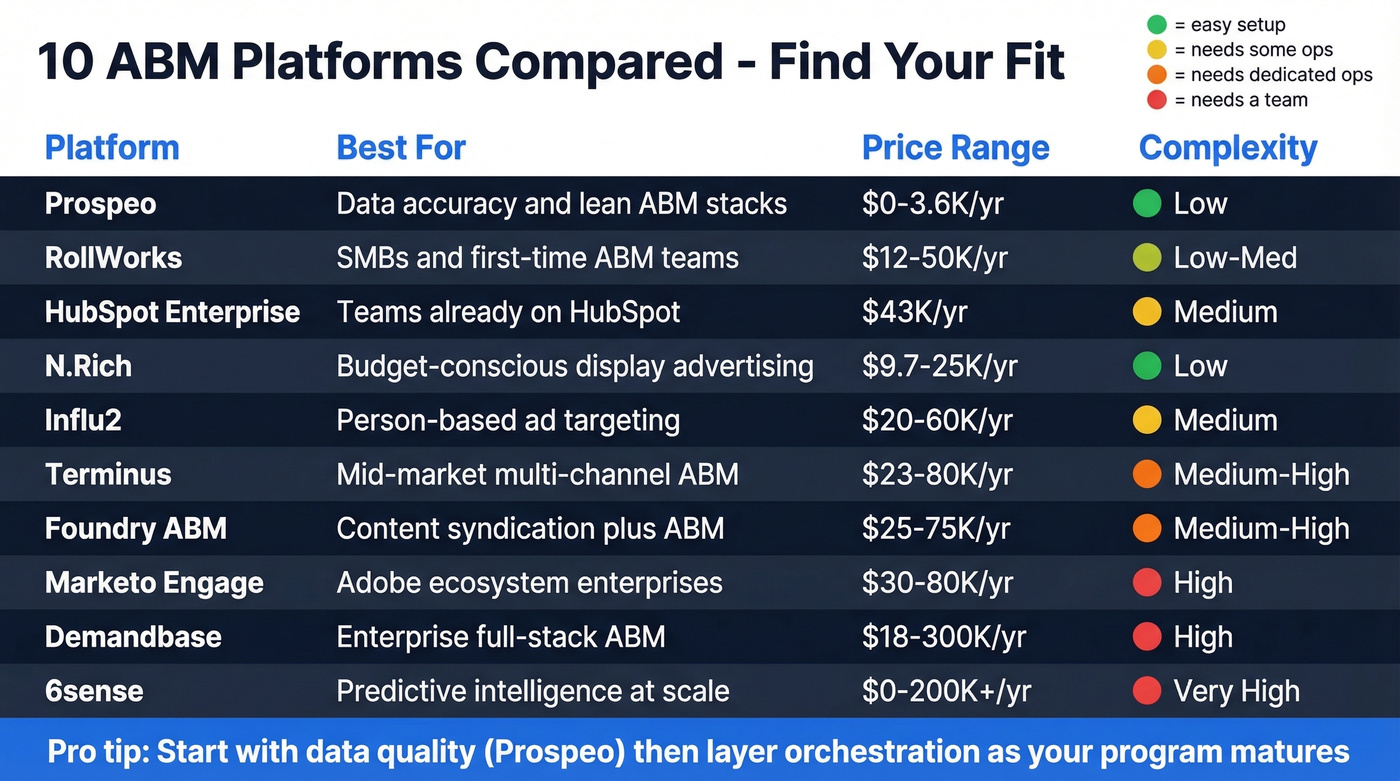
Every tool below was evaluated on pricing transparency, data quality, ease of adoption, and how well it serves its target buyer. We've organized them from most accessible to most complex.
Prospeo - ABM Data Accuracy Leader
Use this if you need a rock-solid data foundation for your ABM program - verified emails, mobile numbers, and intent signals - without committing to a six-figure platform.
Prospeo's database covers 300M+ professional profiles with 98% email accuracy and a 7-day data refresh cycle. The industry average refresh is six weeks. That gap matters when you're running personalized sequences to a CFO who changed jobs three weeks ago.

The 30+ search filters are built for ABM workflows: buyer intent powered by Bombora across 15,000 topics, technographic filters, job change signals, headcount growth, department-level headcount, and funding data. You're not just finding contacts - you're finding in-market contacts at companies showing the exact buying signals you care about.
With clean data feeding their outbound sequences, Snyk's 50-person AE team saw bounce rates drop from 35-40% to under 5% and AE-sourced pipeline grow 180%, generating 200+ new opportunities per month.
Pricing: Free tier with 75 emails/month, then roughly $0.01 per email - about $1,200-$3,600/year at mid-market volumes. No contracts. No sales calls required.
Demandbase - Enterprise ABM Powerhouse
Demandbase is the platform you buy when ABM isn't a pilot anymore - it's a core go-to-market motion with executive sponsorship and a dedicated ops team.
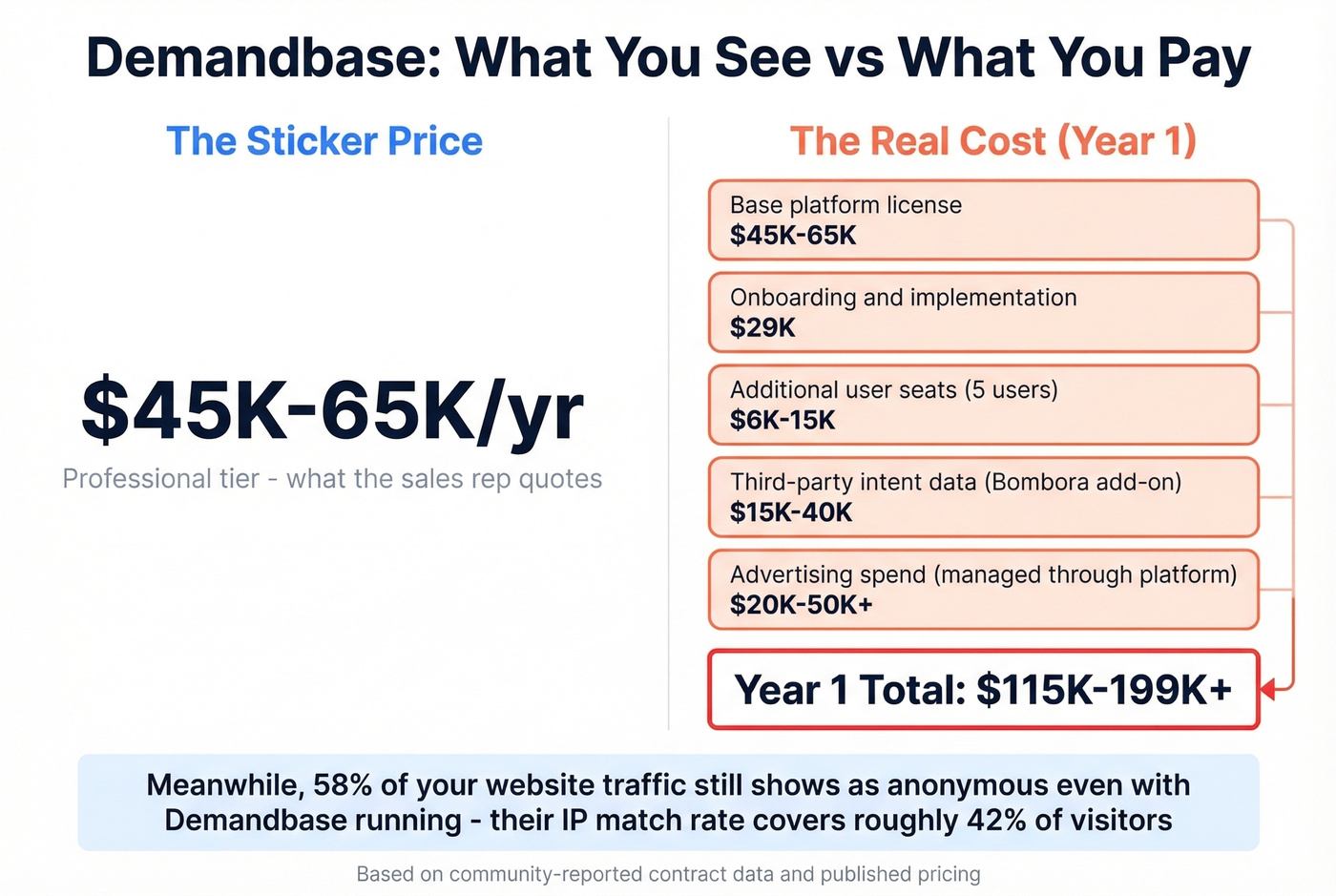
The platform combines account identification, intent data, AI-powered personalization, account-based advertising, and analytics into a single suite. It's genuinely impressive in scope. Demandbase One is rated 4.5/5 on Gartner Peer Insights across 261 ratings, and their benchmark data shows top B2B marketers achieve 81% higher ROI with ABM.

Here's what nobody else will tell you: Demandbase's IP-based account identification matches roughly 42% of website visitors to accounts. That means 58% of your traffic remains anonymous even with the platform running. It's still one of the strongest IP match rates in the category, but if you're expecting full visibility, recalibrate now.
The money: median contract lands around $65,000/year. Starter runs $18K-$24K, Professional $45K-$65K, Enterprise $70K-$300K+. Onboarding is ~$29K. Add visitor deanonymization, personalization modules, and advertising - you're looking at real enterprise spend.
If your team is under 10 people, Demandbase is usually overkill. For companies with 200+ employees, dedicated marketing ops, and ABM budgets north of $75K/year, it remains one of the most complete platforms available.
6sense - Predictive Intelligence (at a Price)
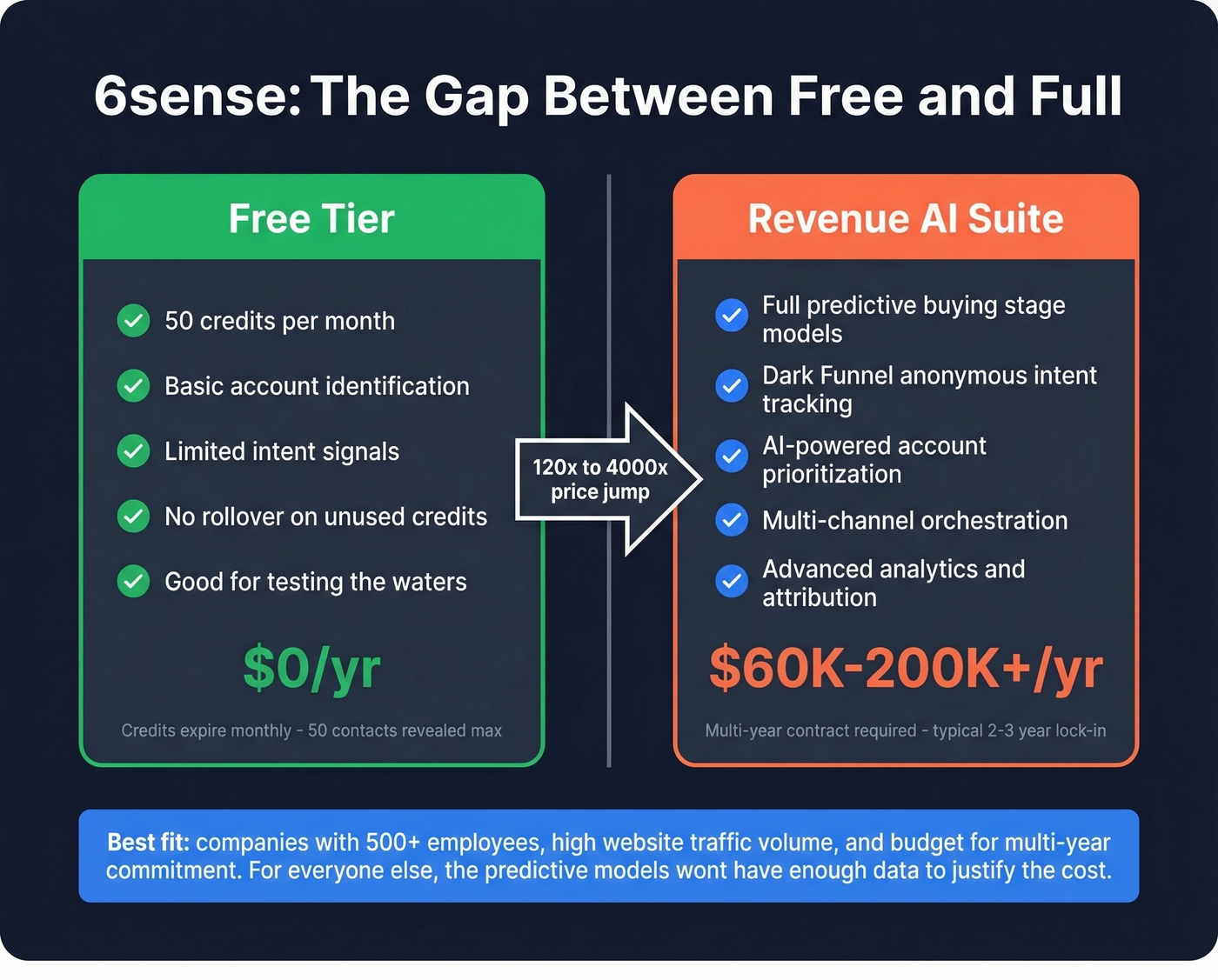
6sense's pitch is the "Dark Funnel" - anonymous buying behavior happening before prospects fill out a form. Their AI models predict which accounts are in-market and at what buying stage, which is genuinely powerful when it works.
| Pros | Cons |
|---|---|
| Best-in-class predictive models | $60K-$200K+/yr with multi-year lock-in |
| Free tier with 50 credits/month | Credits expire monthly, no rollover |
| Strong anonymous intent detection | Steep learning curve |
| Growing adoption across ABM teams | Requires substantial data volume to train |

Each credit unlocks one email or phone number, so 50 free credits means 50 contact reveals per month. The full Revenue AI suite starts at $60,000-$100,000/year and scales to $200K+ with mandatory multi-year contracts. One example: $120,000 for the first year with a two-year commitment.
The consensus on Reddit and G2 consistently flags the multi-year lock-in as the biggest pain point. The predictive models require clean, substantial data to train on - smaller companies with limited website traffic won't get the same value as a mid-market org feeding the system thousands of account signals.
For companies under 500 employees, 6sense is usually the hardest option to justify. If you have the data volume and budget, the predictive accuracy is unmatched. If you don't, you're paying Ferrari prices for a car you can't take out of second gear.
RollWorks - Best for SMBs
RollWorks is the most accessible dedicated ABM platform on the market. At $12K-$50K/year, it's priced for teams running their first real ABM program without the budget for Demandbase or 6sense.
The platform covers account identification, account-based advertising, and basic engagement analytics. It integrates cleanly with HubSpot and Salesforce, which matters because most SMBs already live in one of those ecosystems. Multiple editorial comparisons position RollWorks as the go-to for new-to-ABM teams.
The tradeoffs are real: limited advanced analytics compared to 6sense, fewer enterprise-scale features, and less sophisticated intent modeling. But for a 10-person marketing team targeting 50-200 accounts, RollWorks delivers the core ABM workflow without the complexity tax. This is where most teams should start.
HubSpot Marketing Hub - For Existing Users
If you're already running HubSpot, the native ABM features in Marketing Hub Enterprise ($43,200/year) are the path of least resistance. Marketing Hub Professional starts around $800/month for teams that want workflows and automation without going all the way up-market.
HubSpot's ABM works well for small target account lists. Under 50 accounts, you can build company-level workflows, personalize emails, and track engagement without leaving the platform. Beyond that, things get messy.
One practitioner on r/hubspot described running ABM for just 18 accounts with unique landing pages and personalized emails - and called the "18 separate workflows" approach "insane." They couldn't reliably update contact properties automatically and lacked coding resources for smart content. That's HubSpot ABM at its ceiling: functional but operationally brittle once you push past basic use cases.
Use this if you're already paying for HubSpot Enterprise and targeting fewer than 50 accounts. You'll outgrow it fast beyond that.
Terminus - Full-Lifecycle ABM
Your VP of Marketing wants ads, email, web personalization, chat, and direct mail all orchestrated from one dashboard with account-level attribution. Terminus is built for exactly this.
The median contract sits around $23K/year, scaling up to $250K+ for enterprise deployments. Implementation takes about a month, and many teams take ~12 months to see meaningful ROI. That's a long payback period. The setup complexity - configuring modules, integrating data sources, training the team - is the main friction point.
Strong multi-channel orchestration, but budget 12 months before expecting pipeline impact.
N.Rich - Most Underrated ABM Platform
N.Rich starts at $9,750/year with a free 30-day trial, making it the cheapest dedicated ABM platform we've found.
The feature set punches well above its price: account list builder, dynamic ICP scoring, first- and third-party intent data, proprietary account-based ads, and real-time opportunity attribution. For mid-market companies that want end-to-end ABM without Demandbase pricing, N.Rich deserves a serious look. The 30-day trial means you can validate the platform against your ICP before committing a dollar.
Marketo Engage - Enterprise Automation
Marketo Engage runs $30K-$80K+/year and is built for larger organizations with dedicated marketing ops teams. The ABM capabilities are strong but sit inside a broader marketing automation platform with a notoriously steep learning curve and high setup costs. If you don't have a Marketo admin on staff, budget $80K-$120K/year for the platform plus the person to run it. That's the real cost nobody quotes you.
Influ2 - Person-Level ABM Ads
Most ABM ad platforms target accounts. Influ2 targets individual decision-makers - the actual humans on the buying committee. That person-level precision is its differentiator and earned it a G2 editorial pick. Expect to pay ~$20K-$60K/year. Best suited for teams that have nailed their account list and want to go deeper on ad engagement with specific buying committee members rather than blanketing an entire company.
Foundry ABM - Intent-Driven Engagement
Formerly Triblio, Foundry ABM combines intent data with campaign orchestration. Pricing runs ~$25K-$75K/year. It's a solid mid-market option for teams that prioritize intent signals as the starting point for their ABM plays, though it lacks the brand recognition and ecosystem depth of Demandbase or 6sense. Think of it as the mid-market alternative when N.Rich feels too lightweight and Demandbase feels too heavy.
Choosing the Right ABM Solution
Let's break this down by team size and maturity, because that's what actually determines fit.
| Segment | Best Platform | Budget | ABM Maturity |
|---|---|---|---|
| SMB (<50 accounts) | RollWorks or HubSpot if you're already on it | <$25K/yr | Beginner |
| Mid-market (50-500 accounts) | N.Rich or Terminus for multi-channel | $25K-$75K/yr | Intermediate |
| Enterprise (500+ accounts) | Demandbase or 6sense if you have the data volume | $75K+/yr | Advanced |
Regardless of which orchestration platform you choose, the data layer underneath determines whether your campaigns actually reach the right people. A $65K platform running on stale contact data is worse than a $15K stack with verified emails and fresh intent signals.
ABM Mistakes That Kill ROI
Starting without a defined ICP. If you can't describe your ideal account in specific firmographic and technographic terms, no platform will save you. Define it first, then buy software. (If you need a starting point, use an ideal account template.)
Measuring MQLs instead of account engagement. ABM flips the funnel. Tracking individual lead scores misses the point entirely. Track how many contacts at the account are interacting, across how many channels, at what frequency.
Sending generic content to "target" accounts. Putting 200 companies on a list and blasting the same nurture sequence isn't ABM - it's email marketing with extra steps.
Ignoring data quality. You launch a personalized campaign to 50 high-value accounts. Twenty-two percent of your emails bounce. Your domain reputation takes a hit, deliverability drops across all campaigns, and the CMO asks why the pilot failed. Bounce rates above 5% actively damage your sender reputation and undermine every downstream metric. In our experience, this is the single most common reason ABM pilots get killed before they have a chance to work. (More on email bounce rate benchmarks and fixes.)
Tracking vanity metrics. Impressions and ad clicks feel good in a dashboard. Pipeline generated and revenue influenced are what keep ABM programs funded.
Build an ABM Stack Under $25K/Year
Not every team needs a $65K platform. Here's a stack that delivers real ABM results for under $25K/year:
- Data + intent: Prospeo (~$100-$300/month) - 300M+ profiles, 15,000 intent topics, 98% email accuracy, 7-day refresh
- Automation + CRM: HubSpot Marketing Hub Professional (starts around $800/month) - workflows, email sequences, basic ABM features
- Advertising: LinkedIn Ads + Google Display - direct spend, no platform markup
Total: roughly $12K-$15K/year before ad spend. That's less than a quarter of the median Demandbase contract, and it covers the core ABM workflow: identify in-market accounts, find verified contacts on the buying committee, run personalized sequences, and retarget with ads. If you're building lists manually, consider how to automate target account lists without adding a six-figure suite.
The Reddit practitioner who found enterprise ABM tools "incredibly expensive" for their niche market? This is the stack they should've built.
Running ABM on a lean stack? Prospeo's 30+ filters - intent signals, technographics, job changes, headcount growth - let you build precision account lists without a $65K platform contract. Snyk's 50 AEs cut bounce rates from 35% to under 5% and grew pipeline 180%.
Get enterprise ABM data at $0.01 per email. No contracts, no sales calls.
FAQ
What is account-based marketing software?
ABM software aligns sales and marketing around specific target accounts rather than broad lead generation. It typically supports account identification, intent tracking, multi-channel orchestration, and account-level analytics. Most platforms range from $10K to $300K+ per year depending on feature depth.
How long does ABM take to show ROI?
Most teams report 6-12 months for measurable pipeline impact from a dedicated platform. Lighter stacks targeting fewer than 50 accounts can show results in a single quarter, especially when paired with high-accuracy contact data that keeps bounce rates under 5%.
Can you run ABM without a dedicated platform?
Yes - many teams under 50 accounts use a CRM, a data provider for verified contacts and intent signals, and native ad platforms. A dedicated ABM platform adds value when you scale beyond 100+ accounts or need multi-channel attribution across ads, email, and events.
What's the difference between ABM and demand generation?
Demand gen casts a wide net for inbound leads. ABM flips the model - you select accounts first, then run targeted campaigns to buying committees within those accounts. Most B2B teams blend both approaches, using demand gen for pipeline volume and ABM for high-value deal acceleration.
How do you choose the right ABM tool?
Start with your team size, target account count, and annual budget. SMBs under 50 accounts can lean on a CRM and data provider. Mid-market teams running 50-500 accounts benefit from dedicated platforms like N.Rich or RollWorks. Enterprise organizations with 500+ accounts and six-figure budgets should evaluate Demandbase or 6sense.