

Account Based Marketing Tactics That Actually Move Pipeline in 2026
Your SDR just sent 500 "personalized" emails to target accounts. 180 bounced. Another 200 landed in spam. The remaining 120 got a 2% reply rate - mostly "please remove me from your list."
That's not ABM. That's expensive noise.
Here's the uncomfortable truth: 91% of B2B marketers use intent data, but only 24% report exceptional ROI. The gap isn't strategy - everyone knows you should target high-value accounts with personalized outreach. The gap is execution. Bad contact data, no scoring framework, and email-only cadences are the three failure modes killing most programs. Practitioners on r/b2bmarketing put it bluntly: enterprise ABM platforms are "expensive reminders to sell to your ICP." Let's break down the frameworks first, then the 12 account based marketing tactics that plug into them - with scoring models, cadences, and budget benchmarks you can actually use.
What's Changed in 2026
Three shifts have reshaped how ABM works this year.
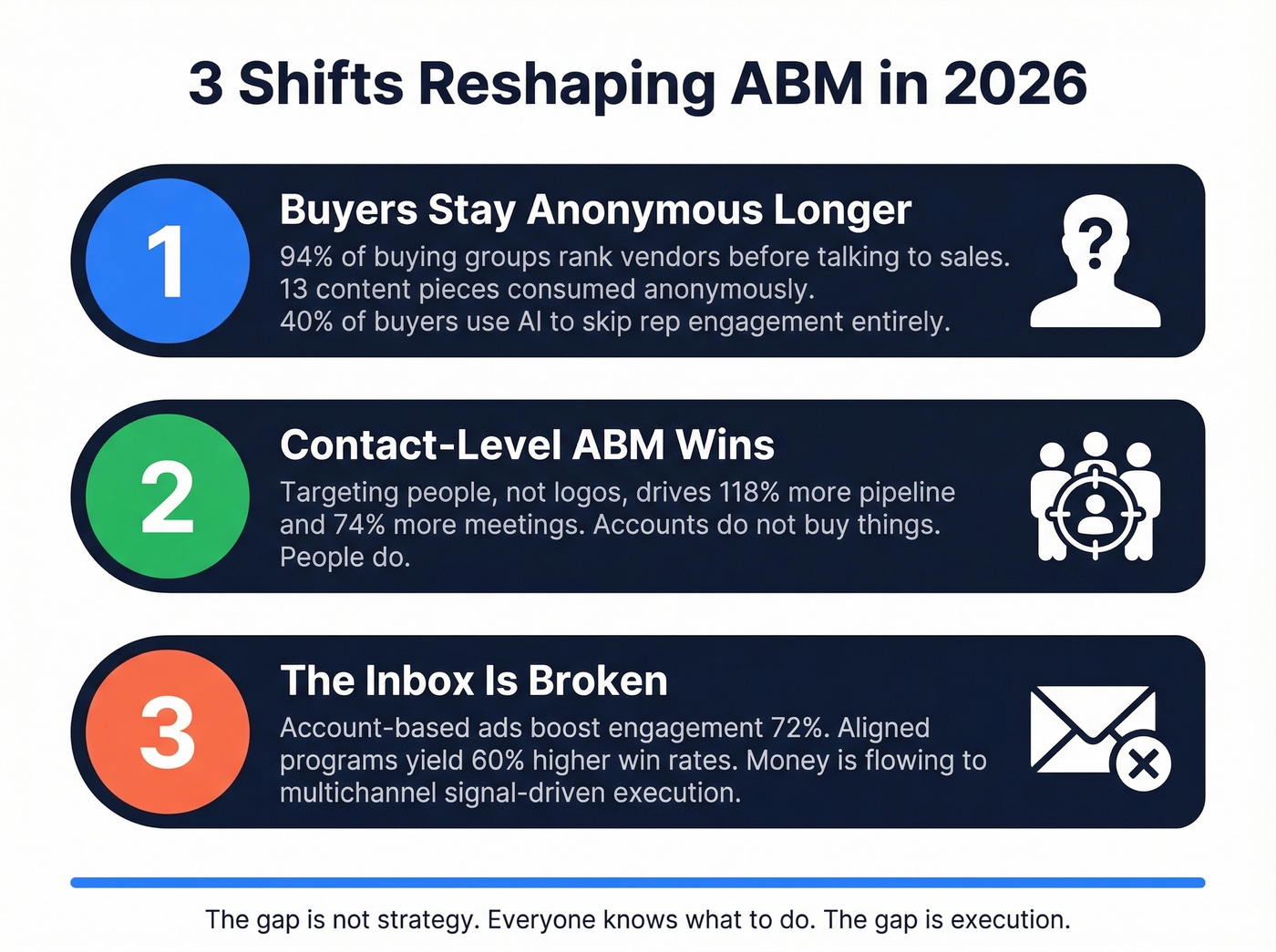
Buyers stay anonymous longer. 94% of buying groups rank their preferred vendors before ever talking to sales, consuming an average of 13 content pieces during research - overwhelmingly anonymously. Meanwhile, 73% of leaders say AI has changed how buyers discover content, and 40% of buyers say AI makes it easier to find information without engaging a rep. Your window to influence is shrinking fast.
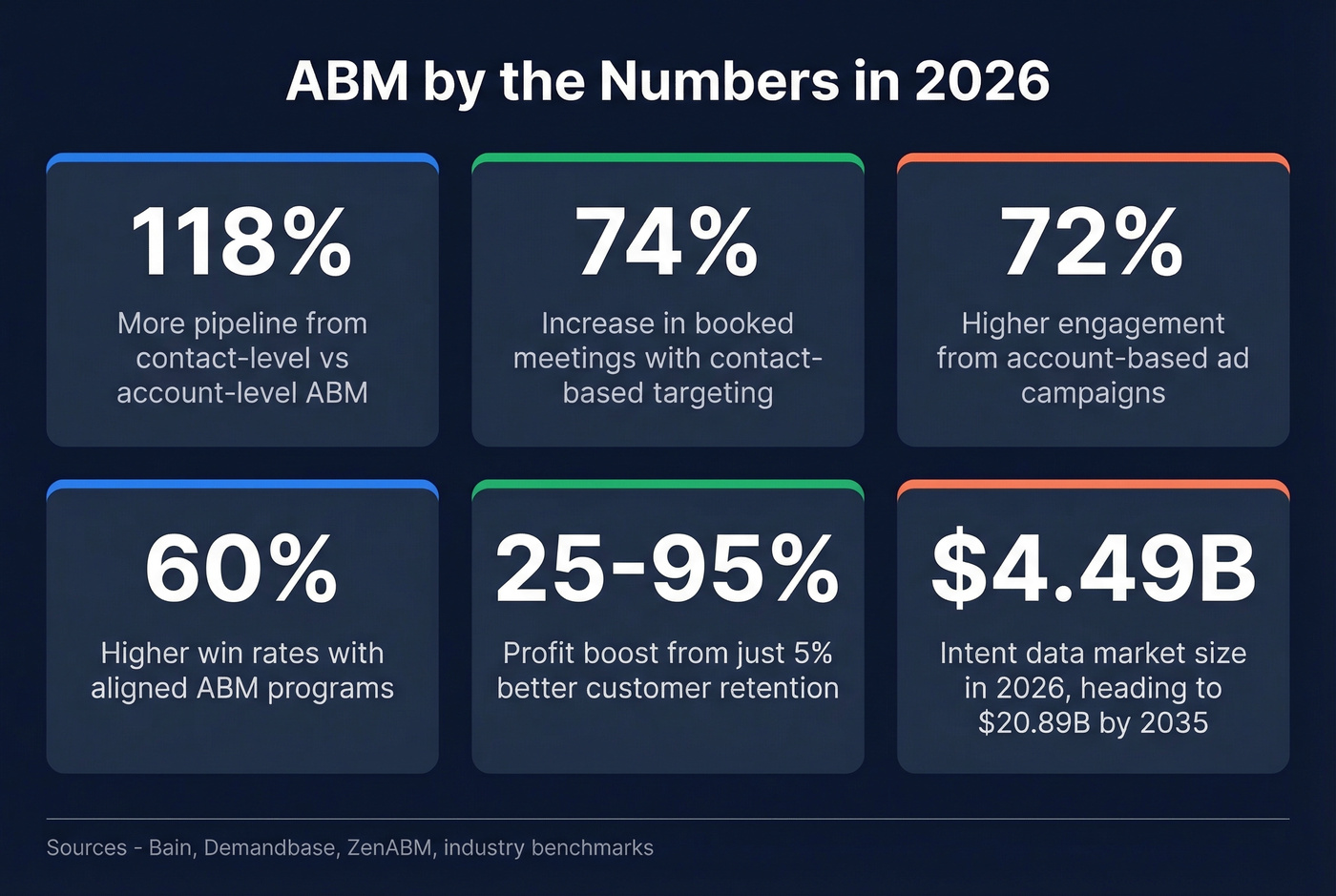
Contact-level ABM outperforms account-level. Targeting individual decision-makers rather than company logos increases pipeline conversion by up to 118% and booked meetings by 74%. The term "contact-based marketing" keeps surfacing in practitioner circles, and for good reason. Accounts don't buy things. People do.
The inbox is broken. Account-based advertising campaigns increase customer engagement by 72%, and aligned ABM programs yield 60% higher win rates. The intent data market hit $4.49B in 2026, projected to reach $20.89B by 2035. Money is flowing toward signal-driven, multichannel execution - not batch-and-blast email. The tooling landscape is consolidating too: HubSpot absorbed Clearbit into Breeze Intelligence, HG Insights acquired TrustRadius. Platforms are merging, which means standalone data accuracy matters more than ever.
Build Your Foundation First
Every failed ABM program we've seen shares the same root cause: they skipped the foundation and jumped straight to tactics.
Define Your ICP From Closed-Won Data
Your ICP isn't a brainstorming exercise. Pull your last 12-18 months of closed-won deals and sort by three dimensions: highest lifetime value, fastest sales cycles, and lowest churn. That intersection is your ICP.
Layer in firmographics like industry, headcount, and revenue range alongside technographics - what tools they already use that complement yours. Map the buying committee roles that appeared in those deals: who initiated, who championed, who signed. Then build something most teams skip: a non-ICP disqualifier list. Incompatible tech stacks, regulated industries you can't serve, company sizes where your product doesn't fit. Disqualifiers save more time than qualifiers.
Narrow your total addressable market to a target account list of 1,000-5,000 accounts - any larger and you're doing demand gen, not ABM. Use a 90-day lookback rule to find warm accounts that engaged but didn't convert. They're often your best starting targets.
Score and Tier Your Accounts
Businesses using account scoring see a 77% boost in lead generation ROI versus those that don't. A point-based model across three dimensions works best: ICP fit covering firmographics and technographics, engagement covering website visits and content downloads, and intent covering first-party and third-party signals.
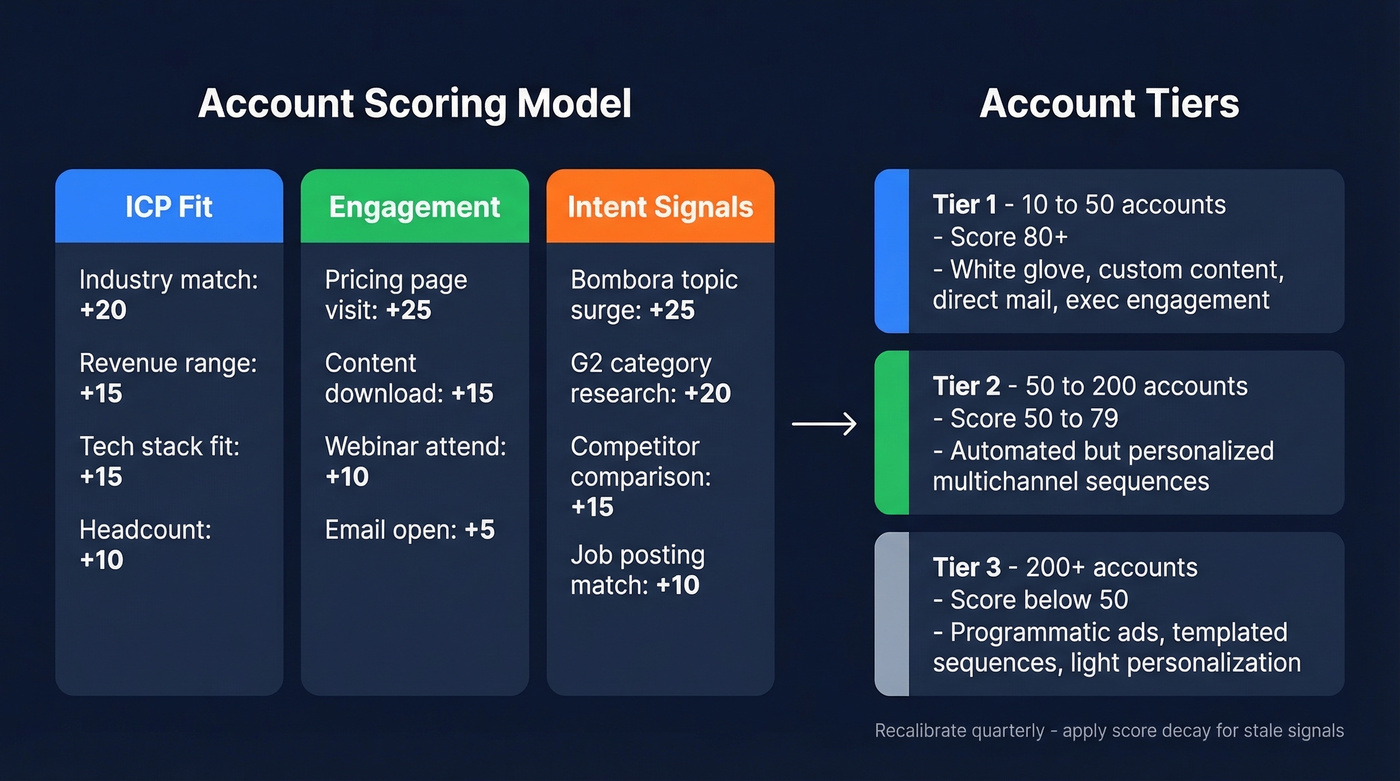
Tier your accounts based on total score:
- Tier 1 (10-50 accounts): White-glove treatment. Dedicated pods, custom content, direct mail, executive engagement.
- Tier 2 (50-200 accounts): Automated but personalized. Multichannel sequences with account-specific messaging.
- Tier 3 (200+ accounts): Mostly automated. Programmatic ads, templated sequences, light personalization.
Implement score decay - an account that visited your pricing page six months ago isn't the same as one that visited yesterday. Recalibrate quarterly against actual pipeline outcomes.
Map Buying Committees and Enrich Contacts
For each Tier 1 and Tier 2 account, identify 5-8 contacts across the buying committee: decision-makers, champions, and end users. This is where most programs break down. You can't run contact-level ABM with bad contact data.

Prospeo's database covers 300M+ professional profiles with 30+ search filters including buyer intent across 15,000 topics via Bombora, technographics, job changes, and headcount growth. Filter by accounts showing active intent signals, pull verified emails and direct dials for your buying committee, and push them straight to your CRM with native Salesforce and HubSpot integrations. The 98% email accuracy and 7-day refresh cycle mean you're not torching your domain reputation on stale data - the silent killer of most ABM sequences.
12 ABM Tactics That Drive Results
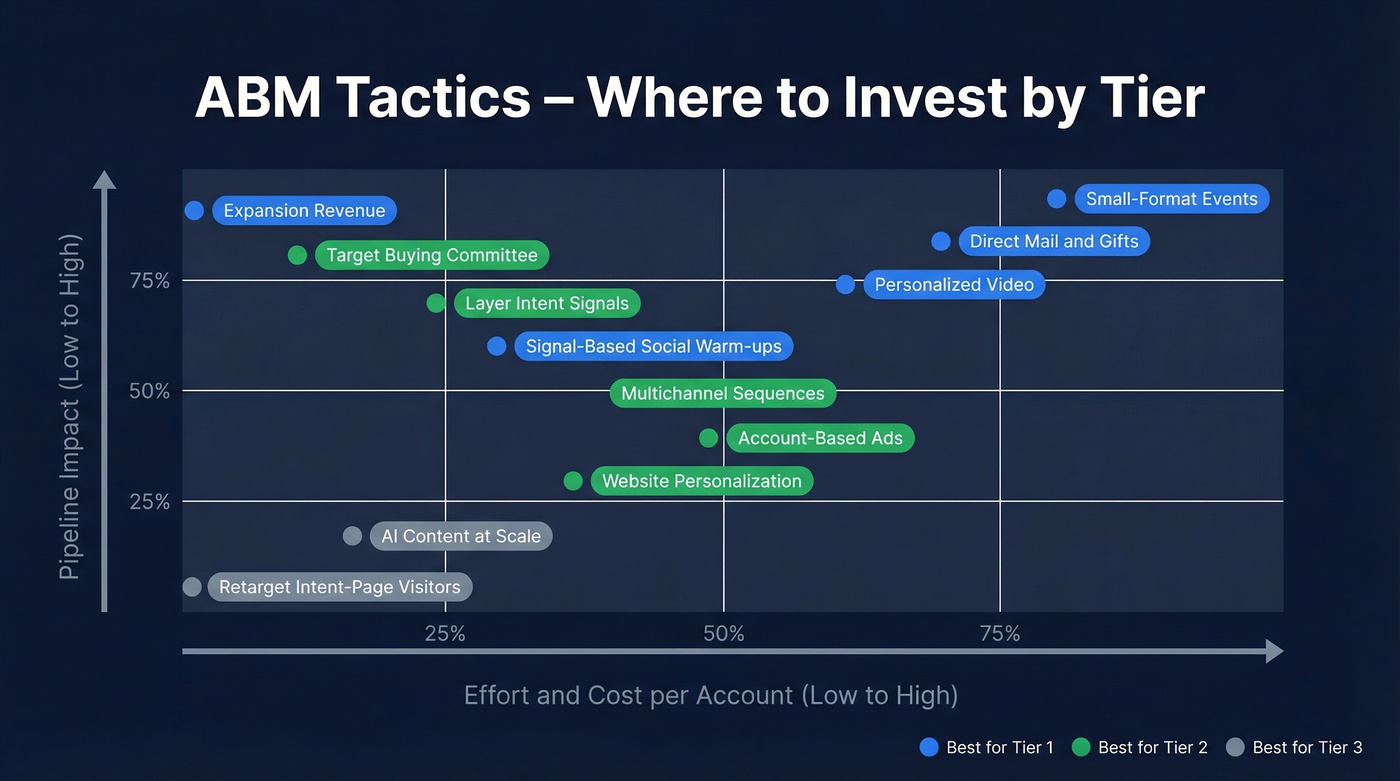
Frameworks are useless without execution. Here are 12 tactics, each mapped to the tier where it delivers the most impact.
1. Start With Expansion Revenue
Your best ABM targets are already paying you. A Bain study found that a 5% increase in customer retention can boost profits by 25-95%. Watch for renewal triggers, feature launches, and usage spikes. Give your top customers Tier 1 treatment - custom QBRs, executive sponsors, expansion-specific content. Most teams chase new logos and ignore the revenue sitting in their CRM.
2. Target the Buying Committee
Stop targeting company names. Target the 5-8 humans who actually make the decision. Contact-level ABM drives up to 118% more pipeline conversion than account-level approaches. Identify the economic buyer, the technical evaluator, the champion who'll sell internally, and the end users who'll block adoption if ignored.
One mid-market SaaS team we spoke with made this shift and moved from 2% reply rates to 14% within 60 days - simply by reaching the right people instead of the right domains. This is one of the most impactful B2B targeting moves available, and it costs nothing beyond better data.
3. Layer Intent Signals for Timing
Intent doesn't replace ICP - it accelerates it. Track three layers: first-party signals like pricing page visits and high-value content downloads, second-party signals from G2 and TrustRadius research activity, and third-party topic surges from Bombora. Only track signals that correlate with your actual closed deals. Random intent spikes without ICP fit are just noise.
4. Run Signal-Based Social Warm-Ups
The mistake: sending a cold email to a C-suite buyer who's never heard of you. The fix: spend 7-10 days engaging with Tier 1 contacts on social before any pitch. Comment on their posts, share their content, react to their updates.
This is the most underrated tactic on the list because it doesn't feel like one. Non-salesy door openers work best - podcast invitations, speaker slot offers, sharing relevant research. The goal is name recognition before the first email lands.
5. Build Multichannel Sequences
Here's the cadence template most ABM guides won't give you:
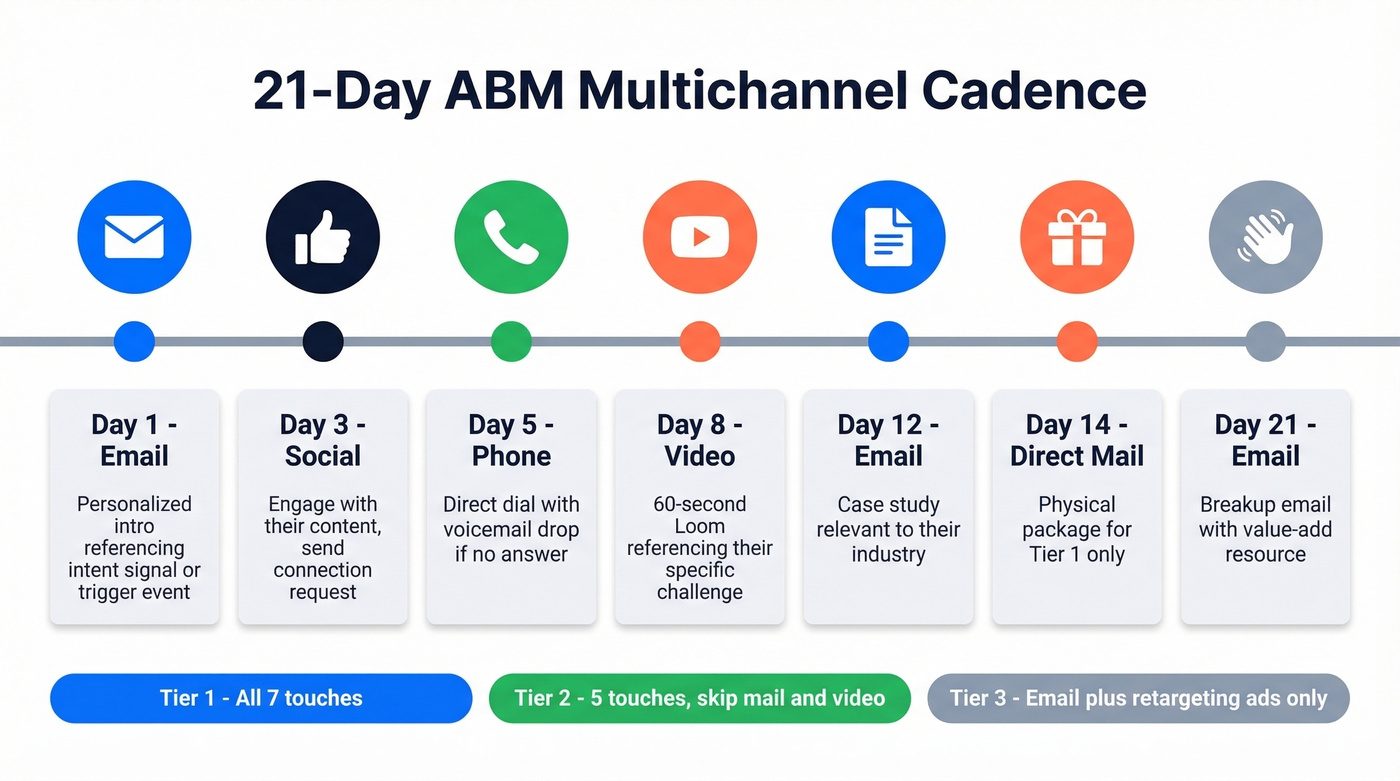
| Day | Channel | Action |
|---|---|---|
| 1 | Personalized intro referencing intent signal or trigger event | |
| 3 | Social | Engage with prospect's content, send connection request |
| 5 | Phone | Direct dial with voicemail drop if no answer |
| 8 | Video | 60-second Loom referencing their specific challenge |
| 12 | Case study relevant to their industry | |
| 14 | Direct mail | Physical package (Tier 1 only) |
| 21 | Breakup email with value-add resource |
Tier 1 accounts get all seven touches. Tier 3 gets email plus retargeting ads. A mediocre message across four channels outperforms a brilliant email that gets ignored.
6. Personalize Video Outreach
Record 60-second videos referencing the prospect's specific challenge, recent company news, or a trigger event. Loom runs ~$12.50/user/month; Vidyard offers free recording with paid plans from around $19/month. Reserve this for Tier 1 accounts where a $50K+ deal is on the line - it doesn't scale to hundreds of accounts, and it shouldn't.
7. Run Account-Based Advertising
Display and social retargeting for your target account list delivers 60% higher win rates and 16% more opportunities tracking to closed-won when aligned with ABM. The ZenABM 2026 benchmark report analyzed $5.5M in ad spend across 211 companies and 161,256 ads. Start with retargeting website visitors from target accounts - it's the highest-ROI ad motion in ABM.
8. Retarget Intent-Page Visitors
Pricing page visitors, product comparison page visitors, and high-value content downloaders deserve their own retargeting audiences. Use a 90-day lookback window. Serve them case studies and ROI calculators - not top-of-funnel blog posts. These people are already evaluating. Meet them where they are.
9. Send Direct Mail and Gifts
Physical packages get opened. Digital messages don't. A well-timed package to a Tier 1 decision-maker, paired with a digital follow-up within 48 hours, creates a memorable touchpoint. Cost per touch is high, so reserve this for accounts worth $50K+ in potential revenue. Use QR codes or personalized URLs for tracking attribution.
10. Host Small-Format Events
Look - roundtables, dinners, and workshops with 8-15 attendees from target accounts are the highest-converting ABM tactic we've seen. Engineer face-to-face interactions between your team and buying committee members. Bring the full pod - AE, SDR, and ABM manager - to hunt in packs.
Practitioners at a recent ABM panel described this approach as the single best way to compress deal cycles. One dinner with the right six people beats a month of email sequences.
11. Personalize Your Website
IP-based or cookie-based personalization lets you show industry-specific case studies, custom CTAs, and account-specific messaging to visitors from target accounts. Tools like Mutiny, Optimizely, or HubSpot's smart content make this achievable without engineering resources. When a VP from a target account hits your site and sees their industry's logo and use case front and center, conversion rates jump.
12. Use AI for Content at Scale
31% of marketers struggle to personalize outreach at scale. AI closes this gap - dynamic landing pages, personalized ad creative, and email variations give Tier 2-3 accounts near-Tier-1 treatment. You're not writing 500 custom emails, but you're not sending the same template to everyone either. This is what makes 1:many ABM viable without a 20-person team.
Late-Stage Tactics: Closing the Deal
The tactics above cover awareness through evaluation, but the most overlooked gap in ABM programs is what happens after an opportunity is created. Late-stage motions focus on accelerating deals already in pipeline - and they're where the highest ROI lives.
For Tier 1 accounts in active evaluation, deploy executive-to-executive outreach where your C-suite engages their C-suite directly. Build custom business cases with ROI models tailored to the prospect's financials. Arrange reference calls with customers in the same industry. Send competitive battle cards to your champion so they can sell internally on your behalf. These closing motions are what separate teams that create pipeline from teams that actually win it.

Contact-level ABM only works when you can actually reach the buying committee. Prospeo gives you 300M+ profiles with 30+ filters - including intent data across 15,000 Bombora topics, technographics, and job changes - so you can pull verified emails and direct dials for every Tier 1 account. 98% email accuracy. 7-day refresh. No more bounced sequences torching your domain.
Stop targeting logos. Start reaching the 5-8 people who sign the check.
The ABM Pod Structure
Organizations with aligned sales and marketing teams grow revenue 24% faster. The most effective ABM teams operationalize this alignment through pods: one AE, one SDR, and one ABM manager working a shared set of Tier 1 accounts.
The AE owns the relationship and the close. The SDR runs the multichannel sequences and books meetings. The ABM manager orchestrates ads, content, events, and reporting. For Tier 1 accounts, a dedicated pod is non-negotiable. Tier 2-3 accounts share pod resources, with the ABM manager running more automated plays.
Most ABM programs fail because marketing runs campaigns in isolation and throws "engaged accounts" over the wall to sales. The pod structure kills that dynamic. Weekly syncs, shared dashboards, and joint account plans keep everyone aligned. As one practitioner put it at a recent Dreamdata panel, "ABM is just good marketing" - the pod is what makes it operational instead of aspirational.
Measuring What Matters
The unit of truth in ABM is the account, not the lead. If you're still measuring MQLs, you're measuring the wrong thing. Buying decisions roll up from multiple stakeholders to the account story - a single MQL tells you almost nothing.
Define your account lifecycle stages: Target, Marketing Engaged, Sales Engaged, Opportunity, Closed Won/Lost. Marketing Engaged means three or more contacts from the account have interacted with your content. Sales Engaged means an AE has had a live conversation. Track marketing qualified accounts rather than marketing qualified leads.
The three KPIs that matter most are pipeline velocity (how fast accounts move through stages), average deal size (ABM should increase this), and win rate comparing ABM accounts versus non-ABM accounts. Demandbase's benchmark report found that marketing teams focused on ABM expected roughly an 8% increase in revenue - conservative but real. Use decaying engagement scores to reflect long sales cycles. Run a weekly operating cadence: review account progression, flag stalled accounts, feed insights back to the pod. Quarterly, recalibrate your scoring model against actual closed-won data.
ABM Tech Stack and Budget
You can run effective ABM for under $500/month. Or spend $100K+. The tactics are the same - the scale and automation differ. Industry guidance suggests dedicating 30-50% of marketing resources to ABM when revenue targets are ambitious.
Here's the thing: if your average deal size sits below $10K, skip ABM entirely. Run demand gen. ABM's ROI only kicks in when the deal size justifies the per-account investment. Below that threshold, you're spending $500 in touches to close a $7K deal.
| Tool | Category | Starting Price | Best For |
|---|---|---|---|
| HubSpot CRM | CRM | Free | Foundation for any ABM program |
| Prospeo | Contact data + intent | Free tier (~$0.01/email) | Verified emails, direct dials, intent signals |
| Apollo | Database + sequences | ~$49/user/mo | SMB prospecting with built-in sequences |
| Bombora | Intent data | ~$12K-$40K/yr | Deep topic-level intent coverage |
| Loom | Video outreach | ~$12.50/user/mo | Personalized Tier 1 video |
| Vidyard | Video outreach | Free / ~$19/mo paid | Video at scale across tiers |
| 6sense | ABM platform | Not public | Predictive intent + AI orchestration |
| Demandbase | ABM platform | Not public | ABM orchestration + account-based ads |
Starter stack (under $500/mo): HubSpot free CRM, Prospeo for verified contact data and intent signals, and one paid social channel for retargeting. This gives you enterprise-grade data infrastructure starting free - prove the model before you invest in a platform.
Scale stack ($500-$3K/mo): Add Bombora for deeper intent coverage, upgrade to HubSpot Marketing Pro at ~$800/mo, and layer in a video tool. This is where Tier 2 automation gets serious.
Enterprise stack ($3K+/mo): Full ABM platform like 6sense or Demandbase, dedicated pods, multichannel orchestration, and website personalization. Implementation typically takes 3-6 months for these platforms - budget for that ramp time.
The article says it plainly: bad contact data is the silent killer of ABM programs. Prospeo's 5-step verification and weekly data refresh mean your multichannel cadences hit real inboxes - not spam traps. At $0.01 per email, you can enrich every account on your target list without blowing your ABM budget on a single data vendor.
Drop your bounce rate below 4% like teams already using Prospeo.
Your 30-Day Sprint Plan
The first week is all foundation. Build your ICP from closed-won data, create your account scoring model across ICP fit, engagement, and intent dimensions, and generate your tiered target account list. Start with 25 Tier 1 and 50 Tier 2 accounts - small enough to execute well, large enough to generate learnings.
Week two shifts to contacts and sequences. Map 5-8 buying committee members per Tier 1 account and enrich them with verified emails and direct dials. Design your multichannel sequence using the cadence template above: email plus social plus phone for Tier 1, email plus ads for Tier 2.
Week three is launch. Activate multichannel sequences, start social warm-ups for Tier 1 contacts, launch retargeting ads against your target account list, and send personalized videos to your top 10 accounts. This is where the pod structure earns its keep - every touchpoint should be coordinated across AE, SDR, and ABM manager.
Week four is measurement and iteration. Review account engagement scores and stage progression. Hold your first pod sync to identify what's working, what's stalling, and where to double down. Feed sales feedback into your scoring model and adjust tier assignments based on real engagement data. In our experience, the teams that iterate fastest in this phase are the ones that build durable programs - and these account based marketing tactics compound over every quarter you run them.
FAQ
How is ABM different from lead generation?
Lead gen casts a wide net and measures MQLs. Account based marketing targets specific high-value accounts with personalized, multichannel campaigns and measures pipeline influence, deal velocity, and win rate at the account level. The unit of measurement shifts from individual leads to the account as a whole.
How long does ABM take to show results?
Expect initial engagement signals within 30-60 days - social interactions, ad clicks, website visits from target accounts. Pipeline impact typically appears in 3-6 months, depending on your sales cycle length. Some teams see closed-won influence within 10 months.
What's the difference between 1:1, 1:few, and 1:many ABM?
1:1 ABM is white-glove treatment for 10-50 accounts with fully custom campaigns. 1:few targets 50-200 accounts grouped by shared traits like industry or tech stack. 1:many uses automated, lightly personalized campaigns for 200+ accounts. Most teams run all three tiers simultaneously.
What KPIs should I track for ABM?
Pipeline influenced, deal velocity, win rate, average deal size, and account engagement score. Drop MQLs as your primary metric - they misrepresent account-level buying behavior. Compare ABM account performance against non-ABM accounts quarterly to prove incremental lift.