

Best Account Planning Tools in 2026 (With Pricing)
SDRs get a dozen tools. Account managers get Excel, a static CRM, and a quarterly business review template from 2019. One poster on r/SalesOperations nailed it: "We run $5M accounts on the same tech stack an intern uses to track conference leads." The build-and-forget account plan is practically a meme on r/techsales - you spend a week building an annual plan, then never open it again.
Fewer than 20% of companies have fully embedded account planning into their operations. The gap between knowing this matters and actually doing it well is enormous, and the right tools close that gap - but only if you pick ones that match your team size and process maturity.
Our Picks
| Pick | Best For | Starting Price |
|---|---|---|
| Altify | Enterprise Salesforce teams | $20/user/mo |
| DemandFarm | Mid-market dedicated planning | $50/user/mo |
| Revegy | Visual relationship mapping | $35/user/mo |
| Kapta | Lean KAM teams | $49/user/mo |
Here's the hot take most articles won't give you: teams managing fewer than 100 accounts probably don't need a dedicated planning tool. They need better data on the people inside those accounts. A gorgeous org chart is worthless if the phone numbers and emails in it are six months stale. Get the data layer right first, then layer on planning software when your process demands it.
Why Most Account Plans Fail
Only 28% of sales leaders believe their account management channels actually meet cross-sell and growth targets. That's a staggering failure rate for something every enterprise sales org claims to prioritize.
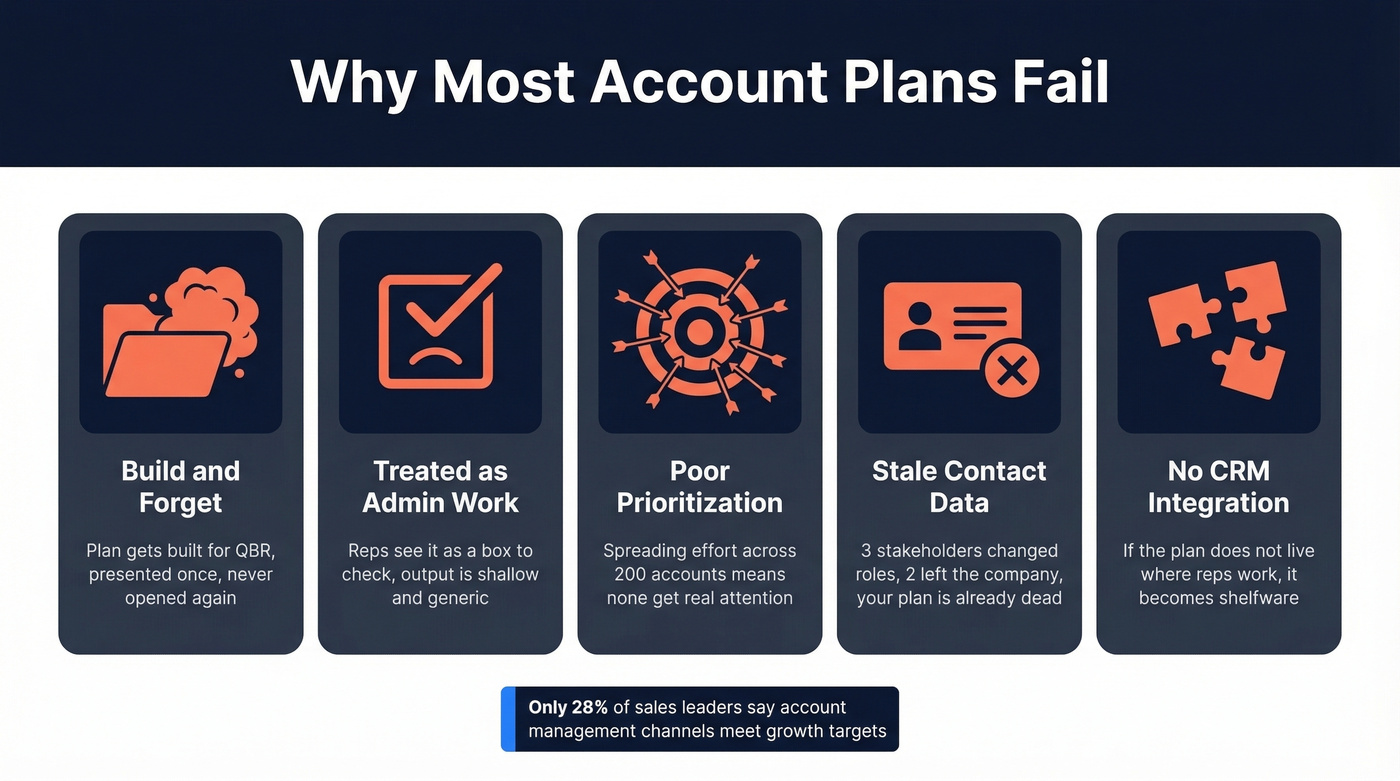
The failure modes are predictable:
- Build-and-forget syndrome. The plan gets built for QBR, presented once, then lives in a folder nobody opens.
- Planning treated as admin work. When reps see it as a box to check, the output is shallow and generic.
- Poor account prioritization. Not every account deserves a full strategic plan. A useful framework: Tier 1 gets 5-10 accounts with deep plans, Tier 2 gets 15-25 with lighter plans, and Tier 3 gets templated coverage. Spreading effort evenly across 200 accounts means none get real attention.
- Stale contact data. You've mapped 11 stakeholders in the buying committee, but three have changed roles and two have left the company. Your plan is already dead.
- No CRM integration. If the plan doesn't live where reps work every day, it becomes shelfware. Every time.
Let's be honest: most account plans don't fail because of bad software. They fail because the underlying data rots faster than the plan gets updated, or because nobody enforces a monthly review cadence. Fix those two problems and even a spreadsheet-based plan can drive real expansion revenue.
The Business Case
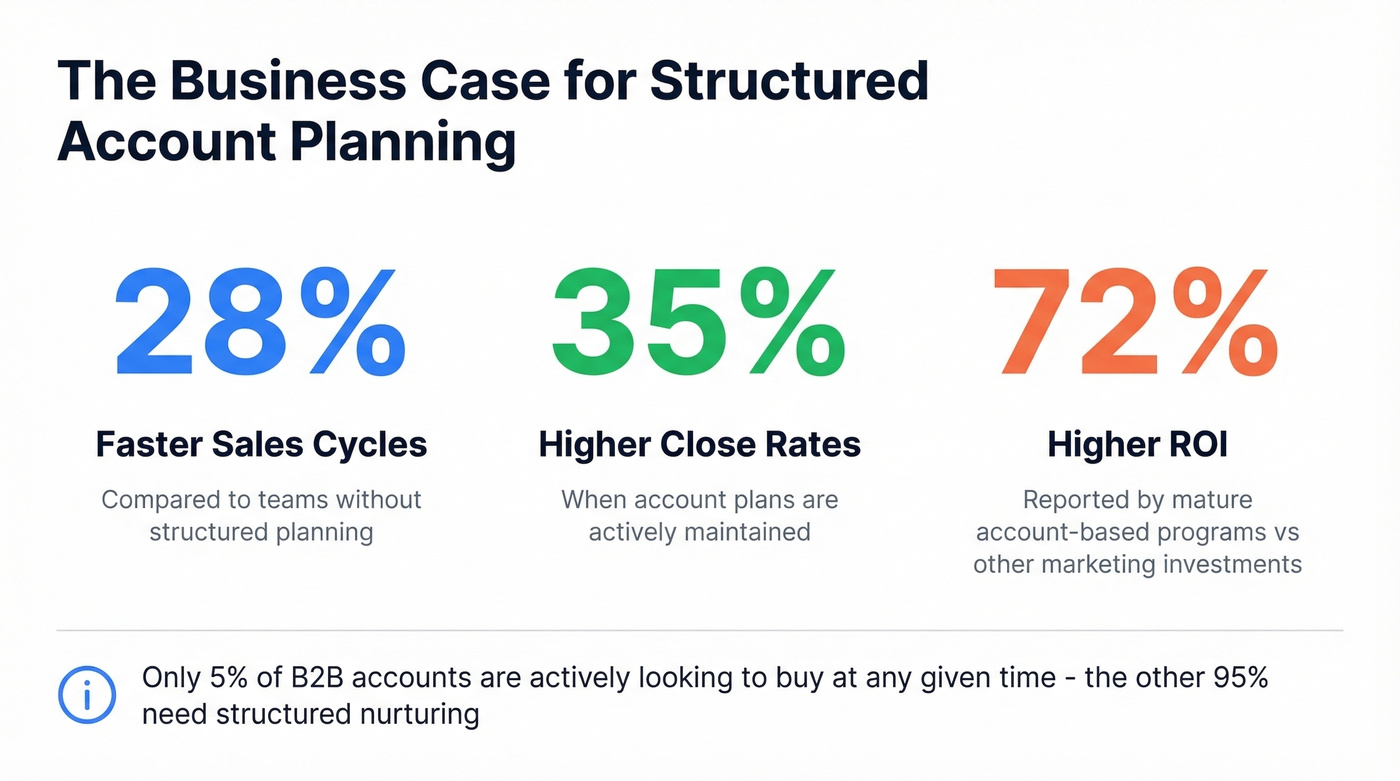
Structured account planning drives 28% faster sales cycles and 35% higher close rates. Mature account-based programs report 72% higher ROI than other marketing investments. Only 5% of B2B accounts are actively looking to buy at any given time, which means the other 95% need exactly the kind of structured nurturing that good account plans provide - and that's where the compound returns show up quarter after quarter.
What to Look For
Not every tool needs every feature. But here's what separates dedicated platforms from glorified note-taking apps:
- Relationship and org chart mapping. B2B deals involve an average of 11 stakeholders. You need to visualize who influences what.
- Whitespace analysis. Which products or services haven't been sold into which business units? This is where expansion revenue hides.
- CRM integration. Salesforce-native matters for enterprise shops. Multi-CRM support matters for everyone else.
- Account health scoring. Automated signals that flag at-risk accounts before renewal conversations get awkward. (If renewals are a big motion for you, pair this with a simple churn analysis model.)
- Collaboration features. Account plans shouldn't live in one rep's head. Cross-functional visibility is the whole point.

Stale contact data kills account plans faster than bad strategy. Prospeo refreshes 300M+ profiles every 7 days - not every 6 weeks - so the 11 stakeholders in your org chart actually have valid emails (98% accuracy) and direct dials (125M+ verified mobiles).
Get the data layer right before you spend $50/user on planning software.
Pricing Comparison
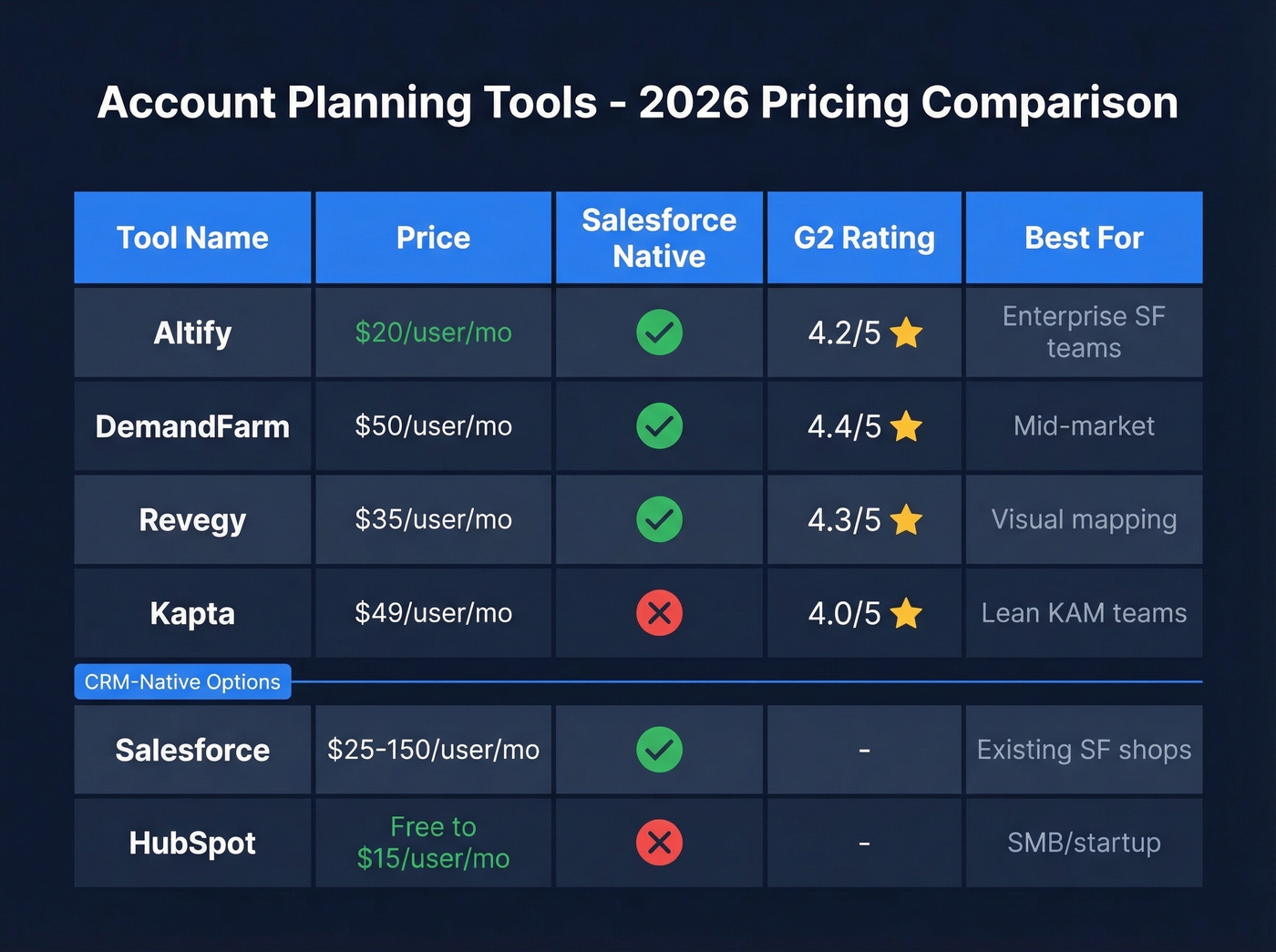
| Tool | Category | Starting Price | SF-Native? | G2 Rating | Best For |
|---|---|---|---|---|---|
| Altify | Dedicated | $20/user/mo | Yes | 4.2/5 (76 reviews) | Enterprise SF teams |
| DemandFarm | Dedicated | $50/user/mo | Yes | 4.4/5 (45 reviews) | Mid-market |
| Revegy | Dedicated | $35/user/mo | Yes | 4.3/5 (40 reviews) | Visual mapping |
| Kapta | Dedicated | $49/user/mo | No | 4.0/5 (1 review) | Lean KAM teams |
| Salesforce | CRM-native | $25-150/user/mo | Yes | - | Existing SF shops |
| HubSpot | CRM-native | Free (up to 2 users) / from $15/user/mo | No | - | SMB/startup |
The Best Dedicated Platforms
Altify
$20/user/mo - 12-month minimum - Salesforce-native
Altify is the gold standard for enterprise Salesforce teams. It's a 100% Salesforce-native application covering relationship mapping, insight mapping, account opportunity mapping (whitespace), and deal qualification. The Account Planning AI Cloud adds AI-assisted research and insights through integrations with the Salesforce/Einstein ecosystem and ChatGPT.

We've tested a lot of relationship mapping tools, and Altify's is genuinely the most intuitive for complex enterprise orgs. Across 76 G2 reviews, users consistently praise the collaboration and transparency it enables across account teams. The biggest complaint? Exporting relationship maps is clunky - users have been requesting simple .png exports for years, and it's still not available. That kind of gap is frustrating when you're paying enterprise prices.
Enterprise implementations with professional services can run well above the $20/user sticker price, so budget accordingly. Use this if you're a Salesforce shop with 50+ reps managing strategic accounts. Skip this if you're not on Salesforce or your team is under 20 people.
DemandFarm
The strongest dedicated option for mid-market teams, and the highest-rated planning tool on G2 at 4.4/5 across 45 reviews.
| Tier | Price | What You Get |
|---|---|---|
| Org Chart only | $20/user/mo | Visual mapping |
| Starter | $50/user/mo | Full planning suite |
| Advanced | $70/user/mo | Analytics + advanced features |
All tiers require a 10-user minimum, so you're looking at $500-700/month to get started. Their official pricing page just says "reach out for pricing" when G2 has the numbers right there. That's a choice.
DemandFarm has multiple AI features marked "Coming soon," including one-click account plan summaries, account health insights, and auto-generated action plans. We'll believe it when we see it ship. Use this if you've outgrown CRM-based planning and want Salesforce-native without Altify's enterprise overhead. Skip this if you have fewer than 10 users who'd actually log in.
Revegy
Most competitor listicles forget Revegy entirely, which is a genuine gap in the conversation. At $35/user/month for the Relationship & Strategy Blueprint module, it's the most affordable dedicated option with serious visual mapping chops.
The integration story is broader than most competitors: Salesforce, Microsoft Dynamics, SAP C4C, and HubSpot are all supported. That multi-CRM flexibility is rare in this category. G2 reviewers give it 4.3/5 across 40 reviews, with consistent praise for visual mapping. The learning curve is real though - several reviewers describe the UI as overwhelming initially before becoming intuitive after a few weeks of daily use.
For teams that prioritize visual relationship intelligence and need multi-CRM support, Revegy beats the field at this price point.
Kapta
$49/user/mo - Enterprise packages $1,000-5,000/mo
Kapta takes a simpler approach to key account management. It's positioned for lean KAM teams that want structure without the complexity of Altify or DemandFarm. The feature set includes account health scoring, interactive org charts, customizable templates, deliverables tracking, reporting, and CRM integration.
Kapta has exactly one review on Capterra at 4.0/5 - not enough signal to recommend confidently. For small teams managing 20-50 key accounts who want a dedicated tool without a massive implementation, it's worth a trial. But go in with eyes open about the thin review base. (If you're comparing options, start with these Kapta alternatives.)
You mapped the buying committee, built the whitespace analysis, and nailed the QBR. Then three contacts changed roles and two left the company. Prospeo's 7-day refresh cycle catches those changes automatically - at $0.01 per email, not $1.
Stop building account plans on data that's already dead.
CRM-Native Options
Salesforce Sales Cloud
Salesforce can handle account planning with custom objects, templates, and the newer Account Plans feature. At $25-150/user/month depending on your edition, it's not purpose-built for planning - but if you're already deep in the ecosystem and don't want another vendor, it works. You'll spend time configuring what dedicated tools give you out of the box, and that configuration cost adds up fast if you don't have a strong admin team. (If you're sanity-checking editions, see our breakdown of Salesforce pricing.)
HubSpot
HubSpot's free CRM tier lets you build lightweight account plans via custom properties and playbooks. Don't expect relationship mapping or whitespace analysis - that's not what HubSpot is built for. But for teams under 50 accounts who need basic structure, it's a reasonable starting point at zero cost. (If you're evaluating CRMs broadly, here are more examples of a CRM.)
AI in Account Planning: 2026 Reality
Altify's Account Planning AI Cloud is the most mature AI implementation in the dedicated planning space right now, bringing AI-assisted research and insights through the Salesforce/Einstein ecosystem and ChatGPT. It's useful, but it's not magic.
On the data side, intent signals are becoming the bridge between static account plans and real-time buying behavior. Tracking which accounts are actively researching solutions in your category turns a quarterly planning exercise into a dynamic prioritization engine. In our experience, the biggest ROI comes from fixing data quality before layering on AI features - the smartest algorithm can't compensate for dead email addresses and outdated org charts. (If you're building a scoring model, start with identifying buying signals.)
How to Choose
The right tool depends on where you are, not where you want to be.
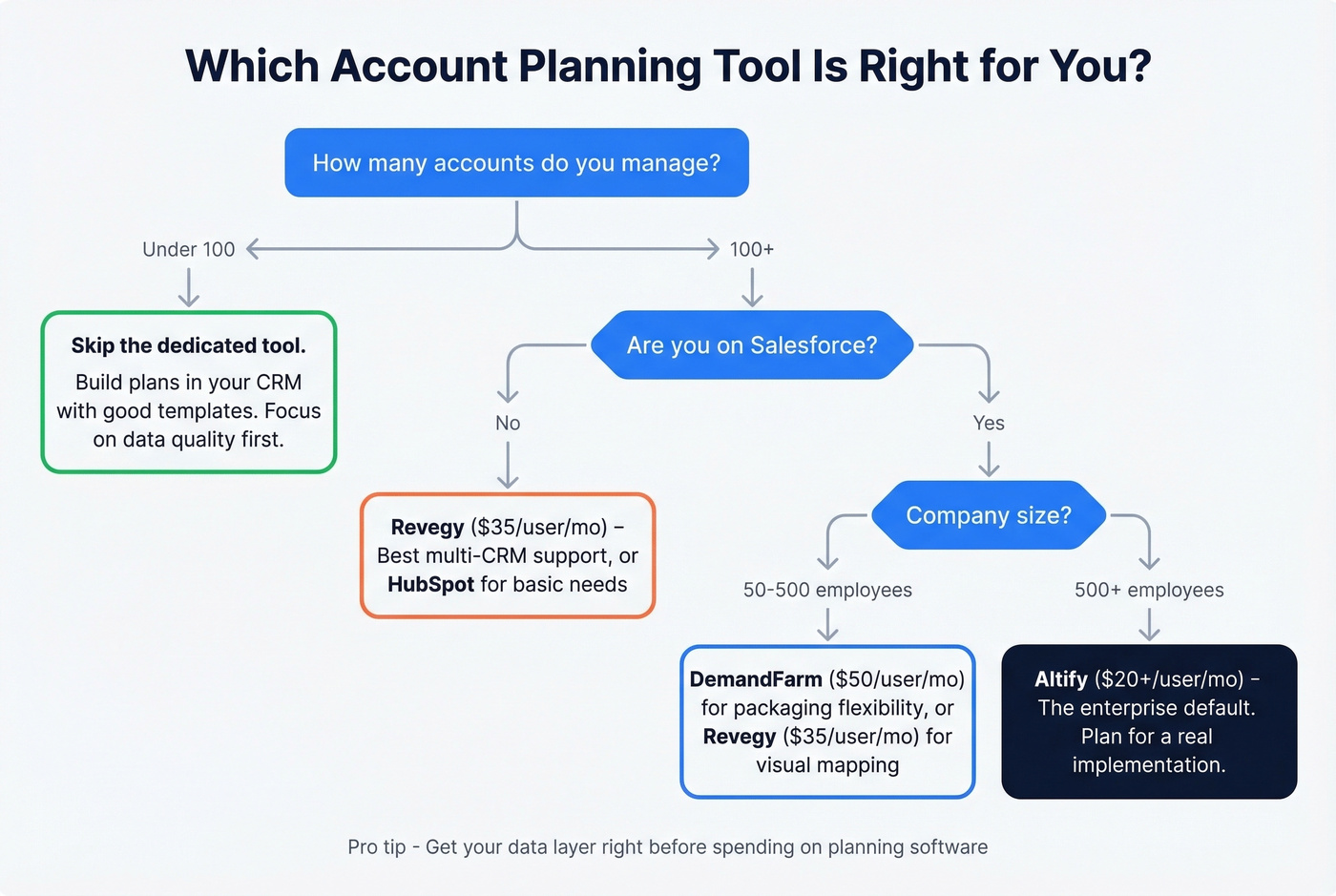
Enterprise Salesforce shops (500+ employees): Altify is the default. Budget $20+/user/month and plan for a real implementation.
Mid-market teams (50-500 employees): DemandFarm or Revegy at $35-70/user/month. DemandFarm has the edge on packaging flexibility; Revegy wins on visual mapping and multi-CRM support.
Lean teams or under 100 accounts: Skip the dedicated tool. Build plans in your CRM with good templates, enforce monthly reviews, and invest in data quality so you can actually reach every stakeholder you've mapped. You'll save $35-70/user/month and solve the problem that actually kills most account plans - stale contact data. (A lightweight way to operationalize this is with contact management software plus a data enrichment workflow.)
FAQ
What's the difference between account planning tools and CRM?
CRMs store data and track activities. Account planning tools add relationship mapping, whitespace analysis, and strategic workflows on top of your CRM. Think of it as the strategy layer that turns raw data into actionable growth plans for your highest-value accounts.
How much do dedicated platforms cost?
Dedicated tools run $20-70/user/month with annual contracts and minimum seat requirements. Budget $500-700/month minimum for a team of 10, or start free with CRM templates and a data enrichment layer like Prospeo (75 free credits/month) to validate your process first.
Do I need a dedicated tool for under 100 accounts?
Probably not. Teams managing fewer than 100 accounts can run effective plans in their CRM with good templates and disciplined monthly reviews. The bigger gap is usually stale contact data, not planning software - fix that first and add a dedicated platform when your account count or process complexity demands it.
What's the most important feature to evaluate?
CRM integration. If the planning tool doesn't live where reps already work, adoption dies within weeks regardless of feature depth. Relationship mapping is a close second - B2B deals average 11 stakeholders, and you need to visualize influence paths clearly to run a real deal.
Can AI replace manual account planning?
Not yet. AI in tools like Altify can accelerate research and surface insights, but strategic planning still requires human judgment about relationships, timing, and competitive dynamics. The best 2026 approach: use AI to automate data gathering and intent signals, then apply human strategy on top.