

AI Follow-Up Emails: How to Write Them in 2026
You sent a great first email. Silence. Now you're staring at a blank draft wondering how to nudge without being annoying - and whether AI can write your follow-up email for you.
It can. But only if you prompt it right and stop before you torch your sender reputation.
Here's the short version:
- Use Claude or ChatGPT with a constrained prompt - 70 words max, grade 5 reading level, specific prospect context. Unconstrained AI writes bloated emails that sound like every other AI email clogging someone's inbox.
- Stop at 3-4 follow-ups. A Belkins study of 16.5M cold emails found that the first email peaks at 8.4% reply rate, and 4+ emails triples your unsubscribe rate while more than tripling your spam-flag risk.
- Verify your list before sending anything. One bounce does more domain damage than ten good follow-ups can fix.
How Many Follow-Ups Should You Send?
The Belkins dataset - 16.5M emails across 93 business domains - paints a clear picture. For founders, replies peak at the second follow-up (6.94%) then drop to 3.01% by the fourth. Enterprises are even less tolerant.
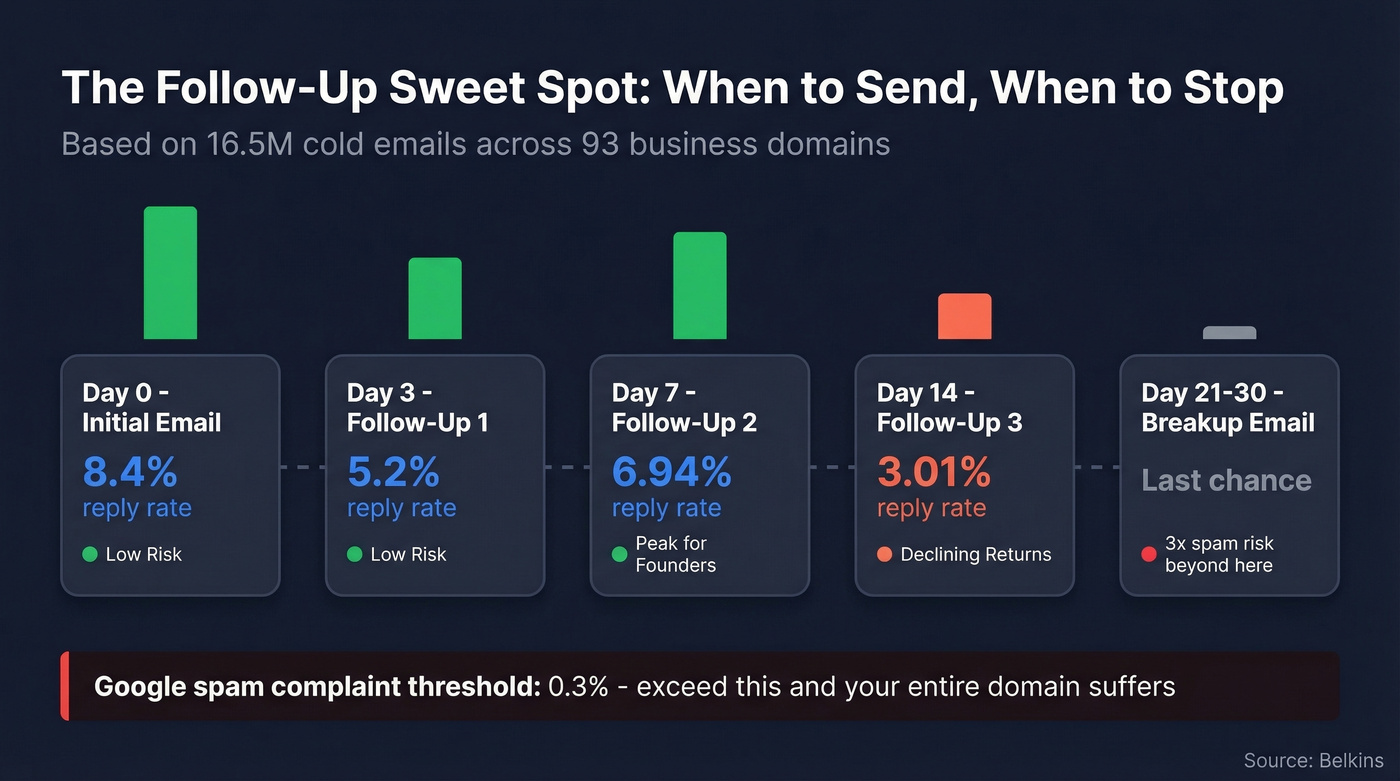
Here's the cadence that balances persistence with deliverability:
- Day 0: Initial email
- Day 3: First follow-up - light touch
- Day 7: Second follow-up - new angle or value add
- Day 14: Third follow-up - case study or social proof
- Day 21-30: Breakup email if warranted
Send Tuesday through Thursday, 9-11 AM in the recipient's timezone, with 3-7 day gaps between touches. Google's spam complaint threshold sits at 0.3% - blow past that and your entire domain suffers, not just one campaign.
If email follow-ups stall after touch three, switch channels. Belkins found that a LinkedIn message paired with a profile visit hit 11.87% reply rates - higher than any email follow-up in their dataset. (If you want a deeper cadence playbook, see our follow-up sequence strategy.)
How to Prompt AI for Follow-Ups
The difference between a useful AI follow-up email and a cringe-worthy one comes down to constraints. Unconstrained prompts produce unconstrained garbage. You need to box the model in. This is also where AI email personalization makes the biggest difference.
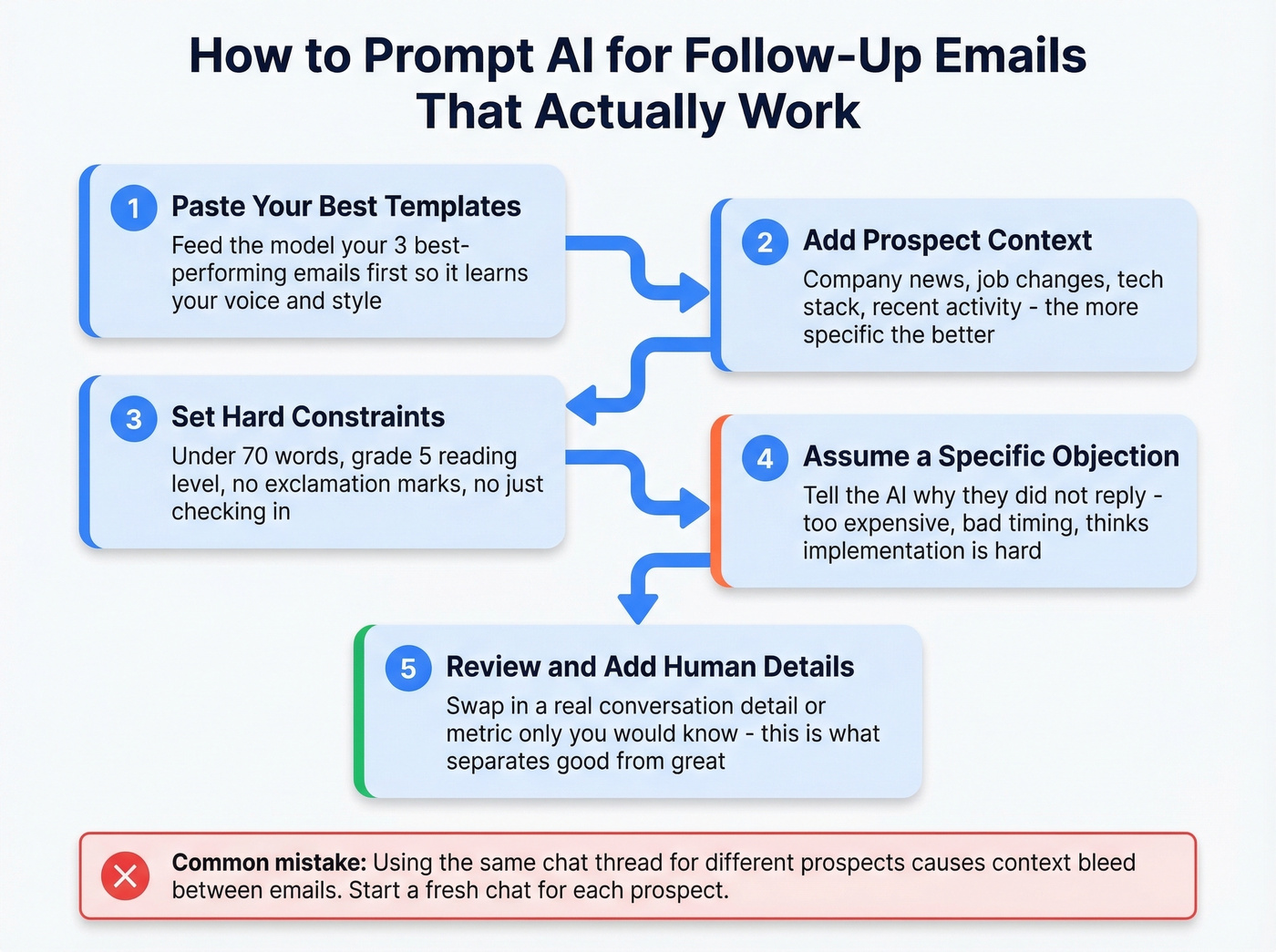
Objection-handled follow-up prompt:
You're a sales rep following up with [Name], [Title] at [Company]. They didn't reply to your first email about [product/value prop]. Assume their silence is because of [specific objection - e.g., "they think implementation takes too long"]. Write a follow-up that addresses this objection with a specific data point or customer story. Keep it under 70 words. Grade 5 reading level. No exclamation marks. No "just checking in."
Breakup email prompt:
Write a final follow-up to [Name] at [Company]. Acknowledge the timing may not be right. Provide one unexpected piece of value - a relevant stat, article, or insight. Reference a future trigger event that might reopen the conversation. Under 60 words. Casual, not guilt-trippy.
Here's what we've found works best in practice: paste your three best-performing email templates into the model first, then ask it to generate new follow-ups in the same style. The output is dramatically better than starting from scratch. Zapier's guide on ChatGPT for sales emails recommends returning to an existing chat thread where you've already fed prospect context - it'll draft faster and more consistently.
Watch out for memory cross-contamination, though. If you're writing follow-ups for different prospects in the same thread, the model bleeds context between them. Start a fresh chat for each prospect. If you need a broader tool shortlist, see our AI email writer breakdown.

You just spent 20 minutes crafting the perfect AI follow-up. It bounces. Now your domain reputation takes the hit. Prospeo verifies emails at 98% accuracy with a 7-day refresh cycle - so every follow-up you send actually lands.
Fix the data first, then let AI handle the words.
Follow-Up Templates by Scenario
Post-meeting recap (send within 24 hours)
Subject: Next Steps from Our [Meeting Topic] Call
Open with a one-line thank you. Recap 2-3 key takeaways as bullets. List action items with an owner and deadline for each. Close with the next meeting date or a specific ask. Speed matters here - leads contacted within 5 minutes of a meeting are 9x more likely to engage.
Cold no-response follow-up
Subject: Quick thought on [specific challenge]
Don't rehash your first email. Bring a new angle - a relevant case study, a metric, or a question that shows you've done homework. Keep it under 60 words. The subject line should reference their world, not yours. For more examples, borrow from these drip campaign templates.
This is where AI shines for sales follow-ups. Feed the model your prospect's recent activity or company news and let it surface a hook you'd have missed on your own. We've seen reps cut their follow-up drafting time by 70% this way while actually improving reply rates, because the AI catches signals a busy human skims past.
Job interview follow-up
Subject: Recap & Next Steps from [Role] Interview
Thank the interviewer, reference one specific moment from the conversation, and restate your enthusiasm. Send within 24 hours. Paste your interview notes into Claude and ask for a concise, warm follow-up - just personalize the specific moment yourself.
Will AI-Written Follow-Ups Trigger Spam Filters?
No. Spam filters analyze sender reputation, authentication (SPF, DKIM, DMARC), and content patterns - not whether a human or an LLM wrote the text. A Validity study of 450 participants found that properly formatted AI emails hit primary inboxes with 0% flagged as spam. (If you're tightening infrastructure, start with sender authentication.)
Here's the nuance, though. By early 2025, 51% of all spam was already AI-generated - a figure that's only grown since. Generic, polished AI prose now pattern-matches with what spam looks like. The fix isn't avoiding AI. It's injecting human specificity. The best AI follow-up emails reference a real conversation, a specific metric from the prospect's company, a detail only someone paying attention would know.
And if you're sending to EU contacts, make sure your sequences include an unsubscribe link - GDPR and CAN-SPAM compliance isn't optional. (For the compliance checklist, see our B2B compliance guide.)
Let's be honest about something: most teams agonize over AI copy while sending to lists with 15%+ bounce rates. A mediocre follow-up that lands beats a brilliant one that bounces. Fix the data first, then worry about the words. If you're troubleshooting deliverability, run an email reputation check.
Best Tools for AI Follow-Up Emails
| Tool | Best For | Starting Price |
|---|---|---|
| Prospeo | Pre-send list verification | Free / ~$39/mo |
| Claude | Best raw writing quality | Free / ~$20/mo |
| ChatGPT | Sequences + context memory | Free / ~$20/mo |
| Smartlead | Automated cold sequences | ~$39-$94/mo |
| Instantly | Warm-up + sequences | ~$30-$100+/mo |
| Mixmax | Gmail power users | $24/mo/user |
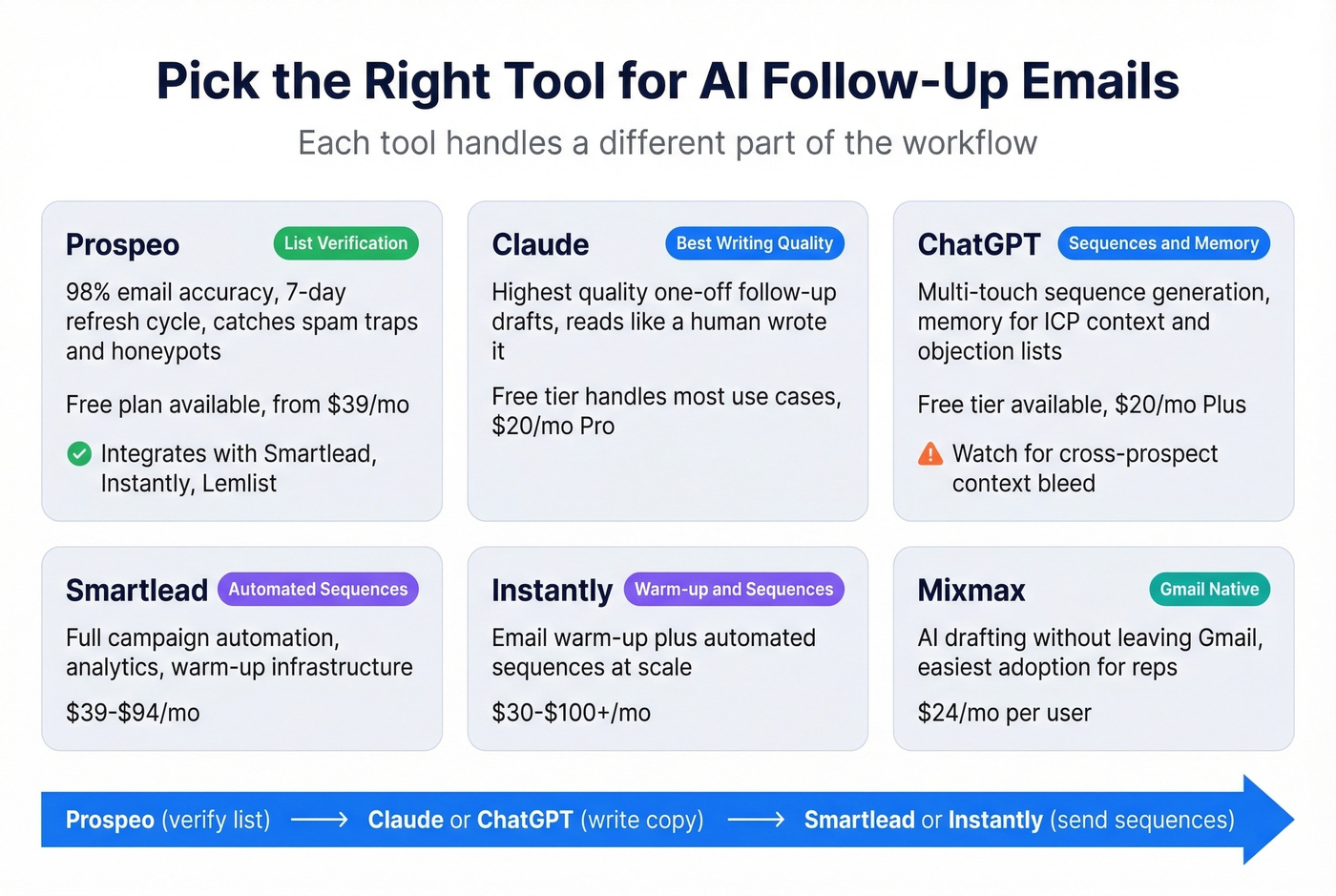
Claude produces the best one-off follow-up copy we've tested. Feed it meeting notes and constraints, and the output reads like a human wrote it. The free tier handles most use cases.
ChatGPT shines for multi-touch sequences. Feed it your ICP, templates, and objection list in one thread, then generate variations. The memory feature is a double-edged sword - great for continuity, risky for cross-prospect bleed.
Smartlead and Instantly are where AI meets sequencing infrastructure. Both handle automated sequences, analytics, and integrations that make running follow-up campaigns at scale far easier. Pick based on which UI you prefer - the feature sets are converging fast. If you're comparing platforms, start with our guide to outbound email automation.
Mixmax is the pick if you live in Gmail and want AI drafting without leaving your inbox. At $24/mo per user, it's the easiest option for reps who don't want another platform.
Before running any sequence through these tools, verify your list. Prospeo's email finder runs a 5-step verification process that catches invalid emails, spam traps, and honeypots - 98% email accuracy, refreshed every 7 days. Native integrations with Smartlead, Instantly, and Lemlist mean verified contacts flow straight into your sending tool without manual exports. Stack Optimize built to $1M ARR using Prospeo-verified lists, maintaining 94%+ deliverability and under 3% bounce rates across all client campaigns - zero domain flags.

AI writes better follow-ups when you feed it real prospect data. Prospeo enriches contacts with 50+ data points - job changes, tech stack, company growth - giving your prompts the specificity that gets replies.
Stop prompting AI with guesses. Start with verified data.
FAQ
How many follow-up emails should I send?
Three to four maximum. Beyond that, spam-mark rates triple and reply rates flatline. The Belkins dataset shows founder reply rates drop from 6.94% at follow-up two to 3.01% by follow-up four. Skip this advice if you're running warm re-engagement campaigns to existing customers - those have different dynamics entirely.
Can spam filters detect AI-written emails?
No. Filters evaluate sender reputation, SPF/DKIM/DMARC authentication, and content patterns - not authorship. A Validity study found 0% of properly formatted AI emails flagged as spam. Keep your domain health solid and you're fine.
What's the best free AI tool for follow-up emails?
Claude's free tier produces the highest-quality drafts. Paste your prospect context, add constraints (under 70 words, casual tone), and you'll get better output than any dedicated "AI email generator." For list verification before sending, Prospeo's free plan includes 75 verified emails per month.
How do I personalize AI follow-ups at scale?
Feed the model specific prospect signals - recent company news, job changes, or tech stack details - alongside your constraints. The consensus on r/sales is that even basic personalization (company name + a recent trigger event) outperforms fully templated sequences by 2-3x. Enrichment tools that return 50+ data points per contact give AI models the raw material to write follow-ups that feel genuinely researched rather than templated.