

AI Lead Generation Agent: What Works in 2026
A RevOps lead we know ran an AI agent for outbound last quarter. It sent 3,000 emails in 48 hours, booked zero meetings, and got their sending domain flagged. The agent worked perfectly. The data underneath it was garbage. That's the story of the AI lead generation agent in 2026 - the orchestration is the easy part. The data layer is where teams win or lose.
What You Need (Quick Version)
Here's the contrarian thesis upfront: you probably don't need an AI lead generation agent. You need an AI-augmented lead generation workflow. An "agent" implies autonomy. A workflow implies human checkpoints, verified data, and iteration. The second one actually books meetings.
Three paths depending on where you are:
- DIY builder on a budget: n8n + a verified data provider + Instantly runs about ~$100-150/mo. You control every step, but you're the engineer, QA team, and support desk.
- All-in-one platform: B2B Rocket (from $59/mo on the low-ticket stack, or $599/mo on the high-ticket stack) or Outreach (typically ~$100-150/user/mo). Higher cost, lower setup burden.
- The non-negotiable regardless of path: A verified data layer. Your agent is only as good as the contacts it reaches. A 30% bounce rate will tank your domain faster than any agent can book meetings.
What Is an AI Lead Generation Agent?
"AI agent" gets thrown around loosely. There's a meaningful distinction between three things that often get conflated.
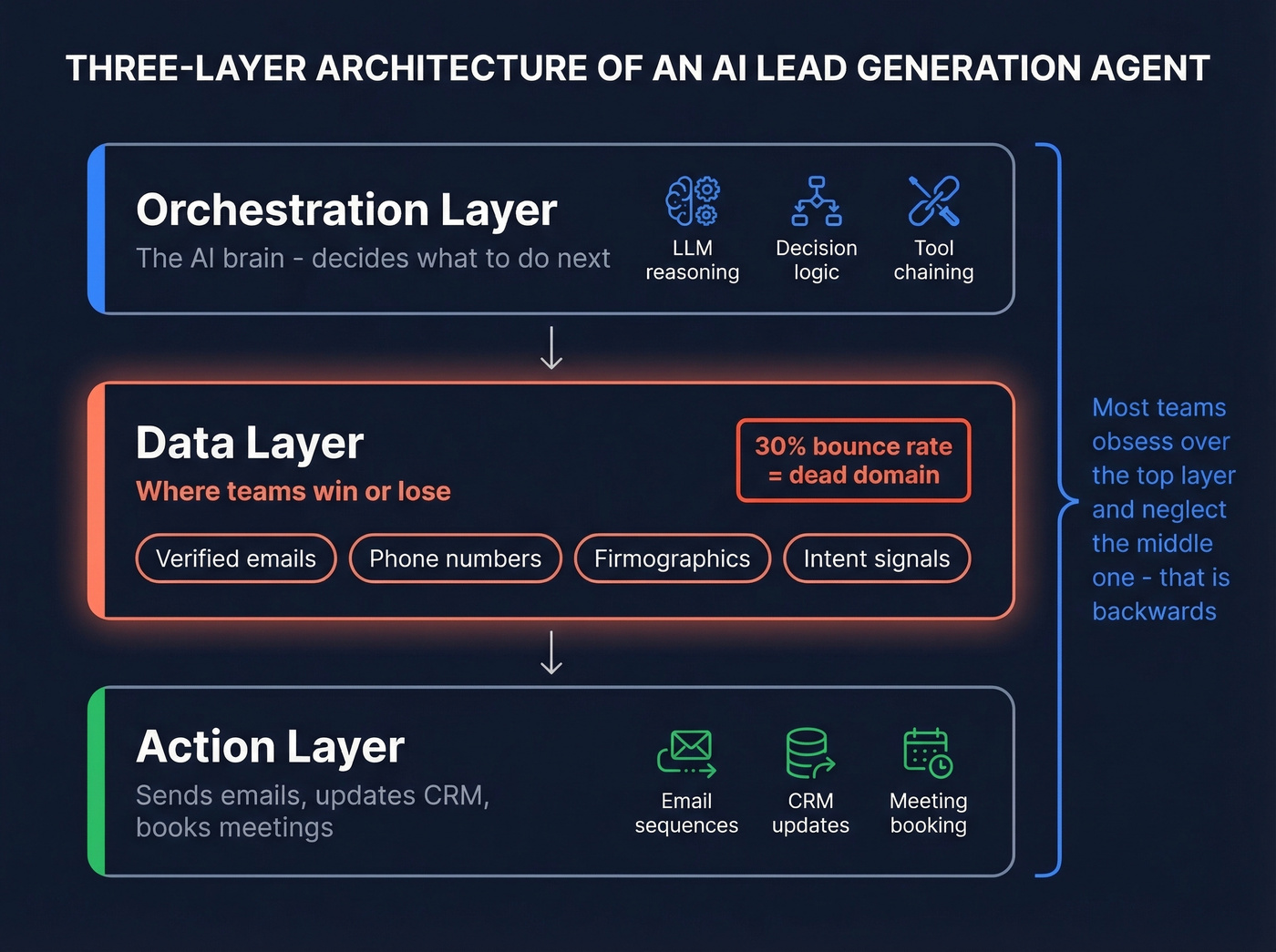
A chatbot responds to inputs within a conversation - no action beyond the chat window. A workflow automation executes a predefined sequence: if X happens, do Y, no judgment involved. An AI agent sits above both. It chains tools together, makes autonomous decisions at each step, and executes multi-step workflows like prospecting, enriching, and sequencing outreach. That's why "AI prospecting agent" has become nearly interchangeable with lead generation agent in most sales orgs.
The architecture that matters has three layers. The orchestration layer - the AI brain deciding what to do next - sits on top. The data layer, where contacts, enrichment, and verification live, sits in the middle. The action layer handles sending emails, updating CRMs, and booking meetings. Most teams obsess over the orchestration layer and neglect the data layer. That's backwards.
Why These Agents Matter Now
The AI agent market hit $5.4B in 2024 and is projected to reach $50.3B by 2030 - a 45.8% CAGR. That's not hype; it's capital flowing into a category solving a real problem.
The problem is time. Bain's research found sellers spend roughly 25% of their time actually selling. The rest goes to research, data entry, list building, and CRM hygiene - exactly the tasks AI SDR sales prospecting agents handle well. When AI absorbs that surrounding work, selling time can double. And 83% of sales teams using AI report revenue growth, compared to 66% of non-AI teams. That 17-point gap isn't trivial. Early adopters who've redesigned processes around AI are seeing 30%+ improvement in win rates.
How the Agent Loop Works
Strip away the marketing and every AI lead generation agent runs the same three-step loop.
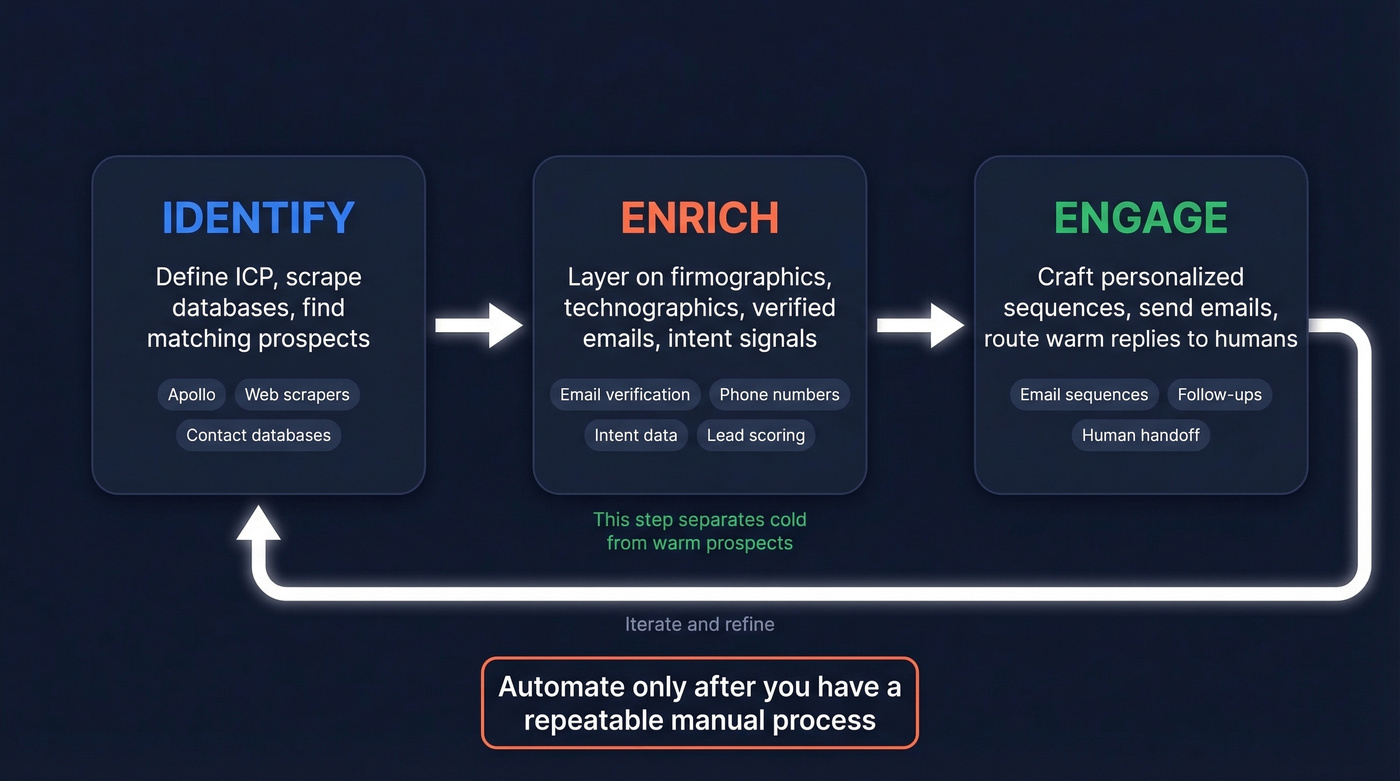
Identify. The agent defines or refines your ICP, then scrapes, searches, or queries databases to find matching prospects. Tools like Apollo, web scrapers, or a verified contact database feed the pipeline.
Enrich. Raw names and companies aren't enough. The agent layers on firmographics, technographics, verified emails, phone numbers, and intent signals that flag which companies are actively researching your category. Intent data separates cold prospects from warm ones - the difference between interrupting someone and arriving at the right moment. This is also where lead prioritization adds the most value, scoring and ranking leads so your team focuses on accounts most likely to convert.
Engage. The agent crafts personalized outreach sequences, sends emails, schedules follow-ups, and routes warm replies to humans.
The Relevance AI marketplace offers a concrete example. Their lead generation agent chains six specialized tools - prospect finder, company enrichment, email sequence generator, lead scoring engine, ICP analyzer, and outreach performance analyzer. It's been cloned 56 times on their marketplace, which tells you there's real demand for pre-built agent templates.
Gumloop benchmarks the time savings at "3 hours of manual research compressed to 15 minutes." That's directional, but the order of magnitude is right. The critical principle: automate only after you have a repeatable manual process. If your manual prospecting workflow is broken, automating it just produces broken outreach faster.
AI Agent vs. Human SDR
Here's where the "replace your SDRs" narrative falls apart.
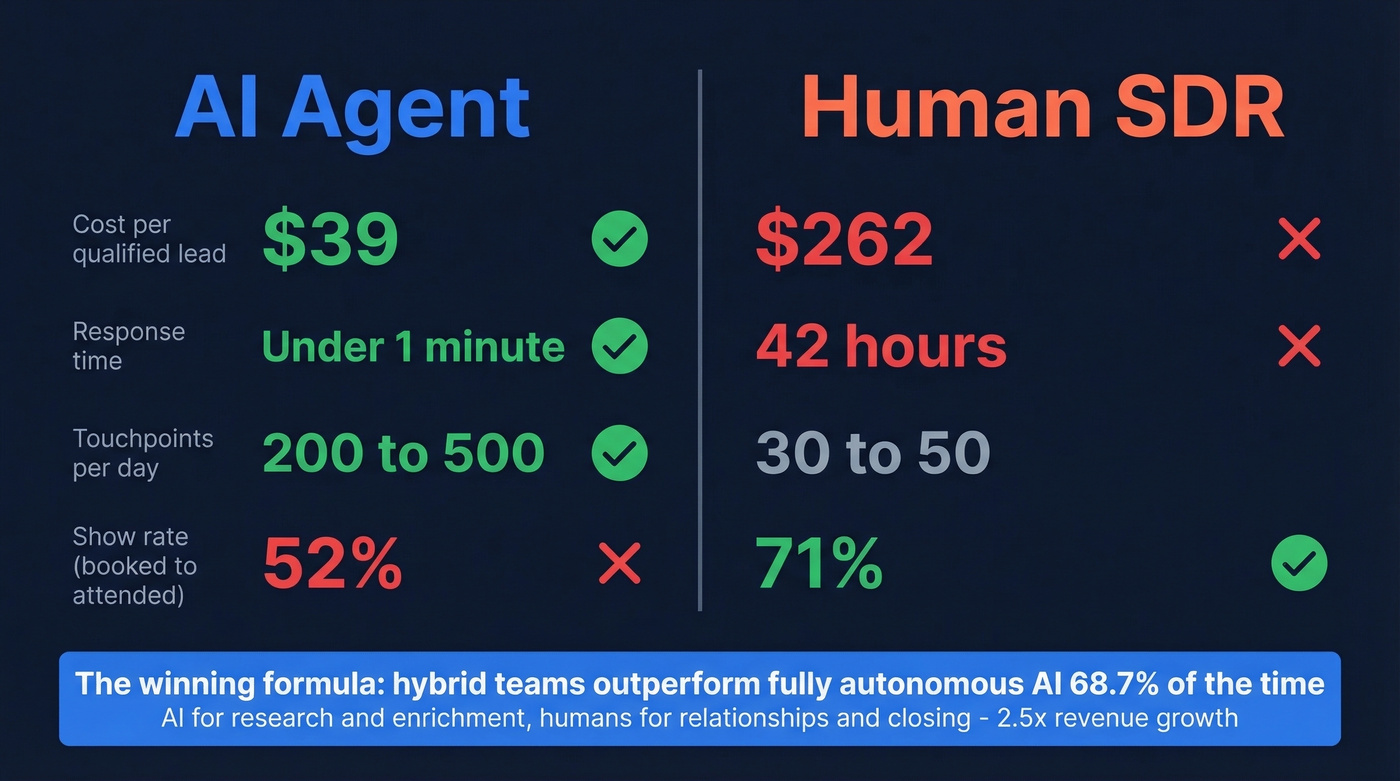
| Metric | AI Agent | Human SDR |
|---|---|---|
| Cost per qualified lead | ~$39 | ~$262 |
| Response time | <1 minute | ~42 hours |
| Touchpoints per day | 200-500 | 30-50 |
| Show rate (booked to attended) | 52% | 71% |
AI wins on speed and cost. Humans win on conversion quality. That show rate gap - 52% vs. 71% - is the whole story. AI can book meetings cheaply, but humans get prospects to actually show up.
Research from Stanford and Carnegie Mellon confirms what we've seen in practice: hybrid human+agent teams outperform fully autonomous agentic AI 68.7% of the time. The winning formula isn't AI or humans. It's AI for research, enrichment, and initial outreach, with humans handling relationship-building and closing. Teams running this hybrid model report 2.5x revenue growth compared to either approach alone.
Hot take: If your average deal size is under $10K, a fully automated agent might work fine - the economics hold even at lower show rates. Above that threshold, every no-show is real money. That's where the hybrid model becomes non-negotiable.

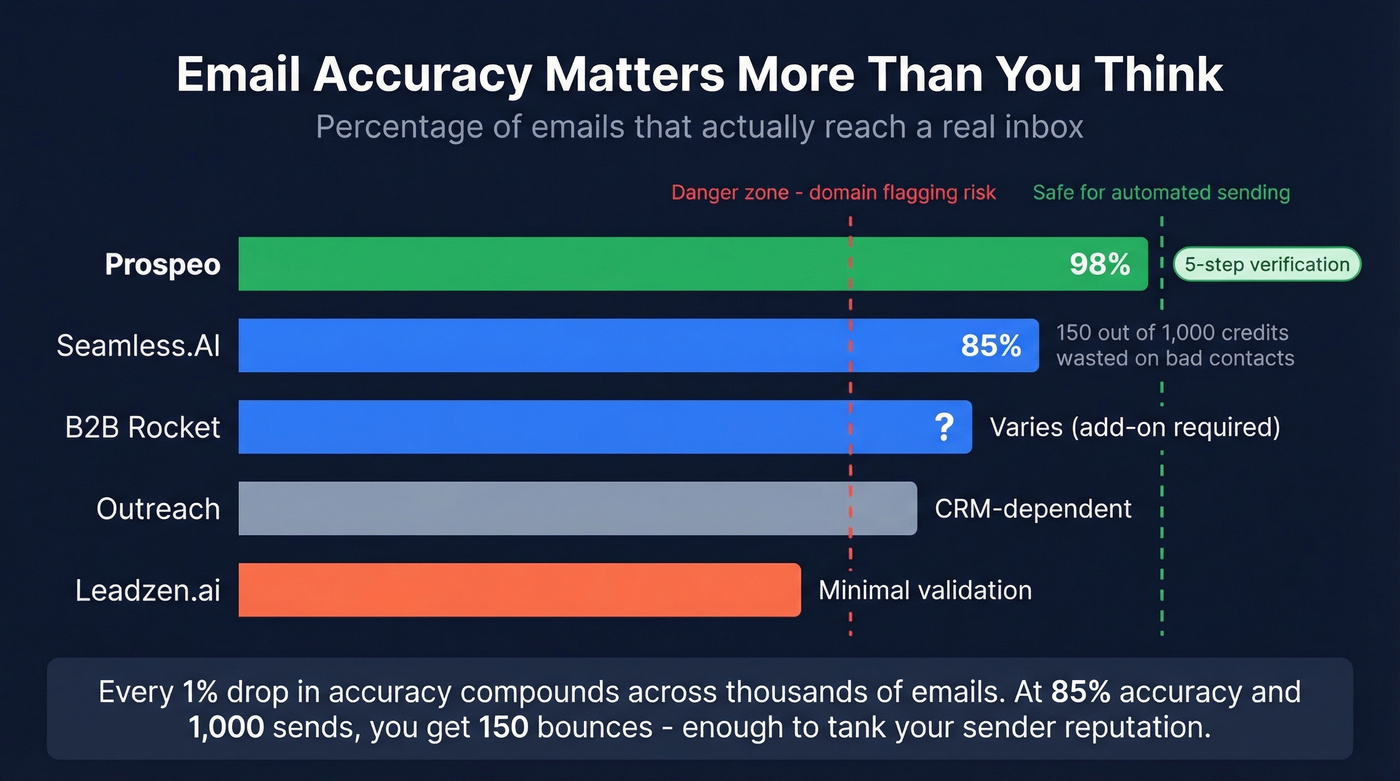
You just read it: the data layer decides whether your AI agent books meetings or burns your domain. Prospeo's 98% email accuracy and 7-day refresh cycle give your agent a foundation that actually converts - not a 30% bounce rate that tanks deliverability.
Fix the data layer before you automate another email.
Build vs. Buy
The DIY Stack (~$150/mo)
A clean DIY approach: n8n for orchestration, Apollo or Apify for scraping leads ($1-2 per 1,000 leads), and Instantly (~$47/mo) or SmartLead (~$39/mo) for sending. Total cost lands around $100-150/mo.
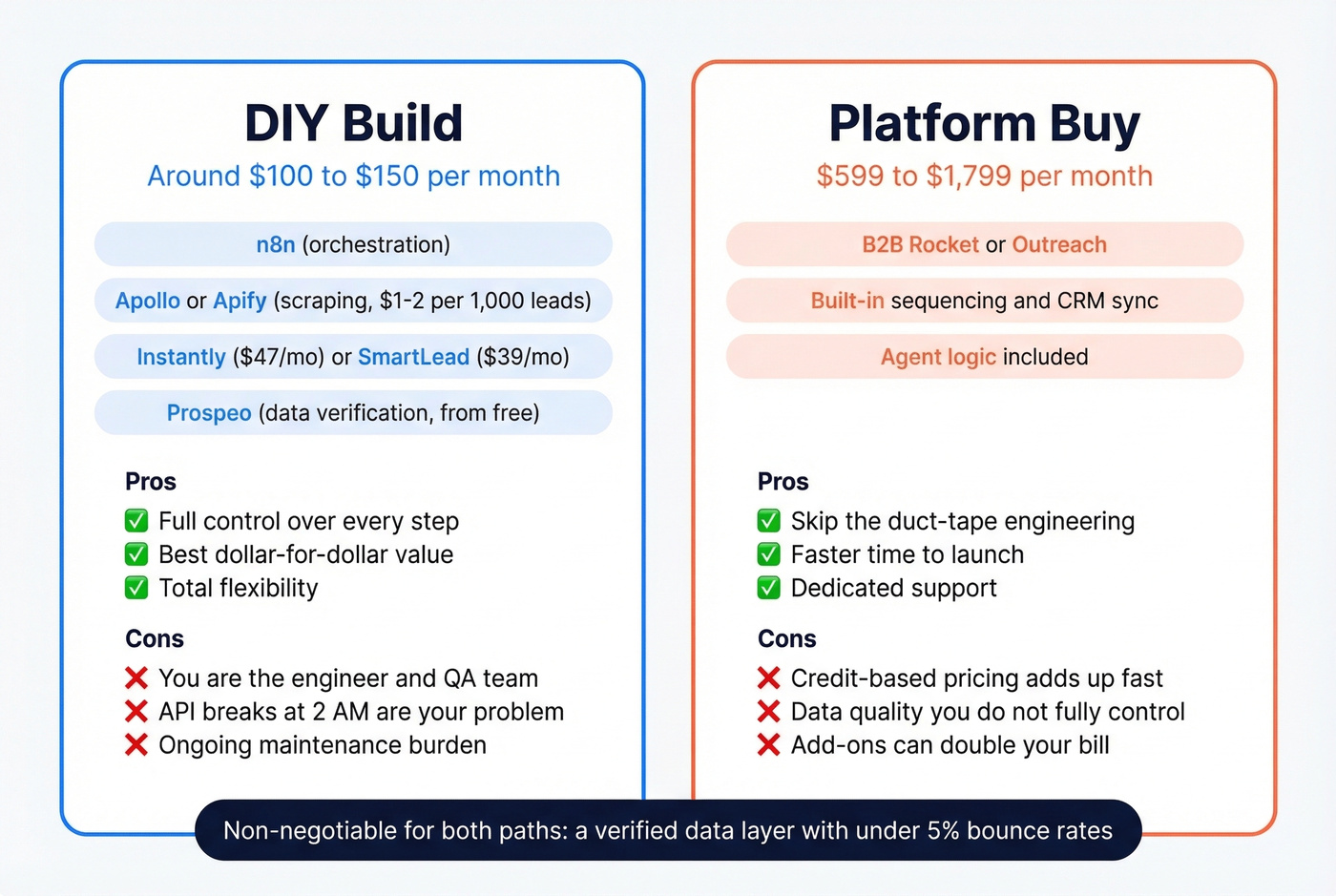
The tradeoff is real. You're the engineer, QA team, and support desk. When the n8n workflow breaks at 2 AM because an API changed its response format, that's your problem. For technical founders and scrappy ops teams, this is the best dollar-for-dollar setup. For everyone else, it's a time sink that never stops sinking.
Platform Solutions ($599-1,799/mo)
B2B Rocket and Seamless.AI represent the "buy" end. Higher monthly cost, but you skip the duct-tape engineering. The tradeoff shifts to credit-based pricing models and data quality you don't fully control.
Tools With Real Pricing
| Tool | Starting Price | Credits/Contacts | Best For | Data Quality |
|---|---|---|---|---|
| Prospeo | Free (75 emails/mo) | Pay-per-lead | Data accuracy layer | 98% email verified |
| B2B Rocket | $59/mo (low-ticket) or $599/mo (high-ticket) | Varies by tier | Full agent platform | Add-on ($10/2,500) |
| Seamless.AI | ~$79/user/mo | 1,000 credits/mo | Contact discovery | ~85% email accuracy |
| Outreach | ~$100-150/user/mo | Unlimited | Enterprise sequences | CRM-dependent |
| Relevance AI | ~$50-200/mo | Template-based | Custom agent builds | Varies by source |
| Leadzen.ai | $133/user/mo | 300 credits | Small-team prospecting | Minimal validation |
Prospeo
Prospeo isn't an agent - it's the data foundation that makes any agent actually work. The platform includes 300M+ professional profiles with 143M+ verified emails and 125M+ verified mobile numbers, with a 30% pickup rate across all regions. The 98% email accuracy rate isn't a marketing number; Snyk's 50-person AE team saw bounce rates drop from 35-40% to under 5% after switching, and Stack Optimize built to $1M ARR with zero domain flags across all clients.
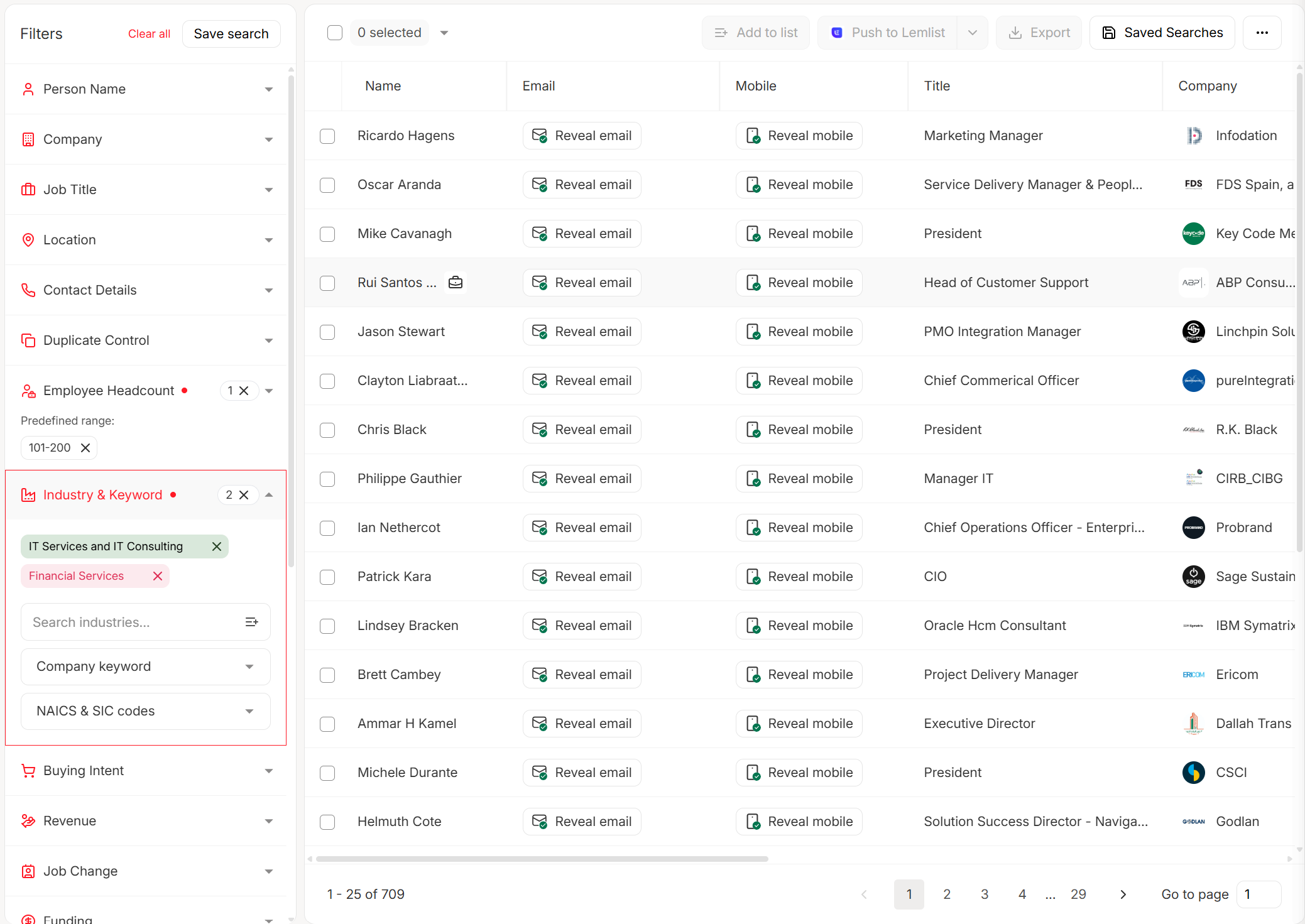
What makes it the right fit for agent workflows: the 7-day data refresh cycle vs. the 6-week industry average, the 5-step verification with spam-trap removal and honeypot filtering, and pricing at ~$0.01/email. The 92% API match rate means your enrichment workflows don't hit dead ends. Native integrations with Salesforce, HubSpot, Instantly, Smartlead, Clay, Zapier, n8n, and Make mean it slots directly into any DIY or platform stack. A free tier gives you 75 verified emails per month plus 100 Chrome extension credits - enough to test before committing.
B2B Rocket
Here's the thing about B2B Rocket: the product is ambitious, but the pricing page is genuinely confusing. Two separate pricing stacks - a "low-ticket" set (Starter $59/mo, Growth $99/mo, Scale $149/mo) and a "high-ticket" set billed annually (Basic $599/mo, Scale $999/mo, Unlimited $1,399/mo). High-ticket quarterly billing is shown separately (Basic $799/mo, Scale $1,299/mo, Unlimited $1,799/mo). Both stacks use the name "Scale" at completely different price points.
Then come the add-ons: database credits at $25 per 500/mo, email verification at $10 per 2,500/mo, extra team members at $100/user/mo, multichannel accounts at $20 each. A team of three on the Basic high-ticket plan with database credits and verification could easily hit $900-1,000/mo before sending a single email.
Use this if you want a full-stack AI agent platform and have the budget to absorb add-on costs. Skip this if you need pricing clarity or you're running lean.
Seamless.AI
Credits don't roll over - that's the first thing to know. Seamless.AI runs a credit-based model, and the consensus on r/sales is that credits burn faster than expected. One user reported their credits lasting only 20 days. Buying two extra packs brought their monthly cost to $177. Enterprise is $149/user/mo with a 5-user minimum - $745/mo before you send anything. At full scale, enterprise pricing can reach $95,000+/year.
Data quality runs ~85% for emails and ~60% for phone numbers. That 15% email miss rate means roughly 150 out of every 1,000 credits go to waste on bad contacts. The #1 complaint on Reddit isn't the data - it's the pricing opacity.
Outreach
Enterprise-grade sequencing platform with increasingly AI-powered prospecting features. Outreach's AI Prospecting Agent can run a fully autonomous sequence with a hand-off to the seller when the prospect is ready. Custom pricing typically lands ~$100-150/user/mo. Best for large sales orgs with existing Salesforce or HubSpot infrastructure who need AI layered on top of established workflows.
Relevance AI
The marketplace approach to AI agents. Their lead generation agent chains six tools for end-to-end prospecting. Expect ~$50-200/mo based on usage tiers. Best for teams that want customizable agent workflows without writing code from scratch.
Leadzen.ai
$133/user/mo for 300 credits. Zero reviews on G2, two reviews on Capterra. The product exists and pricing is real, but independent validation is nearly nonexistent. Proceed with caution.
The Data Quality Problem
Gartner predicts 60% of enterprise AI projects started in 2026 will be abandoned because the underlying data isn't AI-ready. That stat should terrify anyone building an AI lead-gen workflow.
Look, we've watched this scenario play out repeatedly. A team spins up an agent, connects it to a contact database, and launches a 5,000-email campaign. The database has 30% outdated contacts. That's 1,500 bounces hitting their sending domain in 72 hours. Domain reputation tanks. Deliverability craters. Now even the good emails land in spam. The agent worked perfectly - the data destroyed the campaign.

Seamless.AI users report 20-30% of credits wasted on outdated or inaccurate contacts. That's not a tool problem; it's an industry problem. Most databases refresh every ~6 weeks. People change jobs, companies get acquired, email servers get reconfigured. A verification layer with a 7-day refresh cycle and 5-step verification that catches catch-all domains, spam traps, and honeypots solves this upstream - before bad data enters your workflow.
Running a hybrid AI + human workflow? Prospeo feeds your orchestration layer with 300M+ verified profiles, intent data across 15,000 topics, and enrichment returning 50+ data points per contact - at $0.01/email instead of $1.
Stop letting bad data bottleneck your AI agent's pipeline.
Implementation Playbook
Five steps. Don't skip any of them.
1. Map your manual process first. If you can't describe your prospecting workflow on a whiteboard, you're not ready to automate it. Bain's research is clear: the biggest gains come from redesigning processes, not automating broken ones.
2. Clean and verify your data. Before any agent touches your contact list, run it through an email verifier layer. Bulk upload a CSV, get results in minutes, remove the bounces before they cost you a domain.
3. Start hybrid. AI handles research, enrichment, and initial outreach. Humans handle replies, relationship-building, and closing. Hybrid teams outperform fully autonomous agents 68.7% of the time. This is especially true when deploying an AI prospecting agent for outbound - the agent fills the top of the funnel, but human judgment closes the deal.
4. Build in compliance from day one. GDPR and CCPA don't disappear because an AI sent the email. Automated outreach to EU contacts without proper legal basis is still a violation, and regulators are increasingly scrutinizing AI-driven campaigns. Ensure your data provider is GDPR compliant, maintain opt-out lists, and document your legal basis for processing. This isn't optional - it's the cost of doing business in 2026.
5. Measure the right KPIs and iterate weekly. Emails sent is a vanity metric. Track reply rate, positive reply rate, meeting booked rate, and show rate. Review what's working every Friday. Adjust ICP filters, rewrite sequences, swap out data sources. The teams that win treat their agent like a living system, not a set-and-forget tool.
What Goes Wrong
Garbage data in, garbage outreach out. The most common failure mode by a mile. Your agent can't overcome a 30% bounce rate.
Over-automating without human checkpoints. Fully autonomous agents underperform hybrid teams 68.7% of the time. Build in review steps - even a quick scan of the first 50 emails before a 5,000-send campaign catches problems that save your domain.
MQL/SQL misalignment. If marketing and sales disagree on what a qualified lead looks like, your agent optimizes for the wrong thing. We've seen teams where marketing counted a whitepaper download as an MQL while sales wanted budget-confirmed SQLs. The agent dutifully filled the pipeline with leads nobody wanted.
No CRM integration. An agent that can't write to Salesforce or HubSpot creates a data silo. Leads fall through cracks.
Prompt injection risk. Agents with system access - CRM writes, email sends, calendar bookings - are vulnerable to adversarial inputs. Strong access controls and audit logs aren't optional.
The micro-productivity trap. Automating a broken process just makes it fail faster. If your manual workflow converts at 0.5%, your automated workflow will convert at 0.5% - just at higher volume and higher cost.
FAQ
Do AI lead generation agents actually work?
Yes, but hybrid human+AI workflows outperform fully autonomous agents 68.7% of the time. The agent handles research, enrichment, and initial outreach while humans handle relationship-building and closing. Teams running this model report 2.5x revenue growth.
How much does an AI lead-gen agent cost?
DIY stacks run ~$100-150/mo using n8n, a data provider, and a sending tool like Instantly. Platforms range from $59/mo on low-ticket tiers to $95,000+/year at enterprise scale. The biggest hidden cost is credits wasted on unverified data - 20-30% waste rates are common with providers that don't verify aggressively.
What's the difference between an AI agent and a chatbot?
A chatbot responds to inputs within a single conversation window. An AI agent takes autonomous, multi-step actions - chaining tools for prospecting, enriching contacts, scoring leads, and sequencing outreach without manual intervention at each step.
How do I prevent my agent from destroying domain reputation?
Run your contact list through a verification layer before any outreach. A 5-step verification process catches spam traps, honeypots, and catch-all domains, cutting bounce rates to under 5%. Refresh data on a 7-day cycle so contacts don't go stale between campaigns.
Can I build my own AI lead-gen agent?
Yes. An n8n + data provider + sending tool stack costs ~$100-150/mo and gives you full control. The tradeoff: you handle engineering, QA, and maintenance. For technical teams, it's the best ROI. For everyone else, start with a platform and graduate to DIY once you understand the workflow.