

The Best AI Tools for Prospecting in 2026
Every "best AI prospecting tools" list gives you 15 options and zero opinions. You don't need 15 tools. You need three, maybe four, covering distinct layers of your stack - and you need someone to tell you which ones actually work.
Sellers spend roughly 25% of their time actually selling. The rest is research, data entry, list building, and chasing bad contact info. Bain's data shows early adopters hitting 30%+ improvement in win rates, but only when the tooling matches the workflow. AI-driven prospecting is real. The gains just don't materialize if you pick the wrong stack.
Our Top Picks at a Glance
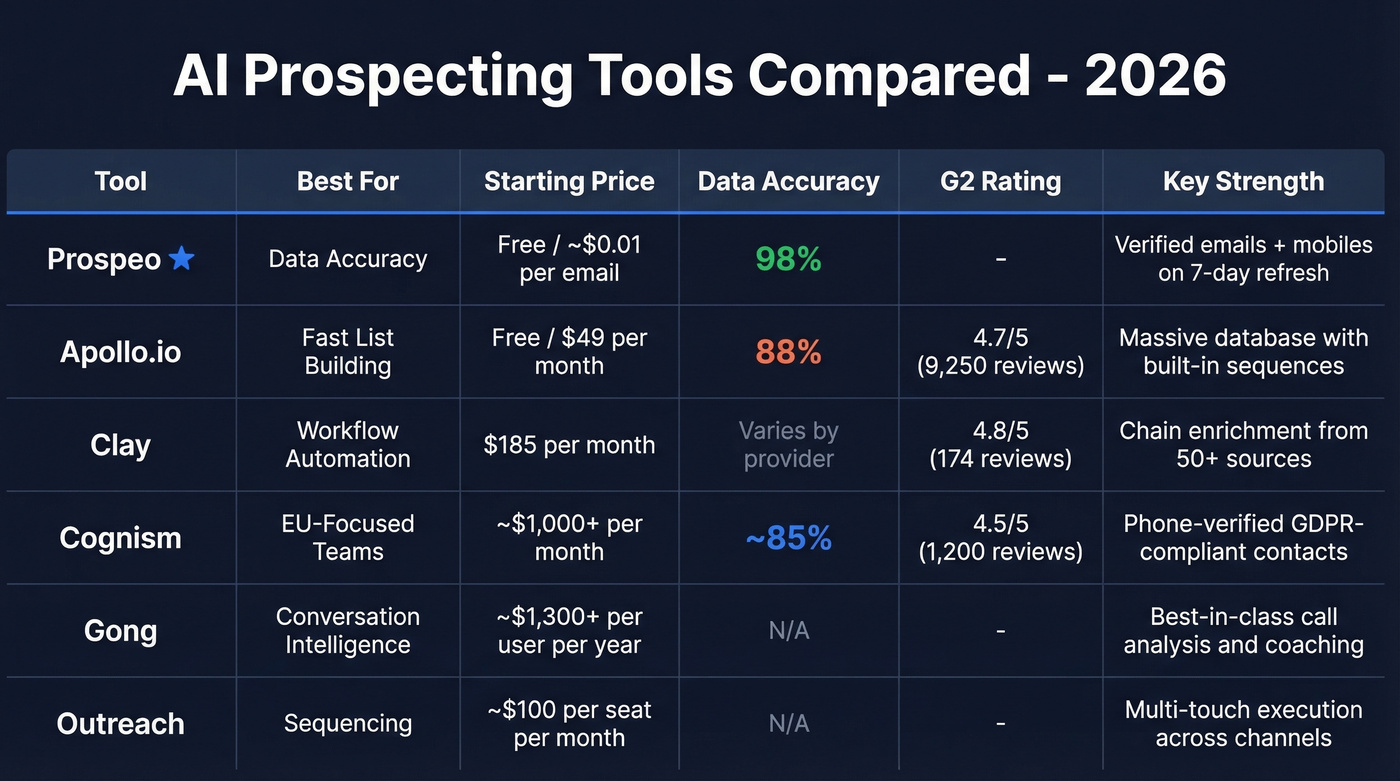
| Tool | Best For | Starting Price | G2 Rating |
|---|---|---|---|
| Prospeo | Data accuracy & verification | Free; ~$0.01/email | - |
| Apollo.io | Fast list building | Free; $49/mo | 4.7/5 (9,250 reviews) |
| Clay | Workflow automation | $185/mo | 4.8/5 (174 reviews) |
| Cognism | EU-focused teams | ~$1,000+/mo | 4.5/5 (1,200 reviews) |
| Gong | Conversation intelligence | ~$1,300+/user/yr | - |
| Outreach | Sequencing | ~$100/seat/mo | - |
AI-Powered Prospecting Tools, Reviewed
Prospeo - Best for Data Accuracy
Bad emails tank your domain reputation. Wrong numbers waste rep time. Prospeo solves this at the foundation layer with 98% email accuracy and a 30% mobile pickup rate - numbers that beat every major competitor we've tested against.

The database covers 300M+ professional profiles, 143M+ verified emails, and 125M+ verified mobile numbers, all refreshed on a 7-day cycle (the industry average is six weeks). You get 30+ search filters including buyer intent signals powered by Bombora, technographics, job changes, and headcount growth - so you're building lists of in-market buyers, not just job titles. The proprietary 5-step verification handles catch-all domains, spam traps, and honeypots before they ever hit your sequences.
The proof is in production: Snyk's 50-person AE team went from 35-40% bounce rates to under 5% after switching, with AE-sourced pipeline up 180%.
Integrates natively with Salesforce, HubSpot, Smartlead, Instantly, Lemlist, Clay, Zapier, and Make. The Chrome extension has 40K+ users and works across websites, professional profiles, and CRMs. Pricing starts free with 75 verified emails/month plus 100 Chrome extension credits/month, and paid plans run roughly $0.01 per email. No contracts, no sales calls required.
Use this if: you're tired of bounced emails destroying your sender reputation. Skip this if: you need a built-in sequencer - pair with Outreach or Instantly for that.
If you want to compare more options at the data layer, start with the B2B database rankings.
Apollo.io - Best for Fast List Building
Apollo is the default starting point for most SMB and mid-market teams, and for good reason. The database is massive, the UI is intuitive, and you can go from zero to a targeted list in minutes. Practitioners on r/salestechniques consistently call it the easiest on-ramp for AI-assisted prospecting.
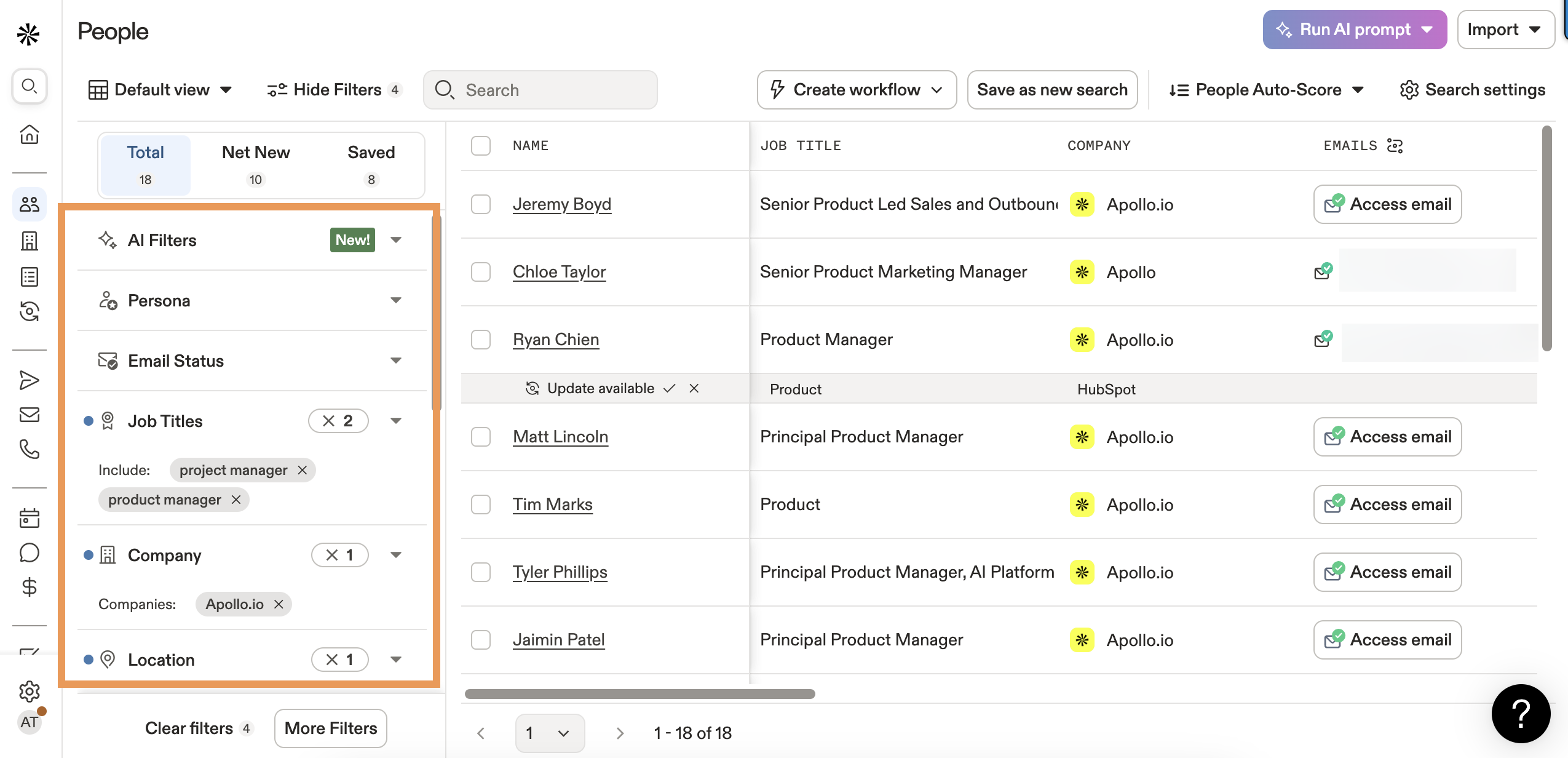
Pricing is straightforward: Free tier with limited credits, Basic at $49/mo, Professional at $79/mo, and Organization at $119/mo with a 3-seat minimum. A 4-seat Professional setup runs about $3,792/year.
Here's the thing about Apollo's data quality, though. Email accuracy runs around 88%, and phone accuracy sits near 71%. That's fine for volume plays, but roughly 1 in 8 emails will bounce. Watch out for waterfall enrichment behavior too - it can introduce cost variability that catches teams off guard when credits don't roll over between billing cycles.
Use this if: you want fast list building with built-in sequences and don't want to stitch together multiple tools. Skip this if: data accuracy is your top priority - you'll want a verification layer on top.
Clay - Best for Workflow Automation
Clay isn't a database. It's a workflow engine that practitioners describe as "LEGO pieces for data." You chain enrichment steps, pull from multiple providers, and build hyper-specific prospect lists that no single database could produce alone.
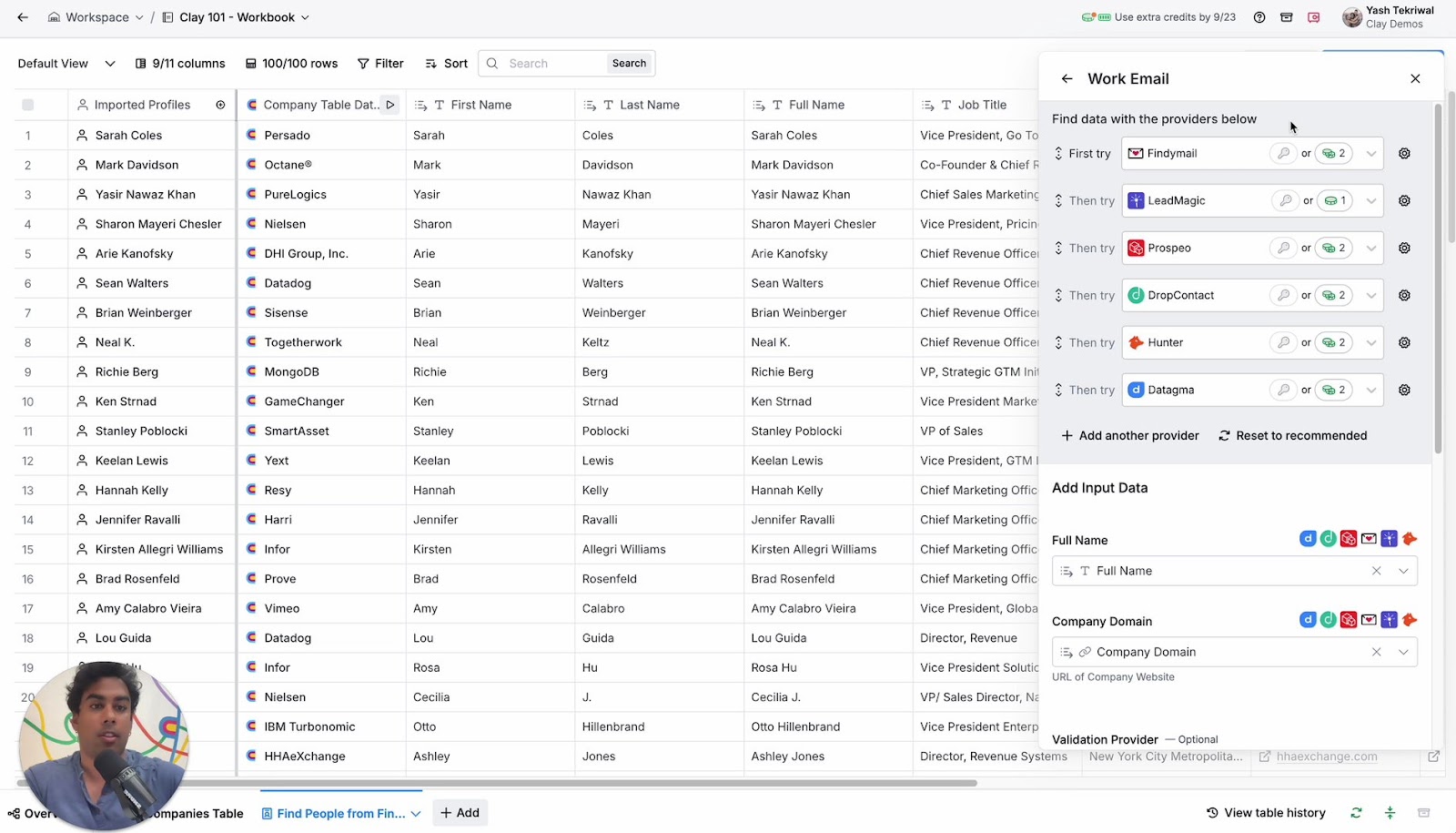
Clay recently overhauled its pricing, splitting costs into Data Credits for enrichment and Actions for orchestration. Plans start at Launch ($185/mo) and Growth ($495/mo). Data costs dropped 50-90% on top enrichments, but CRM pushes, Claygent calls, and HTTP API executions all consume Actions now - orchestration-heavy workflows can still get expensive fast.
The G2 rating (4.8/5 across 174 reviews) reflects genuine enthusiasm from power users. But we've seen teams struggle with the Sales Nav-to-Clay-to-CRM handoff compared to simpler one-click Chrome extension workflows. Clay rewards technical users who enjoy building; it punishes teams that want plug-and-play. If your RevOps team is comfortable chaining signals, enrichment, and scoring into a single flow, Clay is unmatched. If they're not, expect a steep ramp.
Use this if: you have a RevOps person who enjoys building workflows and you need hyper-targeted lists. Skip this if: your team wants a simple search-and-export experience.
If you're going deeper here, the data enrichment landscape matters as much as Clay itself.
Cognism - Best for EU Data
If you're selling into EMEA, Cognism deserves a hard look. Their phone-verified contacts are the differentiator - one customer reported going from ~50% contact accuracy with ZoomInfo to ~85% with Cognism. For teams where every dial matters, that gap is enormous.
Cognism runs annual contracts, typically in the mid-five-figure range. Not cheap. But for EU-focused teams dealing with GDPR complexity and historically weaker European coverage from US-centric providers, it fills a real gap. G2 sits at 4.5/5 across 1,200 reviews, and having compliant data baked in saves legal headaches downstream.
Use this if: your ICP is heavily European and you need compliant, phone-verified data. Skip this if: your ICP is primarily North American - Apollo will have better coverage at a fraction of the cost.
Gong - Conversation Intelligence
Gong is incredible. Gong is also brutally expensive for small teams.
Numbers nobody else publishes: expect a platform fee of $5,000-$50,000/year, per-user licensing of $1,298-$3,000/user/year, and implementation fees of $7,500-$65,000. A 50-user setup typically lands around $105k-$180k in year one, with 2-3 year lock-ins and 5-15% renewal uplifts. The AI-powered call analysis, deal intelligence, and coaching recommendations are genuinely best-in-class for teams that can afford it. But for a 10-person sales team? The math just doesn't work.
Skip this if: you have fewer than 30 reps or your deal sizes don't justify six-figure tooling.
Outreach - Sequencing Layer
Outreach isn't a prospecting tool - it's where your prospecting data goes to work. At ~$100/seat/month, it's the sequencing and engagement layer that pairs with your data tool. Don't buy it expecting a database. Buy it expecting disciplined multi-touch execution across email, phone, and social touches.
If you're evaluating alternatives, use a sales engagement platform checklist before you commit.

You just read the stack. Now fix the foundation. AI prospecting tools can't save you from bad data - bounced emails kill sender reputation and waste every dollar you spend on sequencing. Prospeo delivers 98% email accuracy, 125M+ verified mobiles, and a 7-day data refresh that keeps your lists clean while competitors run on 6-week-old records.
Stop feeding stale data into your AI stack. Start with verified contacts.
AI SDRs - A Reality Check
The "AI SDR" category splits into two camps: tools trying to replace human SDRs entirely, and tools that make existing SDRs faster. The replace camp is overpromising.
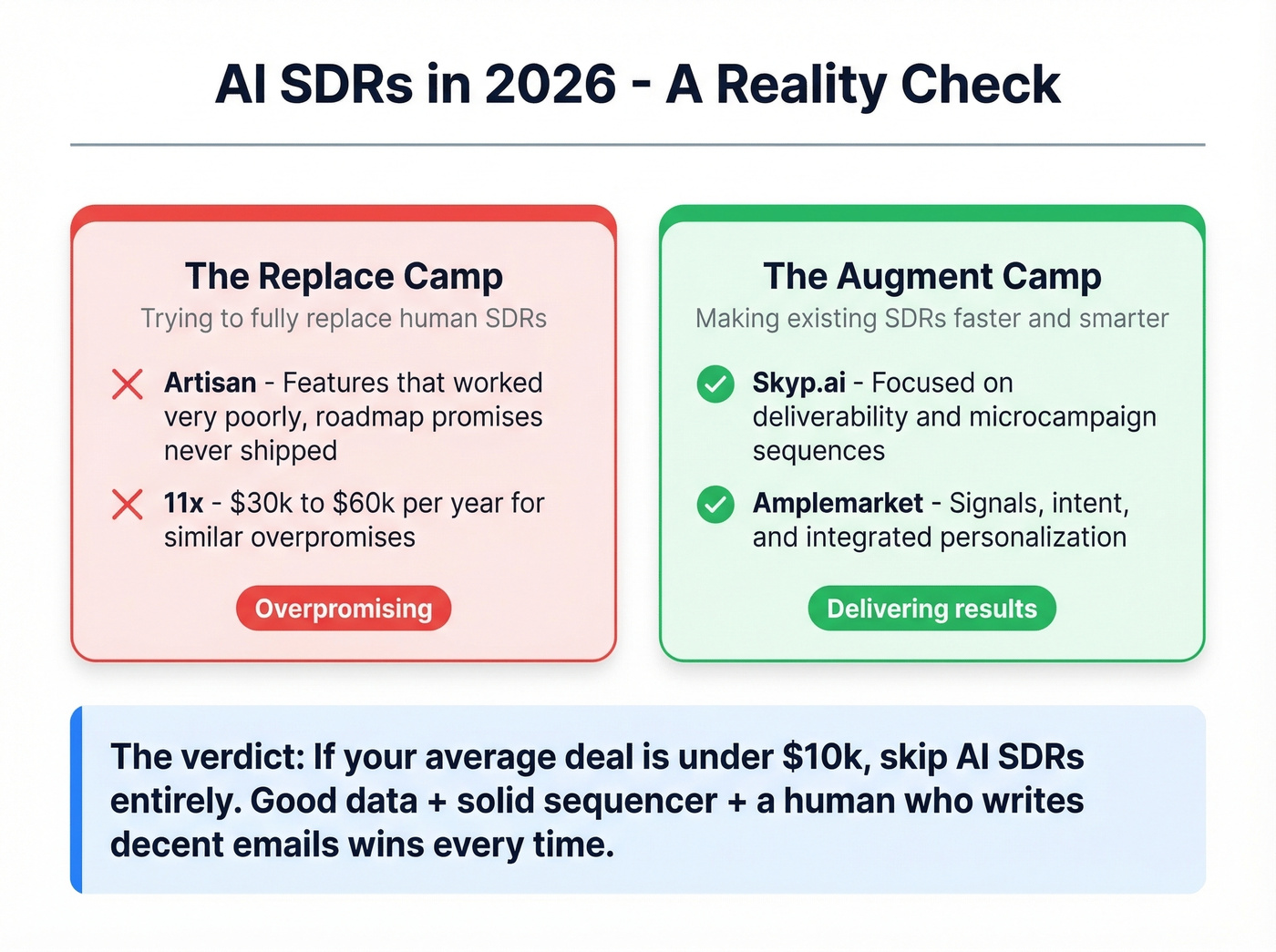
Artisan markets itself as "never hire another human." Users on r/gtmengineering report features that "worked very poorly" and roadmap promises that never shipped. Both Artisan and 11x charge in the $30k-$60k/year range for a similar pitch. The surprise winner in that same thread? Skyp.ai - focused on deliverability and competent microcampaign sequences rather than grand autonomy claims. Amplemarket is also worth watching: it combines signals and intent with integrated deliverability and personalization, and practitioners speak highly of its more measured approach.
Let's be honest: if your average deal is under $10k, you probably don't need any of these AI SDR tools. A lean stack of good data, a solid sequencer, and a human who can write a decent email will outperform a $50k/year AI agent that still can't handle objections. Keeping a human in the loop - augmented by smart tooling - consistently beats full automation at this price point.
What a Real Prospecting Stack Costs
Here's a 4-person team budget that actually works:
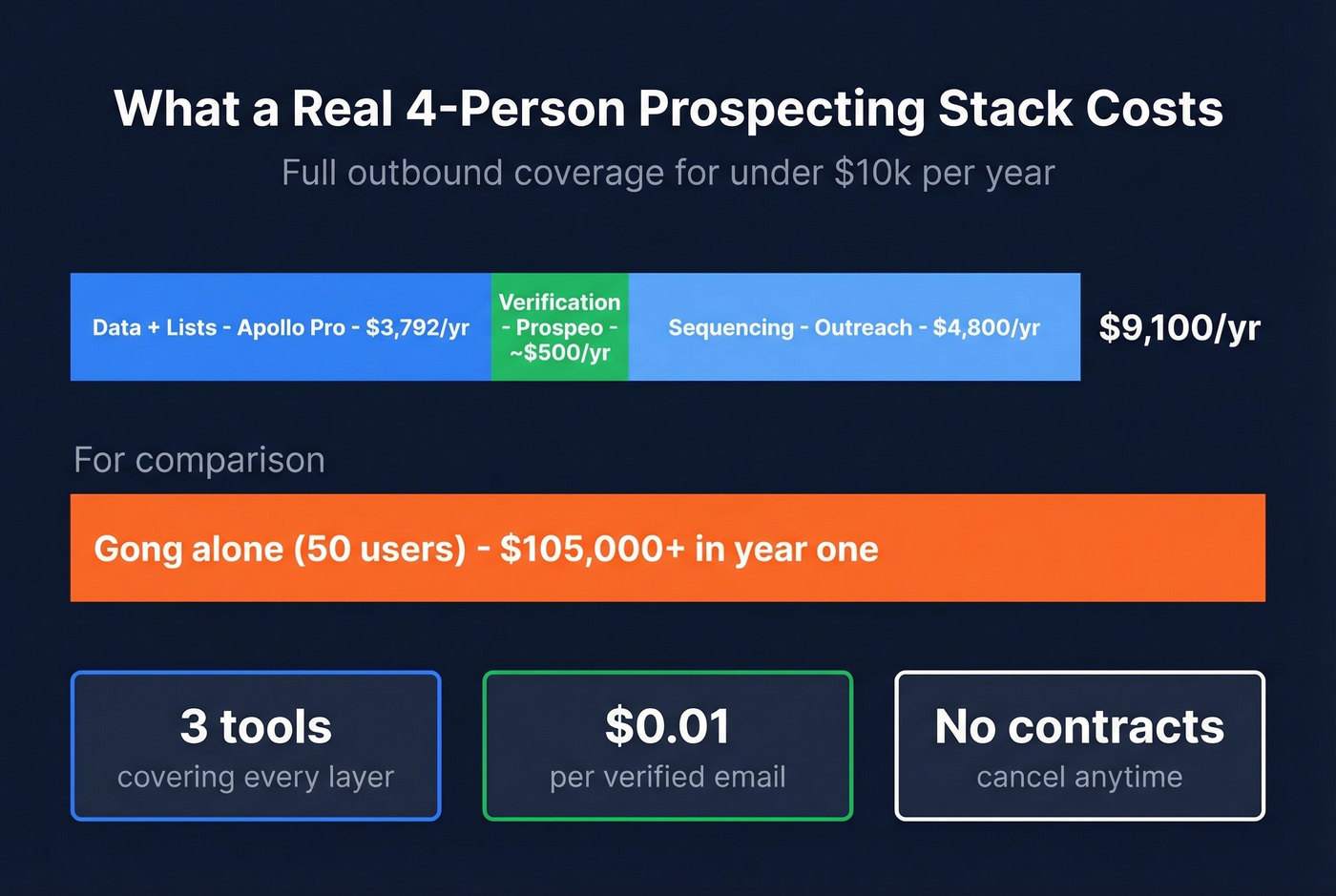
| Layer | Tool | Annual Cost |
|---|---|---|
| Data + lists | Apollo Pro | $3,792/yr |
| Verification | Prospeo | ~$500/yr |
| Sequencing | Outreach | $4,800/yr |
| Total | ~$9,100/yr |
Under $10k/year for a full outbound stack. Compare that to Gong alone at $105k+ for 50 users. For quick one-off lookups, tools like Lusha can supplement at lower commitment, but this three-layer approach covers every function that moves pipeline forward.
If you want more ways to keep costs down without losing coverage, look at pay-as-you-go data options.
Snyk's 50 AEs dropped bounce rates from 35% to under 5% and grew AE-sourced pipeline 180% - because the data layer actually worked. At $0.01 per email with no contracts, Prospeo gives you enterprise-grade prospecting data without the enterprise pricing or the sales call gauntlet.
The best AI prospecting stack starts at a penny per verified email.
Common Mistakes to Avoid
Skipping verification. Roughly 30-40% of CRM data is outdated before you even start layering AI on top. We've seen teams burn through sender reputation in weeks because they trusted raw database exports. Run every list through verification before it touches a sequence.
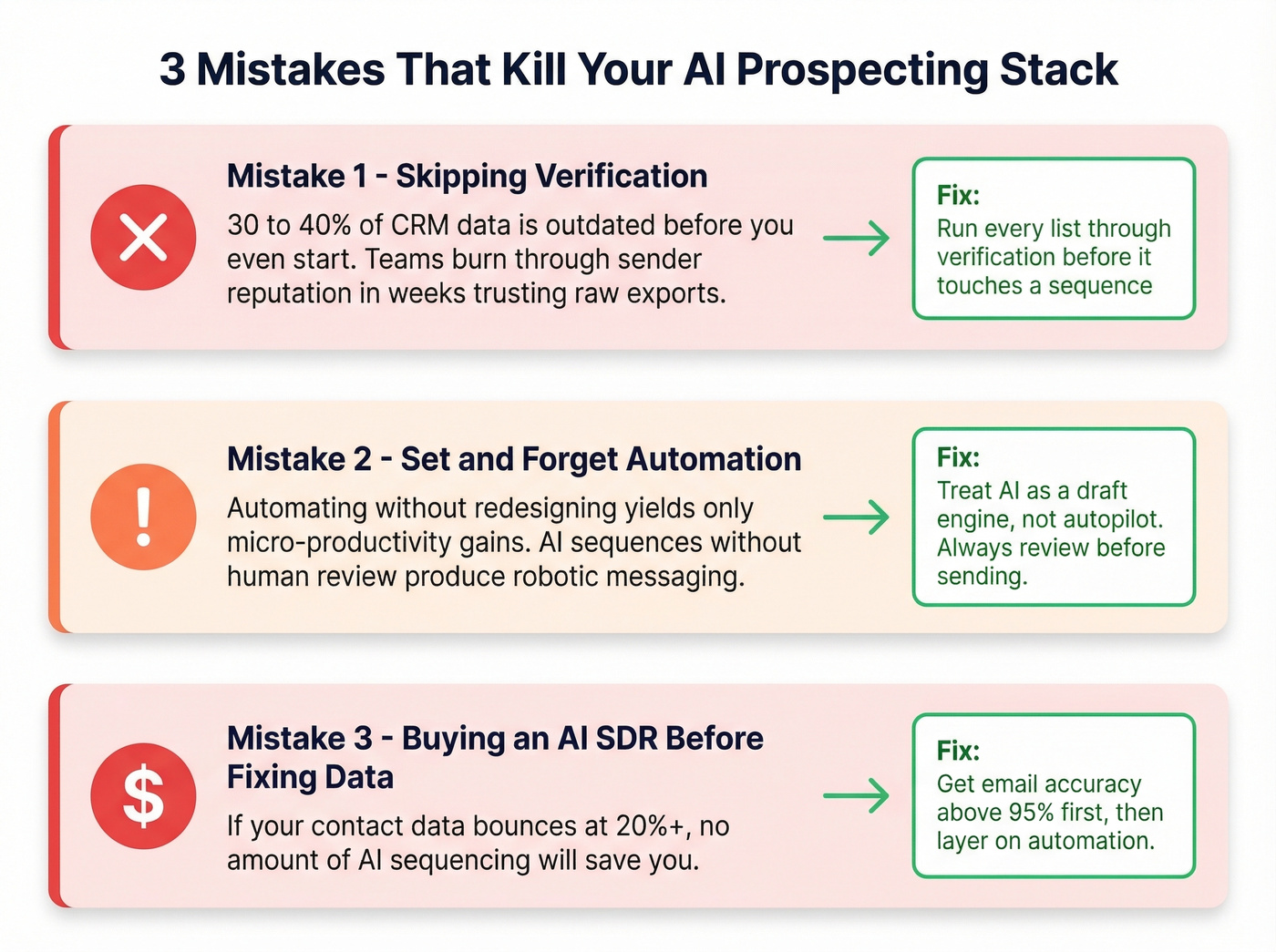
Set-and-forget automation. Bain's research warns that automating existing processes without redesigning them yields only "micro-productivity" gains. AI-powered sequences that run without human review produce robotic, tone-deaf messaging. The teams winning with these tools treat them as a draft engine, not an autopilot.
If you're scaling outbound, follow an outbound email automation playbook instead of guessing.
Buying an AI SDR before fixing your data layer. If your contact data bounces at 20%+, no amount of AI sequencing will save you. Fix the foundation first.
FAQ
What are the best AI tools for prospecting in 2026?
For data accuracy, Prospeo leads with 98% verified emails and a 7-day refresh cycle. Apollo.io is the fastest on-ramp for list building, Clay wins for workflow automation, and Cognism is the top pick for EU-focused teams. Most teams need three to four tools covering distinct layers rather than one platform trying to do everything.
Do AI SDR tools actually replace human reps?
Not yet. Users who tested Artisan and 11x report overpromising on core features. Tools that augment SDRs with better data and smarter sequencing consistently outperform tools trying to replace them entirely. Expect 2-3 more years before full autonomy is viable for complex B2B sales.
How many prospecting tools do I actually need?
Three to four covering distinct layers: data sourcing, verification, sequencing, and optionally conversation intelligence. A typical stack - Apollo for lists, Prospeo for verification, Outreach for sequences - runs under $10k/year for a 4-person team. More than that creates integration headaches and overlapping costs.