

The AIDA Sales Model: Templates, Scripts & How to Actually Use It
Every guide on the AIDA sales model gives you the same thing: a marketing funnel diagram, a Coca-Cola ad breakdown, and maybe a Disney example. That's great if you're writing ad copy for a consumer brand. It's useless if you're a sales rep staring at a blank cold email draft at 8 AM on a Monday.
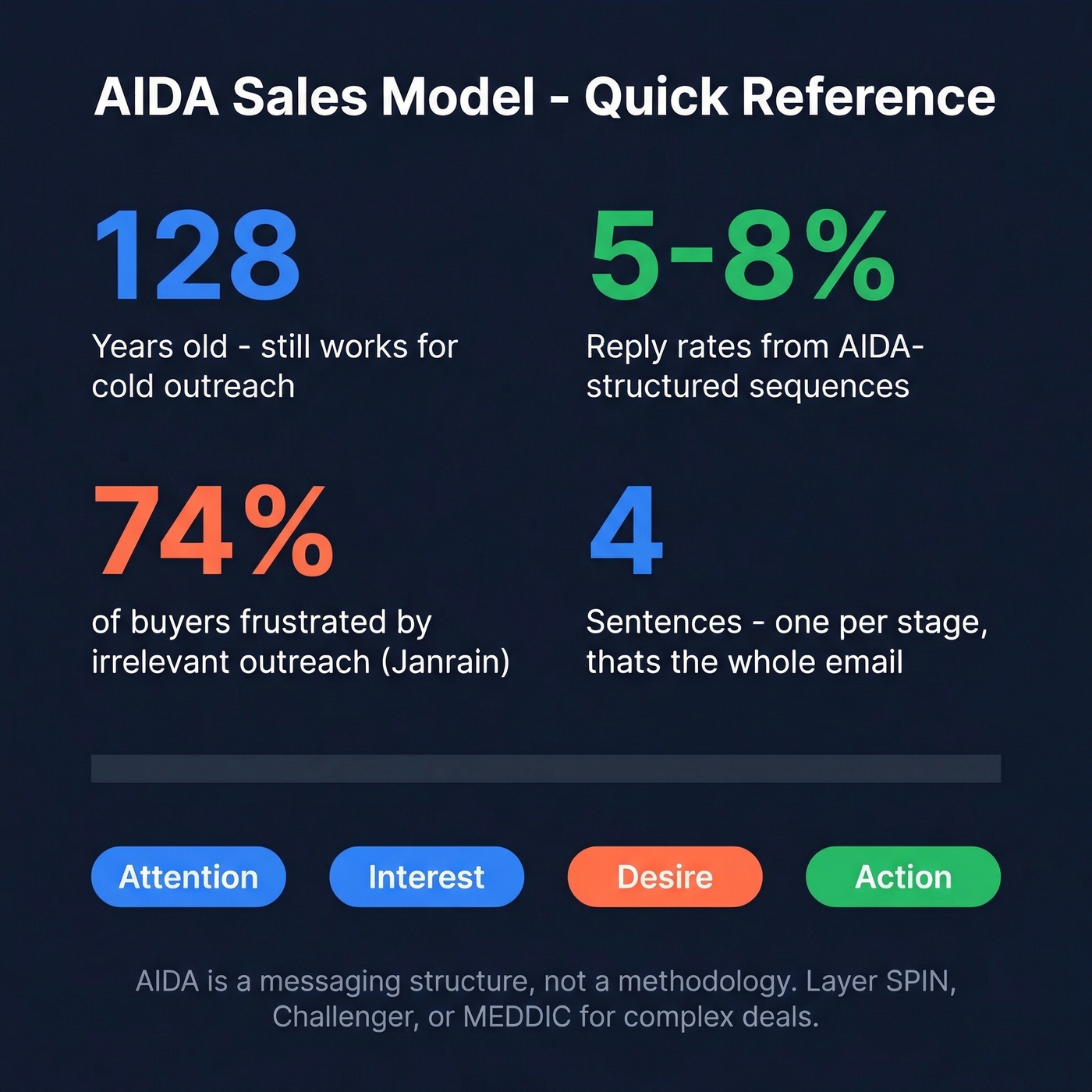
Here's the thing: the framework is 128 years old and it still works. But only if you apply it to actual selling - not textbook marketing exercises. The mistake most people make is treating AIDA as a full sales methodology instead of what it actually is: a messaging structure. We've used it to write outbound sequences that consistently pull 5-8% reply rates, and the templates below are pulled from that experience.
This article is the version written for people who sell.
The Short Version
AIDA - Attention, Interest, Desire, Action - is a messaging structure, not a full sales methodology. Use it to structure cold emails, cold call openers, and outbound sequences. For complex enterprise deals, layer MEDDIC or Challenger on top. Below you'll find copy-paste templates, a cold call script, and a framework comparison so you can decide when AIDA fits and when it doesn't.
What Is the AIDA Framework?
The framework dates back to 1898, when Elias St. Elmo Lewis) outlined the stages a prospect moves through before taking action. Edward Strong refined and popularized it in his 1925 book The Psychology of Selling and Advertising, cementing the four-stage sequence that's survived for over a century.
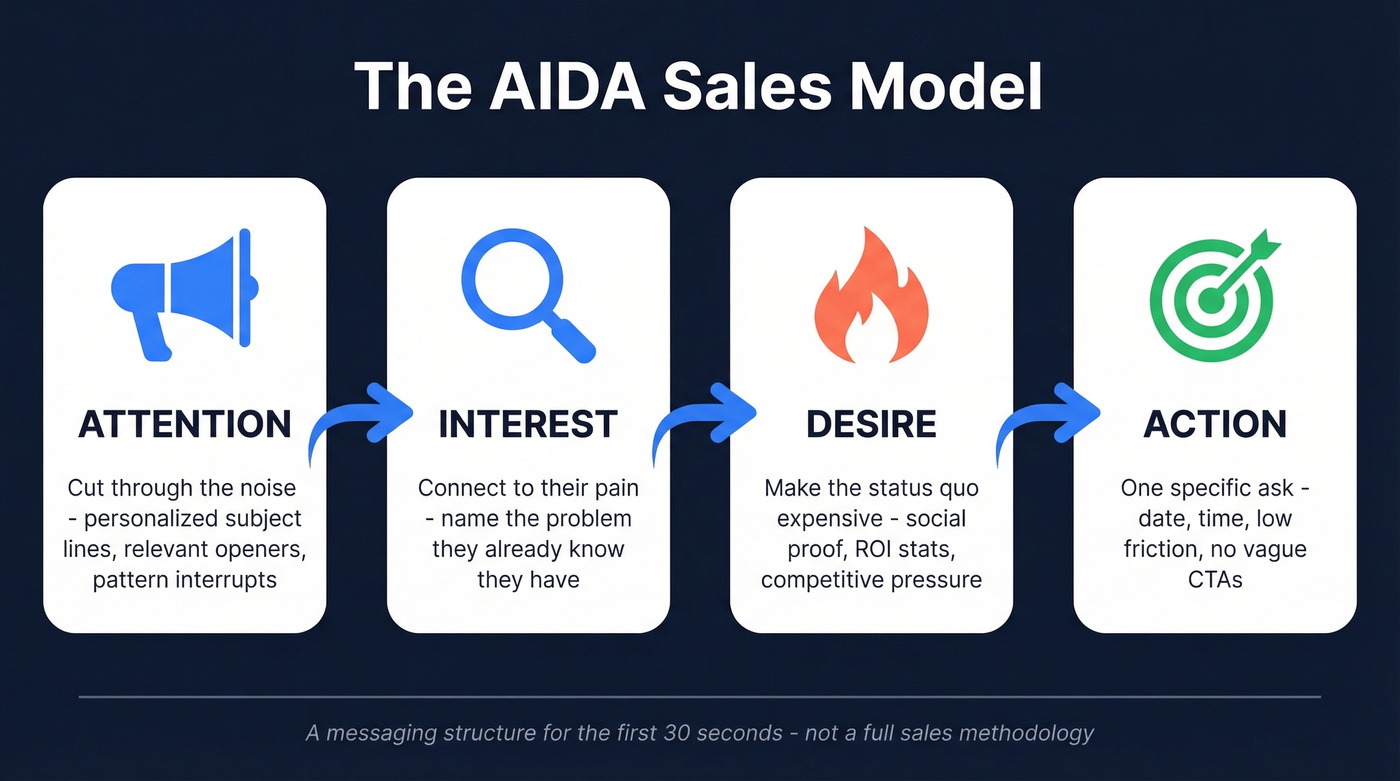
The stages are straightforward:
- Attention - Cut through the noise. Get the prospect to stop scrolling, pick up the phone, or open the email.
- Interest - Connect your message to something they care about. A pain point, a goal, a trend in their industry.
- Desire - Make them want the outcome you're offering. Social proof, ROI framing, competitive positioning.
- Action - Tell them exactly what to do next. Book a call, reply, click, sign up.
AIDA doesn't tell you how to qualify deals, run discovery, or negotiate contracts. It tells you how to organize the first 30 seconds of a conversation - written or spoken - so the prospect actually engages. That's a narrower job than SPIN or Challenger, but it's the job most reps fumble first.
The Four Stages With B2B Examples
Let's break each stage down with examples you'd actually use in outbound sales - not Super Bowl ads.
Attention
You have roughly two seconds in a cold email subject line and maybe five on a cold call before the prospect decides you're noise. Personalization is the single best lever here. Litmus' State of Email research ranks personalizing subject lines as the #2 most effective strategy for boosting email performance.
Good subject lines for B2B outbound: "{{FirstName}}, quick question about {{Company}}'s outbound motion" or "Saw {{Company}} just raised Series B - congrats." On a cold call, it's your first sentence: "Hey Sarah, I noticed your team just posted three SDR roles - sounds like outbound is a priority right now."
The goal isn't cleverness. It's relevance. If you want more options, pull from these subject lines and adapt them to your ICP.
Interest
Once you've got their attention, connect to a problem they recognize. This is where most reps lose the thread - they jump straight to pitching features instead of articulating the pain. In our experience, the Interest stage is where most cold emails die. Research from Janrain found that 74% of customers report frustration when they see irrelevant content from brands, and that dynamic hits even harder in cold outreach. If your second sentence doesn't make the prospect think "this person understands my situation," you've lost them.
B2B example: "Most RevOps teams we talk to are spending 6+ hours a week cleaning bad data out of Salesforce. That's time your reps could be selling." If you're fixing this at scale, data enrichment is usually the fastest lever.
Desire
Now make them want the outcome. Social proof and ROI framing do the heavy lifting here. Don't just say "we help companies grow revenue." Say "We cut bounce rate from 35% to under 4% and helped grow pipeline from $100K to $300K per week."
Competitive positioning works too: "Your competitors are already using intent data to prioritize accounts. Right now, your reps are guessing." Desire is about making the status quo feel expensive. If you need a tighter proof stack, borrow a few patterns from sales communication that consistently land.
Action
The weakest part of most outbound messages. "Let me know if you're interested" isn't a CTA - it's a shrug.
Compare that to "Are you free Thursday at 2 PM for a 15-minute call?" One gives the prospect something to say yes to. The other gives them permission to ignore you. Remove friction, be specific, and only ask for one thing. For more options, use these sales follow-up templates as CTA variations.
AIDA Cold Email Templates
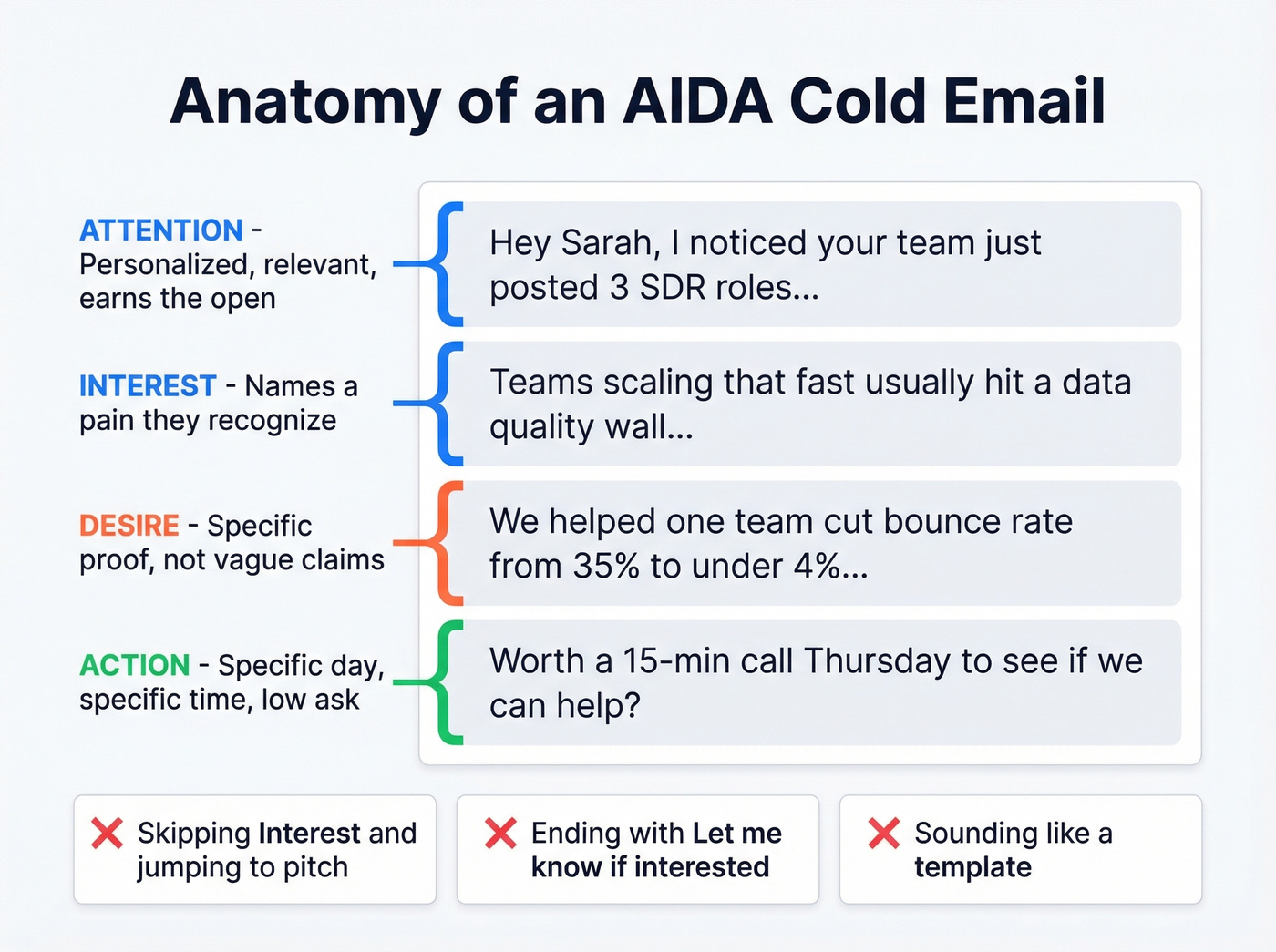
The principle is simple: one sentence per stage, four sentences total. Here are two templates you can adapt today.
Networking Email (Low-Pressure CTA)
Subject: Your talk at SaaStr - quick question
[Attention] Hey {{FirstName}}, I caught your session on scaling outbound at SaaStr and your point about sequence fatigue really stuck with me.
[Interest] We're tackling a similar problem at {{YourCompany}} - our reply rates dropped 40% in Q3 and we're rethinking our entire approach.
[Desire] I'd love to hear how your team handled the channel mix shift you mentioned - it sounds like you're 6 months ahead of where we are.
[Action] Would you be open to a 15-minute call next week? Happy to share what's working on our end too.
Sales Email (Direct Pitch)
Subject: {{Company}}'s bounce rate is costing you pipeline
[Attention] {{FirstName}}, I noticed {{Company}} is running outbound at scale - 4 SDR roles posted in the last month.
[Interest] Teams scaling that fast usually hit a data quality wall. Bad emails mean bounced sequences, burned domains, and reps wasting hours on contacts that don't exist.
[Desire] We helped one team cut bounce rate from 35% to under 4% and grow pipeline from $100K to $300K per week.
[Action] Worth a 15-minute call Thursday to see if we can do the same for {{Company}}?
The common mistakes: sounding like a template (ironic, given this section), skipping the Interest stage entirely, and ending with a weak CTA. AIDA should feel like a conversation, not a checklist. If your email reads like it was assembled from a formula, rewrite until it doesn't.
Of course, the best-structured email in the world bounces if the address is wrong. Prospeo finds and verifies B2B emails with 98% accuracy across 300M+ professional profiles - so your four-sentence email actually lands. If you're troubleshooting deliverability, start with email bounce rate basics.

You just spent time crafting the perfect AIDA cold email - four tight sentences, a killer subject line, a specific CTA. None of it matters if the email bounces. Prospeo delivers 98% verified email accuracy across 300M+ profiles, so your carefully structured outbound actually reaches the inbox. At $0.01 per email, bad data is no longer an excuse.
Stop perfecting copy that bounces. Start sending to verified contacts.
AIDA Cold Call Script
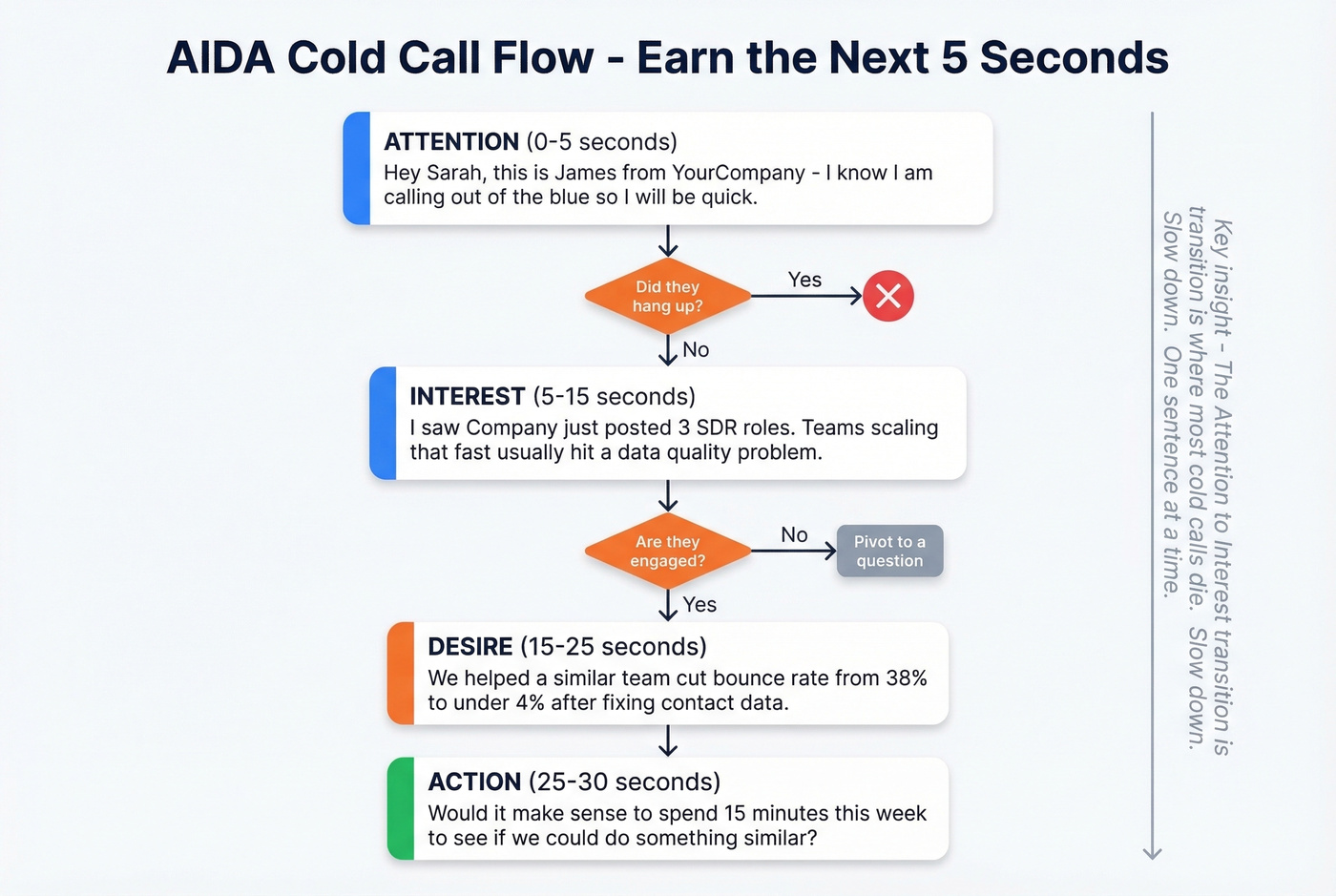
Written frameworks translate surprisingly well to phone conversations. The difference is speed - you have seconds, not a scroll length. Every transition has to earn the next five seconds of the prospect's time. If you're building a repeatable motion, pair this with a full cold calling system.
Here's a script adapted from a Reddit thread on door-to-door selling that maps cleanly to AIDA:
[Attention] "Hello, I'm Rico Suave with XYZ Corporation - how are you today?" (pause)
[Interest] "We're in your area doing some work. Do you know {{Neighbor Name}}?" (pause)
[Desire] "Great - we just set them up with our widget, so we're here helping folks save money on their energy bills."
[Action] "Can I show you what we did for them? Takes about two minutes."
Now here's the B2B phone adaptation:
[Attention] "Hey Sarah, this is James from {{YourCompany}} - I know I'm calling out of the blue, so I'll be quick."
[Interest] "I saw {{Company}} just posted three SDR roles. Teams scaling outbound that fast usually run into a data quality problem pretty quickly."
[Desire] "We helped a similar team cut bounce rate from 38% to under 4% after fixing contact data quality and deliverability."
[Action] "Would it make sense to spend 15 minutes this week to see if we could do something similar?"
The transition from Attention to Interest is where most cold calls die. If you pause after your opening and the prospect doesn't hang up, you've cleared the first gate - now make the Interest sentence count. I've personally blown this transition dozens of times by rushing into a pitch instead of naming the pain. Slow down. One sentence at a time.
AIDA vs Other Sales Frameworks
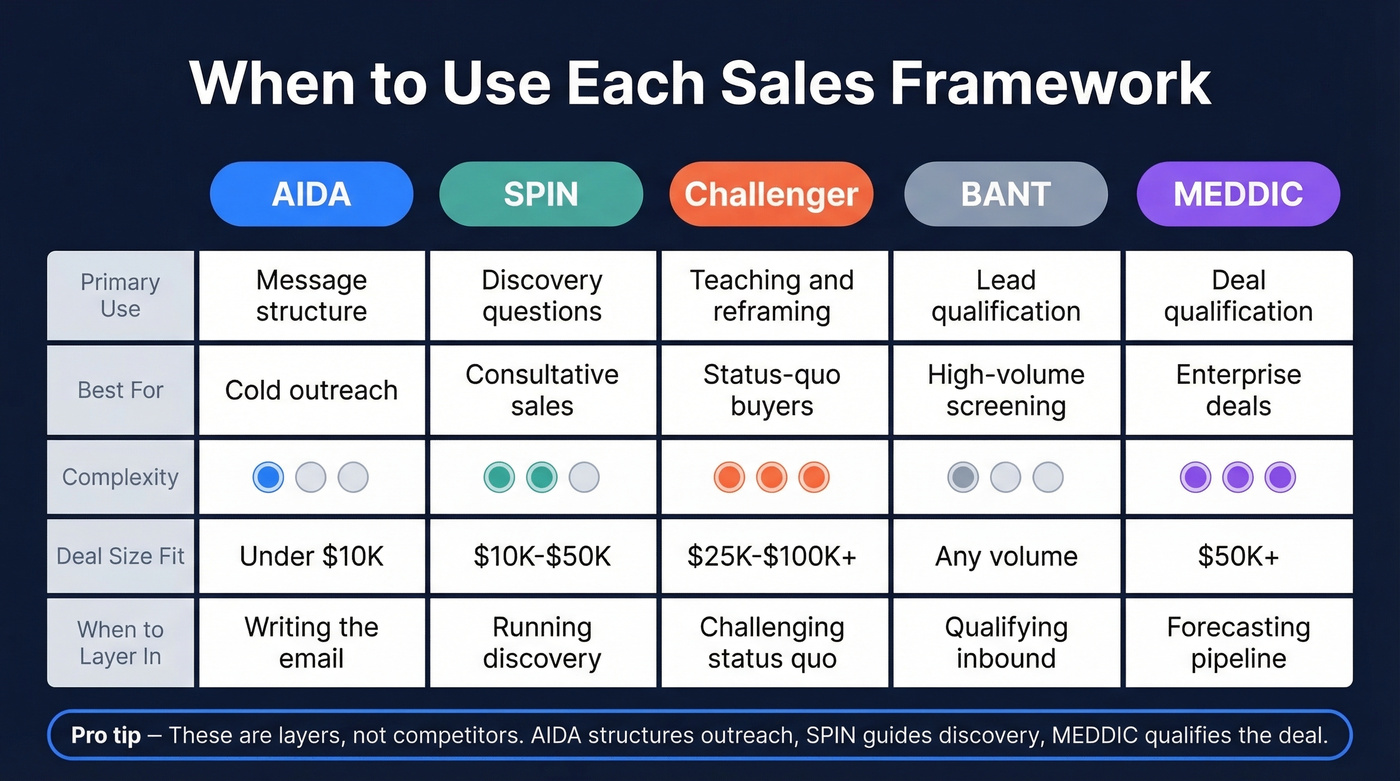
AIDA isn't competing with these frameworks - it's solving a different problem. But since every sales team eventually asks "which methodology should we use?", here's an honest comparison.
| Framework | Purpose | Best For | Research Basis | Complexity |
|---|---|---|---|---|
| AIDA | Message structure | Cold outreach | Lewis 1898 | Low |
| SPIN | Discovery questions | Consultative sales | 35K calls studied | Medium |
| Challenger | Teaching & reframing | Status-quo buyers | 6K+ reps studied | High |
| BANT | Lead qualification | High-volume screening | IBM, 1950s | Low |
| MEDDIC | Deal qualification | Enterprise deals | Common enterprise framework | High |
SPIN Selling's research base is genuinely impressive - 35,000+ sales calls across 20+ countries over 12 years. Challenger's study of 6,000+ reps led to Xerox reporting a 17% increase in sales and $65M in contract value. AIDA has no equivalent empirical base. But you don't need a randomized controlled trial to know that grabbing attention before explaining details works. It's a communication principle, not a clinical intervention.
Here's our hot take: if your average deal size is under $10K, AIDA plus a good email sequence is often enough structure to run outbound. You don't need Challenger reframes or MEDDIC qualification for a $5K/year SaaS deal. You need a sharp cold email that gets a reply and a 15-minute demo that closes. Save the heavy frameworks for when deal complexity demands them. If you're building the rest of the motion, start with sales prospecting techniques and then standardize your B2B cold email sequence.
Use AIDA when you're structuring outbound messaging, writing cold emails, or scripting cold call openers. Short-cycle sales, high-volume outreach.
Use SPIN when you're running discovery-heavy consultative sales where the prospect needs to articulate their own pain before they'll buy.
Use Challenger when you're selling to buyers comfortable with the status quo who need to be taught why change is urgent.
Use MEDDIC for qualifying enterprise deals with multiple stakeholders, long procurement cycles, and six-figure contracts.
Use BANT for quick lead qualification at high volume - though the consensus on r/sales is that most teams aren't qualifying rigorously enough regardless of framework.
The most effective reps blend frameworks. AIDA structures your outreach, SPIN guides your discovery call, and MEDDIC qualifies the deal. They're layers, not competitors.
Limitations Worth Knowing
Skip this section if you just want the templates - but if you're evaluating AIDA as a team-wide standard, these gaps matter.
A literature review by Vakratsas and Ambler found little empirical support for hierarchy-of-effects models in general. The core critique: real buying behavior isn't linear. Prospects don't march neatly from Attention through Interest to Desire and then Action. They loop, skip stages, get distracted, and re-enter at random points.
AIDA also has nothing to say about post-purchase. No retention stage, no referral mechanism, no expansion playbook. For SaaS companies where net revenue retention matters more than new logos, that's a significant gap. And it's not a qualification framework - AIDA won't tell you whether a prospect has budget, authority, or a real timeline. It'll help you get the meeting, but you need MEDDIC or BANT to figure out if the meeting was worth getting.
That said, AIDA doesn't need empirical validation to be useful. It's a communication structure, like the inverted pyramid in journalism. The structure works because it mirrors how attention functions.
Applying AIDA in 2026
The framework is 128 years old. Here's what's changed in how teams apply it.
AI-powered personalization has made the Attention stage faster and cheaper. Instead of manually researching every prospect, AI tools pull recent company news, job changes, and funding events to generate personalized openers at volume. The research time that used to bottleneck AIDA-style outreach has dropped from minutes per prospect to seconds. If you're operationalizing this, a dedicated SDR tools stack helps.
Omnichannel sequences - email, SMS, push notifications, chatbots - can increase conversion rates by 15-20% when coordinated properly. The Action stage isn't just "send one email and hope." It's a multi-touch sequence across channels, each touchpoint following the same AIDA logic but adapted to the medium.
AIDAR adds a Retention stage to the original four, acknowledging that in subscription businesses, the sale doesn't end at Action. Some teams extend this further with Satisfaction and Advocacy stages.
Intent data has transformed the Attention stage from spray-and-pray to precision targeting. Instead of blasting every VP of Sales in your ICP, you can filter for prospects actively researching solutions in your category - so your opener reaches people who are already in-market. Prospeo tracks 15,000 intent topics via Bombora, letting you layer buyer intent signals with job role and company growth filters before you ever write the first line.
The foundation of all of this is data quality. The most sophisticated AIDA sequence in the world fails if it's sent to the wrong person or a dead email address. Start with verified data. Everything else is optimization.
The Desire stage of AIDA depends on real proof - like cutting bounce rates from 35% to under 4% or tripling pipeline to $300K/week. Those aren't hypotheticals. They're Prospeo case studies. With 7-day data refresh, 125M+ verified mobiles, and 30+ filters including buyer intent, you get the data that makes your AIDA scripts actually convert.
Build outbound sequences on data your prospects will actually receive.
FAQ
What does AIDA stand for?
AIDA stands for Attention, Interest, Desire, and Action - four stages of persuasion first outlined by Elias St. Elmo Lewis in 1898 and refined by Edward Strong in 1925. It's a messaging structure, not a full sales methodology.
Is AIDA still relevant in 2026?
Yes - as a messaging structure for outbound sales and copywriting, AIDA remains the fastest way to organize a cold email or call opener. For complex enterprise deals with multiple stakeholders, layer it with MEDDIC or Challenger for qualification and discovery.
What's the difference between AIDA and SPIN Selling?
AIDA structures your message - what to say and in what order. SPIN structures your discovery call - what to ask. Use AIDA for initial outreach, then switch to SPIN for the conversation that follows. They complement each other.
Can I use AIDA for cold emails?
One sentence per stage works perfectly. Grab attention with a personalized hook, build interest with a pain point, create desire with proof, and close with a specific CTA like "Are you free Thursday at 2 PM?" Expect 3-8% reply rates with tight targeting and verified emails.
What tools help execute AIDA outreach at scale?
You need verified contact data first - Prospeo provides 98% email accuracy across 300M+ profiles with a free tier of 75 credits. Then use a sequencing tool like Instantly, Smartlead, or Lemlist to automate multi-touch delivery across channels.