

Aircall vs Dialpad: The Comparison Neither Vendor Will Write
Both Aircall and Dialpad sit at 4.4/5 on G2, with a combined 5,600+ reviews. They look identical on paper. They're not.
Aircall is a CRM-first phone system that charges extra for AI. Dialpad is an AI-first phone system that cuts corners on integrations. Choosing between them depends entirely on which tradeoff you can live with.
Here's the 30-second verdict:
Pick Aircall if your team lives in HubSpot or Zendesk and needs plug-and-play CRM integration. Expect to pay $39/user/month with AI, or $54/user/month once you add AI + Analytics+.
Pick Dialpad if you're a smaller team that wants AI transcription included from day one and can tolerate occasional integration jank. Hard to beat at $15/user/month.
At-a-Glance Comparison
| Category | Aircall | Dialpad | Edge |
|---|---|---|---|
| Starting price | $30/user/mo (annual) | $15/user/mo (annual) | Dialpad |
| AI included? | No - $9/mo add-on | Yes, all plans | Dialpad |
| Integrations | 100+ native | Fewer, selective | Aircall |
| Support hours | 24/7 chat | 24/7 phone + chat (Pro & Enterprise) | Aircall |
| Uptime SLA | 99.95% | 100% (Enterprise only) | Aircall |
| Outbound SMS included | 13K segments/mo | 250/user/mo | Aircall |
| G2 rating | 4.4 (1,536 reviews) | 4.4 (4,067 reviews) | Tie |
| Seat minimum | 3 users | 1 user | Dialpad |
| Visual call flow builder | Smartflow Editor | Basic IVR | Aircall |
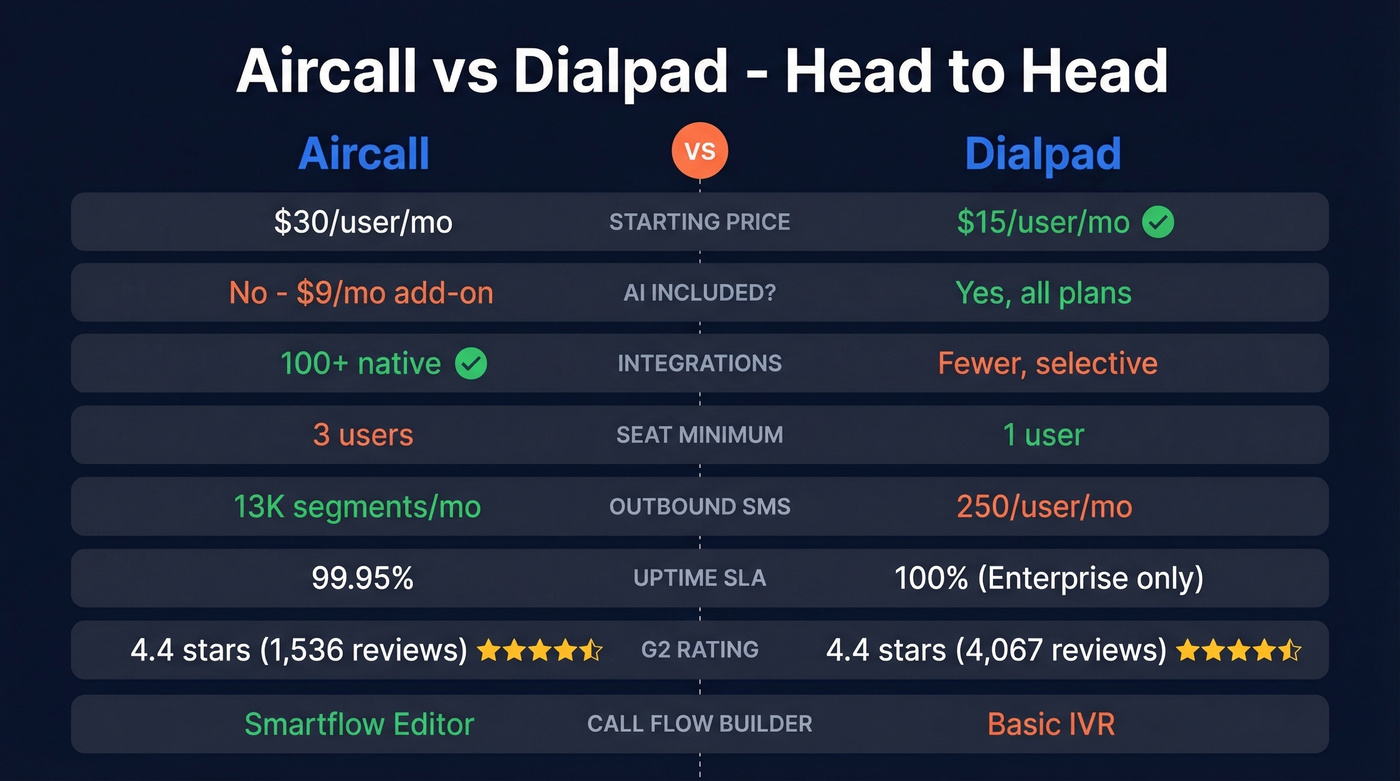
The seat minimum matters more than people think. If you're a two-person team, Aircall forces you to buy a ghost seat. Dialpad doesn't. And Aircall's Smartflow Editor - a drag-and-drop visual builder for call routing - is genuinely useful for teams with complex IVR needs. Dialpad's IVR setup is functional but nowhere near as intuitive.
Pricing: What You'll Actually Pay
Aircall's Real Numbers
| Plan | Annual billing | Monthly billing |
|---|---|---|
| Essentials | $30/user/mo | $40/user/mo |
| Professional | $50/user/mo | Not public |
| Custom | Quote-based | Quote-based |
Every plan requires a 3-seat minimum. That means your floor is $90/month even if only one person makes calls. Add-ons stack fast: AI runs $9/license/month, Analytics+ costs $15/license/month, and extra phone numbers are $6/month each.
Recording retention is tiered too. Essentials gives you up to 1 year of recordings by request, with 6 months available in the dashboard. Professional unlocks unlimited retention by request, with 6 months in the dashboard. If you need historical call data for coaching or compliance, that pushes you toward the pricier plan.
Dialpad's Simpler Structure
Dialpad is cheaper at every tier and easier to understand:
| Plan | Price (annual) | Key gates |
|---|---|---|
| Standard | $15/user/mo | Google/Microsoft only |
| Pro | $25/user/mo | Salesforce, 24/7 support |
| Enterprise | Quote-based | 100% uptime SLA |
AI transcription, summaries, and speech coaching come included on all plans. That's the headline advantage. But some advanced AI features - Custom Moments, AI Scorecards, AI CSAT - are gated to higher tiers or sold as add-ons.
SMS includes 250 messages per user per month, with $0.008/message overage. Recording retention starts at 45 days on Standard and extends to one year on premium tiers.
TCO for a 10-Person Sales Team
This is the table that actually matters:
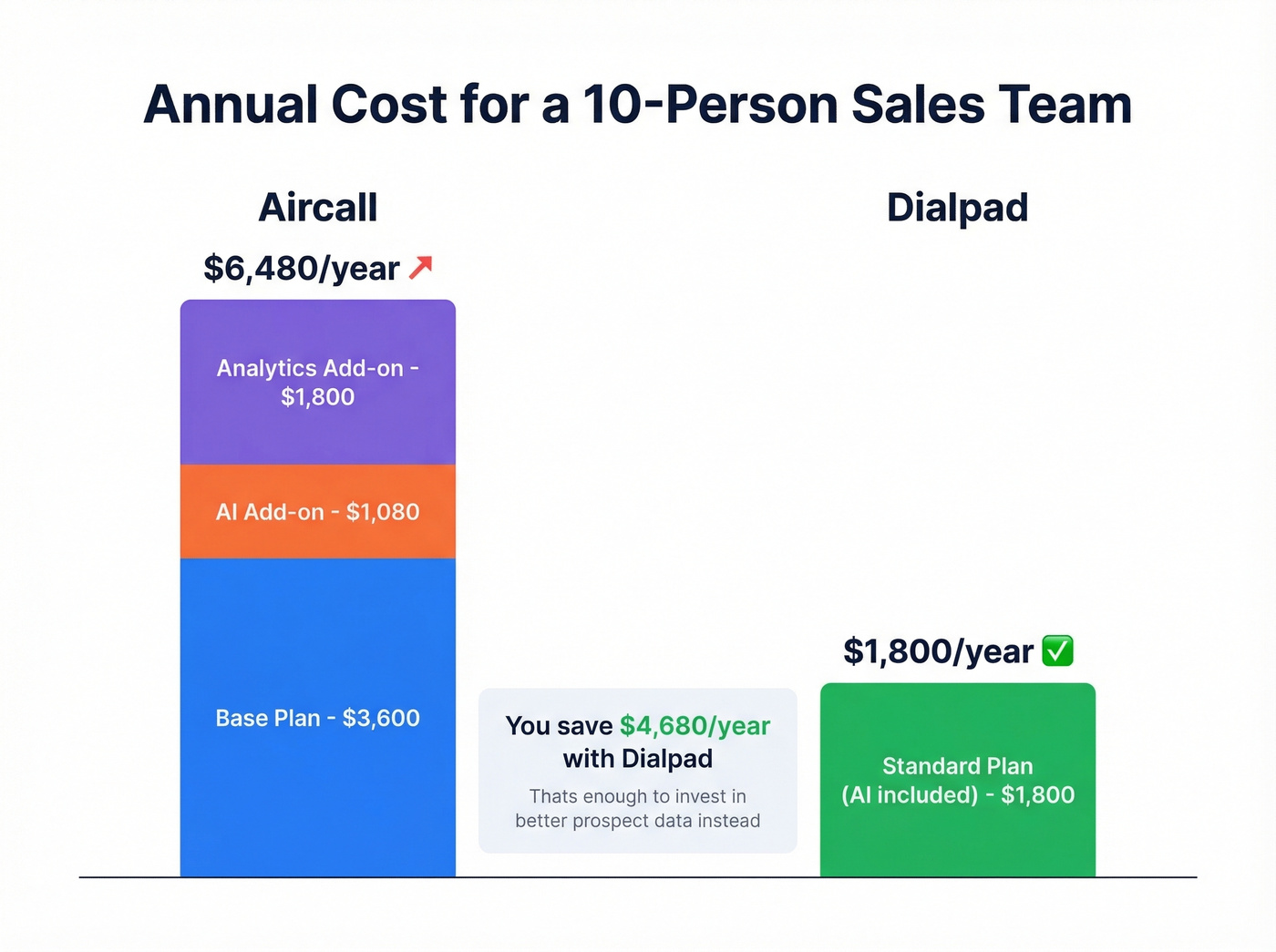
| Cost component | Aircall (Essentials + AI + Analytics) | Dialpad (Standard) |
|---|---|---|
| Base plan (annual) | $30 x 10 x 12 = $3,600 | $15 x 10 x 12 = $1,800 |
| AI add-on | $9 x 10 x 12 = $1,080 | $0 (included) |
| Analytics add-on | $15 x 10 x 12 = $1,800 | $0 (basic included) |
| Annual total | $6,480 | $1,800 |
That's a $4,680/year gap - and it widens if you add extra numbers or move to Aircall Professional. Dialpad's Standard plan delivers AI transcription and basic analytics for roughly what Aircall charges for the base phone system alone.
Here's the thing: most teams closing deals under $10K don't need Aircall-level integration depth. Dialpad Standard plus a solid data provider will outperform Aircall Professional with bad contact lists every single time. The dialer is never the bottleneck. The data is.
AI Features Compared
Dialpad built its identity around AI. The platform has trained on over 6 billion minutes of conversation data, and it shows in the breadth of what's included out of the box. Real-time transcription, post-call summaries, action items, and live speech coaching all come standard on every plan.
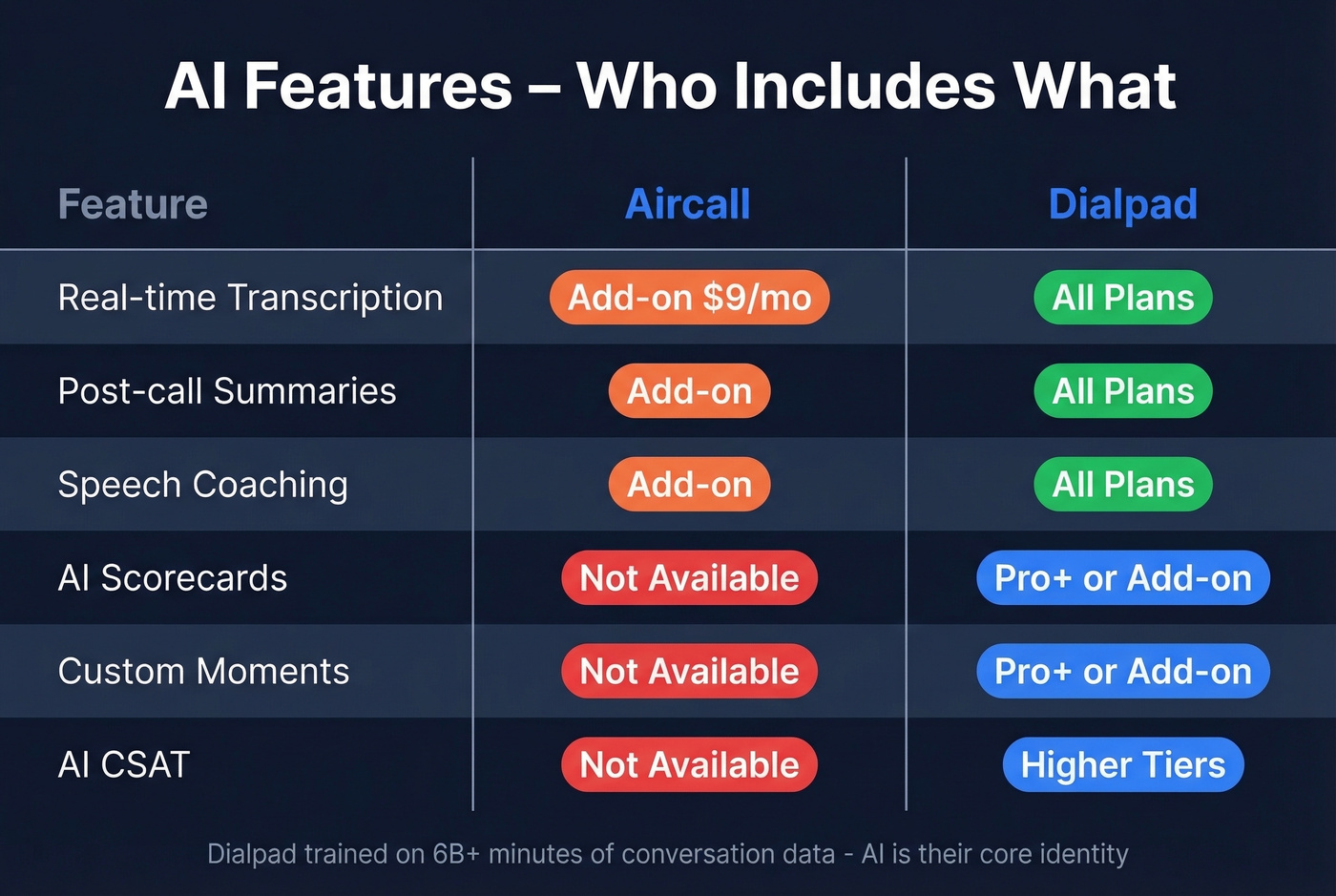
Aircall's AI is competent but costs extra. The $9/month add-on unlocks transcription, call summaries, and sentiment analysis. Without it, you're running a traditional phone system with no intelligence layer.
| AI feature | Aircall | Dialpad |
|---|---|---|
| Real-time transcription | Add-on ($9/mo) | All plans |
| Post-call summaries | Add-on | All plans |
| Speech coaching | Add-on | All plans |
| AI Scorecards | Not available | Pro+ / add-on |
| Custom Moments | Not available | Pro+ / add-on |
| AI CSAT | Not available | Higher tiers |
How accurate is Dialpad's transcription? A Tolly benchmark from February 2025 tested word error rates across platforms and found Dialpad averaging ~8% WER. That's solid but not best-in-class - 8x8 hit ~3.4% in the same test, though transcripts took longer to generate. For most sales teams, 8% WER means transcripts are usable for coaching and CRM logging without heavy manual editing.
We've tested both platforms' transcription on real sales calls, and Dialpad's output is good enough to pipe directly into CRM notes. Aircall's transcription quality is comparable once you pay for the add-on, but the $1,080/year premium on a 10-seat team is hard to justify when Dialpad includes it free. If nobody on your team actually reviews transcripts, neither platform's AI matters - save the money.
Integrations & CRM Compatibility
This is where Aircall pulls ahead decisively. Over 100 native integrations - Salesforce, HubSpot, Zendesk, Intercom, Shopify, Gorgias - and they work out of the box. One Reddit user put it simply: "Setup was simple, CRM integration worked right away, and the reporting tools are actually useful."
Dialpad's integration story is thinner and less reliable. The Standard plan limits you to Google Workspace and Microsoft 365. Salesforce requires the Pro plan at $25/user/month. And even when integrations exist on paper, practitioners say they can be buggy or incomplete. We've worked with teams that switched from Dialpad to Aircall specifically because Dialpad's HubSpot sync kept dropping call records - you can't always trust the integrations listed, and some need Zapier workarounds to function properly.
If your team runs HubSpot or Zendesk as the operational hub, Aircall's native integration depth is worth the premium. For Google Workspace shops with simpler CRM needs, Dialpad's lighter footprint won't hurt you.
If you’re building a repeatable outbound motion, pair your dialer choice with a tighter Outbound Sales Playbook and cleaner contact data so reps aren’t wasting dials.

You just saw the math: the dialer is never the bottleneck - the data is. Whether you pick Aircall or Dialpad, bad contact lists tank your connect rates. Prospeo gives your reps 125M+ verified mobile numbers with a 30% pickup rate and 98% email accuracy, refreshed every 7 days.
Stop paying for a premium dialer and feeding it garbage data.
SMS, Support & Reliability
SMS & Messaging
SMS capabilities differ more than you'd expect. Aircall includes unlimited inbound SMS/MMS in the US and Canada, plus 13,000 outbound text segments per month. No group texting, and international SMS is limited.
Dialpad includes 250 SMS/MMS messages per user per month, with $0.008/message overage. For a 10-person team doing light texting, that's 2,500 messages before overages kick in. A2P compliance requirements add friction - you'll need to register your business and use case through The Campaign Registry, which can take days to weeks for approval. It's not as simple as flipping a switch.
If outbound SMS is a meaningful part of your workflow, Aircall's higher limits win. For occasional texting, Dialpad's 250/user allocation is fine.
Support & Uptime
Neither platform covers itself in glory on base-tier support. Aircall includes 24/7 chat support and a 99.95% uptime SLA. Dialpad offers 24/7 phone and chat support on Pro and Enterprise, but the 100% uptime SLA only kicks in at Enterprise.
We've seen teams pick a platform based on features, then regret it when they hit a support wall during a Friday evening outage. If after-hours reliability matters, budget for Dialpad Pro or Aircall Professional - don't expect white-glove treatment on starter plans from either vendor.
What Real Users Say
Both platforms score nearly identically on G2, but the texture of reviews tells a different story.
Aircall's praise centers on setup speed. Users consistently highlight how quickly CRM integrations go live. The flip side? An r/ITManagers thread calls out the "worst customer service and billing" experience. G2 ease-of-use scores are strong at 9.2, but the support score of 8.6 is mediocre.
Dialpad's Reddit sentiment is harsher. One user in r/EntrepreneurRideAlong describes "one of the worst support teams in existence" and says the platform "breaks down all the time." Dialpad's G2 ease-of-setup score of 9.0 is slightly better than Aircall's 8.9, but its support score of 8.5 is the lowest of the two.
The shared complaint: connection issues and call quality problems. Both platforms. Top complaint for each. Neither vendor has solved support at scale, and those G2 support scores in the mid-8s confirm it. Factor that into your decision, especially if you don't have internal IT to troubleshoot VoIP issues.
If you want to pressure-test the decision, use a simple sales cycle lens: how much time do you lose to logging, QA, and follow-ups?
Which Should You Choose?
Sales teams with 5-20 reps using a CRM daily: Aircall Professional. The integration depth with Salesforce, HubSpot, and Zendesk justifies the premium. Your reps won't waste time on manual call logging.
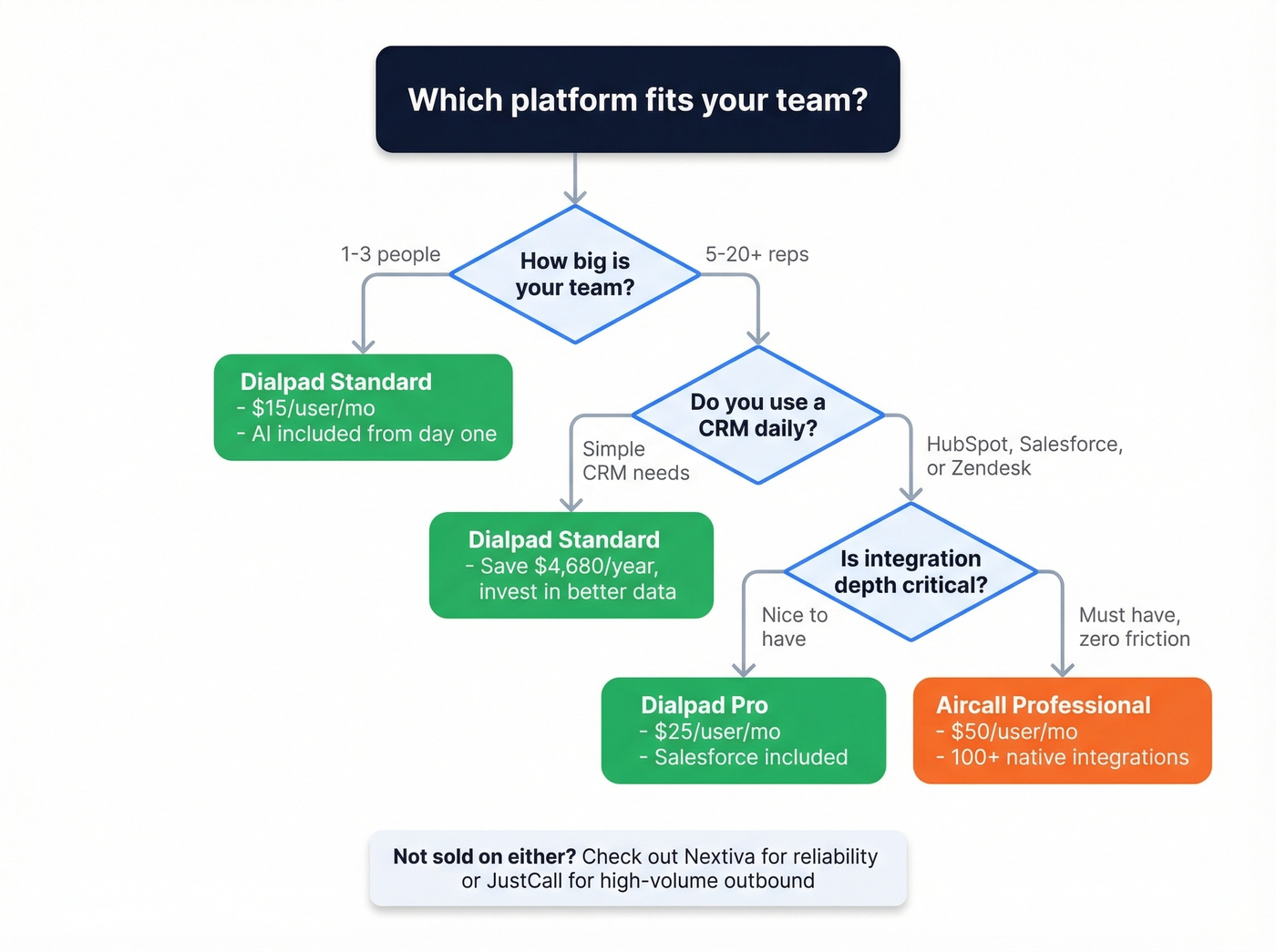
Small teams of 1-3 people who want AI from day one: Dialpad Standard. At $15/user/month with transcription and coaching included, nothing else touches this value. Just know that Salesforce integration requires upgrading to Pro.
Budget-conscious teams: Dialpad Standard, then invest the $4,680/year you saved into better prospect data. Connect rates depend more on data quality than dialer features. Clean numbers and verified emails move your pipeline more than AI transcription ever will. (If you need a system for that, start with modern lead generation process fundamentals and a clear Ideal Client Profile.)
Alternatives Worth Knowing
Nextiva keeps surfacing in Reddit threads as the "boring but reliable" option. Teams that prioritize uptime and phone support over AI bells and whistles tend to land here. Expect $25-35/user/month for comparable plans. Worth a look if neither Aircall nor Dialpad's support reputation inspires confidence.
JustCall targets sales-heavy teams with a built-in auto-dialer and SMS automation that neither Aircall nor Dialpad match at lower tiers. Pricing starts around $19/user/month. If your workflow is high-volume outbound with SMS follow-ups baked in, JustCall is purpose-built for that motion in a way the other two aren't.
If you’re evaluating other calling stacks, it’s also worth comparing against purpose-built automated cold calling software and dialing workflows like a Cold Call + email sequence combo.
The Problem Neither Platform Solves
Let's be honest about something: roughly 30% of outbound calls hit disconnected or wrong numbers. That's not a dialer problem. It's a data problem. Neither Aircall nor Dialpad can fix a bad prospect list.
Prospeo sits upstream of your dialer. With 125M+ verified mobile numbers and a 30% pickup rate, it ensures your reps spend time on live conversations instead of voicemails and dead lines. Email accuracy runs 98% across 143M+ verified addresses, and data refreshes every seven days. Start free, no contract required.
Before you optimize your dialer, optimize your data. That's the lever most teams miss.
A 10-seat team saves $4,680/year choosing Dialpad over Aircall. Redirect that budget to data that actually fills your pipeline. Prospeo delivers verified direct dials at $0.01/email - 90% cheaper than ZoomInfo - so every call your team makes connects to a real buyer.
Spend less on your dialer. Spend smarter on the contacts that pick up.
FAQ
Is Dialpad really cheaper than Aircall?
Yes - roughly 3.6x cheaper for a 10-seat team with AI. Dialpad Standard at $15/user/month totals $1,800/year. Aircall Essentials plus the $9/month AI add-on runs $39/user/month effectively, totaling $6,480/year with Analytics+ included. The gap widens further on Aircall Professional.
Does Aircall include AI features?
Aircall offers AI transcription, summaries, and sentiment analysis as a paid add-on at $9/license/month - it's not included in the base plan. Budget an additional $108/user/year to match what Dialpad bundles by default on every tier.
Which platform has better call quality?
Neither is flawless - dropped calls and audio issues are the top G2 complaint for both. Aircall guarantees 99.95% uptime; Dialpad promises 100% only on Enterprise. Real-world quality depends heavily on your internet infrastructure and ISP, not just the platform.
Can I use Dialpad with Salesforce?
Only on the Pro plan ($25/user/month) or higher. Standard limits you to Google Workspace and Microsoft 365. Factor that $10/user/month upgrade into your total cost if Salesforce is your CRM - it closes much of the pricing gap with Aircall.
What if my real problem is bad contact data?
If over 20% of your dials reach wrong numbers or voicemail, switching dialers won't help. Fix the list first with a tool like Prospeo, then optimize the phone system. Most teams see bigger pipeline gains from cleaner data than from any dialer feature.