

What Is the Process of Lead Generation? A 7-Step Framework
Your marketing team generated 500 leads last month. Sales says 480 are garbage. The finger-pointing starts, nobody agrees on what "qualified" means, and the pipeline forecast looks like fiction.
This isn't a communication problem - it's a process problem. The gap between "we generated leads" and "we generated revenue" is where most teams quietly bleed money. 68% of companies haven't even identified their funnel, 61% of marketers say generating traffic and leads is their biggest challenge, and 79% of marketing leads never convert into sales. Understanding the full lead generation process - from ICP definition to sales handoff - is what separates pipeline reality from pipeline fiction.
The Short Version
The lead generation process breaks into seven steps: define your ICP, build capture systems, drive traffic, verify your data, score leads, nurture through the funnel, and hand off to sales with measurement baked in. The two steps teams underinvest in most? Data quality and measurement.
The rest of this guide gives you conversion benchmarks at every stage (First Page Sage's B2B SaaS benchmarks show Lead-to-MQL at 39% and SQL-to-Closed at 37%), channel close rates (SEO at 14.6% vs outbound at 1.7%), and an ROI formula you can plug real numbers into.
How Lead Generation Actually Works
Lead generation is the process of attracting potential buyers, capturing their information, and qualifying them until they're ready for a sales conversation. Everything else - the tools, the sequences, the content - is plumbing that supports those three actions.
The B2B version is fundamentally different from B2C. B2C purchases can be fast and emotional. A B2B buying group involves 6-10 stakeholders, each with different priorities, and the average sales cycle runs about 102 days. You're not generating a single lead. You're generating entry points into a committee decision that takes months to resolve, and every step of your process needs to account for that complexity.
Types of Leads: MQL, SQL, PQL
Before building a process, you need shared vocabulary. The number-one reason marketing and sales teams fight about lead quality is that they're using the same words to mean different things.
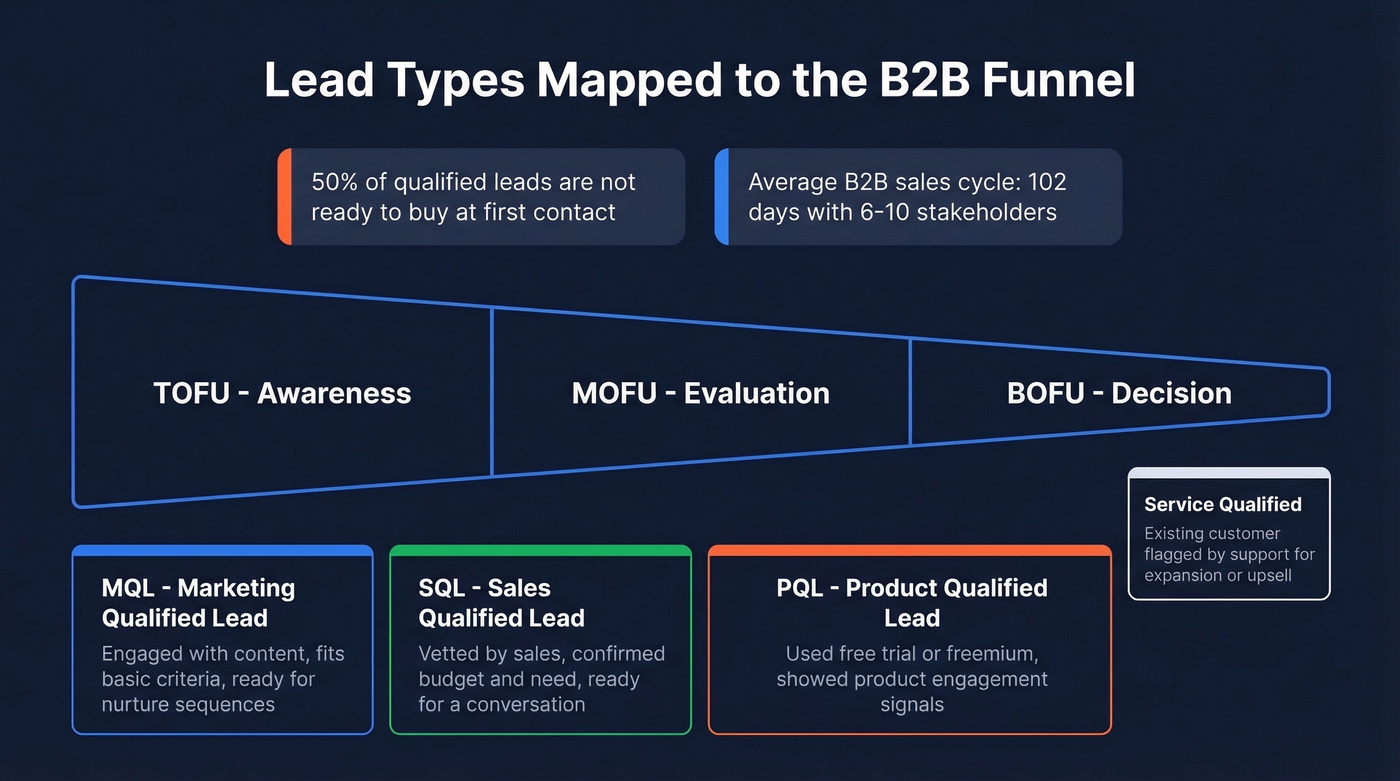
| Lead Type | Definition | When It Matters |
|---|---|---|
| MQL | Engaged with marketing content; fits basic criteria | MOFU - ready for nurture |
| SQL | Vetted by sales; confirmed budget/need | BOFU - ready for a call |
| PQL | Used the product (free trial/freemium) | Product-led growth motions |
| Service Qualified | Existing customer flagged by support | Expansion/upsell plays |
The distinction between a lead and a prospect matters too. A lead is anyone who's shown interest. A prospect is a lead you've confirmed fits your ICP. 50% of qualified leads aren't ready to purchase at first contact - which means your process needs to handle the gap between "interested" and "ready to buy" without losing people along the way.
The 7-Step Lead Generation Process
Step 1: Define Your ICP and Buying Committee
Most teams define their ICP as a job title and a company size. That's a start, but it's not enough.
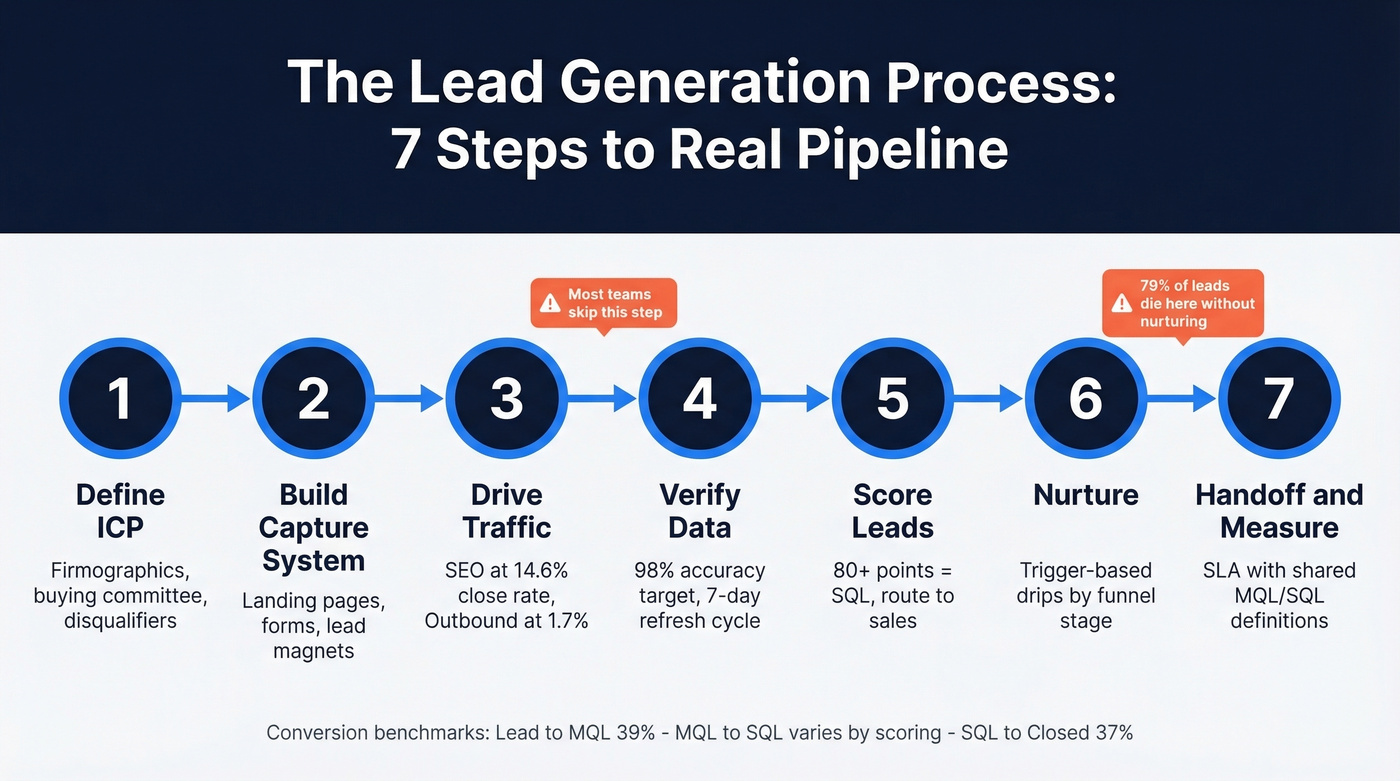
A real ICP definition covers company firmographics: industry, revenue band, headcount, and tech stack. It maps buying committee roles - the economic buyer, the champion, the technical evaluator, and the blocker. It identifies trigger events like funding rounds, leadership changes, and tech migrations. And it explicitly lists disqualifiers: wrong geography, too small, or already locked into a competitor's 3-year contract. Skip the disqualifier list and your team will waste weeks chasing accounts that were never going to close, which is a mistake we've watched happen at companies that should know better.
The concept of competency mapping - breaking your ICP into sub-segments and understanding the full decision process for each - separates teams that generate pipeline from teams that generate noise.
Step 2: Build Your Lead Capture System
Your capture system is the infrastructure that turns anonymous visitors into known contacts: landing pages, forms, CTAs, and lead magnets. The common failure here isn't missing infrastructure - it's generic lead magnets. A PDF titled "The Ultimate Guide to [Your Industry]" doesn't convert because it doesn't solve a specific, urgent problem.
The best-performing lead magnets are narrow and immediately useful. Think ROI calculators, benchmark reports for a specific vertical, or templates that save someone two hours this week. Match the magnet to the funnel stage: a TOFU blog post earns an email address; a BOFU pricing comparison earns a demo request.
Landing page conversion rates typically range from 2-5% for cold traffic to 5-10% for warm or retargeted visitors, so knowing your traffic temperature matters more than obsessing over button colors.
Step 3: Drive Traffic (Inbound vs Outbound)
Use inbound when you're building long-term pipeline, your content team can produce consistently, and you're willing to wait 3-6 months for compounding returns. SEO-driven leads close at 14.6% - roughly 8x the close rate of outbound.
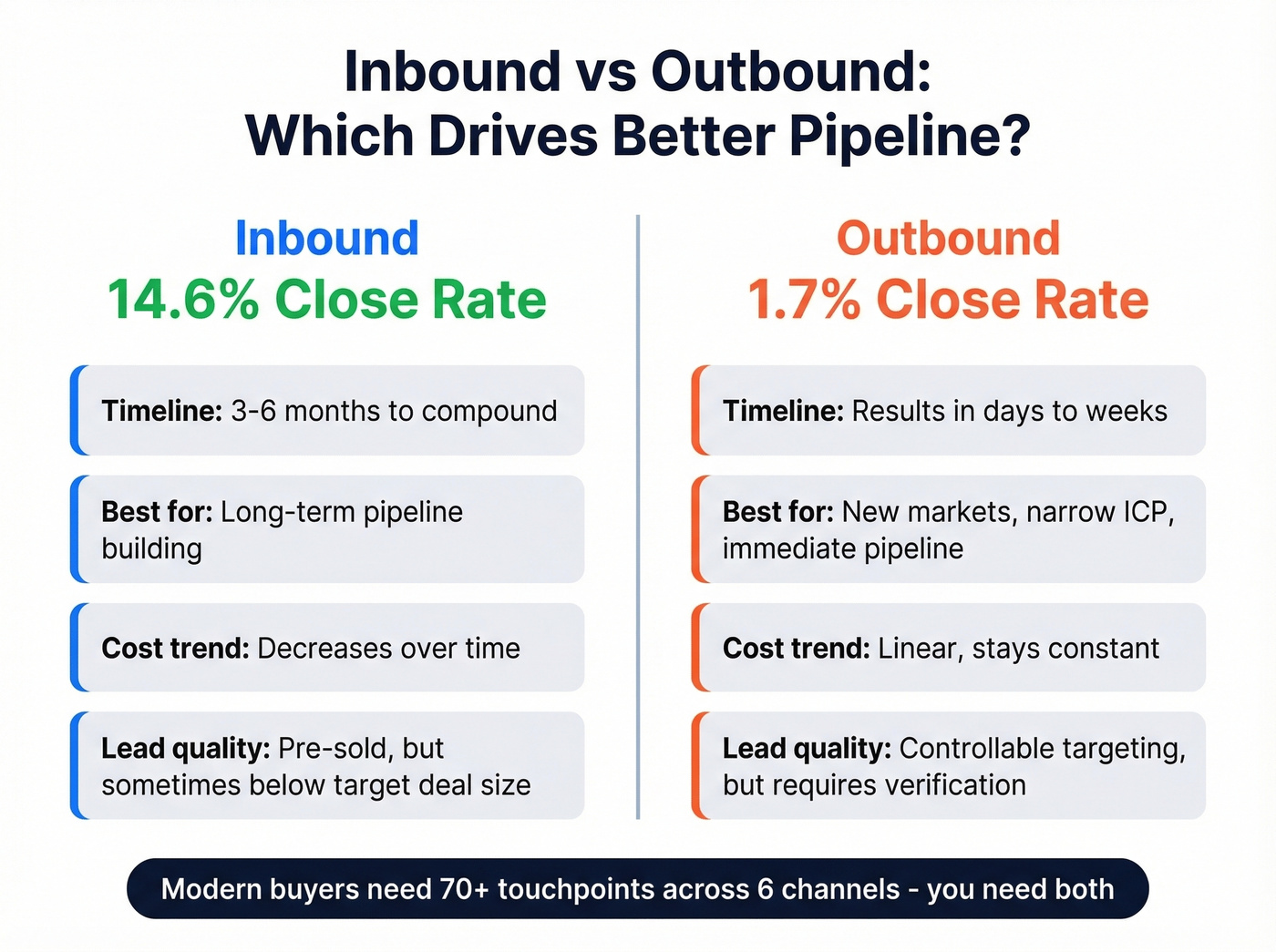
Use outbound when you need pipeline now, you're entering a new market, or your ICP is narrow enough that waiting for them to find you doesn't make sense. Outbound closes at 1.7%, but it's controllable and immediate.
Modern buyers require 70+ touchpoints across six channels before they're ready to engage. Neither inbound nor outbound alone gets you there. The winning sequence for most teams: SEO and content first because it compounds, then targeted outbound to accounts showing intent, then paid to fill gaps.
One practitioner on r/agency described the problem perfectly - inbound brings "pre-sold" leads, but they're often below your target price range. You need outbound to reach the accounts that won't find you on their own. A common pattern on r/DigitalMarketing echoes this: teams running manual prospecting through Apollo, personalized email, and outreach, then asking what can be automated without losing the personal touch.
Here's the thing: if your average deal size is under $10K, you probably don't need a complex multi-channel outbound engine. Invest in SEO and a solid nurture sequence instead. Outbound's economics only work when the contract value justifies the cost per touch.
Step 4: Capture and Verify Lead Data
This is the step most guides skip entirely, and it's the one that silently kills everything downstream. You can nail your ICP, build beautiful landing pages, and run a multi-channel traffic engine - but if a huge chunk of your email addresses bounce, your sender reputation tanks, your nurture sequences break, and sales loses trust in every list marketing hands over.
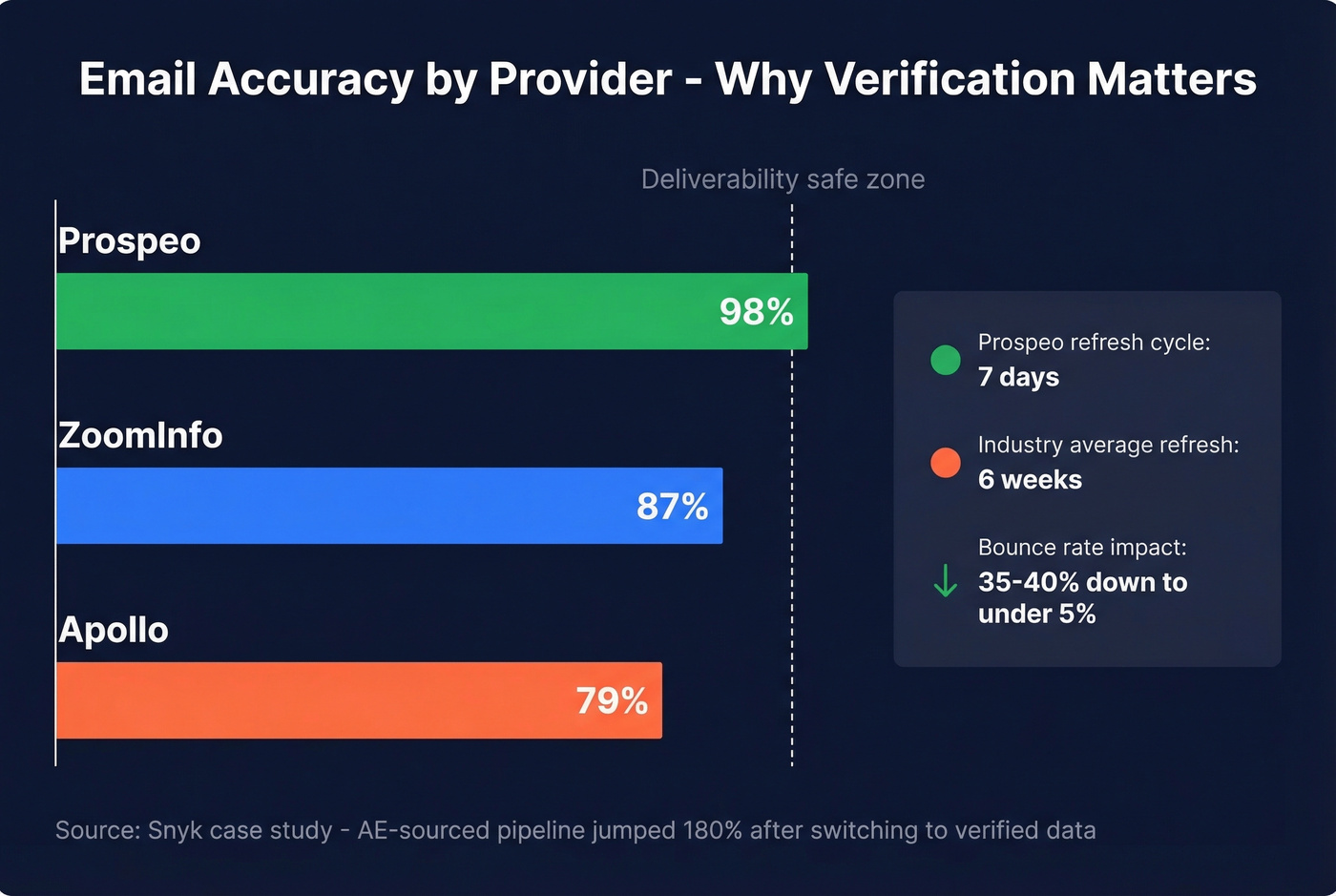
This isn't hypothetical. Snyk had 50 AEs prospecting 4-6 hours per week with bounce rates running 35-40%. After switching to verified data, bounces dropped under 5%, AE-sourced pipeline jumped 180%, and they were generating 200+ new opportunities per month. In our experience, teams that skip data verification often damage deliverability so badly they spend months repairing their sending infrastructure.
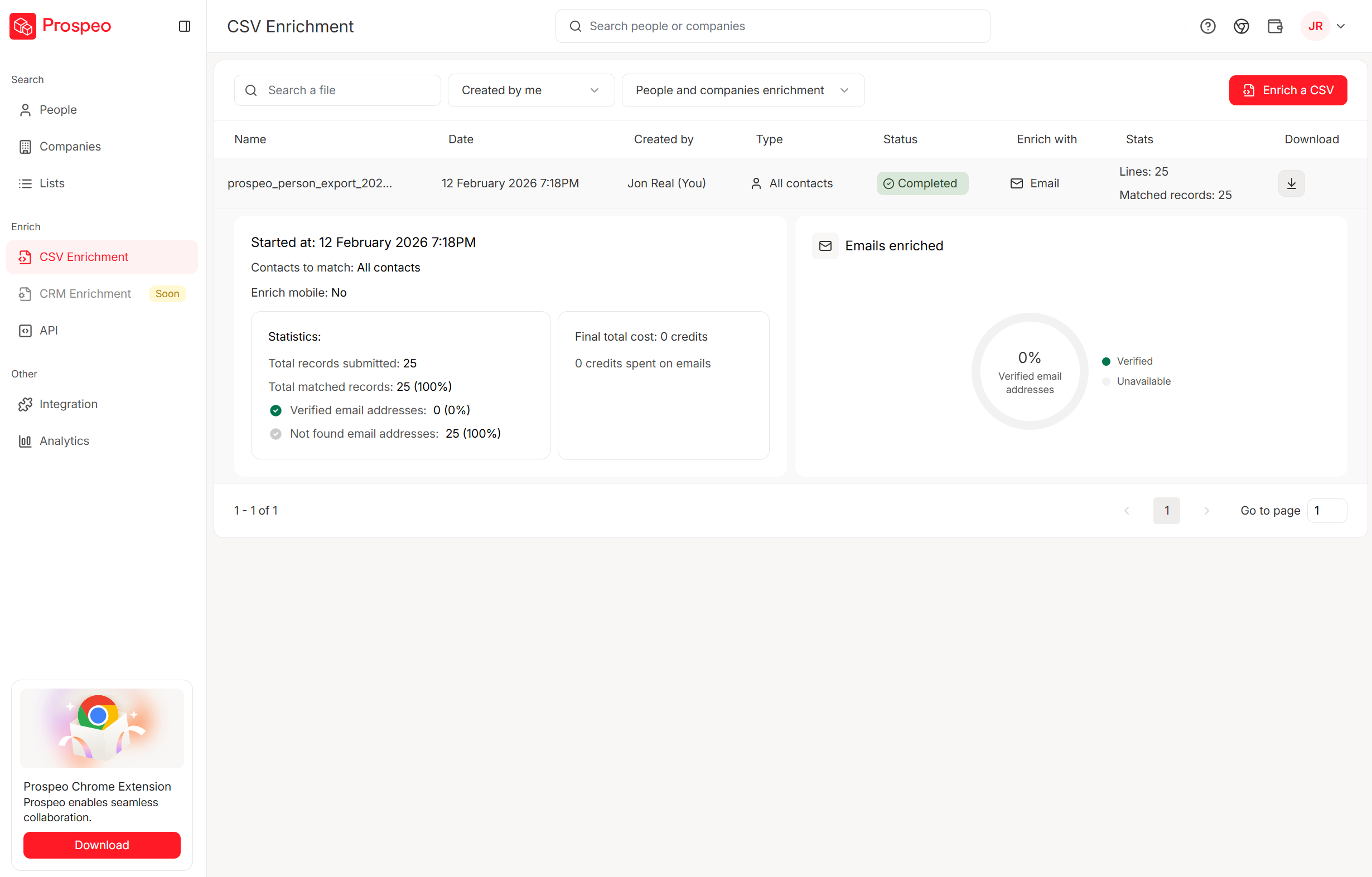
Prospeo solves this at the data layer. Its database covers 300M+ professional profiles with 98% email accuracy, compared to 87% from ZoomInfo and 79% from Apollo. That gap comes from a proprietary 5-step verification process with catch-all handling, spam-trap removal, and honeypot filtering, all refreshed on a 7-day cycle. The industry average refresh is six weeks, which means most databases are serving you stale data by default.
If you're troubleshooting bounces and deliverability, start with email bounce rate benchmarks and an email deliverability checklist before scaling volume.
Step 5: Score and Qualify Leads
Lead scoring turns subjective opinions ("this one feels warm") into a repeatable system. BANT - Budget, Authority, Need, Timeline - is the classic qualification framework. The scoring model below puts point values on it by combining firmographic fit with behavioral signals.
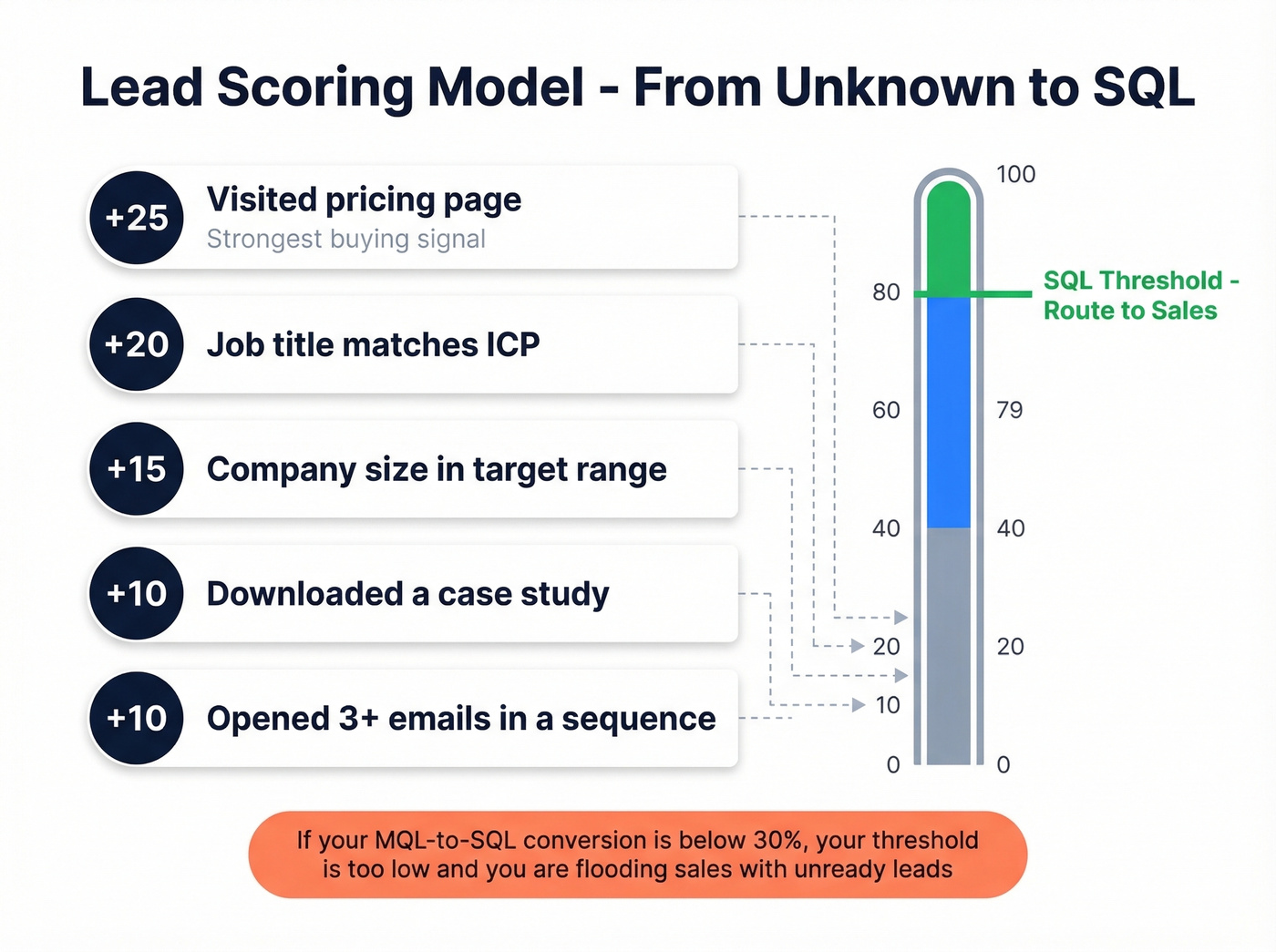
A simple model to start with:
- Visited pricing page: +25 points
- Job title matches ICP: +20 points
- Company size in range: +15 points
- Downloaded a case study: +10 points
- Opened 3+ emails in a sequence: +10 points
- Threshold: 80+ = SQL, route to sales
We've tested a lot of scoring models. Starting at 80 points as your SQL threshold and adjusting from there works for most B2B teams. If your MQL-to-SQL conversion rate is below 30%, your threshold is too low and you're flooding sales with leads that aren't ready.
Step 6: Nurture Through the Funnel
Since 79% of marketing leads never convert into sales - often because of weak or nonexistent nurturing - this step is where most revenue leakage happens. Half of qualified leads aren't ready to buy at first contact. Your job is to stay relevant until they are.
Map content to funnel stages. TOFU leads get educational content: blog posts, industry reports, webinars that build awareness. MOFU leads get comparison guides, case studies, and ROI calculators that help them evaluate options. BOFU leads get pricing breakdowns, implementation guides, and social proof that removes final objections.
Drip sequences do the heavy lifting, but the teams that win don't just send emails on a schedule. They build trigger-based logic. If a lead visits your pricing page twice in a week, skip the educational drip and trigger a case study plus a calendar link instead. That kind of responsiveness is the difference between a nurture sequence that converts and one that gets ignored.
If you're tightening follow-up and sequencing, keep a set of sales follow-up templates and a clean sequence management process so leads don't fall through cracks.
Step 7: Hand Off to Sales and Measure
The handoff is where process meets politics.
41% of B2B marketers struggle to align marketing-generated leads with sales expectations, and 47% of enterprise GTM teams can't deliver a strong customer experience for leads during the transition. The fix is a marketing-sales SLA with shared definitions. What exactly is an MQL? What qualifies as an SQL? How fast does sales need to follow up? What happens to leads that sales rejects? Write it down. Get both teams to sign off. Revisit it quarterly. Without shared definitions, marketing will always think sales is lazy and sales will always think marketing sends garbage. We've seen this pattern destroy pipeline at companies of every size.

Step 4 - data verification - is where most lead generation processes quietly fall apart. Prospeo's 5-step verification delivers 98% email accuracy and refreshes every 7 days, so your nurture sequences reach real buyers instead of dead inboxes.
Stop bleeding pipeline at the verification step. Start with 75 free emails.
Conversion Benchmarks by Stage
Numbers without context are useless. Here's what "good" looks like for B2B SaaS, based on First Page Sage's benchmark report drawing from client data across 2017-2025:
| Funnel Stage | Conversion Rate | What It Means |
|---|---|---|
| Lead to MQL | 39% | ~4 in 10 leads fit your criteria |
| MQL to SQL | 38% | ~4 in 10 MQLs pass sales vetting |
| SQL to Opportunity | 42% | Nearly half become real deals |
| SQL to Closed Won | 37% | Over a third of SQLs close |
And here's how channels compare on close rates and estimated cost per lead:
| Channel | Close Rate | Estimated CPL |
|---|---|---|
| SEO / Content | 14.6% | ~$15-50 |
| Outbound (email/cold call) | 1.7% | ~$40-150 |
| Paid Search | ~2-5% | ~$50-200 |
| Paid Social | ~1-3% | ~$30-100 |
If your MQL-to-SQL rate is below 30%, your qualification criteria are too loose - you're passing leads that aren't ready. If your SQL-to-Closed rate is extremely high, you're probably over-qualifying and leaving pipeline on the table.
To pressure-test your numbers, compare against the average B2B lead conversion rate and track the right funnel metrics end-to-end.
Mistakes That Kill Your Pipeline
Buying lists instead of building them. Purchased lists are someone else's garbage data. Your domain reputation takes the hit, and the "leads" never asked to hear from you. True lead generation means earning attention, not renting it.
Skipping qualification entirely. Every lead goes straight to sales, sales ignores most of them, and marketing wonders why nothing converts. This is the most common pattern we see in early-stage teams, and it's entirely fixable with even a basic scoring model.
No follow-up strategy. A lead downloads your whitepaper and hears nothing for two weeks. By then, they've already talked to your competitor.
Generic lead magnets. "The Complete Guide to Everything" attracts everyone and converts no one. Specificity wins.
Ignoring data verification. You built the whole funnel, then fed it unverified emails. Bounce rates spike, deliverability craters, and your nurture sequences talk to nobody. This is the most expensive mistake because it's invisible until the damage is done.
How to Measure Lead Gen ROI
85% of B2B marketers struggle to connect marketing performance to business outcomes. The formula itself is simple. The hard part is getting honest about your costs.
ROI (%) = [(Revenue - Cost) / Cost] x 100
Cost isn't just ad spend. Include tools like your CRM, automation platform, and data providers. Include labor - SDR salaries, content writers, agencies. Include content production and overhead. Revenue should reflect closed-won deals attributed to the campaign, or better yet, gross profit.
Worked example: you spend $5,000 on a content campaign covering writer, distribution, and tools. It generates $15,000 in closed revenue. ROI = [($15,000 - $5,000) / $5,000] x 100 = 200%.
Let's be honest about attribution, though. Last-click attribution is lying to you. With a 102-day average B2B sales cycle, the touchpoint that gets "credit" for a deal is almost never the one that actually created the opportunity. Use multi-touch or U-shaped attribution - it distributes credit across the first touch, lead creation, and deal close, which is far more realistic for B2B.
2026 Trends Reshaping Lead Gen
AI is operational, not experimental. 42% of businesses already use AI chatbots and predictive analytics. The shift in 2026 isn't adoption - it's integration. AI-powered scoring, automated enrichment, and predictive pipeline models are becoming baseline expectations.
Video is the default content format. 78% of B2B marketers use video, and over half plan to increase investment. Short-form product demos and customer stories outperform whitepapers for MOFU engagement by a wide margin.
Creator and SME partnerships are mainstream. 55% of B2B marketers now partner with creators and industry voices. Brands combining video with influencer partnerships are 2.2x more likely to be trusted.
Trust is the #1 priority. 94% of senior B2B marketers agree trust is key to success, while 49% report declining traditional search traffic due to AI-generated answers. The teams winning in 2026 are building direct audience relationships through email lists, communities, and owned media rather than depending on search alone.
Your ICP is defined, your capture system works, traffic is flowing - but 79% of leads never convert because the data connecting them to sales is wrong. Prospeo gives you 300M+ verified profiles with 30+ filters for intent, tech stack, and funding to match.
Build pipeline that closes at $0.01 per verified email.
FAQ
What are the main stages of lead generation?
Seven stages: ICP definition, lead capture, traffic generation, data verification, lead scoring, nurture sequences, and sales handoff with measurement. Most teams underinvest in verification and measurement - those are the two steps where pipeline quietly breaks down.
How long does B2B lead generation take?
The average B2B sales cycle is 102 days. Expect 3-6 months before a new process produces measurable pipeline. Outbound generates conversations faster, but closed revenue still follows the full cycle length.
What's the difference between inbound and outbound?
Inbound attracts leads through content and SEO, closing at 14.6%. Outbound reaches prospects directly via email and calls, closing at 1.7%. Most B2B teams need both - inbound compounds over time while outbound fills immediate pipeline gaps.
How do you know if a lead is qualified?
Use a scoring model combining firmographic fit and behavioral signals like pricing page visits and content downloads. Leads scoring 80+ points are typically sales-ready. If your MQL-to-SQL conversion is below 30%, your threshold is too low.
What tools do you need for lead generation?
At minimum: a CRM like HubSpot or Salesforce, a verified data source like Prospeo for email accuracy and enrichment, and an email automation tool like Instantly, Lemlist, or Smartlead. Add a scoring layer as you scale.