

The Data-Backed Sales Cycle Guide (With Benchmarks You Can Actually Use)
Win rates are down 18% compared to 2022. Sales cycles have stretched 38% since 2021. Only 43.5% of reps hit quota - meaning more than half your team is missing the number right now.
The standard "7 stages of a sales cycle" content won't fix that. What will: understanding where your cycle actually breaks down, benchmarking it against real data, and knowing which levers move the needle fastest. Buying committees have ballooned from 3-5 stakeholders to 8-12, "no decision" is the fastest-growing loss category, and reps spend 70% of their time on tasks that aren't selling. But teams that understand their cycle with numbers consistently outperform teams running on gut feel.
The Quick Version
- Median B2B SaaS cycle: 84 days. Optimal range is 46-75 days.
- $50k-$100k ACV deals: expect ~120 days. Over $500k? You're looking at 270.
- Three highest-leverage fixes: (1) data quality - bad emails and wrong numbers add weeks before you even start selling, (2) multithreading across the buying committee from day one, and (3) moving compliance and security conversations earlier instead of letting them ambush you at close.
If your cycle is significantly longer than these benchmarks, the problem is almost always in prospecting, qualification, or stakeholder coverage. Rarely is it the pitch itself.
What Is a Sales Cycle?
A sales cycle is the total elapsed time from first meaningful contact with a prospect to a signed deal. Not from lead creation in your CRM, which can sit untouched for weeks - from the first real conversation or engagement. It's the single metric that tells you how efficiently your revenue engine converts interest into revenue.
People confuse three related concepts. The sales cycle is a timeline: how long deals take. The sales process is the repeatable methodology your team follows within that timeline - your playbook, stages, and exit criteria. The buyer's journey is what's happening on the other side of the table, the prospect's internal path from "we have a problem" to "we've selected a vendor."
These three overlap but don't map cleanly onto each other. The cycle is what you measure. The process is what you control. The buyer's journey is what you need to understand but can't dictate. Conflating them is one of the most common mistakes in pipeline management.
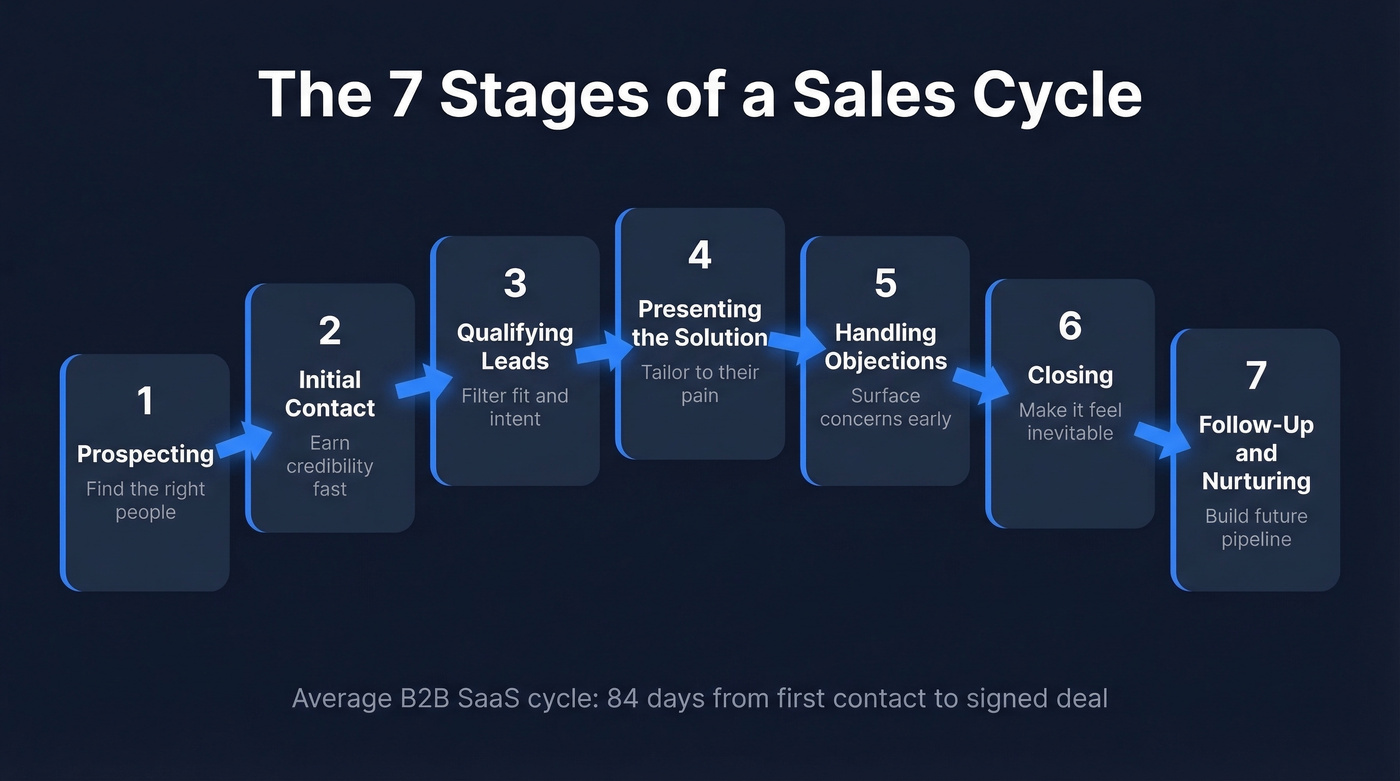
The 7 Stages of a Sales Cycle
The classic seven-stage model is a useful teaching framework, not a perfect mirror of reality. It gives teams a shared language for where deals are and what needs to happen next. Think of these stages as checkpoints - each one should have clear exit criteria before a deal advances.
Prospecting
Everything starts with finding the right people. RAIN Group's research shows it takes an average of 8 touches to generate a meeting with a buyer. Every wasted touch - a bounced email, a wrong number, a message to someone who left the company six months ago - pushes your timeline out before it even begins.
Some frameworks put research before prospecting as a separate stage. In practice, they happen simultaneously when your data platform handles the research layer. The real question is whether your first touch actually lands. When your SDR team isn't burning 3-4 of those 8 touches on bad data, the math changes fast.

Initial Contact
First impressions compress or expand timelines. A generic "just checking in" email starts you at zero. A message that references a specific trigger - a funding round, a leadership change, a technology adoption - starts you at credibility. The goal isn't just a reply; it's a reply that moves to a discovery call within days, not weeks.
Qualifying Leads
This is where most cycles go wrong. Under-qualification lets bad deals clog your pipeline. Over-qualification kills momentum on good ones.
| Framework | Best For | Deal Size | Stakeholders | Typical Cycle | Key Advantage |
|---|---|---|---|---|---|
| BANT | Transactional / SMB | <$100k | 1-3 | <60 days | Speed to qualify |
| MEDDIC/MEDDPICC | Enterprise / complex | >$100k | 5-12 | 90-270 days | +18% win rate |
| SPIN | Complex discovery | Any | 3-8 | 60-180 days | +57% talk time |
| Challenger | Status-quo disruption | Mid-market+ | 3-8 | 60-150 days | +15% on status-quo deals |
73% of SaaS companies selling above $100k ARR use some version of MEDDIC. That's not a coincidence. BANT works fine for sub-$100k transactional deals with one or two decision-makers. If you're running BANT on enterprise deals with 8+ stakeholders, you're using a screwdriver to build a house.
The consensus on r/sales is that most methodologies boil down to need, budget, stakeholders, and timeline - but the structure of MEDDIC forces reps to actually document those answers instead of assuming them.
Presenting the Solution
Tailor the demo or proposal to the problems surfaced in discovery. We've watched teams run the same 45-minute product tour for a 5-person startup and a 2,000-person enterprise. The startup needs to see speed-to-value. The enterprise needs to see security, integrations, and admin controls. Matching the presentation to the buyer's actual concerns can shave a full evaluation cycle off the timeline.
Handling Objections
Objections that surface early are healthy - they mean the buyer is engaged. Objections that surface late, especially around compliance, security, or legal, are cycle killers. The best teams pre-empt the top 3-5 objections for their segment before the prospect even raises them.
Closing
By this stage, the deal should feel inevitable. If it doesn't, something upstream was missed - usually an unidentified stakeholder or an unaddressed concern. The close itself is a formality when qualification and objection handling were done right.
Follow-Up and Nurturing
Not every qualified prospect buys now. The ones who don't still represent your highest-probability future pipeline - the odds of selling to an existing relationship are 60-70%, compared to 5-20% for a net-new prospect. A structured nurture cadence tied to business triggers keeps you top of mind when timing shifts. Marketing-driven warm leads that re-enter the pipeline through content engagement or retargeting campaigns close significantly faster the second time around.
Sales Cycle Benchmarks
Most guides skip this section or fill it with vague generalizations. Here's the actual data.
By Industry
| Industry | Avg Days | Industry | Avg Days |
|---|---|---|---|
| Retail | 70 | Consulting | 103 |
| Hospitality | 85 | Real Estate | 105 |
| Software | 90 | Logistics | 117 |
| Financial Services | 98 | Technology | 121 |
| Telecom | 103 | Healthcare | 125 |
| Education | 126 | Insurance | 127 |
| Manufacturing | 130 | Construction | 134 |
| Pharmaceuticals | 153 | Energy | 155 |
| Non-Profit | 162 |
Source: Focus Digital's 2026 benchmarks.
By Deal Size
| ACV Range | Avg Days |
|---|---|
| <$1k | 25 |
| $1k-$5k | 40 |
| $5k-$10k | 55 |
| $10k-$50k | 75 |
| $50k-$100k | 120 |
| $100k-$250k | 170 |
| $250k-$500k | 220 |
| >$500k | 270 |
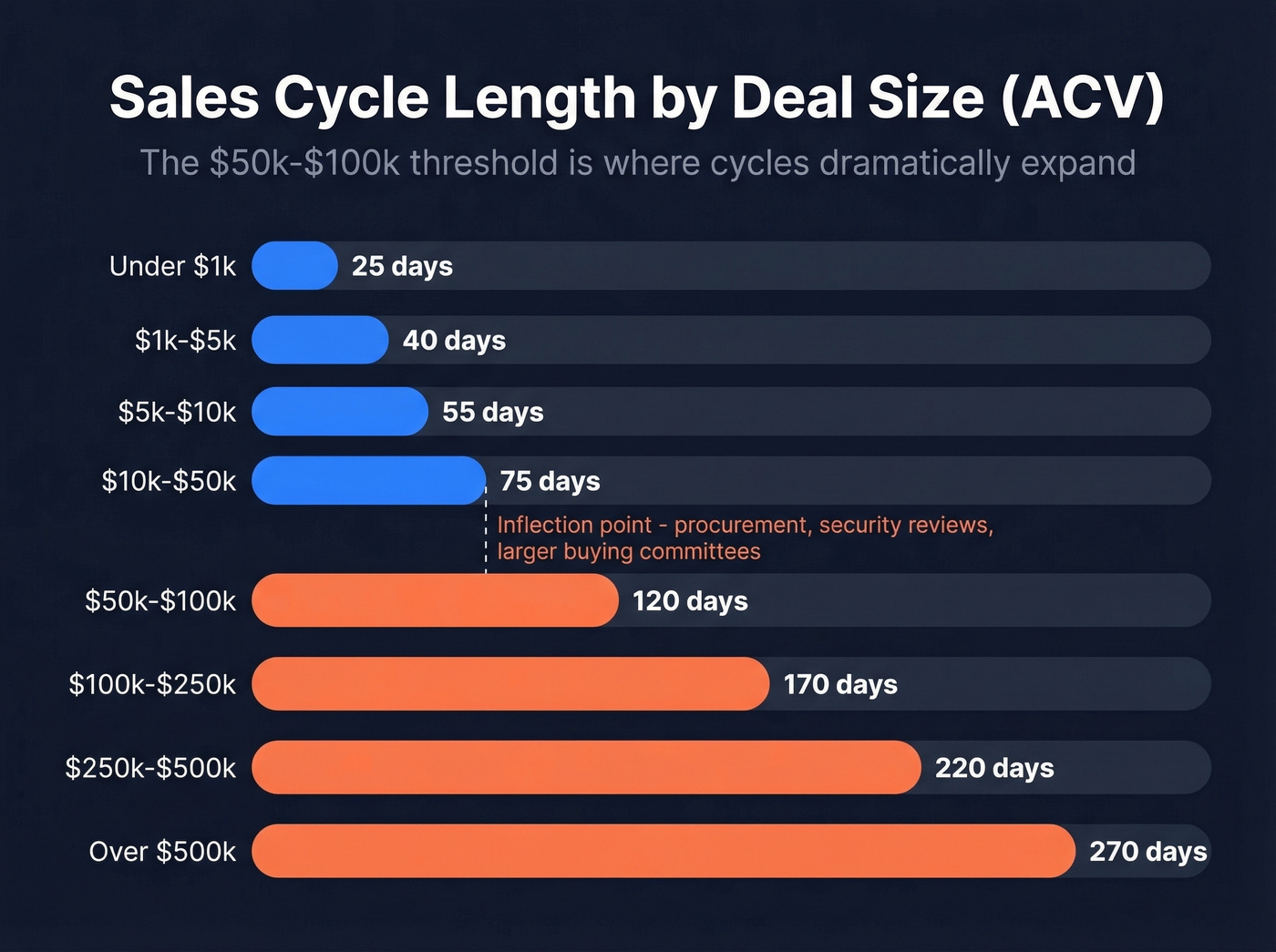
In our experience, the $50k-$100k ACV threshold is where most teams underestimate cycle expansion. That's the inflection point where buying committees grow, procurement gets involved, and security reviews become mandatory. If you're moving upmarket, plan for this jump - it isn't gradual.
By Company Size
| Target Company Size | Avg Days |
|---|---|
| 1-10 employees | 38 |
| 11-50 employees | 57 |
| 51-200 employees | 77 |
| 201-500 employees | 95 |
| 501-1,000 employees | 115 |
| 1,001-5,000 employees | 135 |
| 5,001-10,000 employees | 158 |
| 10,001+ employees | 185 |
The prospect's organizational complexity is often a bigger cycle driver than your deal size. A $50k deal at a 10,000-person company will take longer than a $100k deal at a 200-person company - every time. Enterprise sellers routinely describe "advertised" timelines of 3-6 months ballooning to 9-12 months once procurement, legal, and IT security get involved.
By Lead Source and Complexity
| Lead Source | Low Complexity | Medium | High |
|---|---|---|---|
| Referrals | 20 days | 35 days | 60 days |
| SEO / Inbound | 28 days | 50 days | 75 days |
| Cold Calling | 60 days | 85 days | 110 days |
| Trade Shows | 80 days | 100 days | 150 days |
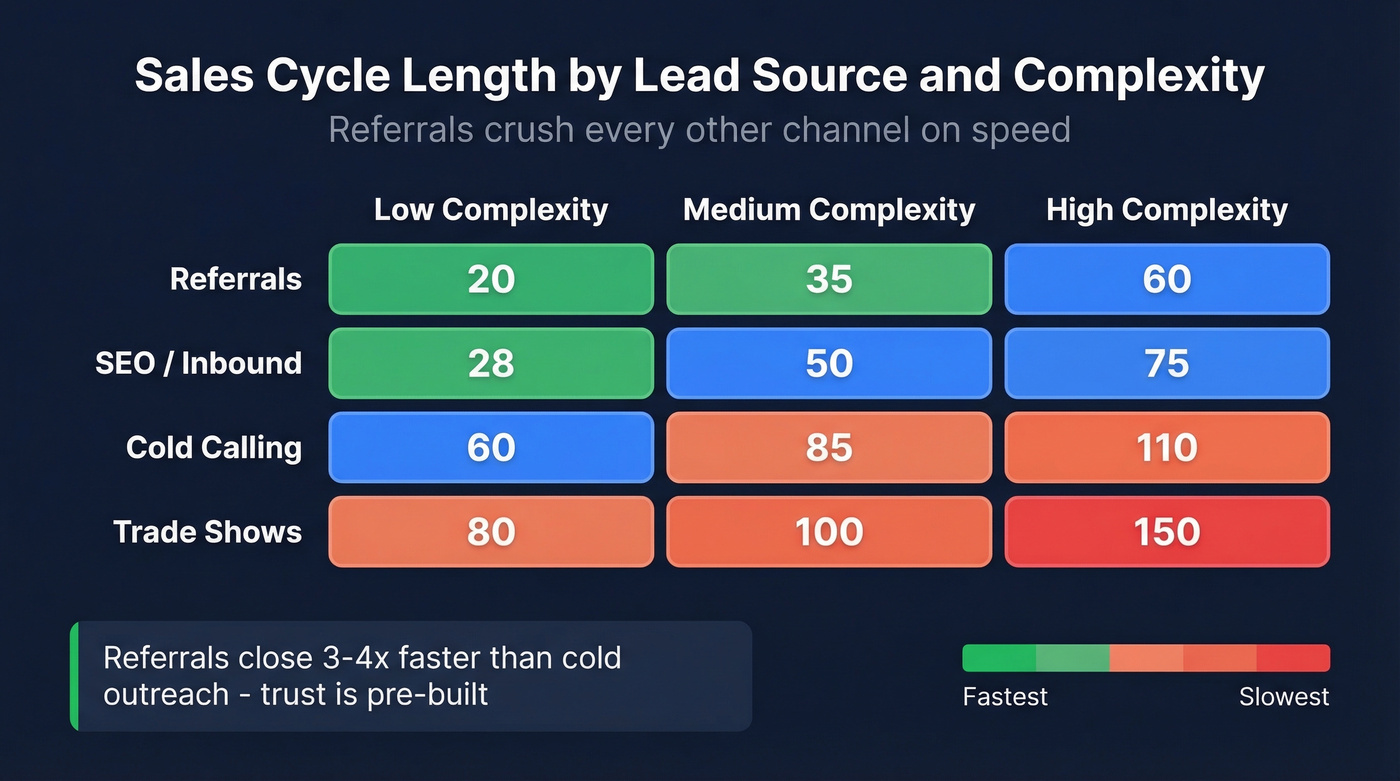
Referrals crush every other channel on speed because trust is pre-built. SEO-sourced leads close nearly as fast as referrals for low-complexity deals, making inbound investment one of the highest-ROI cycle-shortening plays available.
SaaS Funnel Conversion Rates
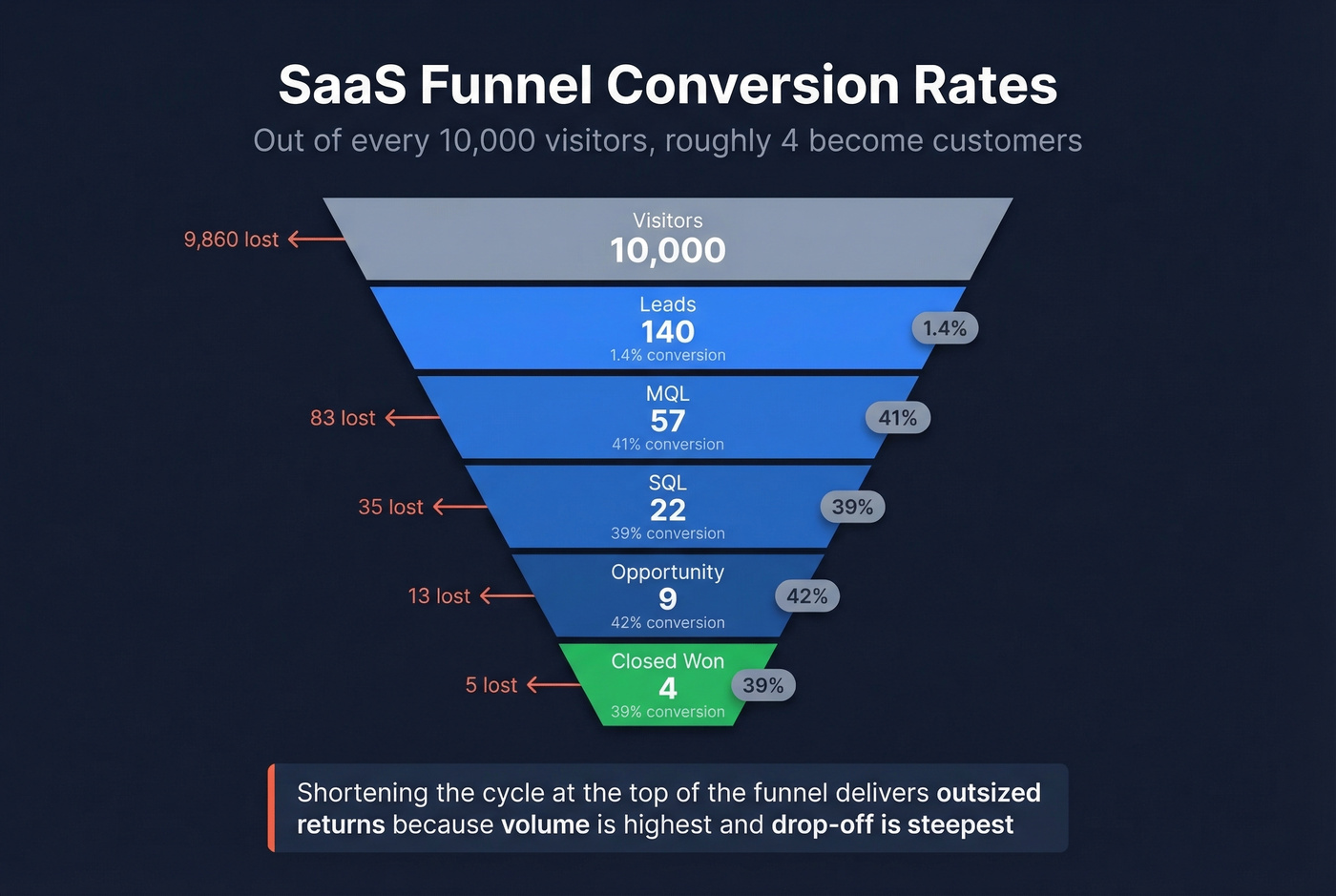
Understanding where prospects drop off matters just as much as knowing how long they take. Visitor-to-Lead conversion runs at 1.4%, Lead-to-MQL at 41%, MQL-to-SQL at 39%, SQL-to-Opportunity at 42%, and Opportunity-to-Close at 39%. The compounding effect is brutal - out of every 10,000 website visitors, roughly 4 become customers. This is why shortening the cycle at the top of the funnel, where volume is highest and drop-off is steepest, delivers outsized returns compared to optimizing the close.
If you want to benchmark this end-to-end, start with funnel metrics and then map where time accumulates inside each stage.

You just read that it takes 8 touches to book a meeting - and bad data wastes 3-4 of them. Prospeo's 98% email accuracy and 125M+ verified mobile numbers mean every touch reaches a real person. Stop inflating your sales cycle before it even starts.
Cut weeks off your cycle by fixing the data layer first.
Why Your Cycle Doesn't Match the Buyer's Journey
The seven-stage model is a useful abstraction, not reality. Gartner's visualization of B2B buying looks like a "spaghetti bowl" - buyers loop back, skip stages, stall, restart, and run parallel workstreams that don't map to any linear funnel. Any diagram you've seen with clean arrows flowing left to right is aspirational at best.
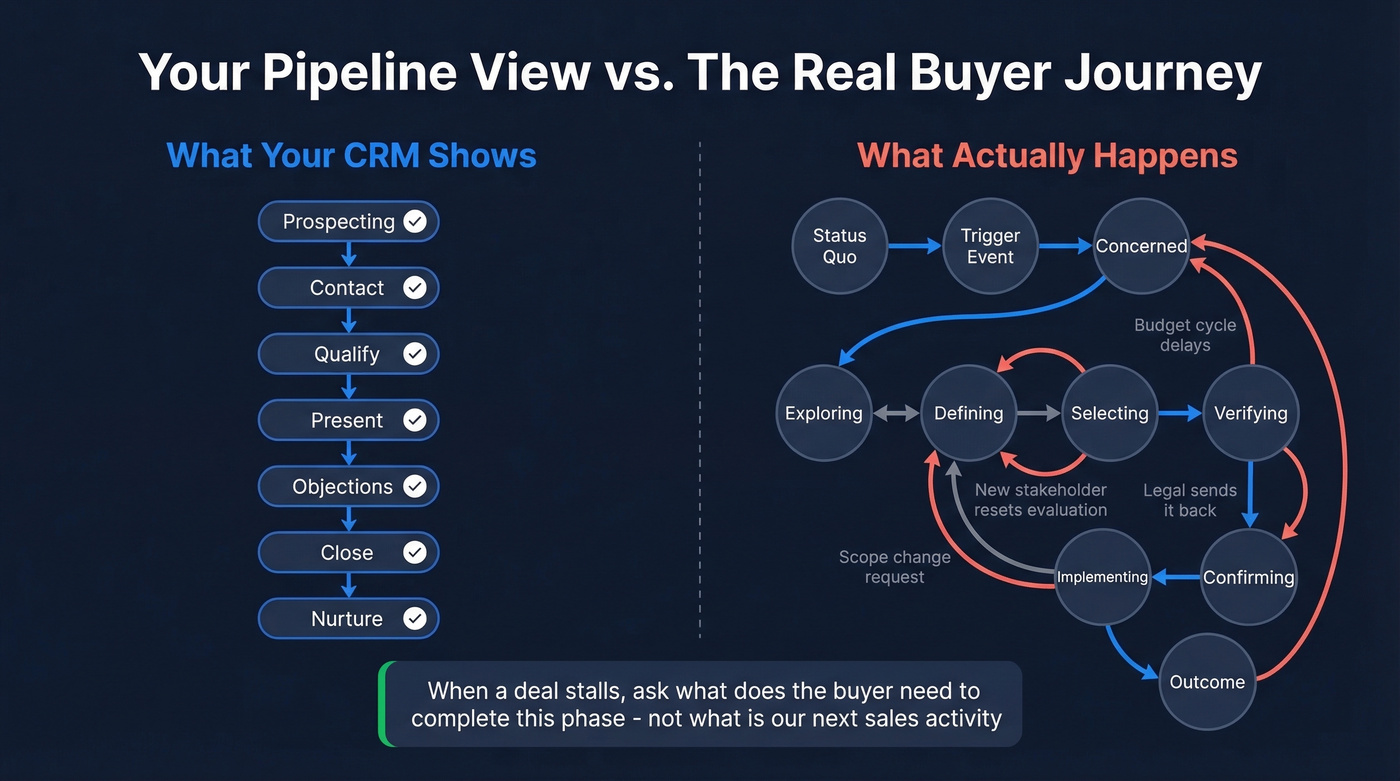
A framework that better reflects this reality tracks opportunities across 10 buyer phases: Status Quo, Trigger Event, Concerned, Exploring, Defining, Selecting, Verifying, Confirming, Implementing, Outcome Achieved. Deals stall when the buyer's "jobs to be done" in a given phase aren't complete - and they move backward, not just forward.
Forrester predicts that more than half of large B2B transactions ($1M+) will be processed through digital self-serve channels. And 50%+ of younger buyers now include 10+ external influencers in their purchase decisions. Your seven-stage pipeline view doesn't capture any of this.
The practical takeaway: track buyer phases alongside your internal stages. When a deal stalls, ask "what does the buyer need to complete this phase?" not "what's our next sales activity?"
Why Cycles Keep Getting Longer
Four forces are compounding simultaneously.
Buying committees have expanded from 3-5 stakeholders to 8-12. More people means more calendars to coordinate, more objections to surface, and more internal politics to navigate. On top of that, 44% of sales leaders report that opportunities lost to "no decision" are increasing. Prospects aren't saying no - they're saying nothing, which is worse because it keeps dead deals in your pipeline.
Reps spend roughly 30% of their time actually selling and 70% of their time on admin, internal meetings, and CRM updates. That's not a productivity problem - it's a structural one. Every hour spent on non-selling tasks is an hour the cycle extends.
The talent pipeline is broken too. 69% of reps fell short of quota last year, and 17% of reps generate 81% of revenue. Reps forget ~80% of training within one month, and AEs take an average of 4.9 months to ramp. When your team is undertrained and overwhelmed, cycles stretch because deals aren't being actively worked. Teams that cut ramp from 5 months to 3 months effectively add two months of productive selling per rep per year.
How to Shorten Your Sales Cycle
Spot the Stall Signals
Before you can fix a stalled deal, you need to recognize one. Belkins identifies five warning signs:
- Single-threaded relationship - you're talking to one person, and they're your only path to the decision
- No pushback on timeline - paradoxically, a buyer who agrees to everything often isn't engaged enough to push back
- Quiet buyers - high listening ratio with minimal questions or challenges
- Shift to conditional language - "we might," "potentially," "if budget allows"
- Late compliance or security requests - these should surface in qualification, not at the finish line
If you're seeing three or more of these in a deal, it's stalling. Act now or lose it to "no decision."
The Highest-Leverage Fixes
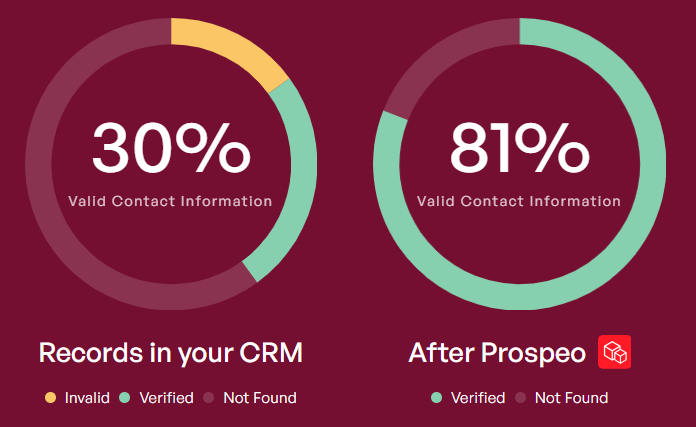
Fix your data first. This is the most underrated cycle-shortening lever. When your SDR team sends 2,000 emails and 540 bounce, you haven't just wasted those touches - you've damaged your domain reputation, which makes future emails less likely to land. Bad contact data adds days or weeks to every deal before a single conversation happens. We've seen teams cut 2-3 weeks off their average deal timeline just by fixing bounce rates.
Prospeo addresses this at the source - 98% email accuracy, a 7-day data refresh cycle versus the 6-week industry average, and 125M+ verified mobile numbers mean your first outreach actually reaches the right person. Snyk's 50-person AE team saw bounce rates drop from 35-40% to under 5%, and AE-sourced pipeline jumped 180% with 200+ new opportunities per month. That's not a marginal improvement; it's a fundamentally different prospecting stage.
If bounce is inflating your cycle, start by tracking your email bounce rate and tightening your email deliverability fundamentals.
Multithread from day one. Don't wait until the deal is at risk to find the CFO, legal contact, and end users. Map the buying committee during qualification and build relationships across budget holders, legal and compliance, end users, influencers, and your champion simultaneously. Single-threaded deals die when your one contact goes on vacation, changes roles, or loses internal momentum.
This is also where account-based selling tends to outperform pure lead-based motion.
Move compliance earlier. Security questionnaires and legal reviews at the end of a cycle are the #1 cause of "we were about to close but..." delays. Surface these requirements during qualification and run them in parallel with evaluation, not sequentially after it.
Go omnichannel. Belkins reports that omnichannel engagement drives 15-20% higher conversions and 20% lower CAC. Email alone isn't enough. Layer in calls, social touches, and direct mail for high-value prospects. Forrester's trust data is telling: 90%+ of B2B buyers trust industry peers, while only 29% trust salespeople. Peer introductions and community-driven selling compress timelines in ways that another follow-up email never will.
Here's the thing: most teams trying to shorten their sales cycle focus on the wrong end. They optimize close techniques and negotiation tactics when the biggest time sink is at the top - bad data, weak qualification, and single-threaded relationships. Fix the first 30 days of your cycle and the last 30 fix themselves.
Multithreading across 8-12 stakeholders is impossible when you only have one contact per account. Prospeo gives you the full buying committee with 30+ filters, verified direct dials, and intent data across 15,000 topics - so you cover every decision-maker from day one.
Map the entire buying committee in minutes, not weeks.
How AI Is Changing the Sales Cycle
81% of sales teams are experimenting with or have implemented AI, and the early results are striking: 83% of AI-using teams report revenue growth, compared to 66% without. AI reduces cycle length by roughly 25%, primarily by compressing the top of the funnel.
The biggest impact is in signal-based outreach. Instead of blasting a generic sequence to a static list, AI-powered workflows identify trigger events - funding rounds, leadership changes, technology adoptions, hiring surges - and personalize outreach around those signals. The result: 15-25% reply rates versus 3-5% for standard cold email.
Speed-to-lead compounds the advantage. Contacting a prospect within 5 minutes of a trigger event makes you 21x more likely to convert compared to waiting 30 minutes. The first seller to reach a buyer after a trigger event is 5x more likely to win the deal. AI makes this kind of responsiveness possible at scale - something that was operationally impossible with manual prospecting workflows even two years ago.
If you're building this motion, pair it with a clear lead generation workflow so speed doesn't turn into noise.
FAQ
How do you calculate average sales cycle length?
Total days to close all deals divided by the number of deals closed in that period. Track from first meaningful contact to signed contract, not from lead creation date in your CRM. Exclude outlier deals - both unusually fast and unusually slow - to get a more actionable median.
What's a good length for B2B SaaS?
The median B2B SaaS sales cycle is 84 days, with an optimal range of 46-75 days. Enterprise deals above $100k ACV typically run 120-170 days. If you're significantly above these benchmarks, focus on qualification speed and data quality first.
What's the difference between a sales cycle and a sales process?
A sales cycle is the timeline from first contact to close, measured in days. The sales process is the repeatable methodology your team follows within that timeline, including stages, exit criteria, and playbooks. You optimize the process to shorten the cycle.
Why do deals stall mid-cycle?
Single-threaded relationships, unaddressed compliance concerns, and a missing internal champion are the top three causes. 44% of sales leaders report "no decision" losses are increasing. When deals go quiet, it's almost always a stakeholder coverage problem, not a product problem.
How does bad data affect cycle length?
Bounced emails and wrong numbers waste touches and delay first conversations by days or weeks. Cleaning up your contact data can drop bounce rates from 35%+ to under 5% - Snyk's 50-person AE team added 200+ new opportunities per month after fixing this. Cleaner data compounds across every stage of the cycle.