

The Complete Guide to the Cold Call in 2026
It's 10:15 AM on a Tuesday. Your SDR has made 12 dials. Nine voicemails. Two wrong numbers. One person who hung up before the opener landed.
That's not a cold call problem - that's a data problem. And until you fix it, no script, no coaching session, and no AI roleplay tool will change your numbers.
What You Need (Quick Version)
Cold calling works in 2026. RAIN Group found that 82% of buyers accept meetings with sellers who proactively reach out, when the outreach is relevant. The #1 variable isn't your script - it's your data. Teams that run strong outbound fundamentals (clean contact data, good timing, and tight talk tracks) hit 5-8% success rates vs. the 2.3% average. Below: benchmarks, scripts, openers, compliance rules, and tools you need to make cold calling actually work.
What Is a Cold Call?
A cold call is an unsolicited phone call to a prospect who has no prior relationship with you or your company. You're reaching out to someone who didn't ask to hear from you. The definition hasn't changed. Everything around it has.
In 2006, cold calling meant pulling names from a purchased list and grinding through a phone book. In 2026, it means using intent signals to identify a VP who's actively evaluating your category, pulling a verified mobile number, and opening with a reference to their Q3 hiring surge. The call is still "cold" in the technical sense - they didn't ask you to call - but the preparation behind it makes modern outreach closer to warm conversations than anything resembling the phone-book era. AI-assisted research, real-time data enrichment, and 7-day refresh cycles have turned this from a volume game into a precision game.
Does Cold Calling Still Work?
Let's kill the "cold calling is dead" narrative right now. It's not dead. It's just harder to do badly and get away with it.
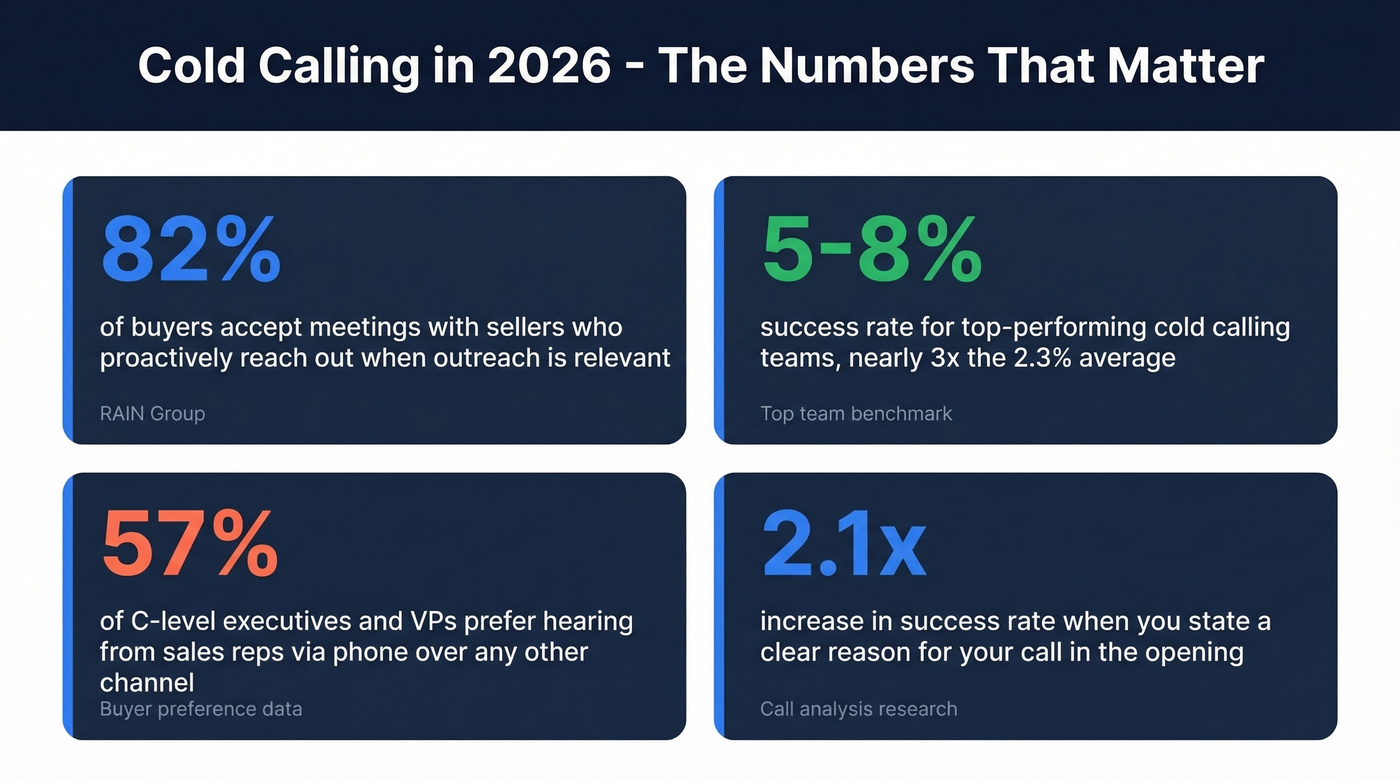
The average cold calling success rate sits at 2.3% - roughly 1 meeting per 40-45 dials. That sounds brutal until you realize top-performing teams consistently hit 5-8%, nearly 3x the average. The gap comes down to data quality, call timing, and structured frameworks. Those teams treat every dial as a prepared conversation, not a lottery ticket.
Here's the human side: 48% of sales reps admit they fear making cold calls. Half your team is fighting psychology before they even pick up the phone. That fear shrinks fast when reps know they're dialing a verified mobile with a relevant opener - not shouting into a disconnected line.
Buyers back this up. 57% of C-level executives and VPs prefer hearing from sales reps via phone over any other channel. And 49% of buyers prefer to be contacted through a phone call.
Our take: If your average deal size is under $10K, you probably don't need a 70-dial-a-day operation. Email-first sequences with phone as a follow-up channel will get you there faster and cheaper. But the moment your ACV crosses $15K-$20K, the phone becomes your highest-ROI channel - and the teams that invest in data quality will eat the ones still dialing switchboards.
Benchmarks That Actually Matter
Numbers without context are useless. Here's what "good" actually looks like for a B2B outbound sales operation in 2026.
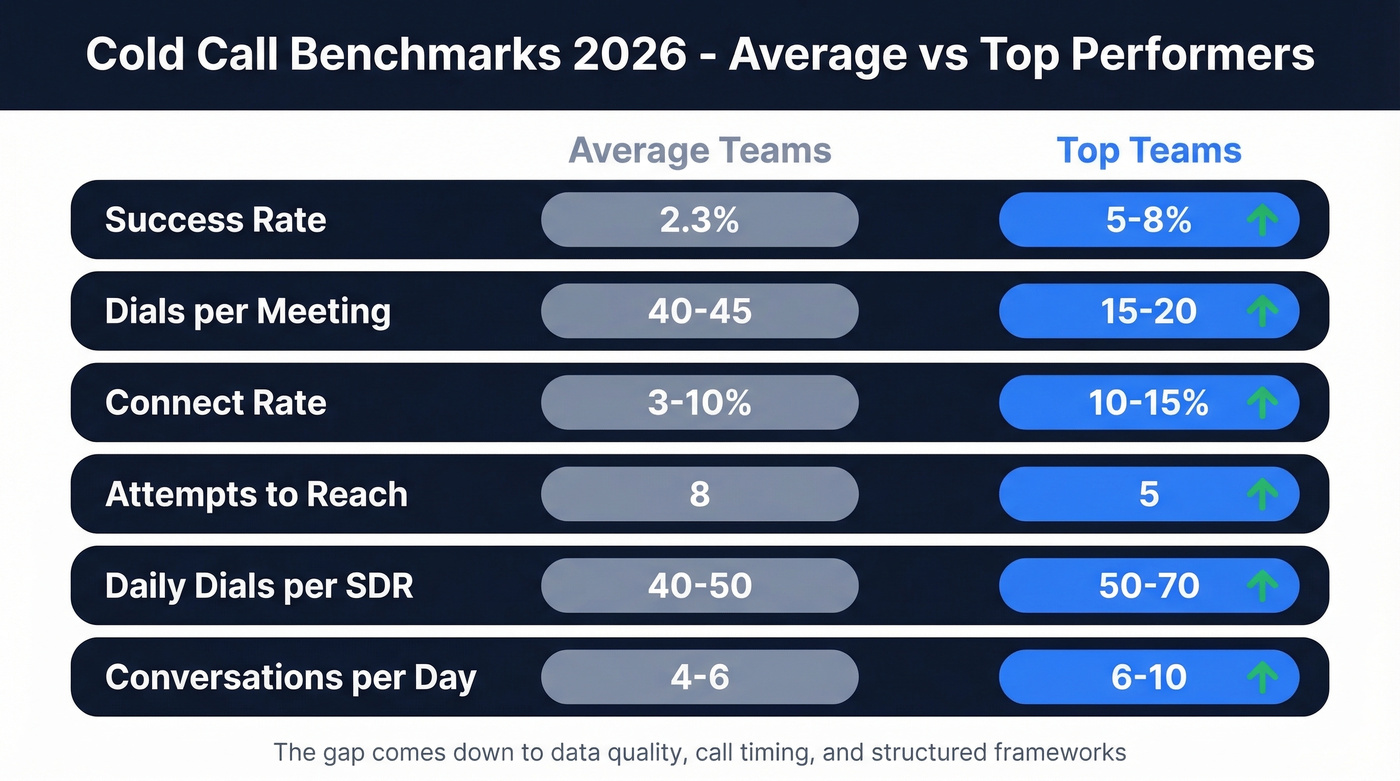
| Metric | Average | Top Teams |
|---|---|---|
| Success rate | 2.3% | 5-8% |
| Dials per meeting | 40-45 | 15-20 |
| Connect rate | 3-10% | 10-15% |
| Attempts to reach | 8 | As few as 5 |
| Daily dials (SDR) | 40-50 | 50-70 |
| Conversations/day | 4-6 | 6-10 |
The dial-to-meeting math is where most teams get reality-checked. At a 2.3% meeting rate, you need roughly 40-45 dials to book 1 meeting. Top teams operating at 5-8% need closer to 15-20 dials for the same result. That efficiency gap is driven by better data, better targeting, and better execution - not some secret script.
Industry matters too.
| Industry | Calls per Conversion |
|---|---|
| Telecom | ~91 |
| Business services | ~45 |
| General B2B average | ~40-45 |
If you're in telecom, your SDRs need to understand that 91 dials per conversion is the baseline - not a sign they're failing. Set expectations by vertical, not by some generic average.
How to Cold Call (Step by Step)
Whether you're a BDR dialing for the first time or a seasoned rep refining your approach, the fundamentals are the same.
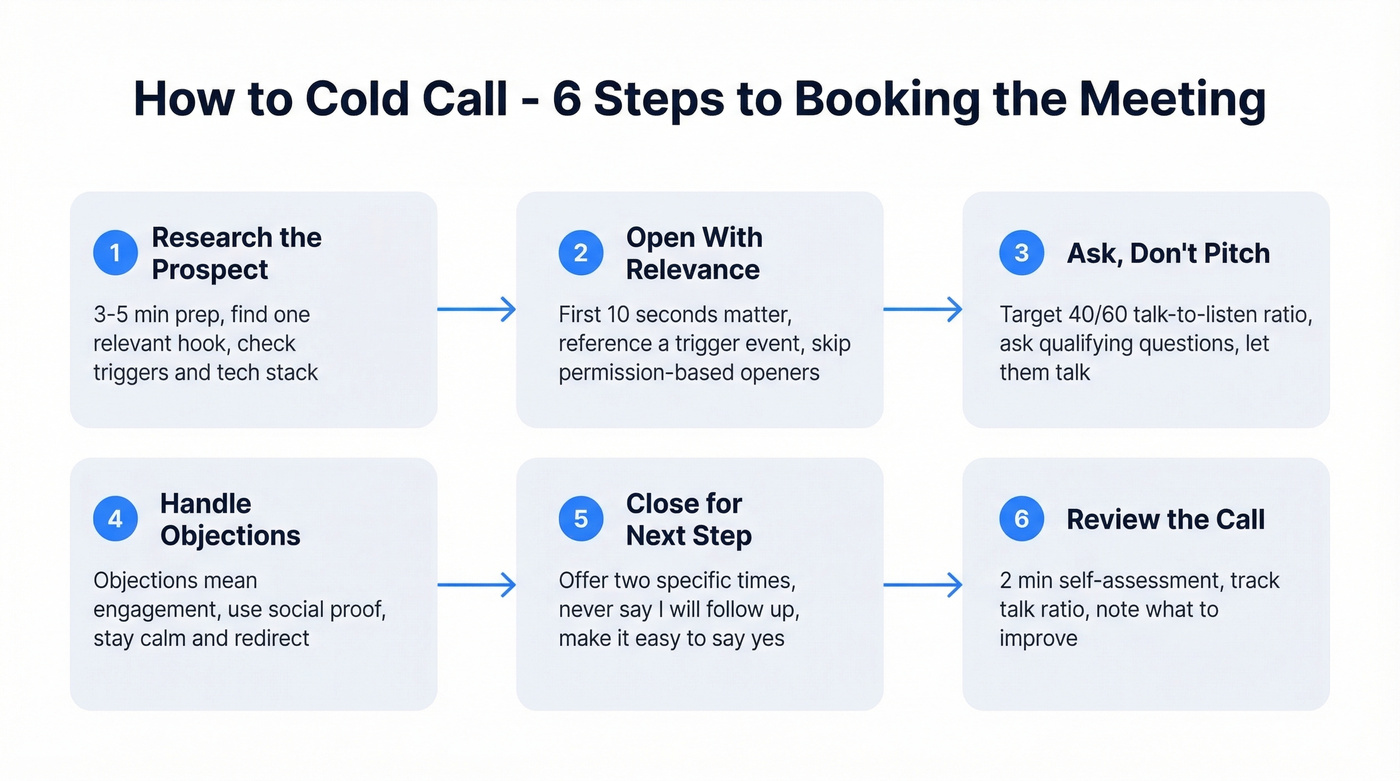
Research the Prospect (3-5 Minutes)
Five minutes of research before a call is worth more than five minutes of rambling on the call. Look for:
- Job title and reporting structure - who do they report to, who reports to them
- Technologies they use - if they run Salesforce and you integrate with it, that's your opener
- Trigger events - new funding, leadership change, hiring surge, expansion
- Company size and growth signals - headcount trends, department changes
The goal isn't to become an expert on the prospect. It's to find one relevant hook that earns you the next 30 seconds.
If you want a tighter prep workflow, use a simple pre call planning checklist your team can repeat.
Open With Relevance, Not Permission
The first 10 seconds determine whether the prospect stays on the line. Don't waste them.
Don't say: "Is this Bob?" - triggers defensiveness. They're already wondering who's asking.
Don't say: "Did I catch you at a good time?" - gives them an easy exit and signals low importance.
Do say: "Hi Bob, this is Sarah from Acme. I know you're busy, so I'll be brief - I'm calling because I noticed you're hiring three SDRs this quarter, and that usually means lead quality is top of mind."
The pattern interrupt works because it acknowledges the interruption and immediately delivers relevance. Stating a reason for your call can increase success rates by 2.1x. Referencing shared context like a common professional group can increase your chances of securing a meeting by 70% - so mine mutual context before you dial.
If you want more options, study data-backed opening lines and test them by segment.
Ask, Don't Pitch
You're not selling your product on this call. You're selling a meeting. The 40/60 talk-to-listen ratio is the target - you talk less than 40% of the time.
After your opener lands, ask one or two qualifying questions before any value prop. "How are you handling [specific problem] right now?" or "What's your current process for [relevant workflow]?" Let them talk. The information they give you is worth more than any pitch deck.
To sharpen this, build a bank of qualifying questions by persona.
Handle Objections Calmly
Objections aren't rejection - they're engagement. The prospect is still on the phone.
"Not interested." → "Totally fair. Most people I call aren't - until they hear how we helped [similar company] cut [specific metric] by 30%. Can I share that in 2 minutes?"
"Send me info." → "Happy to. But pricing depends on your setup - 15 minutes would save us both time and get you numbers that actually apply."
"We already have a vendor." → "I hear that a lot. Other [role] in your space felt the same way. What they found was that even a 10% improvement in [key metric] justified a conversation. What would need to change for you to consider a switch?"
If your team struggles with the “send me info” brush-off, keep a dedicated response framework ready.
Close for the Next Step
Never end a cold call with "I'll follow up." That's not a close - that's a hope. Always close for a specific calendar time.
"I've got 15 minutes open Thursday at 2 PM or Friday at 10 AM - which works better?" If they push back: "Give me 2 minutes. If this isn't for you, I won't call again." That's a fair trade, and most prospects will take it.
For more on tightening your end-of-call language, use a consistent how to end a sales call structure.
Review the Call (2 Minutes)
After every call, spend two minutes on a quick self-assessment: Did I talk less than 40% of the time? Did I uncover a real pain point? What would I do differently? This habit compounds. We've seen reps who debrief after calls improve faster than those who just dial the next number and hope the next one goes better.
If you want a repeatable system, run short cold call practice drills daily.

Your cold call benchmarks are only as good as your data. Prospeo gives you 125M+ verified mobile numbers with a 30% pickup rate - 3x the industry average. Teams using Prospeo book 35% more meetings than Apollo users.
Stop burning dials on wrong numbers. Start connecting with decision-makers.
Scripts That Actually Work
General B2B Script
You: "Hi [Name], this is [Your Name] from [Company]. I noticed [trigger event - hiring, funding, expansion]. That usually means [relevant challenge] is on your radar."
[Pause - let them respond]
You: "Quick question - how are you currently handling [specific problem your product solves]?"
[Listen. Take notes.]
You: "Got it. The reason I'm calling is that we've helped teams like [similar company] [specific result - cut ramp time by 40%, increase pipeline by 3x]. I think there's a fit here."
You: "Would it make sense to grab 15 minutes this week so I can show you what that looks like for [their company]? I've got Thursday at 2 or Friday at 10."
The structure is simple: intro → trigger → question → value → ask. Don't memorize it word-for-word. Internalize the flow and make it yours. If you want more variations, pull from these outbound sales call script sample templates.
Voicemail Script (30 Seconds)
A large share of dials go to voicemail. Have a plan for it.
"Hi [Name], this is [Your Name] from [Company]. I'm calling because [one-sentence trigger - e.g., I saw you're scaling your SDR team this quarter]. I'll try you again Thursday around 2 PM, but if you want to grab time before that, my number is [number]. Talk soon."
Keep it under 30 seconds. One reason for calling, one specific callback time, one phone number. No pitch. The goal is to make the next live call feel like a warm follow-up, not a first touch.
If you’re optimizing voicemail performance, use proven voicemail strategies instead of improvising.
Getting Past Gatekeepers
Gatekeepers respond to confidence and brevity. Hesitation is a tell.
Gatekeeper: "[Company], how can I help you?"
You: "Hi, it's [Your Name] - is [Prospect First Name] available?"
Gatekeeper: "What's this regarding?"
You: "Following up on something I sent [Prospect First Name] last week. Is she in?"
Use the prospect's first name. Keep it casual. The moment you launch into a pitch to the gatekeeper, you've lost.
If this is a consistent blocker, train reps on a dedicated gatekeeper script and roleplay it weekly.
Build Your Own Framework
Rigid scripts sound robotic. Frameworks sound human. As Highspot's research notes, the best scripts are "structured, yet flexible frameworks rather than rigid talk tracks."
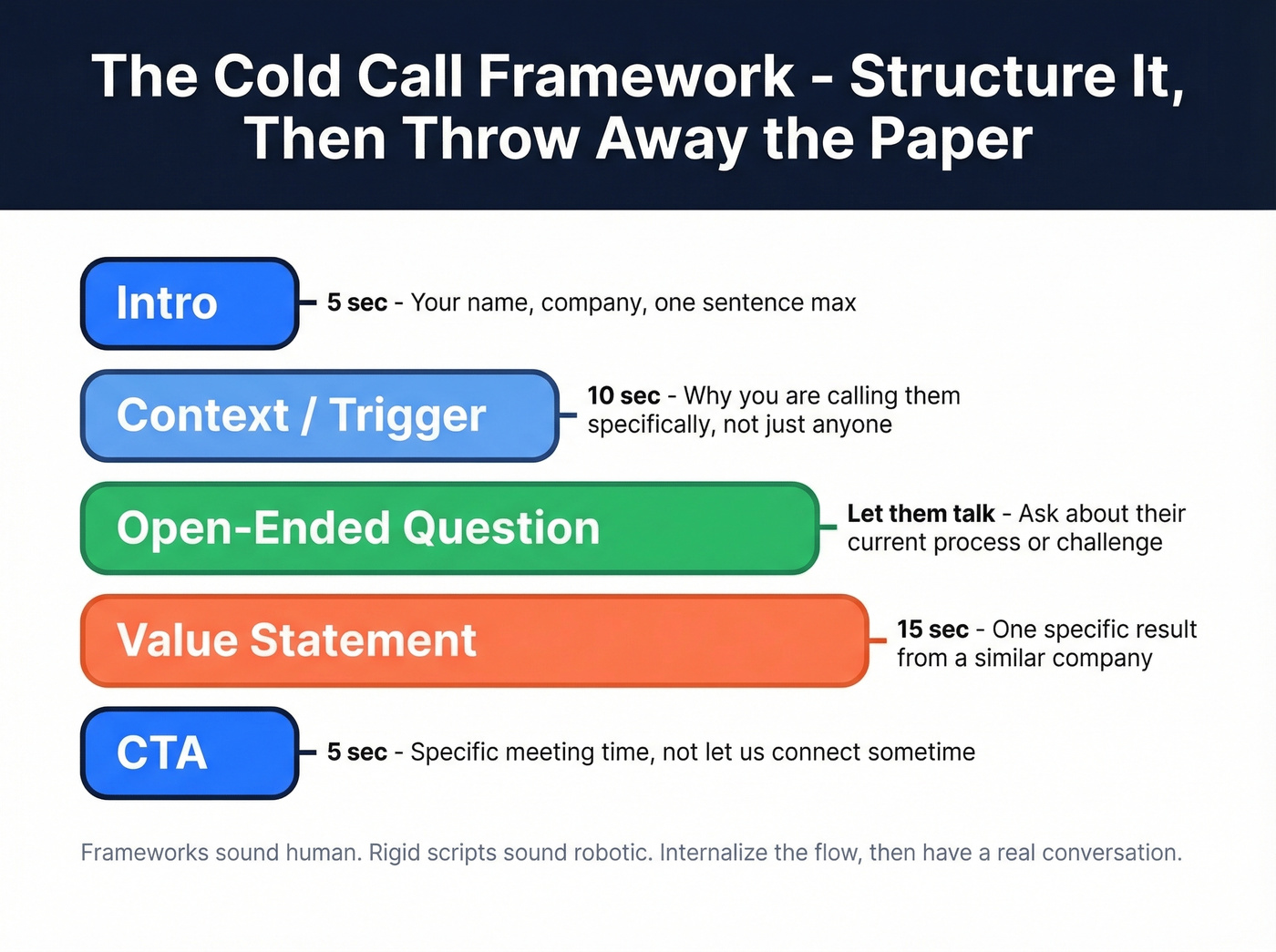
- Intro (5 seconds) - Your name, company, one sentence max
- Context/trigger (10 seconds) - Why you're calling them, not just anyone
- Open-ended question (let them talk) - About their current process or challenge
- Value statement (15 seconds) - One specific result you've driven for a similar company
- CTA (5 seconds) - Specific time for a meeting, not "let's connect sometime"
Build your framework, practice it until the structure is automatic, then throw away the paper and have a conversation. For a deeper breakdown, use a simple cold call framework your whole team can standardize on.
Best Times to Call
Timing alone can lift your connect rate by 40-70%. That's not marginal. That's the difference between 4 conversations a day and 8.
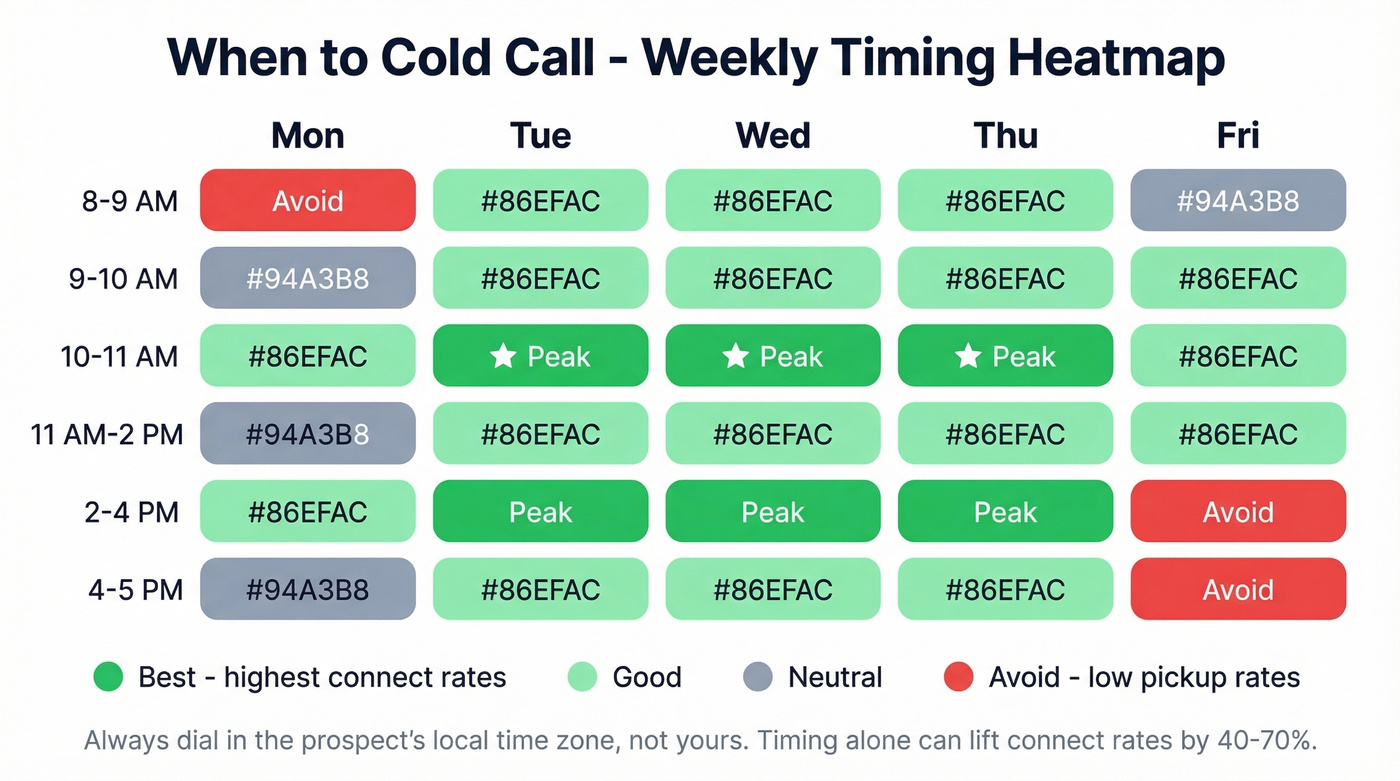
| Factor | Recommendation |
|---|---|
| Best days | Tue-Thu |
| Best windows | 10-11 AM, 2-4 PM |
| Avoid | Before 9 AM, after 4 PM |
| Time zone | Prospect's local time |
| Worst day | Monday AM, Friday PM |
Monday mornings are for catching up on email. Friday afternoons are for checking out. Mid-week, mid-morning and mid-afternoon are when prospects are at their desks, through their inbox, and mentally available for a conversation. Always dial in the prospect's local time zone - not yours.
If you want more granular timing guidance, see the full best time to cold call breakdown.
Mistakes That Kill Results
1. Dialing without research. If you can't name one relevant thing about the prospect's company in your opener, you're not cold calling - you're spam calling. Three minutes of prep changes everything.
2. Reading scripts word-for-word. Prospects can hear it. The cadence is wrong, the pauses are wrong, and the recovery when they go off-script is nonexistent. Use frameworks, not scripts.
3. Talking too much. If you're above a 50/50 talk-to-listen ratio, you're pitching, not selling. The target is 40/60. Ask a question and actually listen to the answer.
4. Using stale or unverified contact data. This is the silent killer. Reps waste 27% of their selling time on bad data - wrong numbers, outdated titles, people who left the company six months ago. If your reps are dialing disconnected numbers half the morning, the problem isn't their pitch. It's the list. We've seen this firsthand: Meritt tripled their pipeline to $300K/week and saw connect rates jump to 20-25% after switching to Prospeo's 7-day refresh data. Fix the data first.
If you’re diagnosing performance, start by measuring your connect rate and fixing list quality before coaching.
5. Giving up after 1-2 attempts. It takes an average of 8 attempts to reach a prospect. Most reps give up after 2-3. And 95% of leads are converted after the sixth call attempt. Persistence isn't annoying - it's professional. Space your attempts across different days and times.
To systematize this, build a simple cold calling cadence your team follows by default.
Cold Calling vs. Cold Email
This isn't an either/or question. It's a sequencing question within your sales cadence.
| Factor | Cold Calling | Cold Email |
|---|---|---|
| Meeting/reply rate | 2-5% | 4-8% |
| Buyer preference (first touch) | - | 77% prefer email first |
| C-level preference | 57% prefer phone | - |
| Best for | High-value, follow-up | Awareness, scale |
77% of buyers prefer email as a first touch - it's async, low-pressure, and easy to ignore politely. But 57% of C-level executives and VPs prefer the phone. The pattern that works best: email first for awareness and social proof, then phone for high-value targets and anyone who engaged with your email but didn't reply. And don't abandon email sequences early - 55% of email replies come after the first touch.
The multi-channel approach wins. Coordinate email + phone in a multi-touch sequence instead of running single-channel outreach. Whichever channel you lead with, you need a verified email and a direct dial for every contact on your list.
If you’re building the email side of the sequence, use a dedicated B2B cold email system instead of one-off templates.
Essential Cold Calling Tools
Contact Data
Your tool stack starts here. Everything downstream - your dialer, your CRM, your coaching software - is only as good as the data feeding it.
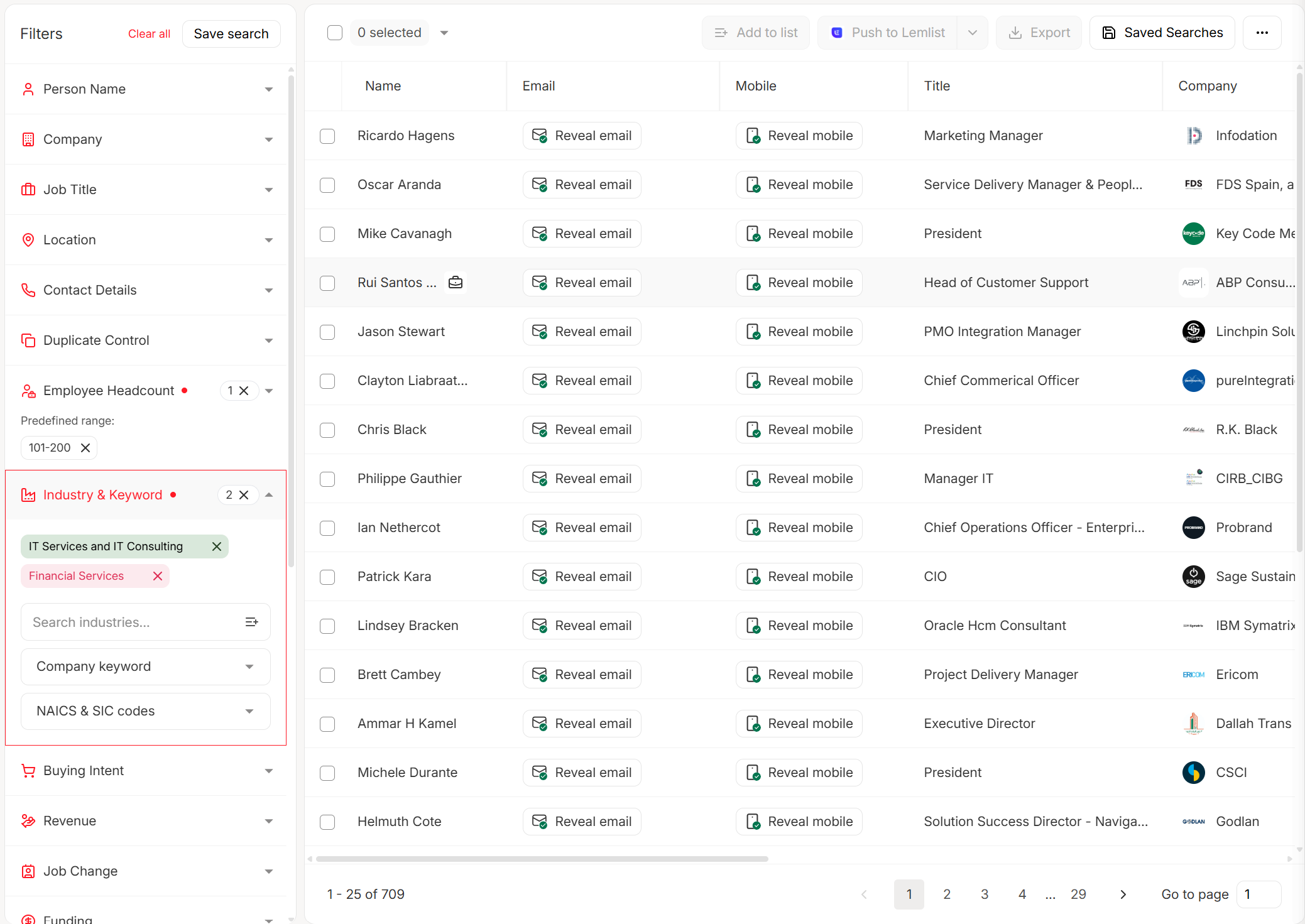
Prospeo is the strongest option for teams that prioritize accuracy over feature bloat: 300M+ profiles, 98% email accuracy, 125M+ verified mobiles with a 30% pickup rate, and a 7-day data refresh cycle while the industry average sits at 6 weeks. The free tier gives you 75 emails and 100 Chrome extension credits per month - enough to run a real test before you commit. Paid plans run roughly $0.01 per email with no contracts.
Cognism is worth considering if you're selling heavily into Europe. Their phone-verified mobiles are strong, and GDPR compliance is baked in. Expect to pay ~$1K-$3K/month for small teams. Apollo is popular for database-driven outbound and has a generous free tier, but email accuracy runs around 79% - which means more bounces and more wasted dials. Skip Apollo if deliverability is a priority.
If you’re comparing providers, start with this ranked list of B2B data platforms.
| Tool | Email Accuracy | Verified Mobiles | Refresh | Pricing |
|---|---|---|---|---|
| Prospeo | 98% | 125M+ (30% pickup) | 7 days | ~$0.01/email; free tier available |
| Cognism | ~95% | Phone-verified | Monthly | ~$1K-$3K/mo |
| Apollo | ~79% | Limited | 4-6 weeks | From $49/mo |
Dialers and CRM
A power dialer pays for itself the moment your team exceeds 30 dials a day. Expect $50-$200/seat/month for tools like Orum, Nooks, or PhoneBurner. The specific dialer matters less than two things: does it integrate with your CRM, and does it log calls automatically? Look for local presence dialing - displaying a local area code to the prospect - and automatic call recording for coaching.
For CRM, Salesforce, HubSpot, and Pipedrive all work. The tool matters less than the discipline of logging every call, every outcome, every next step.
If you’re shopping dialers, compare categories and tradeoffs in our predictive dialer guide.
AI Coaching and Analytics
Gong remains the gold standard for call analytics at ~$100-$300/user/month. It shows you exactly where reps lose prospects, which talk-to-listen ratios correlate with booked meetings, and which openers actually work. Hyperbound is gaining traction for AI roleplay - reps practice objection handling against AI buyers without burning real prospects. Worth evaluating once your team exceeds 5 SDRs.
Compliance and Legal Rules
Compliance isn't optional, and the penalties are real.
TCPA (Telephone Consumer Protection Act): Consent is required for autodialed or prerecorded calls to mobile numbers. Penalties run $500-$1,500 per violation. The FCC has clarified that AI-generated voices qualify as "artificial or prerecorded voice" under TCPA - meaning AI voice calls require the same consent as robocalls. If you're experimenting with AI-powered outreach, that's the line you can't cross.
If you’re unsure where the line is, read the full TCPA compliance checklist.
TSR/DNC (Telemarketing Sales Rule / Do Not Call Registry): Scrub your lists against the National DNC Registry at least every 31 days. Penalties go up to $50,120 per violation. That's not a typo - one bad list can cost you six figures.
Calling hours: 8 AM to 9 PM in the recipient's local time zone. No exceptions.
TCPA Revocation Rule: Consumers can revoke consent by any reasonable manner - text, email, verbal request, carrier-level block. You must honor the revocation within 10 business days. You're allowed one clarification message, but that's it. Broader opt-out scope changes that took effect in 2026 further expanded consumer revocation rights.
STIR/SHAKEN: This caller ID authentication framework is widely adopted across major carriers. If your outbound numbers aren't properly registered and authenticated, your calls get flagged as "Spam Likely" before the prospect even sees your name. Work with your dialer provider to ensure your numbers carry an A-level attestation.
B2B exemption nuance: The TSR's DNC provisions don't apply to B2B calls. But TCPA consent rules can still apply when you're dialing mobile numbers using automated dialing or prerecorded/artificial voice technology.
Compliance isn't exciting. But one TCPA lawsuit can cost more than your entire annual tech stack. Scrub your lists, respect calling hours, and document consent.
You read it above: top teams need 15-20 dials per meeting vs. 40-45 for the average. The difference is data quality. Prospeo refreshes every 7 days, verifies every number through 5 steps, and costs $0.01 per lead.
Turn every dial into a real conversation, not a voicemail or a dead line.
FAQ
What is a cold call?
A cold call is an unsolicited phone call to a prospect who hasn't previously interacted with you or your company. You're proactively reaching out by phone to start a sales conversation - the prospect didn't request the call, but your research makes it relevant to their situation.
What's the average success rate?
The average cold calling success rate is 2.3%, or roughly 1 meeting per 40-45 dials. Teams running strong outbound fundamentals - verified mobiles, tight talk tracks, and optimized timing - consistently hit 5-8%.
What are the best times to call?
Tuesday through Thursday, between 10-11 AM and 2-4 PM in the prospect's local time zone. These windows lift connect rates by 40-70% compared to random dialing. Avoid Monday mornings and Friday afternoons.
How many attempts does it take to reach a prospect?
It takes an average of 8 attempts to reach a decision-maker, and 95% of conversions happen after the sixth attempt. Most reps give up after 2-3 tries, which is why disciplined follow-up is a genuine competitive advantage.
What's the best free tool for cold call data?
Prospeo's free tier includes 75 verified emails and 100 Chrome extension credits per month with 98% email accuracy - enough to run a real test. Apollo offers a larger free database but lower accuracy (~79%), meaning more bounces and wasted dials.