

The Complete B2B Cold Email System for 2026
Reply rates for B2B cold emails dropped from 6.8% to 5.8% year-over-year, and the vibe across cold email communities is blunt: what worked last year is dead. They're not wrong - but they're not right either. Cold email isn't dead. Lazy cold email is.
Here's what actually changed. AI-generated volume flooded inboxes, so spam filters got dramatically smarter. Microsoft started enforcing strict authentication for high-volume senders. Recipients developed pattern recognition for templated outreach - they can smell a mail-merge job from the subject line. The average reply rate across billions of sends now sits at 3.43%. That's the floor most teams are stuck on.
But the teams still booking meetings? They rebuilt from the ground up: better data, tighter infrastructure, shorter copy. One counterintuitive stat tells the whole story - targeting just 1-2 contacts per company yields a 7.8% reply rate, while blasting 10+ contacts at the same company drops it to 3.8%. Precision beats volume every time.
What You Need (Quick Version)
Three things determine whether your cold outreach gets replies, in priority order:
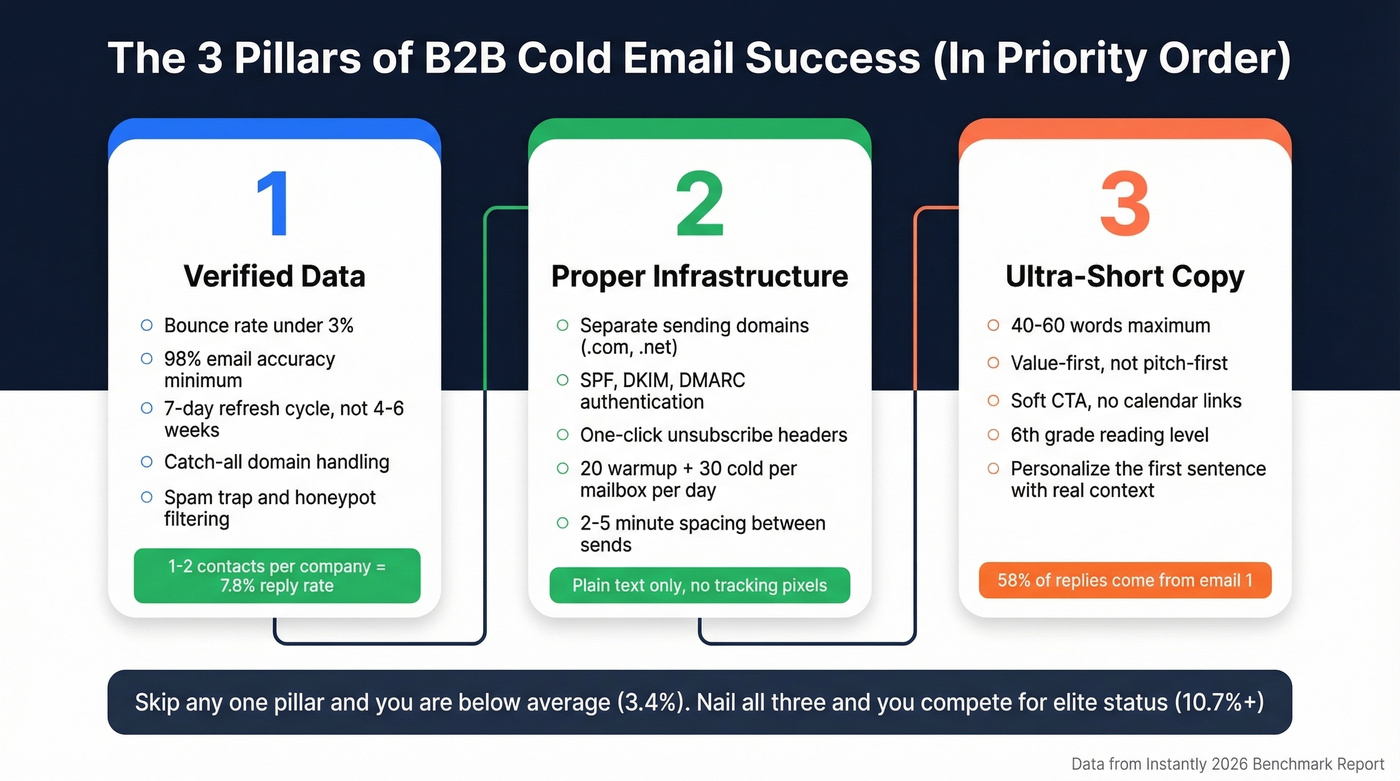
- Verified data. Keep bounce rates under 3%. One bad list torches your domain reputation for weeks. Start with verified emails from Prospeo - 98% accuracy means you're not gambling with your sender score. If you need more options, compare email list providers.
- Proper infrastructure. Separate domains, warmed mailboxes, SPF/DKIM/DMARC, one-click unsubscribe. This isn't optional anymore. For a deeper technical checklist, use an email deliverability guide.
- Ultra-short, value-first copy. 40-60 words. Soft CTA. No calendar links in the first touch. If you want more examples, pull from these cold email subject line examples.
The 2026 benchmark report from Instantly puts the average reply rate at 3.43%. Top quartile hits 5.5%+. Elite campaigns exceed 10.7%. Nail all three pillars and you're competing for that top tier. Skip any one and you're below average.
If your deal sizes sit below $10k, you probably don't need a $30k/year data platform or a 14-tool tech stack. A verified list, one sending tool, and tight copy will outperform a bloated setup every time.
Cold Email Benchmarks for 2026
Let's ground this in real numbers. Instantly analyzed billions of cold email interactions across thousands of workspaces. Belkins studied 16.5 million emails across 93 domains. Here's what the combined data says:
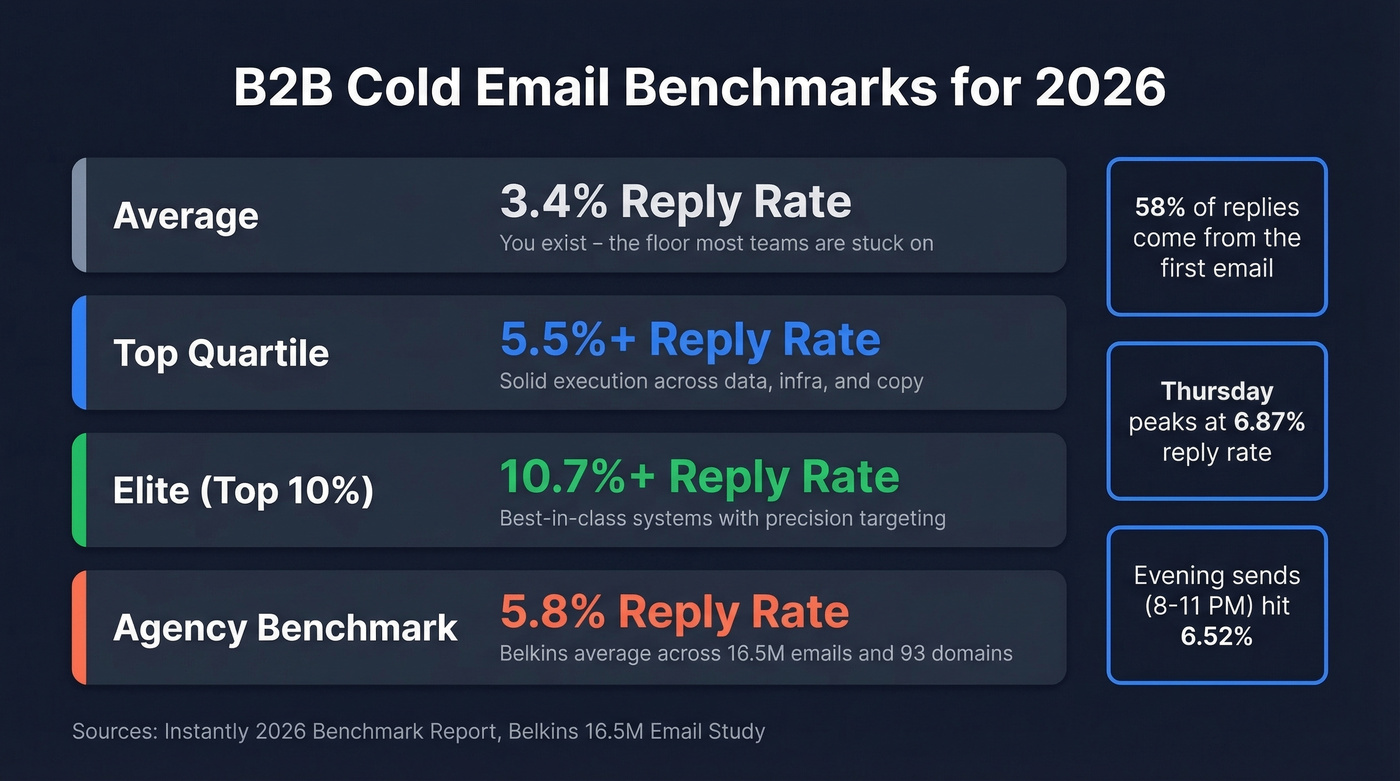
| Tier | Reply Rate | What It Means |
|---|---|---|
| Average | 3.4% | You exist |
| Top quartile | 5.5%+ | Solid execution |
| Elite (top 10%) | 10.7%+ | Best-in-class |
| Agency benchmark | 5.8% | Belkins average |
A few patterns jump out. 58% of all replies come from the first email - your opener carries most of the weight. Thursday pulls the highest reply rate at 6.87%, and evening sends between 8-11 PM peak at 6.52%. Tuesday and Wednesday are strong for initial outreach. (If you want a tighter schedule, see the best time to send cold emails.)
The trend line matters too. Reply rates dropped from 6.8% in 2023 to 5.8% in 2024, and the decline hasn't reversed. Inboxes are more crowded, filters are smarter, and recipients are more skeptical. The bar keeps rising, which is exactly why a deliberate system matters more than any single tactic.
One clarification worth making: cold email is one-to-one, value-led outreach with a clear opt-out. Spam is bulk, untargeted, and non-compliant. The line matters legally and practically - every element of this system is designed to keep you on the right side of it.
Fix Your Data First
Most cold email failures aren't copy problems. They're data problems. And they're invisible until your domain is already damaged.
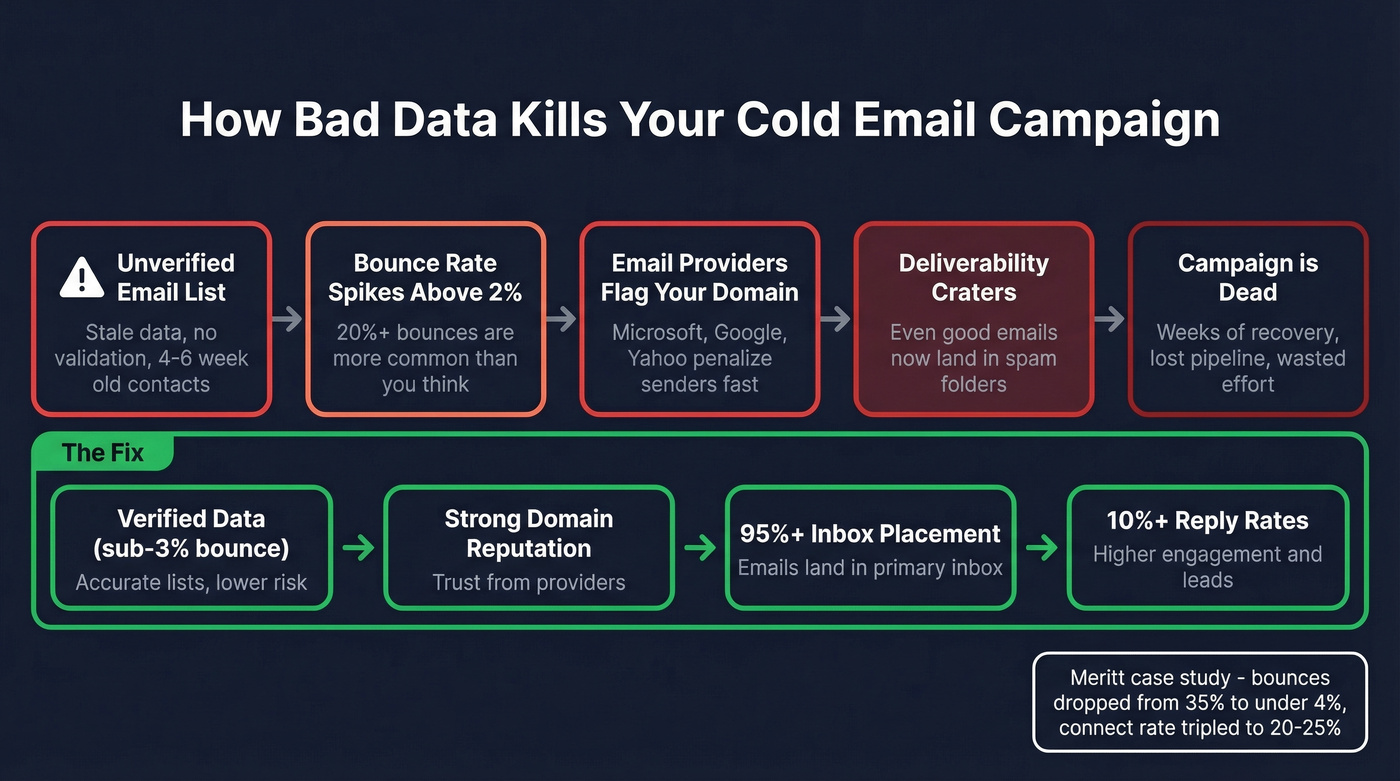
The causal chain is simple. Bad emails bounce. Bounces spike above 2%. Email providers flag your domain. Deliverability craters. Now even your good emails land in spam. We've watched teams spend weeks optimizing subject lines and CTAs while sitting on a contact list that bounces 20%+. It's like tuning the engine on a car with flat tires. If you’re troubleshooting, start with email bounce rate benchmarks and fixes.
Meritt ran into exactly this - bounce rates at 35% before they fixed their data pipeline. After switching to verified contacts, bounces dropped under 4% and their connect rate tripled to 20-25%. Stack Optimize built an entire agency to $1M ARR on the back of clean data: 94%+ deliverability, sub-3% bounce rates, zero domain flags across all clients.
The biggest data problem nobody talks about is staleness. Most databases refresh every 4-6 weeks. That means the email you verified last month might already be invalid - people change jobs, companies restructure, domains expire. By the time you send, you're working with decayed data and wondering why bounces are climbing. Prospeo runs a 7-day refresh cycle across 143M+ verified emails, with a 5-step verification process that handles catch-all domains, strips spam traps, and filters honeypots. Native integrations with Instantly, Lemlist, Smartlead, and HubSpot mean verified contacts flow straight into your sequences without a CSV detour. If you’re evaluating vendors, compare data enrichment services.

The article says it clearly: bounce rates above 2% torch your domain. Prospeo's 5-step verification delivers 98% email accuracy with a 7-day refresh cycle - not the 4-6 week industry average that leaves you sending to dead inboxes. At $0.01 per email, clean data costs less than one bounced send.
Stop optimizing copy on top of bad data. Fix the foundation first.
Deliverability Infrastructure
Clean data gets you to the starting line. Infrastructure gets you into the inbox.
Authentication and Compliance
SPF, DKIM, and DMARC are non-negotiable. If you haven't set these up, stop reading and go do it now. Microsoft started enforcing authentication requirements for senders pushing 5,000+ messages per day in 2025, and Google and Yahoo tightened their rules before that. (If you want to validate your setup, follow how to verify DKIM is working.)
Beyond authentication, you need RFC 8058 one-click unsubscribe headers (List-Unsubscribe and List-Unsubscribe-Post). Keep spam complaints under 0.3% and bounces under 2%. If either metric trends above those thresholds, pause and fix the root cause before sending another email.
On the legal side, CAN-SPAM applies to all commercial email - including B2B. Every email needs a valid physical postal address, a clear opt-out mechanism, and an honest subject line. Penalties reach $53,088 per violation. You must honor opt-out requests within 10 business days, and you're responsible even if you outsource sending. If you're emailing EU/UK prospects, GDPR and PECR add stricter consent requirements - research those separately before launching campaigns in those regions.
Domains, Mailboxes, and Limits
Never send cold email from your primary domain. Set up secondary domains with reputable TLDs like .com or .net, and run 2-3 mailboxes per domain.
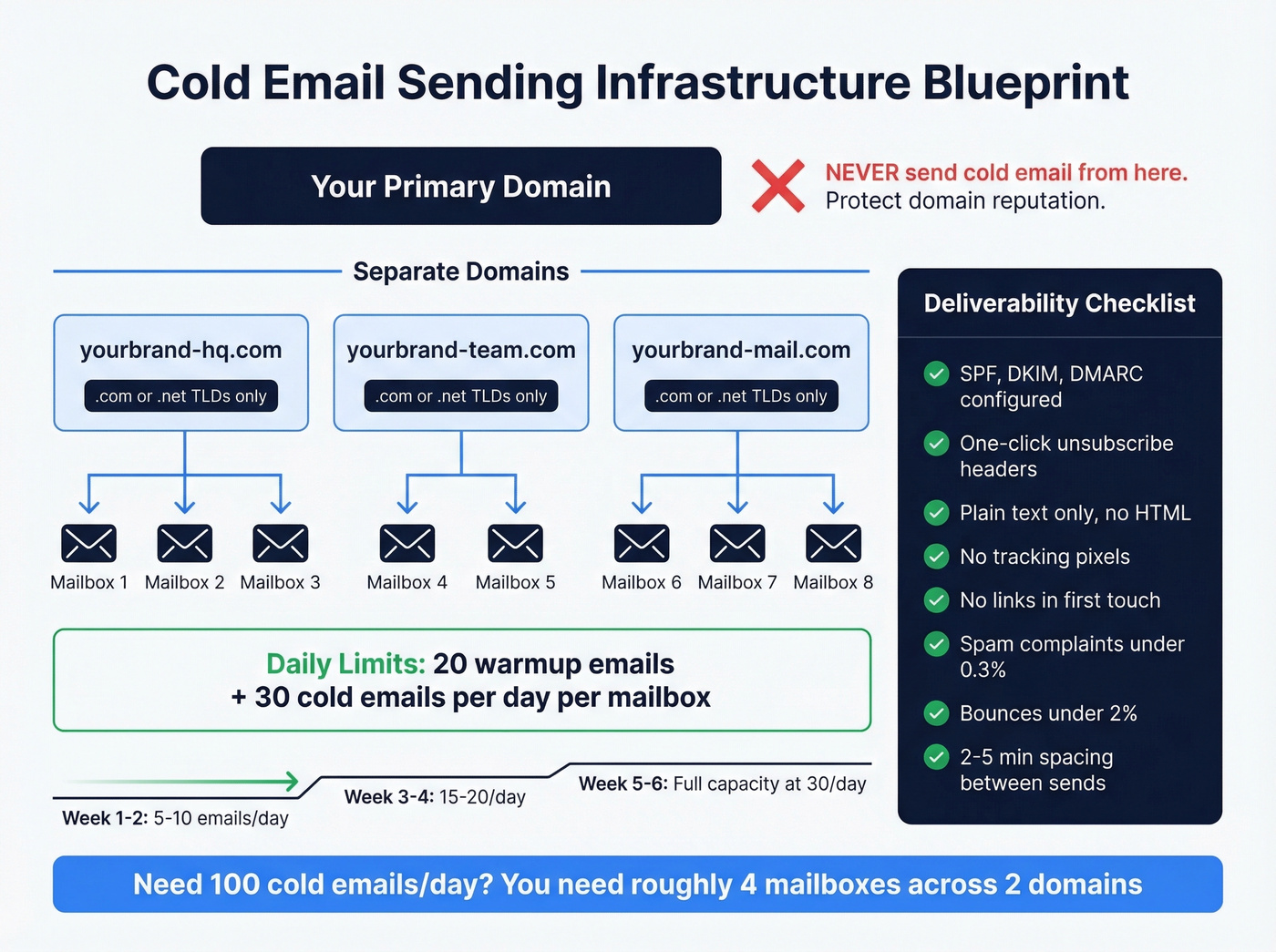
Each mailbox handles roughly 20 warmup emails plus 30 cold emails per day. Start new mailboxes at 5-10 emails per day and ramp over 4-6 weeks. Space sends 2-5 minutes apart and rotate across mailboxes. If you want to send 100 cold emails per day, you need around 4 mailboxes. That's your baseline infrastructure. For safe scaling, use an email velocity framework.
A few rules that separate good deliverability from great: use plain text only. Disable open and click tracking - tracking pixels hurt deliverability. No links, images, or calendar invites in your first touch. These feel like small things, but they compound. The difference between 70% inbox placement and 95% is often just these operational details.
Teams hitting 10%+ reply rates share one trait: precision targeting with verified contacts. Prospeo gives you 30+ filters - buyer intent, job changes, technographics, headcount growth - across 300M+ profiles so you reach the right 1-2 contacts per company, not 10 untargeted ones.
Precision beats volume. Build lists that actually convert.
Writing Cold Emails That Get Replies
Subject Lines
Subject lines of 6-10 words hit 21% open rates. Personalized subject lines get 50% higher opens. Including numbers can boost opens up to 113%. If you want a swipe file, use these email subject line examples.
Keep them under 45 characters - most emails are read on mobile, and long subjects get truncated. Skip exclamation points. Skip clickbait. Write something that sounds like it came from a colleague, not a marketer.
The Ultra-Short Format
The best-performing B2B cold emails in 2026 are absurdly short. We're talking 40-60 words. The structure is dead simple: context trigger, specific offer, soft CTA. For more structure options, see a full B2B cold email sequence breakdown.
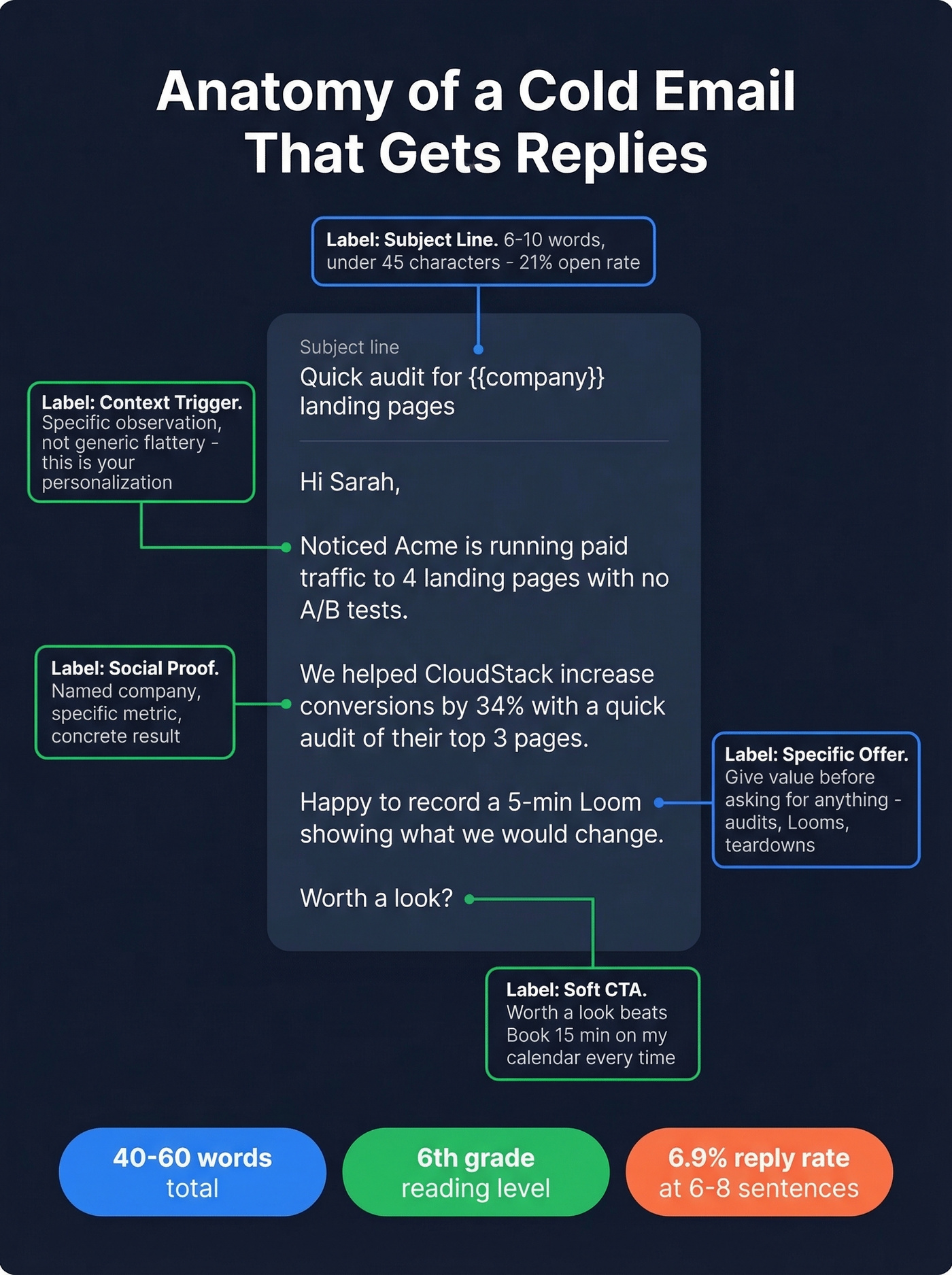
Data across multiple studies converges on the same finding: 6-8 sentences hit a 6.9% reply rate, and top campaigns keep emails under 80 words. Write at a 6th-grade reading level - that can drive 67% better performance. This isn't about dumbing things down. It's about reducing cognitive load so busy people actually read what you sent.
Template 1 - Value-First (Audit Offer):
Hi {{firstName}},
Noticed {{company}} is running {{specific observation}}. We helped {{similar company}} increase {{metric}} by {{result}} with a quick audit of their top 3 landing pages.
Happy to record a 5-min Loom showing what we'd change. Worth a look?
That's 47 words. No fluff, no "hope this finds you well," no three-paragraph company history.
Template 2 - Pain-Point (PAS Format):
Hi {{firstName}},
Most {{role}} teams at {{company size}} companies waste 10+ hours/week on {{pain point}} - and still miss quota.
We built {{solution}} specifically for this. {{One-line proof point}}.
Interested in seeing how it works?
Personalization Beyond Mail Merge
Real personalization means knowing their problem before you email. Dropping {{firstName}} and {{company}} into a template isn't personalization - it's mail merge. Everyone does it. It doesn't move the needle anymore. If you want a system for this, use a personalized outreach playbook.
What works: referencing a specific initiative, a recent hire, a technology they use, or a problem their industry is facing right now. Frontload the first sentence with the personalized element. Reduce "I" and increase "you" throughout. Adding personalization in a PS line can lift performance by roughly 35%.
Intent data takes this further. If a prospect's company is actively researching topics related to your solution, that's a personalization signal worth more than any social post. The difference between "I noticed your company" and "I know what you're trying to solve right now" is massive - and it's the kind of signal that turns a 3% reply rate into a 7% one.
When you're ready to A/B test your personalization approaches, start with a 20/80 split: test the variant on 20% of your list, then deploy the winner to the remaining 80%. This prevents you from burning a full list on an unproven angle.
Soft CTAs Beat Calendar Links
"Worth a conversation?" outperforms "Book 15 minutes on my calendar" every time. The first touch should ask for interest, not commitment. One CTA per email. No Calendly links. No "pick a time that works." For CTA patterns, see email call to action examples.
Template 3 - Social Proof + Soft CTA:
Hi {{firstName}},
{{Similar company}} was dealing with {{problem}} - we helped them {{specific result}} in {{timeframe}}.
{{Company}} looks like it has the same challenge based on {{observation}}.
Worth exploring?
The Follow-Up Sequence
58% of replies come from email one. That means 42% come from follow-ups - but the math gets ugly fast.
| Email # | Spam Rate | Unsub Rate | Reply Trend |
|---|---|---|---|
| 1st | 0.5% | 0.1% | Baseline |
| 2nd | ~0.8% | ~0.5% | +up to 49% |
| 3rd | ~1.2% | ~1.2% | -20% |
| 4th | 1.6% | 2.0% | -55% |
The first follow-up can lift replies by up to 49% in high-performing campaigns. By the fourth email, response rates drop 55% and spam complaints triple. The sweet spot is 4-7 total touches. If you want plug-and-play copy, use these cold email follow-up templates.
Spacing and Timing
Space follow-ups 2-3 business days apart. Tuesday and Wednesday are strong for initial sends. Thursday pulls the highest reply rate at 6.87%. Evening sends between 8-11 PM consistently outperform morning sends at 6.52%.
Template 4 - Follow-Up (New Value Angle):
Hi {{firstName}},
Quick follow-up - I put together {{specific resource}} that shows how {{similar company}} solved {{problem}}.
Happy to share if useful.
Template 5 - Breakup Email:
Hi {{firstName}},
I'll assume the timing isn't right. If {{problem}} becomes a priority, I'm easy to find.
Either way - good luck with {{initiative}}.
When to Stop
Beyond 7 touches, you're in diminishing-returns territory unless each email adds genuinely new value. And here's the data point most teams ignore: contacting 1-2 people per company yields a 7.8% reply rate. Blast 10+ contacts at the same company and that drops to 3.8%.
When email alone stalls, layer in phone and social touches - messaging prospects directly, for example, can re-engage leads who ignored your inbox outreach. Teams using at least three channels see roughly 50% higher engagement rates. The sequence doesn't end. It evolves.
Using AI Without Sounding Like AI
A Hunter survey of 200 decision-makers and 300 B2B professionals found that 67% don't mind if an email was written with AI - as long as it's relevant. But 47% said they'd be less likely to reply if they detected AI. The gap between those two numbers is your opportunity.
Use AI for: research on prospects, first-draft generation, A/B variant creation, subject line brainstorming, and analyzing reply patterns.
Skip AI for: final voice editing, personalization details, and anything that requires genuine knowledge of the prospect's situation. The "AI tells" that kill response rates are repetitive structure, overly formal language, and formulaic openings. If your email reads like it could've been sent to anyone, it sounds like AI - whether it was or not. For a deeper workflow, see AI cold email outreach.
Here's the thing: the real move is using AI for 80% of the work and spending your time on the 20% that makes it feel human. That last pass - tightening the language, adding a specific observation, making the CTA feel natural - is what separates a 3% reply rate from a 7% one. The consensus on r/coldemail backs this up: nobody's anti-AI, they're anti-lazy.
Building Your Outreach Stack
You need three layers: data and verification, sending and warmup, and CRM. Don't overcomplicate it.
| Tool | Layer | Starting Price |
|---|---|---|
| Prospeo | Data & verification | Free tier; ~$0.01/email |
| Instantly | Sending & warmup | ~$30/mo |
| Smartlead | Sending & rotation | ~$39/mo |
| Lemlist | Sending & sequences | $32/user/mo |
| Woodpecker | Sending & sequences | $29/mo (up to 500 prospects) |
Instantly is the default for most teams - strong warmup, good analytics, reasonable pricing. Smartlead edges it on mailbox rotation at scale. Lemlist adds multichannel capabilities if you need calls and social touches alongside email. Woodpecker is the pick for smaller teams who want simplicity without sacrificing deliverability controls. If you’re comparing platforms, start with these SDR tools.
For CRM, most teams already have one. HubSpot's free tier handles pipeline tracking for early-stage teams, and Salesforce is the standard at scale. The key is native integration with your sending layer so replies and engagement data flow back without manual work. If you’re standardizing your process, see how to connect outreach tool to CRM.
Skip the 14-tool stack if you're just getting started. We've seen teams spend more time configuring integrations than actually sending emails. Start with three tools, get to 5%+ reply rates, then add complexity only when you hit a specific bottleneck.
FAQ
What's a good reply rate for B2B cold emails?
The average is 3.43% based on 2026 benchmark data. Top-quartile campaigns hit 5.5%+, and elite campaigns exceed 10.7%. If you're consistently above 3%, you're performing at or above average - focus on incremental improvements to data quality and personalization from there.
How many follow-ups should I send?
Four to seven total touches is the sweet spot. The first follow-up can lift replies up to 49%, but by the fourth email, spam complaints rise from 0.5% to 1.6% and response rates drop 55%. Each follow-up should introduce a new value angle, not just "bumping this up."
Is cold email legal for B2B?
Yes, but CAN-SPAM applies to all commercial email including B2B outreach. Every email needs a physical address, an opt-out mechanism, and an honest subject line. Penalties reach $53,088 per violation. Honor opt-out requests within 10 business days.
How do I keep cold emails out of spam?
Authenticate your domain with SPF, DKIM, and DMARC. Warm up new mailboxes for 4-6 weeks before scaling. Keep bounces under 2% and spam complaints under 0.3%. Using verified data with 98% accuracy keeps bounce rates well under 3%, which protects sender reputation at the source.
Should I use AI to write B2B cold emails?
Use AI for research, drafts, and A/B variants - then edit for voice and specificity. 67% of decision-makers don't mind AI-written emails if they're relevant, but 47% are less likely to reply if they detect AI. The final human pass on personalization is what separates average from elite.