

Connect Rate: 2026 Benchmarks and How to Improve It
A connect rate collapse can kill an outbound operation faster than bad messaging ever will. One operator on r/b2bmarketing detailed a $125K/month outbound program that was printing pipeline in early 2024. By May 2025, their connection rate had cratered from 60% to 15%, conversion collapsed from 3.5% to 0.8%, and revenue barely covered seat licensing and carrier costs. The team didn't get worse. The phones did.
If your numbers feel broken right now, they might just be normal. Outbound calling has fundamentally changed, and the benchmarks most people reference are two or three years stale.
Quick Benchmarks
Realistic cold outbound SDR benchmarks: 5-8% on dials, roughly 1 booked meeting per 200 calls. Call centers running warmer lists see 20-30%.
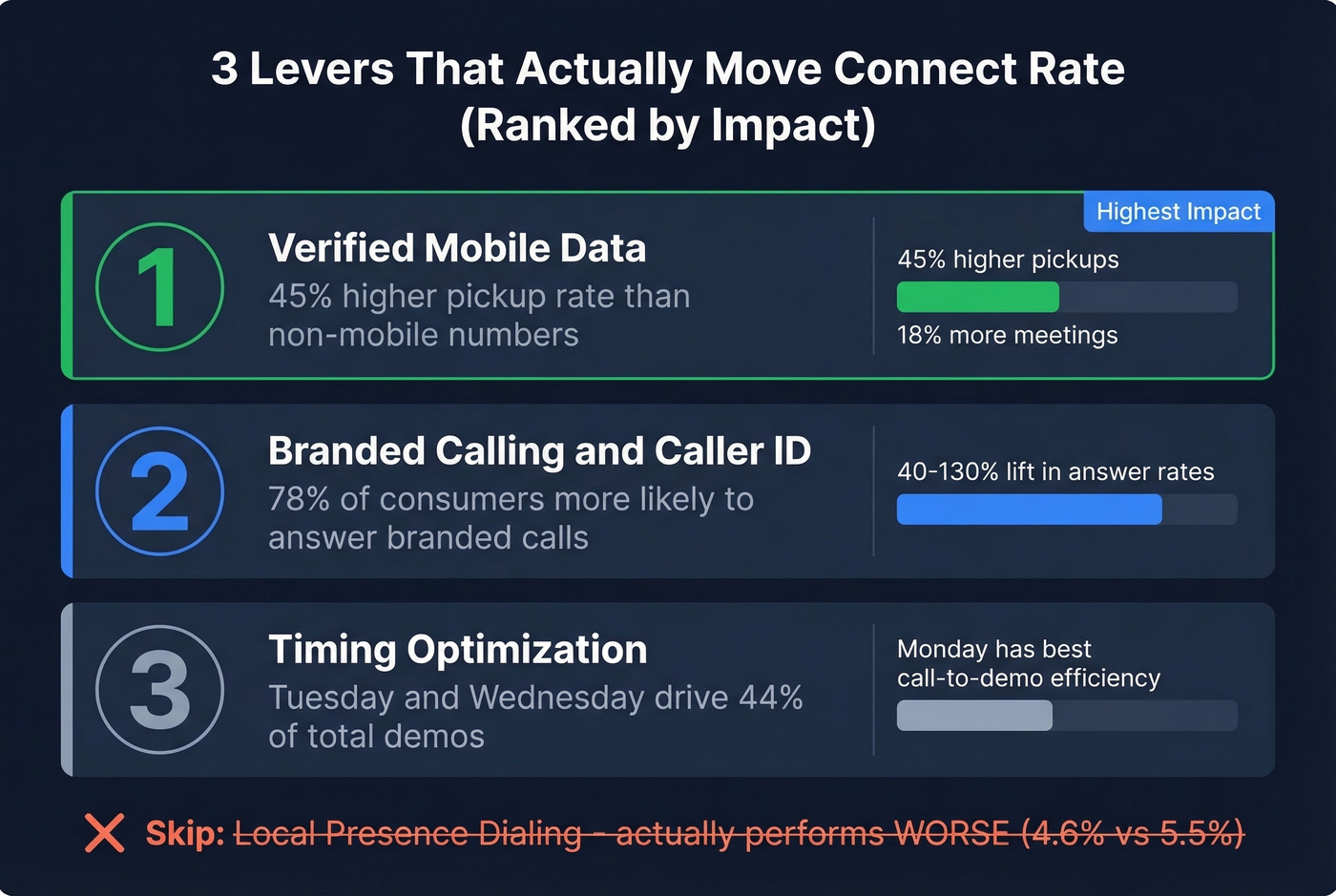
Three levers actually move the needle: verified mobile data (mobile numbers connect at 45% higher rates than non-mobile), branded calling and caller ID reputation management, and timing optimization based on real call data - not folklore. If you're only going to do one thing, fix the data.
What Is a Connect Rate?
This metric measures the percentage of outbound dials that reach a live line. That's it. But the simplicity hides a definitional mess that causes teams to talk past each other constantly.
"Connect" means different things to different teams. Some count any answered call - including voicemail greetings and IVR systems. Others only count a human voice. And "contact rate" gets used interchangeably when the two measure fundamentally different things.
The Formula
(Answered Calls / Total Calls Placed) x 100 = Connect Rate %
If your team places 200 dials and 14 reach a live line, that's 7%. The critical decision is what counts as "answered" - define this before you start tracking, not after.
Connect Rate vs. Contact Rate
The Heartbeat.ai framework breaks it down cleanly:
| Metric | What It Measures | Includes Voicemail? | Includes IVR? |
|---|---|---|---|
| Connect Rate | Dials reaching a live line | Yes | Yes |
| Answer Rate | Human pickups only | No | No |
| Contact Rate | Reaching intended person | No | No |
| RPC Rate | Right party contact confirmed | No | No |
Log separate dispositions for every call: connected-to-human, connected-to-voicemail, connected-to-IVR, invalid/disconnected, and no answer. This granularity separates teams that can diagnose problems from teams that just stare at a single number wondering why it's low.
2026 Benchmarks by Motion
SDR Cold Outbound
The consensus from r/sales practitioners and our own data: SaaS SDR teams making 180-200 cold calls per day hit 5-8% call connect rates. That translates to roughly 1 booked meeting per 200 dials - about a 0.5% meeting-per-dial rate. Call centers running inbound or warm lists operate in a completely different universe, with 20-30% connection rates being typical.
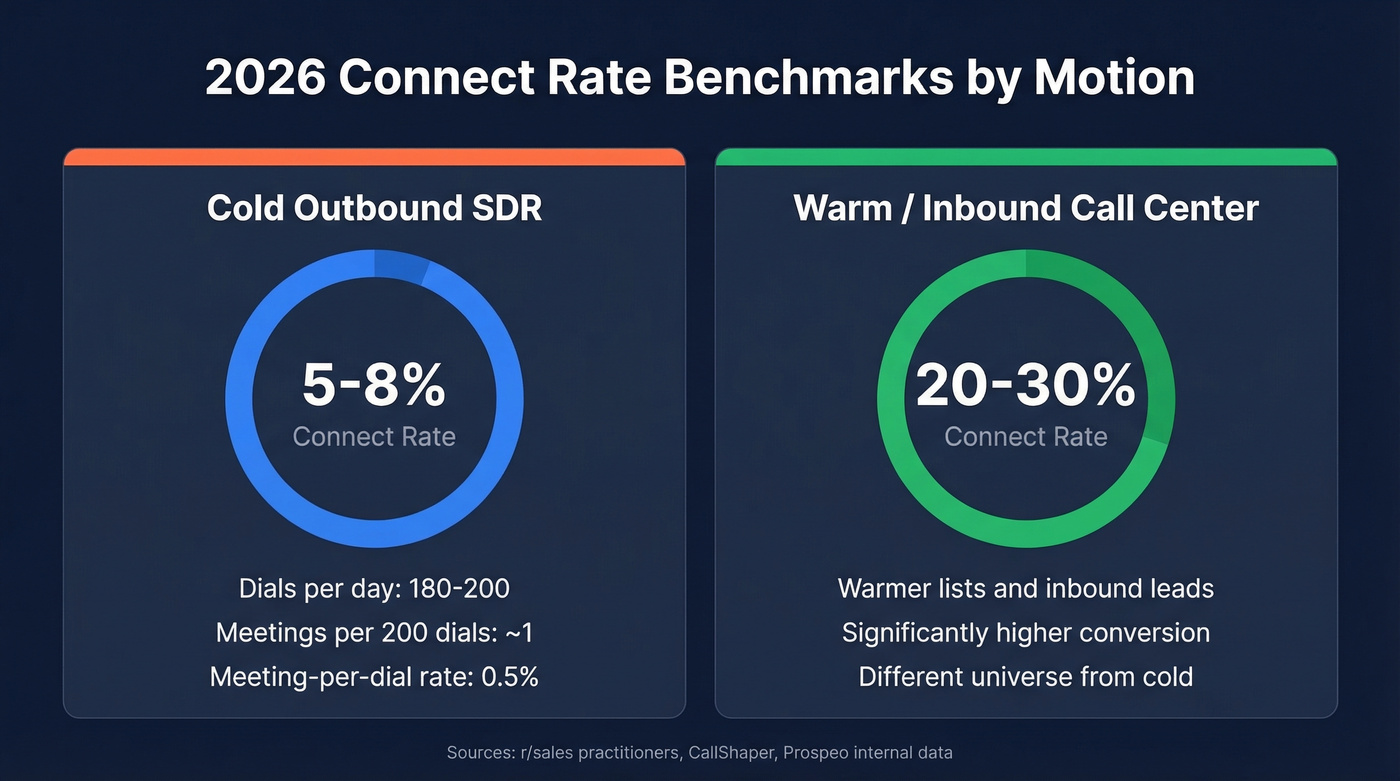
If your SDR team is hitting 5-8% on cold outbound, you're performing at market rate - not failing. The teams that think they're broken are usually comparing themselves to 2021 benchmarks that no longer exist.
Benchmarks by Industry
Cold call conversion rates (meeting set per total calls) vary dramatically by vertical:
| Industry | Conversion Rate |
|---|---|
| Tech/SaaS | 0.81% |
| Business Services | 2.22% |
| Healthcare/Pharma | 1.03% |
| Financial/Insurance | ~1.8% |
| Real Estate | ~1.87% |
These are conversion rates, not connection rates - but they're what matters for pipeline planning. Business services converts at nearly 3x the rate of SaaS, which partly explains why some teams feel outbound is "dead" while others are thriving.

The article says it clearly: SaaS SDRs hit 5-8% connect rates on cold outbound. The fastest way to push past that ceiling is eliminating dead numbers before they enter your dialer. Prospeo's 125M+ verified mobile numbers refresh every 7 days - not every 6 weeks - so your reps stop wasting 20-30% of their dials on disconnected lines.
Fix the data first. Everything else compounds from there.
Why Connection Rates Are Declining
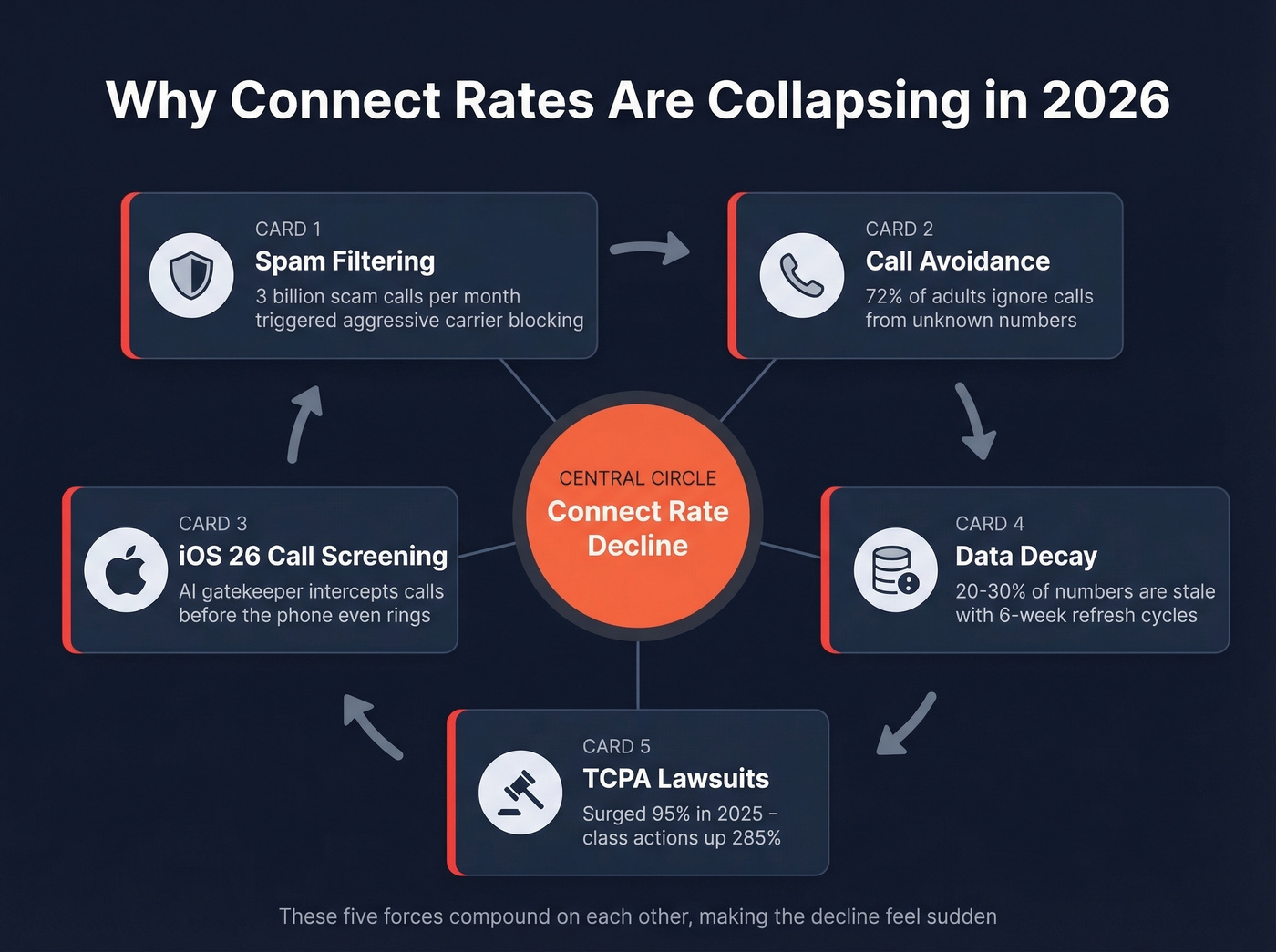
The decline isn't one thing. It's five things happening simultaneously, and they compound on each other in ways that make the problem feel sudden even though it's been building for years.
Spam Filtering and Carrier Blocking
U.S. consumers receive roughly 3 billion scam calls per month. The carriers responded with aggressive STIR/SHAKEN enforcement, and now legitimate B2B calls get caught in the same net.
The result: 72% of American adults simply ignore calls from unknown numbers. That's not a behavioral trend you can overcome with a better script - it's structural. TCPA lawsuits surged 95% in 2025, with class actions up 285% in September alone. Teams running high-volume parallel dialers without proper compliance infrastructure are sitting on a legal time bomb.
Phone number data decay accelerates everything. The industry average refresh cycle is six weeks, meaning 20-30% of the numbers in your dialer are stale by the time a rep hits "call." If you're rebuilding your outbound motion, it helps to start with a tighter cold calling system instead of patching tactics.
The iOS 26 Call Screening Problem
Here's the thing: Apple's iOS 26 introduces Call Screening - an AI gatekeeper that intercepts unknown calls before the phone even rings. It asks the caller their name and reason for calling, transcribes the response, and lets the recipient decide whether to pick up.
With iPhones at 55-58% of the U.S. smartphone market, this isn't a niche feature. It's a structural barrier affecting more than half your prospect list. Predictive and auto dialers are particularly vulnerable because dead air against a screening prompt means an instant hang-up. Industry reports from Cognism indicate cold call success rates have already compressed from roughly 4.82% in 2024 to around 2.3% in 2025, and iOS 26 will push that number even lower through 2026.
The Pipeline Math
The framework that makes this metric tangible is simple: Dials x Connect Rate x Conversion Rate = Meetings.
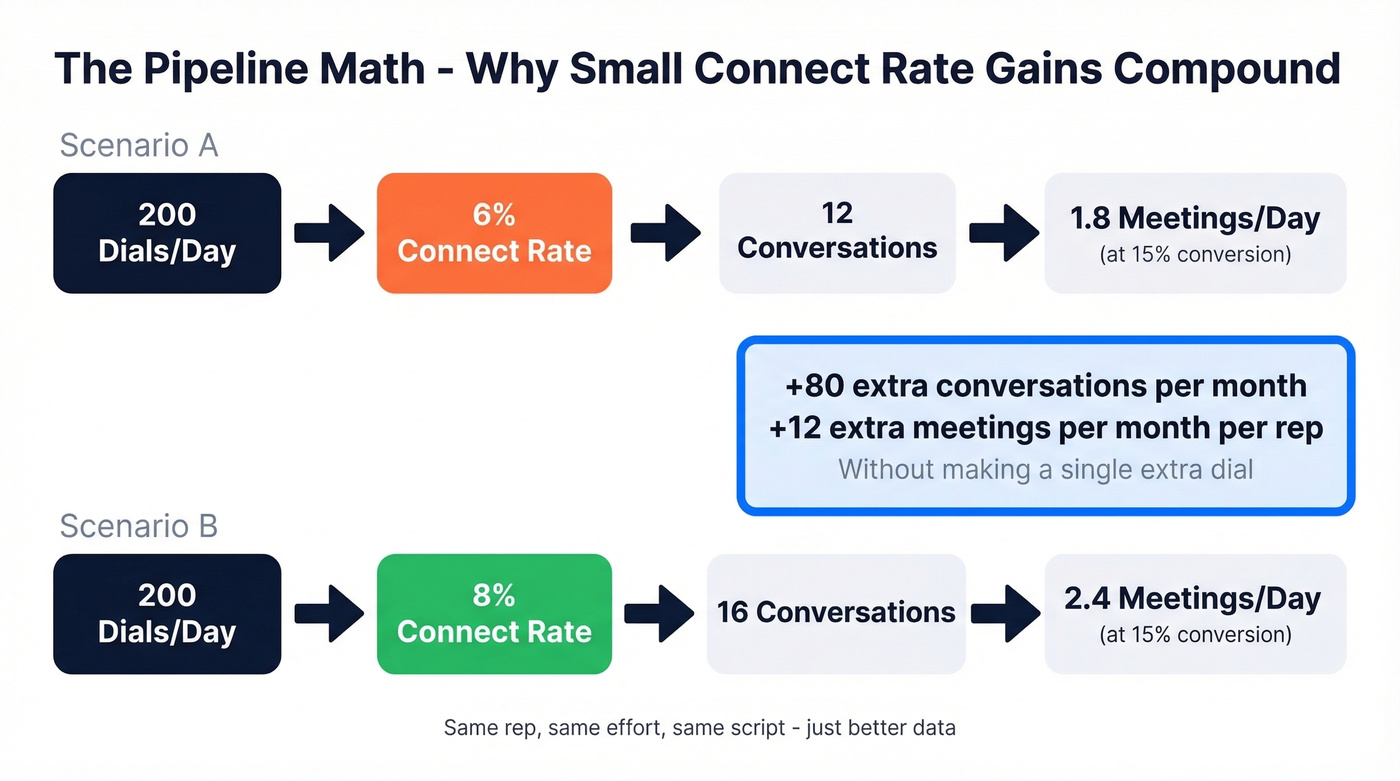
A rep making 200 dials per day at 6% gets 12 conversations. Bump that to 8% and they get 16. Over a 20-day month, that's 80 additional conversations - without making a single extra dial. At even a modest 15% conversation-to-meeting conversion rate, those 80 extra conversations produce 12 more meetings per month per rep.
That cascading math is why small improvements in call connection rates are worth obsessing over. And the fastest way to move the denominator is to stop dialing dead numbers - Prospeo's Mobile Finder verifies numbers on a 7-day refresh cycle, eliminating the 20-30% of calls wasted on disconnected lines before you change anything about your calling strategy. If you want to benchmark the rest of the funnel, map connect rate into your broader sales conversion rate targets.
How to Improve Your Connect Rate
Let's be honest: your problem is almost certainly a data problem, not a dialer problem. We've watched teams spend months evaluating parallel dialers and AI call coaching tools while sitting on a database where a quarter of the phone numbers are disconnected. Here are the levers that actually matter, ranked by impact.
Verified Mobile Data (Lever #1)
Mobile numbers have a 45% higher pickup rate than non-mobile numbers and convert to meetings 18% more often. This is the single highest-leverage change most teams can make.
The problem is data decay. With a six-week industry refresh cycle, a significant chunk of your mobile numbers are stale before anyone dials them. You're paying SDRs $70K+ per year to call disconnected lines - that math should make your stomach turn. If you're evaluating vendors, start with a shortlist of data enrichment services and compare refresh cycles, not just match rates.
Meritt, a Prospeo customer, saw their connection rate triple to 20-25% after switching to verified mobile data, with pipeline jumping from $100K to $300K per week. With Prospeo, mobile numbers are credit-based at 10 credits per number, and you only pay when a number is found, so the ROI is immediate when you stop burning rep time on dead dials.
Branded Calling and Caller ID (Lever #2)
When 78% of consumers say they're more likely to answer calls displaying a recognizable brand name or logo, branded calling stops being a nice-to-have. Early adopters saw 40-130% lifts in answer rates - that's not incremental improvement, that's a step change.
Branded calling requires STIR/SHAKEN authentication. If your authentication or reputation checks fail, the branding gets suppressed and you're back to showing up as an unknown number. Register your outbound numbers with all major carriers, monitor caller ID reputation weekly, rotate dial-from numbers before they accumulate spam flags, and invest in STIR/SHAKEN attestation for your telephony stack. For teams running auto-dialers, train your reps to respond to screening prompts clearly - state your name and reason for calling immediately so the prospect sees a clean transcription. This is also where a modern SDR tools stack can help you standardize workflows across reps.
Timing Optimization (Lever #3)
ZoomInfo's 1.4 million-call study provides the most methodologically sound timing data available. Tuesday and Wednesday drive 44% of total demos. Monday shows the highest call-to-demo efficiency at 1.19%. Friday is worst across every metric.
The historical MIT study found 4-6 PM was 114% better than the worst window (11 AM-12 PM), with 8-10 AM also performing well.
But the best time to call is when your specific prospect is available. A CFO's schedule doesn't care about aggregate Tuesday data. Test your own windows, track by persona, and adjust. In our experience, the teams that build persona-specific call windows outperform the ones blindly following "best day" studies by a wide margin. If you're coordinating call + email touches, align timing with your sequence management rules.
Skip This: Local Presence Dialing
Local presence dialing is the most overrated tactic in outbound sales. Orum's 1.5 million-call study found local area code matching actually performed worse: 4.6% for local numbers versus 5.5% for non-local. They validated this with Chi-square testing on random samples of 5,000 calls.
Consumers have learned that local numbers from unknown callers are often spoofed. The tactic that was supposed to build trust now triggers suspicion. If your dialer vendor is charging extra for local presence, you're paying for negative ROI.
Don't Overlook: Voicemail Drops
Most of your dials will hit voicemail regardless of data quality. A pre-recorded voicemail drop - 18 to 22 seconds, with your name, company, and a single reason to call back - turns a dead dial into a brand impression. It won't move your connect rate directly, but it warms the next attempt and costs almost nothing to implement. Pair it with tighter sales follow-up templates so the next touch is consistent.
Measuring It Right
Most teams track this wrong, or track a single number that hides the real problems.
Log five dispositions minimum on every call: connected-to-human, connected-to-voicemail, connected-to-IVR, invalid/disconnected, and no answer. A single "connected" bucket tells you nothing useful. Report per 100 dials to keep denominators stable across reps and time periods - percentages on small samples are meaningless noise.
Before testing any changes, run a 2-week baseline. You need a stable reference point, or you'll attribute random variance to whatever you just changed. Always separate connection rate from conversion rate in every report - they're different levers driven by different inputs, and mixing them obscures whether your problem is reaching people or persuading them. If you're building a KPI dashboard, pull these into your broader sales operations metrics so leadership stops optimizing the wrong number.
The pipeline math doesn't lie: moving from 6% to 8% connect rate gives each rep 80 extra conversations per month - without a single additional dial. Teams using Prospeo's verified mobiles see a 30% pickup rate, compared to 11-12.5% at competitors. That's the difference between a motion that works and one that barely covers seat costs.
Stop dialing dead numbers. Start at $0.01 per verified contact.
FAQ
What is a good connect rate for sales?
For cold outbound SDR teams, 5-8% is the realistic 2026 benchmark. Call centers running warm or inbound lists see 20-30%. If you're hitting 6-8% on unwarmed cold calls, you're at or above market rate.
How do you calculate connect rate?
(Calls Answered / Total Calls Placed) x 100. Define whether "answered" includes voicemail and IVR or only human pickups before you start tracking - inconsistent definitions make benchmarking impossible.
What's the difference between connect rate and contact rate?
Connect rate measures dials reaching any live line, including voicemail and IVR. Contact rate - or right party contact (RPC) rate - measures reaching the actual decision-maker. RPC is always lower and more meaningful for pipeline forecasting.
Why are cold call connect rates dropping?
Carrier spam filtering, STIR/SHAKEN enforcement, call-blocking apps, phone number data decay of 20-30% within six weeks, and Apple's iOS 26 Call Screening are compressing rates simultaneously. Teams relying on volume over data quality see the steepest declines.
How does phone number verification improve connect rates?
Verified mobile numbers connect at 45% higher rates than unverified or landline numbers. A 7-day data refresh cycle eliminates the 20-30% of dials wasted on disconnected lines - Meritt tripled their rate to 20-25% after switching, with pipeline jumping from $100K to $300K per week.