

Best Time to Cold Call: What 3M+ Calls Actually Tell You
You just finished 30 dials. One conversation. Eight disconnected numbers. It's 2 PM on a Wednesday, and you're wondering if you picked the wrong hour - or the wrong list.
Here's what the data says about the best time to cold call, and the one variable that matters more than timing ever will.
Quick Answer
Best single hour: 10-11 AM local time. Best days: Tuesday through Thursday. Best secondary window: 2-3 PM. Worst time: lunch. Worst day: Friday for booking meetings, Monday for raw conversation volume.
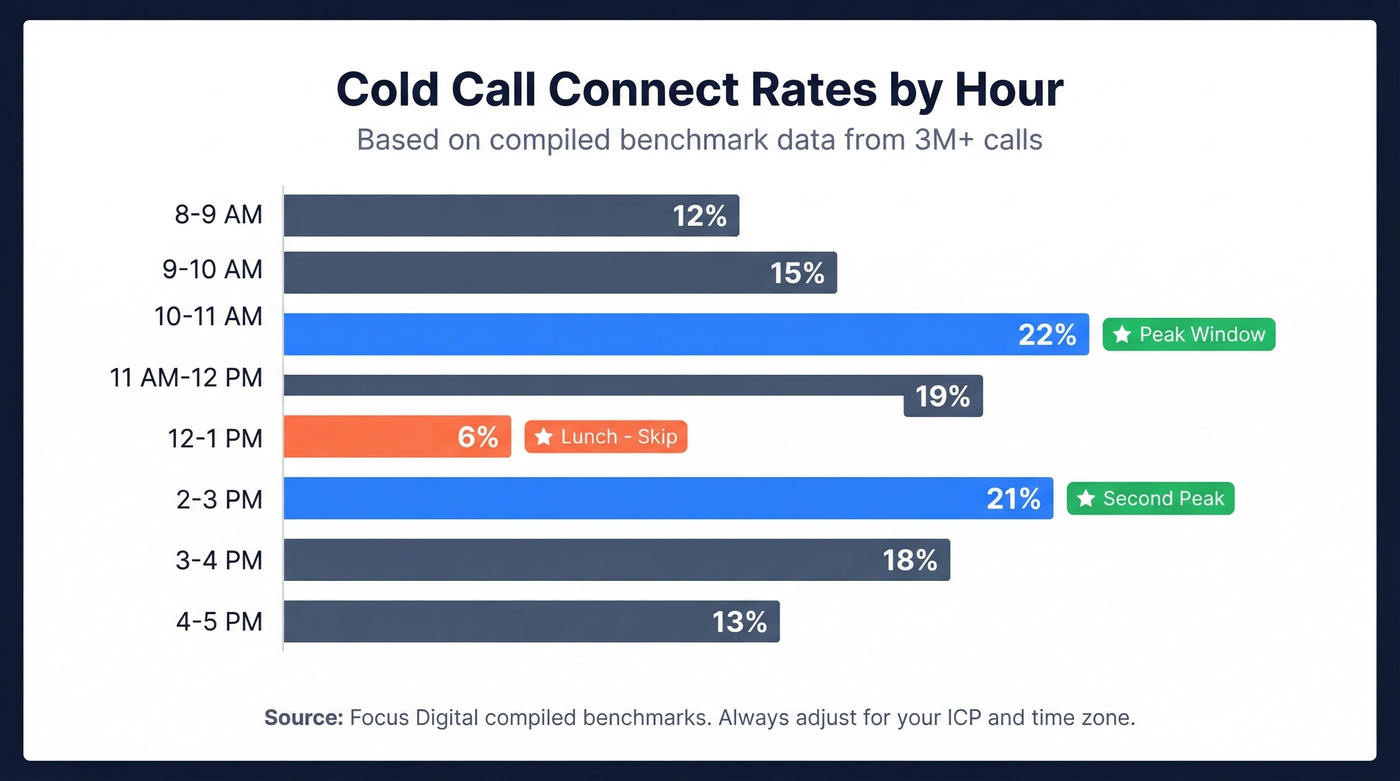
Cognism's 2026 report backs the 10-11 AM sweet spot as the window for the longest, most meaningful conversations. Focus Digital's benchmarks peg that window at a 22% connect rate - compared to just 12% at 8 AM.
But the biggest ROI lever isn't timing. It's whether the number you're dialing is still in service.
What the Data Actually Says
Every major study points the same direction, but the details diverge enough to confuse anyone who reads two of them back to back. Here they are side by side.
| Study | Dataset | Best Time | Best Day | Success Metric |
|---|---|---|---|---|
| ZoomInfo | 1.4M calls | - | Tue-Wed (44% of demos) | Demos booked |
| Cognism 2026 | Not disclosed | 10-11 AM | Thu (#1), Tue (#2) | Conversations to meetings |
| Revenue.io (historical) | Millions | 8-11 AM | - | Connection rate |
| Revenue.io (90-day cold) | Internal | 4-5 PM | - | Engagement |
| Focus Digital | Compiled | 10-11 AM (22%) | - | Connect rate |
| SalesHive | Compiled | 8-9 AM / 4-5 PM | - | Connect rate lift |
The consensus clusters around mid-morning. The outliers - a late-afternoon peak, an early-morning window - reflect different datasets and different definitions of "success." More on why in a moment.
Hourly Connect Rates
Here's the practical scheduling view, drawn from Focus Digital's compiled benchmarks:
| Time Window | Connect Rate | What to Do |
|---|---|---|
| 8-9 AM | 12% | Research + priority dials |
| 9-10 AM | 15% | Ramp into call block |
| 10-11 AM | 22% | Peak dialing - max volume |
| 11 AM-12 PM | 19% | Continue dialing, taper |
| 12-1 PM | Low | Admin, prep, eat |
| 2-3 PM | 21% | Second peak - restart |
| 3-4 PM | 18% | Solid window, wind down |
| 4-5 PM | 13% | Last-chance dials, voicemails |
Two peaks, one trough. SalesHive's data supports this shape - calling in the 8-9 AM or 4-5 PM windows can lift connect rates by 40-70% versus random dialing times.
Don't call before 8 AM or after working hours local time. It doesn't just tank your connect rate - it damages your brand.
Best Day of the Week
ZoomInfo's 1.4M-call study makes the strongest case for mid-week: Tuesday and Wednesday combined produce 44% of all demos booked. Monday actually has the highest call-to-demo conversion at 1.19%, possibly because fewer reps bother dialing on Mondays, which means less competition for your prospect's attention.
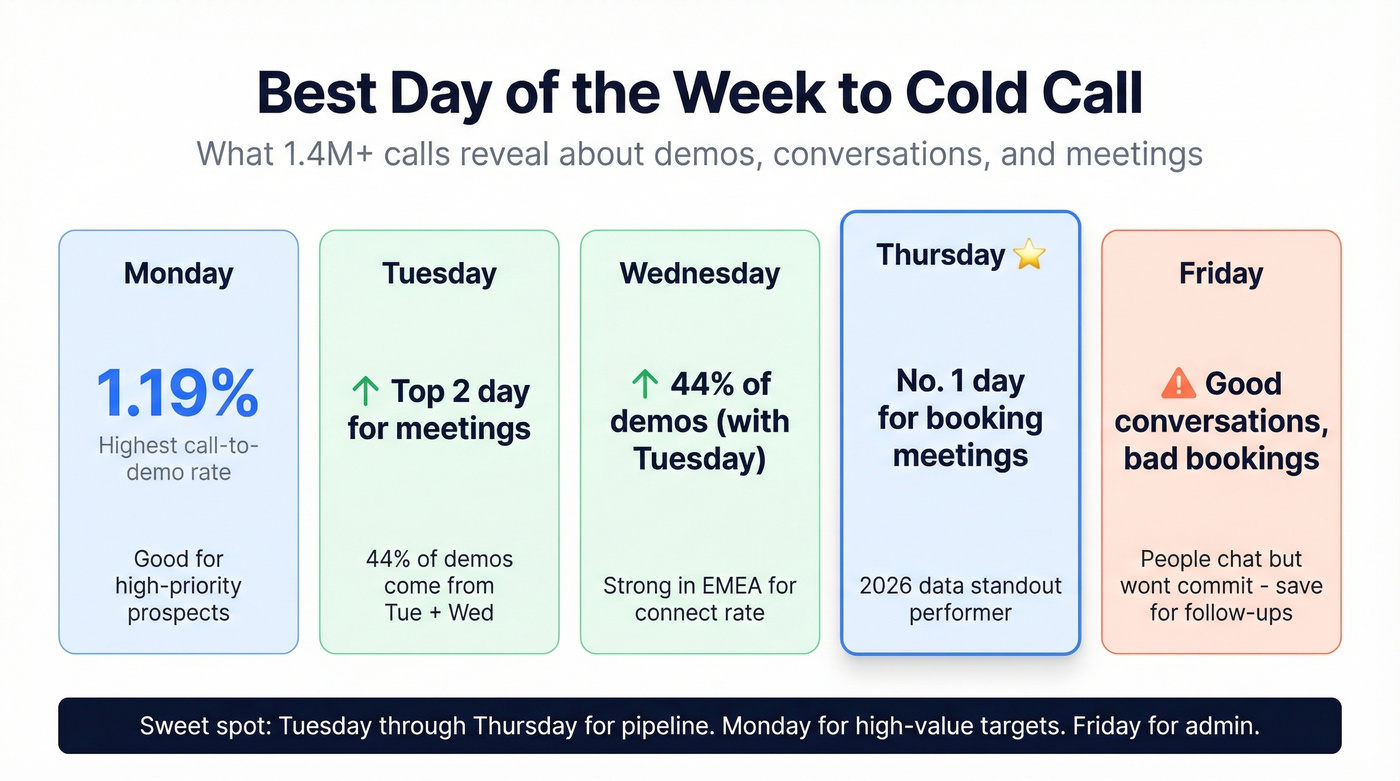
The 2026 data shifts the picture slightly. Thursday held its position as the standout day for booking meetings, while Tuesday overtook Wednesday for the second slot. In EMEA, Wednesday still performs well on connect rate and cold-call-to-demo conversion.
Here's the thing about Friday: it's a trap. People are relaxed, less guarded, more willing to chat. But they're also mentally checked out on commitments. The data shows Friday is one of the best windows for conversations and one of the worst for actually booking meetings. If your goal is pipeline - not pleasant phone calls - save Friday for follow-ups and admin.

That 22% connect rate at 10 AM drops to zero when you're dialing dead numbers. Prospeo gives you 125M+ verified mobile numbers with a 30% pickup rate - refreshed every 7 days, not every 6 weeks.
Stop wasting your peak call window on disconnected numbers.
Why Every Study Disagrees
Revenue.io is the perfect case study in contradictory data. Their historical analysis of millions of calls says 8-11 AM is best. Their own internal 90-day analysis of cold-call-specific sequences says 4-5 PM wins. Same company, opposite conclusions.
The explanation is straightforward: older, larger datasets mix warm follow-ups with true cold calls. A "connection" on a scheduled callback at 9 AM isn't the same as reaching a stranger at 4 PM. Pre-COVID data also skews toward office-hour patterns that don't reflect today's hybrid reality. And the success metric matters enormously. "Connected" versus "had a conversation" versus "booked a meeting" can point to completely different hours.
We've found the study you trust matters less than the data from your own dialer. Use the consensus - 10-11 AM, 2-3 PM, Tuesday through Thursday - as your baseline, then let your CRM tell you what actually works for your ICP.
What Changed in 2026
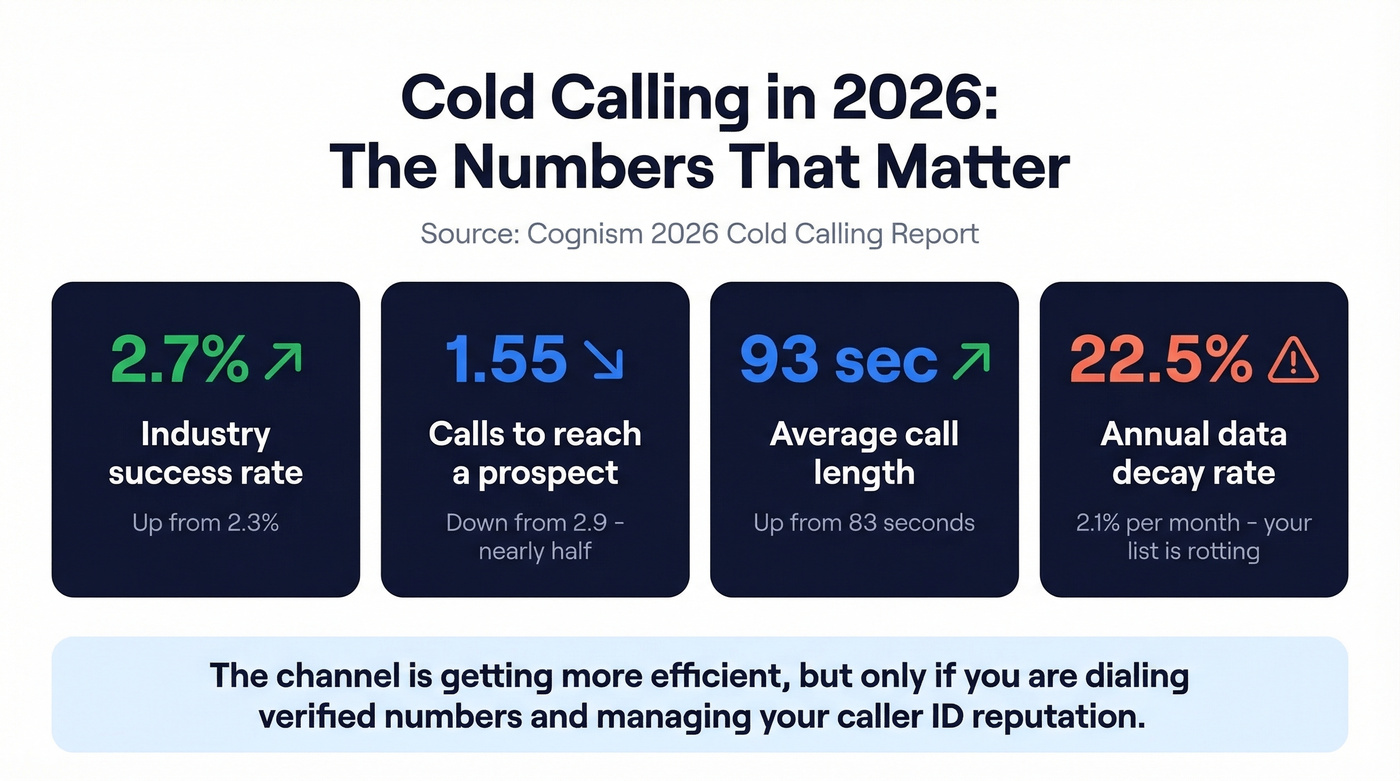
Cold calling is getting more efficient, not less. The 2026 cold calling report from Cognism shows the industry success rate climbing from 2.3% to 2.7%. Reps now need just 1.55 calls on average to reach a prospect, down from 2.9 in the prior season. Average call length increased from 83 to 93 seconds - conversations are getting longer and more substantive.
The remote work effect is real. People working from home pick up unknown numbers more often, partly because it might be a colleague or a delivery driver. That behavioral shift is quietly boosting connect rates across the board.
But there's a counterforce. Spam screening is aggressive now. One recruiter on r/recruiting described calling 300-500 candidates over four weeks and getting exactly two pickups. Two. Unknown-number avoidance is the new gatekeeper, and the reps who win aren't just calling at the right hour - they're calling from numbers that show up as legitimate, dialing mobiles that are actually in service. Use local presence dialing and register your outbound numbers with carrier databases to reduce spam flags.
Build Your Call-Block Schedule
Your own energy matters as much as the clock. Batch cold calls in your highest-energy window, not after an hour of admin drain. Here's a framework that accounts for time zones and the two-peak pattern, assuming you're East Coast-based and calling nationally.
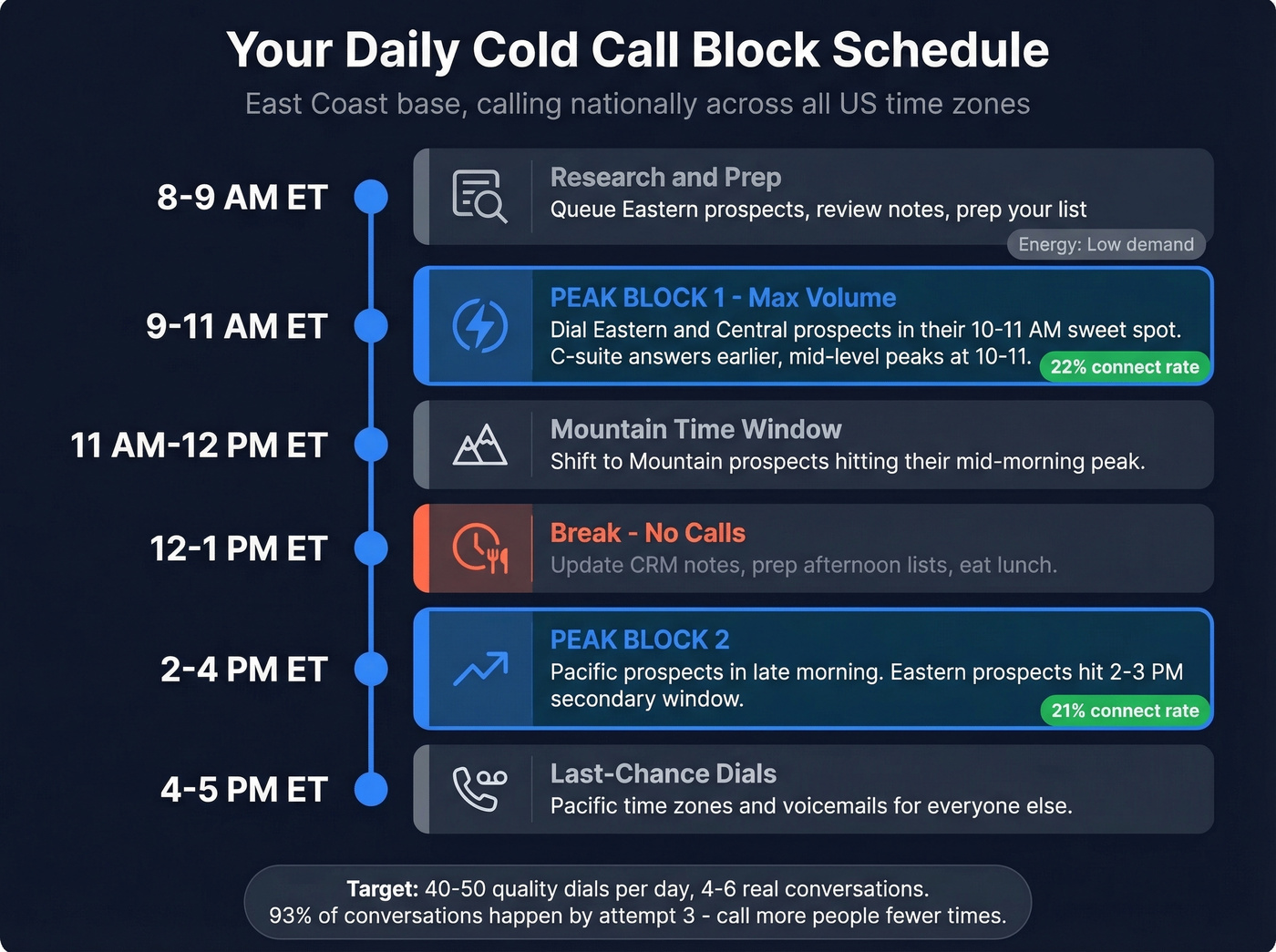
Start with 8-9 AM ET for research and prep - queue your Eastern prospects for the 9 AM ramp.
9-11 AM ET - Peak block #1. Dial Eastern and Central prospects in their 10-11 AM sweet spot. This is your highest-volume window. C-suite and finance prospects tend to answer earlier; ops and mid-level managers peak at 10-11.
11 AM-12 PM ET. Shift to Mountain time prospects hitting their mid-morning peak.
12-1 PM ET. Break. Update CRM notes, prep afternoon lists.
2-4 PM ET - Peak block #2. Pacific prospects are in their late morning. Eastern prospects hit the 2-3 PM secondary window - still productive if you missed the morning block.
Close with 4-5 PM ET for last-chance dials to Pacific time zones and voicemails for everyone else.
The Cognism benchmarks show 93% of conversations happen by the third attempt per prospect. Don't burn five or six dials into the same person - breadth beats depth. The industry average is 52 dials per day; aim for 40-50 quality dials across 4-6 real conversations.
If you're building a repeatable outbound motion, it helps to standardize your sales activities and keep a tight set of sales prospecting techniques for each segment.
Your Timing Is Only as Good as Your Data
Let's be honest about something most cold calling guides skip entirely.
B2B contact data decays at roughly 2.1% per month - that's 22.5% annually. You can nail the perfect calling window and still waste half your block dialing numbers that ring out to nothing. We've watched teams obsess over hourly optimization while 1 in 5 numbers on their list were disconnected. If your average deal size is under $50k, fixing your data quality will move the needle far more than shifting your call block by an hour.
Before each call block, run your list through a verification tool. Prospeo maintains 125M+ verified mobile numbers on a 7-day refresh cycle - compared to the 4-6 week industry average - with a 30% pickup rate across all regions. Teams using that verified data book 26% more meetings compared to ZoomInfo lists, at roughly $0.01 per lead with no annual contract.
If you're evaluating vendors, start with data enrichment and a dedicated sales prospecting database so your lists don't rot between campaigns.
Skip this step if you're already seeing 20%+ connect rates on your current data. But if you're below 15%, bad numbers are almost certainly the bottleneck, not bad timing.
The 2026 data is clear: reps need just 1.55 calls to reach a prospect - but only if the number is real. Prospeo's 125M+ verified mobiles and 98% email accuracy mean every dial in your call block counts. At $0.01 per lead, bad data is no longer an excuse.
Make every dial in your 10-11 AM block actually connect.
Cold Calling Timing FAQ
What's the best time to cold call?
Data consistently points to 10-11 AM local time as the single best window, with a secondary peak at 2-3 PM. Pair those hours with Tuesday through Thursday for maximum connect rates. Use these as a starting point and refine with your own dialer data - every ICP behaves a little differently.
Is 8 AM too early to cold call?
For most lists, yes. Connect rates at 8 AM run around 12% versus 22% at 10 AM. Early morning works for C-suite and early-start industries like finance and manufacturing. For a mixed list, use 8 AM for research and start dialing at 9.
Should I cold call on Mondays?
Monday has the highest call-to-demo conversion rate at 1.19%, but lower overall conversation volume. It's not the worst day - that's Friday for bookings. Use Monday for high-priority prospects you've researched over the weekend.
How many cold calls should I make per day?
The industry average is 52 dials per day. Top SDRs aim for 40-50 quality dials yielding 4-6 real conversations. 93% of conversations happen by attempt three per prospect - call more people fewer times rather than hammering the same list.
Does cold calling still work in 2026?
Yes. The industry success rate climbed to 2.7%, and reps need just 1.55 calls to reach a prospect - down from 2.9. The channel is getting more efficient, but only if you're dialing verified numbers and managing your caller ID reputation. The biggest threat isn't prospect resistance; it's spam filters and dead data.