

The Outbound Sales Playbook: Build Pipeline That Converts in 2026
Go read your last 50 outbound emails. Not the open rates, not the reply metrics - read them like a buyer would. If more than half sound like they could've been sent to anyone at any company, you've found the problem every outbound sales playbook should solve first.
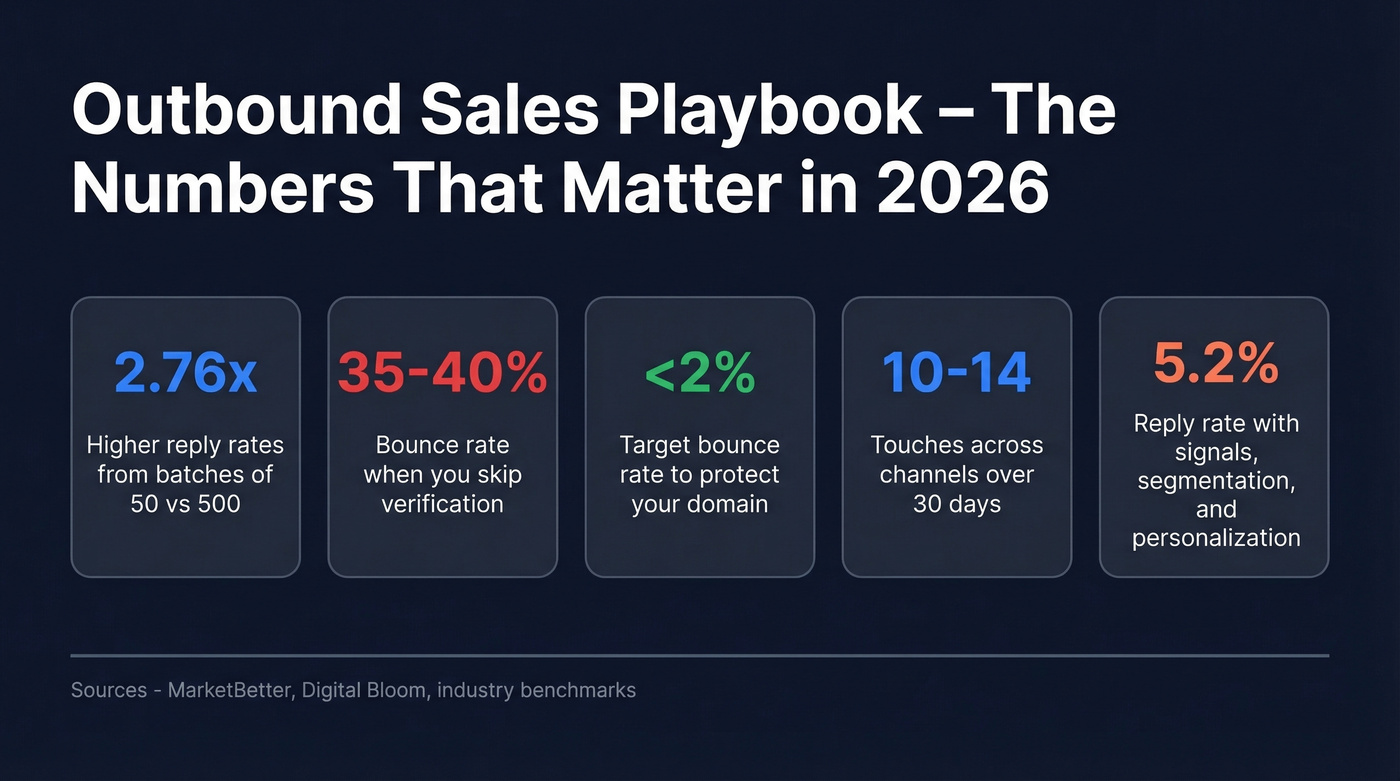
Outbound doesn't fail because of volume. It fails because of relevance, bad data, and single-channel laziness. One founder documented this exact shift: going from a 0.4% response rate blasting generic emails to 5.2% by adding signals, segmentation, and personalization. That's not a marginal improvement. That's a completely different business.
Every number below comes from real campaigns and published benchmarks.
Quick-Start Checklist
If you only read this far, do these five things:
- Audit your last 50 emails like a buyer. Not metrics - the actual words. Would you reply?
- Segment your ICP into cohorts of 50 contacts or fewer. Small batches produce 2.76x higher reply rates than blasting a list of 500.
- Verify every email before sending. A bounce rate above 2% tanks your domain reputation. (If you need a deeper breakdown of bounce codes and thresholds, see bounce rate.)
- Run 10-14 touch multi-channel sequences. Email alone caps your ceiling.
- Measure pipeline quality, not meetings booked. SDRs bonused on meetings drive volume, not revenue.
Here's the thing most playbooks skip: stop optimizing your copy and start optimizing your list. The best email in the world bounces off the wrong person at the wrong company. We'll come back to this.
Define Your ICP and Personas
ICP and persona aren't the same thing. Your ICP describes the company - firmographics, technographics, business situation. Your persona describes the buyer - their role, their pain, their decision authority. Conflating the two is how teams pitch the wrong person inside the right company.
Gartner's research shows the average B2B buying committee involves about five decision-makers. You need to know who they are before you write a single email.
| Segment | Company Size | Estimated Accounts |
|---|---|---|
| SMB | 0-200 employees | ~1,157 |
| Mid-market | 200-1,000 | ~426 |
| Enterprise | 1,000-5,000 | ~109 |
| Large enterprise | 5,000+ | ~33 |
Build your ICP across three buckets: firmographics (industry, revenue, headcount), technographics (what tools they use), and business situation (funding round, hiring velocity, leadership changes). Then layer personas on top. CTO and VP Engineering are different conversations even at the same company, and any solid B2B outbound playbook starts here - with segmentation - before touching copy or tools. (If you want a scoring rubric, use an ideal customer profile template.)
Build Your Data Foundation
Do this: Use at least two data sources and verify every contact before it hits a sequence. Teams that skip verification routinely see 35-40% bounce rates, which is a domain reputation death sentence. One team using verified data dropped from 35% bounces to under 4%. The threshold that matters is under 2%; anything above that and inbox providers start throttling you.
What kills you: Trusting a single database without verification. Sending to lists older than 30 days without a refresh. Assuming "verified" in one tool means deliverable today.
We've tested a lot of data providers, and Prospeo is where we'd start for most teams. It covers 300M+ professional profiles with 143M+ verified emails and 125M+ verified mobile numbers (30% pickup rate), all refreshed on a 7-day cycle - the industry average is six weeks. You can filter by buyer intent across 15,000 topics, technographics, job changes, and headcount growth to build lists that are actually timely. The free tier gives you 75 verified emails a month to test, and it plugs into Salesforce, HubSpot, Smartlead, Instantly, Lemlist, Clay, Zapier, and Make. (For more options, compare data enrichment services and sales prospecting databases.)

You just read that teams sending unverified emails see 35-40% bounce rates - a domain reputation death sentence. Prospeo's 5-step verification and 7-day data refresh cycle keep your bounce rate under 2%, so your outbound playbook actually reaches real inboxes. At $0.01 per email, bad data is no longer an excuse.
Stop burning domains. Start every sequence with verified contacts.
Set Up Email Infrastructure
Before you send a single cold email, get the technical foundation right:
- Authenticate your domains. SPF, DKIM, and DMARC are non-negotiable. Without all three, you're starting in the spam folder.
- Warm up properly. Start at 20-50 emails/day on new domains. Increase volume 20-30% weekly. Rushing this is the number one infrastructure mistake we see. (More on safe sending limits in email velocity.)
- Monitor your thresholds. Bounce rate under 2%. Complaint rate under 0.1%. If either spikes, stop and fix before scaling.
- Follow content rules. Keep emails under 150 words. No URL shorteners - they're spam triggers. Always include an unsubscribe option.
Most teams skip warmup because it feels slow. Then they wonder why their open rates crater in week three. The deliverability fundamentals aren't glamorous, but they're the difference between landing in the inbox and getting silently filtered. (If you want the full checklist, see our email deliverability guide.)
A quick note on DMARC: alignment and policy mistakes can quietly break deliverability even when SPF/DKIM look "set."
A multi-channel playbook only works when you have emails and direct dials for every prospect. Prospeo gives you 143M+ verified emails at 98% accuracy and 125M+ verified mobiles with a 30% pickup rate - plus buyer intent signals across 15,000 topics to time your outreach perfectly.
Fill every channel in your sequence with contacts that actually connect.
Design Your Multi-Channel Sequence
Email-only sequences cap your reply rate. Adding phone and social touches doubles it. The 30MPC framework gets this right: 10-14 touches over roughly 30 days across email, social, and phone.
| Day | Touch | Channel |
|---|---|---|
| 1 | Personalized email #1 | |
| 3 | Connection request | Social |
| 5 | Follow-up email #2 | |
| 7 | First call attempt | Phone |
| 14 | Email #3 (new theme) | |
| 22 | Email #4 (case study) | |
| 28 | Breakup email |
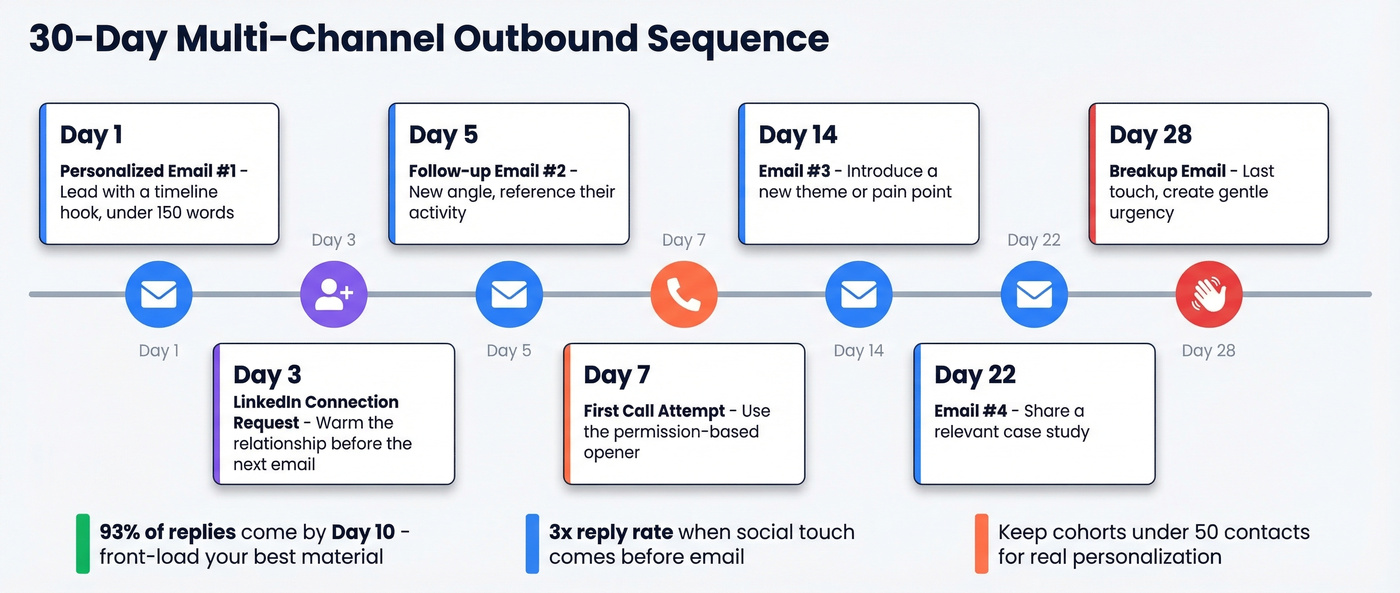
The MarketBetter case study backs this up: prospects who engaged on social first replied to follow-up emails at 3x the rate of cold-only contacts. Their playbook included 200 connection requests per day with a 48-hour handoff to email - that sequencing matters.
A 3-7-7 follow-up cadence captures 93% of replies by Day 10, so front-load your best material. Keep cohorts at 50 contacts or fewer so you can personalize meaningfully - this is where most teams get lazy, and it shows in the numbers. (If you want plug-and-play copy, use these sales follow-up templates.)
Write Cold Emails That Get Replies
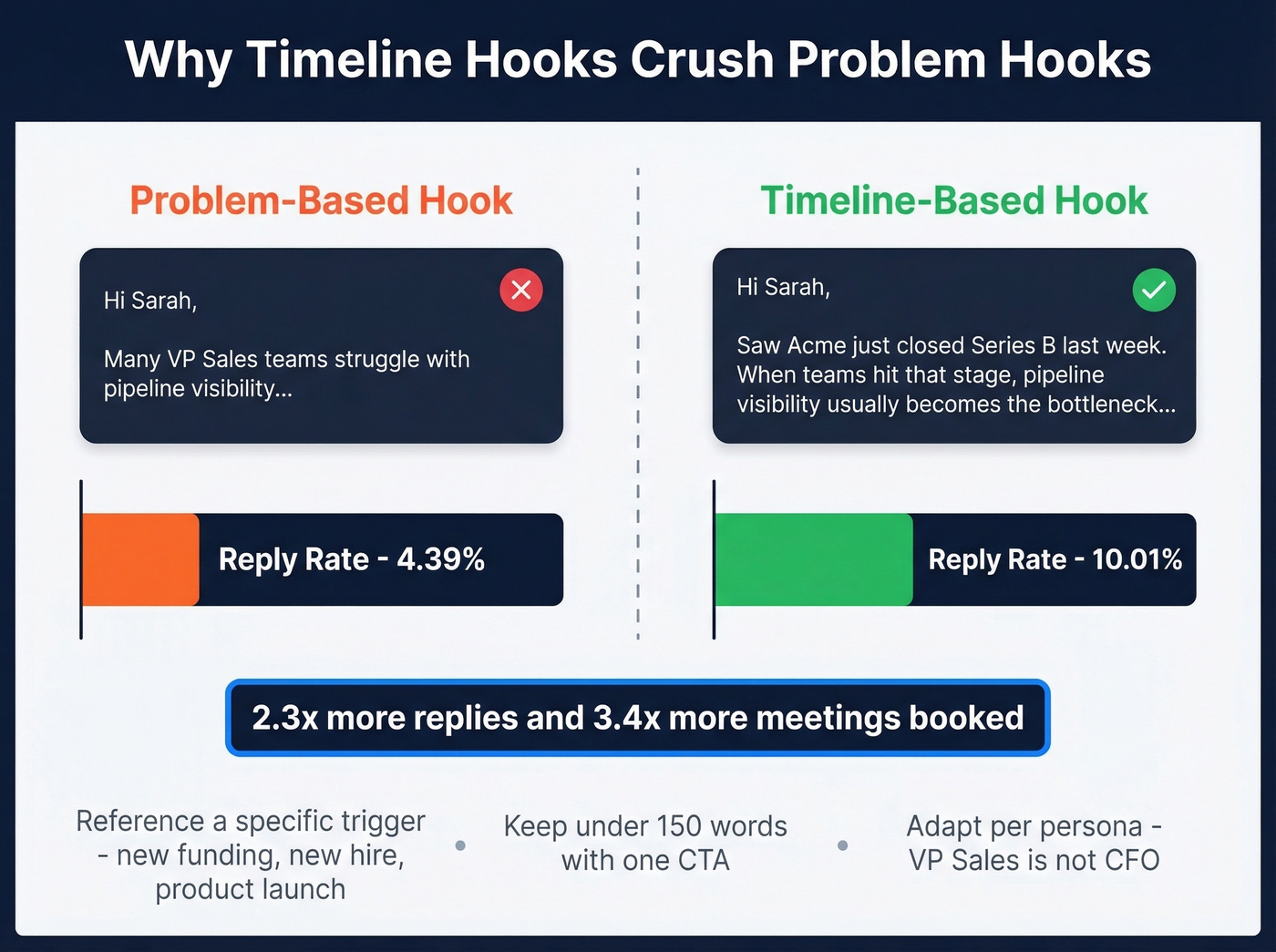
The average B2B cold email reply rate sits around 3-5.1%. Most teams hover at the low end because they lead with the wrong hook. Timeline-based hooks - referencing a specific event, trigger, or deadline relevant to the prospect - pull a 10.01% reply rate versus 4.39% for problem-based hooks. That's 2.3x the replies and 3.4x the meeting rate. In our experience, timeline hooks outperform problem-based openers across every campaign we've analyzed.
Subject: [Trigger event] + [company name]
Hi [First name],
Saw [company] just [specific trigger - new funding, new hire, product launch]. When teams hit that stage, [specific problem] usually becomes the bottleneck.
We helped [similar company] [specific result] in [timeframe].
Worth a 15-minute call this week?
Keep it under 150 words. One CTA. No "I hope this finds you well." (For more angles, steal from these email subject line examples.)
And remember - even this template fails if you're sending it to the wrong person. List quality first, copy second, always. Adapt the template per persona; what resonates with a VP of Sales won't land with a CFO. (If you're building sequences end-to-end, start with a B2B cold email sequence.)
Cold Calling: Scripts and Benchmarks
Cold calling works when you've got the right data and the right opener. The consensus on r/sales is blunt: "Cold calling isn't dead - you're just bad at it." The real issue is data quality and script preparation, not the channel itself.
Current benchmarks from SalesHive's 2026 analysis:
| Metric | Average | Top Teams |
|---|---|---|
| Connect rate | 3-10% | 7-10%+ |
| Dial-to-meeting | 2.3-2.5% | 5-8% |
| Dials/day | 40-50 | 50-70 |
| Best windows | 8-9am, 4-5pm | +40-70% lift |
Some aggressive teams push 200+ dials/day with parallel dialers, but 40-50 thoughtful dials consistently outperform spray-and-pray calling. Having verified mobile numbers matters here - direct dials with a 30% pickup rate mean your reps spend time talking, not navigating gatekeepers. (If you're rebuilding the motion, use a cold calling system.)
The opener that works: Intro, state the problem, permission ask, pause. Research on the "you're free to say no" technique shows that giving prospects explicit permission to refuse increased compliance by 400%.
"Hey [Name], this is [You] from [Company]. We work with [similar companies] who are dealing with [specific problem]. I might be totally off base - you're free to say no - but is that something on your radar?"
Handling Objections
Use the Validate-Isolate-Reframe method:
"Send me an email": "Happy to - want to make sure I send the right thing. Quick question: is [problem] something you're actively working on, or is this more of a timing issue?"
"Not a good time": "Totally fair. If I called back Thursday at 2, would that work better? I'll keep it to five minutes."
Build Your Outbound Tool Stack
| Category | Tool | Price Range |
|---|---|---|
| Data (#1) | Prospeo | Free tier; ~$0.01/email |
| Data | Apollo | Free tier; ~$49-119/user/mo |
| Data | Lusha | ~$36-59/user/mo |
| Sequencing | Lemlist | ~$40-100/user/mo |
| Sequencing | Instantly | ~$30-100/mo |
| Dialing | Orum | ~$100-200/user/mo |
| CRM | HubSpot | Free CRM; Sales Hub ~$20-100/user/mo |
| CRM | Salesforce | ~$25-165/user/mo |
| Enterprise | Outreach / Salesloft | ~$100+/user/mo |
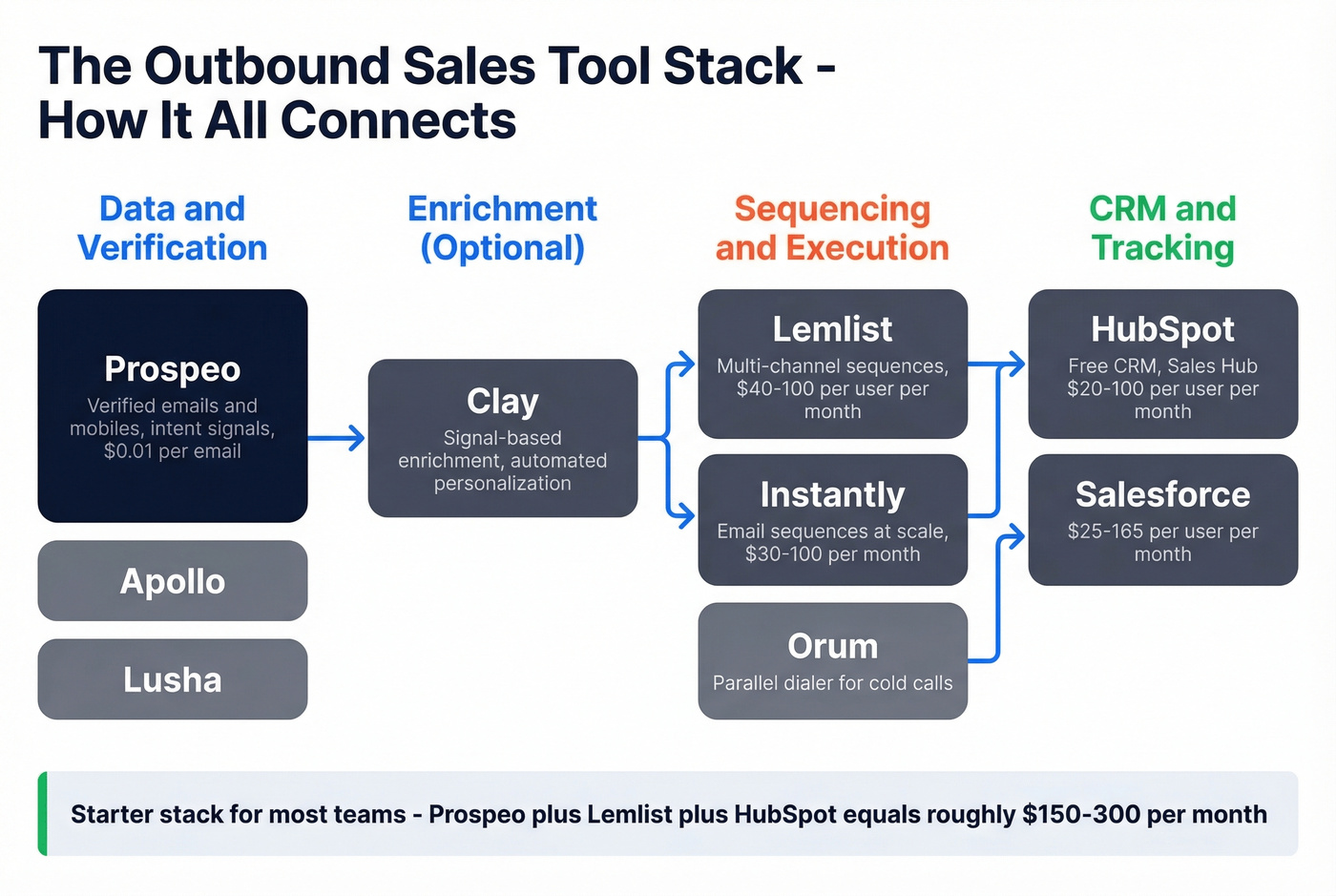
For most teams, pair a verified data provider with Lemlist or Instantly for sequencing and HubSpot for CRM, and you've got a full outbound stack for roughly $150-$300+/month depending on seats. Teams building an AI-assisted prospecting workflow can layer Clay on top for signal-based enrichment and automated personalization at scale - just make sure the underlying data is clean first. (If you're comparing categories, start with SDR tools.)
Skip enterprise tools like Outreach or Salesloft unless you've got 10+ reps. The per-seat costs add up fast, and smaller teams won't use half the features.
Outbound Sales Playbook FAQ
Is outbound dead in 2026?
No. Multi-channel outbound with clean data and relevant messaging produces 5-8% dial-to-meeting conversion and 5%+ email reply rates for top teams. What's dead is spray-and-pray - blasting generic templates to unverified lists. The channel works; the execution is what most teams get wrong.
How many cold emails should I send per day?
Start at 20-50 emails per day on warmed domains, then scale to 100-150 max per mailbox once bounce stays under 2% and complaints under 0.1%. Sending 500+ from a single domain is how you get blacklisted. Use multiple warmed domains for higher volume.
What's the minimum tool stack to start?
Three things: a verified data provider with a free tier, a sequencing tool like Lemlist or Instantly, and a CRM - HubSpot's free tier works. Add a dialer when you're ready to layer in phone. Total cost starts around $70-$150/month for a single rep.
What separates a playbook from a sales script?
An outbound sales playbook is the complete system - ICP definition, data sourcing, channel strategy, sequences, scripts, objection handling, and metrics. A script is just one component. Think of the playbook as the operating manual for your entire outbound motion, not a single conversation guide.