

Allegrow vs Hunter: Verification Tool or Deliverability Platform?
You're comparing a screwdriver to a smoke detector. Hunter.io finds and verifies email addresses. Allegrow monitors your sender reputation and prevents deliverability disasters before they happen. Most teams weighing Allegrow vs Hunter are really trying to figure out which problem is costing them more pipeline.
Here's the gap that matters: delivery means your email didn't bounce. Deliverability means it actually hit the inbox. Hunter lives in the first camp, Allegrow in the second. Litmus found that successful email programs are 22% more likely to actively monitor deliverability - and with baseline deliverability hovering around 85%, every percentage point of improvement counts. If you need a deeper framework, start with an email deliverability guide.
30-Second Verdict
Pick Hunter if you need a straightforward find-verify-send workflow on a credit model and your deliverability infrastructure is already solid.
Pick Allegrow if your real problem is enterprise deliverability risk - catch-all domains, corporate email gateways, bounce spikes tanking your sender reputation. (If you're actively trying to fix that, see how to improve sender reputation.)
Skip both if you need fresh, verified contact data and prospecting in one self-serve platform. Prospeo combines a 300M+ contact database with 98% email accuracy and a 7-day refresh cycle - no stitching required.
Feature Comparison at a Glance
| Category | Hunter.io | Allegrow |
|---|---|---|
| Core function | Email finder + verifier | Deliverability platform |
| Catch-all handling | Confidence scoring | Definitive valid/invalid |
| Built-in outreach | Yes (limited) | No |
| API access | Yes | Yes (custom, starting at ~$1,100/mo for 1M requests) |
| Warmup/monitoring | No | Yes |
| Free tier | 50 credits/mo | 14-day trial (1K contacts) |
| User rating | 4.4/5 (634 reviews) | 4.8/5 (60 reviews) |
Allegrow's 4.8 is exceptional, though it's built on a much smaller review base. Hunter's 634 reviews give you a more statistically reliable picture of day-to-day experience.
What Each Tool Actually Does
Hunter.io - Find, Verify, Send
Hunter's core loop is simple: search for a person or domain, find their email, verify it, and optionally send a cold sequence. The credit model charges 0.5 credits per verification, which keeps costs predictable until you're cleaning lists at scale.

The interface is genuinely excellent - users consistently praise it as one of the cleanest in the space. The free tier (50 credits/month) lets you test before committing, and connected email accounts scale from 1 to 20 across plans with recipient limits from 500 to 15,000 per sequence. For a team that just needs to find an email and confirm it's real, Hunter does the job without fuss.
The tradeoff: Hunter's database is smaller than tools like Apollo or ZoomInfo. Reddit practitioners consistently describe it as "better as a verification layer than a primary source." Credits burn fast if you're re-verifying lists before every campaign (which you should be), and cost at scale is a recurring frustration in community threads. There's no deliverability monitoring, warmup, or sender reputation tracking. If you're building a broader outbound stack, compare options in our SDR tools roundup.
Allegrow - Deliverability Risk Prevention
Allegrow isn't trying to be an email finder. It wraps verification inside a broader risk-prevention framework: inbox placement monitoring, domain health checks, warmup, authentication audits, and - critically - definitive catch-all resolution. (For warmup options, see unlimited email warmup tools.)
Where Hunter returns a confidence score on catch-all domains, Allegrow returns a binary valid/invalid result, even on corporate domains running Proofpoint or Mimecast. That's the headline differentiator.
We've found the Safety Net feature genuinely useful - it flags risky sends before they go out, which is the kind of proactive protection that justifies the price for teams sending at volume. The Scale Plus plan offers unlimited verifications, a relief if you're tired of counting credits. The gap: no native Salesforce or HubSpot integration yet, which is a real problem for RevOps teams running automated workflows. Users note the validation process can feel manual without those integrations. If you're evaluating enrichment + workflow fit, use this data enrichment services guide as a checklist.

Hunter tops its own benchmark at 70% accuracy. Allegrow solves catch-all but has no contact database. Prospeo gives you 300M+ profiles at 98% verified email accuracy - with 5-step verification, catch-all handling, spam-trap removal, and a 7-day refresh cycle. No stitching two tools together.
Stop patching gaps between finders and verifiers. Get both in one platform.
The Catch-All Problem
This is the real battleground between these tools, and it's where most verification conversations fall apart.
Hunter's own analysis of 2,572 email addresses found that 38% of email domains are configured as accept-all. Over a third of your prospect list. When they sent to 100 accept-all addresses versus 100 verified-valid addresses, the accept-all segment bounced at 27% compared to 1% for the valid control.

Most ESPs flag accounts when hard bounces exceed 2-3% or spam complaints pass 0.3% - thresholds that catch-all bounces can breach in a single campaign. If you're troubleshooting bounce spikes, this email bounce rate breakdown helps. Hunter's guidance is honest about the limitation: filter accept-all emails by confidence score (85% minimum, 90%+ during warmup) and keep them to 2-5% of any campaign.
Allegrow's pitch is that you shouldn't have to guess. If you're sending into enterprise accounts where catch-all configurations are common, that distinction matters more than any feature table.
Pricing Reality
| Plan | Hunter.io | Allegrow |
|---|---|---|
| Entry | Free (50 credits/mo) | 14-day trial (1K contacts) |
| Starter | $49/mo (2K credits) | $99/mo (5K contacts) |
| Mid-tier | $149/mo (10K credits) | Add-on: $8 per 1K contacts |
| Top tier | $299/mo (25K credits) | $1,340/mo unlimited (billed annually) |
| Annual discount | 30% off | Billed annually |
At 0.5 credits per verification, Hunter's Starter plan gets you 4,000 verifications per month at about $0.012 each. That's cheap. But credit models punish best practice - if you're re-verifying lists before every campaign, you're burning credits on the same contacts repeatedly.
Allegrow's unlimited tier at $1,340/month eliminates credit anxiety entirely. In our experience, teams running 50K+ verifications monthly often find the math favors Allegrow despite the higher sticker price. For smaller teams doing under 10K verifications a month, Hunter is the obvious budget pick.
Accuracy - What the Numbers Mean
Hunter ran a benchmark of 15 email verifiers using 3,000 real business emails tested through Clay. Hunter topped its own leaderboard at 70% overall accuracy, followed by Clearout (68.37%) and Kickbox (67.53%). If you're shopping beyond these two, see our list of Hunter alternatives.
They disclosed a potential methodology bias: the dataset used emails from recent Hunter activity, which may have given them a home-field advantage. They also noted accuracy drops on mid-market and enterprise domains with stricter mail server configurations - exactly the domains where Allegrow's catch-all resolution is designed to shine.
Let's be honest: 70% accuracy from the winner of a 15-tool benchmark should concern you. It means nearly a third of verifications across the industry are wrong. One Reddit user reported a known-working email flagged as invalid by Hunter and several other tools. Don't suppress entire segments based on one tool's output - cross-reference with a second source when the stakes are high. If you're cleaning lists, add a process for spam trap removal.
Consider a Combined Approach
If you need both prospecting data and reliable verification, stitching Hunter's finder to Allegrow's deliverability layer is one approach. A simpler one: use a platform that does both natively.
Prospeo covers 300M+ professional profiles with 143M+ verified emails, all running through a 5-step verification process that includes catch-all handling, spam-trap removal, and honeypot filtering. The 98% email accuracy rate and 7-day data refresh cycle mean you're working with contacts that are actually current - not stale records from weeks ago. It also integrates natively with Salesforce, HubSpot, Smartlead, Instantly, and Clay, filling the CRM gap that Allegrow currently leaves open. Self-serve, no contracts, and a free tier with 75 emails plus 100 Chrome extension credits per month. For more list-building workflows, see Clay list building.
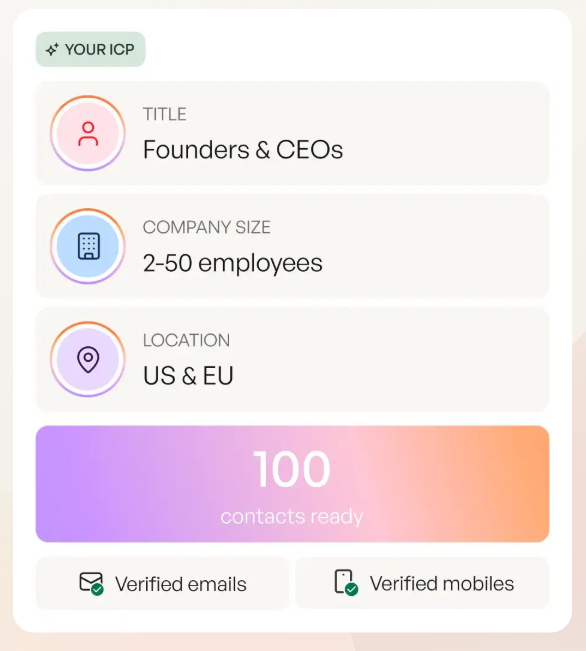
Counting credits for re-verification kills your budget. Prospeo's proprietary email infrastructure delivers verified contacts at ~$0.01 per email - 90% cheaper than legacy providers. 143M+ verified emails, 125M+ verified mobiles, and CRM enrichment with a 92% match rate.
Verified data at a penny per email. No credit anxiety, no annual contracts.
FAQ
What should I do with accept-all emails?
Filter by confidence score - 85% minimum for established domains, 90%+ during warmup. Keep accept-all addresses to 2-5% of any campaign. Cross-reference with a second verification tool when the stakes are high.
Is Hunter.io accurate enough for cold outbound?
Hunter scored 70% in its own 15-tool benchmark - solid but not definitive on enterprise domains. For high-stakes sends, pair it with a second verification source. The 0.5-credit cost makes double-checking affordable at lower volumes.
Does Allegrow replace an email finder?
No. Allegrow focuses on deliverability monitoring, warmup, and catch-all resolution - not prospecting. You still need a separate tool like Hunter or Prospeo to source email addresses before Allegrow can verify and protect your sends.
What if neither tool fits my workflow?
If you want email finding, verification, catch-all handling, and CRM enrichment in a single platform, look at tools that combine prospecting with built-in verification. That eliminates the integration overhead and reduces the chance of data going stale between systems.