

Ampliz vs Salesbot: Which Budget Prospecting Tool Is Worth It?
Most comparison articles pretend both tools are mature players. They're not. Ampliz has 7 G2 reviews. Salesbot has 3. If you're comparing these two, you're probably a small team hunting for affordable data - and the honest answer is that neither might be your best bet.
Let's be real about what we're working with here.
30-Second Verdict
- Ampliz if you need healthcare datasets or APAC-specific intelligence. Rating: 4.2/5 on 7 reviews.
- Salesbot if you want built-in prospecting plus outreach automation at $49/mo and you're comfortable being an early adopter. Rating: 4.8/5 on 3 reviews.
- Skip both if transparency around data freshness and verification matters to your team.
What Each Tool Actually Does
Ampliz is a B2B data platform with dedicated APAC intelligence and healthcare intelligence. Their APAC Intelligence positioning highlights 400M+ B2B contacts across 16 countries. Separately, Ampliz offers healthcare datasets covering physicians, hospitals, and provider networks - specialty coverage that general-purpose tools rarely emphasize.
The Ampliz SalesBuddy Chrome extension gives you contact and company insights plus a prospect fit score while you browse. Reviewers flag that data completeness drops for smaller and mid-sized companies, though, and the workflow for exporting and refining searches takes more clicks than it should.
Salesbot positions itself as AI-powered prospecting plus outbound sales automation. It combines a lead database with outreach features so you can build lists and run campaigns in one place, with automated follow-up on higher tiers. Here's what caught our eye: the pricing page says 650+ million verified leads, but a partner page lists 683 million. Salesbot also markets "Find 19x more leads" and "4x higher response rates" - bold numbers for a product with 3 reviews. G2 categorizes Salesbot under Conversational Marketing, not sales intelligence, which is an odd fit for a prospecting database.
Feature & Pricing Comparison
| Feature | Ampliz | Salesbot | Winner |
|---|---|---|---|
| Starting price | $50/mo ($480/yr saves 20%) | $49/mo Basic; $99/mo Professional | Salesbot |
| Database size | 400M+ contacts | 650-683M leads | Salesbot (on paper) |
| Email credits | 100 credits/month | 12,000/year verified email credits | Salesbot |
| Per-credit cost | ~$0.50 | ~$0.049 | Salesbot |
| Built-in outreach | No | Yes (Professional+) | Salesbot |
| Chrome extension | Yes (SalesBuddy) | No | Ampliz |
| Data refresh cadence | Not stated | Not stated | Tie |
| Free tier | 10 credits | Free trial | Ampliz (always-free credits) |
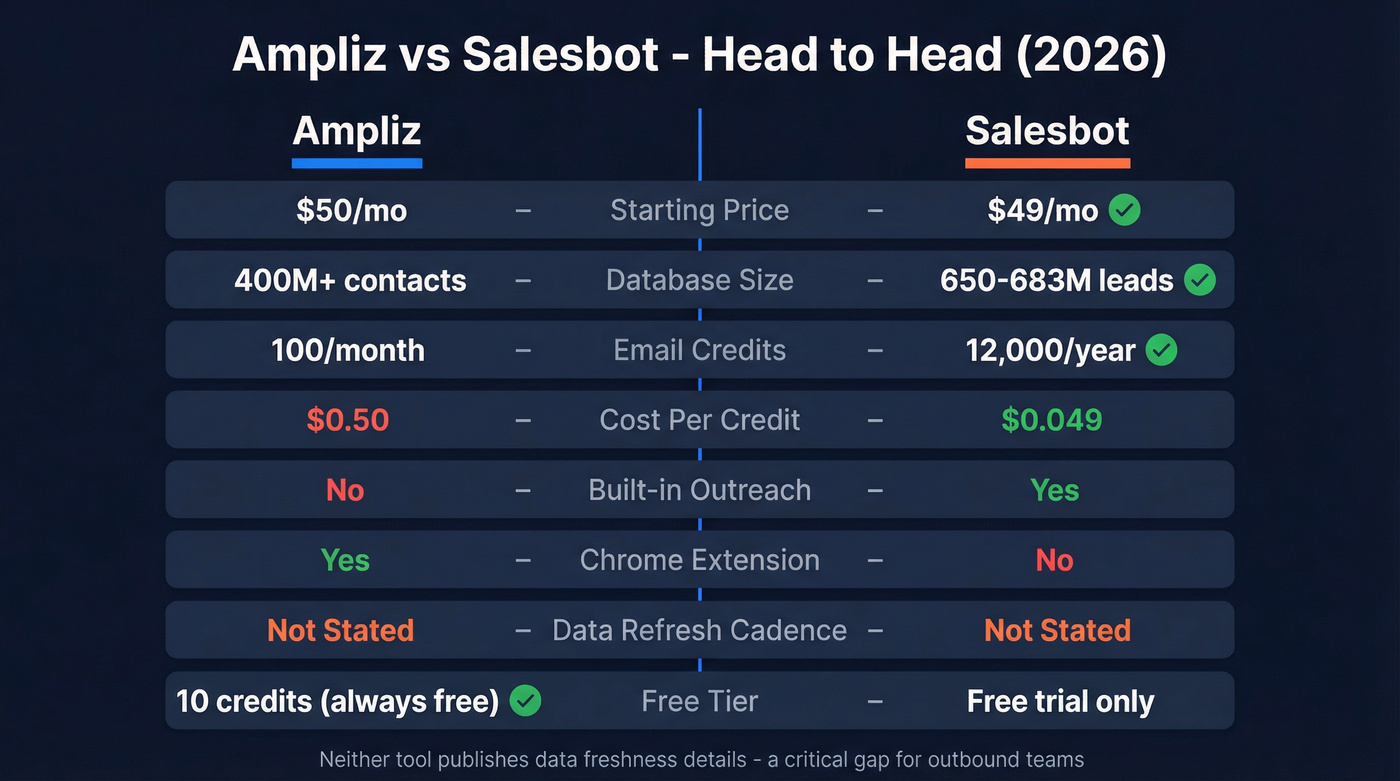
At $0.50 per credit, Ampliz is expensive on pure volume - you're paying for specialized coverage, not max credits. Salesbot's Professional tier at $99/month per user adds advanced filters, team collaboration, and automated follow-up, making it the more complete outbound stack on paper.

Both Ampliz and Salesbot skip the data freshness question entirely. Prospeo answers it: 7-day refresh cycles, 98% email accuracy, and $0.01 per email - up to 50x cheaper than Ampliz's $0.50/credit.
Stop paying budget prices for bounce-rate problems.
What Real Users Say
A G2 reviewer praises Ampliz for strong data quality in the DACH region specifically. Verified emails and direct dials reduce bounces, and filtering by industry, company size, and tech stack works well for targeted prospecting. On the flip side, data completeness drops for smaller companies, the UI feels dated, and exporting takes more clicks than it should.
If you're trying to fix bounces before they hit your domain, it's worth understanding email bounce rate basics and what actually causes them.
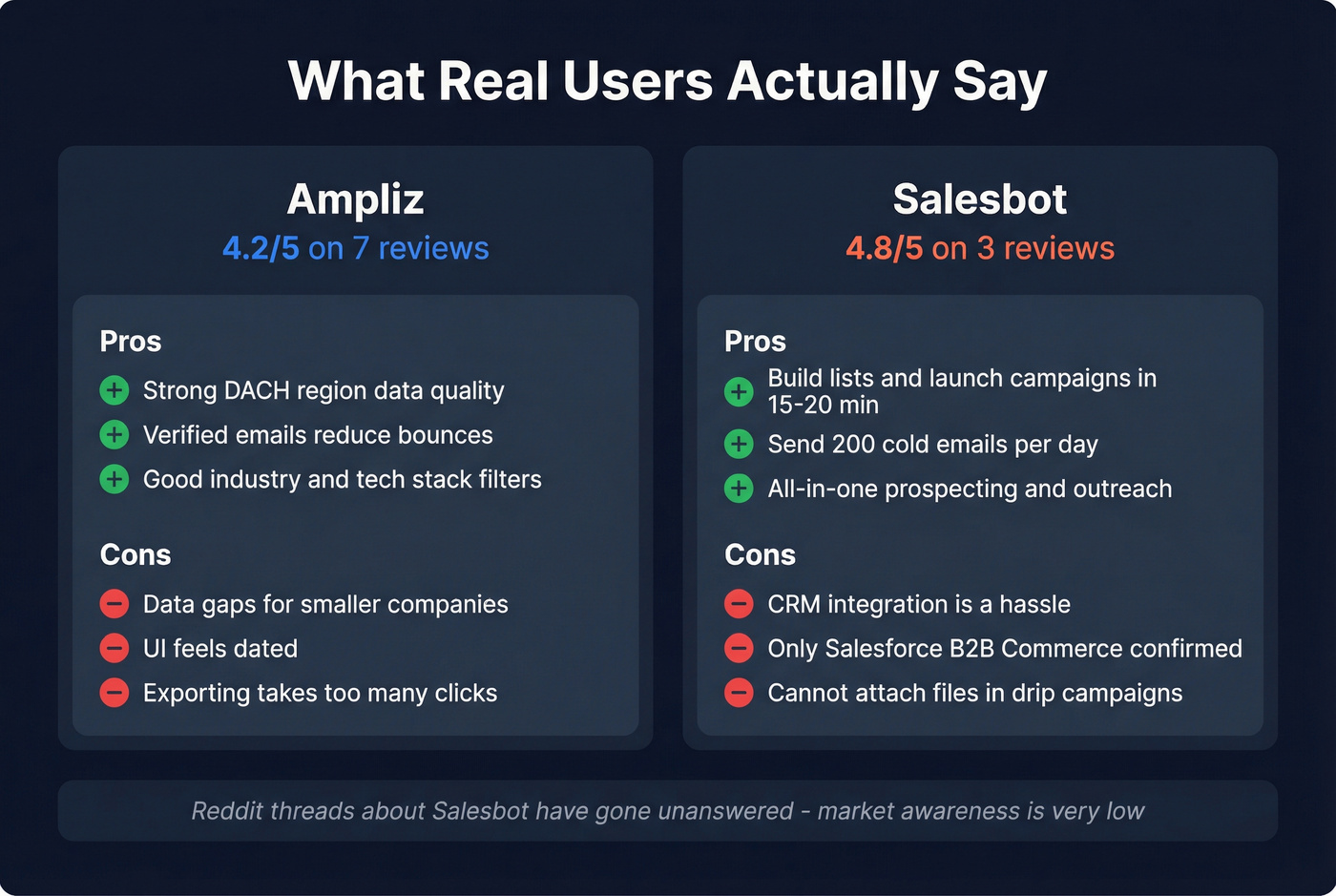
Salesbot users highlight speed. One reviewer described building target lists and launching drip campaigns in 15-20 minutes, sending 200 cold emails a day. The complaints are more concerning: CRM integration was "supposed to be seamless, but turned out to be a hassle," and Capterra lists only Salesforce B2B Commerce as a confirmed integration. You also can't attach files in drip campaigns.
Reddit threads asking about Salesbot have gone unanswered, which tells you something about market awareness. We've evaluated dozens of tools in this price range, and thin review histories are a coin flip - the product either breaks out or quietly disappears.
Here's the thing: if your average deal size is under $5k, you probably don't need either of these tools. A Chrome extension email finder and a $30/mo sending tool will outperform a bundled platform with unverified data every time. (If you want a broader shortlist, start with these free lead generation tools.)
When Neither Feels Right
Both tools leave a critical question unanswered: how fresh is the data? Neither Ampliz nor Salesbot publishes a clear data refresh cadence, and that's a problem when your outbound depends on accurate contact info. If you're building a process around this, a simple lead generation workflow helps you spot where data quality breaks.
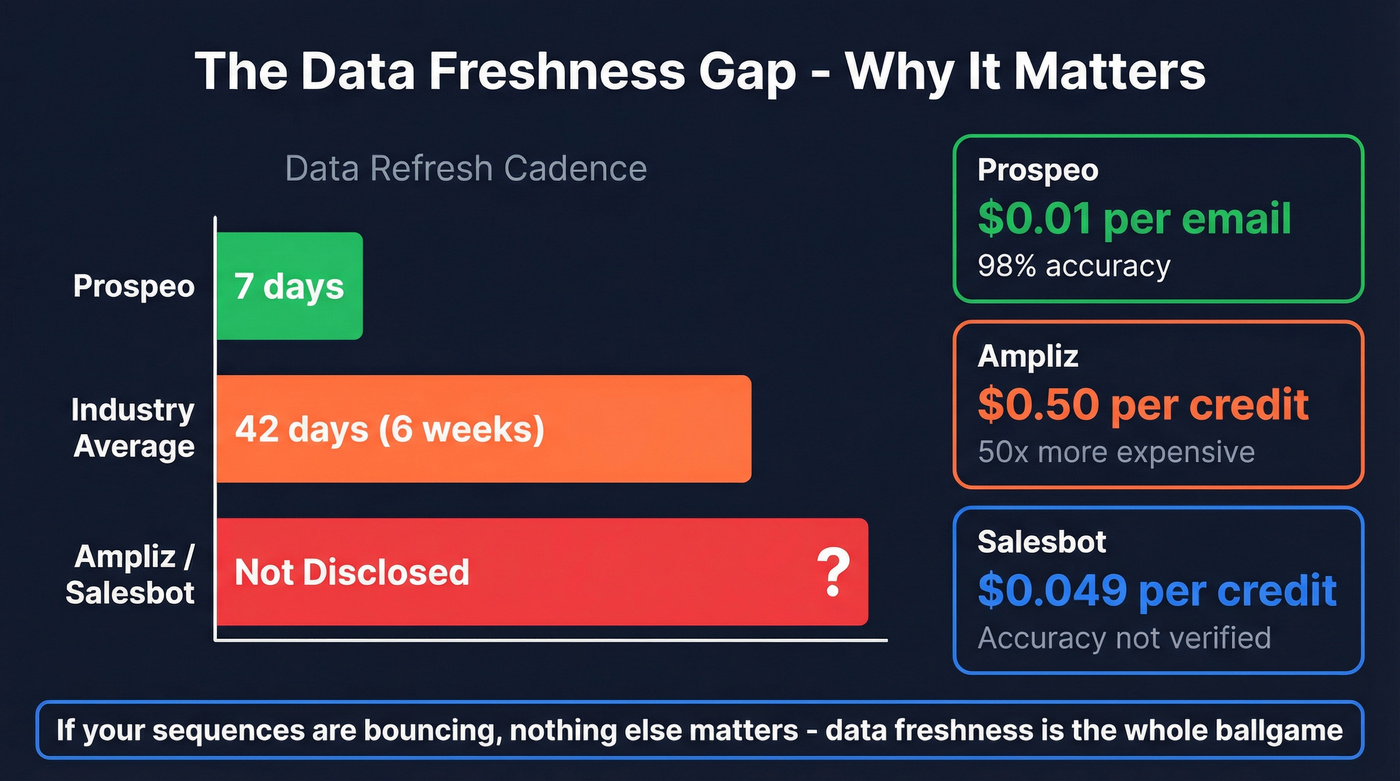
Prospeo refreshes every 7 days - compared to the 6-week industry average - and delivers 98% email accuracy across 300M+ profiles. With 125M+ verified mobile numbers (30% pickup rate) and 30+ search filters including buyer intent and technographics, it covers more ground than either budget option. The free tier gives you 75 emails and 100 Chrome extension credits monthly, enough to run a real test with no contracts and no sales calls. For teams whose bounce rates are killing domain reputation, that accuracy gap isn't a nice-to-have - it's the whole ballgame. (If deliverability is the real pain, use this email deliverability guide to diagnose the root cause.)

Salesbot bundles outreach with unverified data. Ampliz charges $0.50/credit with no stated refresh cadence. Prospeo gives you 300M+ profiles, 125M+ verified mobiles, and 30+ filters - with a free tier that outperforms both paid plans.
Test 98% accurate data before you commit a dollar.
Which Should You Pick?
You need healthcare datasets or APAC data. Go with Ampliz. It's the only one here with that kind of niche focus, and the DACH/APAC coverage is genuinely differentiated. Think of it as a vertical data tool, not a general-purpose one.
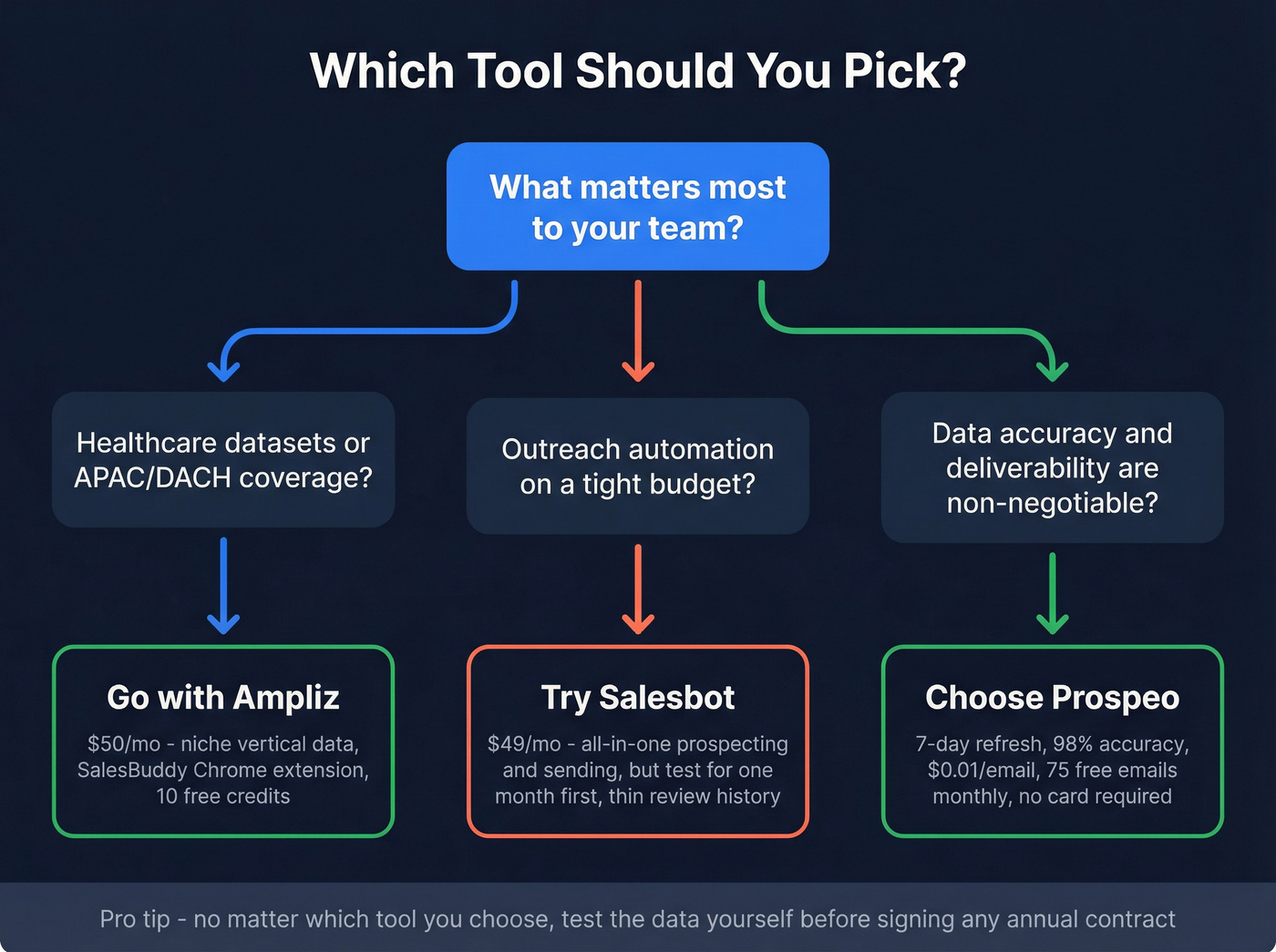
You want outreach automation on a tight budget. Salesbot at $49/mo. Go in with eyes open about the thin review history and CRM friction. We'd recommend starting with a single month before committing to anything longer.
Data accuracy and deliverability are non-negotiable. Prospeo's 7-day refresh cycle and per-email costs at roughly $0.01 make it 5-50x cheaper than either alternative. If your sequences are bouncing, nothing else matters. To keep volume safe while you test, follow an email velocity baseline.
Both Ampliz and Salesbot are early-stage tools with limited independent validation. That doesn't make them bad - it means you should test before committing beyond a month. The same advice applies if you're also evaluating more established options like Apollo or Lusha: verify the data yourself before signing an annual contract. If you want a bigger landscape view, compare against the best sales prospecting databases before you lock in.
FAQ
Is Salesbot's database really 650 million leads?
Their own site lists both 650M+ and 683M depending on the page, with no independent verification. Database size claims rarely reflect unique, verified records. Treat the number as directional, not literal.
Does Ampliz work outside APAC and healthcare?
Yes, but expect gaps. User reviews note that data completeness drops for smaller and mid-sized companies. Mid-market US prospecting will likely surface incomplete records compared to broader platforms like ZoomInfo or Prospeo.
Is Ampliz or Salesbot better for outbound?
Salesbot is better for general outbound because it bundles outreach automation with data at a lower per-credit cost ($0.049 vs $0.50). Ampliz wins only if your ICP falls squarely in healthcare or APAC markets.
What's a good free alternative to both?
Prospeo's free tier includes 75 verified emails and 100 Chrome extension credits monthly - no credit card required. That's more usable than Ampliz's 10 free credits and Salesbot's limited trial, and the data comes with 98% accuracy backed by 5-step verification.