

Anonymous Visitor Identification: What Actually Works in 2026
Ten thousand people visit your website this month. Forty-seven fill out a form. Your CEO asks, "Who were the other 9,953?" That question launched an entire category of anonymous visitor identification tools - and a mountain of inflated claims.
The gap between what vendors promise and what actually works starts with a number everyone gets wrong: the match rate.
The Short Version
Most visitor identification tools identify companies, not people. Realistic company-level match rates run 30-65%. Person-level? More like 5-20%. If a vendor quotes you 80%+, they're usually blending the two numbers together.
Company names alone don't fill your pipeline - you need to actually contact someone at those companies. That's where an enrichment layer turns identified visitors into revenue. The rest of this guide covers the mechanics, realistic benchmarks, the pricing landscape, and the workflow that ties it all together.
How Website Visitor Identification Works
Anonymous website visitor identification connects unknown traffic to a company or individual. Three distinct methods power it, each with different accuracy ceilings.
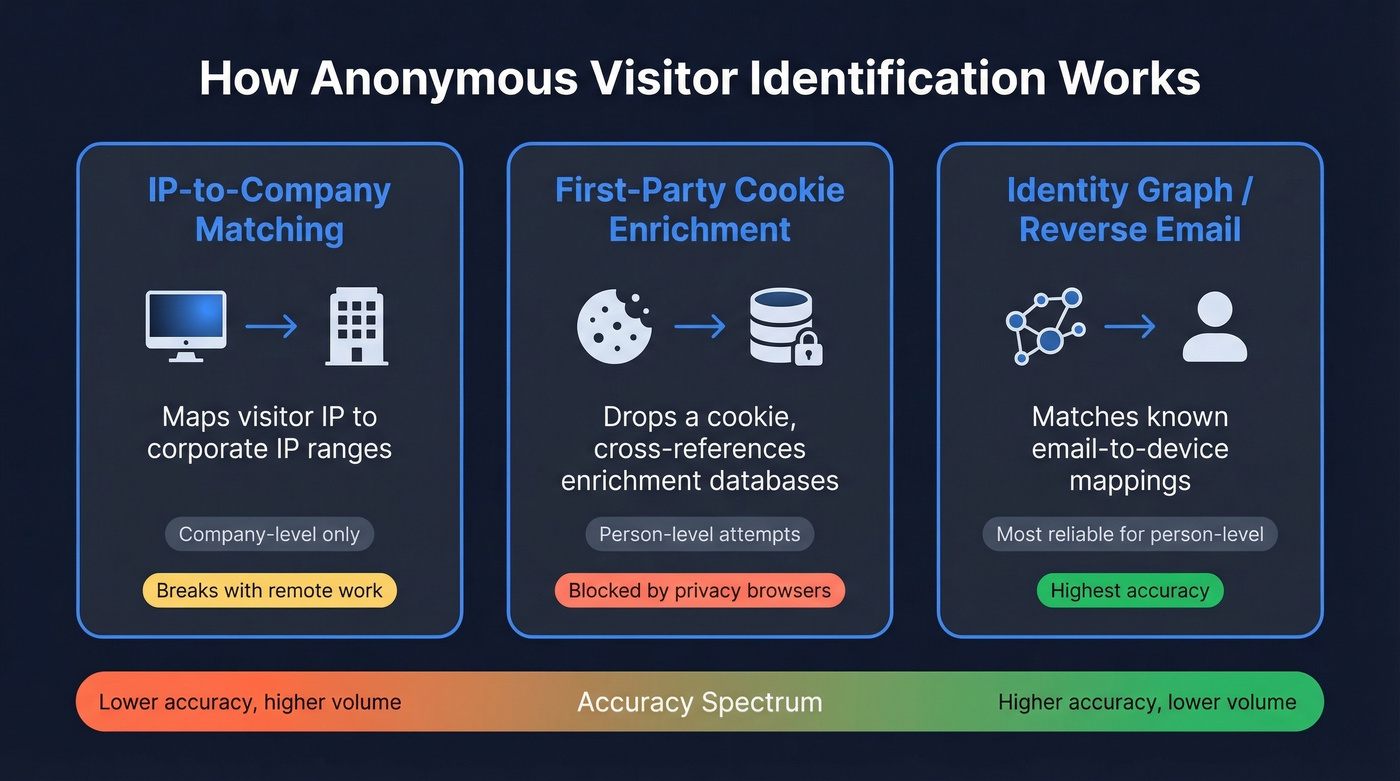
IP-to-company matching maps a visitor's IP address to a known corporate IP range. It only works at the company level, and it works best when people sit in offices. First-party cookie enrichment drops a cookie, then cross-references the browser fingerprint against enrichment databases to attempt person-level identification. Match rates vary wildly depending on the database. Identity graph / reverse email lookup is the most reliable for person-level data, but it's limited to users who've already been identified somewhere in the graph - opted-in contacts, form fills on other sites, or known email-to-device mappings.
Every vendor uses some combination of these three. The ones worth your money are transparent about which method drives their match rate.
Deterministic vs. Probabilistic Matching
This distinction matters more than most buyers realize, and vendors love to blur it.
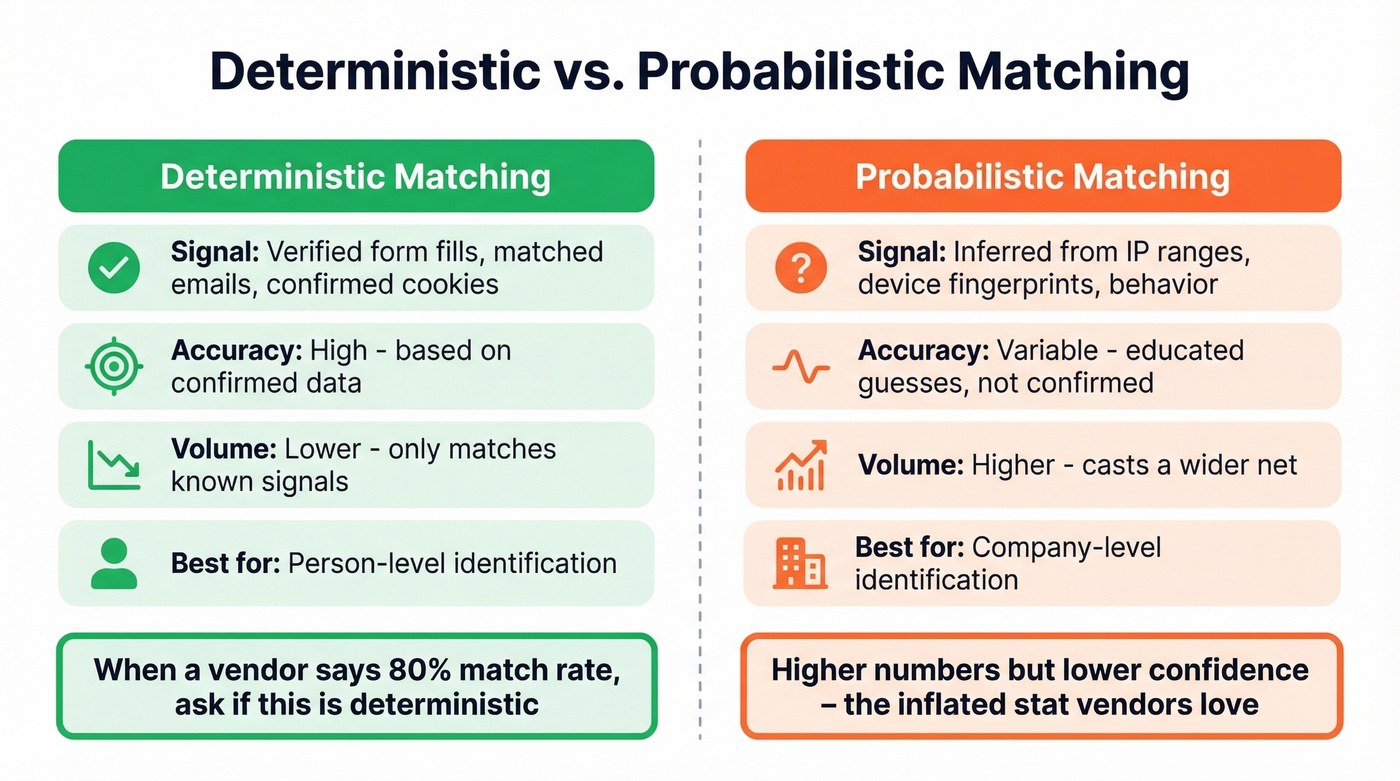
Deterministic matching ties a visitor to a known signal: a form fill, a matched email address, a verified cookie. It's accurate because it's based on confirmed data. Probabilistic matching is an educated guess - correlating IP ranges, device fingerprints, and behavioral patterns to infer identity. It produces higher "match rates," but accuracy drops hard.
| Deterministic | Probabilistic | |
|---|---|---|
| Signal | Verified (form, email) | Inferred (IP, device) |
| Accuracy | High | Variable |
| Volume | Lower | Higher |
| Best for | Person-level ID | Company-level ID |
When a vendor says "80% match rate," ask whether that's deterministic or probabilistic. If they can't answer clearly, that's your first red flag.
Realistic Match Rate Benchmarks
Here's the thing: the match rate you'll get depends almost entirely on who's visiting your site. Enterprise prospects browsing from corporate offices? You'll identify a lot of them. SMB founders working from a coffee shop on a VPN? Good luck.
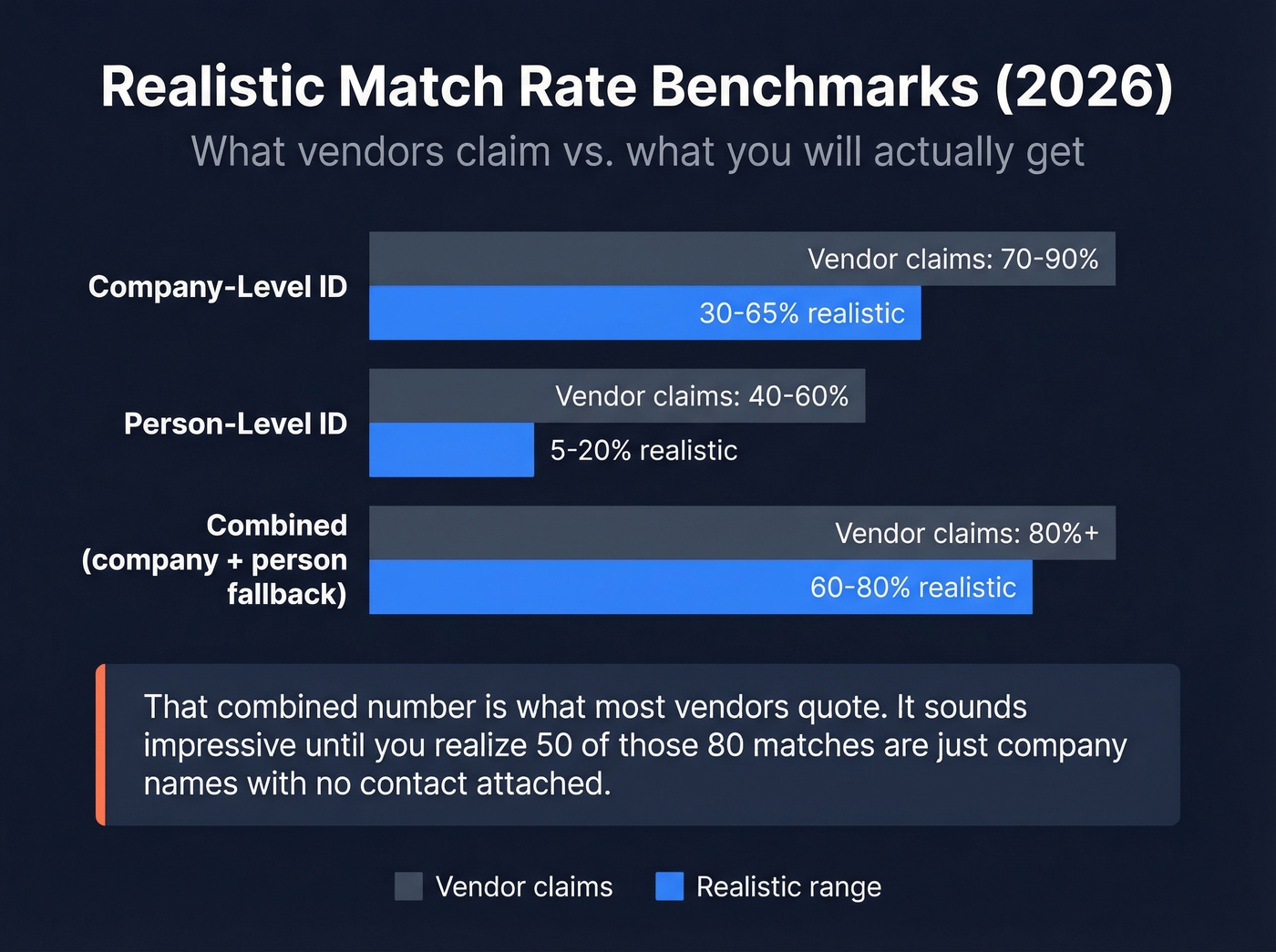
Realistic benchmarks for 2026:
- Company-level identification: 30-65%
- Person-level identification: 5-20%
- Combined (company + person fallback): 60-80%
That "combined" number is what most vendors quote. It sounds impressive until you realize 50 of those 80 matches are just company names with no contact attached.
Estimate Your Real Match Rate
No vendor will give you this, so we built it ourselves. Plug in your traffic mix and do the math before any demo.
| Traffic Type | % of Your Traffic | Company Match Rate | Your Weighted Rate |
|---|---|---|---|
| Enterprise office | ___% | 50-65% | ___ |
| SMB office | ___% | 30-45% | ___ |
| Enterprise remote | ___% | 10-20% | ___ |
| SMB remote | ___% | 5-10% | ___ |
| International | ___% | 15-30% | ___ |
If 60% of your traffic is remote SMB and international, your realistic company match rate is somewhere around 15-25% - not the 60% on the vendor's landing page. Run this exercise before any demo and you'll immediately know whether a sales rep is being straight with you.
Our take: Most B2B companies would get more pipeline from spending $200/mo on a visitor ID tool plus an enrichment platform than from spending $40k/yr on an enterprise ABM suite. The expensive tools are built for companies with 50+ person marketing teams. If that's not you, don't let a sales rep convince you otherwise.
Why Match Rates Dropped After 2020
Remote work broke the core assumption behind IP-based identification. Over 60% of knowledge workers are remote or hybrid now. Their traffic comes from residential ISPs - Comcast, AT&T, Vodafone - not corporate IP ranges. You can't reliably map a residential ISP IP to a specific employer.
VPNs compound the problem. Privacy-focused browsers like Brave and Firefox with enhanced tracking protection block the cookies these tools depend on. If your audience skews remote and tech-savvy, expect match rates at the lower end of every range above. This is the single biggest reason identifying anonymous visitors has gotten harder, not easier, over the past five years.

Visitor ID tools give you company names. Prospeo gives you the people. Enrich identified companies with 98%-accurate emails and verified direct dials from 300M+ profiles - so anonymous traffic becomes booked meetings, not just a logo list.
Turn identified visitors into contacted prospects for $0.01 per email.
Compliance: GDPR vs. US Privacy
The rules split cleanly by geography.
In the EU, you need explicit consent before setting tracking cookies - no identification until someone clicks "Accept." In the US, most states follow an opt-out model, meaning tracking begins by default. Under GDPR, IP addresses and cookie identifiers qualify as personal data. Person-level identification without consent is illegal in the EU, full stop. Company-level IP matching exists in a grayer area, but most compliance teams treat it as requiring consent too.
For US traffic, the patchwork of state privacy laws - CCPA/CPRA in California, CPA in Colorado, VCDPA in Virginia, and a growing list through 2026 - mostly requires honoring Global Privacy Control signals and offering opt-out mechanisms. Your cookie consent setup needs granular category choices, no pre-ticked boxes, a visible "Reject All" button, backend alignment so opted-out tags don't fire, and a persistent "Cookie Preferences" link.
Person-level visitor identification is heavily US-skewed. If your traffic is mostly European, you're limited to company-level identification with proper consent flows. If you need a deeper framework, see our guide to B2B compliance.
Tools and Pricing Compared
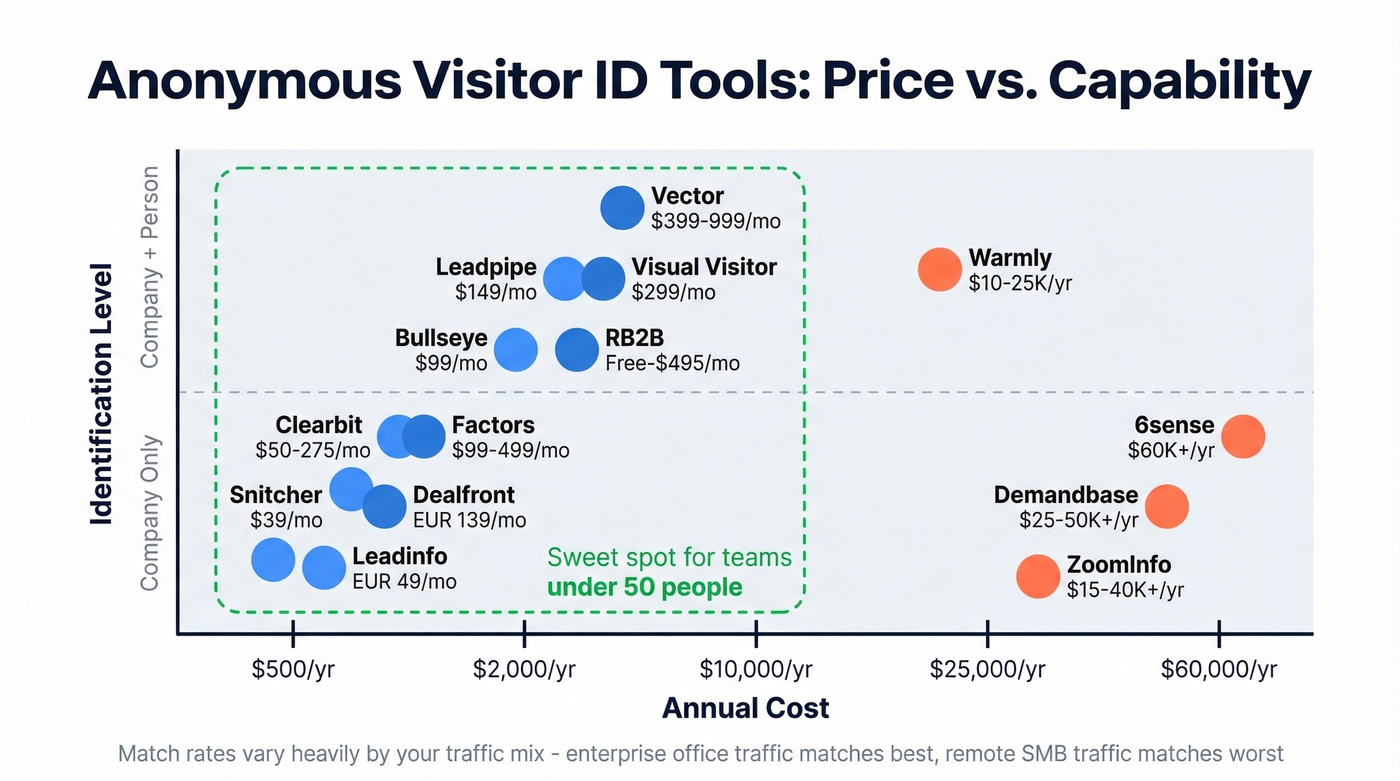
The market spans from $39/mo tools to $60k+/year enterprise platforms. Here's what you're looking at:
| Tool | Level | Match Rate | Starting Price | Best For |
|---|---|---|---|---|
| Snitcher | Company | 30-50% | $39/mo | Budget company ID |
| Leadinfo | Company | 30-50% | EUR 49-499/mo | EU-based teams |
| Bullseye | Both | Up to 40% | $99/mo | Simple Slack alerts |
| Factors | Company | Up to 64% | $99-$499/mo | Mid-market company ID |
| Dealfront | Company | 35-55% | Free / EUR 139/mo | European IP data |
| Leadpipe | Both | 30-40% | $149/mo | Budget person-level |
| Clearbit | Company | 15-20% | ~$50-$275/mo | Usage-based enrichment |
| Visual Visitor | Both | 5-10% | $299/mo | Email-focused ID |
| Vector | Both | 10-25% | $399-$999/mo | Multi-channel attribution |
| RB2B | Person | 5-15% | Free / $495/mo | Free person-level trial |
| Warmly | Both | 10-20% | $10k-$25k/yr | Waterfall data stacking |
| 6sense | Company | Varies | Free / $60k+ | Enterprise ABM |
| Demandbase | Company | Varies | $25k-$50k+/yr | Enterprise ABM |
| ZoomInfo | Both | Varies | $15k-$40k+/yr | All-in-one GTM |
For teams under $100/mo, Snitcher and Leadinfo get you company names fast with minimal setup. Mid-market teams should look at Factors or Bullseye for better match rates and CRM integrations. Enterprise ABM buyers are choosing between 6sense, Demandbase, and ZoomInfo - expect $25k+ and a long sales cycle.
Skip the enterprise suite if you don't have the team to run it. We've seen too many companies buy 6sense or Demandbase, use 10% of the features, and churn after year one. If you're evaluating that route, benchmark against account based marketing tools and current account based marketing benchmarks.
If you want to test person-level identification without commitment, RB2B's free tier is the obvious starting point. Warmly deserves a closer look if you're frustrated with single-source match rates - it runs a waterfall across 20+ data providers, which is why pricing starts at $10k/yr. Factors' "up to 64%" is their best-case scenario with clean office traffic; expect around 30-45% on a typical B2B site with mixed traffic.
What to Do After You Unmask Visitors
You've identified 200 companies on your pricing page this week. Now what?
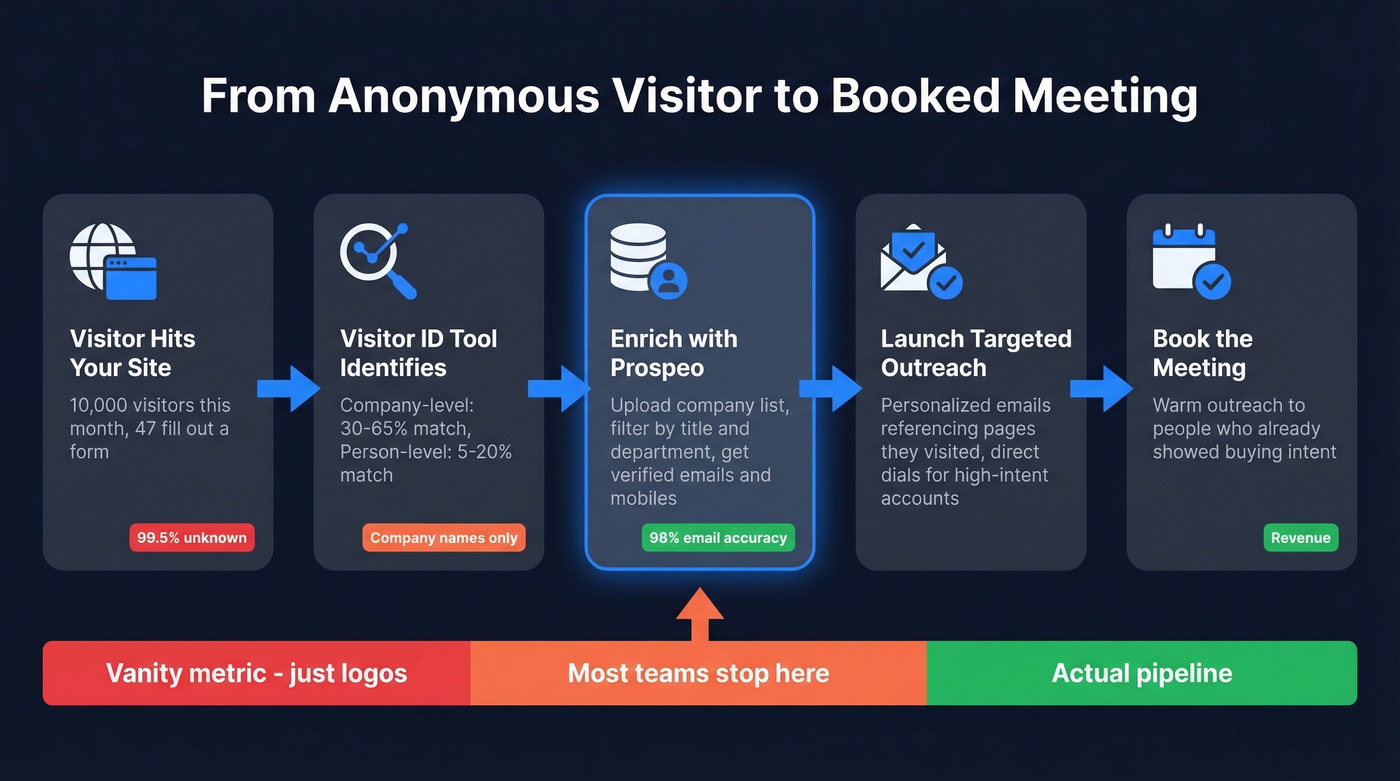
You need the VP of Marketing's verified email. You have company names, maybe industry and size data, but no way to actually reach anyone. This is the gap that kills the ROI of visitor identification - and most vendors conveniently ignore it.
The workflow that works: identify the company, find the right decision-maker, verify their email, launch outreach. Identification without enrichment is a vanity metric. It's like watching someone browse your store and leave - you know they were interested, but you have no way to follow up.
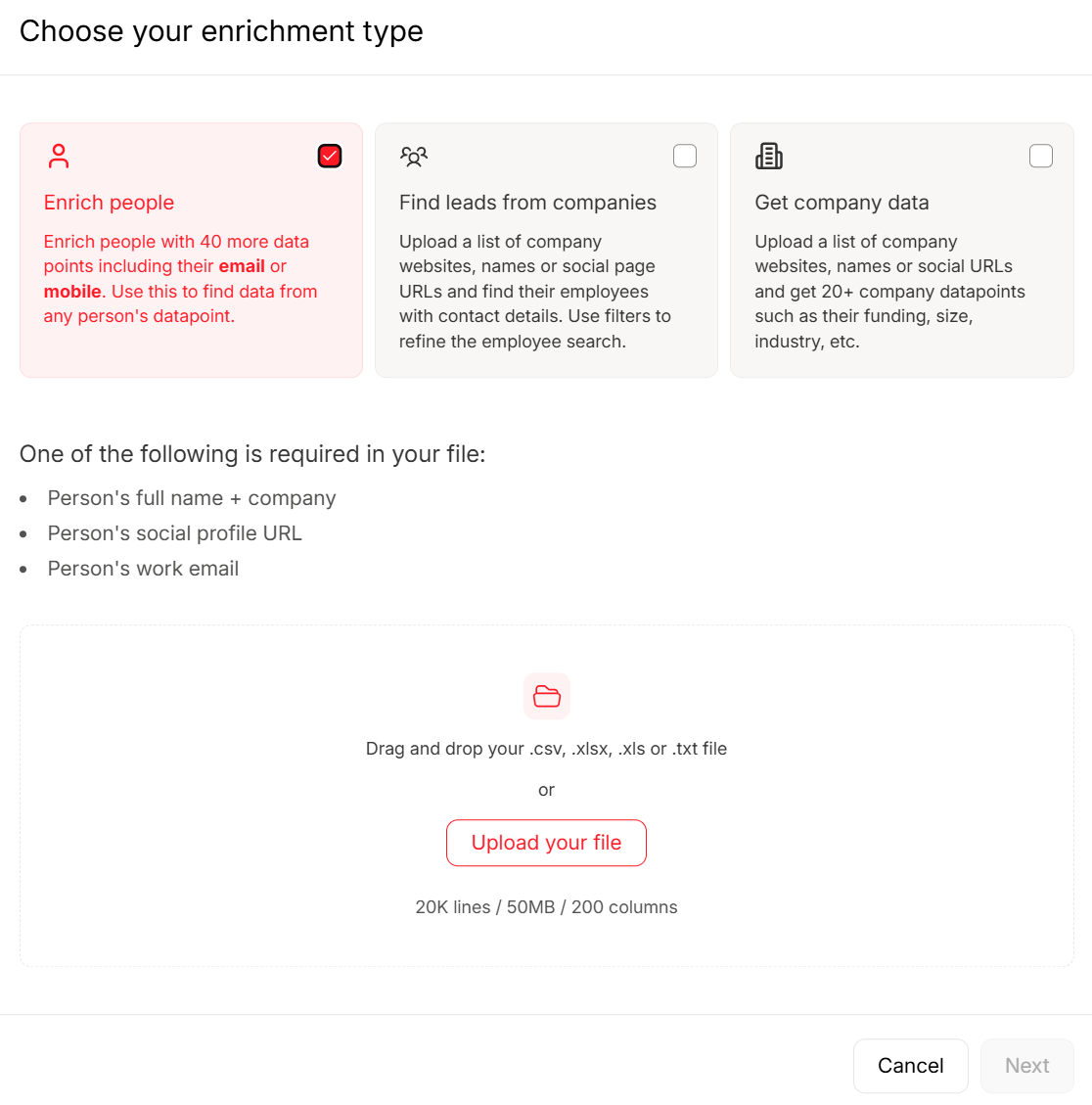
This is where Prospeo fits naturally. Upload your list of identified companies, filter by job title and department, and export verified contacts with 50+ data points each. The database covers 300M+ professional profiles with 98% email accuracy and 125M+ verified mobile numbers. A 7-day data refresh cycle means you're not emailing someone who changed jobs two months ago - a problem we've seen tank outreach campaigns built on stale enrichment data. The free tier gives you 75 emails and 100 Chrome extension credits per month, no contract required.
Spending $40K/yr on an ABM suite that gives you company names and no contacts? Prospeo's enrichment API returns 50+ data points per contact at a 92% match rate - plug it into any visitor ID tool and get verified emails and mobiles for the people who actually visited.
Skip the logo list. Reach the buyer directly with verified contact data.
Mistakes That Kill Your Match Rate
Even the best identification tool underperforms with sloppy implementation. We've debugged enough setups to know the usual suspects:
- Bot and spider traffic not filtered. If a big chunk of your "visitors" are bots, your match rate is artificially deflated and you're wasting credits on non-human traffic.
- Ad blockers preventing scripts from firing. If your identification pixel is blocked, those visitors don't exist in your data.
- Cookie deletion inflating "new" visitors. Safari's Intelligent Tracking Prevention and Firefox's Enhanced Tracking Protection delete first-party cookies aggressively. Returning visitors look new every time.
- Subdomain misconfiguration. If blog.yoursite.com and app.yoursite.com aren't configured as a single tracking domain, you're splitting sessions and losing context.
- Tag conflicts. Multiple tracking scripts competing for the same cookie namespace corrupt data silently. Audit your tag manager regularly.
If you're routing identified accounts into your CRM, make sure your RevOps tech stack and CRM automation rules don't create duplicates or bad handoffs.
How to Spot Vendor BS
Let's be honest - this category has a credibility problem.
Any vendor quoting 90%+ match rates without specifying traffic type and identification level is misleading you. "Up to" language without context is meaningless - "up to 80%" could mean 80% on enterprise office traffic and 8% on everything else. If a vendor doesn't mention GDPR limitations unprompted, they're either ignorant or hoping you won't ask.
Watch for the demo-vs-reality gap too. Vendors run demos on curated enterprise traffic that looks nothing like your actual visitor mix. Insist on a trial with your own data.
The r/SaaS community has been running its own tests. One practitioner installed RB2B and Visual Visitor side-by-side - RB2B identified fewer visitors but the matches checked out against form submissions, while Visual Visitor "wasn't accurate" after 24 hours of testing. The thread also raised a question worth asking every vendor: are multiple tools just reselling the same underlying data sources? In many cases, yes. Stacking two tools that share the same IP database gives you duplicates, not incremental matches.
Ask for a trial on your own traffic before signing anything. Match rates on demo data mean nothing.
FAQ
Is anonymous visitor identification legal?
Yes, with geographic caveats. In the US, most states follow an opt-out model - tracking begins by default, and users can request removal. Under GDPR, you need explicit consent before setting tracking cookies, and person-level identification without consent is illegal. Company-level IP matching still requires a legal basis under GDPR.
Does it work outside the US?
International traffic typically returns 15-30% company-level match rates depending on your audience mix. Person-level identification is heavily US-skewed because GDPR requires explicit consent for non-essential tracking, and most tools lack EU-first consent flows that support individual matching.
What person-level match rates should I expect?
Realistic person-level match rates sit between 5-20% for US traffic using deterministic signals like matched emails. Probabilistic methods inflate numbers but sacrifice accuracy. Always verify claims with a trial on your own traffic - vendor demos use curated data that won't reflect your results.
How do I find the right contact after identifying a company?
Upload your list of identified companies to a B2B enrichment platform like Prospeo. Filter by job title and department, then export verified emails. The free tier gives you 75 emails per month with no credit card required.
The Bottom Line
Match rates are lower than vendors claim, remote work isn't reversing, and company names without contacts don't generate pipeline. The teams getting real ROI from anonymous visitor identification treat it as step one of a two-step process: identify the company, then enrich with verified contacts you can actually reach.
These tools give you a starting point, not a finished lead list. Skip the $40k enterprise suite unless you have the team to use it. Start with a budget identification tool, pair it with an enrichment layer, and measure pipeline - not match rate. If you need more ways to turn traffic into revenue, pull from these pipeline generation ideas.