

7 APISCRAPY Alternatives That Cost Less and Do More
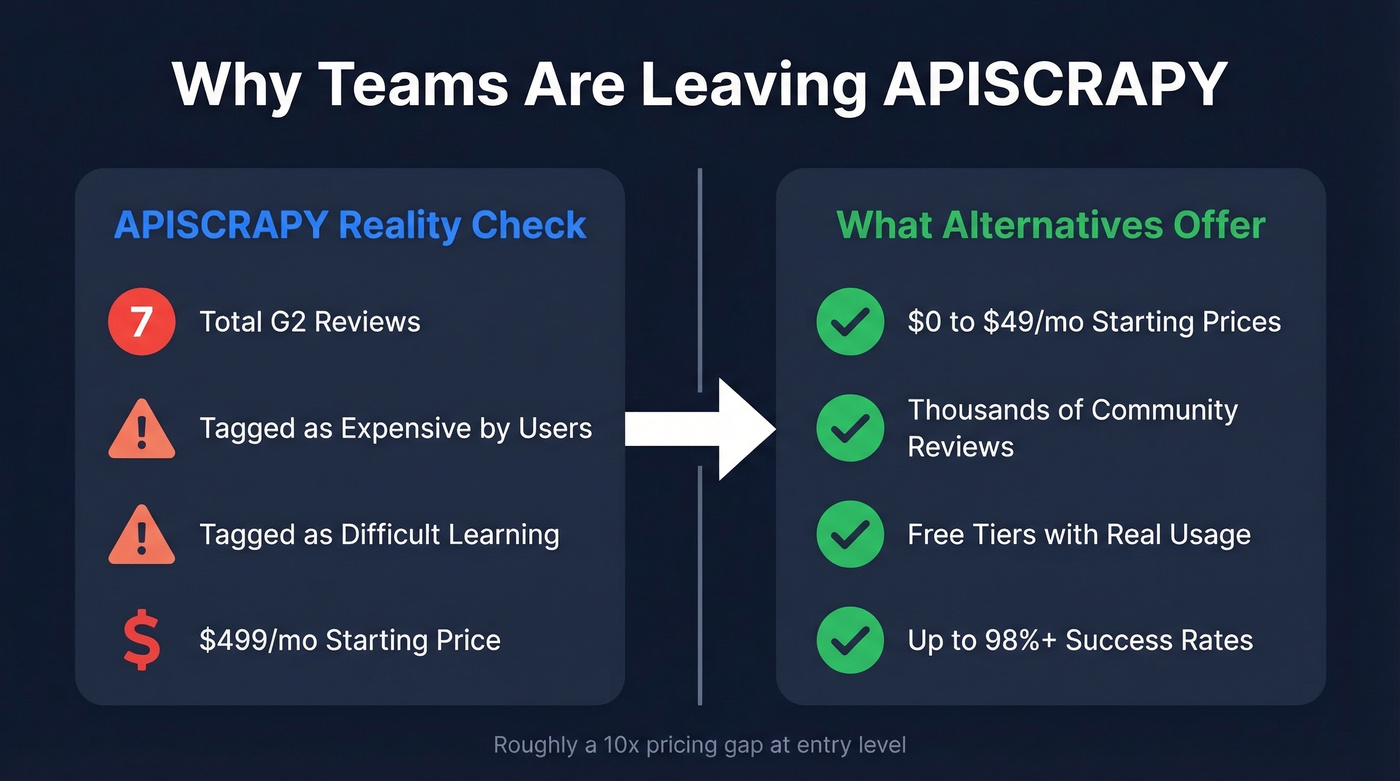
$499 a month for a scraping tool with 7 reviews on G2 - all from Asia - and user-generated tags that literally say "Expensive" and "Difficult Learning." That's a tough sell when the best APISCRAPY alternatives start at $0 and outperform it on every benchmark we've tracked. Here are 7 tools that prove it.
Why People Leave APISCRAPY
APISCRAPY's G2 profile tells the story quickly. A 4.0/5 rating from just 7 reviews, cons tags reading "Expensive" and "Difficult Learning," and a Start-Ups tier priced at $499/mo for up to 10 websites. Mid-Level jumps to $1,299/mo. The alternatives below start between $0 and $49/mo - roughly a 10x gap at entry level, with larger communities and better documentation to match.
Switching scraping providers isn't unusual. The consensus on r/webscraping is that tools degrade over time or hike prices without warning. The market has matured enough that you don't need to overpay for what's become commodity infrastructure - especially if you're doing web scraping lead generation and need the downstream workflow to be efficient.
Our Picks (TL;DR)
- Best overall flexibility: Apify - starts free, 2,000+ pre-built scrapers, pay-as-you-go scaling
- Best for enterprise scale: Bright Data - 98.44% benchmark success rate, 150M+ proxy IPs across 195 countries
- Best for turning scraped data into contacts: Prospeo - 98% email accuracy, 300M+ profiles, free tier included

You're comparing scraping tools that start at $499/mo. Prospeo starts at $0 and solves the part those tools can't - turning scraped company lists into verified contacts. 300M+ profiles, 98% email accuracy, 7-day refresh cycle.
Stop paying enterprise prices for commodity scraping. Enrich for free.
The 7 Best APISCRAPY Alternatives
1. Apify
Apify is the obvious first stop for most teams. Its Actor marketplace has 2,000+ pre-built Actors covering everything from Amazon product pages to Google Maps listings, and you can deploy custom scrapers in minutes using JavaScript or Python.
The free tier includes $5 in usage credits. Starter runs $29/mo, Scale $199/mo, and Business $999/mo - each tier includes matching usage credits, so you're paying for compute at roughly $0.20-$0.30 per compute unit.
Fair warning: credits expire each billing cycle and don't roll over. Store Actors can tack on per-result fees or monthly rentals. Residential proxies cost $7-$8/GB extra. We've seen teams budget $29/mo and land at $150+ once proxy costs and Actor fees stack up, so model your actual usage before picking a tier. If you're deciding between no-code and marketplace-based scraping, see Apify vs Octoparse.

2. Bright Data
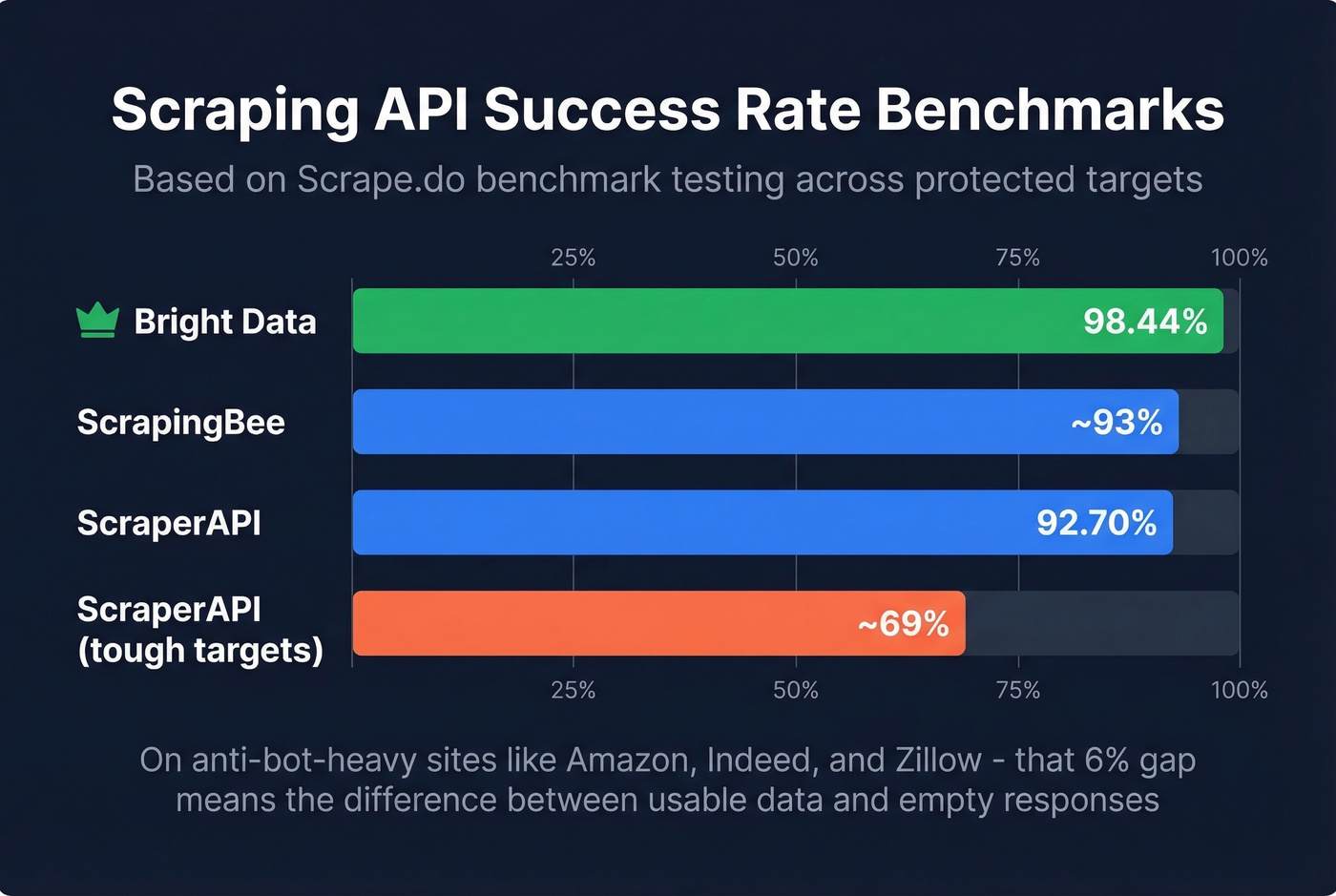
Bright Data is the common enterprise pick, and the benchmarks back it up. Its proxy network spans 150M+ IPs across 195 countries, and benchmark testing puts its success rate at 98.44% - top of the table by a meaningful margin. ScraperAPI and ScrapingBee cluster around 92-93%. On anti-bot-heavy targets like Amazon, Indeed, and Zillow, that gap is the difference between usable data and empty responses.
The Web Scraper API starts at $4/CPM for standard domains, $8/CPM for premium. Residential proxies run $8/GB pay-as-you-go, with volume pricing that can drop to around $4/GB. Serious usage starts around ~$499/mo, but free trial credits let you validate before committing. Solo developers scraping a few hundred pages a week won't need this much firepower, and the pricing complexity across separate proxy, scraper, and SERP products can feel overwhelming for small jobs. Skip this one if your monthly scraping budget is under $200.
3. Prospeo
Here's what most scraping articles miss: raw scraped data doesn't close deals. You need verified contact information attached to it. After you scrape company lists, job boards, or directories with any tool on this list, Prospeo matches that data against 300M+ professional profiles and returns verified emails (98% accuracy) and direct dials from 125M+ verified mobile numbers. Data refreshes every 7 days - the industry average is 6 weeks, which means most enrichment tools are feeding you stale contacts that bounce. If you're comparing providers, start with our breakdown of data enrichment services.
The Chrome extension (40,000+ users) works as a lightweight alternative to building scraping infrastructure for contact data - grab verified emails and phones from any website in one click. Pricing starts free (75 emails + 100 Chrome extension credits/mo), with paid plans running about $0.01 per email. No contracts, no sales calls required. For adjacent workflows, you may also want free lead generation tools and a dedicated SDR tool.
4. Octoparse
Octoparse is the best option if nobody on your team writes code. Its point-and-click interface handles infinite scroll, pagination, and anti-bot patterns without a single line of scripting. The free plan gives you 10 tasks and 50,000 exports/mo - enough to validate the tool on real targets before spending anything. Paid plans start at $89/mo, with residential proxies at $3/GB and CAPTCHA solving at $1-$1.50 per thousand.
5. Firecrawl
Firecrawl is the pick for AI and ML teams. It outputs clean markdown and structured data designed to feed directly into RAG pipelines and LLM workflows - no post-processing gymnastics required. If you're building AI products that consume web data, Firecrawl saves hours of parsing work you'd otherwise build yourself. It's still early-stage compared to Apify or Bright Data, but the GitHub repo has gained serious traction and the developer community is active.
6. ScraperAPI
ScraperAPI handles proxy rotation and CAPTCHA solving automatically starting at $49/mo. Benchmark results vary significantly by source - Scrape.do puts it at 92.70%, while Proxyway benchmarks show as low as 69% on tough targets. Practitioners on r/webscraping report 500 errors where competitors succeed. Test your specific URLs before committing.
7. Browse AI
Browse AI takes a record-and-replay approach - you click through a site, it builds a "robot" that repeats the workflow, with self-healing layout detection when sites change structure. Starting at $49/mo, it's best for monitoring tasks like price tracking or inventory checks rather than large-scale extraction. If you need to scrape millions of pages, look elsewhere.
Pricing at a Glance
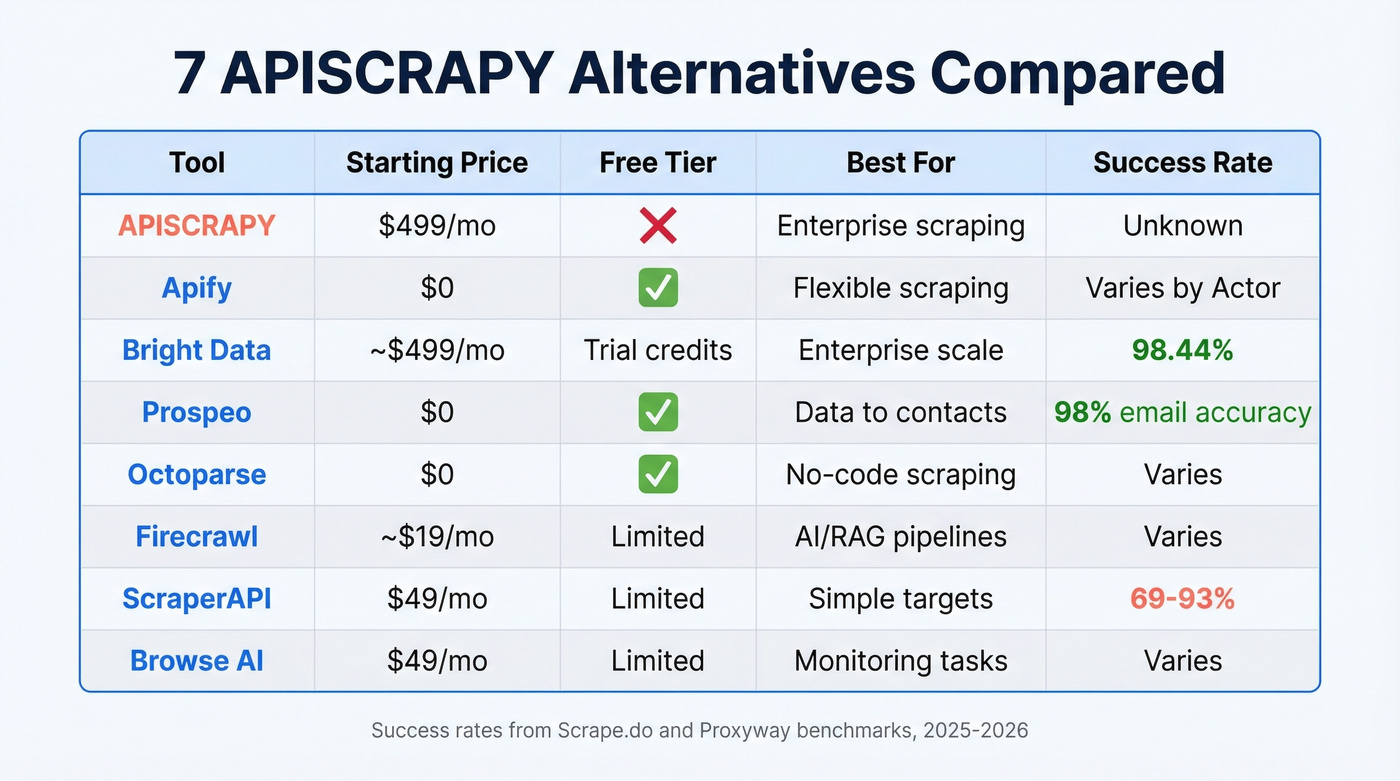
| Tool | Starting Price | Pricing Model | Free Tier | Best For |
|---|---|---|---|---|
| APISCRAPY | $499/mo | Per-website | No (free trial) | Enterprise scraping |
| Apify | $0 (free) | Credits + CU | Yes ($5 credit) | Flexible scraping |
| Bright Data | ~$499/mo | Per-GB / CPM | Trial credits | Enterprise scale |
| Prospeo | $0 (free) | Per-email credit | Yes (75 emails) | Scraped data to contacts |
| Octoparse | $0 (free) | Tiered + add-ons | Yes (10 tasks) | No-code scraping |
| Firecrawl | ~$19/mo | Usage-based | Limited | AI/RAG pipelines |
| ScraperAPI | $49/mo | Per-request | Limited | Simple targets |
| Browse AI | $49/mo | Per-robot | Limited | Monitoring tasks |
How to Choose the Right Tool
Let's be honest: if your average deal size is under $5k, you almost certainly don't need anything beyond Apify's free tier and a contact enrichment tool. The scraping layer is the easy part. It's what you do with the data that determines ROI - especially once you start lead enrichment and tracking lead generation metrics.
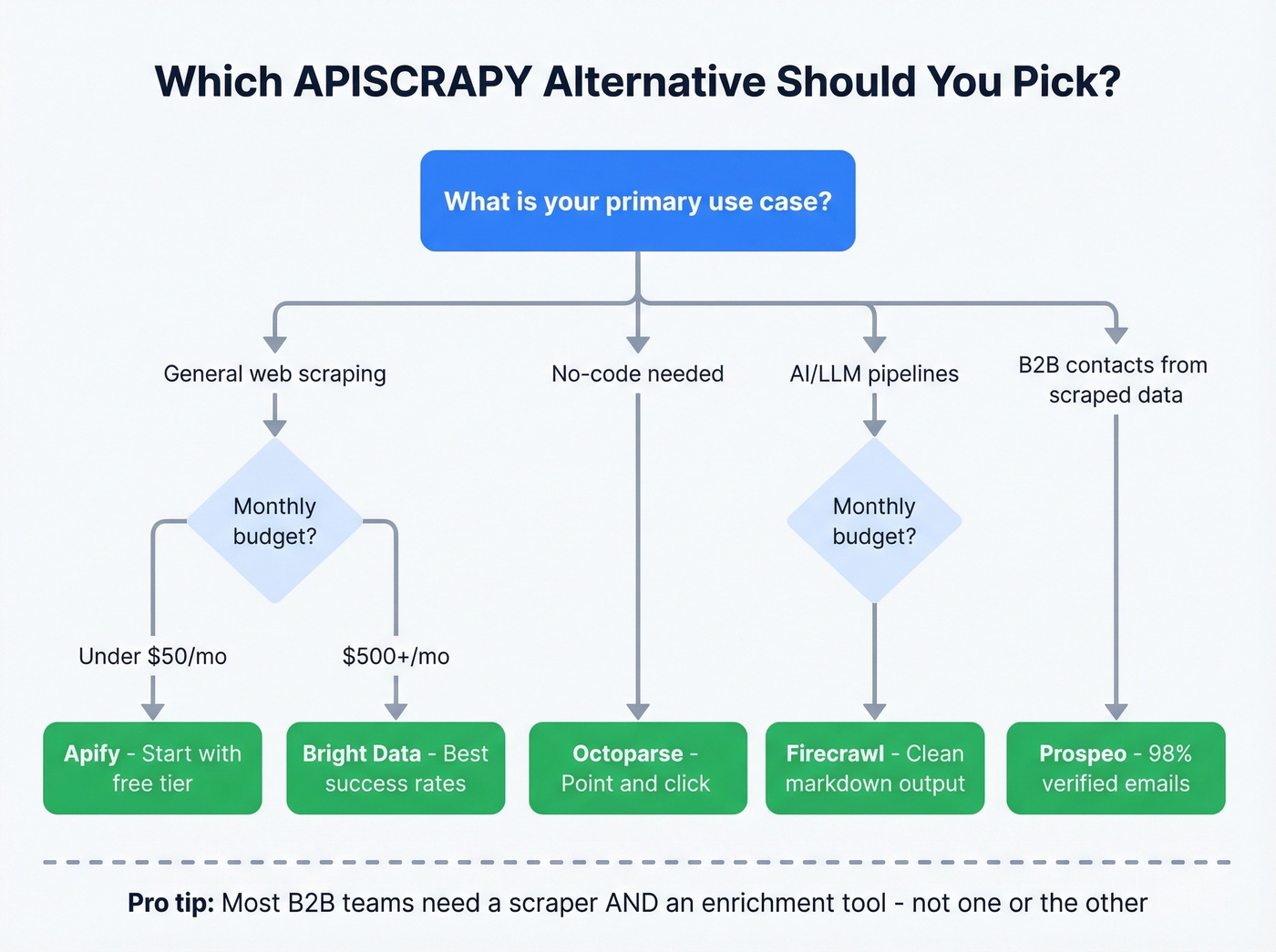
Solo developers and side projects should start with Apify. The Actor marketplace covers most common targets, and you won't pay until you scale past the free credits. Growth teams that need reliability at volume should go with Bright Data - our testing confirms its success rate advantage is real on protected sites, and the proxy network depth matters when you're hitting the same domains thousands of times per day.
For AI and ML teams building LLM pipelines, default to Firecrawl. Clean markdown output saves you from building a parsing layer from scratch. B2B outreach teams get the most value by pairing any scraper here with a contact enrichment step - scraping gets you company names and URLs, but verified emails and direct dials are what actually book meetings. Among these APISCRAPY alternatives, the right choice depends entirely on what happens after the data lands in your spreadsheet - then it becomes a lead generation workflow and outreach execution problem.
Every tool on this list extracts raw data. None of them verify the contacts behind it. Prospeo matches scraped results against 125M+ verified mobiles and 143M+ emails - refreshed weekly, not every 6 weeks like the rest of the market.
Scraped data doesn't close deals. Verified contacts do.
FAQ
Is APISCRAPY Worth $499/Month?
For most teams, no. With only 7 G2 reviews and user-flagged issues around cost and learning curve, APISCRAPY is hard to justify when Apify starts free and Bright Data delivers a 98.44% benchmark success rate at similar spend. Test free tiers first before committing to a $499+ monthly bill.
What's the Most Reliable Scraping API in 2026?
Bright Data leads with a 98.44% success rate across challenging targets like Amazon and Indeed. ScraperAPI and ScrapingBee cluster around 92-93%. Reliability varies by target site, so run your specific URLs through free trials before locking in annual spend.
How Do You Turn Scraped Data into Verified Contacts?
Pair your scraping tool with a B2B enrichment platform that matches scraped company or people data against verified profiles and returns emails and direct dials. The key is using a provider with fresh data - stale contacts burn your sender reputation fast, and most providers only refresh every 4-6 weeks.
What's the Best Free Web Scraping Tool?
Apify's free tier ($5 in monthly credits) covers most small projects with its 2,000+ pre-built Actors. Octoparse offers a free plan with 10 tasks and 50,000 exports/month for no-code users. Both outperform APISCRAPY's free trial in flexibility and community support.