

Apollo Prospecting: What Works, What Breaks, and How to Fix It
You exported 5,000 contacts from Apollo last month, loaded them into your sequencer, and watched your bounce rate climb past 28%. Your domain reputation is tanking, replies have dried up, and your ops lead is asking what happened. This is the most common Apollo prospecting failure mode - and it's entirely fixable.
What You Need (Quick Version)
What Apollo Actually Is (and Isn't)
Apollo's database covers 275M contacts across 73M companies, with 65+ search filters that let you slice by industry, headcount, technographics, funding stage, and more. It's genuinely powerful for finding the right people.
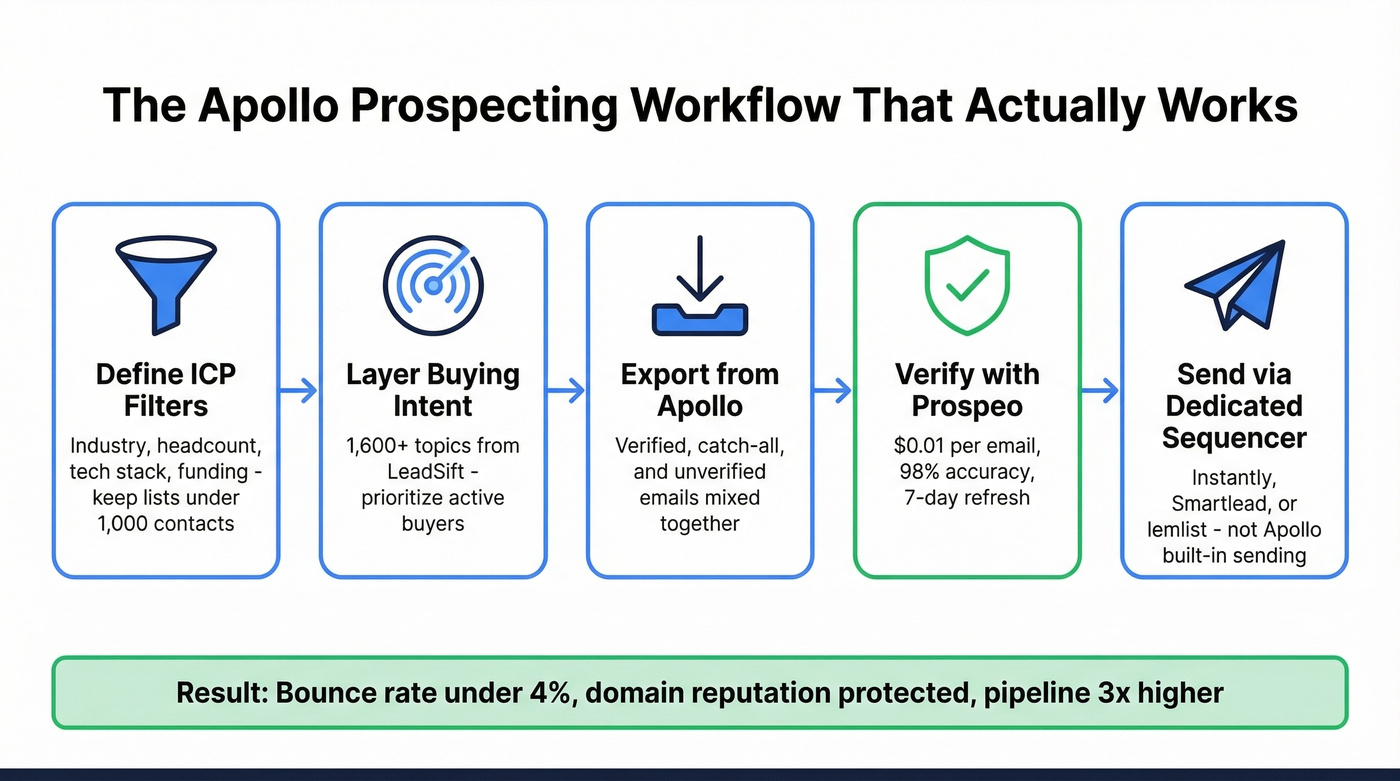
The problem starts when teams try to use Apollo for everything - data sourcing, email verification, sequencing, dialing, and analytics - all in one platform. The consensus on r/sales nails it: Apollo is a "jack of all trades, master of none." The database is the product. The sequencer, dialer, and email infrastructure are bolted-on features that don't compete with dedicated tools. Once you internalize that distinction, Apollo becomes dramatically more useful.
Apollo Pricing in 2026
Apollo runs a hybrid model: a fixed monthly seat fee plus usage-based credits consumed on searches, exports, and enrichment actions. Credits don't roll over. They expire each billing cycle, which catches teams off guard.
| Plan | Price | Key Limits |
|---|---|---|
| Free | $0 | 50 AI credits, up to 2 sequences, 1 intent topic |
| Basic | $49/mo/user | Unlimited sequences, basic filters |
| Professional | $79/mo/user | A/B testing, auto-dialer, advanced analytics |
| Organization | $119/mo/user | Min. 3 seats, multichannel automation, full API |
A comparable ZoomInfo setup runs $15,000-$40,000/year depending on seats and modules. Apollo at $49-$119/mo per user is a fraction of that cost, which is exactly why it's become the default for SMB and mid-market outbound teams. One thing to watch: the credit system has gone through migrations, so legacy accounts and new accounts sometimes have different credit economics, and more actions consume credits than you'd expect.
How to Generate Leads with Apollo
Define Your ICP with Filters
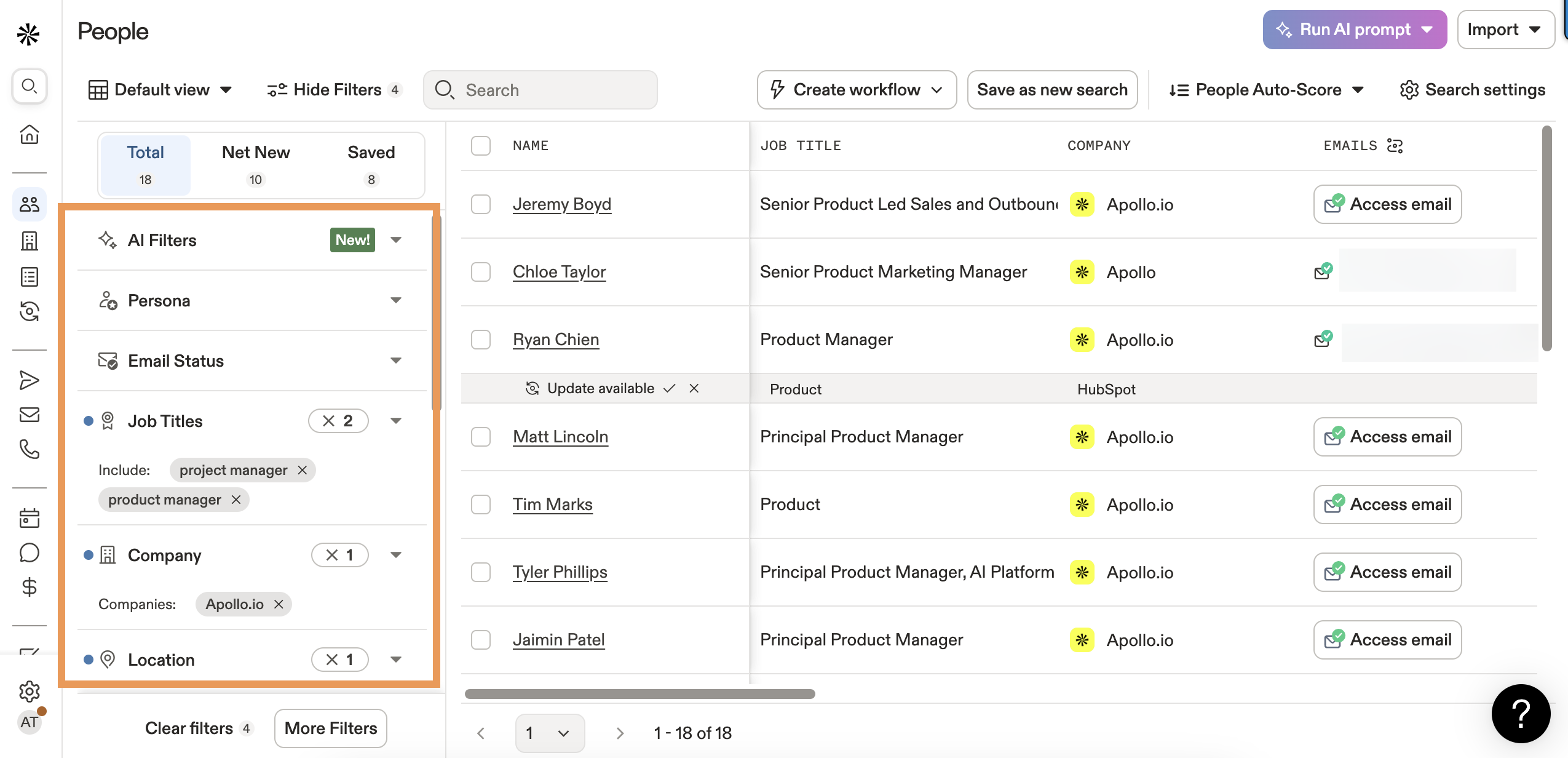
Start tight. The biggest mistake we see is teams pulling 10,000+ contacts and blasting them all. Instead, use Apollo's filters to build focused lists of around 1,000 contacts that genuinely match your ICP. Layer firmographics and targeting signals - industry, company size, tech stack, funding stage.
Save these filtered lists as your working ICP segments. You'll iterate on them, but starting narrow means your messaging stays relevant and your data quality stays manageable.
Layer Buying Intent
Apollo's buying intent feature is powered by LeadSift (a Foundry company) and covers 1,600+ topics with weekly refresh. It's available on every plan, including free - though the free tier limits you to one intent topic. The signals come from public web activity, content engagement, hiring patterns, and technology installs. It's a solid starting point for prioritization, especially if you're new to intent-based prospecting.
Export and Verify
Here's where most workflows fall apart. Apollo's email statuses map to very different risk levels:
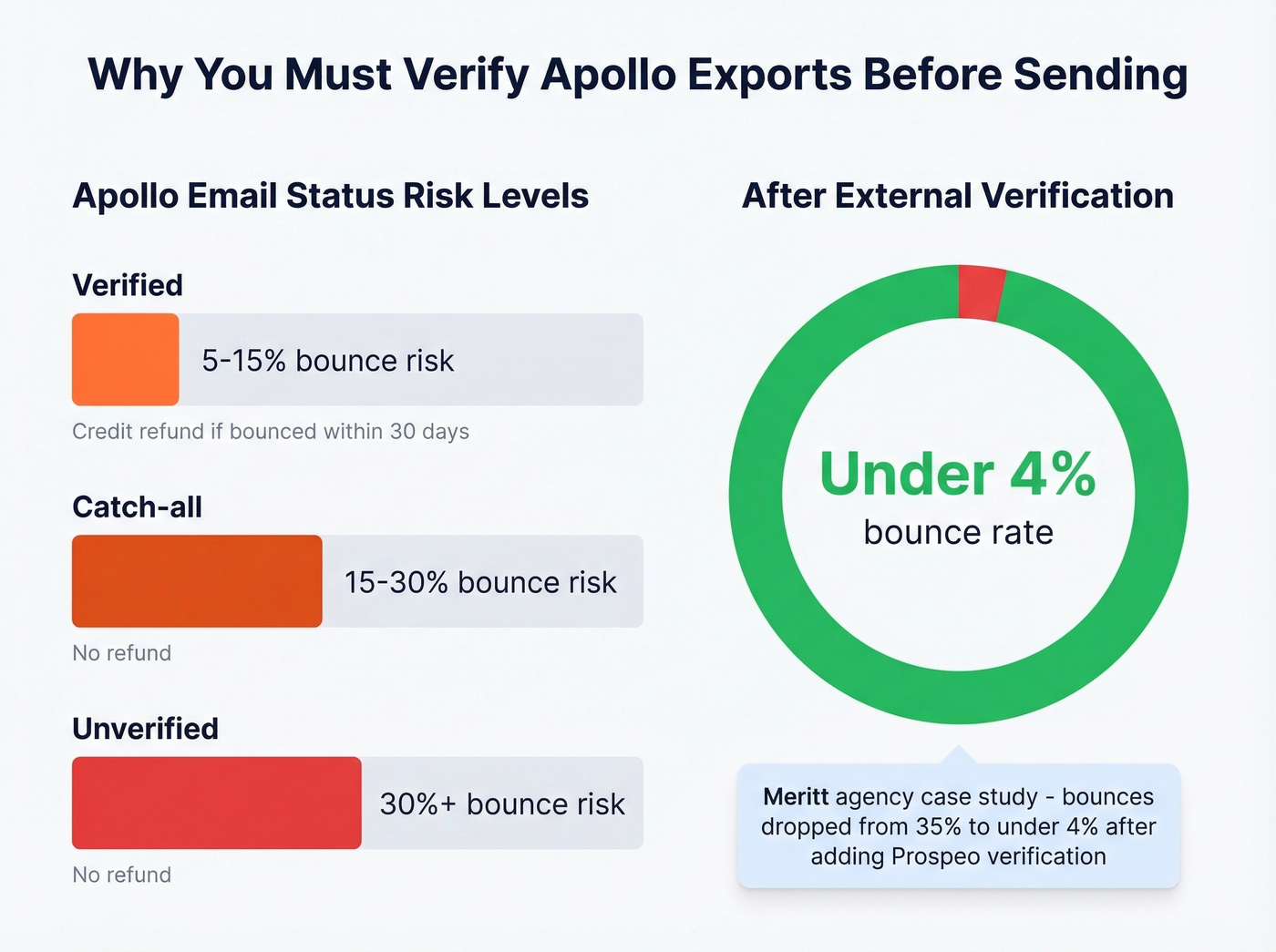
- Verified: 5-15% bounce risk. Apollo refunds credits if a verified email bounces within 30 days.
- Catch-all: 15-30% bounce risk. No refund.
- Unverified: 30%+ bounce risk. No refund.
B2B contact data decays at roughly 22.5% per year, and about 30% of employees switch jobs annually. Even Apollo's "Verified" emails carry real risk. Teams commonly see 16-35% bounce rates when they include catch-all and unverified contacts in their sends.
The fix is simple: run every Apollo export through a second verification layer before it touches your sequencer. Standalone verification tools like NeverBounce or ZeroBounce charge $4-$10 per 1,000 emails. Prospeo runs about $0.01 per email with 98% accuracy and a 7-day data refresh cycle - roughly half the cost with better results. Meritt, an agency running this exact workflow, dropped their bounce rate from 35% to under 4% and tripled their pipeline.

Build Sequences (or Don't)
Apollo supports multichannel sequences - email, calls, and LinkedIn touches - and the interface is decent for building cadences. Here's a stat worth remembering: 43% of buyers say they're fine being contacted five or more times before you get through. Persistence matters, but only when your data is clean enough to sustain it. Cap phone touches at about 7 per contact; beyond that, you're burning goodwill.
If you're sending more than 50-100 emails per day, use a dedicated sequencer. Instantly (~$30-$97/mo), Smartlead (~$39-$94/mo), or lemlist (~$39-$99/mo) all handle mailbox rotation, warm-up, and deliverability better than Apollo's built-in sending. For LinkedIn automation, HeyReach is a community favorite on r/sales. Apollo pushes data to Salesforce and HubSpot natively, so your CRM stays synced regardless of which sequencer you use.
The full stack - Apollo Basic ($49/mo) + a free verification tier to start + Instantly or Smartlead (~$30-$97/mo) - runs under $150/month and outperforms the all-in-one approach.

You just read that Apollo's real-world accuracy sits around 79%. Prospeo hits 98% - verified through proprietary infrastructure, not third-party providers. Meritt ran this exact Apollo-to-Prospeo verification workflow and dropped bounce rates from 35% to under 4%.
Stop paying for emails that bounce. Verify at $0.01 each.
Apollo's Real Data Quality
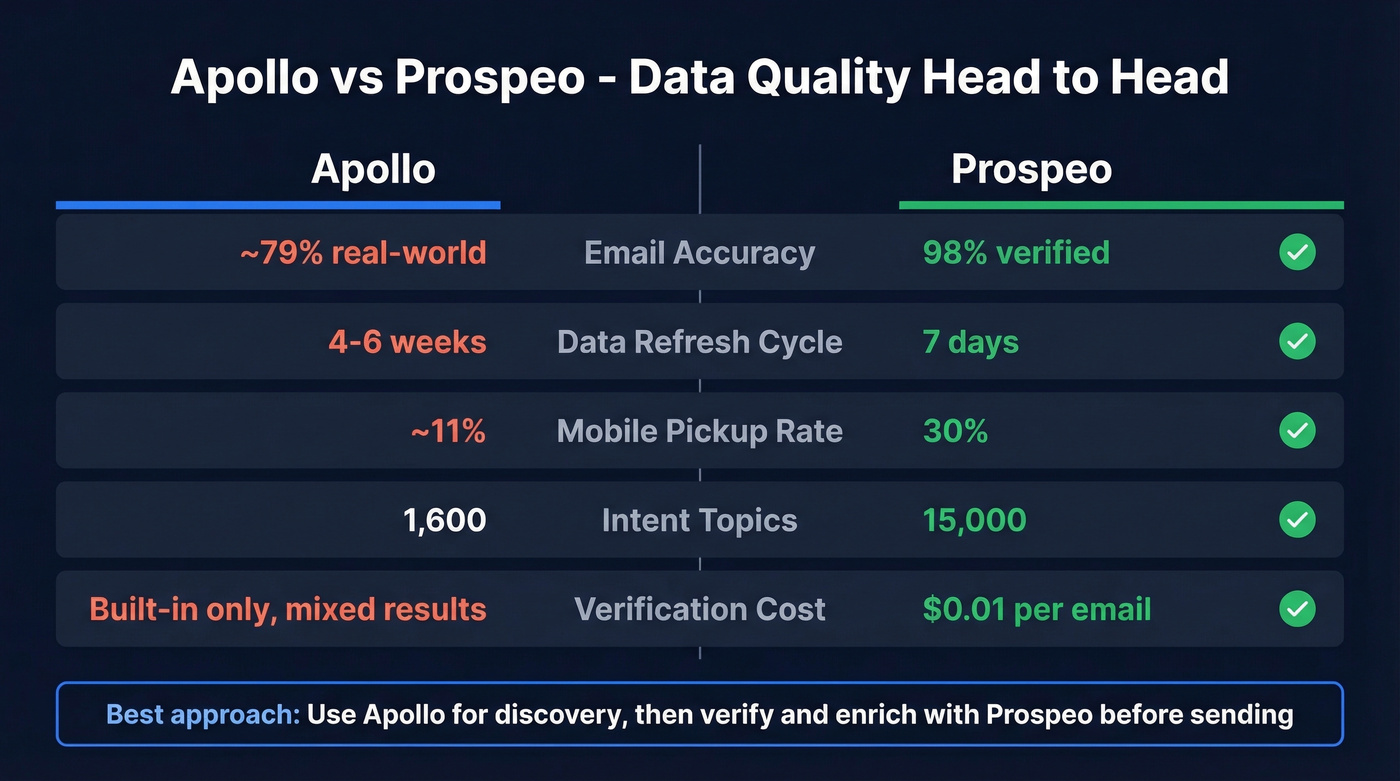
Let's be honest about this one. Apollo markets 91% email accuracy. In outbound operations, plan around ~79%. That's not a rounding error - on a 5,000-contact export, it's the difference between 450 bounces and 1,050 bounces. The 84% match rate Apollo cites is a separate metric measuring how often they find an email at all, which people frequently confuse with accuracy.
Teams that treat the platform as a lead scraping tool without a verification step are the ones who end up on email blacklists.
Data quality also drops outside the US. Outdated contact details, HQ phone numbers instead of direct lines, and incomplete company records for EMEA targets are all common complaints in community threads.
| Data refresh | ~4-6 weeks | 7 days | Prospeo |
| Mobile pickup | ~11% | 30% | Prospeo |
| Intent topics | 1,600 | 15,000 | Prospeo |
| Starting price | Free / $49/mo | Free / ~$0.01/email | Apollo (free tier breadth) |
Mistakes That Kill Your Results
Trusting Apollo's engagement metrics at face value. We've seen teams celebrate 65-70% open rates while booking zero meetings. Those numbers are inflated by bot clicks, security scanners, and pixel-loading artifacts. If opens are sky-high but replies are zero, your metrics are lying to you.
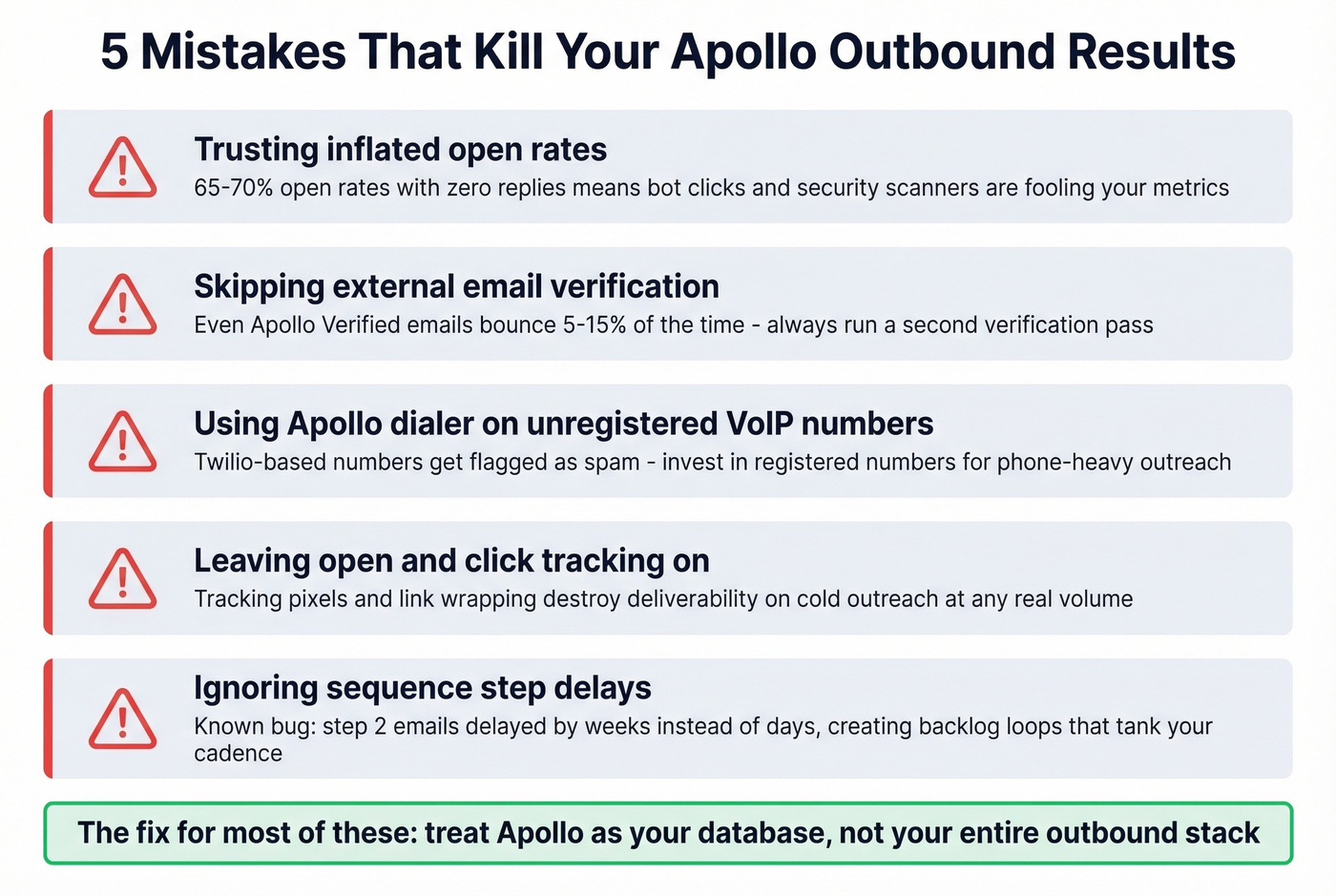
Skipping external verification before sending. Apollo's internal verification isn't enough. Even "Verified" contacts bounce 5-15% of the time. Run every export through a second verification layer - every time, no exceptions. If you want a deeper deliverability breakdown, start with bounce rate benchmarks and what the codes actually mean.
Using Apollo's dialer without understanding spam risk. Apollo's dialer runs on Twilio VoIP numbers that aren't registered and can easily get flagged as spam. If phone is a primary channel for your team, invest in a dedicated dialer with registered numbers. A good starting point is building a repeatable cold calling system instead of relying on bundled dialers.
Leaving open and click tracking enabled. Counterintuitive, but tracking pixels and link wrapping hurt deliverability. The common advice on r/coldemail: turn off open and click tracking for cold outreach at any real volume. The vanity metrics aren't worth the inbox placement hit - especially if you’re using a tracking domain incorrectly.
Ignoring sequence sending delays. Apollo's sequencer has a known issue where step 2 emails get delayed by weeks instead of the configured 3-4 days. Delayed emails pile up and get rescheduled to 7:00 AM the next day, creating backlog loops that are hard to diagnose. If your sequences feel sluggish, this is probably why - tighten up your sequence management rules before scaling volume.
Most Teams Don't Need the All-in-One
Here's the uncomfortable truth: if your deals average under $15K, you probably don't need Apollo's Professional or Organization tiers at all. The Basic plan gives you the database. A separate verification tool gives you clean data. A dedicated sequencer gives you deliverability.
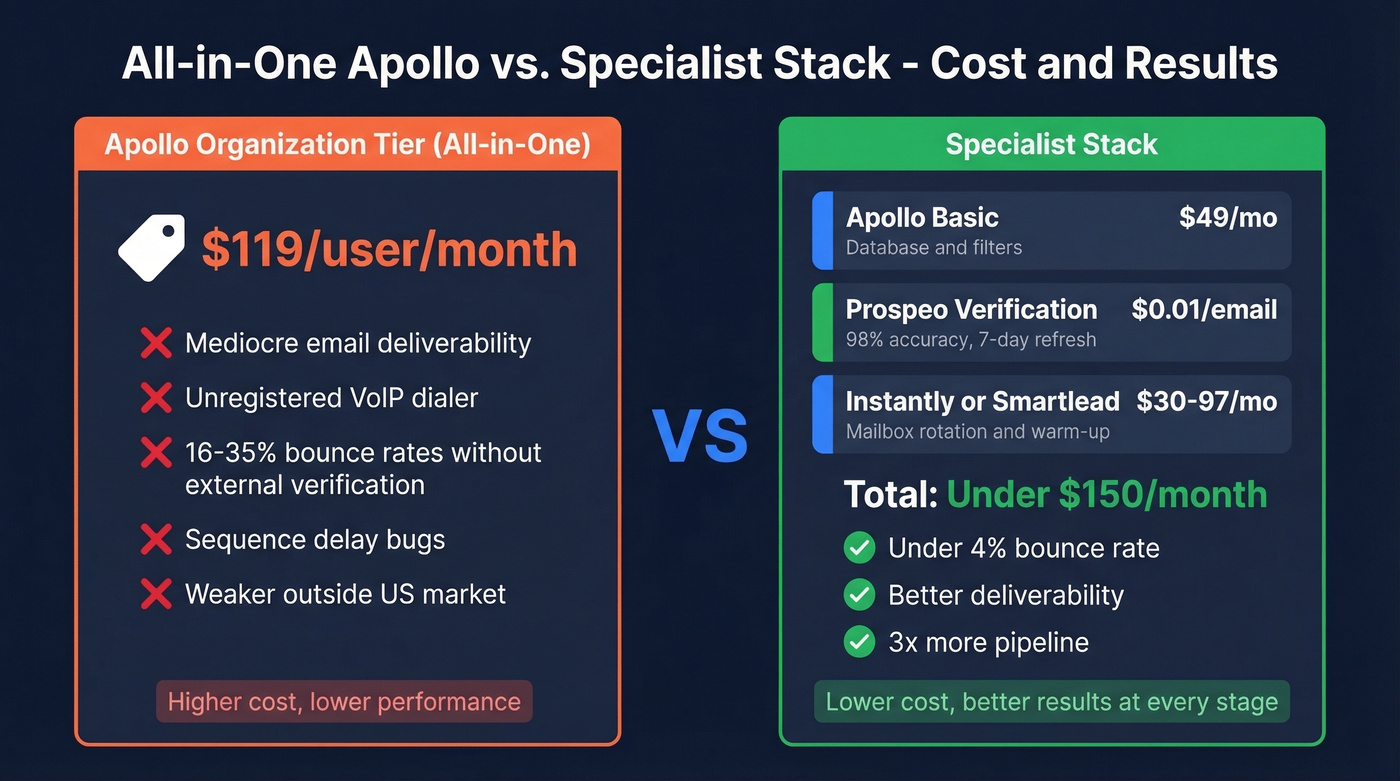
You end up paying less and getting better results at every stage than teams spending $119/user/month trying to do everything inside Apollo. The "all-in-one" pitch sounds efficient until you realize each individual feature is mediocre compared to the specialist alternative. Skip the higher tiers unless you specifically need the auto-dialer or advanced analytics - and even then, test whether a standalone tool does it better first.
When to Use Apollo vs. a Dedicated Tool
Use Apollo when you need a large, filterable database to build targeted prospect lists in the US market. It's unbeatable at its price point for data discovery and sales intelligence - especially when paired with modern sales prospecting techniques.
Pair it with a verification layer when you need emails and mobiles that won't tank your domain. Apollo finds the people; verification confirms the contact data is real and current. If you’re comparing vendors, this roundup of data enrichment services can help you pick the right second layer.
Add a dedicated sequencer when you're sending more than 50 emails/day or need proper mailbox rotation. Instantly and Smartlead both handle this better than Apollo's built-in sending. If you’re scaling, align volume to safe email velocity limits to avoid deliverability cliffs.
Apollo covers 1,600 intent topics with 11% mobile pickup. Prospeo tracks 15,000 intent topics via Bombora, delivers 125M+ verified mobiles with a 30% pickup rate, and refreshes every 7 days - not every 4-6 weeks.
Replace the gaps in your Apollo stack with data that actually connects.
FAQ
Is Apollo.io free?
Yes, with limits. The free plan includes 50 AI credits, basic contact access, up to 2 sequences, and 1 intent topic. It's enough to test the database, not enough to run real outbound campaigns at scale.
How accurate is Apollo's email data?
Apollo markets 91% accuracy, but bounce rates on "Verified" emails run 5-15% in practice. Include catch-all and unverified contacts and you'll see 16-35% bounces. Always verify exports through a dedicated tool before sending.
Does Apollo work for European prospecting?
Data quality drops significantly outside the US - outdated contacts, HQ phone numbers instead of direct lines, and incomplete company records across EMEA. European outreach also carries GDPR compliance risk, with fines reaching EUR 20M or 4% of global annual revenue. If your ICP is primarily European, supplement Apollo with a provider that has stronger regional coverage and fresher data.